Last Updated on October 27, 2026 by Team TBH
Netflix and Disney+ are two major names in global streaming, but they offer different experiences. Netflix focuses on a broad mix of original series, films, documentaries, reality shows, international productions and live events, while Disney+ is built around Disney, Pixar, Marvel, Star Wars, National Geographic and other entertainment brands.
Both services offer ad-supported and ad-free subscriptions in the United States, although their prices, bundles and available features differ. In India, Disney+ is not offered as a standalone streaming service; Disney content is available through JioHotstar.
So which service offers better value? This comparison examines pricing, content libraries, originals, sports, family viewing, features, advertising, business performance to help you choose.
Netflix vs Disney+ at a Glance
| Factor | Netflix | Disney+ |
|---|---|---|
| Owner | Netflix, Inc. | The Walt Disney Company |
| Streaming launch | 2007 | November 2019 |
| Leadership | Co-CEOs Ted Sarandos and Greg Peters | Disney CEO Josh D’Amaro, appointed March 2026 |
| Subscriber reporting | More than 325 million memberships was a milestone highlighted in late 2025; not a regularly updated current count | 131.6 million paid subscribers in September 2025; Disney subsequently stopped regular reporting |
| Availability | More than 190 countries and territories, subject to local restrictions | More than 150 countries and territories outside the US and Canada, with regional differences |
| Cheapest US plan | Standard with ads: $8.99/month | Disney+ with ads: $12.49/month |
| Top US standalone plan | Premium: $26.99/month | Premium: $21.49/month |
| Key franchises | Stranger Things, Wednesday, Bridgerton, Squid Game and international originals | Disney, Pixar, Marvel, Star Wars, The Simpsons and National Geographic |
| Live sports | Selected events, including NFL games and WWE programming | Selected ESPN events, with additional sports available through ESPN services and bundles |
| India | Netflix India, from ₹149/month | Disney content available through JioHotstar |
| Best for | Variety, international entertainment and frequent releases | Franchise fans, Disney and Pixar audiences, and family entertainment |
Prices are US monthly prices unless otherwise stated. Availability, features and prices may vary by country, platform and billing partner.
Pricing Compared
Price is an important factor when choosing between streaming services, but the cheapest subscription is not necessarily the best value. The amount of content you watch, whether you need ad-free playback and whether a bundle replaces other subscriptions all affect the real cost.
United States
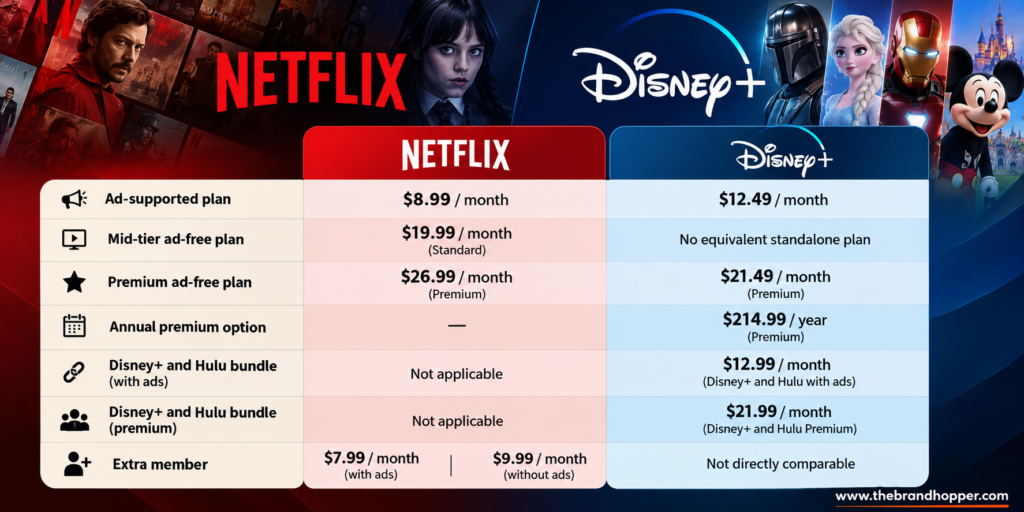
Netflix’s US plans offer different streaming and download limits. Standard with ads supports Full HD and two simultaneous devices; Standard is ad-free and also supports two devices; Premium adds 4K Ultra HD and HDR on supported content and allows up to four simultaneous devices.
Disney+ Premium supports ad-free on-demand viewing, 4K UHD and HDR on supported content, and downloads on up to 10 devices. Ads may still appear in selected live or linear programming and promotional content.
Disney+ Premium’s annual plan costs $214.99, compared with $257.88 for 12 monthly payments at $21.49. That saves approximately $42.89 per year, provided the annual subscription suits your viewing habits.
The Disney+ and Hulu bundle with ads costs $12.99 per month. This can be attractive for US households that want both Disney’s franchise content and Hulu’s broader general-entertainment catalogue.
US pricing verdict: Netflix has the cheapest standalone entry price. Disney+ Premium is cheaper than Netflix Premium, while the Disney+ and Hulu bundle can offer better combined value for households that watch both services.
India
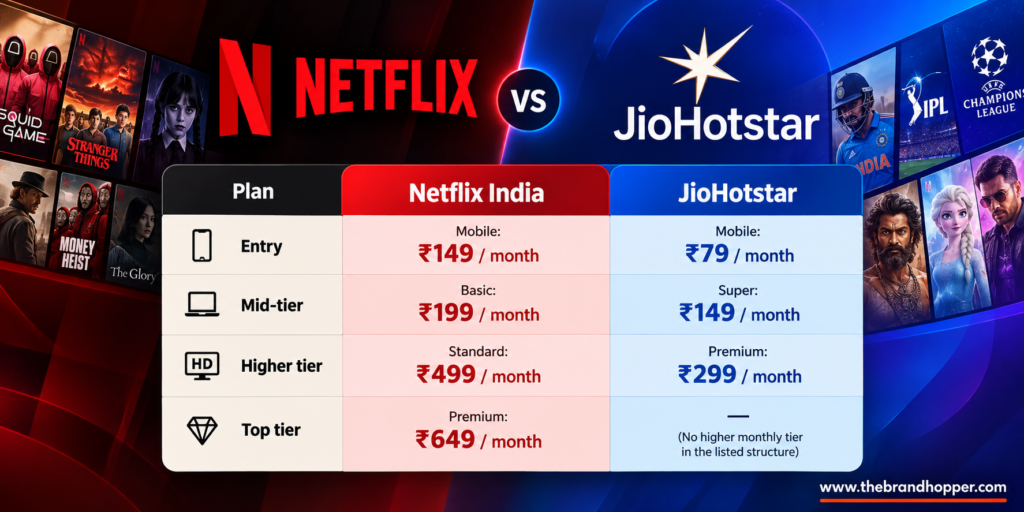
Netflix India offers Mobile, Basic, Standard and Premium subscriptions, with differences in resolution, device support and simultaneous viewing. JioHotstar’s Mobile plan is limited to one mobile device at a time and excludes Hollywood content unless the customer purchases the relevant add-on.
JioHotstar Super supports up to two devices and includes a broader catalogue. Premium supports up to four devices and offers ad-free entertainment, except for live sports and other live programming where advertising may remain.
JioHotstar also offers quarterly and annual subscriptions. The relevant Hollywood add-on and subscription terms should be checked on the official service before subscribing.
Disney’s Indian streaming business became part of the Reliance-Disney joint venture in 2024. The resulting service operates as JioHotstar, so consumers in India should compare JioHotstar’s actual plans with Netflix rather than use US Disney+ pricing.
India pricing verdict: JioHotstar is the lower-cost option at entry level and is particularly relevant for cricket and Indian entertainment. Netflix is a strong alternative for international series, films and a broad selection of global originals.
Content Library and Originals
The main difference between Netflix and Disney+ is the range and type of content available.
Netflix
Netflix produces and licenses content across drama, crime, comedy, reality television, documentaries, anime, stand-up and international entertainment. Its library includes global hits such as Wednesday, Bridgerton and Squid Game, alongside regional originals from markets around the world.
Netflix also licenses content from other studios and broadcasters. Its catalogue changes by country and over time, so the availability of a particular film or series should be checked in the viewer’s market.
Netflix’s advantage is breadth. Someone who watches crime dramas, Korean series, documentaries, comedy specials and reality television may find more reasons to keep the subscription active throughout the year.
Disney+
Disney+ is built around Disney’s established entertainment brands, including Disney Animation, Pixar, Marvel, Star Wars and National Geographic. In the US, it also connects with Hulu, bringing more general-entertainment programming into the wider Disney streaming experience.
The service is especially valuable to viewers who follow specific franchises or want to watch multiple titles from the same fictional universe. Major theatrical releases may arrive on Disney+ after their cinema runs, depending on release strategy and market.
Disney+ is not exclusively a children’s service. Its catalogue includes content aimed at different age groups, and its US integration with Hulu adds more adult-oriented drama, comedy and general entertainment.
Content verdict: Netflix is generally the stronger choice for variety across genres and international productions. Disney+ is the stronger choice for audiences who prioritise Disney, Pixar, Marvel, Star Wars and related franchises.
Live Sports and Events
Both services are expanding beyond traditional films and television, but their live-content strategies differ.
Netflix streams selected live events, including NFL games, WWE programming and special entertainment broadcasts. Its live-event offering varies by market and event, and the availability of sports does not mean that Netflix provides a comprehensive sports package.
Disney’s sports strategy is closely connected to ESPN. In the US, Disney+ carries selected ESPN events, while ESPN services and eligible bundles provide access to broader sports coverage.
Disney+ and ESPN have also announced that Disney+ subscribers in the US will be able to watch ESPN’s presentation of Super Bowl LXI on February 14, 2027. This is a future event announcement, not an event that has already taken place.
In India, JioHotstar is an important destination for live cricket and other sports rights available through the service. Sports availability can change as broadcasting agreements are renewed.
Sports verdict: Disney’s ecosystem is stronger for US viewers who want ESPN access through an eligible subscription or bundle. Netflix is more relevant for selected live sports and entertainment events, while JioHotstar is an important choice for cricket viewers in India.
Kids and Family Viewing
Disney+ is often the more natural choice for households that regularly watch Disney Animation, Pixar, Marvel and Star Wars. Its recognisable franchises and family-oriented catalogue make it convenient for viewers who want to return to familiar characters and stories.
Netflix also offers children’s profiles, parental controls and a substantial selection of family and animated titles. However, the service’s broader catalogue includes a large amount of adult-oriented entertainment.
Neither service should be treated as automatically suitable for every child. Parents should use profile restrictions, age ratings and parental controls to select content appropriate to the child’s age.
Family verdict: Disney+ is generally the stronger choice for Disney and Pixar fans. Netflix is also worth considering if the household wants a broader mix of family programming and adult entertainment.
Features and Viewing Experience
Both services offer profiles, recommendations, mobile apps and support across a wide range of connected devices. Offline downloads are available on supported devices and plans, although download limits and device eligibility differ.
Netflix Standard supports Full HD on two simultaneous devices, while Premium adds 4K UHD and HDR on supported content and allows four simultaneous devices. The ad-supported plan has its own content and feature restrictions.
Disney+ Premium supports 4K UHD and HDR where available, ad-free on-demand viewing and downloads on supported mobile devices. Actual picture and sound quality depend on the title, device, internet connection and plan.
Netflix is known for its personalised recommendations and extensive viewing history. Disney has also been improving discovery, personalisation and the integration of its streaming products.
In August 2026, Disney and TikTok announced a collaboration to bring selected fan-created short-form videos into Disney+ through its Verts experience. The initiative was announced as a pilot beginning in the US, with potential expansion to other markets; it should not be described as universally available to all subscribers without checking the current rollout.
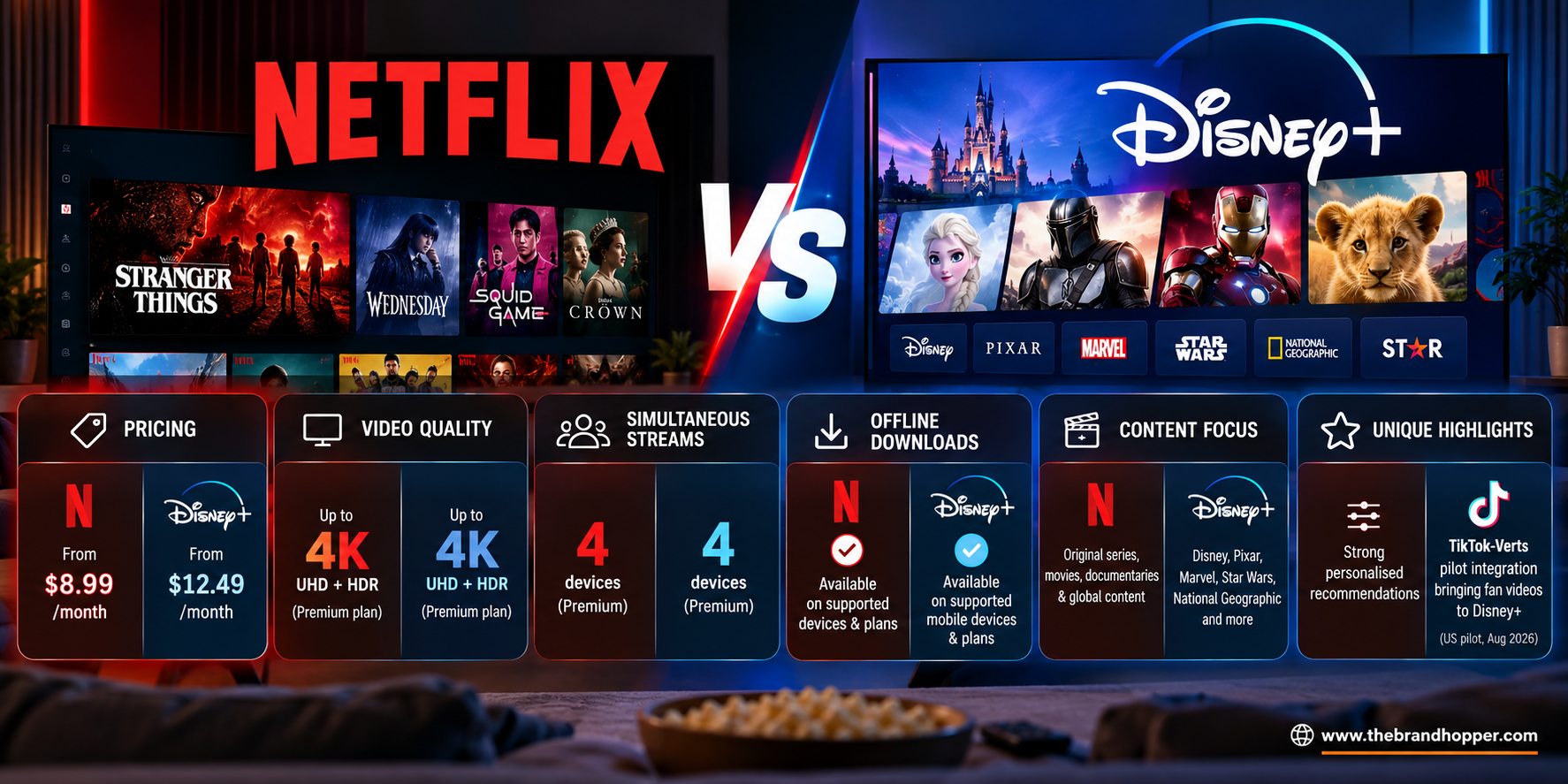
Features verdict: Netflix is a strong all-round streaming interface with extensive recommendations and a broad content catalogue. Disney+ is evolving its interface and content discovery, particularly around franchises and its broader entertainment ecosystem.
Ads: How the Cheaper Plans Compare
Both services use ad-supported subscriptions to provide lower entry prices and generate advertising revenue.
Netflix’s Standard with ads plan costs $8.99 per month in the US. It includes most of the service’s catalogue, although some titles may be unavailable because of licensing restrictions, and it supports Full HD playback on two devices at a time.
Disney+ with ads costs $12.49 per month in the US. The Premium plan removes ads from most on-demand entertainment, but selected live and linear programming may still contain advertising.
The Disney+ and Hulu bundle with ads costs $12.99 per month, which is only 50 cents more than Disney+ with ads alone. For customers who want both services, the bundle can be a better value than subscribing separately.
Advertising revenue is becoming more important to both companies, but it should not be assumed that ad-supported plans contain identical ad loads, catalogue access or viewing restrictions. Those details depend on the service and market.
Business Strength: Netflix vs Disney Streaming
Financial performance matters because it helps fund content investment, technology, marketing and future growth. However, Netflix and Disney have different business structures, so comparing their total company revenue directly with Disney’s streaming revenue would be misleading.
Netflix is primarily a streaming entertainment company, although it also earns revenue from advertising, consumer products, live experiences and other activities. Disney operates a much broader portfolio that includes entertainment studios, streaming, television networks, sports, theme parks, cruises, resorts and consumer products.
| Metric | Netflix | Disney |
|---|---|---|
| FY2025 revenue | Approximately $45.2 billion | Total company revenue is not directly comparable with streaming-only revenue |
| FY2025 operating income | Approximately $13.3 billion | Streaming operating income is reported within Disney’s entertainment business |
| Latest reported quarter | Q3 2026, ended September 30, 2026 | Q3 FY2026, ended June 27, 2026 |
| Latest quarterly revenue | Approximately $12.9 billion | Entertainment and streaming figures are reported under Disney’s segment structure |
| Latest quarterly operating margin | 34.6% | Disney reported profitable Entertainment SVOD operations in Q3 FY2026 |
| 2026 outlook | Revenue guidance of approximately $51.1 billion and an operating margin of 31.5% | Disney forecast a 10% Entertainment DTC SVOD operating margin for FY2026 in its prior guidance; subsequent results should be checked against its latest filings |
| Subscriber reporting | Netflix last highlighted a milestone above 325 million paid memberships in late 2025 | Disney stopped regularly reporting Disney+ and Hulu subscriber counts starting FY2026 |
Netflix’s Q3 2026 shareholder letter reported revenue of $12.874 billion and operating income of $4.459 billion, producing an operating margin of 34.6%. Its full-year 2026 guidance at the time projected revenue of approximately $51.1 billion and an operating margin of 31.5%.
Disney’s fiscal year differs from Netflix’s calendar-year reporting, and its streaming disclosures distinguish Entertainment SVOD from other businesses. Disney’s Q3 FY2026 streaming results should therefore be compared with Netflix using clearly labelled business segments and reporting periods, not treated as equivalent to Netflix’s total company results.
Disney appointed Josh D’Amaro as CEO effective March 18, 2026, succeeding Bob Iger. Iger became Senior Advisor and a member of the board during the transition period.
Netflix continues to be led by co-CEOs Ted Sarandos and Greg Peters. In February 2026, Netflix declined to raise its offer for Warner Bros. Discovery after the latter’s board determined that Paramount Skydance’s proposal was superior; Netflix did not proceed with the acquisition.
Business verdict: Netflix’s reported operating performance demonstrates the scale and profitability of its streaming-led business. Disney’s strength comes from combining streaming with valuable entertainment franchises, sports and physical experiences, but its wider corporate financial results should not be treated as a direct measure of Disney+ alone.
Beyond TV and Films: Games and Extras
Netflix includes games with eligible memberships at no additional charge, with availability depending on the title, device and market. Its wider business also includes consumer products, live experiences and events connected to its entertainment properties.
Disney connects its streaming business with a larger ecosystem of films, television, merchandise, games, theme parks, cruises and other experiences. Its strategy is to create stronger relationships with fans across these different touchpoints.
Disney has said it intends to introduce additional elements of an expanded digital ecosystem beginning in spring 2027. These are planned developments, rather than a complete set of benefits already available to every Disney+ subscriber.
For now, Netflix’s included games and Disney’s wider franchise ecosystem serve different purposes. The better choice depends on whether you value extra entertainment features within a subscription or the ability to connect streaming with a broader entertainment brand.
How to Save Money on Netflix and Disney+
With subscription prices rising, a few practical choices can help reduce the annual cost of streaming.
- Consider annual billing where available. Disney+ Premium in the US costs $214.99 per year, compared with $257.88 for 12 monthly payments at $21.49. The annual plan saves approximately $42.89.
- Compare bundles. The US Disney+ and Hulu bundle with ads costs $12.99 per month, making it worth considering if you would otherwise pay for both services separately.
- Choose an ad-supported plan. Netflix Standard with ads costs $11 less per month than Netflix Standard in the US, a saving of $132 over 12 months before taxes.
- Rotate subscriptions. Subscribe to a service when the shows you want become available and cancel when you no longer need it. Check renewal dates to avoid paying for unused months.
- Check telecom and broadband offers. In India, some mobile, broadband and other service plans include streaming benefits. Confirm which tier is included and whether it requires an additional payment.
- Use Netflix extra-member options where appropriate. Standard subscribers can add one eligible extra member, while Premium subscribers can add up to two. US pricing is $7.99 per month with ads or $9.99 without ads per extra member, subject to eligibility.
Netflix vs Disney+: Pros and Cons
Netflix Pros
- Broad selection of genres, including drama, thrillers, documentaries, reality shows and international content.
- Frequent new releases and a large range of original productions.
- Lower US entry price through its ad-supported plan.
- Personalised recommendations and a mature streaming interface.
- Selected live events, including NFL games and WWE programming.
- Multiple plan options for different viewing and device needs.
Netflix Cons
- The ad-free Standard and Premium plans are relatively expensive in the US.
- 4K UHD and HDR require Premium and supported content and devices.
- Licensing restrictions mean some titles may not be available in the ad-supported plan or in every country.
- It does not offer a comprehensive sports package comparable to a dedicated sports service.
Disney+ Pros
- Strong franchises, including Disney, Pixar, Marvel and Star Wars.
- A compelling choice for viewers who regularly watch family and franchise content.
- US bundles with Hulu offer access to a broader entertainment catalogue.
- Premium supports 4K UHD and HDR on compatible content.
- Selected ESPN events are available through Disney+ in the US.
- Connects with Disney’s wider entertainment and consumer-products ecosystem.
Disney+ Cons
- Its franchise-led catalogue may be less suitable for viewers who want broad genre variety above all else.
- The standalone US Premium plan costs more than Netflix Standard, although it includes 4K UHD and HDR.
- Prices and bundles differ by market, and US offers cannot be assumed to apply internationally.
- Disney no longer regularly reports Disney+ subscriber counts.
- Disney+ is not available as a standalone service in India; customers access Disney content through JioHotstar.
Which Should You Choose?
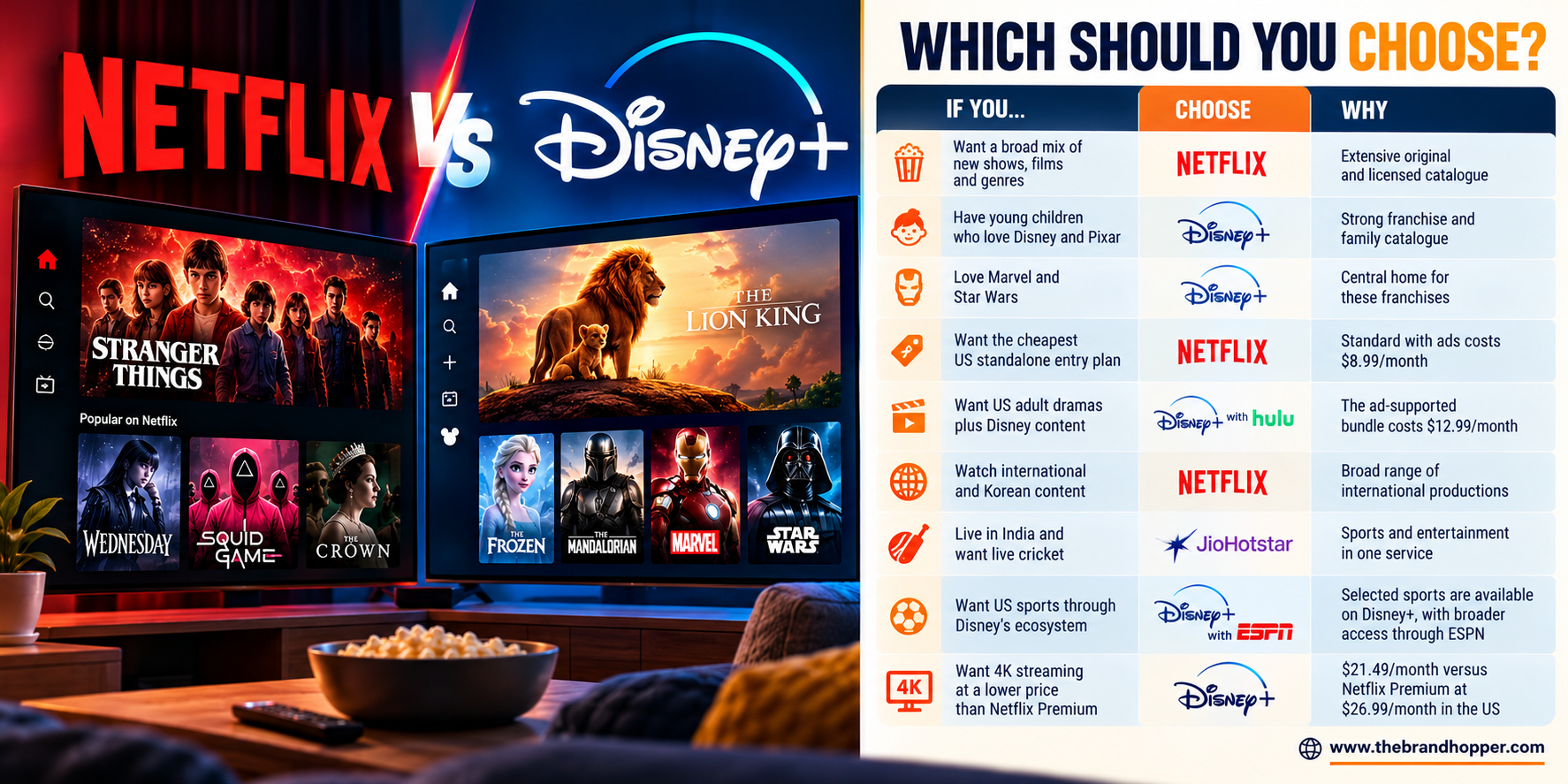
Final Verdict: Netflix or Disney+?
If you can subscribe to only one service, Netflix is a strong all-round choice for viewers who want variety across genres, international entertainment and a steady stream of new releases. Its ad-supported plan is also the cheaper standalone option in the US.
Disney+ is the better fit for viewers whose entertainment habits revolve around Disney, Pixar, Marvel and Star Wars. In the US, its bundle with Hulu can offer attractive value for households that want both franchise entertainment and a broader catalogue of general-entertainment programming.
In India, the relevant comparison is Netflix versus JioHotstar rather than Netflix versus a standalone Disney+ app. JioHotstar offers lower entry-level pricing and live cricket, while Netflix is particularly appealing for its international and original entertainment.
Many households may benefit from rotating subscriptions rather than keeping every service year-round. Subscribe when the content you want is available, review the cost regularly, and choose the service that best matches what you actually watch.
Frequently Asked Questions
Q: Is Netflix or Disney+ better?
A: Netflix is generally better for genre variety and international entertainment. Disney+ is a stronger choice for Disney, Pixar, Marvel and Star Wars fans, as well as households that value those franchises.
Q: Which is cheaper, Netflix or Disney+?
A: In the US, Netflix Standard with ads costs $8.99 per month, compared with $12.49 for Disney+ with ads. Disney+ Premium costs $21.49 per month, while Netflix Premium costs $26.99.
Q: How many subscribers do Netflix and Disney+ have?
A: Netflix last highlighted more than 325 million paid memberships in late 2025. Disney+ reported 131.6 million paid subscribers in September 2025; Disney subsequently stopped regularly reporting subscriber counts, so these figures should not be presented as current, directly comparable totals.
Q: Is Disney+ available in India?
A: Not as a standalone Disney+ streaming service. Disney content is available in India through JioHotstar, operated by the Reliance-Disney joint venture.
Q: How much does Netflix cost in India?
A: The listed Netflix India monthly plans are Mobile at ₹149, Basic at ₹199, Standard at ₹499 and Premium at ₹649. Check Netflix’s official India pricing page for the latest availability and terms.
Q: Does Disney+ have ads?
A: In the US, Disney+ with ads is the lower-priced standalone plan, while Premium removes ads from most on-demand content. Selected live or linear programming may still include advertising.
Q: Which service has better kids’ content?
A: Disney+ is a strong choice for Disney and Pixar films and family franchises. Netflix also has a substantial children’s catalogue and parental controls, so parents should compare specific titles and age ratings.
Q: Can I watch live sports on Netflix or Disney+?
A: Yes, both offer selected live events. Netflix streams events including NFL games and WWE programming, while Disney+ carries selected ESPN events in the US. Broader sports access depends on the relevant ESPN service or bundle, and JioHotstar is an important sports option in India.
Also Read: Netflix vs Amazon Prime: Which Is Better? (2026 Guide)
To read more content like this, subscribe to our newsletter