
Last Updated on September 4, 2026 by Team TBH
Walmart is the largest retailer on Earth by revenue, a company so vast that its financial results function almost as a barometer for the health of American consumer spending.
But despite operating on a scale most public companies never approach, Walmart has never fully separated from the family that built it.
Here’s the complete story of who owns Walmart, how the Walton family’s stake evolved, and how the company is actually run today.
How Walmart Began: A Small-Town Bet Nobody Else Would Make
Walmart’s origin traces back to Sam Walton, who got his retail start not with Walmart itself but with a Ben Franklin variety five-and-dime store he opened in Newport, Arkansas, in 1945, later relocating operations to Bentonville, Arkansas.

By the early 1960s, Walton and his brother James operated a small regional chain of Ben Franklin franchise stores, and Walton grew convinced that a new kind of store — a discount retailer built specifically around small, rural towns that larger chains ignored — could work at scale.
When Ben Franklin’s own corporate leadership rejected his pitch to build this concept within their system, Walton decided to build it himself.
The first Walmart Discount City store opened on July 2, 1962, in Rogers, Arkansas, built on a simple but radical premise for the time: offer name-brand merchandise at consistently low prices, in towns too small to interest most national retailers.
From One Store to a Public Company
Walton’s small-town strategy worked far better than most competitors expected.
Within five years, the Walton family owned 24 stores generating $12.7 million in annual sales, and in 1969 the business was formally incorporated as Wal-Mart Stores, Inc.
By 1970, just eight years after that first Rogers store opened, Walmart had gone public, listing on the New York Stock Exchange and giving outside investors their first opportunity to buy into what would become the largest retail company in history.
Even after going public, the Walton family deliberately retained a dominant ownership stake rather than diluting their position the way many founders eventually do, a decision that has compounded into one of the largest family fortunes ever assembled.
Who Owns Walmart Today? The Walton Family’s Dominant Stake
Walmart is unusual among companies of its size and age in that its founding family never lost control.
The Walton family collectively owns somewhere between 45% and 49% of all outstanding Walmart shares, depending on how the various family trusts and holding entities are counted, held primarily through two vehicles: Walton Enterprises, LLC, which alone controls roughly 44.21% of shares (about 3 billion shares), and the Walton Family Holdings Trust, which holds an additional 6.53%.
Institutional investors — asset managers like Vanguard and BlackRock — collectively hold roughly 36.76% of remaining shares, with the general public holding about 17.8% and company insiders holding under 1%.
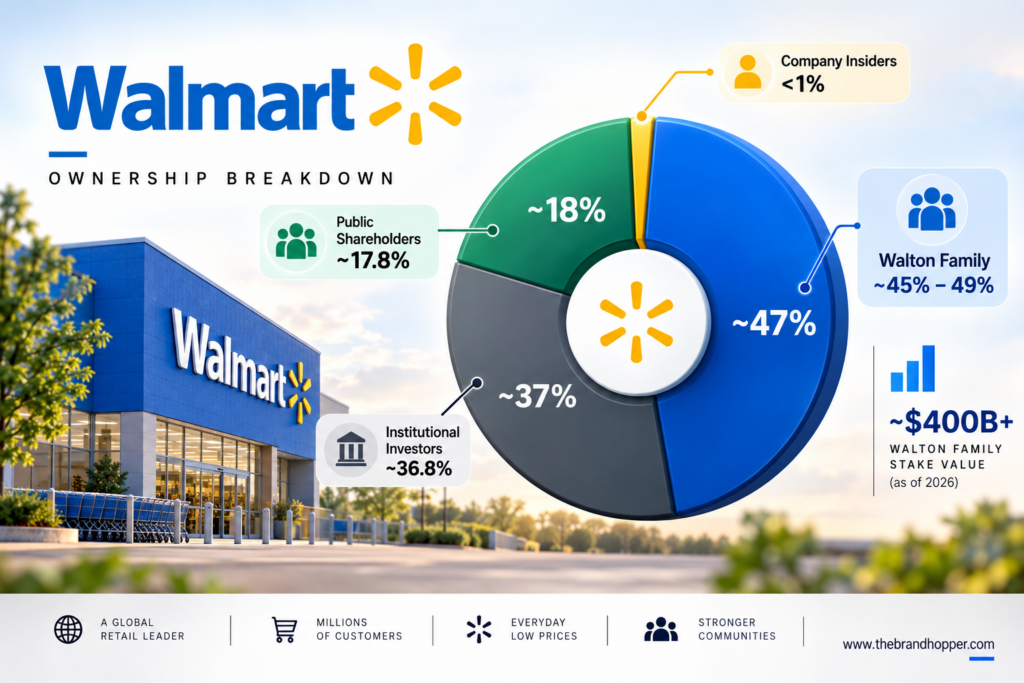
In dollar terms, the Walton family’s Walmart stake was worth an estimated $400 billion or more in mid-2026, based on Walmart’s roughly $900 billion market capitalization at the time, making it comfortably the largest single source of family wealth in the world.
The Walton Family: The Richest Family on Earth
Sam Walton’s three surviving children — Rob Walton, Jim Walton, and Alice Walton — have consistently ranked among the wealthiest individuals on the planet almost entirely because of their Walmart shareholdings rather than any other business venture.
As of early 2026, Rob Walton’s net worth was estimated at roughly $145.1 billion (11th richest person globally), Jim Walton’s at approximately $142.4 billion (12th richest), and Alice Walton’s at around $116 billion, making her the richest woman in the world.
Combined, Bloomberg has pegged the Walton family’s total fortune at over $450-500 billion depending on Walmart’s stock price at any given moment, consistently ranking them as the single richest family in the world.

Rob Walton, the eldest son, served on Walmart’s board for decades — including as chairman from 1992 to 2015 — before retiring from the board entirely in 2025 after roughly four decades of service, a symbolic milestone in the family’s generational transition from direct governance toward pure ownership.
Who Runs Walmart Day to Day?
While the Walton family holds the dominant ownership stake, Walmart’s operational leadership has been handled by professional, non-family executives for decades.
Doug McMillon, who joined Walmart as an hourly warehouse associate in 1984, rose through the ranks to become CEO in 2014 and led the company for roughly 12 years, overseeing its aggressive e-commerce buildout and digital transformation.
McMillon retired effective January 31, 2026, and was succeeded by John Furner, another long-tenured Walmart veteran who joined the company as an hourly associate in 1993 and had most recently served as president and CEO of Walmart U.S. since 2019.

McMillon has remained on Walmart’s board through the company’s next annual shareholder meeting and will continue advising Furner through early 2027, ensuring continuity through the leadership transition.
This pattern — promoting deeply experienced internal operators to the CEO role rather than external hires or family members — has been Walmart’s leadership model for decades, even as the Walton family maintains ultimate ownership control from the boardroom.
Walmart’s Financial Scale in 2025
Walmart’s sheer size is difficult to overstate.
The company reported fiscal year 2025 revenue of $681 billion, employing approximately 2.1 million associates worldwide, making it not only the largest retailer on Earth but also one of the largest private employers of any kind globally.

Walmart’s business now spans far beyond its traditional supercenters, including Sam’s Club warehouse stores, a rapidly growing e-commerce and Walmart+ membership operation, and an expanding advertising and data-analytics business built on its massive customer transaction volume, all of which have become increasingly important profit drivers as the company works to compete with Amazon’s dominance in online retail.
Why Hasn’t the Walton Family Sold Down Their Stake?
Unlike many founding families who diversify away from a single company’s stock over multiple generations, the Waltons have deliberately kept the overwhelming majority of their wealth concentrated in Walmart shares, largely through the coordinated structure of Walton Enterprises, LLC, which was specifically designed to keep the family’s holdings unified rather than fragmented across dozens of individual heirs making independent decisions.
This concentrated, coordinated ownership approach gives the family outsized influence over Walmart’s board and long-term strategic direction even without any single Walton holding an individual majority stake, and it has proven enormously lucrative given Walmart’s decades of consistent stock appreciation, though it also means the family’s fortune remains almost entirely tied to a single company’s performance rather than being diversified across a broader portfolio.
Walmart vs Amazon: A Different Kind of Ownership Battle
Walmart’s biggest competitive rival, Amazon, presents an interesting ownership contrast.
Amazon founder Jeff Bezos still holds a meaningful stake in the company he built but has sold down shares over the years to fund other ventures, and Amazon’s ownership is far more diffuse among institutional investors than Walmart’s.
Walmart, by contrast, has maintained an unusually concentrated founding-family ownership structure for a company of its age and public-market maturity, giving the Walton family a level of enduring influence over boardroom decisions that few other founding families of comparably sized public companies still hold today.
Walmart’s Global Footprint and Store Formats
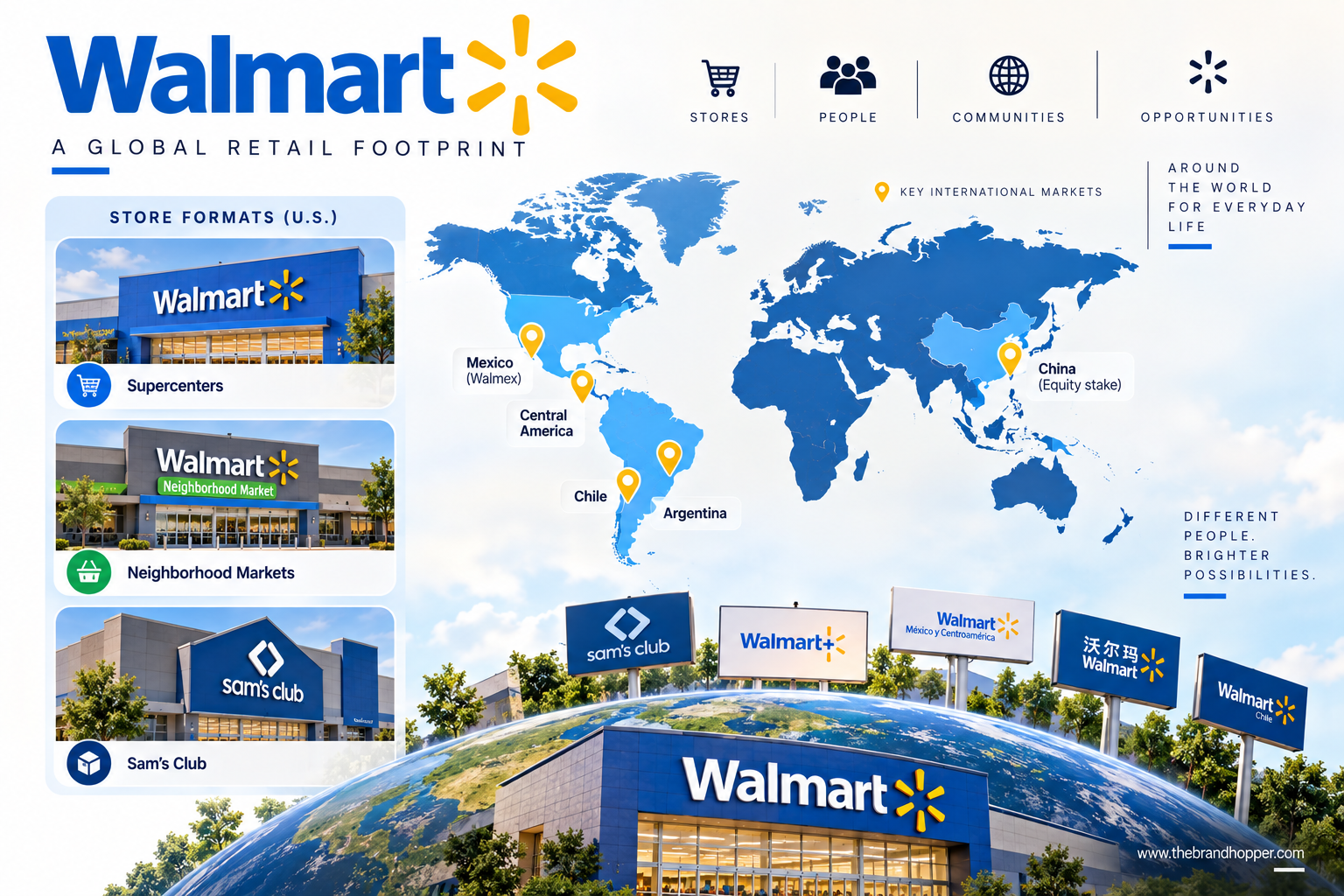
Beyond its US roots, Walmart has grown into a genuinely global retail operation, running thousands of stores across multiple countries and formats under various banners, including Walmart Supercenters, Neighborhood Markets, and Sam’s Club warehouse locations in the US, along with international operations in markets like Mexico (Walmex), Central America, and China, where Walmart holds significant equity stakes in local retail partners rather than always operating stores directly.
This international diversification has become an increasingly important growth lever as US market saturation has slowed the pace of new domestic supercenter openings, pushing Walmart to lean more heavily on e-commerce expansion, membership programs like Walmart+, and international joint ventures to sustain its historical growth trajectory.
The Walton Family Foundation and Philanthropy
Beyond their direct Walmart holdings, the Walton family has also built one of the largest philanthropic operations in the world through the Walton Family Foundation, which funds education reform, environmental conservation, and economic development initiatives, particularly in the family’s home region of Northwest Arkansas.
Alice Walton has additionally used her personal fortune to fund major cultural investments, most notably founding the Crystal Bridges Museum of American Art in Bentonville, Arkansas, and backing a new medical school, reflecting a broader pattern among the Waltons of reinvesting Walmart-derived wealth into the same Arkansas region where the company was founded rather than spreading it evenly across unrelated geographies.
Walmart Ownership & History at a Glance
| Fact | Detail |
| Founded | July 2, 1962, in Rogers, Arkansas, by Sam Walton |
| Incorporated | 1969, as Wal-Mart Stores, Inc. |
| Went public | 1970, on the New York Stock Exchange |
| Walton family ownership | ~45-49% of outstanding shares |
| Primary holding vehicle | Walton Enterprises, LLC (~44.21%) |
| Secondary holding vehicle | Walton Family Holdings Trust (~6.53%) |
| Institutional ownership | ~36.76% |
| Walton family net worth (est.) | $450-500+ billion (richest family in the world) |
| Current CEO | John Furner (since February 1, 2026) |
| Previous CEO | Doug McMillon (2014–2026) |
| FY2025 revenue | $681 billion |
| Employees worldwide | ~2.1 million |
| Key business segments | Walmart U.S., Sam’s Club, Walmart International, e-commerce/Walmart+ |
Key Takeaways
Walmart occupies a rare position among the world’s largest public companies: despite being publicly traded since 1970, it never fully passed out of its founding family’s hands.
Sam Walton’s heirs — primarily his three children Rob, Jim, and Alice Walton — collectively control roughly 45-49% of Walmart’s shares through coordinated holding entities like Walton Enterprises, LLC, making them the richest family in the world with a combined fortune exceeding $450 billion.
Day-to-day operations, meanwhile, remain firmly in the hands of professional executives risen through Walmart’s own ranks, most recently new CEO John Furner, continuing a leadership model that has defined Walmart’s management for decades even as the Walton family’s ownership stake has only grown more valuable over time.
Frequently Asked Questions
Q: Who owns Walmart?
A: The Walton family owns roughly 45-49% of Walmart’s outstanding shares, primarily through Walton Enterprises, LLC (44.21%) and the Walton Family Holdings Trust (6.53%). The remainder is held by institutional investors and the general public, since Walmart is a publicly traded company (NYSE: WMT).
Q: Who founded Walmart?
A: Sam Walton founded Walmart in 1962, opening the first store in Rogers, Arkansas, after his earlier Ben Franklin variety store franchise rejected his idea for a small-town discount retail concept.
Q: Is Walmart still family-owned?
A: Not entirely, but the Walton family retains majority influence. Walmart has been publicly traded since 1970, but the Walton family has never sold down its stake the way many founding families eventually do, keeping close to half the company’s shares under coordinated family control.
Q: Who is the richest member of the Walton family?
A: As of early 2026, Rob Walton was the wealthiest individual Walton family member, with an estimated net worth of roughly $145.1 billion, followed closely by his brother Jim Walton and sister Alice Walton.
Q: Who is Walmart’s current CEO?
A: John Furner became Walmart’s President and CEO effective February 1, 2026, succeeding longtime CEO Doug McMillon, who retired after roughly 12 years leading the company.
Q: How much is the Walton family worth?
A: The Walton family’s combined net worth has been estimated at over $450-500 billion, consistently ranking them as the richest family in the world, with their fortune derived almost entirely from Walmart stock.
Q: How big is Walmart as a company?
A: Walmart reported fiscal year 2025 revenue of $681 billion and employs approximately 2.1 million associates worldwide, making it the largest retailer on Earth and one of the largest private employers globally.
Q: Does any single Walton own a majority of Walmart?
A: No individual Walton family member holds a majority stake alone; rather, the family’s combined ownership is coordinated through entities like Walton Enterprises, LLC, giving them collective control without any one person holding more than 50% individually.
Also Read: Marketing Strategies, Marketing Mix and STP of Walmart
To read more content like this, subscribe to our newsletter