Last Updated on September 7, 2026 by Team TBH
Apple and Samsung have been the two defining forces in consumer electronics for over a decade, and their rivalry extends far beyond smartphones into tablets, wearables, smart TVs, and even the chips that power rival devices.
But the two companies are built on almost opposite philosophies: one is a tightly controlled, vertically integrated ecosystem company answering to a diffuse shareholder base, the other a sprawling Korean conglomerate still guided by the founding family three generations in.
Here’s a complete comparison of both giants — history, ownership, financials, market share, and which one actually deserves the crown.
How Apple Began: A Garage, Three Founders, and a $666 Computer
Apple Computer Company was founded on April 1, 1976, by Steve Jobs, Steve Wozniak, and Ronald Wayne, operating out of Jobs’s parents’ garage in Los Altos, California.
The trio’s first product, the Apple I, sold for $666.66 and was aimed squarely at hobbyist computer enthusiasts.
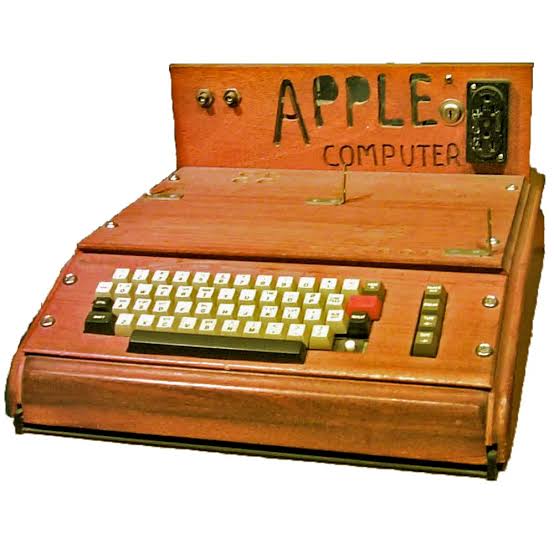
Wayne sold his 10% stake back to Jobs and Wozniak for just $800 within weeks of the company’s founding, a decision that would have made him a multi-billionaire had he held on.
The 1977 launch of the Apple II is widely credited with kickstarting the personal computing revolution, and Apple has spent the nearly five decades since reinventing itself repeatedly — from the Macintosh in 1984, to the iPod in 2001, to the iPhone in 2007, the product that would eventually become the single largest revenue driver in company history.
How Samsung Began: Dried Fish, Noodles, and a Korean Trading Company
Samsung’s origin story could not be more different. Lee Byung-chul founded Samsung on March 1, 1938, in Taegu, Korea, starting a modest trading company with roughly 30,000 won (about $25 at the time) that dealt in dried fish, vegetables, and noodles.
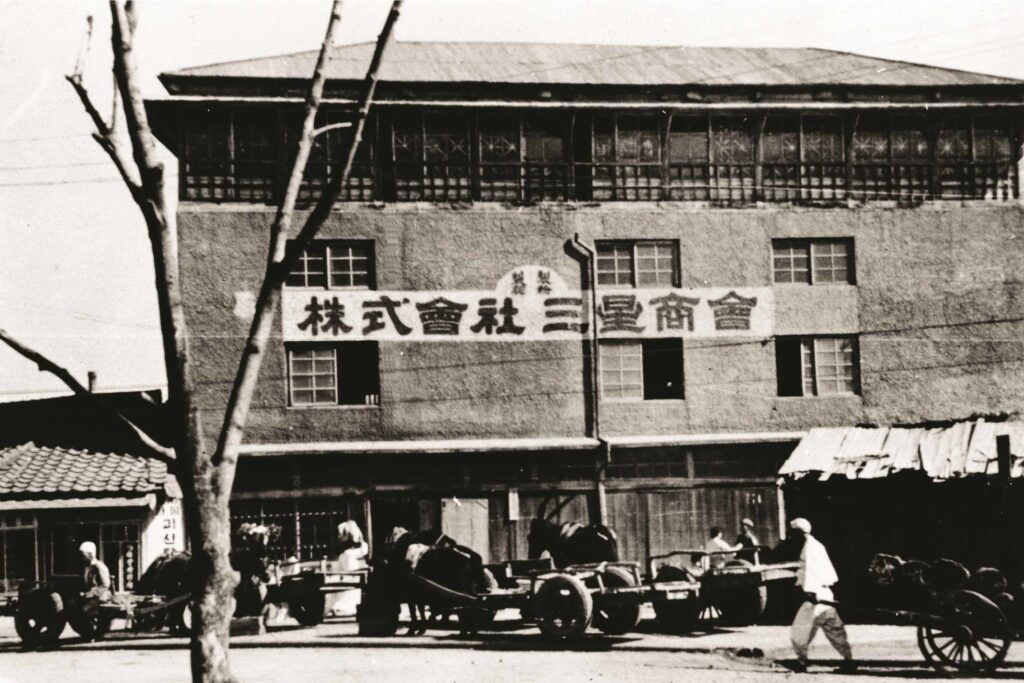
Over the following decades, Samsung diversified aggressively into textiles, insurance, securities, and eventually electronics, becoming one of South Korea’s defining “chaebols” — large, family-controlled industrial conglomerates.
Samsung Electronics, the subsidiary most people associate with the Samsung name today, was established in 1969 and grew into a global force in semiconductors, displays, and consumer electronics, eventually becoming the largest single company within the broader Samsung Group empire.
Who Owns Apple Today? A Fully Public, Diffuse Shareholder Base
Apple Inc. is a publicly traded company (NASDAQ: AAPL) with no controlling shareholder and a straightforward single-class share structure. Unlike tech peers such as Meta or Alphabet, Apple has no dual-class or founder-controlled voting shares.
The largest institutional shareholders reported in Apple’s 2026 proxy are Vanguard (~9.63%) and BlackRock (~7.10%). These figures are based on ownership information available as of January 2, 2026, and should not be treated as current September 2026 holdings.
Apple’s CEO has also changed: John Ternus became CEO on September 1, 2026, succeeding Tim Cook, who became executive chairman of the board. Cook led Apple from 2011 to 2026.
In the 2026 proxy, Tim Cook was reported to beneficially own 3,280,295 shares, equivalent to approximately 0.0223% of shares outstanding as of the table date. This is a historical ownership figure, not a current September 2026 holding.
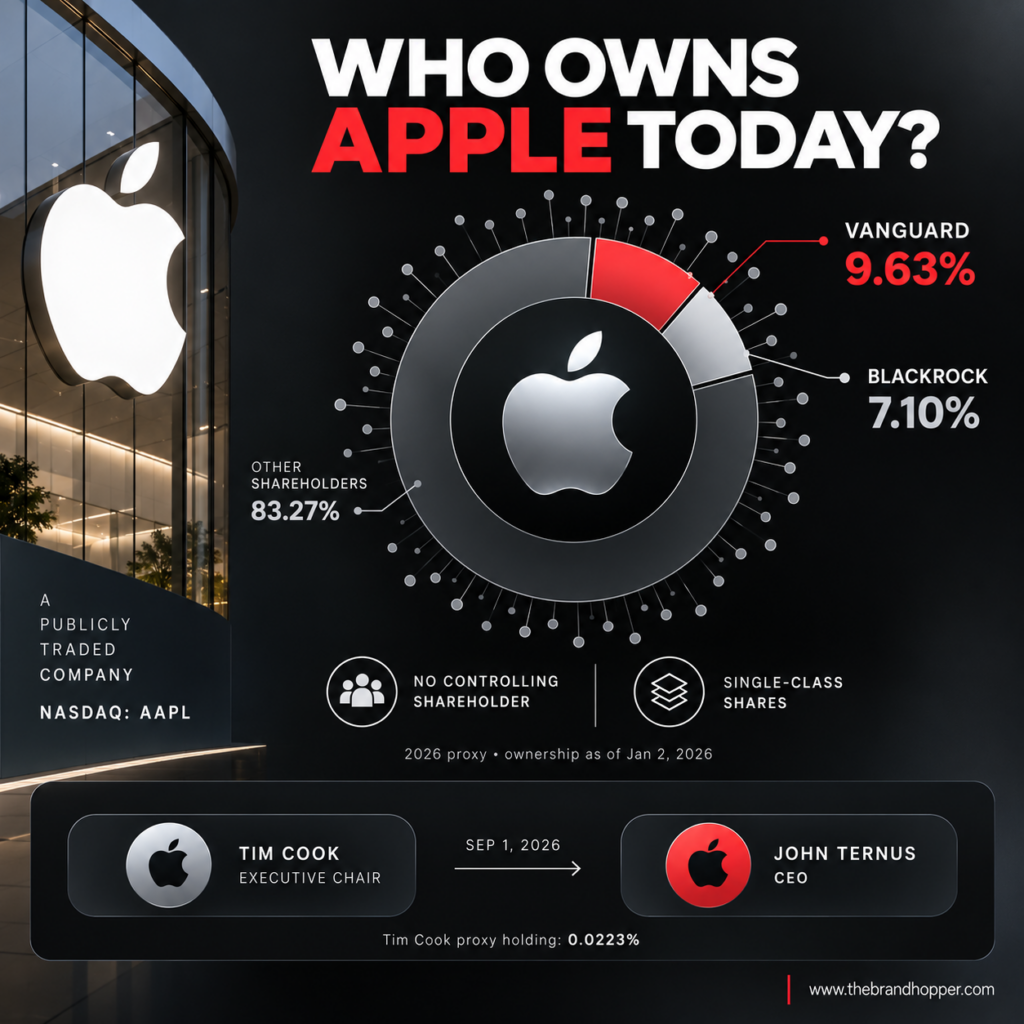
Apple therefore has a diffuse, single-class shareholder structure, in which institutional investors hold substantial positions but no single shareholder controls the company through a special founder-class voting arrangement.
Who Owns Samsung Today? The Lee Family’s Web of Control
Samsung’s ownership structure is a study in contrast.
The Lee family controls the entire Samsung Group empire despite holding a relatively small direct economic stake in Samsung Electronics itself — control flows instead through a complex web of cross-shareholdings between affiliated companies.
The key lever is Samsung C&T, the group’s de facto holding company: Lee Jae-yong, grandson of founder Lee Byung-chul, is Samsung C&T’s largest shareholder with roughly 22% of its common stock as of early 2026, and that single position anchors his authority over the entire conglomerate.
Lee’s own direct stake in Samsung Electronics has risen to about 1.67%, up from 0.7% before he inherited shares following his father’s 2020 death, and in January 2026 his mother Hong Ra-hee gifted him additional shares, raising his personal Samsung C&T stake from 19.76% to 20.82%.
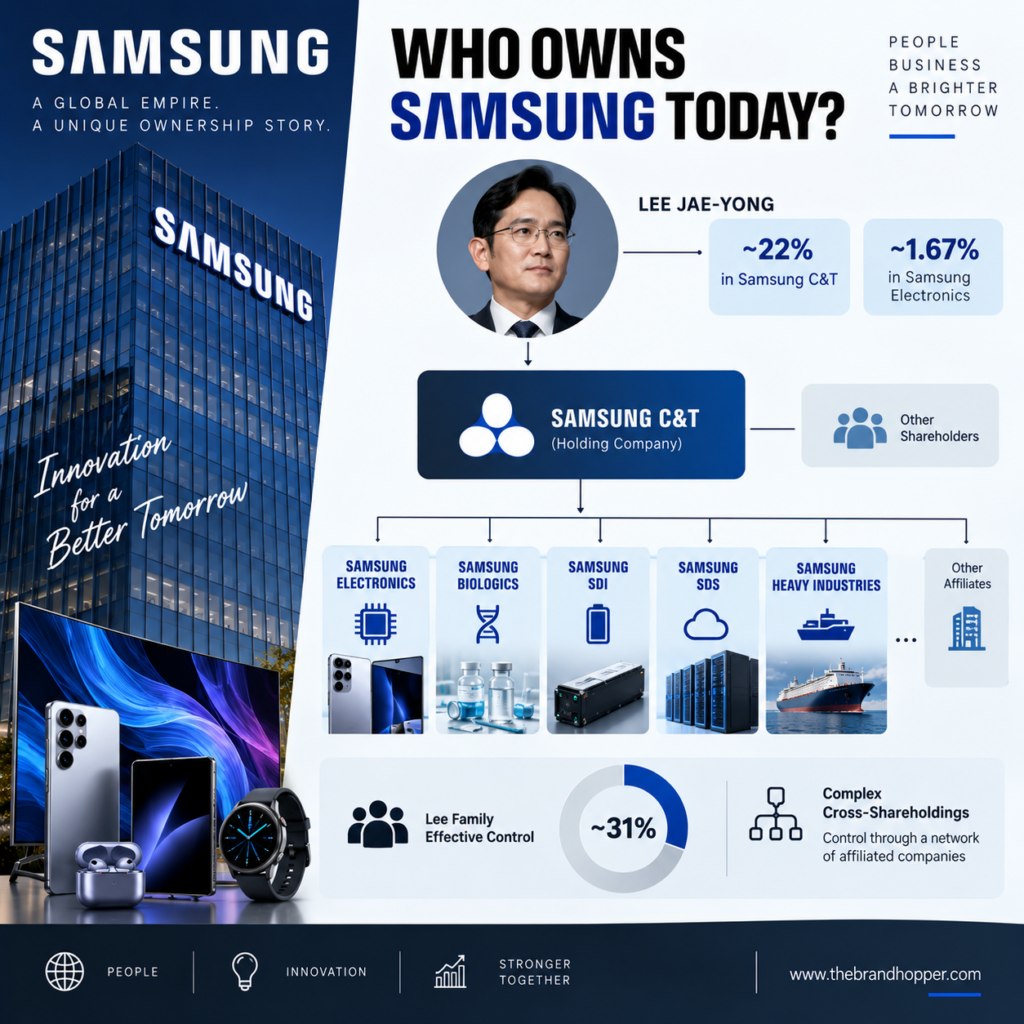
Counting the broader Lee family’s combined holdings across the ownership chain, the family’s effective control sits at around 31%, illustrating how South Korean chaebol structures allow founding families to retain decisive control without needing anything close to majority direct ownership.
Apple vs Samsung: FY2025 Financial Results Compared
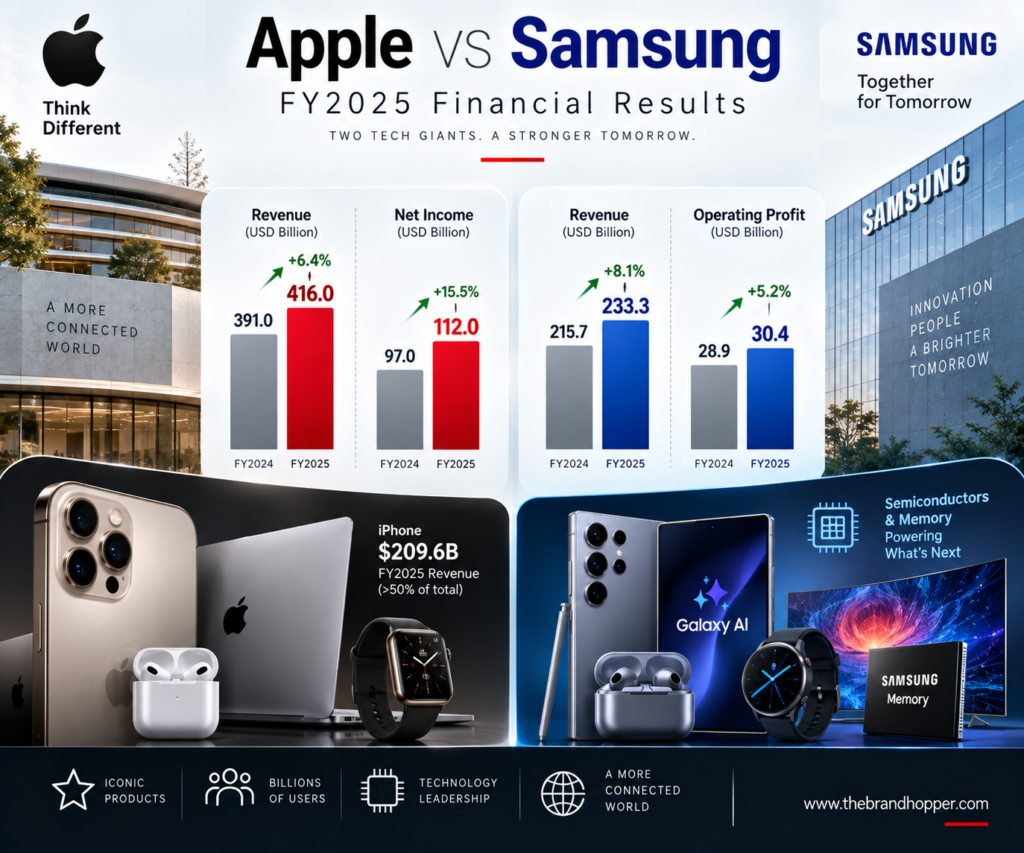
Apple’s FY2025 (ended late September 2025) results were record-setting: revenue of $416 billion, up 6.4% year-over-year from $391.04 billion in FY2024, with net income of $112 billion.
The iPhone remained Apple’s single largest product line by a wide margin, generating $209.59 billion in FY2025 revenue — more than half of total company revenue on its own.
Quarterly performance showed consistent strength throughout the year, including a $124.3 billion Q1 (Apple’s holiday quarter) and a strong $102.5 billion Q4 close.
Samsung Electronics, reporting on a full calendar-year basis, posted FY2025 revenue of roughly KRW 333.6 trillion (approximately $233.3 billion) and operating profit of KRW 43.6 trillion, with growth driven significantly by its semiconductor memory division riding an AI-fueled chip demand boom, even as its Device eXperience (DX) division — which houses smartphones, tablets, and wearables — saw an 8% sequential revenue decline in Q4 2025 amid reduced new-model launch effects and intensifying competition.
Samsung also poured a record KRW 37.7 trillion into R&D for the full year, underscoring its continued heavy investment in semiconductor and display technology leadership.
Smartphone Market Share: Apple’s Record Year
2025 was a landmark year in the smartphone rivalry specifically. Apple captured 20% of global smartphone shipments for the full year — its highest annual share ever — fueled by strong iPhone 17 demand, healthy holiday-quarter sales, and improving traction in emerging markets, and posted 10% year-over-year growth, the fastest growth rate of any major smartphone brand in 2025.
Samsung held onto second place with 19% global share, itself up on 5% year-over-year shipment growth driven by robust flagship sales and a strong Galaxy Z Fold7 launch. Xiaomi rounded out the podium in third with 13% share, with Oppo and Vivo each holding roughly 8%.
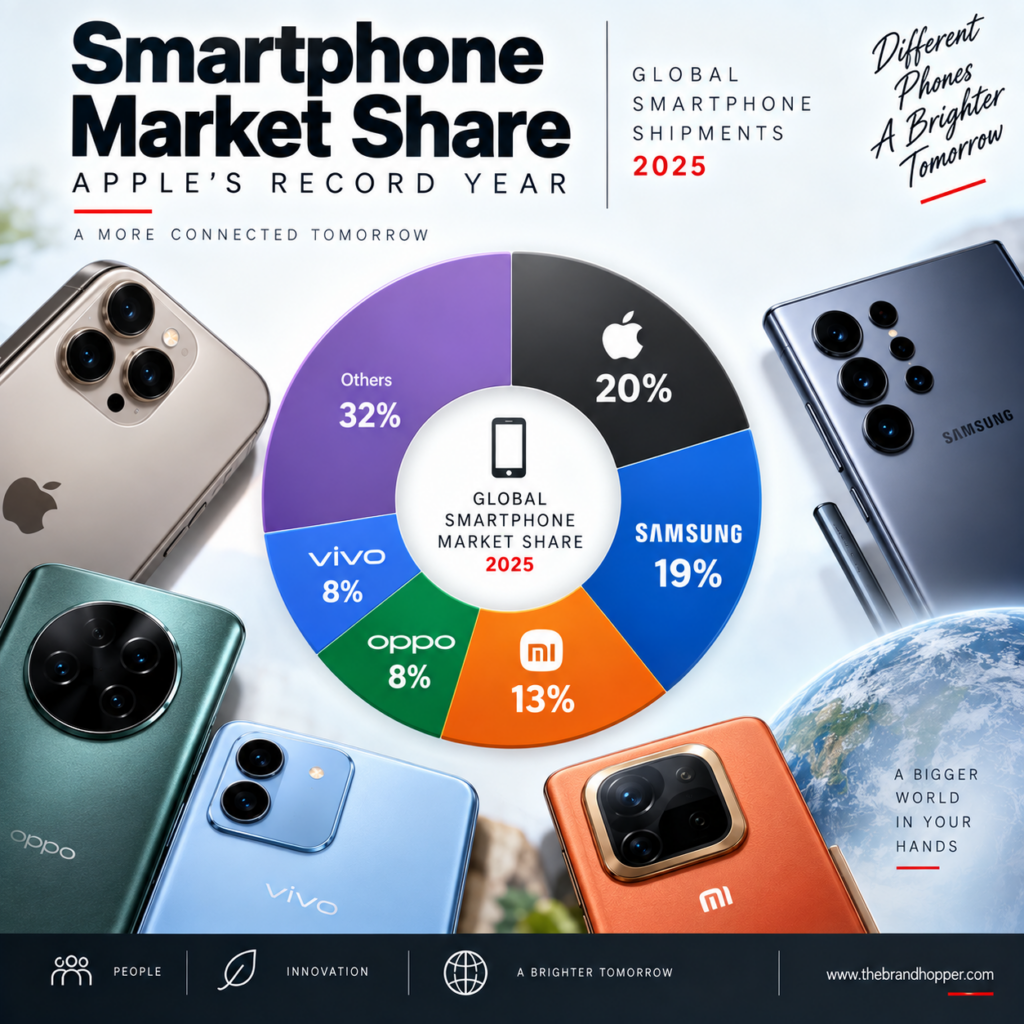
Notably, in Q4 2025 alone, Apple posted its highest-ever quarterly share of global shipments, edging out Samsung’s 17% share in the same quarter — meaning the gap between the two rivals, while still narrow on an annual basis, widened meaningfully in Apple’s favor during the crucial holiday shopping period.
Product Ecosystem: Walled Garden vs Open Diversification
The most fundamental strategic difference between Apple and Samsung is ecosystem philosophy. Apple runs a famously “walled garden” approach: iPhone, iPad, Mac, Apple Watch, and AirPods are designed to work seamlessly together through proprietary software and services (iCloud, iMessage, AirDrop, Continuity features), which drives strong customer retention but limits cross-compatibility with non-Apple devices.
Samsung, by contrast, builds primarily on Google’s open Android operating system, giving customers more hardware and software customization options, broader price-point coverage (from ultra-budget models to premium foldables), and interoperability with a wider range of third-party devices and accessories.
Samsung’s foldable lineup, led by devices like the Galaxy Z Fold7, also gives it a genuine hardware differentiation angle Apple has yet to match, since Apple has not released a foldable iPhone as of this writing despite years of persistent rumors.
Beyond Phones: Semiconductors and Services
Samsung’s business extends into territory Apple doesn’t directly compete in at all: Samsung is one of the world’s largest semiconductor manufacturers, supplying memory chips and components not just for its own devices but for countless other electronics makers globally, including, at times, components used in Apple’s own products.
This semiconductor business was actually the primary growth engine behind Samsung’s strong FY2025 results, riding a broader industry boom in AI-related chip demand.
Apple, meanwhile, has increasingly leaned on its Services segment — the App Store, Apple Music, iCloud, Apple TV+, and AppleCare — as a high-margin, recurring-revenue complement to hardware sales, a strategic pivot that has made Apple’s earnings less dependent on iPhone upgrade cycles alone than in years past.
Which Brand Is Best for You? A Practical Breakdown
If you want the tightest, most polished hardware-software integration and don’t mind paying a premium for it, Apple’s ecosystem remains the more cohesive choice, especially if you already own other Apple devices.
If you want more choice — across price points, screen formats (including foldables), and customization options — Samsung’s broader Android-based lineup offers more flexibility.
As an investor, Apple offers a larger, more services-diversified, single-class-share business with genuinely democratic governance, while Samsung offers exposure to the booming semiconductor industry alongside consumer electronics, wrapped in a chaebol ownership structure that concentrates real control in the Lee family regardless of a given investor’s actual shareholding.
And if brand momentum is what matters most to you, 2025’s numbers tilt toward Apple, which grew smartphone share faster than any other major manufacturer and posted its best-ever quarterly result in Q4.
Apple vs Samsung at a Glance (FY2025)
| Fact | Apple | Samsung |
| Founded | 1976 (Los Altos, California) | 1938 (Taegu, Korea); Electronics arm 1969 |
| Founders | Steve Jobs, Steve Wozniak, Ronald Wayne | Lee Byung-chul |
| Company structure | Independent, publicly traded, single-class shares | Part of Samsung Group chaebol; Lee family control via cross-holdings |
| Stock listing | NASDAQ: AAPL | Korea Exchange: 005930 |
| Largest shareholders | Vanguard (~9.63%), BlackRock (~7.10%) | Lee family (~31% effective control via Samsung C&T chain) |
| CEO | John Ternus | Lee Jae-yong (Executive Chairman) |
| FY2025 revenue | $416 billion (+6.4% YoY) | ~$233.3 billion (KRW 333.6 trillion) |
| FY2025 profit | $112 billion net income | ~KRW 43.6 trillion operating profit |
| Top product/segment | iPhone — $209.59 billion (FY2025) | Semiconductors (memory chip boom drove FY2025 growth) |
| Global smartphone share (FY2025) | 20% (record high, +10% YoY) | 19% (+5% YoY shipments) |
| Ecosystem approach | Closed “walled garden” (iOS) | Open Android-based, broader price range |
| Notable hardware edge | Deep hardware-software integration | Foldables (e.g., Galaxy Z Fold7) |
Key Takeaways
Apple and Samsung enter 2026 in unusually strong positions relative to each other: Apple just posted its best smartphone market-share year ever, at 20% global share and record Q4 shipments, backed by $416 billion in company-wide revenue and $112 billion in profit.
Samsung remains close behind in phones at 19% share, while its semiconductor division — riding an AI-driven memory chip boom — has become the company’s real growth engine, even as its smartphone division faced late-2025 headwinds.
The two companies’ ownership structures could not be more different: Apple is genuinely, democratically shareholder-owned with no controlling party, while Samsung remains firmly under the Lee family’s control through a chaebol-style web of cross-holdings anchored by roughly 31% combined family influence.
Neither brand “wins” outright — Apple leads on profit, brand momentum, and shareholder democracy, while Samsung leads on product breadth, semiconductor scale, and hardware innovation like foldables.
Frequently Asked Questions
Q: Which company had more revenue in FY2025, Apple or Samsung?
A: Apple, by a wide margin. Apple’s FY2025 revenue was $416 billion, compared to Samsung Electronics’ roughly $233.3 billion (KRW 333.6 trillion) for the same period.
Q: Who owns Apple?
A: Apple is a publicly traded company (NASDAQ: AAPL) with no controlling shareholder. The largest holders are institutional investors like Vanguard (~9.63%) and BlackRock (~7.10%), and it operates a single-class share structure with no founder voting privileges.
Q: Who owns Samsung?
A: Samsung is effectively controlled by the Lee family through a web of cross-shareholdings anchored by Samsung C&T, the group’s de facto holding company. Lee Jae-yong personally holds about 1.67% of Samsung Electronics directly, but the broader Lee family’s combined influence across the ownership chain is estimated at around 31%.
Q: Which brand has a bigger smartphone market share, Apple or Samsung?
A: Apple led in FY2025 with a record 20% global smartphone market share, compared to Samsung’s 19%, though Samsung remained close behind and posted its own year-over-year shipment growth.
Q: Who founded Apple and Samsung?
A: Apple was founded in 1976 by Steve Jobs, Steve Wozniak, and Ronald Wayne. Samsung was founded in 1938 by Lee Byung-chul as a Korean trading company, decades before entering electronics.
Q: Is Samsung bigger than Apple overall?
A: No, not by revenue. Apple’s FY2025 revenue of $416 billion is significantly larger than Samsung Electronics’ roughly $233.3 billion, though Samsung’s broader business (including semiconductors) covers more industries than Apple’s.
Q: Does Samsung make parts for Apple products?
A: Yes, at various points Samsung has supplied components, including displays and memory chips, to Apple, even while the two companies compete directly in the smartphone market.
Q: Which company is more profitable, Apple or Samsung?
A: Apple is more profitable in absolute terms, reporting FY2025 net income of $112 billion, while Samsung Electronics reported FY2025 operating profit of roughly KRW 43.6 trillion (about $30 billion), driven largely by its semiconductor division.
Also Read:
- Netflix vs Amazon Prime: Which Is Better?
- GoPro vs DJI: Best Action Camera Brand?
- Intel vs AMD: Which CPU Brand Is Better?
To read more content like this, subscribe to our newsletter