Last Updated on November 13, 2026 by Team TBH
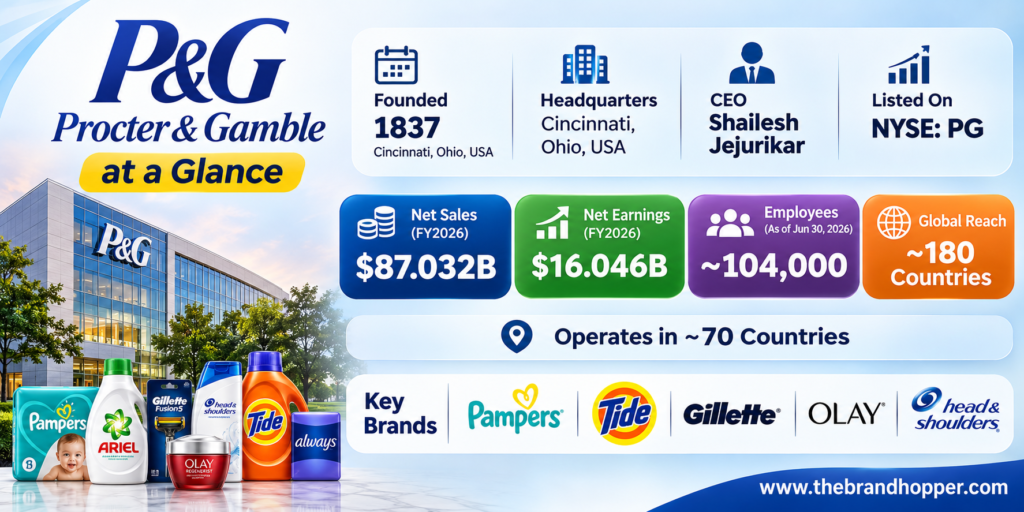
Procter & Gamble (P&G) is the multinational consumer goods company behind household and personal-care brands such as Tide, Pampers, Gillette, Oral-B, Head & Shoulders, Ariel and Vicks. Its products are sold in approximately 180 countries and territories, making it one of the world’s largest consumer goods businesses.
P&G generated US$87.0 billion in net sales in FY2026, which ended on June 30, 2026. Although the company owns a large portfolio of internationally recognised brands, it does not belong to one individual, family or parent corporation. P&G is a publicly traded company owned by its shareholders.
This guide explains who owns P&G, who manages the company, how it performs financially, which brands belong to its portfolio and how its ownership and business structure have evolved.
1. Who Owns Procter & Gamble? The Shareholder Breakdown
Procter & Gamble is owned by its shareholders. Because it is listed on the New York Stock Exchange, investors can purchase its common stock and become partial owners of the business.
P&G reported 2,323,858,841 common shares outstanding as of June 30, 2026. Its ownership is distributed among institutional investors, investment funds, retirement accounts and individual shareholders.
P&G’s 2026 proxy statement identified two beneficial owners holding more than 5% of its common stock.
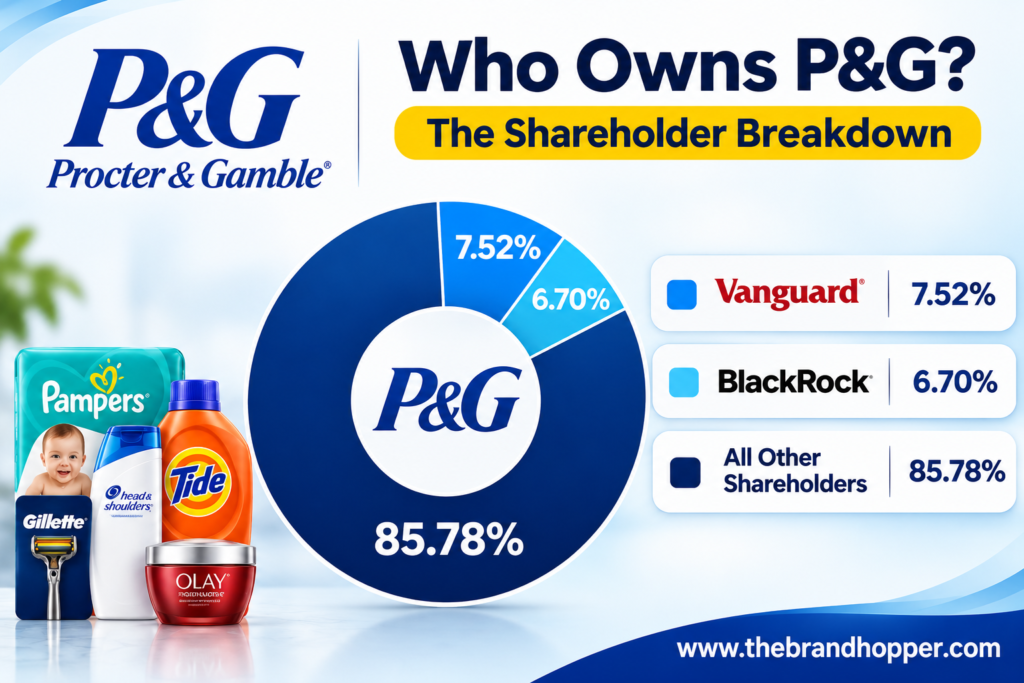
The figures are based on the ownership disclosures included in P&G’s 2026 proxy statement. Vanguard’s reported position is based on March 31, 2026, while BlackRock’s is based on December 31, 2023. Percentages use P&G’s common shares outstanding as of June 30, 2026.
Vanguard and BlackRock are investment management companies that manage funds and investment products on behalf of clients. Their disclosed holdings therefore represent investments managed for clients and fund investors, rather than personal ownership by the asset management companies’ executives.
These holdings do not give either institution control of P&G. The remaining common shares are distributed among other institutional investors, pension funds, mutual funds and individual investors.
P&G’s Employees Are Shareholders Too
P&G has a long-standing Profit Sharing Trust and Employee Stock Ownership Plan. The arrangement forms part of the company’s retirement and employee-benefit structure and includes investments in P&G stock.
P&G also has Series A and Series B ESOP Convertible Class A Preferred Stock. These securities have voting and dividend rights under their terms, and their existence means the company’s ownership structure is not limited to common stock alone.
Do P&G’s Directors and Executives Own Much of the Company?
P&G’s directors and senior executives hold company shares and share-based awards, but their individual ownership is small relative to the company’s total outstanding shares.
The company’s executive compensation arrangements include stock ownership guidelines. These are intended to align management’s interests with those of shareholders over the longer term.
Bottom line on ownership: P&G is owned by its shareholders, not by the founding families or a parent company. Vanguard and BlackRock are its largest disclosed common-stock holders in the 2026 proxy statement, while its employee retirement arrangements also hold P&G securities.
2. Who Runs Procter & Gamble? Leadership in 2026
P&G’s shareholders elect the Board of Directors, which oversees the company and appoints its senior management. The Board is responsible for corporate governance, strategic oversight and management accountability.
At the October 13, 2026 Annual Meeting, shareholders elected all 12 director nominees.
Shailesh Jejurikar, Chairman, President and CEO
Shailesh Jejurikar became President and Chief Executive Officer of P&G on January 1, 2026, succeeding Jon Moeller. Before becoming CEO, Jejurikar served as Chief Operating Officer and held leadership responsibilities across several business categories and international markets.
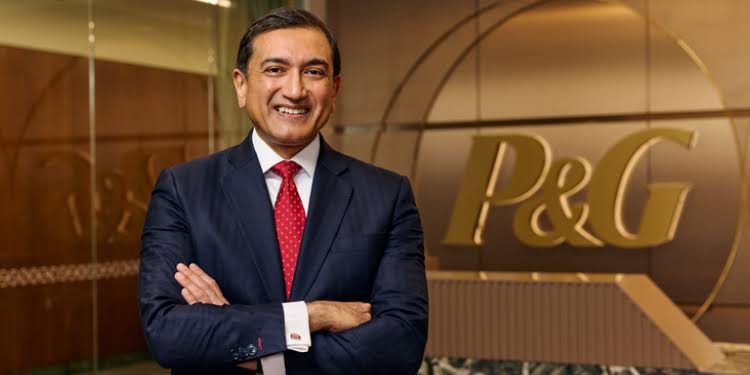
Jejurikar joined P&G in 1989 and has held senior positions across Fabric Care, Home Care, global operations and enterprise markets. His experience includes leadership responsibilities in India, Latin America, the Middle East, Africa, Southeast Asia and Eastern Europe.
On July 29, 2026, P&G announced that Jejurikar would also become Chairman of the Board effective August 1, 2026. Jon Moeller retired from the Board on July 31 and from P&G on August 14, 2026.
The Leadership Team
Andre Schulten serves as P&G’s Chief Financial Officer. Other senior leaders oversee the company’s major business segments and corporate functions.
P&G’s leadership structure includes executives responsible for Beauty, Grooming, Health Care, Fabric & Home Care and Baby, Feminine & Family Care. The company periodically updates its leadership assignments, so individual segment leadership titles should be checked against its current leadership directory before publication.
3. How Big Is P&G? Financial Performance
P&G’s financial year ends on June 30. Its FY2026 results represent the latest completed full-year financial reporting period as of November 13, 2026.
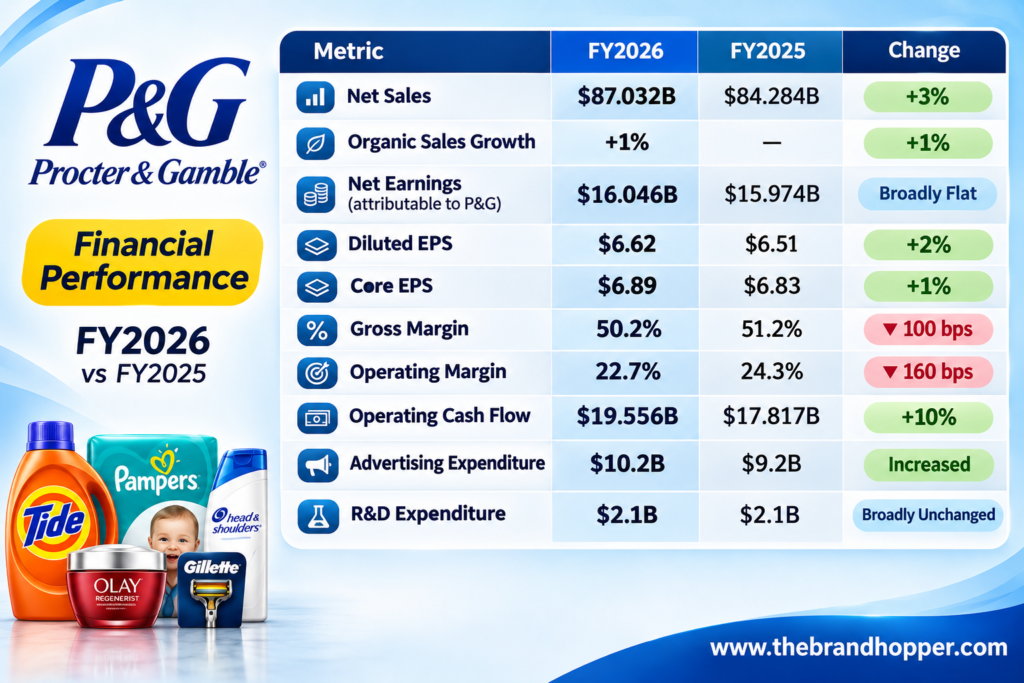
P&G’s FY2026 net sales increased by 3% to US$87.032 billion. Organic sales increased by 1%, while net earnings attributable to P&G remained broadly unchanged at US$16.046 billion.
The company’s gross margin declined by 100 basis points to 50.2%, while operating margin fell by 160 basis points to 22.7%. Higher product and packaging investments, restructuring costs, product mix and other cost pressures contributed to the margin decline.
P&G generated US$19.556 billion in operating cash flow during FY2026. It returned more than US$15 billion to shareholders through dividends and share repurchases.
Advertising expenditure increased to US$10.2 billion in FY2026, compared with US$9.2 billion in FY2025. Research and development expenditure remained at approximately US$2.1 billion.
Where Does P&G Generate Its Revenue?
P&G’s business is organised into five reportable segments. Fabric & Home Care is the largest, accounting for approximately 35% of FY2026 net sales.
| Segment | FY2026 net sales | Approximate share of sales |
|---|---|---|
| Fabric & Home Care | US$30.314 billion | 35% |
| Baby, Feminine & Family Care | US$20.401 billion | 24% |
| Beauty | Approximately US$16.4 billion | 19% |
| Health Care | US$12.456 billion | 14% |
| Grooming | US$6.918 billion | 8% |
Segment shares exclude Corporate net sales. Figures are rounded.
P&G’s geographic sales are also diversified. In FY2026, North America accounted for approximately 51% of net sales, followed by Europe at 23%, Latin America at 7%, Greater China at 7%, Asia Pacific at 7% and India, Middle East & Africa at 5%.
The Latest Quarter: Q1 FY2027
P&G reported its first-quarter FY2027 results on October 22, 2026. The quarter covered the three months ended September 30, 2026.
Net sales increased 4% to US$23.276 billion, while organic sales also increased 4%. Diluted EPS was US$1.97, up 1%, and core EPS was US$2.00, also up 1%.
Operating cash flow was US$5.8 billion, while net earnings were approximately US$4.8 billion. P&G returned US$3.9 billion to shareholders through dividends and share repurchases during the quarter.
For FY2027, P&G maintained its organic sales growth guidance of 1% to 3%. Following the Thorne acquisition, it updated its all-in sales growth guidance to 2% to 4%.
4. What Does Procter & Gamble Own? The Brand Portfolio
P&G owns and markets a large portfolio of consumer brands across household care, beauty, grooming, baby care and healthcare. The company organises its business into five reportable segments.
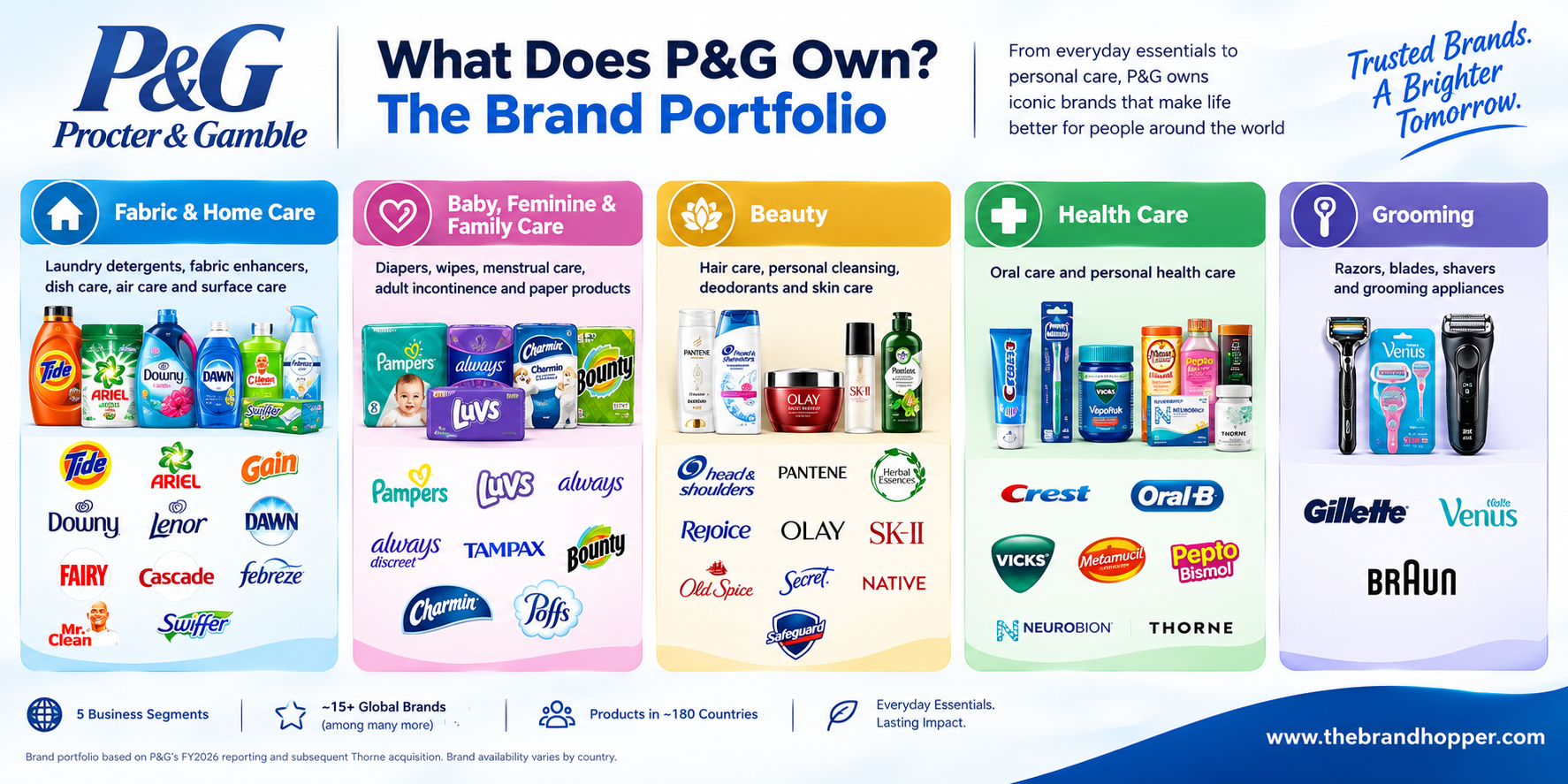
Brand portfolio based on P&G’s FY2026 reporting and subsequent Thorne acquisition. Brand availability varies by country.
Fabric & Home Care: P&G’s Biggest Business
Fabric & Home Care is P&G’s largest reportable segment, generating US$30.3 billion in FY2026 net sales. The business includes laundry and home-care products sold under brands such as Tide, Ariel, Gain, Downy, Dawn, Cascade, Febreze and Swiffer.
The segment includes fabric care and home care, with products ranging from laundry detergents and fabric conditioners to dishwashing products, air fresheners and surface cleaners. P&G reported that segment net sales increased 2% in FY2026.
Baby, Feminine & Family Care
P&G’s Baby, Feminine & Family Care segment generated US$20.4 billion in FY2026 net sales. Its portfolio includes Pampers and Luvs in baby care, Always and Tampax in feminine care, and Bounty, Charmin and Puffs in family care.
The segment reported 1% net sales growth in FY2026, although organic sales declined 1%. The results reflect different market conditions across baby, feminine and family care categories.
Beauty
P&G’s Beauty segment includes hair care, personal care and skin care products. Major brands include Head & Shoulders, Pantene, Herbal Essences, Olay, SK-II, Old Spice, Secret, Native and Safeguard.
The segment generated approximately US$16.4 billion in FY2026 net sales, representing around 19% of P&G’s total segment sales. P&G reported high-single-digit net sales growth in Beauty during the year.
Health Care
P&G’s Health Care segment includes oral care and personal health care products. Crest and Oral-B are important oral-care brands, while Vicks, Metamucil, Pepto-Bismol and Neurobion operate across personal health-care categories.
The segment generated approximately US$12.5 billion in FY2026 net sales. In October 2026, P&G completed its acquisition of Thorne, expanding its presence in vitamins, minerals, supplements and premium wellness products.
Grooming
P&G’s Grooming segment includes shaving and personal grooming products. Gillette and Venus are its major blade and razor brands, while Braun operates in electric grooming appliances.
The segment generated approximately US$6.9 billion in FY2026 net sales. Its portfolio serves both male and female grooming markets across multiple countries.
Brands P&G No Longer Owns
P&G has reshaped its portfolio over the years by selling or transferring brands that no longer fit its core business strategy.
It sold Folgers to J.M. Smucker in 2008 and transferred Pringles to Kellogg in 2012. Duracell was transferred to Berkshire Hathaway in 2016.
P&G also transferred a portfolio of beauty brands, including CoverGirl and Max Factor, to Coty in 2016. These transactions were part of a broader effort to focus on its core consumer goods categories.
5. P&G’s Biggest Moves in 2026
Thorne Acquisition
On August 4, 2026, P&G announced an agreement to acquire Thorne, a premium wellness and dietary supplement brand, for approximately US$3.8 billion. The acquisition was intended to expand P&G’s Health Care portfolio into vitamins, minerals, supplements and personalised wellness.
P&G completed the acquisition on October 1, 2026, in an all-cash transaction for US$3.9 billion. Thorne is expected to become part of P&G’s Personal Health Care operating segment.
Glad Joint Venture Ends
P&G’s joint venture with Clorox for the Glad bags and wraps business ended on January 31, 2026. Under the agreement, Clorox purchased P&G’s 20% interest in the venture for US$476 million.
Restructuring Programme
In June 2025, P&G announced a restructuring programme intended to simplify its organisation and improve operational efficiency. The two-year programme included plans to eliminate up to 7,000 non-manufacturing positions by the end of FY2027.
P&G reported approximately 104,000 employees as of June 30, 2026, a decrease of 4% compared with the previous year. The company attributed the reduction partly to its ongoing restructuring programme.
Leadership Transition
Shailesh Jejurikar became CEO on January 1, 2026, succeeding Jon Moeller. He also became Chairman of the Board on August 1, 2026, following Moeller’s retirement from the Board.
6. A Brief History of Procter & Gamble
| Year | Milestone |
|---|---|
| 1837 | William Procter and James Gamble establish a soap and candle business in Cincinnati, Ohio |
| 1879 | P&G launches Ivory soap |
| 1890 | The company is incorporated in New Jersey |
| 1905 | P&G is incorporated in Ohio |
| 1946 | Tide laundry detergent is introduced |
| 1961 | Pampers disposable diapers are launched |
| 2005 | P&G acquires The Gillette Company |
| 2008 | Folgers is sold to J.M. Smucker |
| 2012 | Pringles is transferred to Kellogg |
| 2016 | Duracell is transferred to Berkshire Hathaway and several beauty brands are transferred to Coty |
| 2018 | P&G acquires Merck KGaA’s global consumer health business |
| 2026 | Shailesh Jejurikar becomes CEO and Chairman; P&G completes the Thorne acquisition |
7. How to Invest in Procter & Gamble
P&G is publicly traded on the New York Stock Exchange under the ticker symbol PG. Investors can purchase its shares through brokerage platforms that provide access to US stock markets.
Indian residents can invest in eligible overseas securities through permitted routes under the Reserve Bank of India’s Liberalised Remittance Scheme, subject to the applicable limits, tax collection requirements and other regulatory rules. Investors should check their broker’s eligibility, remittance process and tax obligations before investing.
P&G is also a constituent of major US equity indices, including the Dow Jones Industrial Average and the S&P 500. It is held by numerous index funds and dividend-focused investment products.
Indian investors can also consider the separately listed Indian P&G group companies, including P&G Hygiene and Health Care, Gillette India and P&G Health. These are distinct investments with their own financial performance, valuations and shareholder structures.
As with any investment, investors should evaluate the company’s financial performance, valuation, dividend policy and risk factors before making a decision.
8. The Bottom Line
Procter & Gamble is a publicly traded American consumer goods company owned by its shareholders. Vanguard Capital Management and BlackRock are its largest disclosed common-stock holders in the 2026 proxy statement, while P&G’s employee retirement arrangements also hold company securities.
Under Chairman, President and CEO Shailesh Jejurikar, P&G operates five major business segments and owns some of the world’s best-known consumer brands, including Tide, Pampers, Gillette, Oral-B, Head & Shoulders and Vicks.
The company reported US$87.0 billion in FY2026 net sales and US$16.046 billion in net earnings attributable to P&G. Its acquisition of Thorne in October 2026 also expanded its presence in the premium wellness and supplement market.
9. Frequently Asked Questions
Q: Who is the owner of Procter & Gamble?
A: P&G does not have one individual owner. It is a publicly traded company owned by its shareholders, with Vanguard Capital Management and BlackRock among its largest disclosed common-stock holders in the 2026 proxy statement.
Q: Is P&G owned by a family?
A: No. P&G was founded by William Procter and James Gamble in 1837, but it is now a publicly traded company. Neither founding family controls the company.
Q: Who is the CEO of Procter & Gamble?
A: Shailesh Jejurikar is P&G’s Chairman, President and Chief Executive Officer. He became CEO on January 1, 2026, and Chairman on August 1, 2026.
Q: Which country owns P&G?
A: P&G is an American company headquartered in Cincinnati, Ohio. It is not owned by any government or another parent company.
Q: What brands does Procter & Gamble own?
A: P&G’s major brands include Tide, Ariel, Downy, Dawn, Febreze, Pampers, Always, Tampax, Charmin, Bounty, Head & Shoulders, Pantene, Olay, SK-II, Old Spice, Crest, Oral-B, Vicks, Gillette, Venus and Braun. Following its October 2026 acquisition, Thorne is also part of its portfolio.
Q: Does P&G own Gillette?
A: Yes. P&G acquired The Gillette Company in 2005. Gillette, Venus and Braun are now part of P&G’s Grooming segment.
Q: Does P&G still own Duracell?
A: No. P&G transferred Duracell to Berkshire Hathaway in 2016.
Q: How much does Procter & Gamble make a year?
A: P&G reported net sales of US$87.032 billion and net earnings attributable to P&G of US$16.046 billion in FY2026, which ended on June 30, 2026.
Also Read: P&G’s Top 18 Competitors: Brands Challenging the Giant
To read more content like this, explore The Brand Hopper
Subscribe to our newsletter