Last Updated on August 10, 2026 by Team TBH
Founded in 1837 by William Procter and James Gamble in Cincinnati, Ohio, Procter & Gamble has spent nearly two centuries building one of the world’s most recognized and trusted consumer goods portfolios. With FY2024 net sales of $84.0 billion, net earnings of $14.9 billion, and a brand presence spanning 180+ countries, P&G operates at a scale that few companies in any industry can match. The company’s five operating segments — Beauty, Grooming, Health Care, Fabric & Home Care, and Baby, Feminine & Family Care — encompass 65+ brands serving approximately five billion consumers daily.
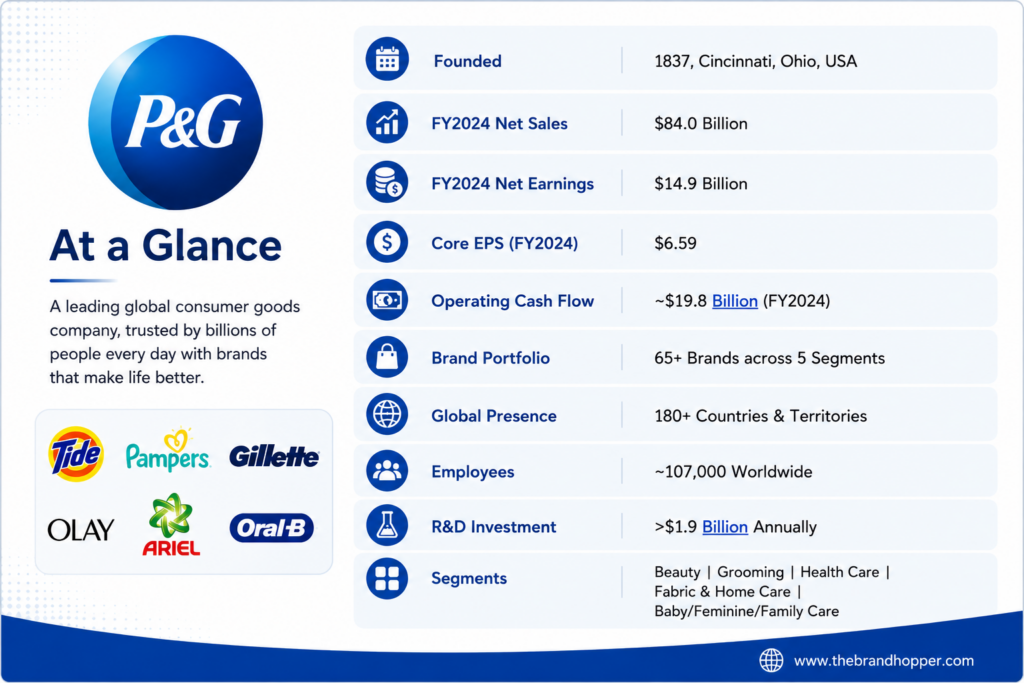
P&G’s portfolio includes some of the world’s best-known household brands: Tide and Ariel (laundry), Pampers (baby care), Gillette and Venus (shaving), Oral-B and Crest (oral care), Pantene and Head & Shoulders (hair care), Olay and SK-II (skin care), Vicks (respiratory health), Febreze (home fragrance), Dawn and Fairy (dish care), and Bounty and Charmin (paper products). This breadth — combined with P&G’s unmatched retail distribution, data analytics capabilities, and $1.9+ billion annual R&D investment — creates formidable competitive barriers. To understand P&G’s competitive strategy better, read about its
To understand marketing strategies and marketing mix of P&G and its brand architecture, which has enabled it to manage 65+ brands across five distinct segments while maintaining consistent global growth.
Yet P&G’s dominance has attracted formidable competitors across every category it operates in. From Unilever’s comparable global scale in personal care and home care, to Kimberly-Clark’s fierce rivalry in baby and family care, to Colgate-Palmolive’s entrenched oral care leadership, the competitive landscape P&G navigates is among the most complex in global business. Below, we profile 18 of P&G’s most significant competitors — examining their revenue scale, brand portfolios, and the specific ways they challenge P&G’s market position.
P&G’s Competitors at a Glance
| # | Competitor | Revenue (FY2025) | HQ | Primary Competition Area |
|---|---|---|---|---|
| 1 | Unilever | €50.5 billion | London, UK | Personal Care |
| 2 | Colgate-Palmolive | ~$20.4 billion | New York, USA | Oral Care |
| 3 | Kimberly-Clark | ~$16.5 billion | Irving, Texas, USA | Baby Care |
| 4 | L’Oréal | €44.05 billion | Clichy, France | Hair Care |
| 5 | Reckitt | ~£14.0 billion | Slough, UK | Hygiene |
| 6 | Kenvue | ~$15.1 billion | Skillman, NJ, USA | Skin Health |
| 7 | Henkel | €20.5 billion | Düsseldorf, Germany | Laundry Care |
| 8 | Beiersdorf AG | €9.85 billion | Hamburg, Germany | Skin Care |
| 9 | Haleon | £11.0 billion | Brentford, UK | Oral Health |
| 10 | Nestlé | ~CHF 89.5 billion | Vevey, Switzerland | Baby Nutrition |
| 11 | The Estée Lauder Companies | ~$14.3 billion | New York, USA | Prestige Skin Care |
| 12 | Church & Dwight | $6.20 billion | Ewing, NJ, USA | Laundry |
| 13 | Kao Corporation | ~¥1.69 trillion | Tokyo, Japan | Laundry Care |
| 14 | SC Johnson | ~$13 billion (est.) | Racine, WI, USA | Home Fragrance |
| 15 | Edgewell Personal Care | ~$2.22 billion | Shelton, CT, USA | Men’s & Women’s Shaving |
| 16 | Coty Inc. | $5.89 billion | New York, USA | Color Cosmetics |
| 17 | Godrej Consumer Products | ~₹14,500 crore | Mumbai, India | Home Care |
| 18 | Prestige Consumer Healthcare | $1.14 billion | Tarrytown, NY, USA | OTC Eye Care |
P&G’s Top 18 Competitors: In-Depth Analysis
1. Unilever
Official Website: unilever.com
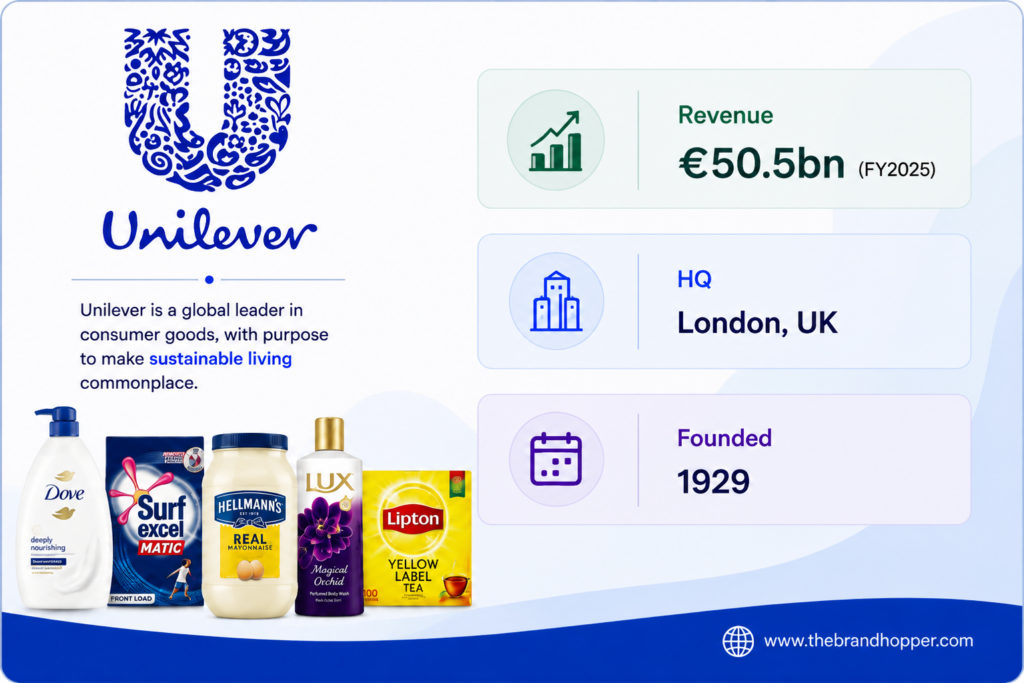
Unilever is P&G’s most comprehensive global rival, matching or exceeding it in personal care, home care, and beauty across emerging markets. The Anglo-Dutch consumer giant manages a portfolio of 400+ brands — organized around 30 “Power Brands” — across 190+ countries, generating approximately €50.5 billion in FY2025 annual revenue. Its brand architecture spans segments that nearly mirror P&G’s own five operating divisions.
The head-to-head brand battles are intense across every aisle. In hair care, Dove, TRESemmé, and Sunsilk challenge P&G’s Pantene and Head & Shoulders for shelf space and consumer loyalty. In skin care, Dove and Vaseline compete with Olay, while Simple and Dermalogica target the premium skin health segment that P&G’s SK-II occupies. In fabric care, Omo, Persil, and Surf compete with Tide and Ariel; in home care, Domestos and Cif take on Mr. Clean and Microban.
Unilever’s “Beauty & Wellbeing” and “Personal Care” divisions are growing fastest, driven by premium hair care acquisitions (OUAI, K18, Nutrafol) and functional beauty brands. Its “Brilliant Basics” supply chain program and e-commerce-first distribution approach directly threaten P&G’s retail market-share fortress in emerging markets across Asia, Africa, and Latin America. Unilever’s sustainability commitments under the Unilever Compass — including net-zero emissions by 2039 and halving virgin plastic use — have also set a high bar for ESG performance that P&G must actively match.
| HEAD-TO-HEAD BATTLE
Category: Personal Care, Hair Care, Fabric Care, Home Care, Skin Care P&G Brands: Pantene, Head & Shoulders, Olay, Tide, Ariel, Febreze, Old Spice, SK-II Rival Brands: Dove, TRESemmé, Sunsilk, Lux, Omo, Surf, Domestos, Vaseline, Rexona, Signal |
2. Colgate-Palmolive
Official Website: colgatepalmolive.com
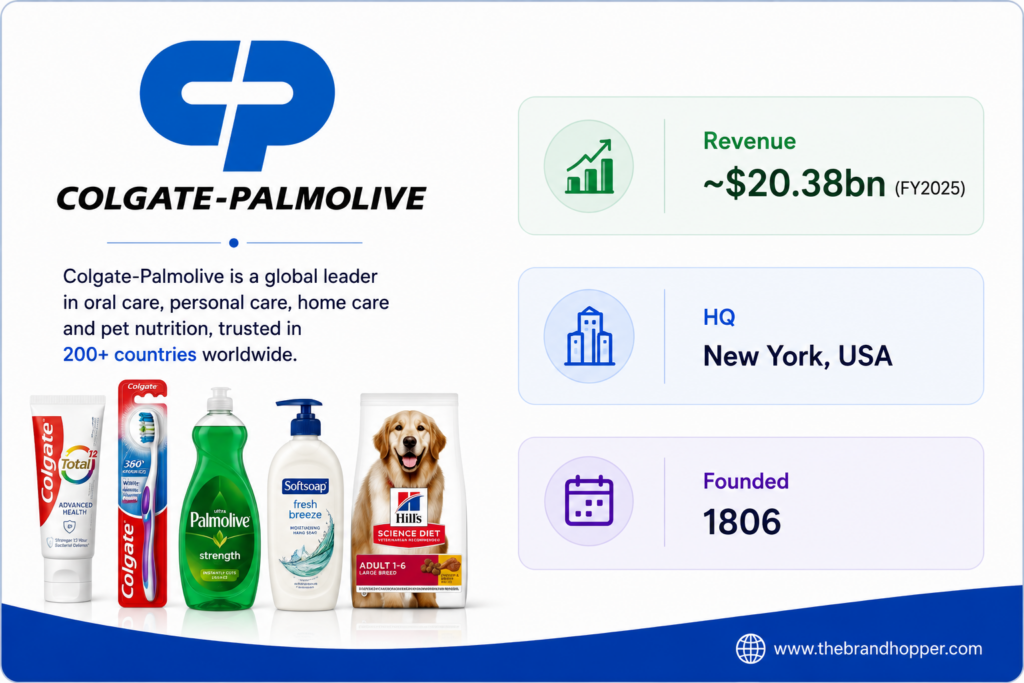
Colgate-Palmolive’s century-long dominance in global toothpaste — holding approximately 40% worldwide market share — makes it P&G’s most dangerous rival in oral care. The company reports FY2025 annual revenues of approximately $20.38 billion across oral care, personal care, home care, and pet nutrition in 200+ countries. Its flagship Colgate brand remains the best-selling toothpaste worldwide, consistently ahead of P&G’s Crest in global reach.
The Colgate vs. Crest/Oral-B duel is one of the longest-running brand wars in consumer goods. Colgate’s innovation pipeline — including Colgate Renewal calcium-based toothpastes, Colgate Smart Electric toothbrushes, and fully recyclable tube packaging — forces P&G’s Oral-B to constantly respond. In dish care, Palmolive and Ajax compete with P&G’s Fairy and Dawn across North America and Latin America. In personal wash, Colgate’s Softsoap and Irish Spring challenge Old Spice and Safeguard in key North American markets.
Colgate’s Hill’s Pet Nutrition segment — generating over $10bn in revenue — occupies premium pet nutrition space that P&G fully exited when it sold Iams and Eukanuba to Mars in 2014. Colgate has also made strategic moves into skin health: its acquisitions of EltaMD (dermatologist-recommended sunscreen) and Filorga (anti-aging skincare) signal a direct move into territory held by Olay and SK-II. In Latin America, where Colgate has unmatched distribution depth, it remains P&G’s toughest overall competitor across multiple categories.
| HEAD-TO-HEAD BATTLE
Category: Oral Care, Home Care, Personal Care, Pet Nutrition P&G Brands: Oral-B, Crest, Dawn, Fairy, Old Spice, Safeguard Rival Brands: Colgate, Palmolive, Ajax, Softsoap, Irish Spring, Speed Stick, Hill’s Science Diet |
3. Kimberly-Clark
Official Website: kimberly-clark.com
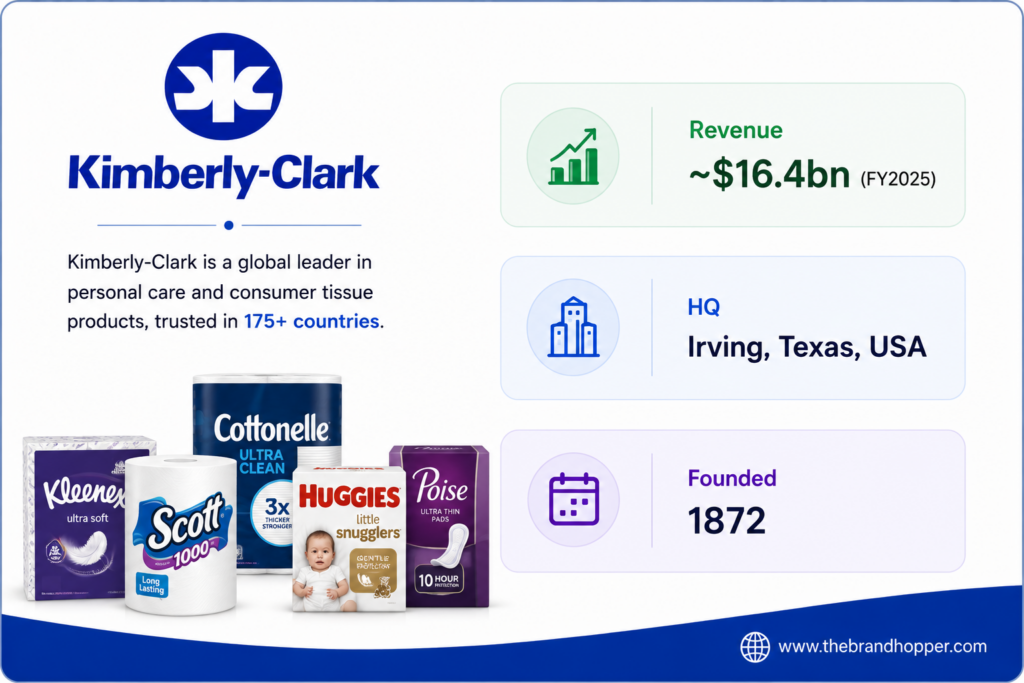
Kimberly-Clark is P&G’s most direct rival in baby care and family essentials, with the Huggies vs. Pampers rivalry considered one of the most intense brand duels in consumer goods. The Irving, Texas-based company generates approximately $16.14 billion in FY2025 annual revenue across three flagship brands — Huggies (baby care), Kleenex (tissue), and Scott (bathroom tissue) — as well as the Cottonelle, Viva, Poise, and Depend brands.
In the global baby diaper category, Huggies and Pampers together account for over 70% of market share, battling across premium, mid-tier, and economy segments. Kimberly-Clark’s Depend brand is the clear leader in the rapidly growing adult incontinence category — an area where P&G has minimal direct exposure — while its Poise brand leads women’s light incontinence. In tissue and paper, Kleenex facial tissue and Scott bath tissue challenge P&G’s Charmin and Bounty for pharmacy and grocery shelf leadership.
Kimberly-Clark’s “Powering Care” strategy focuses on accelerating innovation in its highest-margin diaper tiers, including Huggies Special Delivery (plant-based materials) and Huggies Skin Essentials (developed with dermatologists). The company is also accelerating growth in emerging markets through low-unit-price packs and community health programs — mirrors of P&G’s own emerging-market playbook. Kimberly-Clark’s Cottonelle flushable wipes range competes with P&G’s Charmin Fresh Mates in the premium personal care adjacency to bath tissue.
| HEAD-TO-HEAD BATTLE
Category: Baby Care, Family Care, Tissue & Paper, Adult Care P&G Brands: Pampers, Charmin, Bounty, Always (some overlap in personal hygiene) Rival Brands: Huggies, Depend, Kleenex, Scott, Cottonelle, Poise, Viva, Pull-Ups |
4. L’Oréal
Official Website: loreal.com
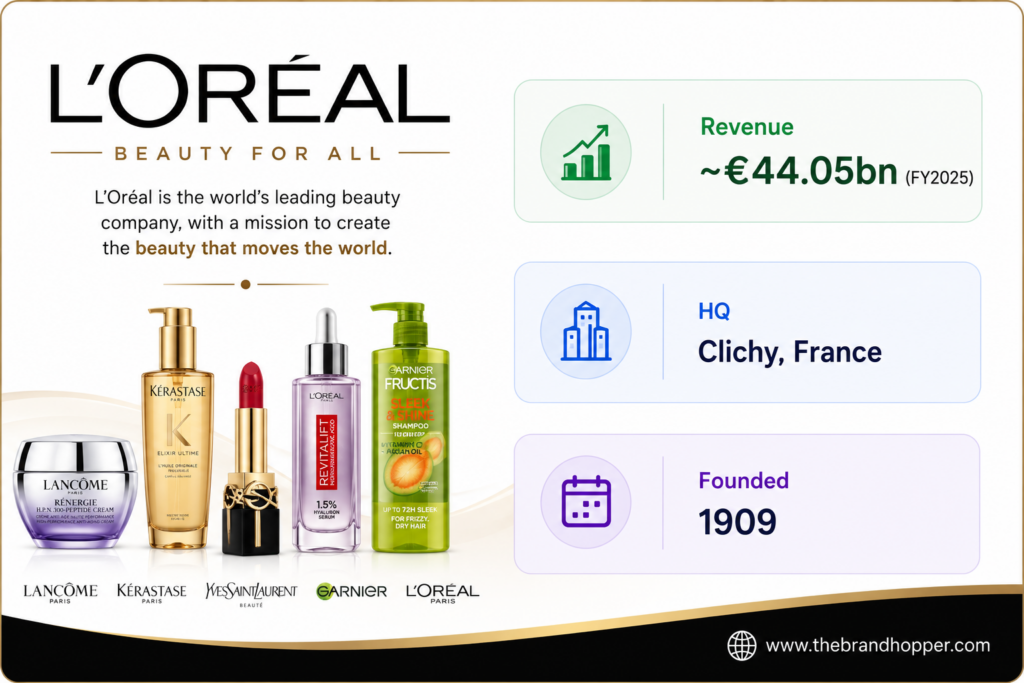
L’Oréal is the world’s largest beauty company by revenue, with approximately €44.05 billion in FY2025 annual sales and a portfolio spanning mass-market, luxury, professional, and dermocosmetics segments. Its 36 international brands — including Maybelline, Lancôme, Garnier, Vichy, CeraVe, and Kérastase — give it unmatched coverage from drugstore shelves to department store counters, making it P&G’s most formidable rival in hair care, skin care, and cosmetics.
In hair care, Garnier and L’Oréal Paris compete with P&G’s Pantene and Herbal Essences at the mass-market tier; Kérastase and Redken challenge P&G’s premium hair care play in professional salons. In skin care, L’Oréal Paris (mass) and Lancôme (prestige) battle Olay across anti-aging, moisturizers, and serums. L’Oréal’s dermatological beauty division — anchored by CeraVe, La Roche-Posay, and Vichy — is growing at a remarkable clip, capitalizing on the skincare-as-healthcare macro trend that P&G’s SK-II also targets.
L’Oréal’s annual R&D investment exceeds €1.1 billion with 4,000+ researchers worldwide, providing scientific credibility that supports its premium and dermocosmetics positioning. The 2023 acquisition of Aesop for approximately US$2.5 billion cemented its luxury beauty ambitions. L’Oréal’s AI-powered beauty tools — including Style My Hair (virtual hair color) and Skin Genius (personalized skin diagnosis) — are building a direct consumer relationship that increasingly positions it as a technology-first beauty company, directly challenging P&G’s SK-II Future Solution LX franchise and Olay’s Skin Advisor digital platform.
| HEAD-TO-HEAD BATTLE
Category: Hair Care, Skin Care, Color Cosmetics, Luxury Beauty, Professional Care P&G Brands: Pantene, Head & Shoulders, Olay, SK-II, Herbal Essences Rival Brands: Garnier, Maybelline, L’Oréal Paris, Lancôme, Vichy, CeraVe, La Roche-Posay, Kérastase |
5. Reckitt
Official Website: reckitt.com
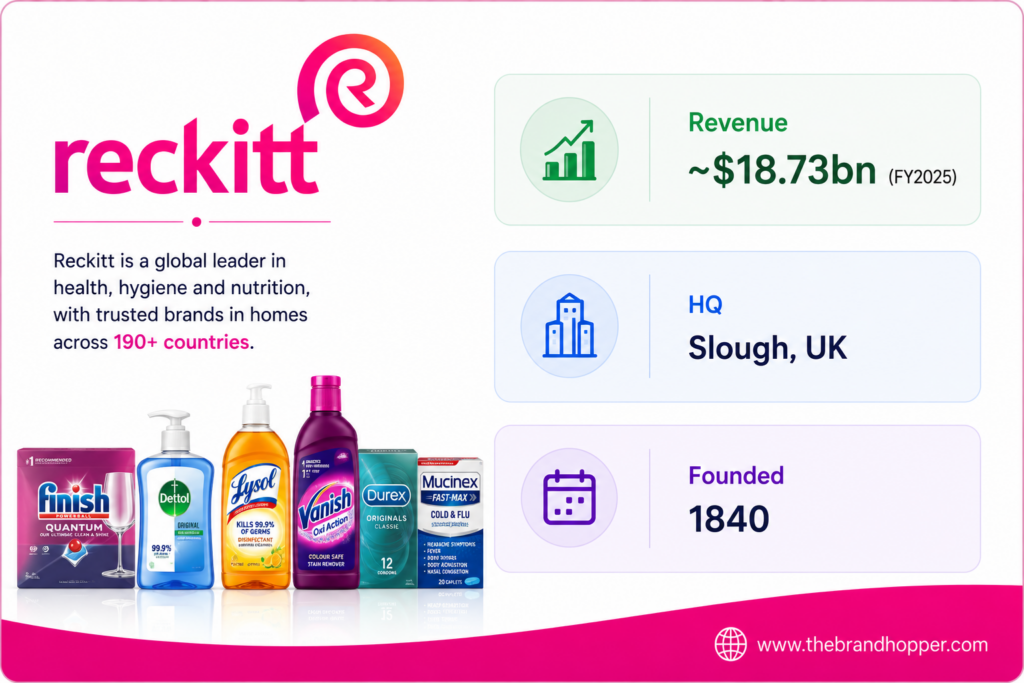
Reckitt — formerly Reckitt Benckiser — is a focused rival to P&G in health, hygiene, and home categories, generating $18.73 billion in FY2025 revenue (as reported in its official FY2025 annual results). Built on power brands including Dettol, Lysol, Durex, Nurofen, Strepsils, Gaviscon, Finish, and Vanish, Reckitt competes head-on with P&G across hygiene protection, surface cleaning, OTC healthcare, and dishwasher care.
The hygiene battle is where Reckitt excels. Lysol’s dominance in surface disinfection — reinforced during the COVID-19 pandemic — gives it a platform that P&G’s Microban and Mr. Clean struggle to match on antibacterial efficacy claims. Dettol leads the antiseptic hand care and body wash category across Asia, Africa, and South Asia, challenging P&G’s Safeguard soap. In dishwasher care, Reckitt’s Finish competes with P&G’s Cascade (US) and Fairy Platinum (Europe) in the automatic dishwasher category. Vanish fabric stain remover competes with Ariel OXI and Tide OXI variants.
Reckitt has reorganized into two operating units: Hygiene (Lysol, Dettol, Harpic, Durex, Scholl) and Health (Nurofen, Strepsils, Gaviscon, Mucinex, Digestive Health). Its health portfolio — OTC self-care medicines — is growing as consumer health markets expand. In cold and respiratory care, Mucinex and Strepsils compete with P&G’s Vicks DayQuil, NyQuil, and throat range for pharmacy shelf dominance. Reckitt’s digital health investments and e-pharmacy expansion are shaping its long-term competitive posture against both P&G Health Care and Haleon.
| HEAD-TO-HEAD BATTLE
Category: Hygiene, OTC Health, Surface Care, Dishwasher Care, Stain Removal P&G Brands: Vicks, Pepto-Bismol, Febreze, Mr. Clean, Microban, Cascade, Safeguard Rival Brands: Lysol, Dettol, Nurofen, Strepsils, Mucinex, Gaviscon, Finish, Vanish, Durex, Harpic |
6. Kenvue
Official Website: kenvue.com
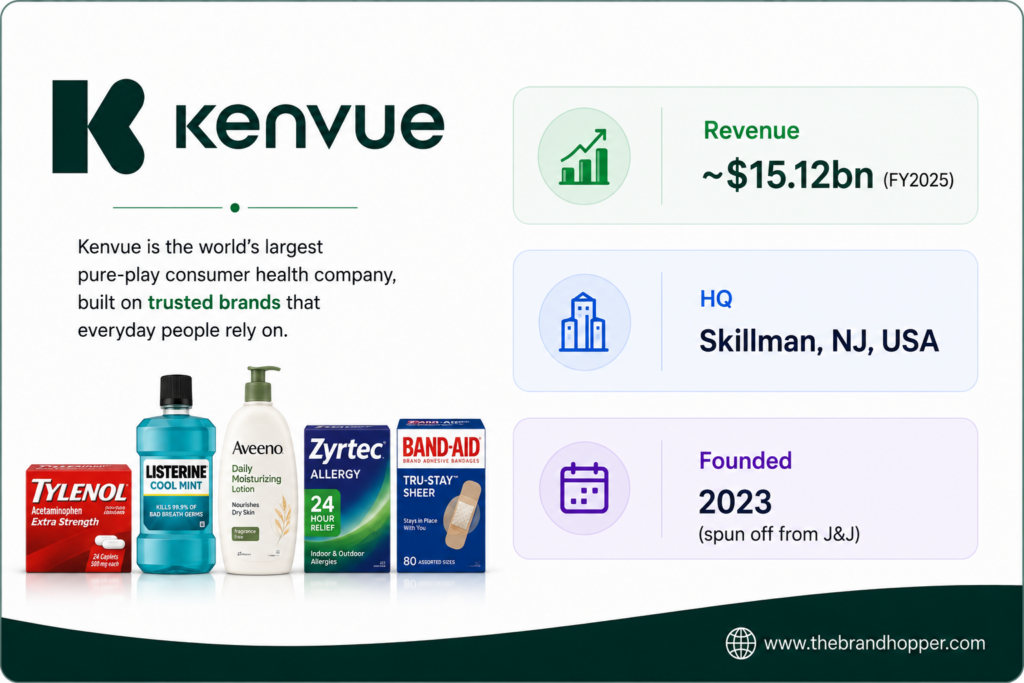
Kenvue is the world’s largest pure-play consumer health company, spun off from Johnson & Johnson in August 2023 in one of the largest consumer IPOs in recent years. With approximately $15.12 billion in annual revenue, Kenvue manages iconic global brands — Neutrogena, Aveeno, Johnson’s Baby, Band-Aid, Listerine, Tylenol, Motrin, Zyrtec, and Nicorette — across skin health, essential health, and self-care segments. Its J&J heritage gives it clinical credibility that few consumer brands can match.
In skin care, Kenvue’s Neutrogena and Aveeno — both built on dermatologist-backed platforms — compete directly with P&G’s Olay and SK-II, particularly in the premium skin health and sensitive-skin segments. Listerine’s mouthwash leadership challenges P&G’s Crest Pro-Health rinse and Oral-B Gum & Enamel Pro-Repair rinse. On the OTC health front, Tylenol and Motrin (analgesics), Zyrtec (allergy), and Nicorette (smoking cessation) are among Kenvue’s biggest revenue drivers — competing with P&G’s Vicks, Pepto-Bismol, and Metamucil.
As an independent company, Kenvue is executing its ‘Unleash the Power of’ strategy, concentrating resources on its top 14 power brands. Its Johnson’s Baby line — trusted by pediatricians and parents across 100+ countries — competes with P&G’s Pampers ecosystem for baby care brand loyalty. Kenvue’s clinical-grade consumer positioning, rooted in J&J’s pharmaceutical heritage, gives it a credibility edge in the dermatological and self-care OTC segments where P&G must work harder to establish medical authority.
| HEAD-TO-HEAD BATTLE
Category: Skin Health, Oral Care, Baby Care, OTC Health, Self-Care P&G Brands: Olay, SK-II, Oral-B, Crest, Vicks, Pepto-Bismol, Metamucil, Pampers Rival Brands: Neutrogena, Aveeno, Johnson’s Baby, Listerine, Band-Aid, Tylenol, Zyrtec, Nicorette |
7. Henkel
Official Website: henkel.com
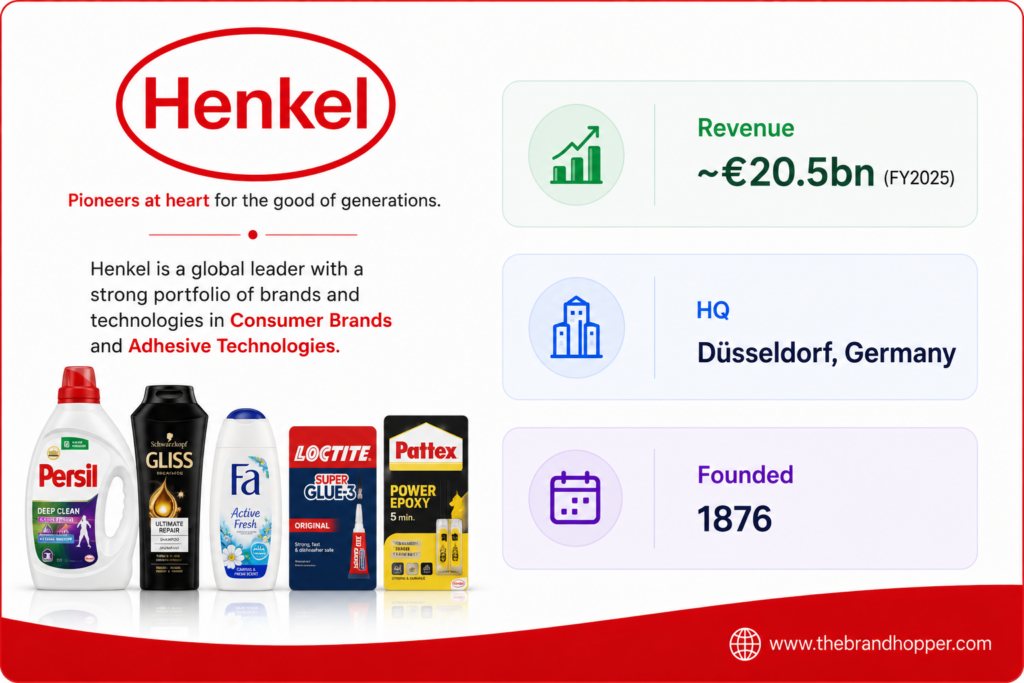
Henkel is a German industrial and consumer goods powerhouse generating approximately €20.5 billion in FY2025 annual revenue, split between its Adhesive Technologies (~57%) and Consumer Brands (~43%) divisions. While its adhesive business serves industrial clients, its consumer segment competes directly with P&G in laundry care, hair care, and personal care — particularly across Europe, North America, and emerging markets.
Persil is Henkel’s flagship laundry brand and one of the most recognized detergent names in Europe, competing head-on with P&G’s Ariel across Germany, UK, and Central/Eastern Europe. Schwarzkopf — spanning retail color, shampoo, styling, and professional care (Schwarzkopf Professional, Syoss) — is among the most significant rivals to P&G’s Pantene and Herbal Essences in the European hair care market. In North America, Henkel’s Dial soap and Right Guard deodorant compete with P&G’s Old Spice and Safeguard.
Henkel has significantly transformed its consumer portfolio through strategic acquisitions and divestitures. It acquired Shiseido’s professional hair care brands (including hair dyes and treatments) and has invested in bio-based cleaning formulations as sustainability becomes a competitive battleground. The company’s “2030+ Ambition” strategy targets doubling revenue with focused innovation in its Power Brands. Henkel’s Bref/WC Fresh toilet care and Bloo compete with P&G’s Febreze bathroom products and Domestos (Unilever) in European lavatory care.
| HEAD-TO-HEAD BATTLE
Category: Laundry Care, Hair Care, Personal Care, Home Care P&G Brands: Ariel, Pantene, Herbal Essences, Old Spice, Febreze, Safeguard Rival Brands: Persil, Schwarzkopf, Syoss, Dial, Right Guard, Bref, Pril, Pritt, Loctite |
8. Beiersdorf AG
Official Website: beiersdorf.com
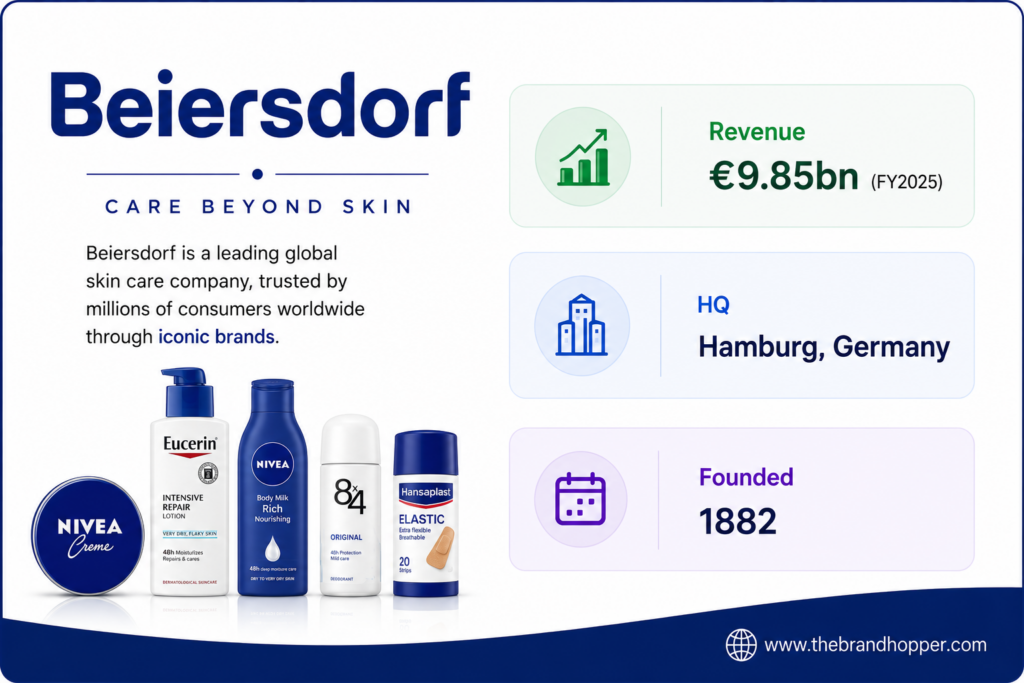
Beiersdorf is a Hamburg-based skincare specialist with €9.85 billion in FY2025 revenue — smaller in scale than P&G but formidably focused through its NIVEA brand, which carries the distinction of being the world’s most trusted skin care brand by consumer preference surveys. The company’s Consumer segment (NIVEA, Eucerin, Coppertone, Labello) competes directly with P&G’s Olay and SK-II in body care, facial moisturizers, sun care, and men’s grooming.
NIVEA’s near-50% unaided brand awareness in skin care globally gives Beiersdorf a recognition advantage that few brands — including P&G’s Olay — can match at the mass-market level. NIVEA body lotions, facial day and night creams, lip care (Labello), and men’s grooming (NIVEA Men) overlap directly with P&G’s Olay, Old Spice, and Gillette Fusion ProGlide skin care lines. Coppertone (acquired 2019 from Bayer) competes with P&G through specialty retail and pharmacy in the sun care category.
Beiersdorf’s dermocosmetic brand Eucerin — the leading dermatological skincare brand in Germany and growing rapidly across Europe and the Americas — competes in the medical beauty segment alongside Kenvue’s Neutrogena and L’Oréal’s La Roche-Posay. Under its “Care Beyond Skin” strategy, Beiersdorf is doubling R&D investment with focus areas including microbiome science, personalized skin care, and sustainable packaging — all areas where it increasingly overlaps with P&G’s premium Olay Regenerist and SK-II innovation roadmaps.
| HEAD-TO-HEAD BATTLE
Category: Skin Care, Body Care, Sun Care, Men’s Grooming, Dermocosmetics P&G Brands: Olay, SK-II, Old Spice, Gillette (skin care lines) Rival Brands: NIVEA, Eucerin, La Prairie, Labello, Coppertone, NIVEA Men, Hansaplast |
9. Haleon
Official Website: haleon.com
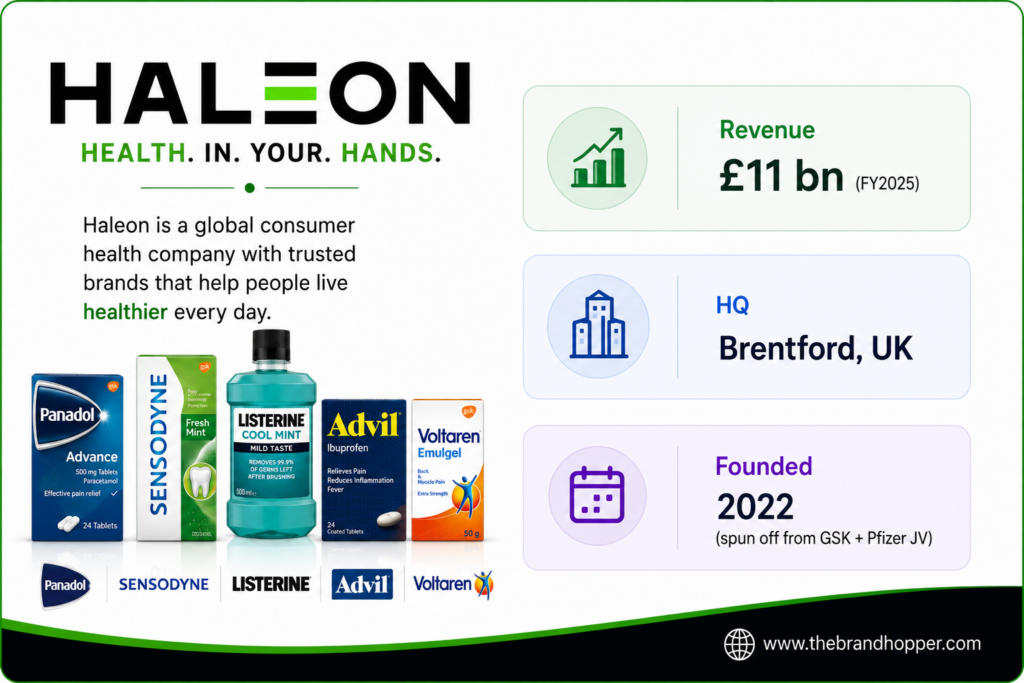
Haleon is the world’s largest dedicated consumer health company, formed in 2022 as an independent public company spun out from a joint venture between GSK and Pfizer. With £11 billion in FY2025 revenue and a portfolio of 24+ power brands spanning oral health, pain relief, respiratory, digestive health, and vitamins — Haleon competes directly with P&G’s health care segment across the medicine cabinet.
The most direct competition is in oral health: Haleon’s Sensodyne — the world’s #1 sensitivity toothpaste — and parodontax gum health toothpaste compete with P&G’s Crest Pro-Health and Oral-B toothpaste across pharmacy and grocery channels worldwide. Advil (ibuprofen) and Panadol (paracetamol) pain relievers compete with P&G’s Vicks pain relief variants, while Centrum vitamins and supplements compete in the wellness category where P&G plays with Metamucil and Align probiotics. Theraflu directly challenges Vicks DayQuil and NyQuil in the cold and flu aisle.
Haleon has articulated a strategy centered on its top 14 power brands and accelerating growth in high-potential markets including India, China, and Brazil. The company’s consumer health credentials — rooted in pharma-grade research from GSK and Pfizer’s consumer divisions — give it clinical trust and efficacy positioning that P&G’s OTC brands must actively work to match in pharmacy channels. Haleon’s Polident (denture care) and Voltaren (topical pain relief) also occupy healthcare sub-categories where P&G has minimal direct presence.
| HEAD-TO-HEAD BATTLE
Category: Oral Health, Pain Relief, Vitamins & Supplements, Respiratory, Digestive Health P&G Brands: Vicks, Pepto-Bismol, Metamucil, Crest, Oral-B Rival Brands: Sensodyne, parodontax, Advil, Centrum, Theraflu, Panadol, Voltaren, Tums, Polident |
10. Nestlé
Official Website: nestle.com
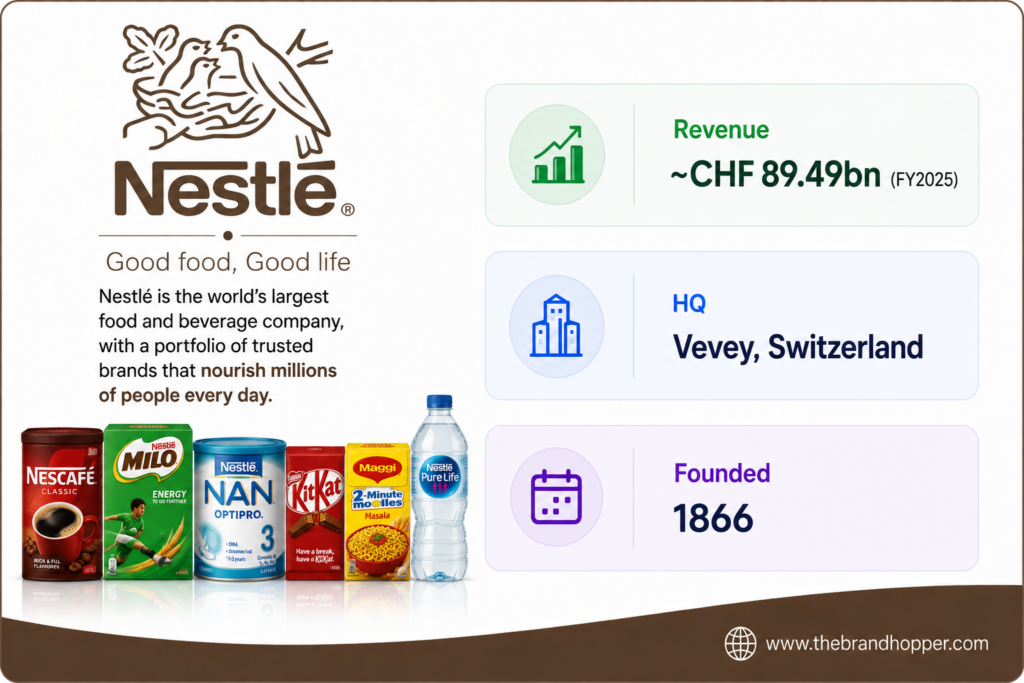
Nestlé is the world’s largest food and beverage company by revenue, with approximately CHF 89 billion in FY2025 annual sales. While its core business in nutrition, beverages, and packaged food differs substantially from P&G’s categories, meaningful competitive overlap exists in baby nutrition, pet care, and consumer wellness — three segments where both companies compete for parental and consumer trust. Nestlé operates in 186 countries with a portfolio that includes Nescafé, KitKat, Maggi, Purina, Gerber, and Nestlé Pure Life.
In baby nutrition, Nestlé’s Gerber purees, cereals, and snacks compete with P&G’s Pampers ecosystem for parental brand loyalty and cross-selling opportunities in the first-1,000-days consumer lifecycle. Nestlé Purina (Pro Plan, Felix, Purina ONE) dominates premium pet care — a category P&G exited with the sale of Iams and Eukanuba to Mars in 2014 — giving Nestlé an unchallenged position in pet nutrition relative to P&G. Nestlé Health Science’s dietary supplement portfolio competes with P&G’s Metamucil in the digestive health segment.
Nestlé’s ongoing portfolio transformation — accelerating in high-protein, gut health, and premium nutrition while exiting slower-growth food businesses — places it increasingly in consumer health territory where P&G also operates. Acquisitions including Vital Proteins, Garden of Life, and Persona Nutrition are building a robust supplement platform that overlaps with P&G’s fiber and digestive health brands. As both companies invest in functional wellness, the boundary between their competitive landscapes is narrowing — particularly in the pharmacy, mass retail, and e-commerce supplement channel.
| HEAD-TO-HEAD BATTLE
Category: Baby Nutrition, Pet Care, Consumer Wellness, Dietary Supplements P&G Brands: Pampers (baby), Metamucil (digestive health) Rival Brands: Gerber, NAN, Nestlé Pure Life, Purina, Felix, Vital Proteins, Garden of Life |
11. The Estée Lauder Companies
Official Website: elcompanies.com
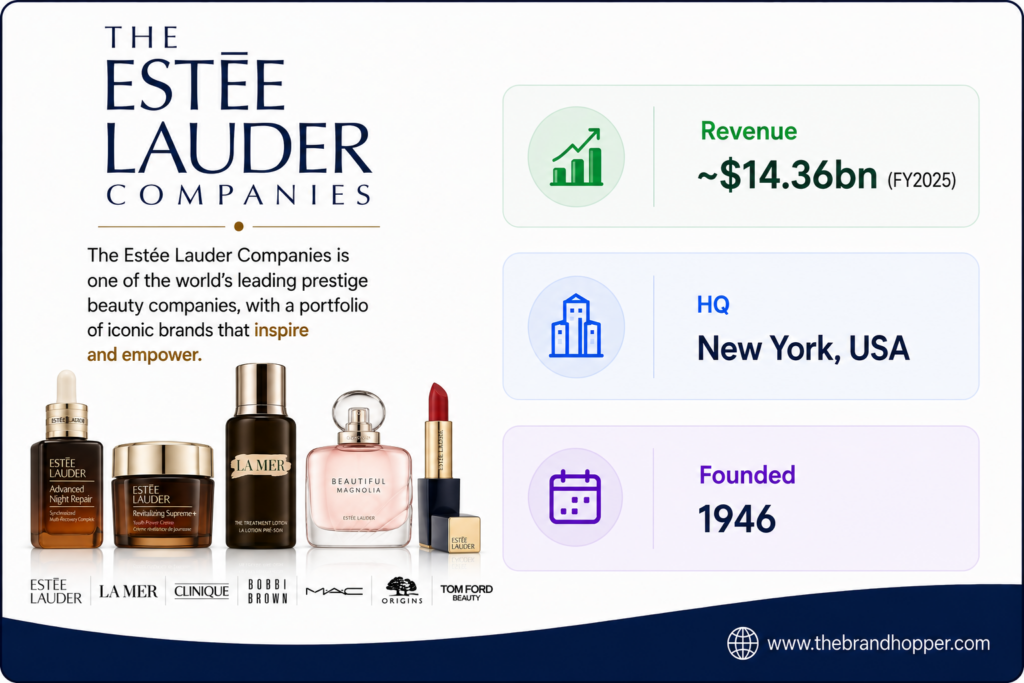
The Estée Lauder Companies is a global leader in prestige beauty, managing 20+ luxury and high-end brands including Estée Lauder, MAC, Clinique, La Mer, Bobbi Brown, and Jo Malone London. With approximately $14.36 billion in FY2025 revenue, the company’s premium positioning makes it a direct competitor to P&G’s SK-II — P&G’s own prestige skin care franchise priced at $80–$900+ per product — as well as to Olay’s clinical efficacy tier.
The competition is sharpest in premium skin care across Asia-Pacific. SK-II’s iconic Facial Treatment Essence competes directly with Estée Lauder’s Advanced Night Repair serum, both targeting anti-aging, brightening, and skin health at premium price points. MAC cosmetics competes with P&G’s premium cosmetics positioning, while Clinique’s dermatologist-tested platform challenges Olay Regenerist’s clinical credibility messaging in department stores and specialty beauty retail.
Estée Lauder’s recent headwinds — significant China market softness and leadership transitions — led to a broad restructuring and cost-saving program targeting $1.1–$1.4 billion in savings. The full acquisition of Tom Ford Beauty in 2023 and continued investment in perfume (Le Labo, Frédéric Malle) anchor its luxury beauty strategy. As K-beauty brands disrupt the prestige market, both Estée Lauder and P&G’s SK-II are doubling down on their Asia-Pacific premium positioning, making the rivalry as much about cultural resonance and dermatological science as it is about brand heritage.
| HEAD-TO-HEAD BATTLE
Category: Prestige Skin Care, Luxury Beauty, Color Cosmetics, Fragrance P&G Brands: SK-II, Olay Regenerist Rival Brands: Estée Lauder, MAC, Clinique, La Mer, Bobbi Brown, Jo Malone, Tom Ford Beauty |
12. Church & Dwight
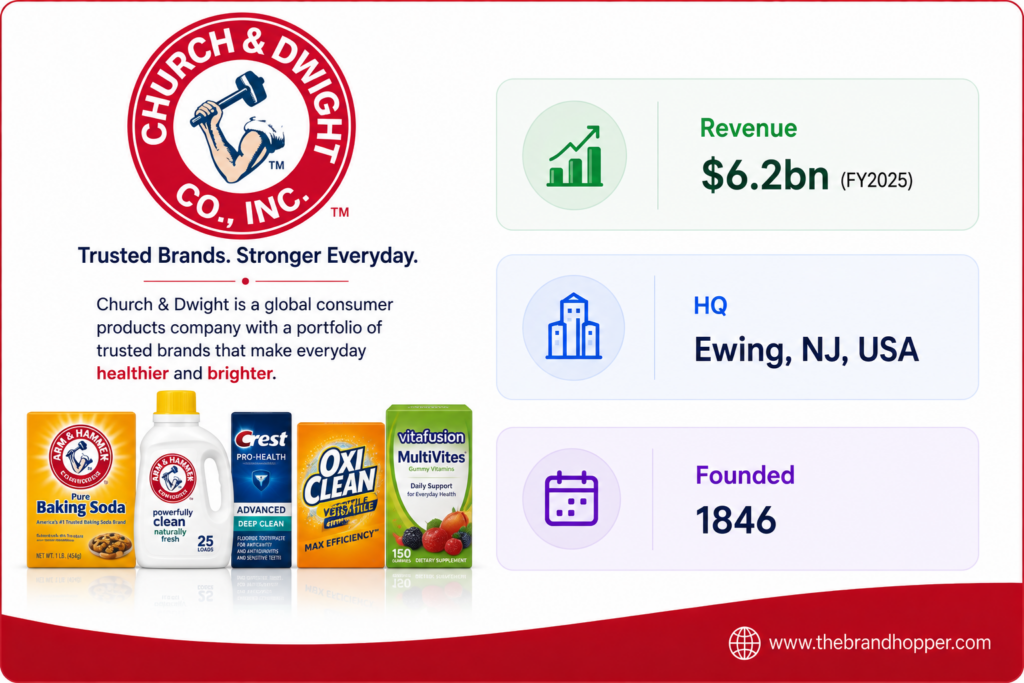
Official Website: churchdwight.com
Church & Dwight is a mid-tier consumer goods specialist with $6.1 billion in FY2024 revenue (as reported in its official FY2024 full-year results), built on a portfolio of high-market-share niche brands rather than broad category coverage. Its Arm & Hammer brand carries an 80-year heritage as a household staple, providing a powerful platform for extension into laundry detergent, toothpaste, deodorizers, cat litter, and baking — all categories where P&G has leading or adjacent brands.
OxiClean is the most pointed competitive threat to P&G in laundry: OxiClean’s Multi-Purpose Stain Remover competes vigorously with Tide Plus OXI and Ariel Oxy in laundry boosters and pre-treaters, while OxiClean’s standalone detergent line challenges Tide’s core franchise on value and stain-fighting credentials. Waterpik — the leading water flosser brand — competes with P&G’s Oral-B water flosser and electric toothbrush lineup in the premium oral care appliance category. Vitafusion gummy vitamins compete with supplement brands in drug channels where P&G’s Metamucil and Align are also present.
Church & Dwight’s acquisition strategy has been consistently shrewd — adding Batiste dry shampoo (now the US dry shampoo category leader, directly challenging P&G’s Pantene and Herbal Essences dry shampoo lines) and TheraBreath (premium breath care). The company earlier acquired Spinbrush (originally a P&G brand, divested in 2009). Its consistent mid-single-digit organic growth track record and disciplined bolt-on acquisition model have made it an increasingly formidable mid-tier competitor that punches well above its revenue weight in shelf negotiation and category share.
| HEAD-TO-HEAD BATTLE
Category: Laundry, Oral Care, Personal Care, Vitamins & Supplements P&G Brands: Tide, Ariel, Oral-B, Pantene, Herbal Essences, Metamucil Rival Brands: OxiClean, Arm & Hammer, Waterpik, Batiste, Vitafusion, TheraBreath, Spinbrush |
13. Kao Corporation
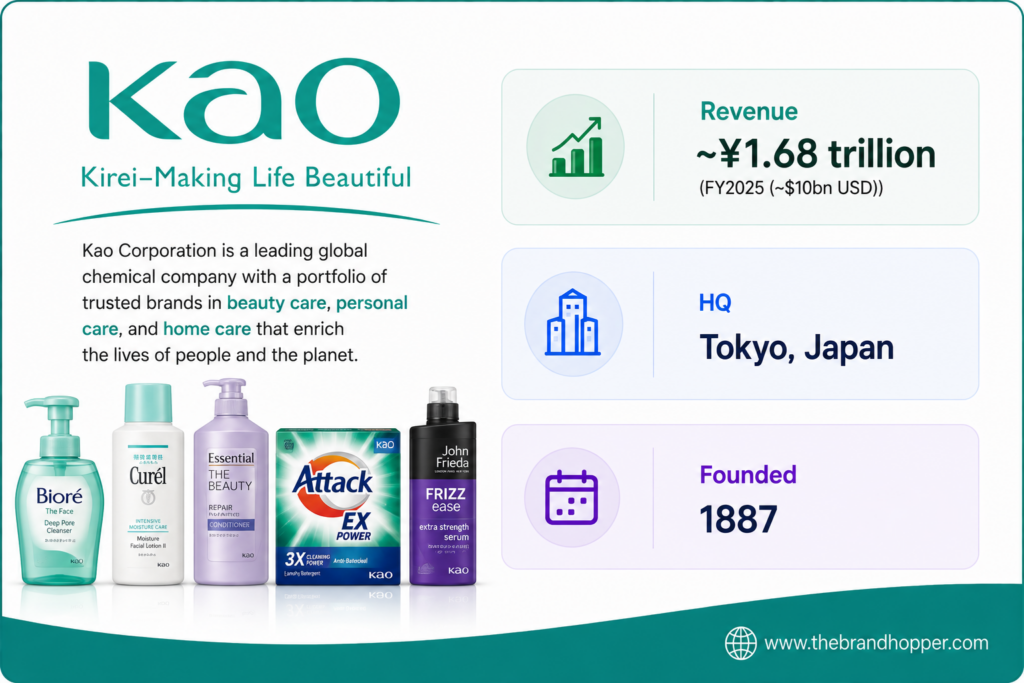
Official Website: kao.com
Kao Corporation is Japan’s leading consumer goods company, with approximately ¥1.49 trillion (~$10 billion USD) in FY2024 revenue and a strong competitive presence across personal care, fabric care, and professional beauty throughout Asia-Pacific and globally. Its portfolio includes Attack and Attack Zero (laundry), Merit and Essential (hair care), Bioré (skin care and sun care), Jergens (body lotions), Curél (sensitive skin care), Goldwell (professional hair color), and KMS (professional styling).
In Japan and Southeast Asia, Kao’s Attack and Attack Zero laundry detergents — formulated specifically for front-loading washing machines and cool-water effectiveness — compete directly with P&G’s Ariel and Bold in Japanese retail. Bioré’s UV sunscreen and deep cleansing lines are among Asia’s best-selling skin care products, competing with P&G’s Olay and SK-II for shelf share across drug stores, convenience stores, and e-commerce platforms. Jergens body lotions and Curél sensitive skin care compete internationally with Olay body care and Beiersdorf’s NIVEA.
Kao invested heavily in sustainability under its ESG 2030 strategy — targeting carbon neutrality and using bio-based surfactants in its laundry formulations. Through Goldwell and KMS (professional salon brands), Kao also competes in the global professional hair care market alongside Schwarzkopf (Henkel), Redken (L’Oréal), and Wella (Coty) — brands P&G once owned but divested. Kao’s deep integration with Japanese pharmacy and convenience retail channels gives it structural distribution advantages that P&G must contend with across the Asia-Pacific region’s fastest-growing consumer markets.
| HEAD-TO-HEAD BATTLE
Category: Laundry Care, Skin Care, Hair Care, Professional Beauty P&G Brands: Ariel, Olay, SK-II, Pantene, Herbal Essences Rival Brands: Attack, Attack Zero, Bioré, Jergens, Merit, Curél, Goldwell, KMS |
14. SC Johnson
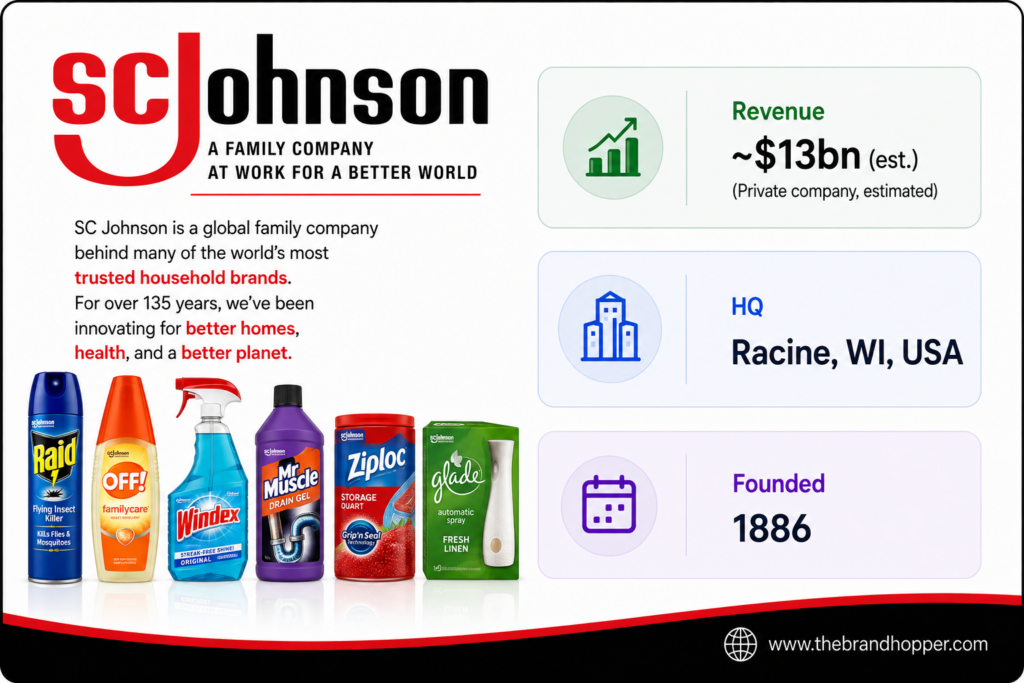
Official Website: scjohnson.com
SC Johnson is one of the world’s largest privately held consumer goods companies, with estimated annual revenue of approximately $13 billion across household cleaning, pest control, and home storage categories. Founded in 1886 and family-owned for five generations by the Johnson family of Racine, Wisconsin, the company manages iconic brands including Pledge, Windex, Scrubbing Bubbles, Drano, Raid, OFF!, Ziploc, Saran, Glade, and Method — many of which compete directly with P&G’s home care portfolio.
SC Johnson’s Glade air fresheners and home fragrance products compete directly with P&G’s Febreze — one of the most successful P&G brands of the past two decades — in the home fragrance and odor elimination category. Pledge surface care products and Windex glass cleaner compete with Mr. Clean’s multi-surface spray variants, while Scrubbing Bubbles bathroom cleaner competes with Mr. Clean’s bathroom range. Raid and OFF! pest control products occupy a category where P&G has minimal direct presence, representing a key area of differentiation.
SC Johnson’s private ownership provides strategic flexibility: without quarterly earnings pressure, it can invest in long-cycle innovation and purpose-driven initiatives like its Forest Positive and Net-Zero Carbon programs without shareholder scrutiny — a distinct advantage over P&G, which must balance shareholder returns with long-term investments. Method (SC Johnson brand acquired in 2017) targets the growing premium eco-friendly home cleaning segment with plant-based, design-forward formulations, competing with P&G’s Dawn EZ-Squeeze and Microban+ for eco-conscious consumers in natural and specialty retail channels.
| HEAD-TO-HEAD BATTLE
Category: Home Fragrance, Surface Care, Pest Control, Home Storage P&G Brands: Febreze, Mr. Clean, Dawn, Microban, Cascade Rival Brands: Glade, Pledge, Windex, Scrubbing Bubbles, Raid, OFF!, Ziploc, Method |
15. Edgewell Personal Care
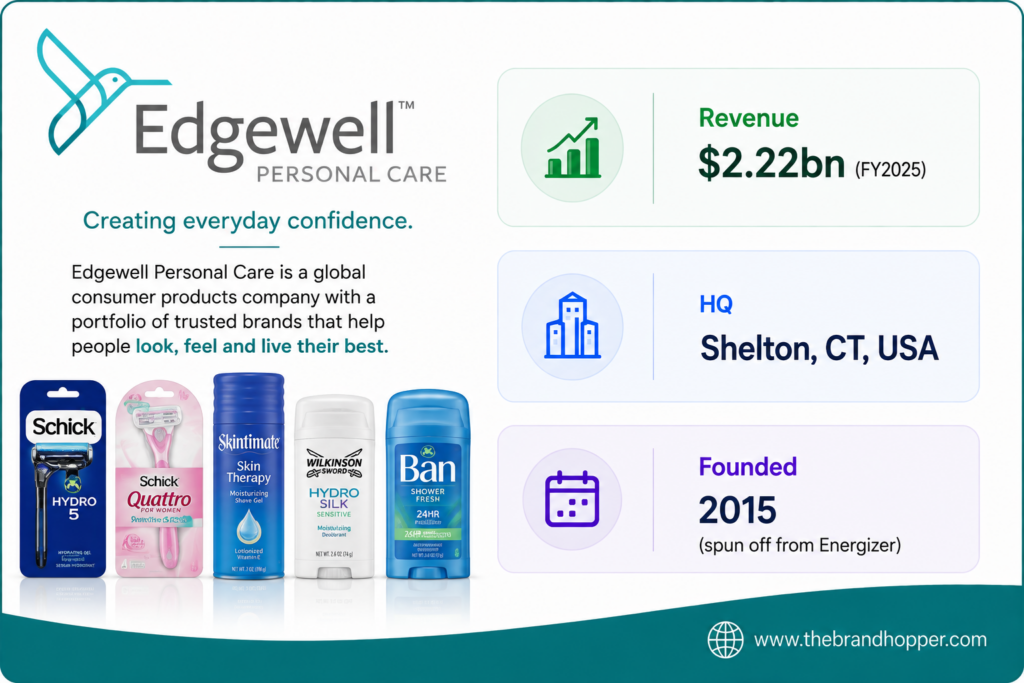
Official Website: edgewell.com
Edgewell Personal Care is a specialized personal care company with $2.25 billion in FY2024 revenue (as reported in its official FY2024 full-year results), created in 2015 as a spinoff from Energizer Holdings. While smaller in scale than P&G, Edgewell is highly focused in its competitive scope: its Schick and Wilkinson Sword brands make it P&G’s most direct challenger to the Gillette razor franchise — one of P&G’s highest-margin and highest-profile businesses.
Schick Hydro and Schick Quattro compete head-on with Gillette Mach3 and Gillette Fusion series across mass-market retail and subscription channels globally. Edgewell’s women’s shaving portfolio — Schick Intuition, Schick Hydro Silk, and Wilkinson Sword Quattro — competes with P&G’s Gillette Venus for dominance of the women’s wet shaving category. In feminine care, Edgewell’s Carefree (panty liners), Stayfree (sanitary pads), Playtex (tampons), and o.b. (tampons) brands directly compete with P&G’s Always and Tampax — the two leading feminine hygiene brands globally.
Edgewell has strategically acquired premium men’s grooming brands Bulldog Skincare and Jack Black, and added Cremo men’s grooming products, to compete with Gillette and Old Spice in the fast-growing premium men’s grooming space. The company’s 2019 attempt to acquire DTC shaving brand Harry’s for $1.37 billion was blocked by the FTC in 2020 on antitrust grounds — a rejection that would have created a stronger challenger to P&G’s Gillette. Despite that setback, Edgewell has continued gaining category share through value-tier positioning, innovation, and direct-to-consumer subscription models that compete with Gillette’s own shave club.
| HEAD-TO-HEAD BATTLE
Category: Men’s & Women’s Shaving, Feminine Care, Men’s Grooming P&G Brands: Gillette, Gillette Venus, Always, Tampax, Old Spice Rival Brands: Schick, Wilkinson Sword, Carefree, Stayfree, Playtex, o.b., Bulldog, Jack Black, Cremo |
16. Coty Inc.
Official Website: coty.com
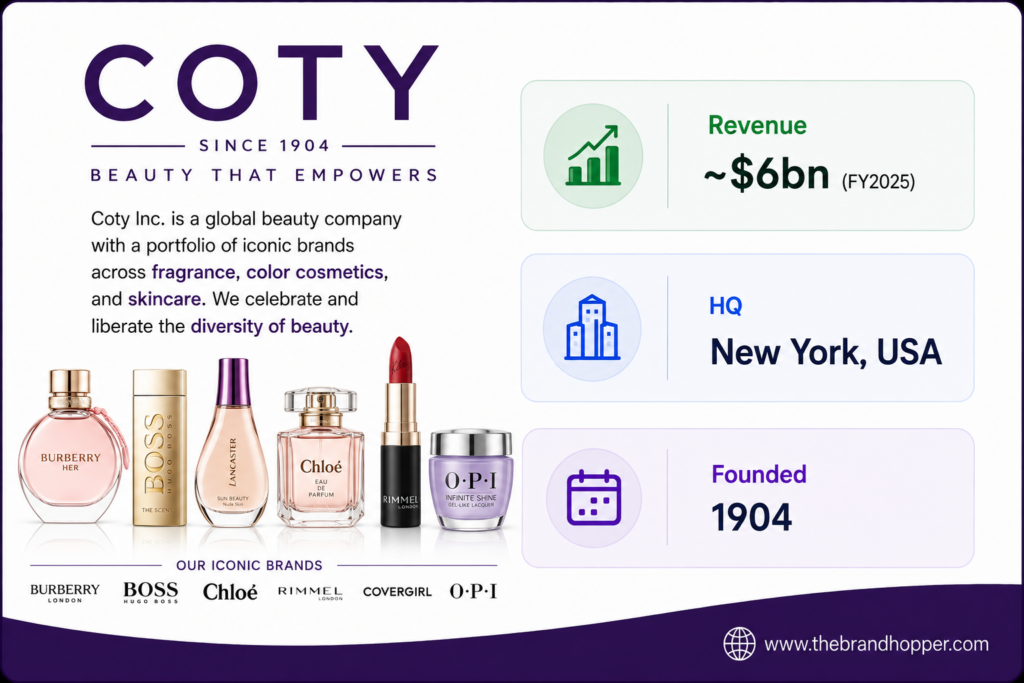
Coty Inc. occupies a unique competitive position against P&G: it is simultaneously a rival and a successor — having acquired several beauty brands directly from P&G. Coty acquired CoverGirl and Clairol from P&G in 2016 for $12.5 billion, and subsequently acquired a controlling 60.1% stake in Wella Professional (now approximately 50.1%) in a deal completed in 2020. With approximately $6 billion in annual revenue from prestige fragrance, mass color cosmetics, and professional hair care in 130+ countries, Coty is a distinctive competitor with deep ties to P&G’s own brand history.
In mass-market cosmetics, CoverGirl (now Coty) competes across drugstore and mass-market channels in the foundation, mascara, and lip color categories. Clairol home hair color competes with L’Oréal Garnier Nutrisse and Revlon in the at-home color market. Coty’s prestige fragrance portfolio — including Calvin Klein, Hugo Boss, Gucci, Burberry, Kylie Jenner, and Marc Jacobs fragrances (licensed) — competes in department stores and specialty fragrance retail. Coty’s mass fragrance brands (Adidas, David Beckham) target the same accessible-luxury consumer where P&G’s Old Spice and Safeguard operate in personal care.
Wella Professional — in which Coty holds a controlling stake — is one of the world’s most recognized professional salon brands alongside Schwarzkopf (Henkel), Redken (L’Oréal), and Goldwell (Kao). P&G had owned Wella since 2003 before divesting it as part of its broader beauty portfolio divestiture program in 2020. Coty’s ongoing ‘Transform for Growth’ turnaround strategy, led by CEO Sue Nabi, aims to premiumize its portfolio, accelerate e-commerce, and stabilize the brands acquired from P&G — creating a competitor who now directly uses P&G’s legacy brands to compete in categories P&G itself chose to exit.
| HEAD-TO-HEAD BATTLE
Category: Color Cosmetics, Hair Color, Professional Hair Care, Prestige Fragrance P&G Brands: Olay (ongoing), Old Spice (P&G retained) Rival Brands: CoverGirl, Clairol, Wella Professional, Calvin Klein (fragrance), Hugo Boss (fragrance), OPI |
17. Godrej Consumer Products
Official Website: godrejconsumerproducts.com
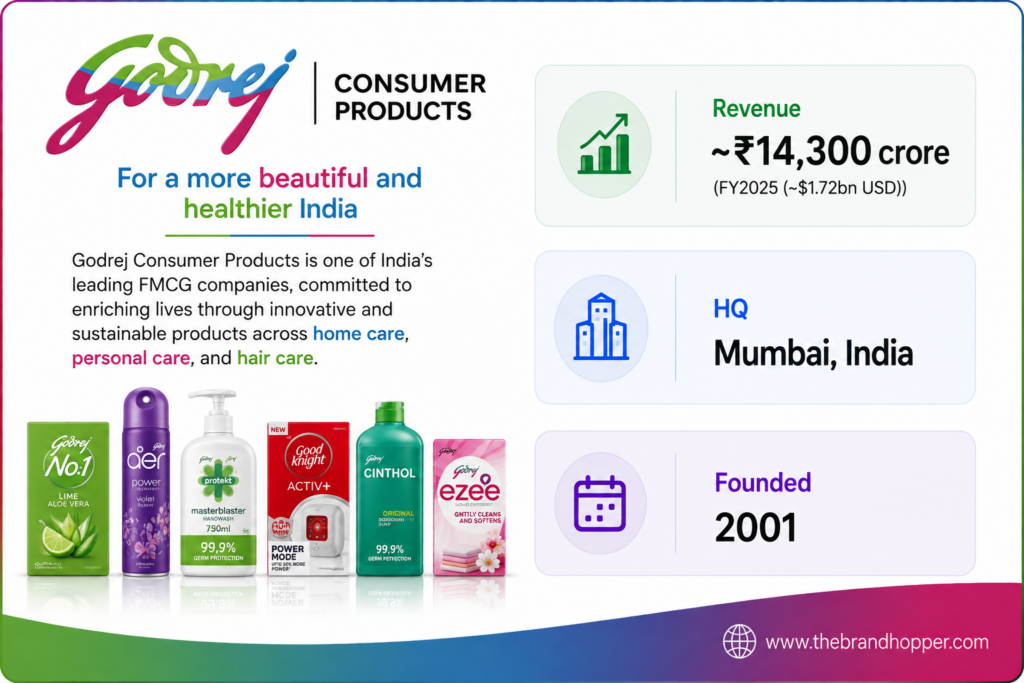
Godrej Consumer Products (GCPL) is one of India’s most prominent consumer goods companies and a leading challenger to P&G in South Asia, Africa, and Latin America. With approximately ₹14,600 crore (~$1.75 billion USD) in FY2024 revenue, GCPL manages a portfolio spanning household insecticides, home care, hair care, and personal wash — overlapping directly with P&G’s presence across India’s mass-market and mid-tier consumer segments.
GCPL’s Good Knight and HIT brands dominate India’s household insecticide category with a combined ~50% market share — a segment where P&G has no direct presence, representing a key defensive moat. Godrej No.1 soap competes with P&G’s Safeguard and Camay in the mass-market personal wash category across India, Indonesia, and Africa. In hair care, GCPL’s Expert Rich Crème hair color competes with L’Oréal Garnier and other mass-market brands for the rapidly growing Indian at-home hair color segment. Its Cinthol brand in soaps and deodorants competes with P&G’s Old Spice in the men’s personal care category.
GCPL has pursued aggressive geographic diversification, acquiring businesses across Indonesia (Megasari), Africa (Darling Group, Kinky, Frika), and Argentina — building a multi-geography emerging-economy competitive profile. The company’s distribution footprint spans 7+ million retail outlets in India (including kirana stores), giving it structural penetration advantages in general trade channels where P&G competes through its ‘Shikhar’ distributor and ‘e-B2B’ digital platforms. GCPL’s ‘3×3’ strategy (3 categories × 3 geographies) is a direct acknowledgment of where it intends to confront P&G-scale rivals in the next decade.
| HEAD-TO-HEAD BATTLE
Category: Home Care, Household Insecticides, Personal Wash, Hair Care P&G Brands: Safeguard, Old Spice, Ariel, Tide, Vicks Rival Brands: Good Knight, HIT, Godrej No.1, Cinthol, Expert Rich Crème, Protekt |
18. Prestige Consumer Healthcare
Official Website: prestigeconsumerhealthcare.com
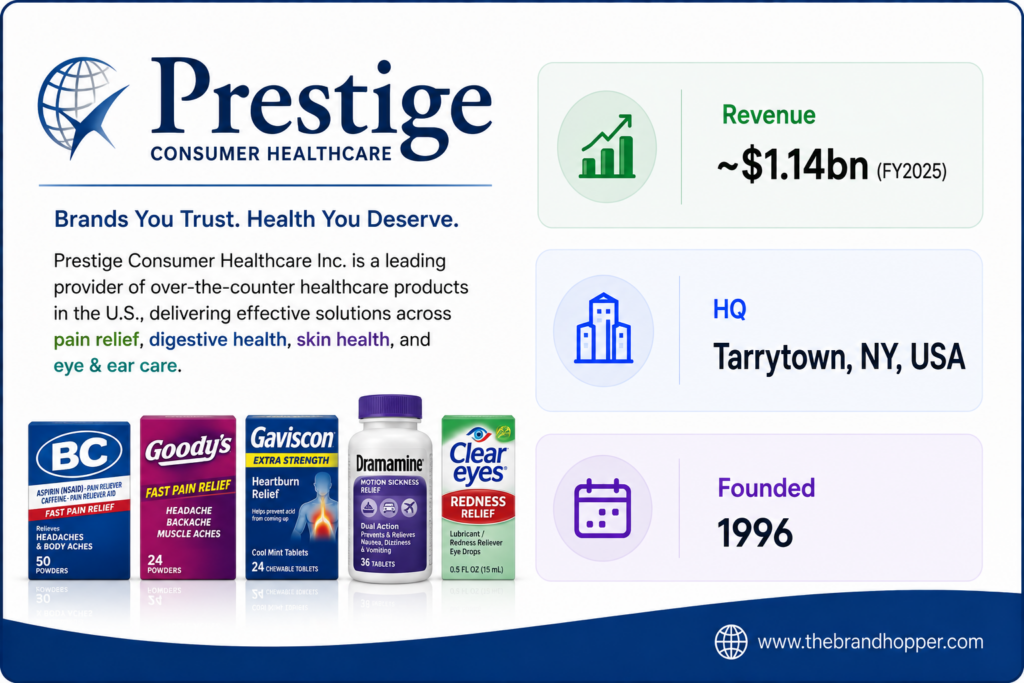
Prestige Consumer Healthcare is a specialized OTC (over-the-counter) healthcare company focused exclusively on consumer self-care brands in North America. With approximately $1.07 billion in revenue for its FY2024 (fiscal year ended March 31, 2024), Prestige manages 40+ OTC brands across eye care (Clear Eyes), women’s health (Monistat), cold and pain relief (Chloraseptic, BC Powder, Goody’s), ear care (Debrox), and antacids (Gaviscon in the US) — competing directly with P&G’s OTC health portfolio on pharmacy shelves.
Clear Eyes eyedrops is the #1 OTC eye redness reliever brand in the US, competing for pharmacy shelf space adjacent to P&G’s Vicks brand ecosystem. Monistat antifungal treatment is the category leader in women’s OTC health — a segment where P&G has no direct branded presence. Chloraseptic sore throat sprays and lozenges directly compete with Vicks throat care; BC Powder and Goody’s fast-dissolving headache powders compete with P&G’s analgesic adjacencies and Pepto-Bismol in the southern US market, where powdered analgesics have regional brand loyalty.
Prestige’s strength lies in managing established, niche OTC brands with high consumer loyalty and relatively low advertising intensity — a lean model that generates strong cash flow margins even at modest revenue scale. As P&G continues to focus its health care portfolio around its highest-volume brands, niche OTC specialists like Prestige are positioned to capture share in the highly fragmented self-care market. The broader OTC healthcare space is expected to benefit from increasing prescription-to-OTC drug switches in the US and globally, creating new growth opportunities in categories where both Prestige and P&G seek to plant flags.
| HEAD-TO-HEAD BATTLE
Category: OTC Eye Care, Women’s Health, Cold & Pain Relief, Antacids P&G Brands: Vicks, Pepto-Bismol, Metamucil, Align Rival Brands: Clear Eyes, Monistat, Chloraseptic, BC Powder, Goody’s, Debrox, Gaviscon (US) |
Conclusion: Navigating the P&G Competitive Landscape
P&G’s competitive landscape is one of the most complex in global business — spanning 180+ countries, five distinct operating segments, and rivals ranging from trillion-dollar multinationals (Nestlé, Unilever) to focused niche challengers (Edgewell, Prestige Consumer Healthcare). No single competitor matches P&G across its full portfolio breadth, but each of the 18 companies profiled here presents a meaningful threat in one or more categories where P&G generates significant revenue.
P&G has responded to intensifying competition through a focused portfolio strategy — divesting non-core brands since 2014 to concentrate resources on its highest-return businesses — combined with data-driven marketing that maximizes media effectiveness, and sustained R&D investment exceeding $1.9 billion annually. Its pricing power in premium segments, distribution scale in both modern trade and e-commerce, and brand equity built across generations remain formidable competitive advantages.
For brand managers, investors, and students of competitive strategy, the key insight is this: P&G does not face a single existential rival, but rather a multi-front competitive war across every category, geography, and price tier. Understanding the specific strengths of each rival — and the specific P&G brands they threaten most — is essential for projecting where P&G’s market share will be gained or defended in the years ahead.
For a deeper look at how P&G activates its brand portfolio, read the case study on P&G’s iconic ‘Thank You, Mom’ campaign — one of the most celebrated purpose-led marketing campaigns in consumer goods history.
Frequently Asked Questions (FAQs)
Q: Who is P&G’s biggest competitor?
A: Unilever is widely considered P&G’s biggest and most direct global competitor. With approximately €59.5 billion in annual revenue, 400+ brands across 190+ countries, and a category footprint that nearly mirrors P&G’s own, Unilever matches P&G in personal care, home care, and beauty across both developed and emerging markets. However, Colgate-Palmolive is P&G’s closest rival specifically in oral care, while Kimberly-Clark poses the fiercest competition in baby and family care.
Q. What is P&G’s annual revenue and which is its most profitable segment?
A: P&G reported net sales of $84.0 billion for FY2024, with net earnings of $14.9 billion and core EPS of $6.59. Its most profitable segment by absolute earnings is Fabric & Home Care (including Tide, Ariel, Febreze, and Cascade), which generates the highest revenue of its five divisions. Baby, Feminine & Family Care (Pampers, Always, Tampax) and Health Care (Oral-B, Vicks, Metamucil) are also high-margin contributors.
Q. Does Colgate-Palmolive compete with P&G beyond toothpaste?
A: Yes — while Colgate-Palmolive’s core rivalry with P&G is in oral care (Colgate vs. Crest and Oral-B), competition extends to home care (Palmolive dish soap vs. P&G’s Dawn/Fairy), personal wash (Softsoap and Irish Spring vs. Old Spice and Safeguard), and personal care. Colgate has also moved into skin health (EltaMD, Filorga acquisitions) and pet nutrition (Hill’s Science Diet), encroaching on P&G-adjacent territories. Latin America is the most intense multi-category battleground between the two companies.
Q. How does Kimberly-Clark’s Huggies compare to Pampers globally?
A: Pampers and Huggies together hold over 70% of the global diaper market, making it one of the most concentrated two-brand rivalries in consumer goods. Pampers maintains a general global market share lead and is especially strong in Europe and Latin America. Huggies typically leads in specific markets such as Australia and certain US segments, and has gained ground through innovation in plant-based materials (Huggies Special Delivery) and premium baby wipes. Both brands compete fiercely on absorption technology, fit, sustainability credentials, and digital parent community building.
Q. Why is Coty considered both a competitor and a successor to P&G?
A: Coty acquired CoverGirl and Clairol from P&G in 2016 for $12.5 billion, and later acquired a controlling stake in Wella Professional from P&G in 2020 — making it the only company that directly competes with P&G using brands originally built, scaled, and sold by P&G. This creates a unique dynamic where Coty manages P&G’s former beauty legacy while simultaneously competing against P&G’s retained brands (Olay, SK-II, Pantene) in beauty and personal care categories.
Q. What categories has P&G exited that its competitors still actively operate in?
A: P&G has strategically divested numerous categories over the past decade. Key exits include: food and beverages (Pringles sold to Kellogg’s in 2012, Folgers sold to Smucker’s in 2008); pet care (Iams and Eukanuba sold to Mars in 2014); mass beauty brands (CoverGirl and Clairol sold to Coty in 2016); professional hair care (Wella Professional sold to Coty in 2020); and battery brands (Duracell sold to Berkshire Hathaway in 2016). P&G also has no branded OTC analgesics (like Tylenol), no adult incontinence product (Depend is Kimberly-Clark’s), and no pet food.
Q. How are P&G and its competitors competing on sustainability?
A: Sustainability has become a strategic battleground. P&G’s Ambition 2030 targets 100% renewable electricity globally, recyclable or reusable packaging for all products, and a 50% reduction in manufacturing greenhouse gas emissions. Unilever’s Compass strategy targets net-zero emissions by 2039. Henkel and Beiersdorf lead in bio-based and biodegradable formulations across Europe. SC Johnson’s Forest Positive initiative focuses on responsible sourcing. Consumers — especially Millennials and Gen Z — increasingly factor environmental credentials into brand choice, making sustainability investment a core competitive requirement rather than a differentiator.
Q. Who are P&G’s biggest competitors in emerging markets?
A: In India, Hindustan Unilever (HUL) — Unilever’s listed Indian subsidiary — and Godrej Consumer Products are dominant forces across personal care, home care, and hair care. In China, local brands including Liby Group (laundry) and Chicmax (skin care) are growing challengers. In Latin America, Natura & Co, Yanbal, and Belcorp compete in personal care. In Africa, Reckitt (Dettol, Harpic), Unilever (Vaseline, Lifebuoy), and Godrej Consumer Products (Good Knight, HIT) are the primary rivals. Emerging market competition is also intensifying through e-commerce platforms and private-label brands in modern trade.
Also Read: Marketing Strategies and Marketing Mix of P&G
Also Read: Understanding the Brand Architecture of Proctor & Gamble (P&G)
Also Read: A Case Study on “P&G: Thank You, Mom” Brand Campaign
To read more content like this, subscribe to our newsletter