Last Updated on July 30, 2026 by Team TBH
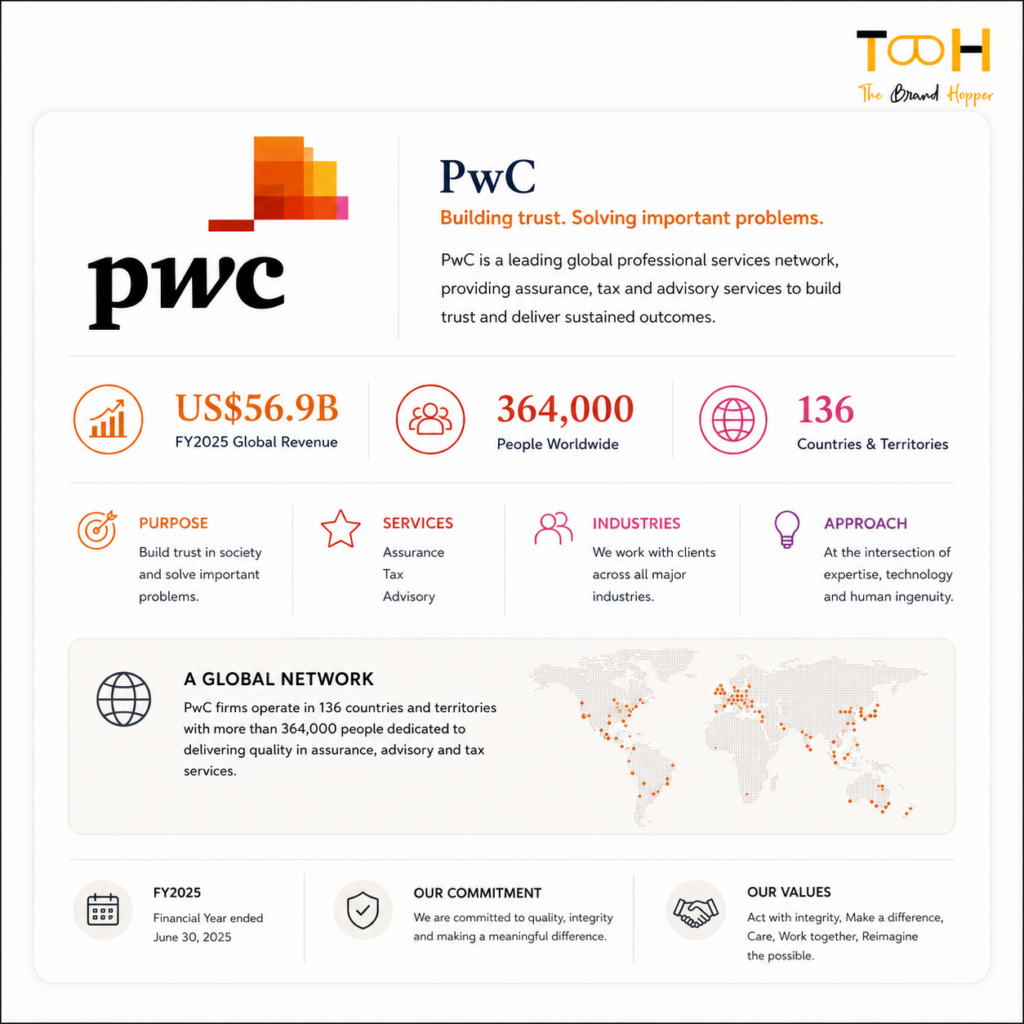
PricewaterhouseCoopers — universally known as PwC — is one of the world’s most respected professional services networks. Spanning 136 countries, serving clients in virtually every industry and sector, and generating revenues of US$56.9 billion in its most recent fiscal year, PwC occupies a singular position at the intersection of audit, advisory, tax, and technology services. Understanding PwC means understanding how complex global organisations navigate change, manage risk, and unlock growth in an era of relentless disruption.
This article provides an in-depth look at PwC’s history, its core business units, financial performance, governance practices, strategic direction, and its growing role as a global thought leader. Whether you are a business professional evaluating a Big Four relationship, a student researching the professional services landscape, or simply curious about how one of the world’s largest partnerships operates, this guide covers everything you need to know.
The History of PwC: From Humble Beginnings to a Global Leader
Few organisations can trace a lineage as long or as distinguished as PwC. The firm’s roots stretch back to Victorian Britain, when the foundational concepts of professional accountancy were still being codified, and what began as two separate accounting practices has evolved over more than 170 years into one of the largest and most influential professional services networks on earth.
Origins of Price Waterhouse and Coopers & Lybrand
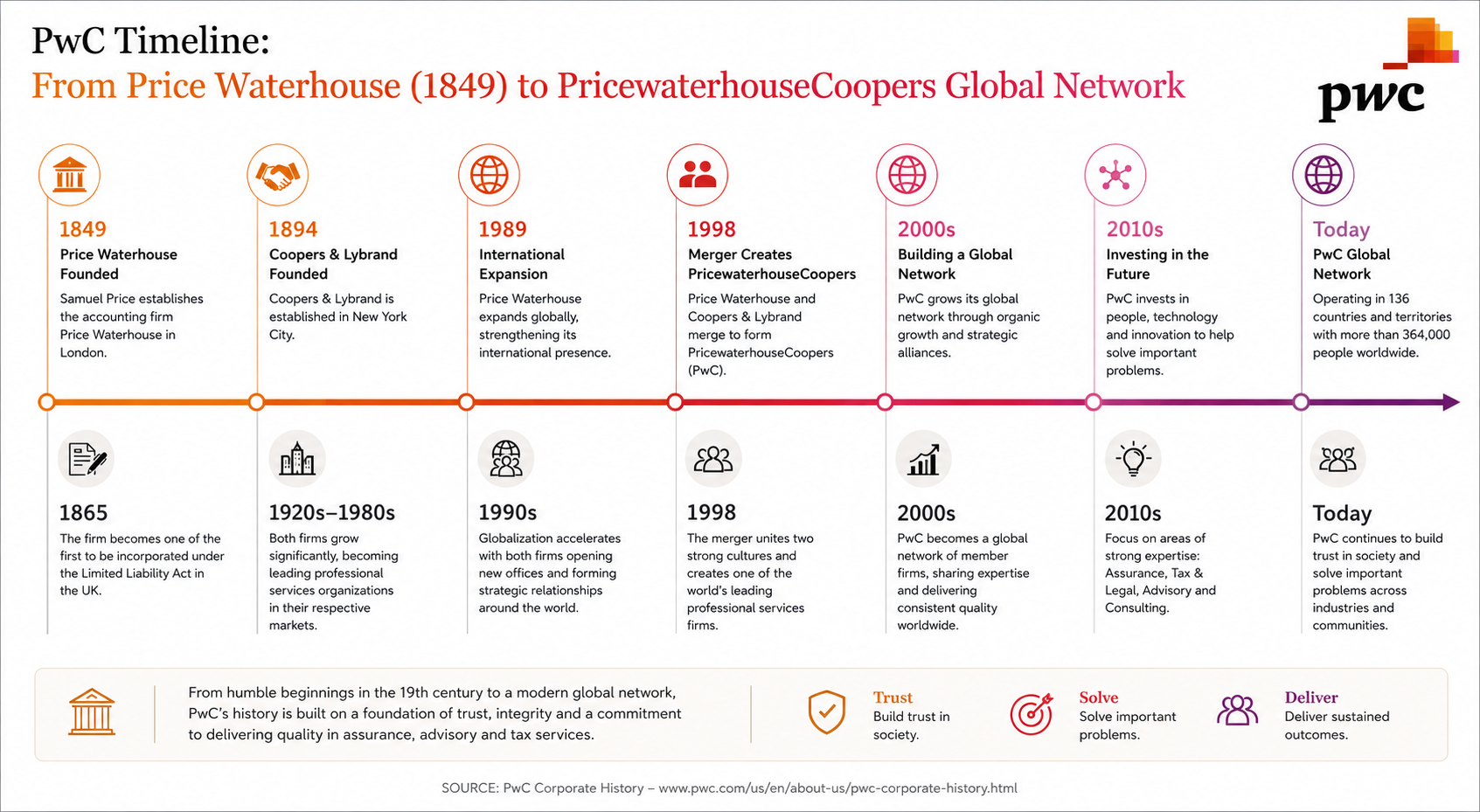
The story begins in 1849, when Price Waterhouse was founded in London by Samuel Lowell Price, later joined by William Hopkins Holyland and Edwin Waterhouse. From the outset, the firm established a reputation for rigorous audit standards and ethical practice, qualities that would define it for generations. Price Waterhouse opened its first US office in 1890, recognising the growing importance of American capital markets.
The other branch of PwC’s genealogy flows through Coopers & Lybrand, formed in 1957 through the union of three founding partners: Cooper Brothers & Co. (UK), McDonald, Currie and Co. (Canada), and Lybrand, Ross Bros & Montgomery (US). Lybrand itself was established as early as 1854. Together, these firms built a trans-Atlantic practice with deep roots in manufacturing, financial services, and government.
The 1998 Merger: Creating PricewaterhouseCoopers
The world of professional services changed dramatically on 1 July 1998 when Price Waterhouse and Coopers & Lybrand formally merged to create PricewaterhouseCoopers. At the time, it was one of the largest professional services mergers in history, combining the resources of two globally respected firms and instantly creating a network of extraordinary scale. The combined entity brought together tens of thousands of professionals across more than 150 countries, with combined revenues that established it as the largest professional services firm in the world by headcount and revenue.
The rationale was straightforward: the complexity of global business, the rise of multinational corporations, and the accelerating pace of regulatory change demanded a firm capable of serving clients wherever they operated, in whatever domain they faced challenges. The merger enabled exactly that — a truly integrated global network.
Rebranding and the Modern Era
In 2010, the firm adopted the abbreviated brand name “PwC” to reflect the modern, dynamic character of its services and global reach. The rebrand was more than a name change — it signalled a strategic evolution from a traditional accounting firm to a diversified professional services powerhouse embracing technology, digital transformation, and advisory services alongside its heritage in audit and tax.
Over the following decade, PwC continued to invest heavily in capabilities: acquiring specialist consultancies, building out digital and data practices, launching alliances with major technology providers, and expanding its presence in emerging markets. Today, PwC is synonymous with the Big Four — the quartet of global professional services firms that, alongside Deloitte, EY, and KPMG, audit the vast majority of the world’s largest publicly listed companies.
PwC’s Global Footprint and Financial Performance
PwC operates as a network of member firms, each independently owned and managed in its jurisdiction, but collectively bound by shared standards, methodologies, and the PwC brand. This structure allows the network to maintain both global consistency and local relevance — a critical combination when serving multinational clients with complex cross-border needs.
FY2025 Revenue Performance
For the 12 months ending 30 June 2025, PwC member firms reported global gross revenues of US$56.9 billion, representing growth of 2.7% in local currency terms (2.9% in US dollar terms). This result followed revenues of US$55.4 billion in FY2024 (+3.7% local currency). All three major service lines contributed to the growth.
| Service Line | FY2025 Revenue | Growth (USD) |
| Advisory | US$24.3 billion | +4.5% |
| Assurance | US$19.8 billion | +1.7% |
| Tax & Legal Services | US$12.7 billion | +1.0% |
| Total | US$56.9 billion | +2.9% |
Source: PwC Global Revenues Press Release, FY2025 (year ended 30 June 2025), pwc.com
Advisory remains the largest service line by revenue, reflecting strong demand for consulting, digital transformation, and business reinvention services. Assurance, anchored by financial statement audit, continues to generate significant revenue while undergoing modernisation through technology. Tax & Legal Services rounds out the portfolio, benefiting from increased complexity in global tax regulations, including OECD Pillar Two reforms and expanding sustainability reporting requirements.
People and Presence
As of FY2025, PwC employs approximately 364,000 people across 136 countries and territories. The network serves clients ranging from some of the largest multinational corporations to governments, not-for-profit organisations, and private mid-market businesses. This breadth of client base, combined with deep sector specialisation, underpins PwC’s enduring relevance and competitive position.
PwC’s investment in its people and capabilities remains a defining characteristic. In FY2025 alone, the network invested US$1.5 billion to scale its artificial intelligence capabilities — part of a broader multi-year commitment to building digital, data, and technology skills across the workforce.
PwC’s Business Units: A Deep Dive into Each Service Line
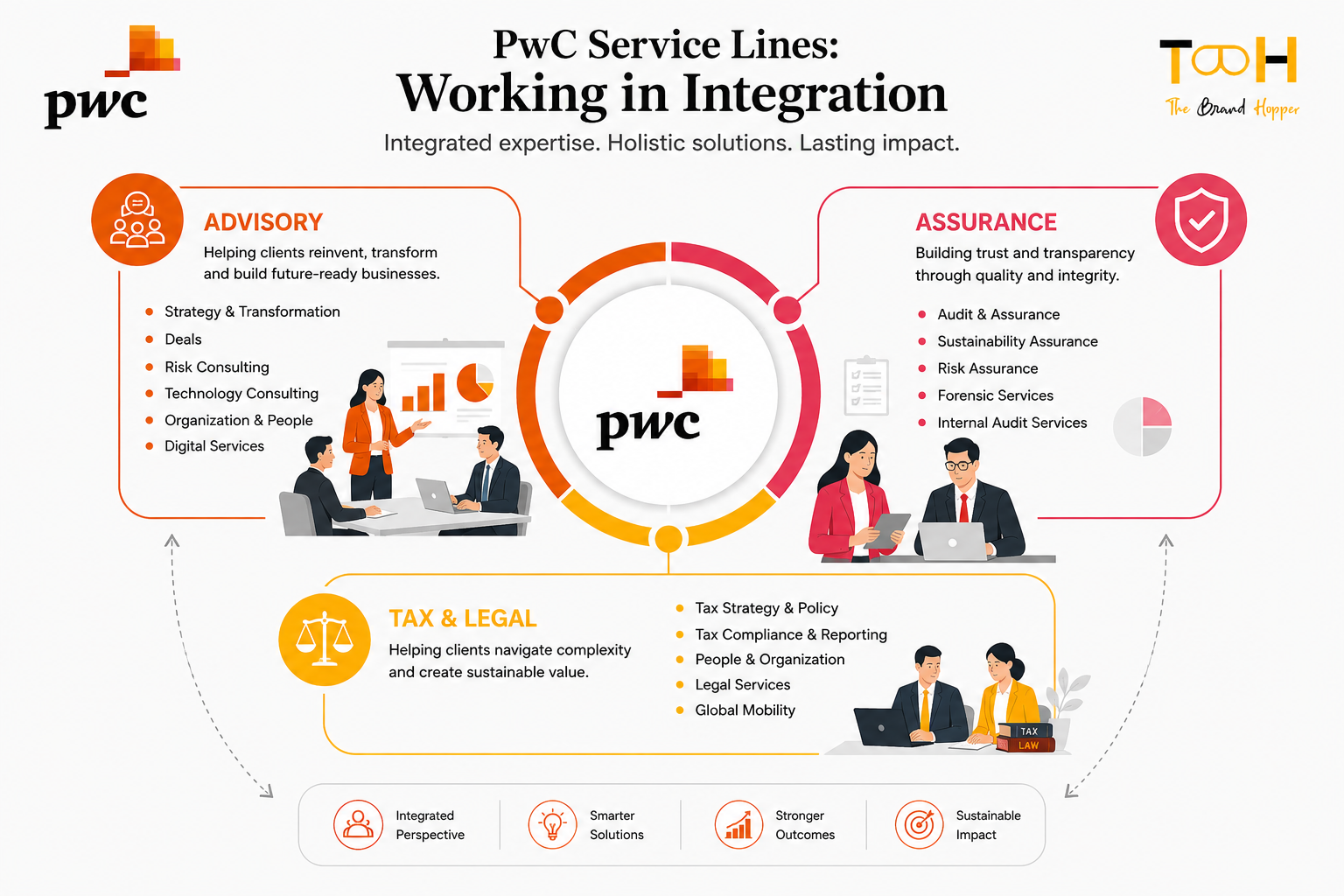
PwC’s services span three integrated pillars — Advisory, Assurance, and Tax & Legal Services — each of which contains multiple specialist capabilities. While often discussed as separate service lines, PwC increasingly deploys these capabilities together, creating integrated solutions that address the multi-dimensional challenges clients face.
1. Advisory
Advisory is PwC’s largest and fastest-growing service line, generating US$24.3 billion in FY2025 revenue (up 4.5%). It encompasses a broad spectrum of consulting and transformation services, helping organisations navigate strategy, operations, technology, and human capital.
Consulting & Business Transformation
PwC’s consulting practice assists organisations in reimagining their operating models, improving operational efficiency, and executing large-scale transformation programmes. Working alongside industry specialists, PwC consultants help clients from strategy through execution — closing the gap that has historically left strategic plans unimplemented.
Digital & Technology Services
Digital transformation sits at the heart of PwC’s Advisory agenda. The firm has built a comprehensive suite of digital services covering cloud migration, data analytics, cybersecurity, enterprise technology (including SAP, Oracle, Salesforce, and Microsoft implementations), and the deployment of artificial intelligence and automation. Strategic alliances with major technology providers including Microsoft, Google Cloud, SAP, and AWS amplify these capabilities globally.
Deals Services
PwC’s Deals practice supports the full lifecycle of transactions: from deal origination and commercial due diligence through valuation, structuring, financing, and post-merger integration. In a global environment characterised by continuing consolidation, digital-driven disruption, and private equity activity, demand for high-quality transaction advisory services remains robust.
Managed Services
An increasingly important component of Advisory is PwC’s managed services offering, where the firm takes operational responsibility for specific client functions — ranging from finance and accounting operations to regulatory compliance and risk management. This recurring, outcome-based model represents a shift from project-based engagement to deeper, ongoing client partnership.
Strategy (Strategy&)
Strategy& is PwC’s global strategy consulting business, formed through the acquisition of Booz & Company in 2014. Sitting at the top of the advisory value chain, Strategy& advises boards and C-suites on questions of corporate strategy, portfolio management, competitive positioning, and business model innovation. Its global team of senior advisers brings deep functional and industry expertise to the most complex strategic challenges.
2. Assurance
Assurance generated US$19.8 billion in FY2025 revenue (+1.7%), with financial statement audit accounting for approximately 74% of that total. The remainder comes from risk, digital, capital markets, and accounting advisory services.
Financial Statement Audit
At the core of Assurance is financial statement audit — an independently delivered opinion on the fairness and accuracy of an organisation’s financial statements. PwC audits hundreds of the world’s largest publicly listed companies, governments, and financial institutions, applying rigorous methodologies and professional scepticism to provide confidence to investors, regulators, and the public. PwC’s Next Generation Audit platform, into which the firm has invested over US$1 billion, deploys AI, automation, and cloud-enabled delivery to improve audit quality and efficiency.
Accounting Advisory & Corporate Reporting
Beyond audit opinions, PwC’s accounting advisory practice helps organisations navigate complex accounting standards (IFRS, US GAAP), IPO readiness, corporate reporting transformation, and financial restatements. As sustainability reporting requirements expand globally — driven by ISSB standards, the EU CSRD, and SEC climate disclosures — PwC’s assurance capability extends into sustainability assurance, an area of rapid growth.
Risk & Regulatory Services
PwC’s risk services help organisations identify, assess, and manage the full spectrum of risks — from operational and IT risk to regulatory, financial, and reputational risk. In an environment of increasing regulatory scrutiny, boards place high value on the independent, expert perspective PwC brings to enterprise risk management, internal audit, and compliance functions.
3. Tax & Legal Services
Tax & Legal Services generated US$12.7 billion in FY2025 revenue. This service line serves multinational corporations, private businesses, financial services organisations, and governments navigating increasingly complex global tax environments and legal frameworks.
Global Tax Compliance & Advisory
At the heart of Tax & Legal is PwC’s Connected Tax Compliance platform, which uses technology and data to help multinationals manage tax filings, respond to transfer pricing challenges, and navigate indirect tax obligations across jurisdictions. The OECD’s Pillar Two global minimum tax framework, which has entered into force in major jurisdictions, has significantly increased demand for specialist global tax advisory services — an area where PwC has invested heavily.
Legal Business Solutions
PwC Legal is among the world’s largest legal services providers by headcount, offering contract management, regulatory compliance, dispute resolution support, and general commercial legal services. PwC’s ability to combine legal services with tax, compliance, and advisory expertise in an integrated offering differentiates it from traditional law firms for clients seeking a single-provider solution to multifaceted challenges.
People & Workforce (Tax)
PwC’s workforce and employment tax practice helps organisations manage the complexity of employing people across multiple jurisdictions: from global mobility and expatriate tax services to employment tax compliance and remuneration strategy. As distributed and hybrid working models have become mainstream post-pandemic, demand for global mobility expertise has grown significantly.
4. Sustainability & Climate Services
Sustainability has become a major and rapidly growing practice area within PwC, drawing on expertise from across all three service lines. PwC assists organisations with ESG strategy, sustainability reporting and assurance, decarbonisation roadmaps, climate risk assessment, and the transition to net zero. PwC’s research consistently shows that organisations integrating sustainability into their core strategies see superior long-term outcomes — a thesis backed by data from PwC’s annual CEO Survey (see Section 8 below).
The New Equation: PwC’s Global Strategy
In June 2021, PwC launched The New Equation, its landmark global strategic framework designed to respond to fundamental shifts in the business environment: technological disruption, climate change, fractured geopolitics, and deepening societal expectations. The strategy organises PwC’s work around two deeply interconnected needs that organisations across the globe share.
| The New Equation — Two Strategic Pillars
Building Trust: Organisations face an intensifying need to earn and maintain trust across an increasingly broad range of stakeholders — employees, customers, investors, regulators, communities, and governments. Audit quality, transparent reporting, ethical conduct, and responsible use of technology are all dimensions of trust that PwC helps its clients build. Delivering Sustained Outcomes: Organisations must not only envision the future but achieve meaningful, lasting results in an environment of constant competitive pressure and rapid technological change. PwC’s integrated, cross-disciplinary approach is designed to help clients move from strategy to execution to measurable impact. |
Underpinning The New Equation was a commitment to invest US$12 billion over five years — one of the largest investment programmes ever announced by a professional services firm. This investment has funded new ESG Centres of Excellence, Leadership Institutes, accelerated technology deployments including generative AI, and expanded audit quality programmes. It has also supported the creation of over 100,000 new jobs across the network.
Global Chairman Mohamed Kande, who took the helm in FY2025, has reinforced and extended The New Equation’s foundations, emphasising that PwC must itself model the reinvention it helps clients achieve. In his first annual review letter, Kande described an agenda of continuous reinvestment in people and capabilities, with AI and digital transformation as central levers.
PwC and Artificial Intelligence: Leading the Transformation Agenda
No topic dominates the business agenda more than artificial intelligence, and PwC is deeply embedded in the global AI landscape — both as an advisor helping clients navigate AI adoption and as an adopter of AI within its own operations.
Investment in AI Capabilities
PwC invested US$1.5 billion in FY2025 alone to scale its AI capabilities, building on a US$1 billion commitment previously announced in the US. Across its global network, PwC has developed AI-powered tools for audit (Next Generation Audit), tax compliance (Connected Tax), legal contract review, risk assessment, and client insight generation. These tools are deployed in client engagements worldwide, improving quality, speed, and insight.
Helping Clients Capture AI Value
PwC’s work with clients on AI spans strategy, governance, implementation, and risk management. The firm assists organisations in designing AI strategies aligned with business objectives, building governance frameworks to use AI responsibly, selecting and integrating technology partners, and measuring the return on AI investments. Given that PwC’s own research (see CEO Survey, Section 8) shows that more than half of CEOs have yet to realise revenue or cost benefits from AI, the advisory opportunity in this space is substantial and growing.
AI in Audit and Assurance
Audit is being fundamentally transformed by AI. PwC’s Next Generation Audit platform, built on cloud infrastructure and enhanced by AI and automation, enables auditors to test larger samples, identify anomalies more effectively, and focus human judgement on the highest-risk areas. Rather than replacing the auditor, AI extends the auditor’s capacity for insight — a philosophy that underpins PwC’s approach to technology-enabled audit quality improvement.
| PwC AI Facts at a Glance
US$1.5B invested in AI capabilities in FY2025 US$1B committed for AI investment in the US market Next Generation Audit platform scales AI, automation & cloud for audit quality AI alliances with Microsoft, Google Cloud, SAP, AWS and other leading technology providers AI deployed across Advisory, Assurance, Tax, and Deals service lines |
Corporate Governance and Regulatory Compliance
As a firm that exists to help clients build trust and navigate complexity, PwC holds itself to the highest standards of governance and professional conduct. Its governance structure reflects the network model, balancing global coordination with the independence of member firms.
Governance Structure
PwC International Limited (PWCIL) acts as the principal governing entity of the PwC network, setting standards and policies that member firms agree to apply. Each member firm is a separate legal entity — independent partnerships or incorporated practices — that operates within its local regulatory and legal environment. The PwC Global Board provides strategic governance at network level, while a network leadership team coordinates strategy, quality, and operations.
Mohamed Kande serves as PwC’s Global Chairman — the first person from sub-Saharan Africa to hold that role. Kande previously served as the US & Global Advisory Leader, where he played a pivotal role in steering the network’s alliance strategy and acted as executive sponsor for capability investments in generative AI, managed services, and business model reinvention.
Audit Quality and Independence
Perhaps no dimension of PwC’s governance is more important than audit quality and auditor independence. As the statutory auditor of some of the world’s largest companies, PwC operates under strict independence rules enforced by national regulators including the PCAOB (US), FRC (UK), IAASB standards bodies, and dozens of national securities regulators. PwC publishes transparency reports in major jurisdictions, disclosing quality review findings, regulatory inspections, and actions taken to improve audit quality.
Ethics, Conduct and Professional Standards
PwC’s Code of Conduct governs the behaviour of every partner and employee in the network, covering professional ethics, anti-bribery and corruption, data privacy, confidentiality, and conflicts of interest. The firm operates a confidential ethics hotline and has established Global Compliance and Ethics policies that set minimum standards across the network. All partners and staff are required to complete regular training on ethical standards and professional responsibilities.
Regulatory Landscape
PwC operates in a highly regulated environment. Financial statement audit is subject to oversight by national audit regulators, stock exchange listing rules, and securities legislation in every major market. Tax advisory services must navigate an increasingly demanding global tax regulatory environment, including the OECD’s BEPS project, Pillar Two implementation, and expanding transfer pricing documentation requirements. Advisory services face growing scrutiny around conflicts of interest, particularly in markets where the boundary between audit and non-audit services rendered to audit clients is being tightened by regulators.
PwC’s Thought Leadership and Research
PwC invests heavily in research, analysis, and thought leadership — not merely to demonstrate expertise but to genuinely advance understanding of the challenges and opportunities facing business, government, and society. PwC’s flagship publications and annual surveys are among the most cited and closely followed in the business world.
The Global CEO Survey
PwC’s Annual Global CEO Survey is one of the most authoritative barometers of business sentiment in the world. The 29th edition surveyed 4,454 CEOs across 95 countries and territories, providing an unparalleled picture of leadership priorities, economic confidence, and technology adoption. Key findings from the most recent survey include:
- Revenue confidence: Only 30% of CEOs express confidence in revenue growth over the next 12 months, down from 38% the prior year, reflecting macroeconomic uncertainty and geopolitical complexity.
- AI returns: Despite widespread AI investment, more than 56% of CEOs say they have realised neither revenue nor cost benefits from AI to date. Only 12% report achieving both cost and revenue benefits.
- Transformation urgency: 42% of CEOs cite the pace of technological transformation as their top concern — the question on leaders’ minds being whether they are adapting fast enough.
- Sector diversification: More than 40% of companies have started competing in new sectors in the last five years, reflecting the competitive disruption reshaping industry boundaries.
- Sustainability returns: Climate-related investments were six times more likely to have increased revenue (33%) than decreased it (5%), reinforcing the business case for sustainability.
Explore PwC’s CEO Survey at:
https://www.pwc.com/gx/en/ceo-agenda/ceosurvey.html
Workforce of the Future
PwC’s Workforce of the Future research explores how technological, demographic, and cultural shifts are reshaping the world of work. The research examines how automation, AI, and the changing expectations of the workforce are redefining the employer-employee relationship and what organisations need to do to attract, retain, and develop the talent they need to succeed.
Explore PwC’s Workforce research at:
https://www.pwc.com/gx/en/services/people-organisation/publications/workforce-of-the-future.html
Consumer Intelligence Series
The State of the Consumer research tracks evolving consumer behaviours, preferences, and spending patterns across global markets. In an era where consumer expectations are shaped by digital experience, sustainability values, and economic pressure, PwC’s consumer intelligence gives business leaders the data-driven insights they need to understand and respond to their customers.
Explore PwC’s Consumer Insights at:
https://www.pwc.com/gx/en/industries/consumer-markets/consumer-insights-survey.html
Other Major Research Platforms
- Global Economy Watch: Monthly macroeconomic analysis examining global growth trends, inflation, and economic policy.
- Digital IQ Survey: Annual benchmarking of organisations’ technology investment effectiveness and digital maturity.
- ESG & Sustainability Reports: Research covering climate risk, nature-related financial disclosures, and sustainability reporting best practices.
- State of Compliance: Annual insights on regulatory trends, compliance programme effectiveness, and ethics in the workplace.
PwC’s Sustainability and ESG Commitment
PwC has made sustainability a central pillar of both its client advisory work and its own operations. The firm recognises that climate change, social inequality, and governance failures are not just ethical issues — they are material business risks and opportunities that affect every organisation it serves.
PwC’s Own Net Zero Commitment
PwC has committed to achieving net zero greenhouse gas emissions from its own operations and value chain. As part of The New Equation strategy, the firm established ESG Centres of Excellence in major markets to deepen expertise in sustainability strategy, reporting, and assurance. PwC publishes an annual Global Environmental Sustainability Report detailing its progress against targets for carbon reduction, sustainable travel, supply chain engagement, and energy use.
Sustainability Assurance — A Growing Market
As mandatory sustainability reporting expands under frameworks such as the EU Corporate Sustainability Reporting Directive (CSRD), the ISSB’s IFRS S1 and S2 standards, and SEC climate disclosure rules, the market for third-party sustainability assurance is growing rapidly. PwC’s assurance practice is among the most active providers of sustainability and non-financial information assurance globally, building on its audit heritage to bring rigour and credibility to ESG reporting.
Social Impact and Community Investment
Through the New Equation commitments and its member firm activities, PwC invests in skills development and education, supporting initiatives that help young people access the digital skills needed for the future economy. PwC Foundation programmes operate in multiple countries, focused on literacy, numeracy, and digital capability for underserved communities. Diversity and inclusion are explicit strategic priorities: PwC tracks and publishes data on gender diversity, ethnic representation, and inclusive culture metrics across the network.
PwC in the Big Four Context
PwC operates alongside three other global professional services giants — Deloitte, EY, and KPMG — which together constitute the “Big Four.” These four firms audit the vast majority of the world’s largest publicly traded companies, provide substantial portions of global management consulting and tax advisory services, and collectively employ well over a million professionals worldwide.
| Firm | FY2024/25 Revenue | Headcount | Countries |
| PwC | US$56.9B (FY2025) | ~364,000 | 136 |
| Deloitte | US$67.2B (FY2024) | ~460,000+ | 150+ |
| EY | US$51.2B (FY2024) | ~395,000 | 150+ |
| KPMG | US$38.4B (FY2023) | ~275,000 | 143 |
Note: Revenue figures based on most recently published annual results for each firm. Headcount and country figures are approximate.
While all four firms offer broadly similar service portfolios, PwC is widely regarded as particularly strong in audit quality, financial services advisory, and its Strategy& capability. Its investment in AI and managed services has also positioned it well for the next generation of professional services delivery. For more on one of PwC’s key Big Four peers, see our in-depth feature:
Frequently Asked Questions About PwC
Q: What does PwC stand for?
PwC stands for PricewaterhouseCoopers, the name formed when Price Waterhouse and Coopers & Lybrand merged in 1998. The firm adopted the abbreviated “PwC” brand in 2010 to reflect its modern, dynamic character as a global professional services network.
Q: How much revenue does PwC generate?
For the fiscal year ended 30 June 2025, PwC reported global gross revenues of US$56.9 billion — an increase of 2.9% in US dollar terms and 2.7% in local currency. Advisory (US$24.3B), Assurance (US$19.8B), and Tax & Legal Services (US$12.7B) were the three contributing service lines.
Q: How many employees does PwC have?
As of FY2025, PwC has approximately 364,000 people working across 136 countries and territories. This includes partners, professional staff, and business services employees across all member firms.
Q: Who leads PwC globally?
PwC’s Global Chairman is Mohamed Kande, who took on the role in FY2025. Kande previously served as PwC’s US & Global Advisory Leader. He is the first Global Chairman from sub-Saharan Africa in PwC’s history.
Q: What is PwC’s “The New Equation” strategy?
The New Equation, launched in June 2021, is PwC’s global strategic framework built around two interconnected pillars: Building Trust and Delivering Sustained Outcomes. The strategy was backed by a commitment to invest US$12 billion over five years and create over 100,000 new jobs across the PwC network.
Q: How is PwC investing in artificial intelligence?
PwC invested US$1.5 billion in AI capabilities in FY2025 alone, building on previous commitments including a US$1 billion AI investment in the US. The firm has deployed AI across audit (Next Generation Audit platform), tax (Connected Tax Compliance), legal, advisory, and consulting, and maintains deep alliances with leading technology providers including Microsoft, Google Cloud, and AWS.
Q: Which companies does PwC audit?
PwC is the statutory auditor of hundreds of the world’s largest publicly listed companies, including major financial institutions, consumer goods companies, pharmaceutical firms, technology companies, and energy companies across all major global markets. A full list is available in PwC’s annual transparency reports published in individual jurisdictions.
Q: How does PwC differ from other Big Four firms?
While all Big Four firms — PwC, Deloitte, EY, and KPMG — offer audit, advisory, and tax services, PwC is particularly recognised for its audit quality standards, financial services expertise, Strategy& consulting capability, and its scale of investment in AI and technology. PwC’s network model and The New Equation strategy provide a clear differentiating framework around trust and sustained outcomes.
Q: Is PwC a public company?
No. PwC operates as a network of privately held partnerships and incorporated professional service firms. Member firms are independently owned by their partners. PwC is not listed on any stock exchange and does not report publicly to shareholders in the manner of a publicly traded company.
Q: What industries does PwC serve?
PwC serves clients across all major industries including financial services, technology, media and telecommunications, consumer markets, healthcare and pharmaceuticals, energy and utilities, industrial manufacturing, government and public sector, and private equity. Deep industry specialisation is a core component of PwC’s service model.
Conclusion
PwC’s journey from a Victorian accounting firm to a global professional services powerhouse generating nearly US$57 billion in annual revenue is a story of continuous reinvention. Through landmark mergers, strategic investments, the embrace of digital and AI, and a clear philosophical commitment to building trust and delivering sustained outcomes, PwC has maintained its position at the heart of global business.
What distinguishes PwC in the modern era is not simply scale — though scale matters — but integration. The ability to deploy audit rigour, tax expertise, strategic advisory, digital capability, and legal insight through a single, trusted relationship makes PwC an indispensable partner for organisations navigating the complex, fast-moving challenges of the 21st century.
As artificial intelligence reshapes industries, sustainability reporting becomes mandatory, and geopolitical pressures reshape global supply chains and capital flows, the demand for PwC’s distinctive combination of professional rigour and transformative insight will only intensify. For any organisation seeking to understand — and shape — the future, PwC remains an essential voice.
Also Read: Building a Legacy of Excellence: The EY Success Story
To read more content like this, subscribe to our newsletter