

Last Updated on September 4, 2026 by Team TBH
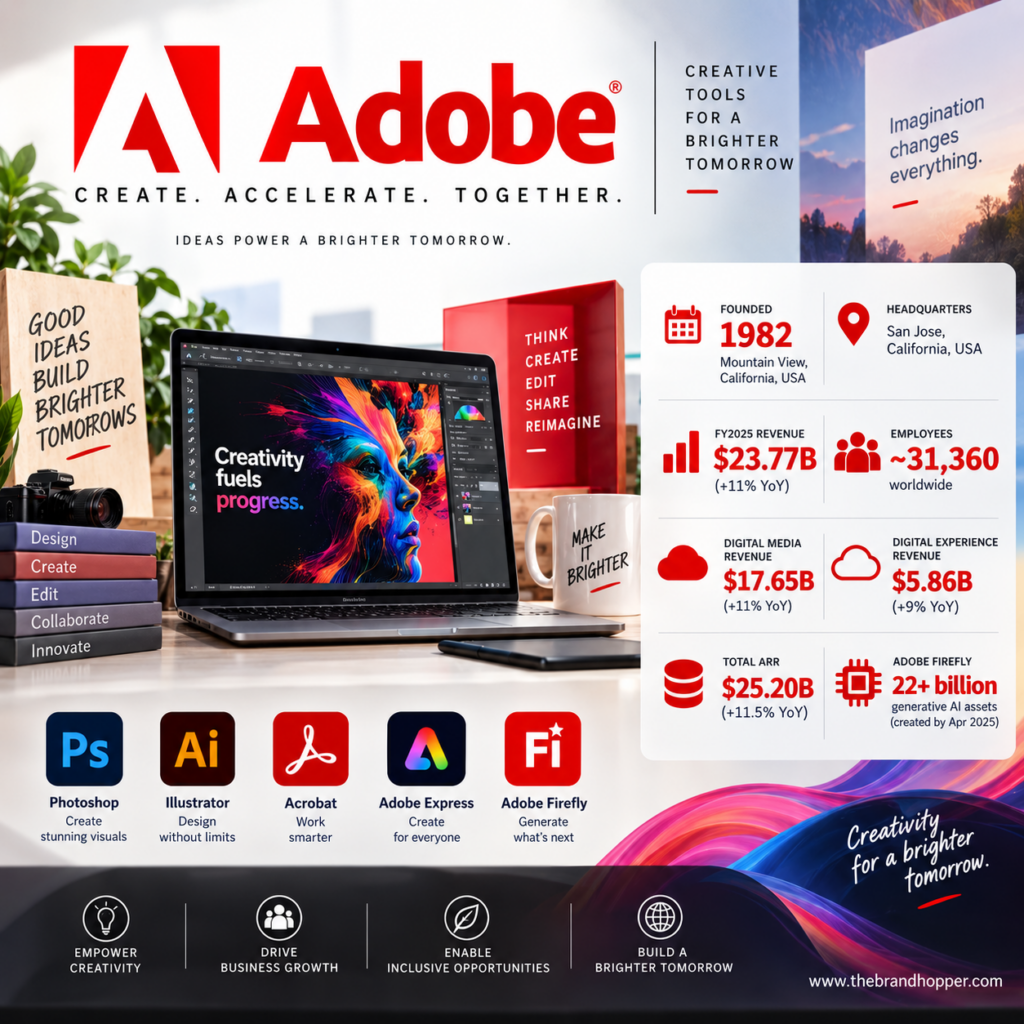
For over four decades, Adobe Inc. has been the undisputed backbone of the global creative economy. From the printing revolution it triggered with PostScript in the 1980s to its present-day leadership in AI-powered creativity, Adobe’s journey is a masterclass in strategic evolution — continuously reinventing itself to stay indispensable to creators, marketers, and enterprises worldwide.
Founded in 1982 by John Warnock and Charles Geschke in Mountain View, California — two alumni of Xerox PARC — Adobe introduced PostScript, a programming language that gave printers precise control over fonts and page layout. Apple’s adoption of PostScript for the LaserWriter in 1985 ignited the desktop publishing revolution, and Adobe has not looked back since. Today, the company’s marketing strategy is as sophisticated as the software it builds: data-driven, community-centric, AI-augmented, and designed for compounding loyalty.

In FY2025 (fiscal year ending November 28, 2025), Adobe reported record revenues of $23.77 billion — up 11% year-over-year — with total Annualized Recurring Revenue (ARR) of $25.20 billion and operating cash flows of $10.03 billion. These results confirm that Adobe’s transition to a cloud-subscription model and its AI-first pivot are both commercially validated and structurally durable.
This article provides a comprehensive analysis of Adobe’s marketing strategies, marketing mix (4Ps), brand architecture, and the pivotal role that Firefly generative AI and Adobe GenStudio are playing in reshaping the company’s competitive positioning for the decade ahead.
Marketing Strategies of Adobe
Adobe’s marketing brilliance lies not in any single tactic but in a carefully interlocked system of strategies — each reinforcing the others to create what amounts to a self-perpetuating growth flywheel. From its product architecture to its community initiatives to its AI-first messaging, every element is designed to deepen user engagement, expand the addressable market, and convert creative dependency into subscription loyalty. Here is a comprehensive breakdown of the strategies that have made Adobe one of the most formidable software marketers in the world.
1. Product Portfolio Strategy
Adobe’s product portfolio is organized around three cloud pillars — Digital Media, Digital Experience, and Adobe Express/AI — each targeting a distinct but overlapping user segment. This architecture ensures that once a user or organization adopts one Adobe product, the entire ecosystem creates pull toward additional products.
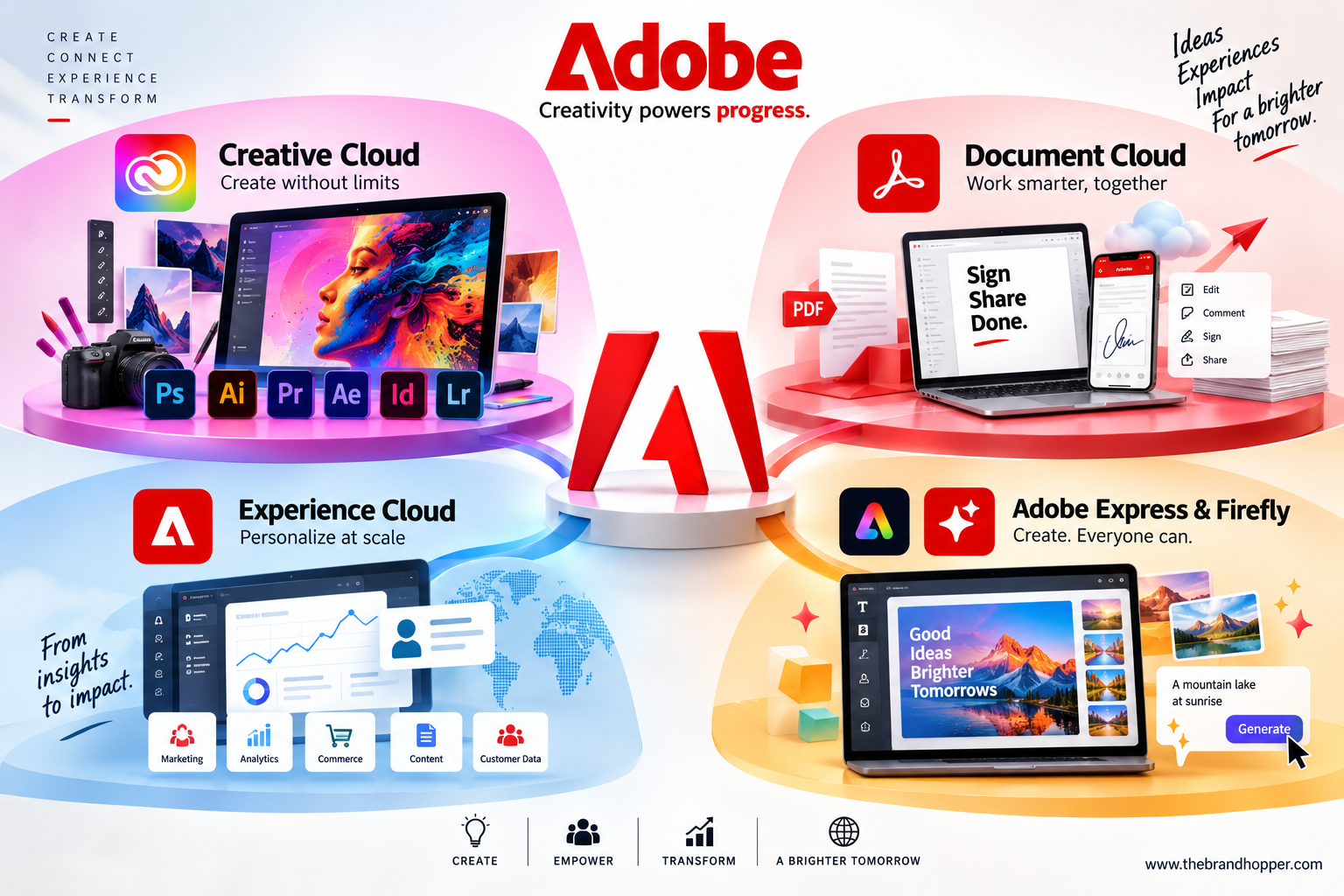
Creative Cloud — Adobe’s flagship offering — provides access to 20+ industry-standard applications including Photoshop (photo editing), Illustrator (vector graphics), Premiere Pro (video editing), After Effects (visual effects), InDesign (print & digital publishing), Lightroom (photo management), and XD (UX/UI design). Creative Cloud also bundles cloud storage, Adobe Fonts, and seamless cross-application workflows. In FY2025, Creative Cloud remained the primary revenue driver within the $17.65 billion Digital Media segment.
Document Cloud, anchored by Adobe Acrobat, is the world’s most widely used PDF platform. Acrobat Reader has over 500 million installs globally and serves as the de facto standard for PDF creation, editing, signing, and sharing. Document Cloud’s integration with Microsoft 365, Google Workspace, and enterprise DMS platforms has made it mission-critical for businesses of all sizes.
Adobe Experience Cloud is an enterprise-grade suite of marketing, analytics, e-commerce, and content management solutions. Generating $5.86 billion in FY2025 revenue, it serves Fortune 500 companies and government agencies seeking to deliver personalized, data-driven digital experiences at scale. Core products include Adobe Experience Manager (AEM), Adobe Analytics, Adobe Audience Manager, Adobe Marketo Engage (marketing automation), Adobe Commerce (e-commerce), and Adobe Real-Time CDP (customer data platform).
Adobe Express and Adobe Firefly represent the company’s push into the mass-market and AI-native segments. Adobe Express democratizes design for non-professionals, while Firefly — Adobe’s family of generative AI models trained on licensed content — is embedded across Creative Cloud, Document Cloud, and GenStudio to accelerate content creation. By April 2025, Firefly had powered the creation of over 22 billion AI-generated assets, demonstrating both its rapid adoption and Adobe’s leadership in commercially safe generative AI.
2. Subscription Model: From Perpetual to Annualized Recurring Revenue
Adobe’s 2013 transition from perpetual software licences to cloud subscriptions was one of the most consequential strategic decisions in enterprise software history. At the time it was controversial; in retrospect, it was visionary. By FY2025, subscription revenues constituted $22.80 billion of Adobe’s total $23.77 billion revenues, and the company’s total ARR had grown to $25.20 billion — a metric that illustrates the forward visibility and predictability of the business model.
The subscription model creates recurring, compounding revenue while simultaneously lowering the barrier to adoption. Rather than asking customers to commit to a $600+ perpetual licence, Adobe offers monthly plans that convert discretionary purchase decisions into habitual subscriptions. The result is dramatically expanded market access — students, freelancers, and small businesses that could not previously afford perpetual licences became subscribers, growing Adobe’s addressable market several-fold.
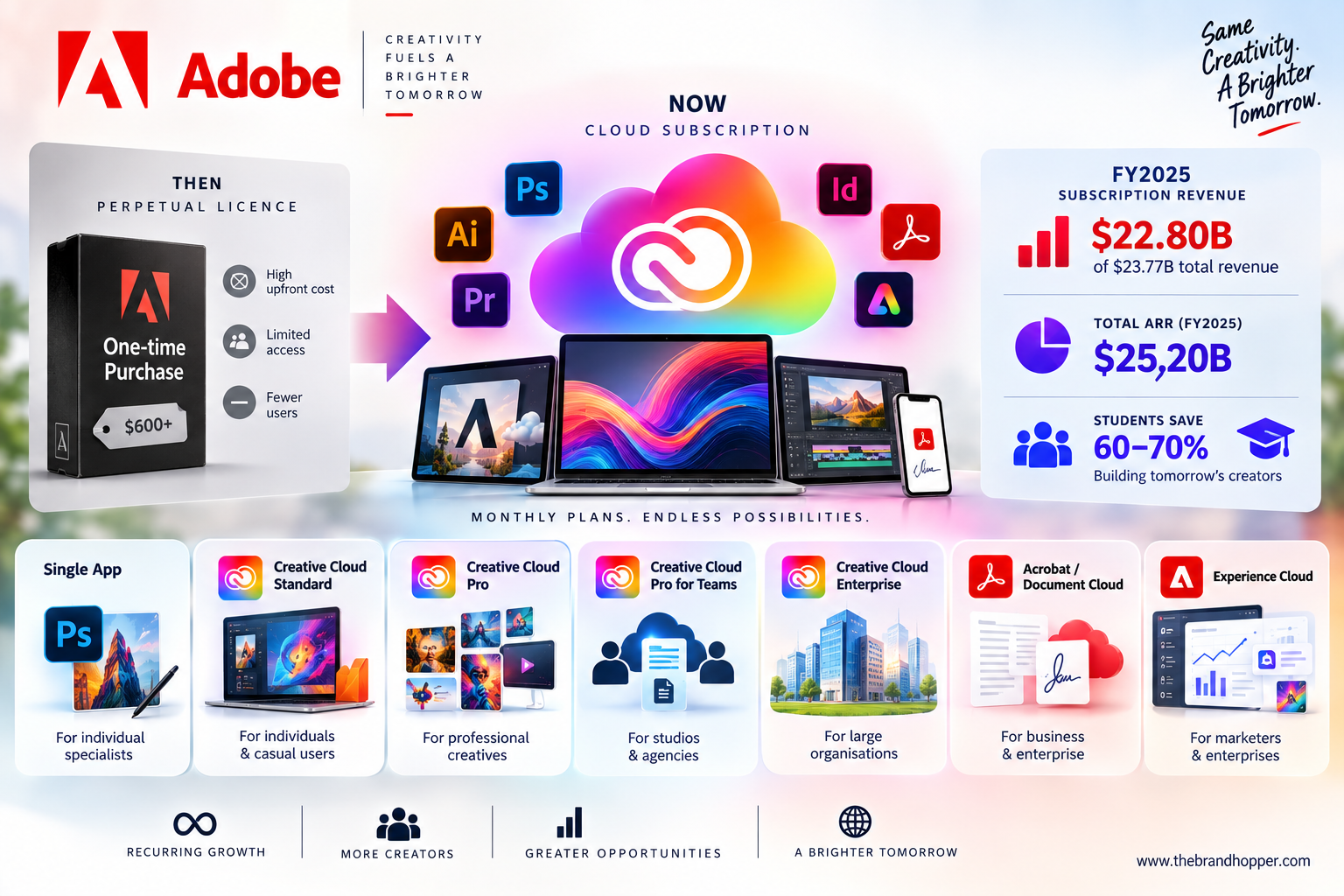
As of 2025, Adobe restructured its Creative Cloud plans significantly. The legacy “All Apps” plan was replaced by two new tiers: Creative Cloud Standard and Creative Cloud Pro, ensuring subscribers receive a clearly differentiated value proposition aligned to their usage intensity. Generative AI credits (for Firefly) are bundled into plans, with higher-tier plans receiving more credits — creating a monetisation layer that directly links AI consumption to subscription upsell. Enterprise customers under Creative Cloud Pro Plus receive 4,000 Firefly generative credits per month.
| Plan Tier | Target User | Key Inclusions |
| Single App (e.g., Photoshop) | Individual specialist | 1 Creative Cloud app + 25 generative credits/month |
| Creative Cloud Standard | Individuals / casual users | 20+ CC apps, cloud storage, Adobe Express |
| Creative Cloud Pro (Individual) | Professional creatives | 20+ CC apps, enhanced Firefly credits, premium features |
| Creative Cloud Pro for Teams | Studios / agencies | Admin console, 4,000 generative credits/month, advanced sharing |
| Creative Cloud Enterprise | Large organisations | Custom pricing, SSO, governance, dedicated support |
| Adobe Acrobat / Document Cloud | Business & enterprise | PDF creation, e-sign, AI-powered document tools |
| Adobe Experience Cloud | Marketers & enterprises | AEM, Analytics, Marketo, Real-Time CDP, Commerce |
Student and educator discounts (typically 60–70% off standard pricing) ensure that Adobe embeds itself at the start of creative careers — a deliberate investment in lifetime customer value. The student who learns Photoshop or Premiere Pro in college is overwhelmingly likely to continue as a paid subscriber in professional life, creating a self-renewing pipeline of new subscribers who arrive pre-trained on Adobe’s interface paradigms.
3. AI-First Strategy: Adobe Firefly and Sensei GenAI
Artificial intelligence is no longer a feature within Adobe’s products — it is the central organising principle of Adobe’s competitive strategy. Adobe Sensei, the company’s long-standing AI/ML framework powering features like Content-Aware Fill, Auto Tone, and neural filters, has been superseded in prominence by Adobe Firefly — a family of generative AI models purpose-built for creative workflows and trained exclusively on licensed, royalty-free content.
Firefly’s commercial safety positioning is a deliberate marketing differentiator. At a time when generative AI tools from competitors raised intellectual property concerns (models trained on scraped web content without consent), Adobe was able to position Firefly as the enterprise-safe alternative: models trained on Adobe Stock, openly licensed content, and public domain materials, with IP indemnification for commercial use. This positioning resonated powerfully with enterprise legal and procurement teams.
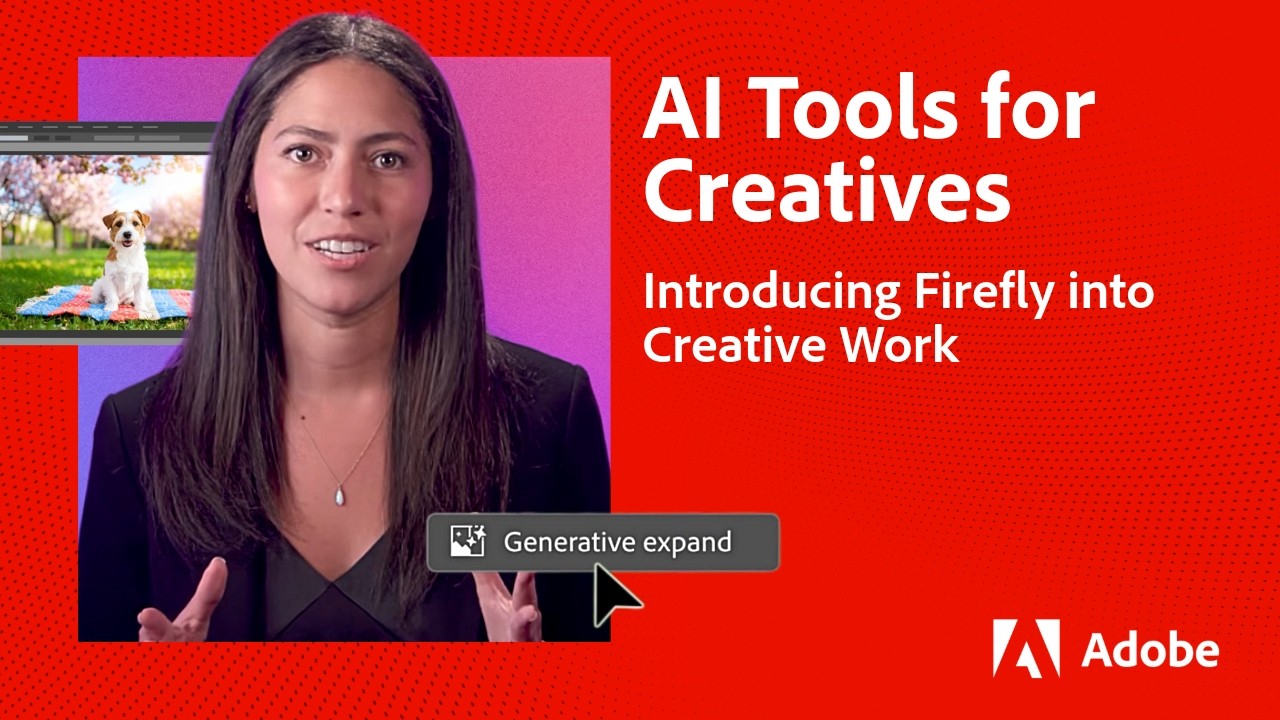
By April 2025, Firefly had enabled the creation of over 22 billion AI-generated assets. Management reported a 3x quarter-over-quarter increase in AI generation volume, driven by expanded integrations across Photoshop, Lightroom, Illustrator, and Premiere Pro. New modalities — including Firefly Video Model, Firefly Vector Model, and Firefly 3D — extend AI capabilities beyond images into every major creative format.
Adobe Firefly Foundry, launched at Adobe MAX 2025, enables enterprises to train private, deeply customised AI models on their own proprietary branded content. This means a company can build a Firefly model that understands and replicates its exact brand language, visual style, and creative guidelines — producing on-brand content at machine speed. Companies including The Coca-Cola Company, The Estée Lauder Companies, Dentsu, Publicis Groupe, and Newell Brands are active Firefly Foundry customers.
From a marketing strategy perspective, Firefly serves multiple functions simultaneously: it drives subscription upsell (via generative credit consumption), creates word-of-mouth through viral creative outputs, positions Adobe as an AI leader in the press and analyst community, and — critically — makes Adobe’s products stickier. A creative who has trained their personal Firefly Custom Model on their own style library has a powerful switching cost: that model only lives in Adobe’s ecosystem.
4. Adobe GenStudio: The Content Supply Chain Revolution
Adobe GenStudio is the company’s most significant product launch in the enterprise marketing space in over a decade. It is an AI-powered content supply chain platform that unifies the end-to-end marketing content lifecycle — from campaign planning and creative production to activation, measurement, and optimization — into a single governed workflow.
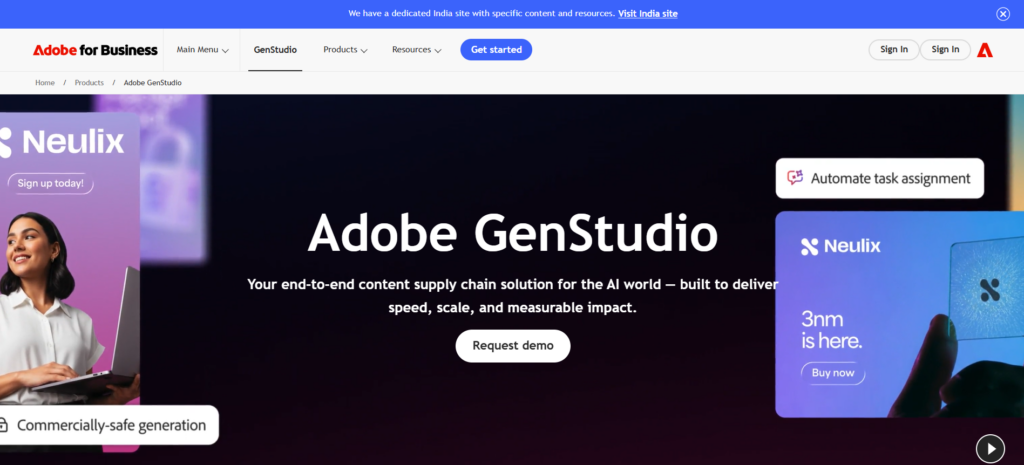
GenStudio for Performance Marketing enables brand, creative, and performance marketing teams to rapidly produce personalized, on-brand content for social media, email, display advertising, and video at scale. Through integrations with advertising partners including Amazon Ads, Google Marketing Platform, LinkedIn, TikTok, and Innovid, teams can activate campaigns directly from within the platform — dramatically compressing the time between creative ideation and live campaign delivery.
The Content Production Agent — one of GenStudio’s AI-native features — can accept a marketing brief and automatically generate visual styles, copy recommendations, and channel-specific assets without manual creative intervention. For enterprise marketing teams managing hundreds of concurrent campaigns across multiple geographies and languages, this is transformative. Major brands including The Coca-Cola Company, Lumen Technologies, and Dentsu have publicly cited GenStudio in their content supply chain transformations.
Adobe’s GenStudio strategy reflects a broader competitive repositioning: Adobe is no longer solely a creative tool vendor. It is positioning itself as the operating system for marketing — the platform through which enterprise marketing organizations plan, produce, activate, and measure all content. This brings Adobe into direct competition with enterprise marketing clouds from Salesforce, Adobe’s Experience Cloud vs. Salesforce Marketing Cloud is now a defining enterprise software rivalry.
5. Precision Audience Targeting
Adobe’s market segmentation strategy is a model of precision. Rather than one undifferentiated creative software audience, Adobe has built distinct product architectures, pricing tiers, community initiatives, and messaging frameworks for each of its key segments:
Professional Creatives: Graphic designers, photographers, videographers, motion graphic artists, and UX designers who rely on industry-standard tools. Reached through tutorials, certifications (Adobe Certified Professional), and events like Adobe MAX.
Students & Educators: Future creative professionals trained on Adobe tools through subsidised plans, Adobe Education Exchange, and integrations with learning management systems. A deliberate investment in lifetime customer value.
Freelancers & Content Creators: Social media creators, YouTubers, Reels creators, and independent creators served by Adobe Express, Premiere Rush, and Lightroom Mobile. Reached through influencer partnerships, TikTok and Instagram content, and in-app freemium entry points.
SMBs & Marketing Teams: Small-to-mid-market businesses using Creative Cloud for Teams and Adobe Express to manage brand assets and campaign content. Reached through digital advertising, reseller partnerships, and self-serve trial funnels.
Enterprises & Global Brands: Fortune 500 companies and government organisations using Adobe Experience Cloud, GenStudio, and Document Cloud Enterprise. Reached through Adobe Summit, executive briefings, system integrator partnerships (Accenture, Deloitte, IBM, TCS), and Account-Based Marketing (ABM) campaigns.
6. Content Marketing: The Tutorial-to-Loyalty Pipeline
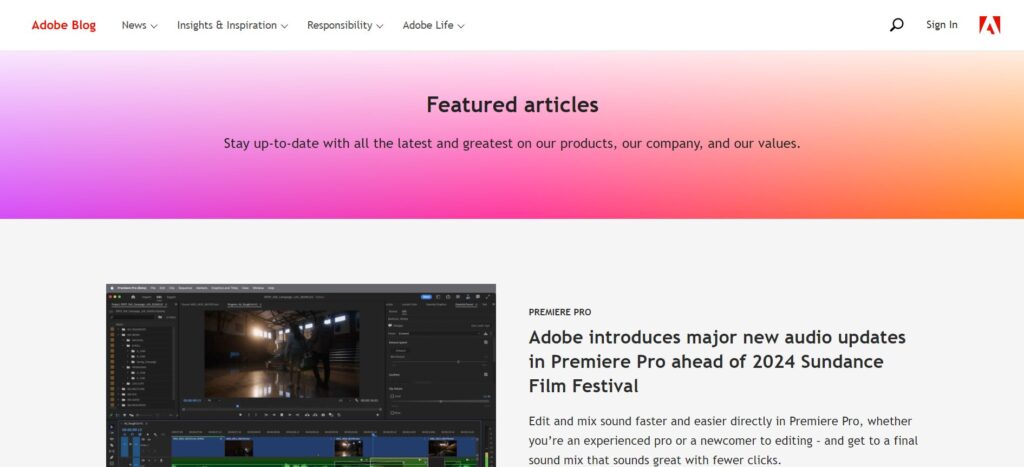
Adobe operates one of the most sophisticated content marketing ecosystems in enterprise software. Its content strategy is built on a simple but powerful insight: creators who learn a skill through Adobe’s content become advocates for the product that enabled that skill. Content is simultaneously educational, product-demonstrating, and brand-building.
The Adobe Blog is one of the most-visited creative industry destinations on the internet, publishing in-depth tutorials, industry insights, product announcements, and creative inspiration across design, photography, video, and marketing. Vertically organised by product and creative discipline, the blog ensures relevance for every segment of Adobe’s audience.
Adobe’s YouTube presence spans multiple dedicated channels — Adobe Creative Cloud, Adobe Document Cloud, Adobe Experience Cloud, Adobe Express, and product-specific channels for Photoshop, Premiere Pro, After Effects, and others. Combined, these channels host tens of thousands of tutorials, speed art videos, and product demos, delivering free value to creators at every skill level while keeping Adobe products top of mind.
Adobe also publishes print poster templates and thousands of free design assets through Adobe Express, demonstrating the platform’s capabilities while attracting new users organically through search. Every free template that a user opens is a product demonstration that converts explorers into subscribers.
The Adobe Blog’s Think Tank section targets CMOs and digital experience leaders — positioning Adobe Experience Cloud as a thought leadership platform, not just a software product. By publishing research on customer experience trends, digital maturity, and AI adoption, Adobe builds credibility with the enterprise buyers who control the largest software procurement decisions.
7. Community Engagement: Building the Creative Ecosystem
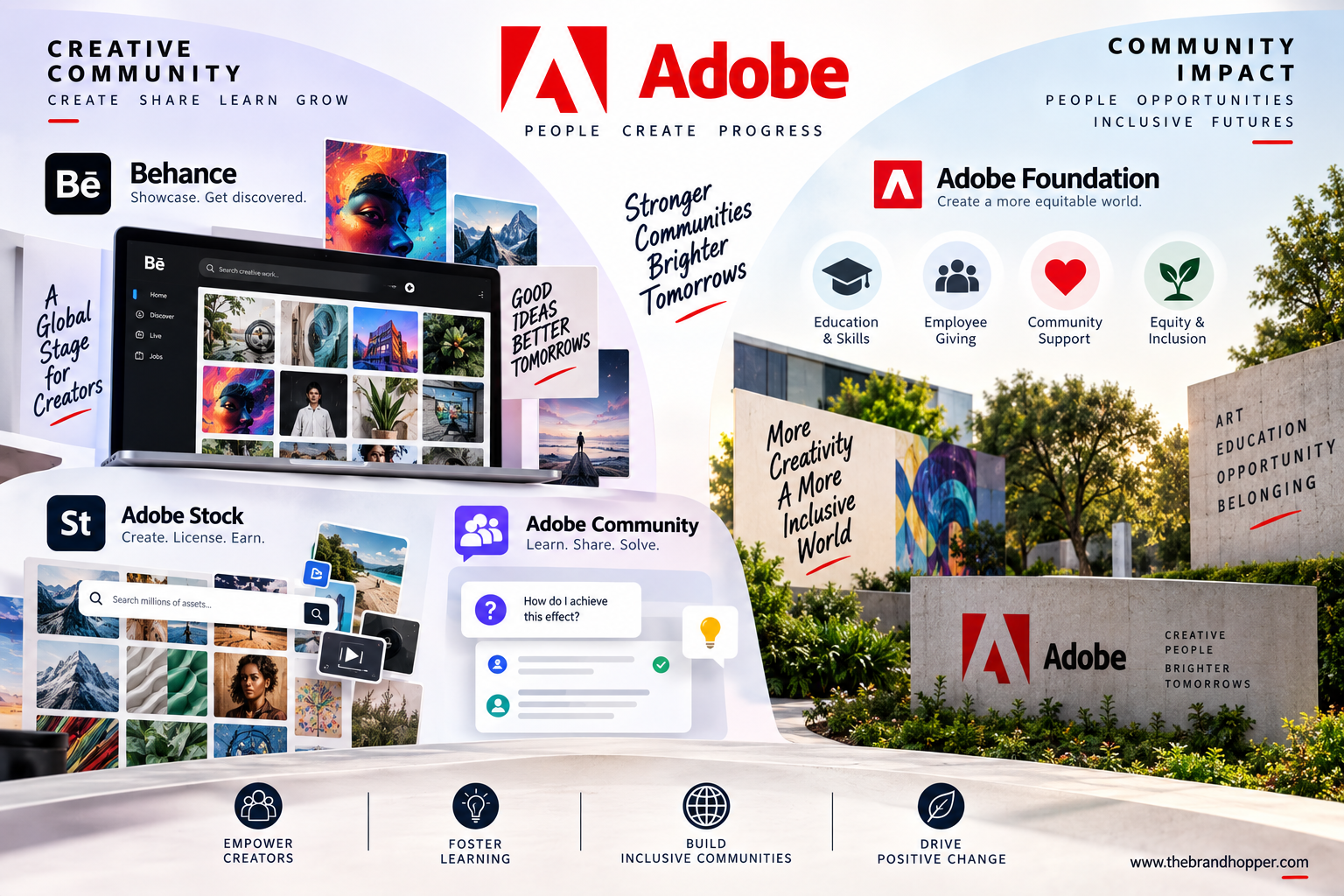
Adobe’s community strategy operates at two levels: the professional creative community (anchored by Behance and Adobe Community) and the civic/philanthropic community (anchored by the Adobe Foundation and corporate social responsibility initiatives).
Behance — acquired by Adobe in 2012 — is the world’s largest professional creative portfolio platform, with over 50 million members showcasing work across graphic design, illustration, photography, UX/UI, branding, motion graphics, and more. Behance serves a dual strategic purpose: it is both a community that creates genuine value for creators (portfolio hosting, feedback, job opportunities) and a marketing channel that makes Adobe’s products visible through the work they enable. When a creative professional’s Behance project goes viral, it is simultaneously a brand impression for Adobe.
Adobe Stock complements Behance by offering a marketplace where creators can monetise their work — selling photos, illustrations, vectors, videos, templates, and 3D assets. This creates a financial incentive for creators to produce content through Adobe tools and license it through Adobe’s platform, deepening the ecosystem lock-in from both the supply and demand sides.
The Adobe Community (formerly the Adobe Help Community) is a peer-to-peer support forum with millions of active participants who answer technical questions, share tutorials, and provide feedback on product features. Adobe Community Professionals — a curated group of highly engaged experts rewarded with recognition, early access, and events — serve as volunteer brand ambassadors who provide credible, peer-sourced advocacy that no advertising budget can replicate.
Through the Adobe Foundation, the company runs the Matching Grants Program (matching employee donations to nonprofits), Volunteer Grants (incentivising employee volunteering), the Employee Community Fund (supporting local communities), and the Equity and Advancement Initiative (launched by the Adobe Foundation) — a global program supporting nonprofit organizations through grants, product access, and pro bono services. These philanthropic efforts serve genuine social good and simultaneously strengthen Adobe’s brand among socially conscious consumers and enterprise buyers with ESG commitments.
8. Strategic Partnerships: Expanding the Adobe Ecosystem
Adobe’s partnership strategy has evolved from bilateral technology integrations into a multi-tiered ecosystem model that spans technology platforms, global agencies, system integrators, and sustainability advocates. Strategic partnerships now constitute a critical distribution and co-innovation channel for both Creative Cloud and Experience Cloud.
Adobe’s deepest technology partnerships are with Microsoft (Creative Cloud integration with Teams, SharePoint, OneDrive; co-sell agreements for Experience Cloud), and increasingly with Amazon Web Services (AWS), Google Cloud, NVIDIA, Anthropic, OpenAI, and IBM — all enabling Adobe’s AI capabilities to run within customers’ preferred cloud environments. These partnerships ensure Adobe’s tools are available wherever enterprise workloads run, removing infrastructure friction from the purchasing decision.
In the marketing services ecosystem, leading global agencies including dentsu, Havas, Omnicom, Publicis, Stagwell, and WPP have standardised on Adobe GenStudio and Creative Cloud Enterprise, creating a downstream network effect: as agencies adopt Adobe’s content supply chain, their clients become familiar with Adobe’s workflow model, creating enterprise pull toward Experience Cloud.
System integrators — Accenture, Capgemini, Cognizant, Deloitte Digital, EY, IBM, Infosys, PwC, and TCS — deliver Adobe Experience Cloud implementations for enterprise clients. Adobe’s partner ecosystem generates an estimated $8–10 of partner revenue for every $1 of direct Adobe revenue in the enterprise segment, making the SI channel a disproportionately important distribution force.
Adobe also maintains strategic partnerships with hardware and platform companies including Apple, Dell, HP, and Wacom — ensuring Creative Cloud is optimized for the devices and workflows that creative professionals use most, while receiving preferred placements and joint marketing opportunities from those companies’ ecosystems.
9. Events and Conferences: Adobe MAX and Adobe Summit
Adobe’s flagship events are among the most important annual brand-building exercises in enterprise software — and they serve a function that no digital advertising campaign can replicate: they create genuine enthusiasm, belonging, and urgency among Adobe’s most influential users.
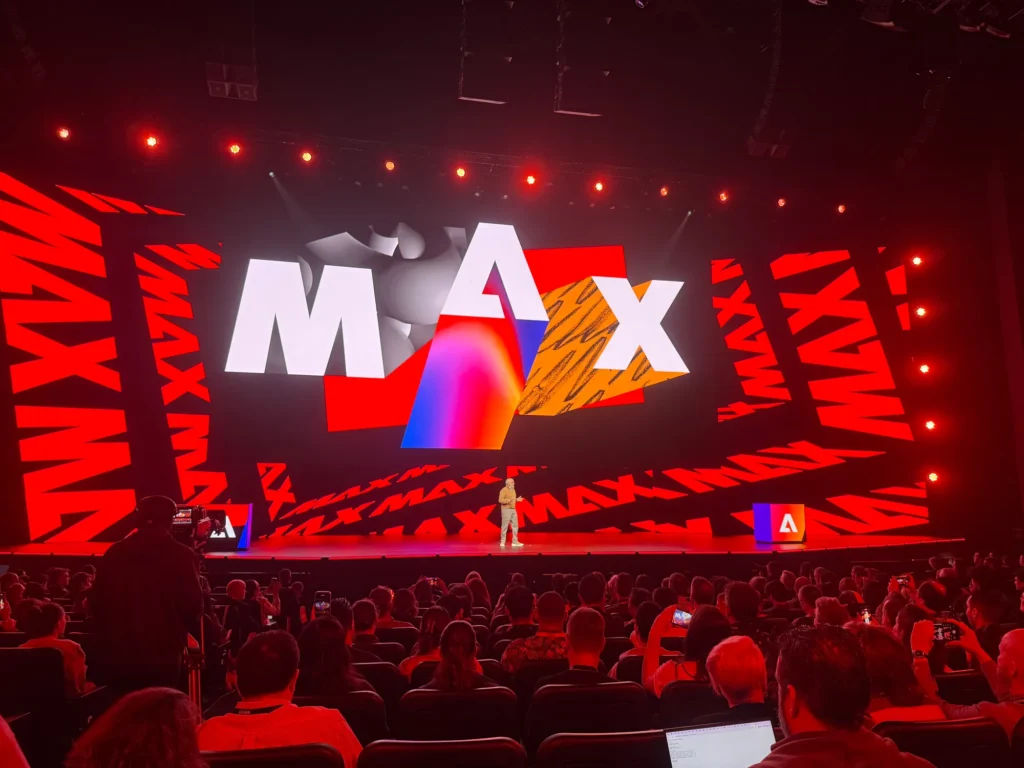
Adobe MAX — “The Creativity Conference” — is Adobe’s annual creative extravaganza, typically held in Los Angeles each October and broadcast globally as a hybrid event. MAX is the venue for Adobe’s most significant product announcements (including Firefly, GenStudio, and new Creative Cloud features), live keynote performances, hands-on labs, and “Sneak Peeks” at products in development. MAX attendees are the tastemakers of the creative world: professional photographers, motion designers, 3D artists, UX designers, and creative directors. By exciting this community, Adobe generates authentic word-of-mouth that reaches millions of creators through social media, blog posts, and YouTube reviews.
Adobe Summit is Adobe’s annual digital experience conference targeting marketing executives, CMOs, and digital leaders. Typically held in Las Vegas and broadcast globally, Summit is the primary venue for Adobe Experience Cloud announcements, customer case studies, and industry thought leadership. Summit sessions cover Customer Experience Management (CXM), data-driven personalization, AI-powered marketing, and content supply chain optimization. Adobe Summit establishes Adobe Experience Cloud’s market leadership narrative and creates the social proof that enterprise buyers require before committing to a multi-year software investment.
Adobe also participates prominently in Cannes Lions International Festival of Creativity — the world’s most prestigious advertising and creativity festival. Adobe’s presence at Cannes Lions, including sponsored stages, executive panels, and product showcases, positions the company as a creative industry patron and thought leader rather than merely a tool provider.
10. Social Media Marketing Strategy
Adobe’s social media strategy is built around platform-specific content that showcases what Adobe tools can do, rather than what Adobe wants to sell. This product-led social approach drives organic reach by generating content that is inherently useful, visually arresting, or technically impressive — the kind of content creators share because it adds value to their own professional identity.
On Instagram and TikTok, Adobe publishes quick tutorials (“how to remove a background in Photoshop in 3 seconds”), before/after transformations, and user-generated creative showcases that demonstrate product capabilities in seconds. Adobe Express and Firefly content dominates these short-form channels, targeting the consumer and prosumer segments. These platforms also serve as recruitment channels for the Adobe Creative Residency — a programme that embeds selected creators in a year-long funded creative exploration, generating authentic content and brand advocacy.
On LinkedIn, Adobe maintains a distinct voice targeting marketing and enterprise decision-makers — publishing research reports on digital experience trends, AI adoption in marketing, and content supply chain optimization. The Adobe Experience Cloud and Adobe GenStudio feeds on LinkedIn speak directly to CMOs and heads of digital, building thought leadership credibility that supports the enterprise sales cycle.
Adobe’s YouTube strategy is the most substantial of any creative software company. Adobe maintains over 20 separate YouTube channels organised by product and creative discipline. The flagship Adobe Creative Cloud channel, alongside dedicated channels for Photoshop, Premiere Pro, After Effects, Illustrator, and Adobe Stock, collectively deliver millions of tutorial views monthly. This creates a perpetual discovery funnel: a beginner searching “how to edit photos” finds Adobe content, learns the skill using Adobe tools, and converts to a paid subscriber.
11. Influencer & Creator Marketing
Adobe’s influencer strategy is built around authentic expertise rather than follower count. The Adobe Creative Experts programme certifies and supports a global network of highly skilled Adobe users — professional photographers, designers, videographers, and illustrators — who share their knowledge through tutorials, live streams, and social content. Unlike traditional paid influencer campaigns, Creative Experts are chosen for their genuine mastery and community credibility, ensuring that Adobe’s influencer content carries the authentic weight of professional endorsement.
The Adobe Certified Professional programme similarly elevates skilled users into brand advocates: individuals who have passed Adobe certification exams prominently display their credentials in professional contexts, creating passive brand advocacy in job postings, LinkedIn profiles, and portfolio sites. For Adobe, every certified professional is both a validated customer and a walking advertisement for the professional value of Adobe proficiency.
Adobe’s partnerships with creative talents at Cannes Lions, Adobe MAX, and through sponsored projects create premium brand associations. When a Grammy-winning music video or a viral advertising campaign is produced using Adobe Premiere Pro or After Effects, the resulting press coverage and creator attribution generates earned media that reinforces Adobe’s status as the professional standard.
12. Data-Driven Marketing and the Adobe Digital Economy Index
Adobe uses its own technology stack — Adobe Analytics, Adobe Real-Time CDP, and Adobe Target — to manage its global marketing performance with the same sophistication it sells to enterprises. Adobe’s marketing organisation is its own most demanding customer, driving internal use cases that simultaneously validate the product and generate institutional knowledge that informs product development.
The Adobe Digital Economy Index is a proprietary research programme that analyses trillions of data points from e-commerce and digital marketing transactions to produce widely cited insights on consumer spending, inflation, holiday retail trends, and digital advertising. By publishing this research freely, Adobe positions itself as the authoritative source of digital economic data — the same credibility positioning that Salesforce achieves with its “State of Sales” reports. These research outputs generate press coverage, backlinks, and executive mindshare that no paid campaign could replicate at the same cost efficiency.
Adobe’s Marketing Mix (4Ps): A Comprehensive Analysis
Adobe’s marketing mix has been comprehensively redesigned for the subscription, cloud, and AI era. The traditional 4Ps — Product, Price, Place, Promotion — have been reimagined to reflect the realities of a software-as-a-service business where customer lifetime value, annual recurring revenue, and product adoption depth are the primary commercial metrics.
Product
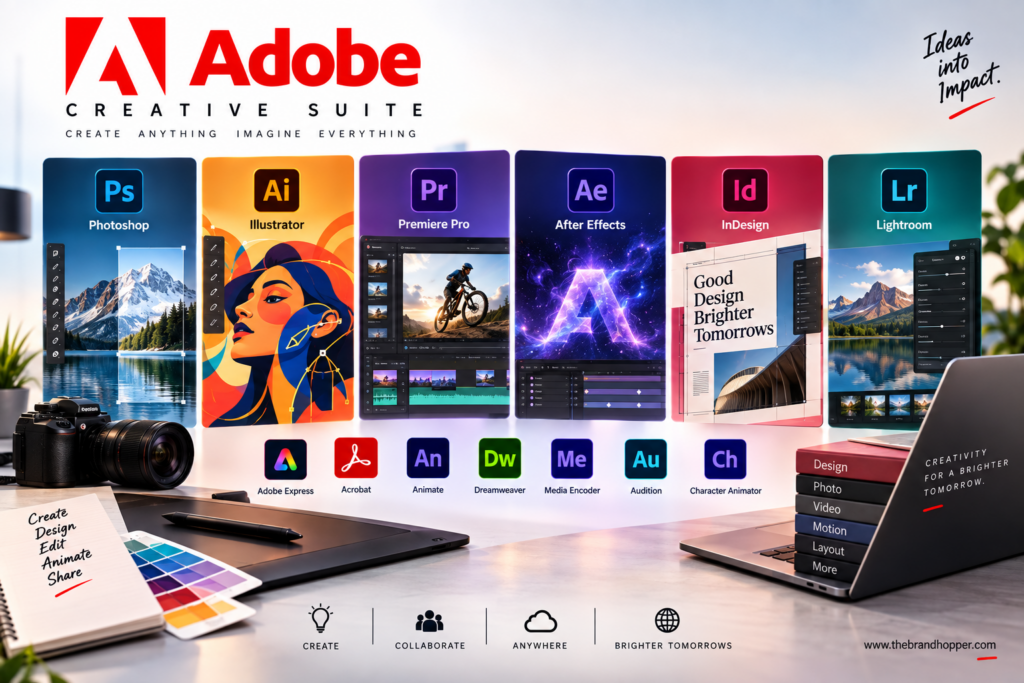
Adobe’s product strategy is built on breadth, depth, integration, and continuous innovation. Breadth ensures that Adobe covers every major creative and marketing workflow — from pixel editing (Photoshop) to motion graphics (After Effects), from vector design (Illustrator) to immersive 3D (Substance 3D), from PDF workflows (Acrobat) to marketing automation (Marketo). Depth ensures that each application has both entry-level accessibility and professional-grade capability. Integration ensures that products interoperate seamlessly — a design created in Illustrator exports directly to Premiere Pro; an asset managed in Lightroom publishes instantly to Adobe Stock.
Innovation is the product strategy dimension that Adobe has invested most heavily in since 2022. Adobe Firefly generative AI is embedded natively in Photoshop (Generative Fill, Generative Expand), Illustrator (Generative Recolor, Text-to-Vector), Premiere Pro (Generative Extend, AI audio enhancement), Adobe Express, and GenStudio. Adobe Sensei powers intelligent automation across Document Cloud — including AI-assisted form recognition, intelligent redaction, and automated document summarisation. Every major product release deepens AI integration, creating a compounding capability advantage over competitors who are building AI features from scratch.
Price
Adobe’s pricing strategy in 2025 reflects three overlapping objectives: maximising market penetration across all user segments, monetising AI capabilities through consumption-based credit systems, and protecting enterprise margins through differentiated tiering.
The Creative Cloud Pro individual plan, Adobe’s primary offer for professional creatives, is priced at approximately $59.99/month (billed monthly) or $54.99/month (billed annually) in the US market — positioning it as a professional tool comparable to a monthly software subscription expense rather than a capital expenditure. Single-app plans allow budget-conscious users to access one application at $9.99–$20.99/month, creating entry points for segment-specific adoption. Students and educators receive discounts of up to 70%, securing early-career brand loyalty at subsidised acquisition cost.
Adobe’s generative credit system creates a usage-linked monetisation layer: standard plans include a base allocation of monthly Firefly credits; heavy users who exhaust their credits face in-product prompts to upgrade to higher-tier plans or purchase credit add-ons. This usage-based pricing layer generates organic upsell pressure from within the product — converting heavy AI users into higher-revenue subscribers without requiring any outbound sales motion.
For enterprises, Adobe Experience Cloud pricing is highly customised: multi-year agreements, volume-based discounts, and cross-cloud bundling (Creative Cloud + Document Cloud + Experience Cloud) are negotiated through a dedicated enterprise sales team, with system integrators and resellers participating in deal origination. Enterprise deal sizes range from hundreds of thousands to tens of millions of dollars annually.
Place
Adobe’s distribution model is multi-channel and globally scalable. Direct sales through adobe.com is the primary channel for individual and SMB subscriptions, supported by in-product trial-to-paid conversion funnels, automated onboarding email sequences, and self-serve billing management. The adobe.com direct channel captures the highest gross margin and provides Adobe with complete customer data for retention and upsell analytics.
Adobe Creative Cloud is pre-installed on millions of laptops sold by Apple (Mac) and major PC manufacturers, and is available through the Mac App Store, Microsoft Store, and Amazon. These channel partnerships expand Adobe’s discovery surface to users who might not proactively seek out creative software — converting passive browser browsing into subscription trials.
Cloud delivery eliminates geographic distribution constraints. Adobe Creative Cloud subscribers in Lagos, São Paulo, Jakarta, and Warsaw access the same products as subscribers in New York and London — enabling Adobe to monetise emerging creative markets where physical software distribution was historically impractical. Mobile apps (Photoshop, Lightroom, Fresco, Adobe Express, Premiere Rush) extend Adobe’s presence to smartphones and tablets, meeting creators wherever they work.
For Experience Cloud, the primary distribution channel is the enterprise sales team, supported by a global network of resellers, system integrators (Accenture, IBM, Deloitte, TCS), and Value-Added Resellers (VARs). Adobe’s partnership with Microsoft ensures Experience Cloud is available through Microsoft Azure Marketplace, reaching enterprise IT procurement teams through their preferred cloud vendor relationships.
Promotion
Adobe’s promotional strategy integrates paid, owned, and earned media into a unified funnel that converts awareness into trial, trial into subscription, and subscription into long-term advocacy. Rather than relying on mass advertising, Adobe concentrates its promotional investment in channels where creative professionals spend their time — tutorial platforms, social media, industry events, and peer community forums.
Paid search advertising ensures Adobe captures demand from creatives actively searching for tools, tutorials, and solutions. Adobe’s search marketing strategy is built around high-intent, product-specific keywords (“how to remove background Photoshop”, “best video editing software for YouTube”) that attract users with immediate adoption potential. Adobe Free Trials are the primary conversion mechanism from paid search — offering full-featured product access for 7–30 days with minimal friction, knowing that creative users who invest time in learning an application rarely switch.
Adobe’s promotional communications are consistent in tone: inspirational, creator-centric, and product-confident without being aggressive. Campaign messaging emphasises creative empowerment (“Make it”) rather than feature specifications — trusting that demonstration through tutorials and community showcases is more persuasive than specification-led advertising. Adobe’s “Creativity for All” brand platform underpins this ethos, positioning every Adobe product as a tool that removes barriers between creative vision and finished work.
Adobe’s Brand Architecture
Adobe operates a “branded house” architecture with a strong parent brand and sub-brands that carry the Adobe name as a prefix (Adobe Photoshop, Adobe Firefly, Adobe GenStudio, Adobe Experience Manager). This architecture ensures that brand equity built by any individual product transfers to the parent brand, and that the parent brand’s credibility lends authority to new product launches. When Adobe Firefly launched, it immediately benefited from decades of Adobe brand trust — a competitive advantage that a standalone AI startup cannot replicate.
The Adobe Firefly brand specifically is being managed as a platform rather than a product — a family of AI models (image, video, vector, audio, 3D) that run across all Adobe surfaces. This platform positioning allows Adobe to market “Firefly” as an enterprise AI capability rather than a single-use tool, creating a broader narrative about AI-powered creativity that is more defensible than any individual feature.
Notable Adobe Marketing Campaigns
Adobe MAX “Sneaks” Campaign: Each year, Adobe’s MAX conference culminates in “Sneaks” — a presentation of experimental features from Adobe Research that may become future product capabilities. The theatrical presentation (complete with on-stage celebrity collaborations) generates enormous social media engagement and press coverage, positioning Adobe as an innovation leader and creating anticipation that sustains subscriber excitement between product cycles.
Firefly “Commercially Safe AI” Campaign: Following the controversy around copyright issues in generative AI, Adobe launched targeted campaigns positioning Firefly as the commercially responsible AI option for enterprises — trained on licensed content, offering IP indemnification, and transparent about training data sources. This campaign directly addressed the concerns of legal and procurement stakeholders blocking AI tool adoption.
Cannes Lions Activation: Adobe’s multi-year presence at Cannes Lions — including sponsored stages, executive speaking slots, and exclusive creative showcases — positions the company as a patron of creativity and a peer to advertising industry leaders. The 2025 Cannes activation specifically showcased the integration of Firefly AI with creative and marketing workflows, demonstrating how AI accelerates rather than replaces human creativity.


“Make It” Brand Platform: Adobe’s core creative advertising uses “Make It” as a rallying call — short, imperative, and universally relevant to every creator from a student making their first Photoshop edit to a motion designer producing a Super Bowl spot. The campaign runs across YouTube pre-roll, social media, and out-of-home advertising near creative industry hubs.
Adobe Express “The Easiest Way to Create”: Targeting the non-professional creator segment, Adobe Express campaigns emphasise instant results and zero learning curve — directly competing with Canva for the “quick social media design” occasion. TikTok and Instagram Reels campaigns showing 60-second Express design workflows have driven significant freemium trial acquisition.
Frequently Asked Questions (FAQs)
Q1. What is Adobe’s marketing strategy?
A: Adobe’s marketing strategy is built on five interlocking pillars: (1) a cloud-subscription model that generates predictable, recurring revenue; (2) an AI-first product strategy centered on Firefly generative AI; (3) a content marketing engine that educates and inspires creators; (4) a community ecosystem spanning Behance, Adobe Stock, and Adobe Community; and (5) flagship events (Adobe MAX, Adobe Summit) that create annual moments of brand renewal. Together these create a compounding flywheel where each new user deepens Adobe’s ecosystem, and deeper ecosystems attract more users.
Q2. What is Adobe’s FY2025 revenue?
A: Adobe reported record revenues of $23.77 billion in FY2025 (fiscal year ending November 28, 2025), up 11% year-over-year. Digital Media segment revenue was $17.65 billion (+11%); Digital Experience segment revenue was $5.86 billion (+9%). Total Annualized Recurring Revenue (ARR) exiting FY2025 was $25.20 billion (+11.5% YoY). Adobe generated $10.03 billion in operating cash flows during FY2025. All figures are sourced from Adobe’s official Q4 FY2025 Earnings Release (December 10, 2025).
Q3. What is Adobe Creative Cloud?
A: Adobe Creative Cloud is Adobe’s flagship subscription offering, providing access to 20+ professional creative applications including Photoshop, Illustrator, Premiere Pro, After Effects, InDesign, Lightroom, XD, and Adobe Firefly. Creative Cloud plans include cloud storage, Adobe Fonts, access to Adobe Stock (trial basis), and Firefly generative AI credits. In FY2025, Creative Cloud was the primary revenue driver within Adobe’s $17.65 billion Digital Media segment. Plans range from single-app subscriptions (~$9.99–$20.99/month) to the Creative Cloud Pro All Apps plan (~$54.99/month billed annually).
Q4. What is Adobe Firefly?
A: Adobe Firefly is Adobe’s family of generative AI models designed for creative professionals, trained exclusively on licensed Adobe Stock content and public domain materials to ensure commercial safety. Firefly models generate images, vectors, video, audio, and 3D assets from text prompts and can be used within Photoshop (Generative Fill), Illustrator, Premiere Pro, Adobe Express, and GenStudio. By April 2025, Firefly had powered the creation of over 22 billion AI-generated assets. Adobe Firefly Foundry allows enterprises to train private Firefly models on their own branded content.
Q5. What is Adobe’s subscription model?
A: Adobe transitioned from perpetual software licences to cloud subscriptions in 2013 — a pivotal strategic shift that transformed its business model. Today, subscription revenues represent approximately $22.80 billion of Adobe’s $23.77 billion FY2025 revenues. The model offers monthly and annual billing, tiered plans (Standard, Pro, Enterprise), student/educator discounts, and usage-based Firefly generative credit consumption. Subscriptions lower the upfront cost barrier, enable continuous product updates, facilitate cross-sell and upsell, and generate the predictable, recurring revenue that supports Adobe’s R&D investment cycle.
Q6. What is Adobe Experience Cloud?
A: Adobe Experience Cloud is Adobe’s suite of enterprise marketing, analytics, commerce, and content management solutions. It generated $5.86 billion in FY2025 revenue. Core products include Adobe Experience Manager (content management and digital asset management), Adobe Analytics (digital analytics), Adobe Audience Manager (DMP), Adobe Marketo Engage (marketing automation), Adobe Commerce (e-commerce), Adobe Real-Time CDP (customer data platform), and Adobe GenStudio (AI-powered content supply chain). Experience Cloud is deployed by Fortune 500 companies, global agencies, and government organizations.
Q7. What is Adobe’s target audience?
A: Adobe targets five primary audience segments: (1) Professional creative artists — graphic designers, photographers, videographers, illustrators, UX designers; (2) Students and educators — current and future creative professionals reached through heavily discounted education plans; (3) Content creators and freelancers — social media creators, YouTubers, and independent designers served by Adobe Express and mobile apps; (4) SMBs and marketing teams — businesses using Creative Cloud for Teams and GenStudio for content production; and (5) Enterprise and government organisations — large-scale buyers of Adobe Experience Cloud, Document Cloud Enterprise, and Firefly Foundry.
Q8. What is Behance?
A: Behance is the world’s largest creative portfolio platform, owned by Adobe (acquired in 2012). With over 50 million members, Behance allows creative professionals to showcase portfolios, follow other creatives, discover job opportunities, and gain recognition. For Adobe, Behance serves as both a community engagement platform and a product marketing channel: the work showcased on Behance was created using Adobe tools, making every Behance portfolio a living advertisement for Creative Cloud. Behance is accessible at behance.net.
Q9. How does Adobe use AI in marketing?
A: Adobe uses AI in marketing in two distinct ways. First, as a product feature that drives customer value and subscription retention: Firefly generative AI is embedded in Photoshop, Illustrator, Premiere Pro, After Effects, and GenStudio, enabling faster, higher-quality creative output. Second, as a marketing tool: Adobe uses its own Experience Cloud (including Adobe Analytics, Adobe Target, and Adobe Real-Time CDP) to run highly personalized marketing campaigns, optimize digital experiences for different user segments, and measure ROI across every marketing channel. Adobe is simultaneously an AI product vendor and one of the most sophisticated enterprise AI marketing practitioners.
Q10. How does Adobe differentiate from competitors like Canva and Figma?
A: Adobe’s primary competitive differentiators are: (1) Professional depth — 40+ years of software development give Adobe tools (especially Photoshop, Premiere Pro, After Effects) capabilities that consumer-grade tools like Canva cannot match for complex professional workflows; (2) Integration — 20+ Adobe products work seamlessly together, creating workflow efficiencies unavailable in point solutions; (3) AI advantage — Firefly’s commercial safety positioning (trained on licensed content) and Firefly Foundry’s enterprise customisation capabilities are differentiated from Canva’s consumer AI tools; (4) Enterprise platform — Adobe Experience Cloud, GenStudio, and Document Cloud Enterprise provide enterprise workflow integration that Canva and Figma do not offer; and (5) Community — Behance, Adobe Stock, and Adobe Community create network effects unavailable to standalone competitors.
Conclusion
Adobe’s marketing strategy is a masterclass in building a self-reinforcing ecosystem. The subscription model generates predictable revenue that funds continuous product innovation. Product innovation (Firefly, GenStudio) creates reasons for existing subscribers to upgrade and new audiences to subscribe. Content marketing (the blog, YouTube tutorials, social media) educates users who become loyal customers. Community platforms (Behance, Adobe Stock, Adobe Community) create social proof and switching costs. Events (MAX, Summit) create annual renewal moments. Partnerships (Microsoft, AWS, global agencies, system integrators) expand distribution and deepen enterprise integration.
In FY2025, this system generated record revenues of $23.77 billion — 11% growth despite macroeconomic headwinds — and an ARR base of $25.20 billion that provides extraordinary forward visibility. Adobe Firefly’s 22 billion assets generated by April 2025, and Adobe GenStudio’s growing enterprise client base (Coca-Cola, Estée Lauder, Dentsu, Publicis), validate that the AI pivot is commercially real and structurally accretive.
Adobe is no longer just creative software. It is the operating system for creativity and marketing — the infrastructure through which professional creators, enterprise marketing teams, and global brands bring ideas to life.
Also Read: Unlocking Creativity: Inspiring Success Story of Adobe
To read more content like this, subscribe to our newsletter