Last Updated on September 5, 2026 by Team TBH
In the crowded, hypercompetitive world of athleisure, very few brands have grown from a YouTube bedroom vlog into a $100M+ business without a single dollar of venture capital, a celebrity acquisition, or a Wall Street IPO. Alphalete Athletics is one of those rare exceptions — a brand built entirely on community, content, and a founder’s authentic obsession with fitness.
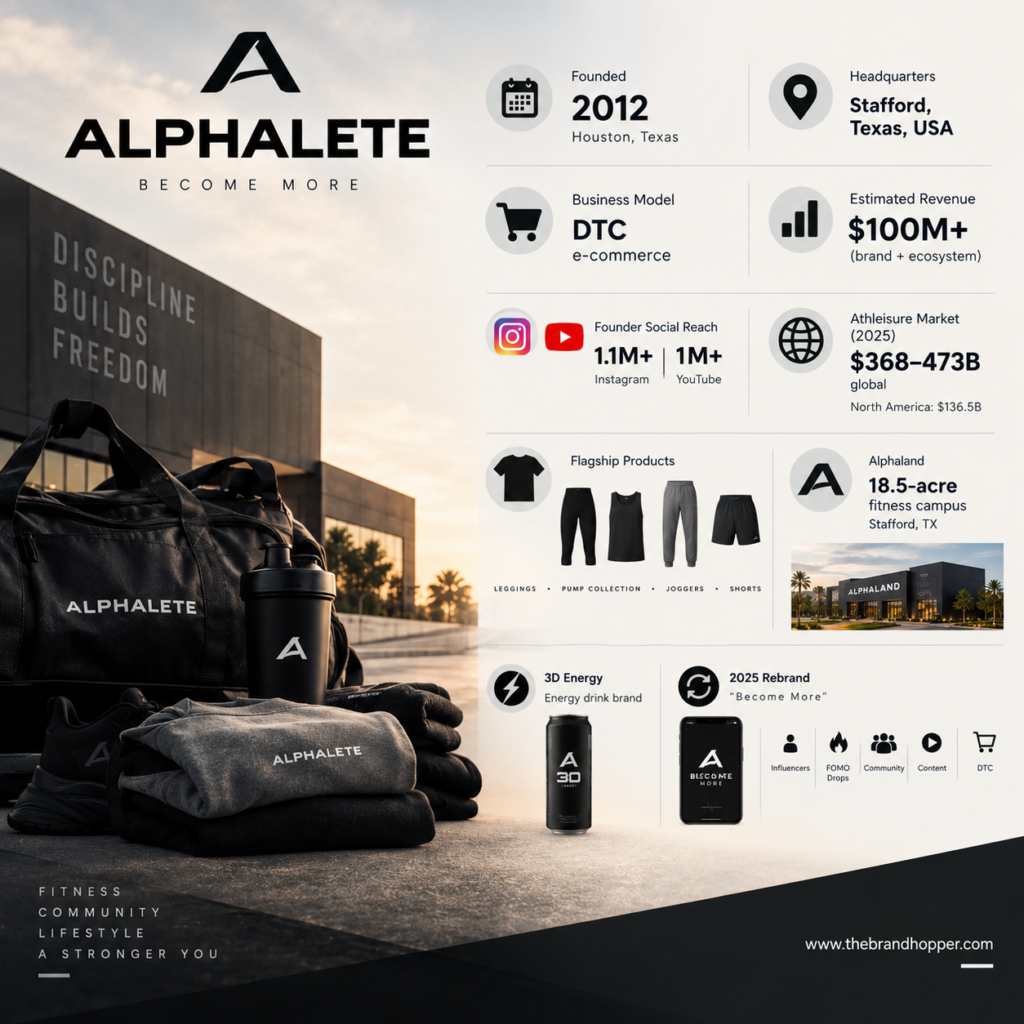
Founded in 2012 by bodybuilder and fitness content creator Christian Guzman, Alphalete has carved a fiercely loyal following across North America, Europe, and beyond by doing what most legacy brands can’t: making every customer feel like an insider. Through FOMO-driven product drops, a two-tier influencer programme that generated 87% of the brand’s Earned Media Value from its core ambassadors, and a $100M+ business empire that now includes Alphaland — a 18.5-acre fitness destination in Texas — Alphalete has rewritten the playbook for how a DTC athleisure brand grows in the social media era.
This comprehensive guide examines every dimension of Alphalete’s marketing strategy — from its social media dominance and influencer machine, to the 2025 “Become More” rebrand, the 4Ps marketing mix, STP analysis, competitive landscape, and the ecosystem of businesses that Christian Guzman has assembled around the core apparel brand.
The Founding Story of Alphalete: From YouTube Vlog to $100M+ Empire
Christian Guzman began posting fitness content on YouTube in 2012 at a time when the fitness influencer economy barely existed. A self-taught bodybuilder from Houston, Texas, Guzman built his audience by documenting his training, nutrition, and daily life with an authenticity that resonated deeply with young fitness enthusiasts who were tired of glossy, unattainable fitness advertising. By the time he had developed a loyal subscriber base, Guzman recognized an opportunity that few fitness creators had acted on: turn attention into a product.
Alphalete Athletics was born from this insight. Rather than licensing his name to an existing apparel company, Guzman built his own brand from scratch — designing garments that reflected his personal aesthetic, testing them in his own workouts, and launching them to an audience already primed to trust his judgment. The initial offering was modest: a collection of premium joggers and shorts that positioned the brand at the intersection of performance and style. The response was immediate and overwhelming. Products sold out within hours of launch, a pattern that would become the defining feature of Alphalete’s commercial model.

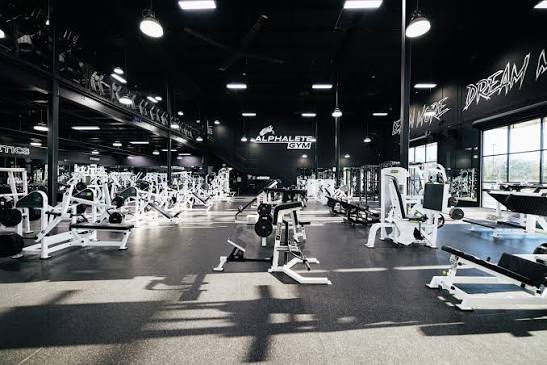
Over the following years, Guzman steadily expanded the business infrastructure behind the brand. He opened a warehouse gym in Texas that served as both a creative studio and community hub. He launched the Summer Shredding Challenge — an annual bodybuilding event now hosted at Alphaland — which doubled as a content engine and community-building event. He diversified into energy drinks with the launch of 3D Energy, creating a second revenue stream that complemented the apparel business and broadened the brand’s lifestyle positioning.
The culminating investment was Alphaland: an 18.5-acre multi-facility campus in Stafford, Texas, that opened after delays caused by COVID-19. The 30,000-square-foot facility features three distinct gym spaces, a restaurant, a VIP lounge, retail space, a soccer field, and two basketball courts — and generated nearly $10 million in its first year of operation. Alphaland represents the physical manifestation of everything Christian Guzman has built digitally: a destination where the online community becomes a real-world experience.
The Alphalete Ecosystem
One of the most distinctive aspects of Alphalete’s business model is that it is not a standalone apparel brand — it is the anchor of a multi-vertical fitness and lifestyle ecosystem. Understanding each pillar of this ecosystem is essential to understanding why Alphalete’s marketing strategy is so effective.
Alphalete Athletics — The Core Apparel Brand
The original and primary business, Alphalete Athletics is a premium DTC athleisure brand operating primarily through its e-commerce platform at alphaleteathletics.com. The brand is structured around periodic launch campaigns rather than an always-available catalogue, with major seasonal drops, limited-edition releases, and the occasional restock driving sustained customer engagement between launches.
The flagship Amplify legging range — particularly the “Amplify” and “Amplify SE” lines — remains the most recognized product in the portfolio, followed by the new Pump collection launched in 2025.
Alphaland — The Physical Experience
Alphaland is Christian Guzman’s most ambitious investment: an 18.5-acre campus in Stafford, Texas, that functions simultaneously as a world-class gym, a retail destination, a content studio, and a hospitality venue.
With three separate gym facilities catering to different training styles, a hotel for out-of-state visitors, a full-service restaurant, and an extensive retail floor stocked with Alphalete apparel, Alphaland is arguably the most sophisticated example of omnichannel fitness branding in the United States.
It generated nearly $10 million in revenue in its first year of operation and has become a pilgrimage destination for Alphalete fans globally.
3D Energy — The Beverage Extension
3D Energy is Christian Guzman’s energy drink brand, created to diversify the ecosystem’s revenue streams and capture the highly lucrative sports nutrition market. The brand went through a significant turbulence period — Guzman publicly discussed nearly liquidating the brand — before staging a major comeback in 2025.
The 3D Energy 2025 relaunch introduced a fully reworked formula: clear liquid (removing all colour dye), improved digestibility (certain ingredients removed), and up to eight new flavors including reworked versions of original fan favourites alongside entirely new offerings.
The transparent rebrand of 3D Energy in parallel with the Alphalete rebrand demonstrated Guzman’s willingness to make radical decisions to protect long-term brand health over short-term revenue.
Target Audience of Alphalete
Alphalete targets a specific, well-defined demographic within the fitness and lifestyle market: fitness-focused young adults aged 18–34 with a strong interest in health, aesthetics, and an active lifestyle. This audience demands both performance and style in their activewear — garments that function in the gym but look equally credible in a coffee shop or on a social media feed.
Demographically, Alphalete’s website traffic skews female (approximately 58%), reflecting the outsized impact of the brand’s legging range and the strong representation of female athletes in its ambassador programme. The brand’s presumed average household income of $75,000 indicates a consumer base with meaningful discretionary spending capacity — sufficient to invest in premium-priced athleisure while remaining price-sensitive enough to respond to FOMO-driven scarcity tactics.
Psychographically, the Alphalete consumer falls into one of three archetypes. The Community Seeker is drawn to Alphalete because of the brand’s tight-knit fitness community — they want to belong to something, not just buy something. The Performance Pursuer prioritises technical apparel credentials and trusts Alphalete’s quality claims because of Guzman’s own athlete credibility. The Collector is motivated by the brand’s limited-edition release strategy and derives identity value from owning rare Alphalete pieces before they sell out.
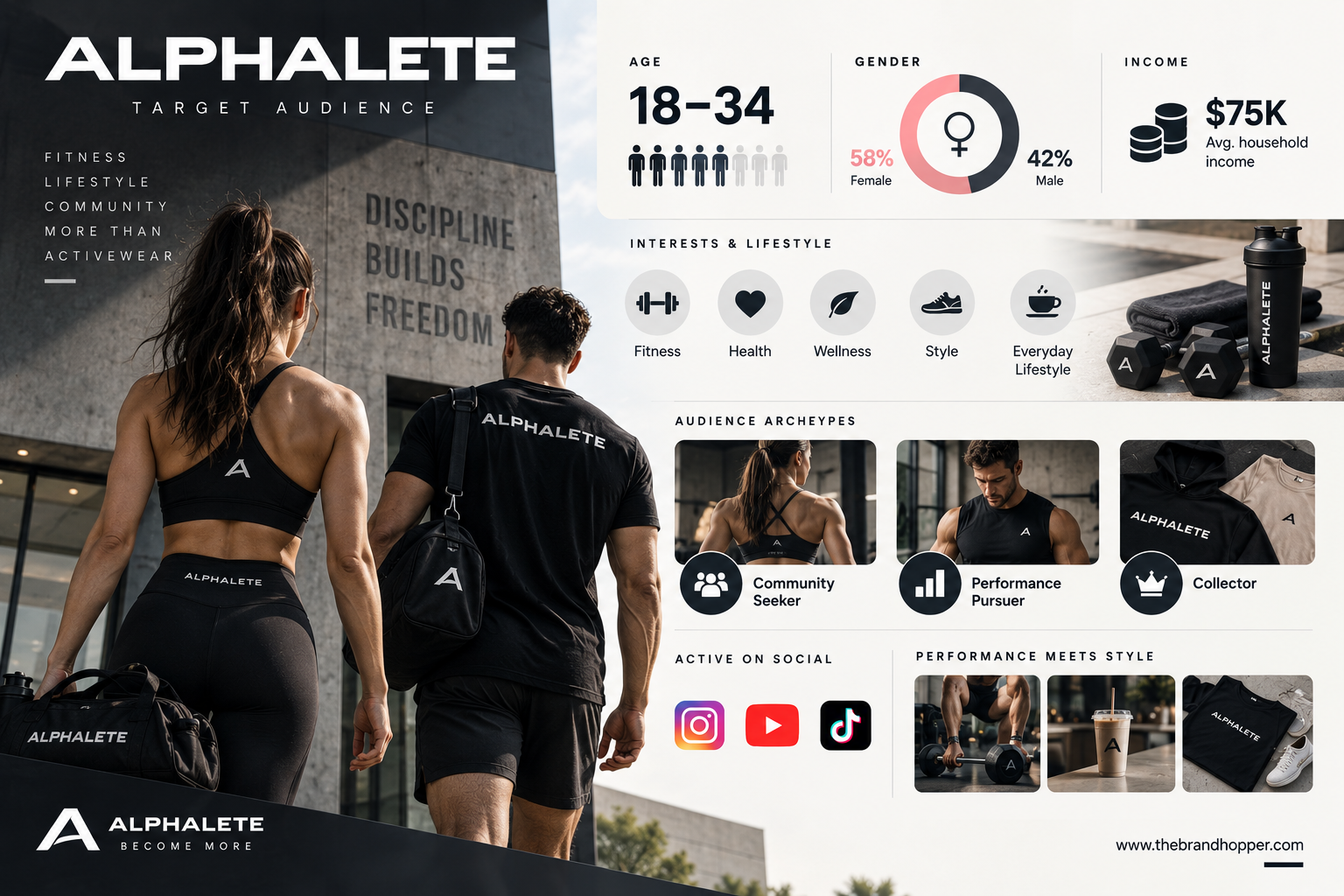
This audience’s deep engagement with social media — particularly Instagram, YouTube, and TikTok — makes Alphalete’s content-first marketing strategy a perfect fit. The brand reaches its customers where they already spend their time, through creators they already trust.
Marketing Strategies of Alphalete
1. Social Media Presence
Alphalete’s social media strategy is one of the most disciplined and community-focused in the DTC athleisure market. The brand maintains a consistent content cadence on Instagram — typically posting high-quality product and lifestyle imagery every two to three days, supplemented by daily Stories.
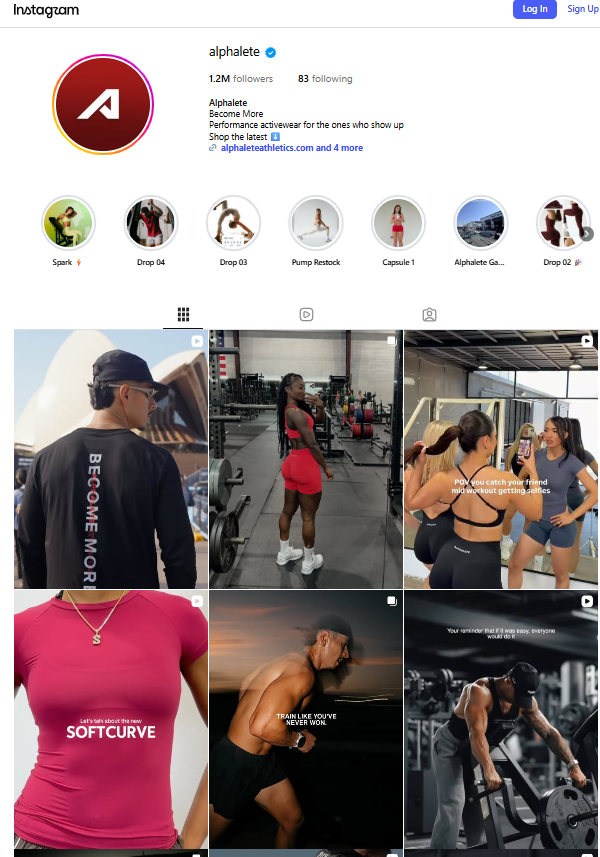
In 2025, the brand made a bold move as part of its “Become More” rebrand: it wiped its Instagram clean, posting only the cryptic words “thank you for everything” before relaunching with a fresh identity and content strategy. What appeared to be a farewell was in fact a calculated reset — a marketing masterstroke that generated enormous earned media coverage and sparked widespread speculation in the fitness community.
Christian Guzman’s personal accounts serve as the primary amplification engine. With 1.1M+ followers on Instagram and over 1 million YouTube subscribers, Guzman functions as a living, breathing brand channel for Alphalete. His vlogs, behind-the-scenes content, and product development reveals drive direct traffic to product launches and pre-sell anticipation in the days and weeks before a drop.
2. Influencer Marketing: The Two-Tier Model
Alphalete’s influencer marketing architecture is one of its most studied and replicated competitive advantages. The model operates on two distinct tiers that together create a powerful, authentic amplification network.
The first tier is the “official Alphalete athletes” programme — a curated squad of fitness professionals and social media personalities who represent the brand across their platforms. These brand ambassadors are selected for a combination of fitness credibility, aesthetic alignment with the Alphalete brand, and genuine product affinity. The programme has historically included well-known fitness personalities including Amanda Bucci, Steve Cook, and Calum Von Moger, each appealing to different segments of the Alphalete community. This core group has generated a staggering 87% of the brand’s total Earned Media Value — a testament to the power of a small, aligned team of authentic advocates over a broad, transactional influencer network.
The second tier is an affiliate programme open to any Alphalete enthusiast. By providing a personal referral code and commission structure, the affiliate programme transforms loyal customers into brand promoters, creating a distributed word-of-mouth network that extends far beyond the brand’s owned channels. The programme’s genius lies in its alignment of incentives: affiliates only earn when they drive actual sales, ensuring that promotional effort is genuine and purchase-motivated rather than impression-driven.
3. FOMO Marketing & Limited Editions
Alphalete’s product release strategy is engineered around the psychology of scarcity and urgency. Rather than maintaining a permanent, always-available catalogue, the brand operates on a launch-based model: products are released in defined windows, often with limited quantities and no guarantee of restock. This approach creates powerful FOMO (Fear Of Missing Out) dynamics that drive purchase urgency and generate social media buzz organically.
Launch day is treated as a cultural event within the Alphalete community. In the days and weeks leading up to a drop, Guzman and his team build anticipation through teaser content, behind-the-scenes product development footage, colourway reveals, and countdown posts. By the time a collection goes live on alphaleteathletics.com, the audience is primed and purchase-ready — a dynamic that routinely results in sell-outs within hours.
Limited-edition releases amplify this model further. Products such as the Limited Edition Red Camo Premium Joggers, the Amplify SE Gravity Legging in the “Nocturnal” colourway, and the collectible Alphalete 2017 Limited Edition Backpack have achieved near-cult status among brand loyalists. The secondary market for rare Alphalete pieces — with products trading at significant premiums — is evidence of a brand that has successfully created genuine collector demand, a phenomenon more commonly associated with luxury streetwear than functional athleisure.
4. Content Marketing & YouTube Strategy
Before Alphalete sold a single piece of apparel, Christian Guzman was building an audience through documentary-style YouTube vlogs that offered a transparent, often raw window into his fitness journey, his business decisions, and his daily life. This content-first approach created a level of trust with his audience that no paid advertising could replicate. When Guzman eventually introduced Alphalete products to his channel, his audience received them not as advertisements but as personal recommendations from someone they had come to know intimately over months and years of content consumption.
This YouTube heritage continues to be a core part of the Alphalete marketing ecosystem. Product development vlogs, behind-the-scenes launch preparation content, Summer Shredding Challenge training series, and Alphaland construction and launch documentation have all generated millions of views and driven substantial direct traffic to product launches. The YouTube channel functions as both a brand-building asset and a long-form advertising platform — and because Guzman’s audience actively seeks out his content, it operates with dramatically higher engagement and conversion rates than equivalent paid video advertising.
5. E-Commerce & DTC Model
Alphalete operates a direct-to-consumer e-commerce model that gives the brand complete control over its customer experience, brand presentation, and pricing strategy. By bypassing wholesale retail entirely, Alphalete captures the full retail margin on every sale — a structural advantage that enables investment in product quality, content production, and community events that would be impossible under a traditional wholesale distribution model.
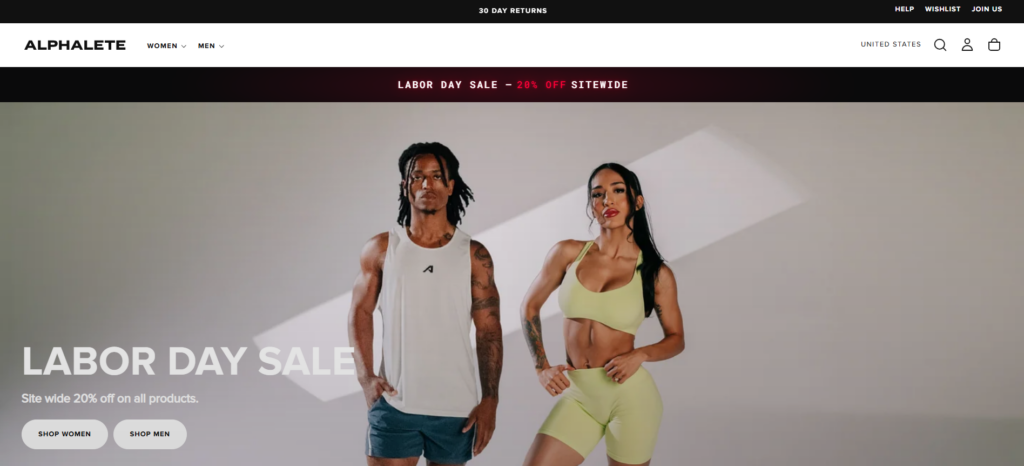
The e-commerce platform is supported by a UK-based warehouse that handles international orders, enabling global reach without the complexity of physical retail expansion. As part of the 2025 rebrand, Alphalete added a dedicated European distribution centre — a significant infrastructure investment that signals the brand’s commitment to scaling its European community without the shipping friction that had historically disadvantaged non-US customers.
The new Alphalete app (launched May 2025) and loyalty programme add a direct-to-consumer engagement layer that deepens customer relationships between product launches. Members can track points, access early launch notifications, and participate in community features that reinforce brand attachment beyond the transactional purchase moment.
The 2025 “Become More” Rebrand
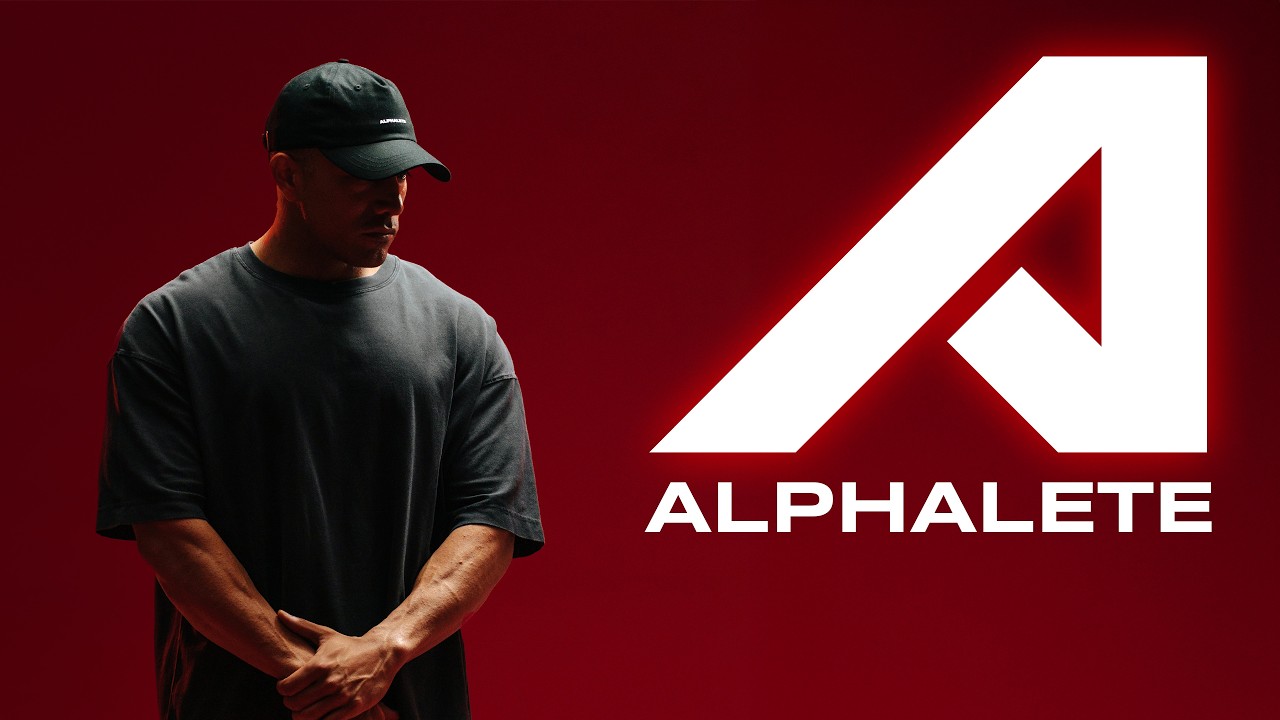
On May 7, 2025, Alphalete unveiled what it described as a full-scale reboot: a simultaneous refresh of its brand identity, website, app, loyalty programme, and live events strategy. The announcement came after one of the most attention-grabbing marketing moves in recent athleisure history — the complete wiping of the Alphalete Instagram account and the posting of just three words: “thank you for everything.”
The rebrand replaced the brand’s long-standing mantra “Proud but Never Satisfied” with an entirely new platform: “Become More.” The three pillars underpinning this new brand identity — “Learn more, dream more, be more” — represent a deliberate broadening of the brand’s aspirational positioning, from a fitness-specific identity to a broader philosophy of personal growth. This shift positions Alphalete not just as an apparel brand for gym-goers, but as a lifestyle brand for anyone committed to becoming a better version of themselves.
The operational changes accompanying the rebrand were equally significant. A redesigned website with improved UX and product discovery, a new dedicated Alphalete app providing a direct communication channel to the brand’s community, a revamped loyalty programme rewarding repeat purchasers, and a European distribution centre to reduce international shipping times all launched simultaneously. The return of large-scale community events — beginning in Los Angeles — marked Alphalete’s recommitment to the physical, real-world community experiences that have always differentiated it from purely digital-first competitors.
The 2025 rebrand is strategically significant for several reasons. It signals Alphalete’s intent to grow beyond its founding community into a more mainstream lifestyle positioning, while retaining the authenticity and intimacy that built the brand. It also addresses several of the structural competitive disadvantages that had accumulated since the brand’s early growth period — notably the lack of a dedicated app, the friction of international shipping, and the absence of a formal loyalty mechanism.
STP Analysis of Alphalete: Segmentation, Targeting & Positioning
Segmentation
Alphalete segments its market across four primary dimensions.
Demographically, the brand targets adults aged 18–34, with a slight female skew (approximately 58% of web traffic).
Geographically, the primary market is the United States, with significant secondary markets in the UK, Australia, Canada, and Germany — the latter of which is growing rapidly following the 2025 addition of European distribution infrastructure.
Psychographically, the brand identifies community-seekers, performance-pursuers, and collectors as its three core consumer archetypes.
Behaviourally, the brand distinguishes between launch-day loyalists (who buy every drop), sporadic purchasers (drawn in by specific limited-edition releases), and discovery-stage consumers (who enter the brand via influencer exposure and make a first purchase).
Targeting
Alphalete’s primary targeting strategy is highly focused: young, digitally native fitness enthusiasts who consume fitness content on social media platforms and whose purchase decisions are heavily influenced by peer and influencer recommendations.
This audience’s media habits — high social media consumption, active YouTube engagement, and strong community participation — align perfectly with Alphalete’s content-led growth model.
Secondary targeting extends to lifestyle consumers who are adjacent to the fitness world: those who value aesthetics and comfort in casual wear but are not competitive athletes, a segment that the 2025 “Become More” rebrand explicitly courts.
Positioning
Alphalete is positioned as the most authentic premium athleisure brand for the fitness-obsessed community.
The brand’s positioning triangle rests on three pillars: Founder Authenticity (Christian Guzman is not a celebrity endorser but a genuine athlete who built the brand for himself), Community Premium (Alphalete is not just a brand to wear but a community to belong to), and Quality at Price (premium materials and construction at a price point that is accessible to a working-young-adult audience without the luxury-tier price point of Lululemon).
This positioning creates clear differentiation from mass-market competitors (Nike, Adidas) on authenticity, from pure-luxury competitors (Lululemon) on price accessibility, and from other influencer-founded brands (Gymshark, Young LA) on depth of community engagement and physical experience through Alphaland.
Marketing Mix: The 4Ps of Alphalete
Product
Alphalete’s product strategy centres on performance-driven design with a premium aesthetic that commands attention both inside and outside the gym. The brand’s core product architecture includes: the Amplify legging family (the original hero product, featuring distinctive V-seam construction, moisture-wicking fabric, and a figure-flattering silhouette that has become the brand’s most recognizable signature); the Pump Collection (launched 2025, designed for performance-ready training with enhanced fit and fabric technology); Premium Joggers and shorts (men’s core category with a relaxed-meets-functional aesthetic); and a growing accessories range including bags, hats, and gym accessories.
Fabric technology is central to the product’s premium positioning. Alphalete uses high-quality moisture-wicking materials that manage perspiration effectively during high-intensity workouts. Strategic seam placement and panelling provide targeted muscle support without restricting range of motion. The overall garment construction prioritises longevity — Alphalete’s quality reputation is sustained by products that maintain their shape, colour, and performance characteristics through hundreds of washes, generating positive word-of-mouth and high repeat purchase rates among the brand’s core audience.
Price
Alphalete occupies the premium mid-market price tier — above mass-market athleisure brands (Nike basics, H&M Sport) but below true luxury positioning (Lululemon, Vuori). A typical pair of Alphalete leggings retails between $60–$80, with premium or limited-edition pieces reaching higher price points. This pricing strategy reflects a deliberate calculation: the brand’s target audience (young adults earning $75,000+) can afford premium athleisure but is price-sensitive enough to respond powerfully to launch urgency and scarcity signals.
The launch-based business model reinforces price discipline. Because products sell out quickly, Alphalete rarely needs to discount — there is no clearance rack, no perpetual sale, no outlet store. This scarcity-driven full-price sell-through is a significant financial advantage, preserving brand equity and margin integrity that brands operating on traditional wholesale/markdown models struggle to maintain.
Place (Distribution)
Alphalete’s distribution model is intentionally narrow. The primary sales channel is the brand’s own website (alphaleteathletics.com), which gives it complete control over brand presentation, customer data, and pricing. A UK warehouse handles international fulfilment for European and global customers, and the 2025 addition of a dedicated European distribution centre dramatically improves delivery times for a market that represents a growing share of the brand’s revenue.
Alphaland in Stafford, Texas, provides the only significant physical retail touchpoint — a deliberate choice that transforms a shopping trip into an experiential brand encounter rather than a commodity purchase. The absence of third-party retail partners (no Amazon, no department store wholesale) is a strategic choice that protects brand exclusivity and prevents commoditisation.
Promotion
Promotion is where Alphalete’s marketing machine operates at its most sophisticated. The brand’s promotional mix blends owned, earned, and paid channels in a model that most DTC brands aspire to but few achieve. Owned channels include the Alphalete website, the new Alphalete app, Christian Guzman’s YouTube channel (1M+ subscribers), and the brand’s Instagram and TikTok accounts. Earned media is generated primarily through the two-tier influencer programme, with the core Alphalete athletes generating 87% of earned media value. Paid channels play a supporting role — retargeting campaigns on Meta and Google capture high-intent shoppers in the launch window — but the brand’s earned media dominance means paid advertising is an amplifier rather than the primary customer acquisition mechanism.
For further reading on how premium sports brands build promotional ecosystems, see this detailed article on A Deep Dive into the Marketing Strategies of Oakley, which explores how a heritage sports brand maintains relevance through product innovation, athlete partnerships, and lifestyle marketing — a model that shares meaningful parallels with Alphalete’s community-driven approach.
Competitive Landscape of Alphalete
The global athleisure market is estimated at $368–473 billion in 2025, growing at a CAGR of approximately 9.4–9.7% — a market that has attracted intense competition from legacy sportswear giants, well-funded DTC challengers, and an increasingly sophisticated cohort of influencer-founded brands. Alphalete competes across multiple tiers of this market.
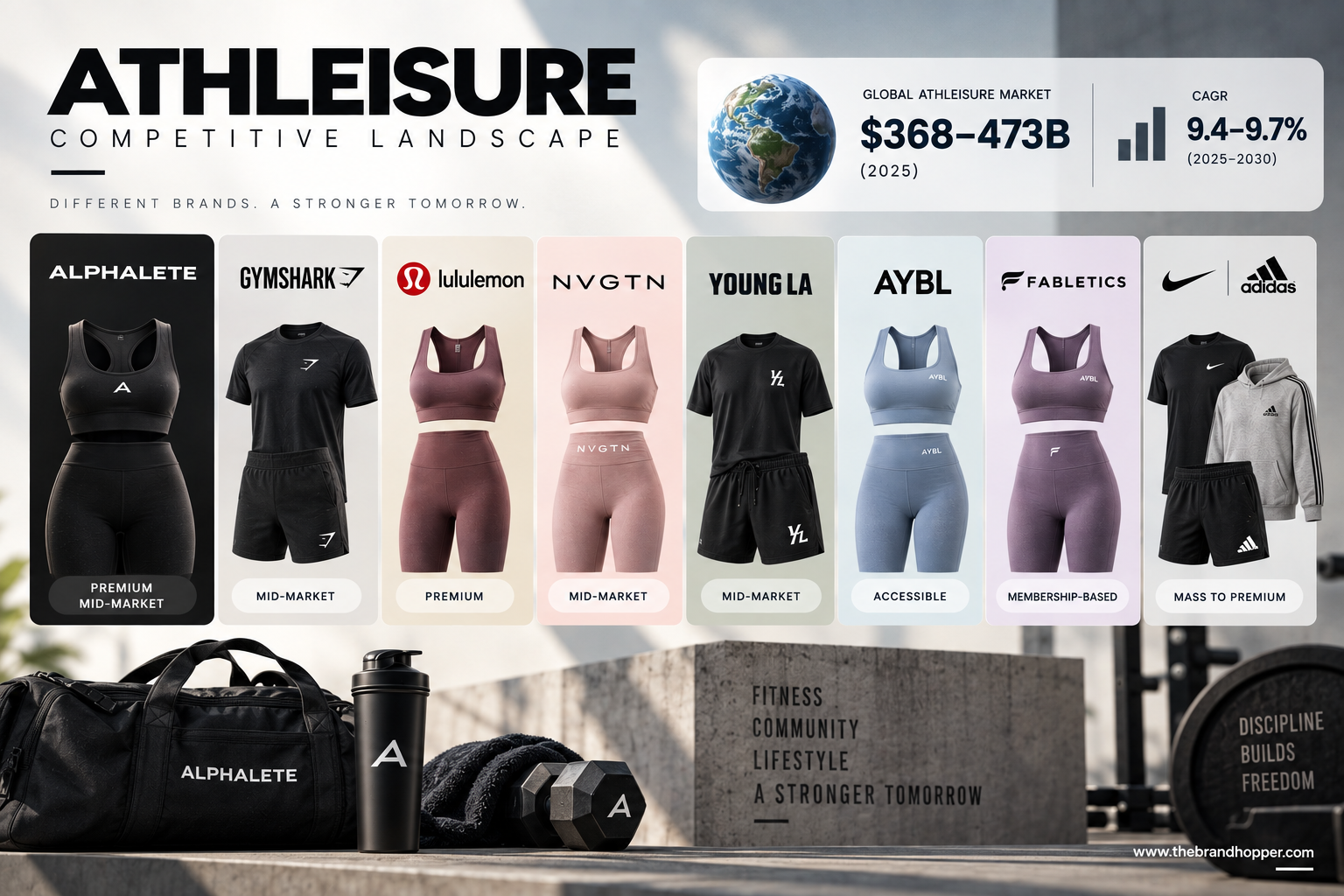
Alphalete’s primary competitive advantage versus Gymshark — its closest DTC peer — lies in community depth rather than community breadth. Gymshark’s community is significantly larger in raw numbers, but Alphalete’s community is more engaged, more loyal, and more willing to queue up at launch, pay full price, and advocate organically.
The brand’s closest competitive threat comes from emerging female-focused athleisure brands (NVGTN, AYBL) whose growth in the legging category — Alphalete’s revenue heartland — is accelerating through social media virality. The 2025 Pump collection launch appears directly positioned to defend and extend Alphalete’s leadership in the performance legging segment.
Frequently Asked Questions (FAQs)
Q: What is Alphalete’s marketing strategy?
A: Alphalete’s marketing strategy is built on five pillars: founder-led content marketing (Christian Guzman’s YouTube and Instagram), a two-tier influencer programme (official athletes + affiliate network), FOMO-driven product drops with limited stock, a direct-to-consumer e-commerce model at alphaleteathletics.com, and community-building through physical events, the Alphaland campus, and the 2025 “Become More” rebrand. The brand’s core ambassador group generates 87% of its Earned Media Value.
Q: Who founded Alphalete and when?
A: Alphalete was founded in 2012 by Christian Guzman, a bodybuilder and fitness content creator from Houston, Texas. Guzman began building his audience on YouTube in 2012 before launching the athleisure brand, which grew from a small apparel line into a $100M+ business empire including the Alphaland fitness campus and the 3D Energy drinks brand.
Q: How much revenue does Alphalete make?
A: Alphalete Athletics is estimated to generate over $100 million in annual revenue across its combined business activities. Some third-party business data sources estimate annual revenue at approximately $147 million. The brand does not publicly disclose exact financial figures as it is a privately held company, but multiple credible sources confirm the $100M+ scale of the business.
Q: What is the 2025 Alphalete “Become More” rebrand?
A: On May 7, 2025, Alphalete unveiled a comprehensive brand reboot under the new mantra “Become More,” replacing the previous tagline “Proud but Never Satisfied.” The rebrand included a new website, a dedicated Alphalete app, a revamped loyalty programme, a new European distribution centre for faster international delivery, and the return of large-scale community events. The brand also wiped its Instagram account clean and relaunched with a fresh content identity — a marketing move that generated significant earned media coverage.
Q: What is the Alphalete FOMO marketing strategy?
A: Alphalete’s FOMO (Fear Of Missing Out) marketing strategy is built around periodic, time-limited product launches with intentionally constrained inventory. Products are released in defined launch windows rather than maintained as a permanent catalogue, with popular items regularly selling out within hours. Limited-edition collections — featuring unique colourways, special edition logos, and exclusive designs — create collector demand and a secondary market, driving urgency and full-price sell-through without the need for clearance discounts.
Q: Who are Alphalete’s main competitors?
A: Alphalete’s primary competitors are Gymshark (its closest DTC peer by audience profile and business model), Lululemon (the premium market benchmark), NVGTN and AYBL (fast-growing female-focused athleisure challengers), and Young LA (male-focused streetwear-athleisure crossover). Nike and Adidas represent the mass-market competitive framing rather than direct premium segment rivals. In the broader athleisure market, Fabletics competes for a similar female-focused, digitally native audience.
Q: What is Alphaland?
A: Alphaland is an 18.5-acre multi-facility fitness campus in Stafford, Texas, built and owned by Christian Guzman. The 30,000-square-foot complex features three distinct gym facilities, a full-service restaurant, a VIP lounge, a hotel for visiting guests, a retail floor stocked with Alphalete apparel, a soccer field, and two basketball courts. Alphaland generated nearly $10 million in revenue in its first year of operation and functions as both a premium fitness destination and a flagship brand experience for the Alphalete community.
Q: How does Alphalete use influencer marketing?
A: Alphalete uses a two-tier influencer model. The first tier is a curated squad of “official Alphalete athletes” — fitness professionals and social media personalities who are genuine users of the brand and consistently promote it across their platforms. This core group has been responsible for generating approximately 87% of Alphalete’s total Earned Media Value. The second tier is an open affiliate programme that allows any brand enthusiast to earn commission by promoting Alphalete products, extending the brand’s reach through an authentic distributed network.
Q: What is the Alphalete direct-to-consumer model?
A: Alphalete sells exclusively through its own website (alphaleteathletics.com) and its Alphaland retail space, bypassing wholesale retailers and third-party platforms like Amazon. This direct-to-consumer model gives the brand complete control over brand presentation, pricing, customer data, and margin. It also enables the launch-based, scarcity-driven sales model that drives FOMO purchasing behaviour. International orders are fulfilled via a UK warehouse, with a new European distribution centre added in 2025 to serve the growing European community.
Q: What are Alphalete’s flagship products?
A: Alphalete’s most iconic product is the Amplify legging — a premium performance legging featuring distinctive V-seam construction, moisture-wicking fabric, and a figure-flattering silhouette. The Amplify SE (Special Edition) line extends the flagship with exclusive colourways and limited-edition design details. In 2025, Alphalete launched the Pump Collection — a new performance-focused line described as “the best thing since Amplify” featuring enhanced fit and fabric technology. The men’s premium jogger range and a growing shorts category round out the core apparel offering.
Conclusion
Alphalete’s rise from a YouTube creator’s passion project to a $100M+ fitness and lifestyle empire is one of the most instructive brand-building stories of the social media era. What makes Alphalete remarkable is not any single tactic but the coherent system that connects all of them: a founder who is genuinely trusted by his audience, an influencer programme that generates 87% of earned media from a small core group, a FOMO-driven launch model that drives full-price sell-through without discounting, a physical campus that transforms digital community into real-world experience, and a DTC model that captures the full value of every customer relationship.
The 2025 “Become More” rebrand signals the next chapter: a brand that is ready to grow beyond its founding community into a broader lifestyle positioning, while investing in the infrastructure — European distribution, a dedicated app, a loyalty programme, live events — that will be needed to serve a significantly larger audience. The addition of the Pump Collection, the 3D Energy comeback, and the return of large-scale community events all point to a brand that is accelerating, not consolidating.
For marketers and brand builders, Alphalete offers a masterclass in what becomes possible when a brand is built around genuine community, authentic content, and a founder who understands the audience because he is the audience. In a market where consumer trust is increasingly scarce and expensive to buy, Alphalete built it for free — one YouTube video at a time.
Also Read: Marketing Strategies of Gymshark
To read more content like this, subscribe to our newsletter