Last Updated on October 16, 2026 by Team TBH
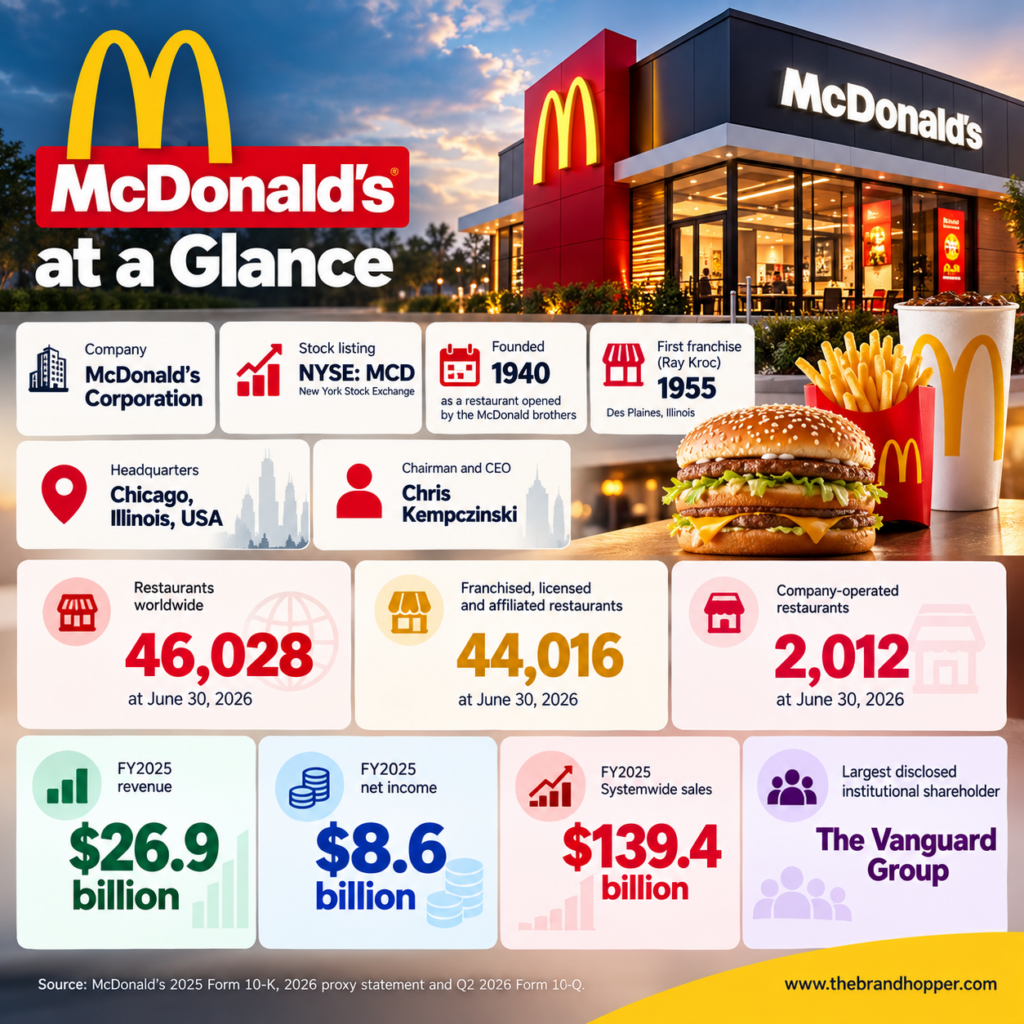
McDonald’s serves more than 70 million customers daily across a global network of more than 46,000 restaurants. Yet most of the people working in those restaurants are employed by franchisees, licensees or affiliated operators rather than directly by McDonald’s Corporation.
So, who actually owns McDonald’s? McDonald’s Corporation is a publicly traded company listed on the New York Stock Exchange under the ticker MCD. It owns the brand and operating system and holds substantial real estate interests, while millions of public-market investors own its shares.
The company generates much of its revenue from franchised restaurants through rent, royalties and related fees. This guide explains who owns McDonald’s, its major shareholders, its franchise model, its international operating partners and its latest financial performance.
Quick Answer: McDonald’s is owned by its public shareholders, with The Vanguard Group, BlackRock and State Street among its largest disclosed institutional shareholders. It has no corporate parent company, and Chairman and CEO Chris Kempczinski leads the business.
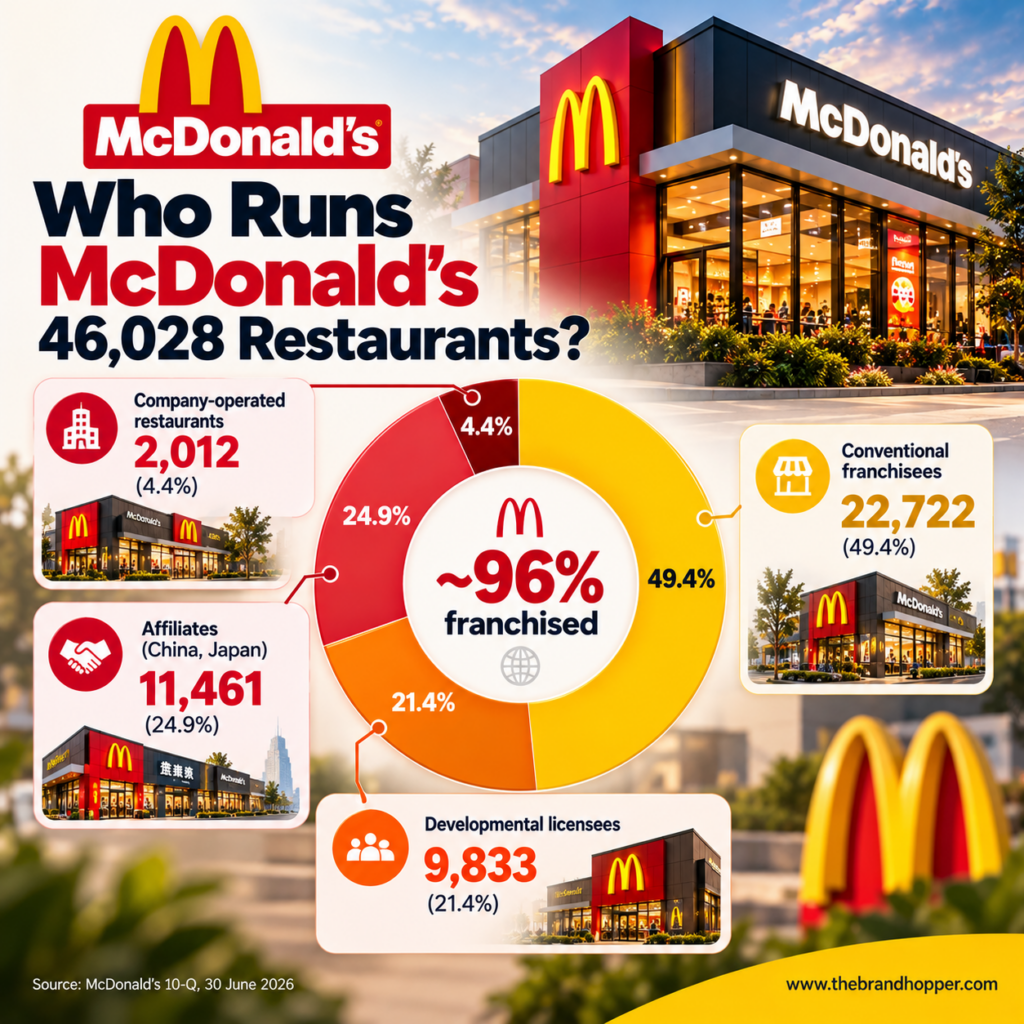
Approximately 95.6% of McDonald’s restaurants were franchised, licensed or affiliated as of June 30, 2026. The remaining restaurants were company-operated.
Who Owns McDonald’s Corporation?
McDonald’s Corporation is a widely held public company. Its common stock trades on the New York Stock Exchange under the ticker symbol MCD, allowing individuals and institutions to buy and sell shares.
Unlike founder-controlled businesses with special voting arrangements, McDonald’s has one class of common stock. No single shareholder is publicly identified as controlling the company.
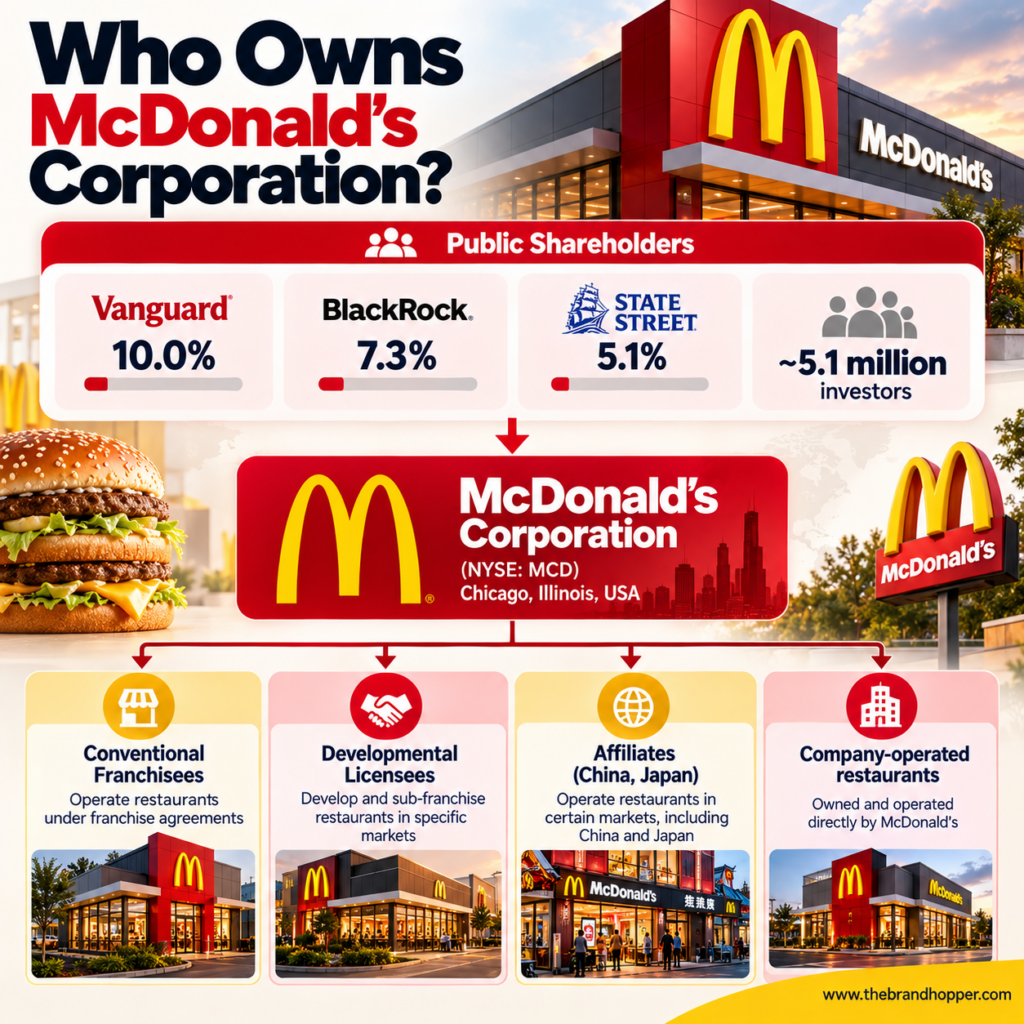
According to McDonald’s 2026 proxy statement, three institutional investors each beneficially owned more than 5% of its common stock as of December 31, 2025.
| Shareholder | Shares beneficially owned | Percentage of common stock |
|---|---|---|
| The Vanguard Group | 71,635,329 | 10.03% |
| BlackRock, Inc. | 51,974,467 | 7.3% |
| State Street Corporation | 35,988,736 | 5.1% |
These institutions commonly manage investments through index funds, exchange-traded funds and other investment products on behalf of clients. Their disclosed shareholdings do not mean that they directly manage McDonald’s restaurants or exercise unilateral control over the company.
McDonald’s proxy statement also reports that directors and executive officers collectively owned less than 1% of the company’s common stock. This reinforces the distinction between the company’s public shareholders and its management team.
Who Runs McDonald’s?
McDonald’s shareholders elect the Board of Directors, which oversees corporate governance and senior leadership. The executive team manages the company’s strategy, financial performance and global operations.
| Name | Role |
|---|---|
| Chris Kempczinski | Chairman and Chief Executive Officer |
| Miles White | Lead Independent Director |
| Ian Borden | Executive Vice President and Global Chief Financial Officer |
| Skye Anderson | President, McDonald’s USA |
McDonald’s appointed Skye Anderson as President of McDonald’s USA in August 2026. She succeeded Joe Erlinger and was selected to lead the company’s largest national market.
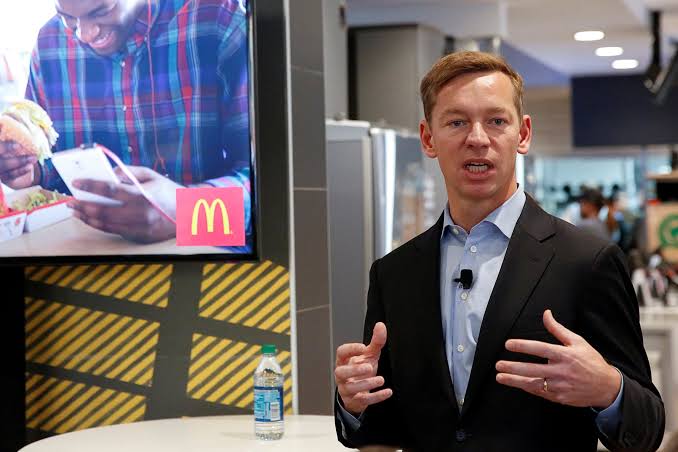
The distinction is important: shareholders own the company, the Board provides oversight, and management is responsible for running the business.
The McDonald’s Franchise Model Explained
McDonald’s describes itself as primarily a franchisor. Rather than owning and operating every restaurant, it works with franchisees, developmental licensees and affiliated operators around the world.
Its 2025 Form 10-K identifies four principal restaurant categories.
| Structure | How it works | Restaurants at December 31, 2025 |
|---|---|---|
| Conventional franchise | McDonald’s generally owns or leases the property; franchisees operate restaurants and pay rent and royalties | 22,570 |
| Developmental licence | A licensee generally finances and operates restaurants and pays McDonald’s a royalty | 9,675 |
| Foreign affiliate | McDonald’s has an equity interest in the operator, alongside its other commercial arrangements | 11,072 |
| Company-operated | McDonald’s directly operates the restaurant | 2,039 |
| Total | Worldwide restaurant system | 45,356 |
By June 30, 2026, McDonald’s reported 46,028 restaurants worldwide: 22,722 conventional franchised, 9,833 developmental licensed, 11,461 foreign affiliated and 2,012 company-operated restaurants..
Franchise and licence agreements generally run for 20 years, although the precise terms depend on the arrangement. McDonald’s sets brand and operating standards, while franchisees are responsible for running their businesses in accordance with their agreements.
Franchisees typically manage local staffing and day-to-day restaurant operations. They benefit from the McDonald’s brand, established operating systems, purchasing scale and marketing infrastructure, while paying fees and meeting contractual requirements.
Why McDonald’s Is Often Called a Real Estate Company
Real estate is an important part of McDonald’s business model. Under many conventional franchise arrangements, McDonald’s owns or leases the restaurant property and charges the franchisee rent in addition to royalties and other fees.
McDonald’s has historically reported substantial ownership of the land and buildings used by restaurants in its consolidated markets. This property strategy helps the company maintain greater control over restaurant locations and creates a recurring income stream tied to the franchise network.
The model has historical roots in the expansion led by Ray Kroc and the company’s early focus on acquiring or leasing restaurant sites. Real estate remains an important source of competitive advantage, but McDonald’s is still a restaurant franchisor and operator—not formally a real estate investment company.
How McDonald’s Makes Money
McDonald’s earns revenue through three main channels: franchised restaurants, company-operated restaurants and other revenue sources.
Franchised restaurant revenue includes rent, royalties and initial fees. Company-operated restaurant revenue comes from food and beverage sales at restaurants run directly by McDonald’s.
| Revenue line | FY2025 | FY2024 |
|---|---|---|
| Revenue from franchised restaurants | $16.5 billion | $15.7 billion |
| Sales by company-operated restaurants | $9.7 billion | $9.8 billion |
| Other revenue | $0.6 billion | $0.4 billion |
| Total revenue | $26.9 billion | $25.9 billion |
| Operating income | $12.4 billion | $11.7 billion |
| Net income | $8.6 billion | $8.2 billion |
| Diluted earnings per share | $11.95 | $11.39 |
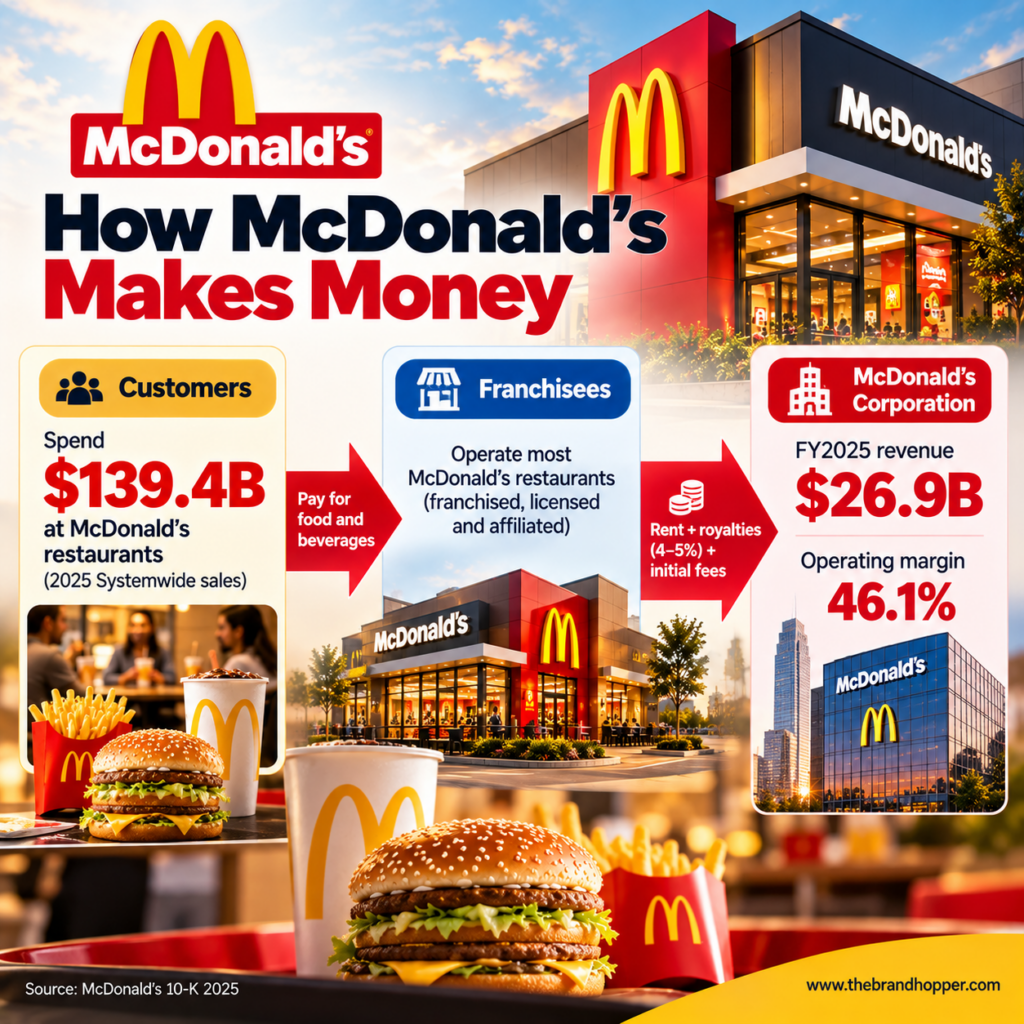
McDonald’s reported $139.4 billion in Systemwide sales in 2025. Systemwide sales include sales generated by franchised and company-operated restaurants, whereas consolidated revenue is the amount McDonald’s itself recognises under accounting rules.
This difference explains why McDonald’s reported revenue is much smaller than the total amount customers spend across the restaurant network. Franchisees retain the restaurant-level sales revenue they earn, while McDonald’s receives contractual rent, royalties and other payments.
McDonald’s reported an operating margin of 46.1% in FY2025, up from 45.2% in 2024. This high margin reflects the economics of its franchised business, although results can still be affected by operating costs, foreign exchange, consumer demand and investment requirements.
Systemwide sales at franchised restaurants were approximately $129.7 billion in 2025. The total includes conventional franchised, developmental licensed and foreign affiliated restaurants; figures may not sum precisely because of rounding.
Latest Financial Results
McDonald’s second-quarter 2026 results cover the three months ended June 30, 2026. Revenue increased 4% year on year to approximately $7.1 billion, net income reached $2.362 billion and diluted earnings per share rose 6% to $3.32.
Global comparable sales increased 1.3%, while global Systemwide sales grew 5% to $37 billion. Across 70 loyalty markets, Systemwide sales to loyalty members reached $40 billion over the trailing 12 months, with nearly 220 million 90-day active loyalty users. Source: McDonald’s Q2 2026 results.
These figures show the scale of the business, but quarterly results should not be directly compared with full-year totals without accounting for the different reporting periods.
Dividends and Shareholder Returns
McDonald’s has a long record of paying dividends and increasing its dividend annually. In late 2025, it announced a 5% increase in its quarterly dividend to $1.86 per share, equivalent to $7.44 per share annually at that rate.
The company also returns capital to shareholders through share repurchases. Dividend payments and buybacks are separate from restaurant-level sales and franchisee earnings, and future distributions depend on Board decisions and business conditions.
How Much Does a McDonald’s Franchise Cost?
Becoming a McDonald’s franchisee in the United States requires substantial capital and approval from the company. The 2026 US Franchise Disclosure Document provides the following estimates for a traditional restaurant.
- Initial franchise fee: $45,000 for a standard traditional restaurant arrangement.
- Service fee or royalty: Generally 4% or 5% of gross sales, depending on the applicable circumstances and agreement.
- Advertising contribution: At least 4% of gross sales under the stated FDD terms.
- Rent: Determined by the lease and can include base rent and percentage rent.
- Estimated initial investment: Approximately $1.472 million to $2.807 million for a traditional restaurant.
- Agreement term: Generally 20 years for the applicable conventional franchise arrangement.
The estimated investment includes more than the initial franchise fee. Equipment, signage, seating, décor, opening expenses and working capital can account for a substantial part of the total.
Applicants must also meet McDonald’s financial, operational and training requirements. The figures above apply to the US and should not be used as estimates for opening a McDonald’s in India or another country.
Who Owns McDonald’s Around the World?
McDonald’s uses different ownership and operating arrangements across countries. Its international structure includes markets where the company operates and franchises restaurants directly, alongside developmental licensed markets where local partners run much of the business.
A local company operating McDonald’s restaurants is not necessarily the owner of the global McDonald’s brand. Brand ownership, the ownership of individual restaurants and the ownership of the local operating company are distinct concepts.
McDonald’s India
McDonald’s entered India in 1996 and operates through regional business arrangements. The west and south of India are served by Westlife Foodworld’s operating business, while the north and east are served by Connaught Plaza Restaurants Limited (CPRL).
West and South India: Westlife Foodworld
Westlife Foodworld is a publicly listed Indian company associated with the Hardcastle Restaurants business, which operates McDonald’s restaurants in west and south India. It is a local operating partner, not the owner of the worldwide McDonald’s Corporation.
Westlife reports its own restaurant count, revenue and expansion plans through its financial disclosures. These numbers should be dated to the relevant quarter or financial year because restaurant counts and targets change over time.
North and East India: Connaught Plaza Restaurants
Connaught Plaza Restaurants Limited operates McDonald’s restaurants in north and east India. McDonald’s resolved its long-running dispute with former partner Vikram Bakshi through a buyout arrangement and subsequently entered into a partnership with the MMG Group for the region.
CPRL’s local operating arrangements are distinct from ownership of McDonald’s Corporation and the global brand. Any investment or restaurant expansion target attributed to CPRL should be tied to a dated company announcement rather than presented as a completed result.
McDonald’s China
McDonald’s operations in mainland China, Hong Kong and Macau are run through a business in which McDonald’s Corporation holds a minority equity stake alongside a controlling local investment consortium.
At the end of 2025, McDonald’s held a 48% stake, while a consortium led by CITIC Capital held the remaining 52%. The transaction that increased McDonald’s interest from 20% to 48% was announced in 2023 and completed in 2024.
The arrangement illustrates how McDonald’s can retain a significant economic interest in a market while a local partner holds the controlling stake and supports regional operations.
McDonald’s Japan
McDonald’s Japan operates through McDonald’s Japan Holdings Co., Ltd., a company listed in Japan. McDonald’s Corporation held a 35% stake at the end of 2025.
This is another example of a market where the global brand owner has an equity interest in the local business rather than directly owning every restaurant in the country.
Russia: A Notable Exit
In 2022, following Russia’s invasion of Ukraine, McDonald’s announced its exit from the Russian market and sold its Russian business to a local licensee associated with Alexander Govor.
The restaurants reopened under the Vkusno i tochka brand. McDonald’s no longer operates its former Russian restaurant network under the McDonald’s brand.
A Brief History of McDonald’s Ownership
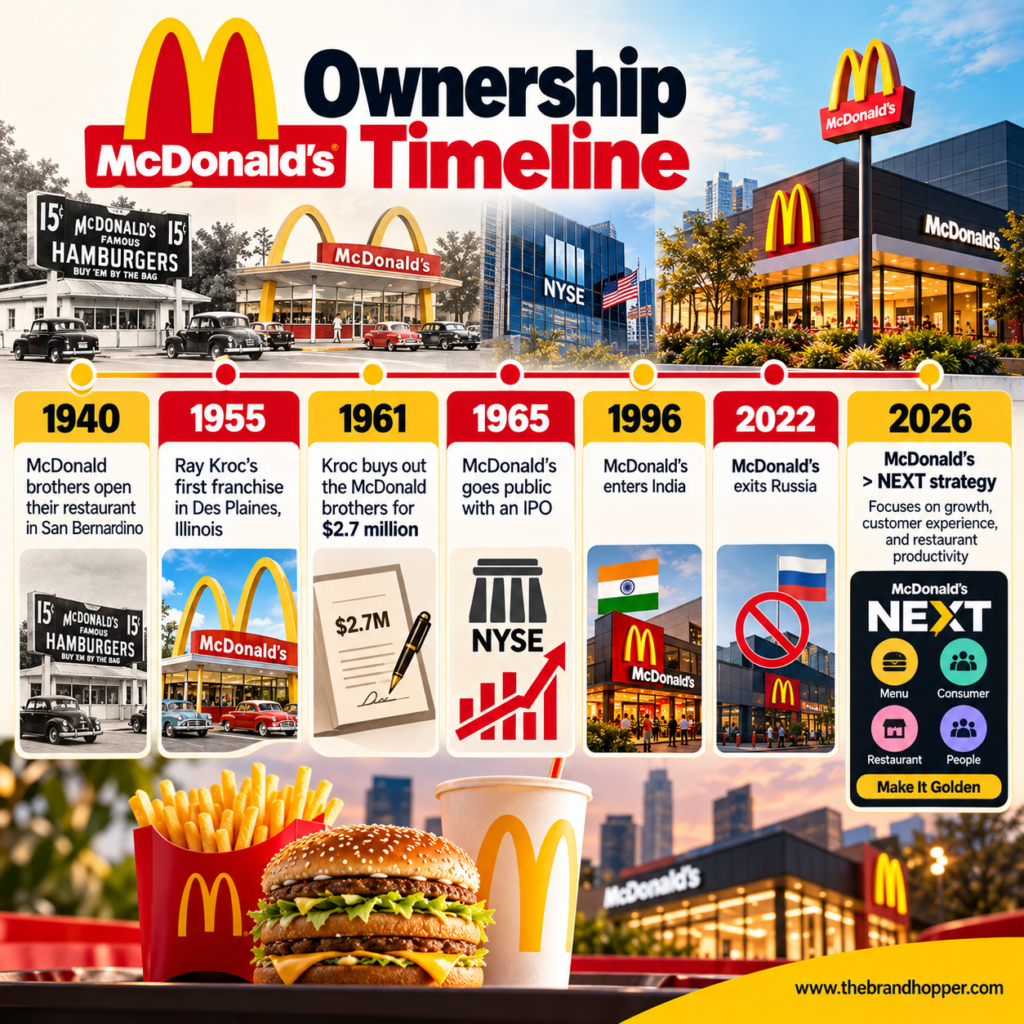
What’s Next for McDonald’s?
In September 2026, McDonald’s announced its McDonald’s > NEXT strategy, building on its earlier Accelerating the Arches plan. The strategy focuses on customer preference, menu quality, personalised consumer engagement, restaurant productivity and employee experience.
The company set a target of gaining 1.5 percentage points of market share in both chicken and beverages by 2030, while maintaining its leadership position in beef. It also aims to reach an operating margin in the low-to-mid 50% range and deliver approximately 250 basis points of gross restaurant-level efficiency gains as the strategy is deployed.
These are company targets, not achieved results. McDonald’s also announced Make It Golden, a multi-year commitment to improving food and hospitality across its restaurant system.
Restaurant expansion remains another part of its growth model. McDonald’s opened nearly 2,300 restaurants across the system in 2025 and expects new restaurants to contribute to Systemwide sales growth in 2026.
The company continues to rely heavily on franchisees, licensees and affiliates for global expansion. This allows it to extend its footprint while sharing investment and operating responsibilities with local partners.
The Bottom Line
McDonald’s Corporation owns the McDonald’s brand and operating system and is itself owned by public shareholders. Vanguard, BlackRock and State Street are among its largest disclosed institutional shareholders, but none is identified as a controlling owner.
The restaurants are a different matter: most are operated by franchisees, developmental licensees or affiliates. These local businesses manage restaurant operations under agreements with McDonald’s, while the corporation earns revenue from rent, royalties, company-operated restaurants and other sources.
This combination of brand ownership, franchising, real estate and local partnerships is central to McDonald’s global business model. It enables the company to maintain a consistent brand while expanding through different operating arrangements across markets.
Frequently Asked Questions
Q: Who is the owner of McDonald’s?
A: McDonald’s is owned by McDonald’s Corporation, a publicly traded company listed on the New York Stock Exchange under the ticker MCD. Its shares are held by public investors, including major institutional shareholders such as Vanguard, BlackRock and State Street.
Q: Does McDonald’s have a parent company?
A: No. McDonald’s Corporation is the ultimate parent company of the McDonald’s system and is not a subsidiary of another company.
Q: Who is the largest shareholder of McDonald’s?
A: The Vanguard Group was the largest institutional shareholder listed in McDonald’s 2026 proxy statement, with 71,635,329 shares, or 10.03% of common stock, based on the disclosed ownership information.
Q: What percentage of McDonald’s restaurants are franchised?
A: Approximately 95.6% of McDonald’s restaurants were franchised, licensed or affiliated at June 30, 2026. The company reported 44,016 such restaurants out of a worldwide total of 46,028.
Q: Who owns McDonald’s in India?
A: McDonald’s operates in India through regional businesses. Westlife Foodworld’s operating business serves west and south India, while Connaught Plaza Restaurants Limited serves north and east India.
Q: Who owns McDonald’s China?
A: McDonald’s China, Hong Kong and Macau operations are run through a business in which McDonald’s Corporation held a 48% stake at the end of 2025. A consortium led by CITIC Capital held the remaining 52%.
Q: Is McDonald’s a real estate company?
A: McDonald’s is primarily a restaurant franchisor and operator, but real estate is a major part of its business model. The company owns or leases properties used by many conventional franchisees and earns rent in addition to royalties and other fees.
Q: How much does it cost to open a McDonald’s franchise?
A: In the United States, the 2026 Franchise Disclosure Document estimates an initial investment of approximately $1.472 million to $2.807 million for a traditional restaurant, including a $45,000 initial franchise fee. Royalties, advertising contributions, rent and other ongoing expenses apply, and the terms vary by arrangement.
Q: Who is the CEO of McDonald’s in 2026?
A: Chris Kempczinski is the Chairman and CEO of McDonald’s Corporation. Skye Anderson is President of McDonald’s USA, the company’s largest national market.
Also Read: McDonald’s vs Burger King: Which Fast Food Brand Wins?
To read more content like this, subscribe to our newsletter