
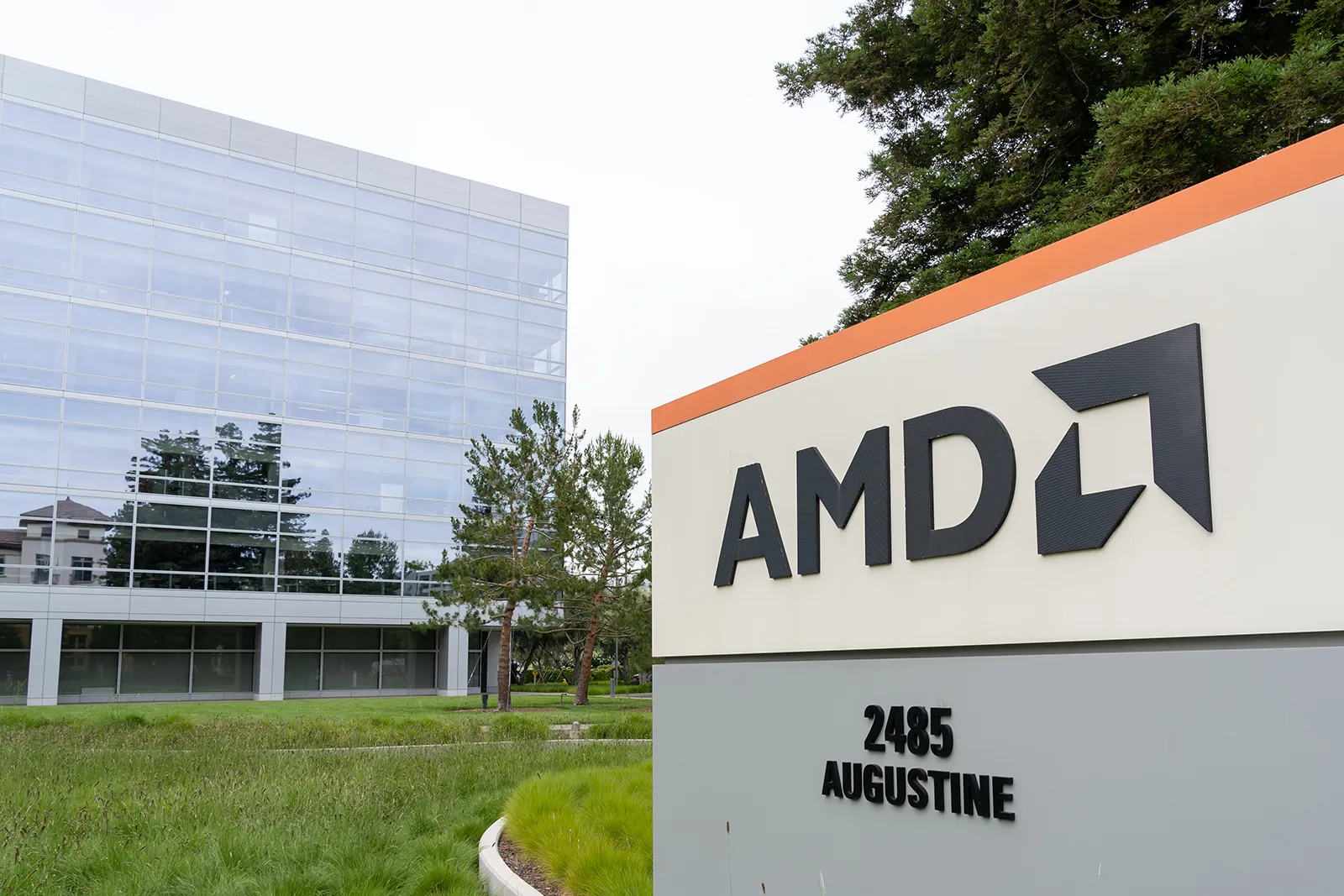
Last Updated on October 20, 2026 by Team TBH
Advanced Micro Devices (AMD) has completed one of the most significant turnarounds in the semiconductor industry. After years of financial pressure and intense competition from Intel, the company has built a major position in desktop and server processors, graphics cards, adaptive computing and AI accelerators.
AMD reported record revenue of $34.6 billion in FY2025, up 34% year over year. Its growth reflects demand for EPYC server CPUs, Ryzen processors and Instinct AI accelerators, although competition and execution risks remain substantial.
The semiconductor industry requires sustained research and development, advanced manufacturing partnerships, software ecosystems and long customer qualification cycles. AMD competes with established chip designers, vertically integrated technology companies and cloud providers developing their own processors and AI accelerators.
This guide examines 17 important AMD competitors across CPUs, GPUs, AI accelerators, embedded computing and custom silicon.
AMD at a Glance
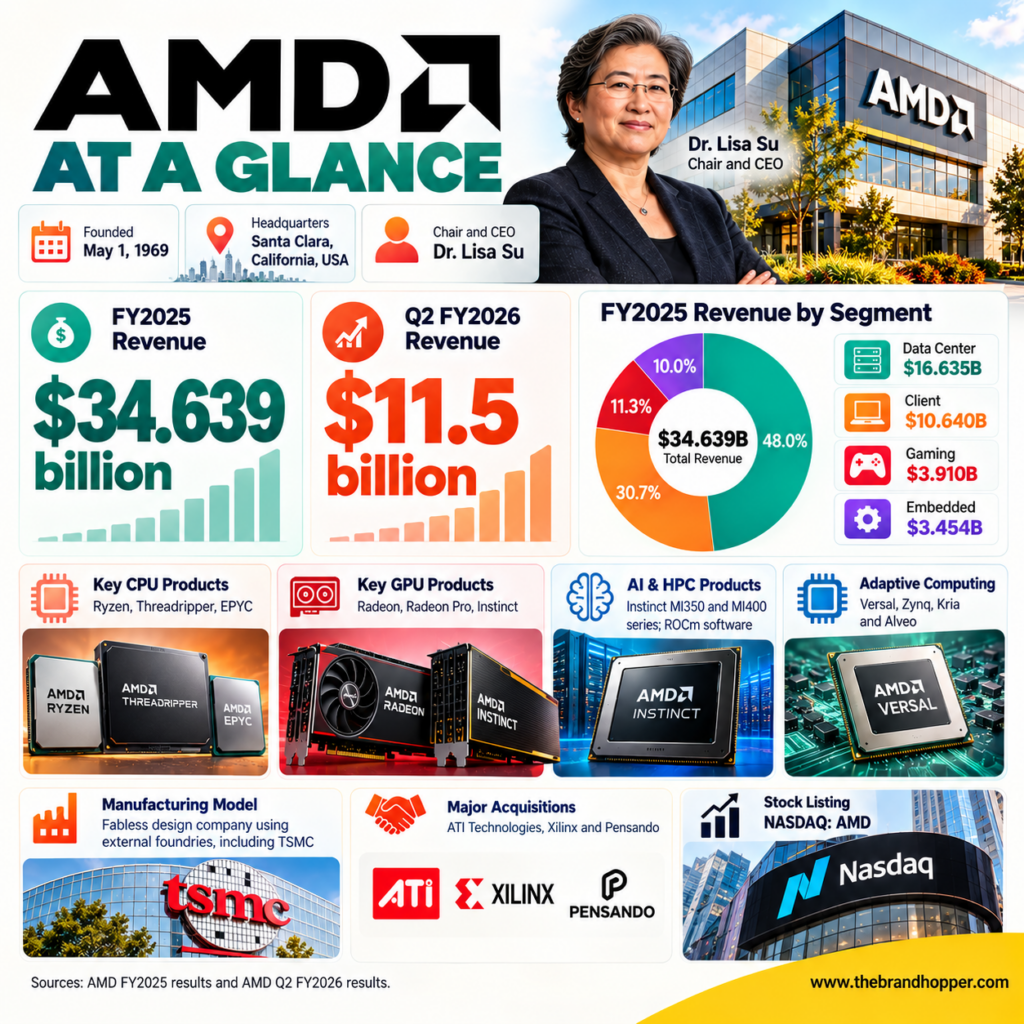
AMD’s FY2025 segment figures are important for understanding its business mix. Data Center revenue was $16.635 billion, Client revenue was $10.640 billion, Gaming revenue was $3.910 billion and Embedded revenue was $3.454 billion.
In the second quarter of FY2026, AMD generated $11.5 billion in total revenue, with Data Center revenue reaching $6.7 billion. The company said demand for EPYC processors and Instinct accelerators drove the increase.
AMD’s Five Competitive Battlegrounds
AMD does not compete in a single semiconductor market. Its products span five distinct competitive arenas, each with different customer requirements, economics and rivals.
1. CPUs for PCs and Servers
AMD’s Ryzen processors compete in desktop and laptop PCs, while EPYC processors target servers and data centres. Intel is its most direct competitor in the x86 CPU market, while Arm-based chips from Apple, Qualcomm and hyperscalers create additional competition in selected workloads.
AMD’s server CPU share has increased substantially since the introduction of EPYC. Mercury Research data reported in 2026 put AMD’s server CPU revenue share at approximately 46% in Q1 2026, with unit share at around 33%; these are market estimates for the x86 server processor segment, not the entire server market.
2. Consumer and Workstation Graphics
AMD’s Radeon RX graphics cards compete with NVIDIA’s GeForce RTX family, while Radeon Pro products target professional graphics and workstation workloads. NVIDIA has a stronger position in many high-end graphics segments, supported by ray-tracing performance, AI upscaling and its broader software ecosystem.
AMD often competes on price-to-performance, rasterisation performance and memory capacity. The relative value of each card depends on the specific model, game, resolution and current retail price.
3. AI and High-Performance Computing
AMD’s Instinct accelerators compete with NVIDIA GPUs and with custom chips designed by cloud providers. AMD is investing in hardware, rack-scale systems and ROCm software to serve AI training, inference and high-performance computing workloads.
Its MI400 family includes products such as the MI455X for large-scale AI infrastructure and the MI430X for scientific computing and sovereign AI. NVIDIA remains a formidable competitor because its CUDA ecosystem, networking and integrated data-centre systems are widely adopted.
4. Laptop and Mobile Computing
AMD’s Ryzen and Ryzen AI processors compete with Intel Core Ultra and Qualcomm Snapdragon X chips in Windows PCs. Apple’s M-series processors also influence buyer expectations around performance per watt, battery life and integrated hardware-software design.
Qualcomm’s ARM-based processors can be attractive for thin-and-light devices, while AMD offers the broad x86 software compatibility many businesses require. Actual performance and battery life vary by laptop design and workload.
5. Embedded, Automotive and Edge AI
AMD expanded its embedded and adaptive computing business through its acquisition of Xilinx. Versal adaptive SoCs, FPGAs and Kria modules serve applications including industrial automation, communications, medical imaging and edge AI.
Competitors include Texas Instruments, NXP Semiconductors, Microchip Technology and STMicroelectronics. These companies have deep embedded software ecosystems and long-established customer relationships, particularly in automotive and industrial markets.
Top 17 Competitors and Alternatives to AMD
1. Intel Corporation
Website: intel.com
Intel is AMD’s most direct competitor in x86 CPUs for desktop PCs, laptops and servers. Its Core Ultra processors target client computing, while Xeon processors compete with AMD EPYC in enterprise servers and data centres.
AMD’s Zen architecture helped it regain competitiveness in the late 2010s, and subsequent Ryzen and EPYC generations have expanded its position. Intel continues to compete through CPU architecture, platform integration, pricing and its own manufacturing capabilities.
Intel reported $52.9 billion in FY2025 revenue, approximately flat year over year. The company has been restructuring its operations and investing in its foundry business, including development of its 18A process technology.
Intel also competes in AI acceleration through products such as Gaudi and in laptop AI processing through its integrated NPUs. The commercial success of these products depends on performance, availability, software support and total cost of ownership.
For AMD, Intel remains the key competitive benchmark in CPUs. Intel’s manufacturing progress and product execution could affect AMD’s pricing power and performance advantages, but the outcome depends on actual products and customer adoption rather than process-node announcements alone.
2. NVIDIA Corporation
Website: nvidia.com
NVIDIA is AMD’s most significant competitor in discrete graphics and AI accelerators. It has developed an integrated AI computing platform that combines GPUs, networking, systems and software.
NVIDIA reported $215.9 billion in FY2026 revenue, up 65% year over year, with Data Center demand driving much of the growth. Its Blackwell products and broader AI infrastructure portfolio are central to its strategy.
NVIDIA’s CUDA software platform is a major competitive advantage. It has extensive libraries, developer tools and production deployments, which can make migration to alternative hardware more difficult.
In gaming, GeForce RTX competes with Radeon RX through features such as ray tracing, DLSS and frame generation. AMD competes with Radeon performance, pricing and FSR technologies, with results varying by model and game.
AMD’s Instinct accelerators offer an alternative for organisations seeking additional supplier choice, high memory capacity and open software options. However, NVIDIA’s software maturity, integrated systems and scale make it difficult for AMD to compete on hardware specifications alone.
3. Qualcomm Technologies
Website: qualcomm.com
Qualcomm is a major supplier of smartphone processors and connectivity technologies. Its Snapdragon platforms integrate CPUs, GPUs, AI processing and wireless connectivity, and its Snapdragon X family extends the company’s reach into Windows laptops.
The Snapdragon X Elite and X Plus brought Qualcomm’s custom Oryon CPU architecture to Windows PCs. Qualcomm’s advantage includes power-efficient designs and integrated connectivity options, while AMD’s Ryzen chips compete through x86 compatibility, performance and a broad PC ecosystem.
Qualcomm reported $44.3 billion in FY2025 revenue, with record revenue in its semiconductor business. Its automotive and IoT businesses also expand its competitive reach beyond smartphones.
Windows on Arm compatibility has improved, but software support and performance still vary by application. Qualcomm’s success against AMD depends on laptop design wins, application compatibility, pricing and battery-life advantages in real-world use.
Qualcomm also competes in automotive computing through its Snapdragon Digital Chassis portfolio. This creates overlap with AMD’s embedded and adaptive computing business, although the products do not always address identical workloads.
4. Arm Holdings

Website: arm.com
Arm designs and licenses processor intellectual property rather than competing primarily as a merchant CPU vendor. Its architecture is used by companies including Apple, Qualcomm, Amazon, Google and Microsoft.
Arm reported $4.92 billion in FY2026 revenue, with growth in licensing and royalty revenue. Its business benefits from the adoption of Arm-based processors in smartphones, cloud computing and edge devices.
Arm’s influence on AMD is indirect but substantial. Cloud providers can use Arm-based processors for internal workloads, reducing their dependence on x86 server CPUs for suitable applications.
Examples include AWS Graviton, Google Axion and Microsoft Azure Cobalt. These chips can be attractive for cloud-native workloads, although performance, software compatibility and economics vary by workload.
Arm is therefore best understood as an architectural ecosystem competitor rather than a direct equivalent of AMD. Its importance comes from enabling many companies to build processors that compete with AMD products.
5. Apple
Website: apple.com
Apple designs its own processors for Macs, iPhones and iPads. Its M-series chips combine CPU, GPU, memory and neural-processing capabilities within tightly integrated systems.
Apple’s vertical integration gives it significant control over hardware, operating systems and application optimisation. This can deliver strong performance-per-watt, particularly in portable devices.
Apple does not sell its M-series chips as general-purpose merchant processors. Its competition with AMD is mainly indirect: Mac sales compete with Windows PCs powered by Ryzen and Intel processors.
Apple’s Neural Engine also raises expectations for on-device AI performance. However, peak AI processing figures alone do not establish which processor performs better across different AI applications, software frameworks and power limits.
For AMD, Apple is an important benchmark in client computing rather than a direct supplier of competing processors to PC manufacturers.
6. Samsung Electronics
Website: semiconductor.samsung.com
Samsung operates across chip design, memory manufacturing and semiconductor foundry services. Its Exynos processors compete in mobile devices, while its memory products supply the wider semiconductor industry.
Samsung has also licensed AMD graphics IP for selected Exynos products. This relationship makes Samsung both a technology partner and a potential competitor in graphics-enabled mobile processors.
Samsung’s foundry business competes with TSMC in advanced manufacturing. AMD’s reliance on external foundries means that manufacturing capacity, cost, yield and access to advanced packaging are important factors in its competitiveness.
Samsung also supplies high-bandwidth memory and other components used in AI systems. Its role in the semiconductor supply chain is therefore broader than direct competition with AMD CPUs and GPUs.
7. MediaTek

Website: mediatek.com
MediaTek develops processors for smartphones, connectivity products, smart TVs and other connected devices. Its Dimensity family competes with Qualcomm in Android smartphones, while its connectivity and edge products address markets adjacent to AMD’s embedded business.
MediaTek reported NT$595.966 billion in FY2025 revenue, up 12.3% year over year. Its growth reflected demand for smartphone system-on-chips and other consumer electronics products.
Its NeuroPilot platform supports AI features on compatible devices, while its Filogic family targets wireless connectivity. These products can compete with or complement processing solutions used in edge devices.
MediaTek’s competitive overlap with AMD is narrower in high-performance CPUs and GPUs. It is more relevant in power-efficient embedded computing and connected-device markets.
8. IBM Corporation
Website: ibm.com
IBM competes with AMD in enterprise computing through its POWER processor architecture and Power Systems servers. IBM’s products target workloads where reliability, security, virtualisation and long-term support are important.
AMD EPYC processors compete in enterprise databases, virtualisation and high-performance computing. IBM Power systems can be attractive for customers invested in IBM’s hardware and software ecosystem, while EPYC systems often compete on core density, x86 compatibility and acquisition economics.
IBM also invests in quantum computing. This is a long-term technology development area, not a direct substitute for AMD CPUs or GPUs in mainstream commercial computing today.
IBM should therefore be treated as a specialised enterprise-computing competitor rather than a direct rival across AMD’s entire portfolio.
9. Broadcom Inc.
Website: broadcom.com
Broadcom is a major competitor in custom AI silicon and data-centre networking. Rather than selling only general-purpose accelerators, it works with large customers to design application-specific chips for their own workloads.
These custom accelerators can be highly efficient when optimised for a particular AI model or infrastructure environment. They also give hyperscalers more control over cost, supply and system design.
Broadcom’s networking products, including Ethernet switching silicon, are also important to large AI clusters. Networking performance becomes increasingly important as data centres connect thousands of accelerators.
Broadcom’s custom silicon business creates a structural challenge for AMD because some workloads that might otherwise run on merchant GPUs can migrate to customer-specific chips. However, custom silicon is not suitable for every workload, and general-purpose accelerators retain advantages in flexibility and software availability.
10. Marvell Technology

Website: marvell.com
Marvell develops semiconductors for data infrastructure, networking, storage and custom silicon. Its products are increasingly relevant to AI data centres, where custom accelerators and high-speed optical interconnects are important.
Marvell reported $8.195 billion in FY2026 revenue, up 42% year over year. The company attributed its record revenue to strong demand, particularly in data-centre markets.
Its custom silicon capabilities can help cloud providers develop chips tailored to their workloads. Its optical and networking technologies address data movement between processors and across large computing systems.
Marvell competes with AMD indirectly when a customer chooses custom silicon instead of merchant accelerators. Its role in networking can also complement AMD-based AI systems rather than displace them.
11. Texas Instruments

Website: ti.com
Texas Instruments (TI) is a major supplier of analog semiconductors and embedded processors. Its products serve industrial automation, automotive electronics, power management and connected devices.
TI’s embedded portfolio includes Sitara processors, Jacinto automotive processors and C2000 microcontrollers. These products target specialised applications that require long product lifecycles, reliable operation and extensive engineering support.
TI’s competitive advantage comes from its broad product catalogue, customer relationships and manufacturing capabilities. AMD’s adaptive computing products generally target higher-performance applications than many of TI’s lower-power microcontrollers.
TI announced a definitive agreement in February 2026 to acquire Silicon Labs for approximately $7.5 billion in enterprise value, subject to regultory and other closing conditions.
12. Google Cloud TPU

Website: cloud.google.com/tpu
Google develops Tensor Processing Units (TPUs) to accelerate machine-learning workloads across its own infrastructure and Google Cloud. These processors are designed for tensor operations commonly used in AI training and inference.
Google’s seventh-generation Ironwood TPU is designed for inference-intensive workloads. Google says its largest configuration contains 9,216 chips and delivers a total of 42.5 exaflops of compute.
TPUs can be attractive for organisations using supported AI frameworks and Google Cloud infrastructure. However, comparisons with AMD Instinct GPUs depend on model architecture, software support, memory requirements and total system costs.
Google also develops Axion, an Arm-based server CPU for cloud workloads. Axion competes indirectly with AMD EPYC when customers or Google itself choose Arm-based compute for suitable applications.
13. Amazon Web Services: Trainium and Graviton

Website: aws.amazon.com
Amazon Web Services develops custom silicon for AI acceleration and general-purpose cloud computing. Its Trainium chips target AI training, Inferentia targets inference and Graviton processors address general-purpose server workloads.
These products allow AWS to optimise selected workloads within its own infrastructure. Trainium and Inferentia can compete with AMD Instinct accelerators, while Graviton can compete with EPYC for cloud-native workloads.
AWS also sells instances powered by AMD EPYC processors. This means Amazon is simultaneously a customer of merchant silicon suppliers and a competitor through its own chip development programme.
The effect on AMD depends on the workloads AWS moves to its custom chips. General-purpose CPUs and GPUs remain useful where customers require x86 compatibility, flexible software support or a broad range of deployment options.
14. Microsoft Azure Maia and Cobalt

Website: azure.microsoft.com
Microsoft develops custom chips to improve the efficiency of its cloud and AI infrastructure. Azure Maia is an AI accelerator, while Azure Cobalt is an Arm-based CPU designed for general-purpose cloud workloads.
Maia and Cobalt allow Microsoft to optimise selected workloads and reduce its reliance on externally supplied processors. Cobalt competes indirectly with AMD EPYC in suitable cloud workloads, while Maia targets some workloads that could otherwise use merchant AI accelerators.
Microsoft continues to offer infrastructure powered by third-party processors, including AMD products. The long-term competitive impact depends on deployment scale, performance, software support and economics.
Microsoft’s custom silicon is best viewed as a strategic alternative within Azure rather than a complete replacement for AMD hardware.
15. Microchip Technology
Website: microchip.com
Microchip Technology supplies microcontrollers, analog products, timing devices and FPGAs. Its PIC and AVR microcontroller families have extensive installed bases in industrial, automotive and consumer applications.
Its PolarFire and PolarFire SoC FPGAs compete with selected AMD Xilinx products, especially in applications prioritising low power, security and long-term availability. AMD’s FPGA and adaptive SoC portfolio is generally stronger in some high-performance and data-centre acceleration applications.
Microchip reported $4.402 billion in FY2025 net sales, down sharply from the prior year amid a semiconductor inventory correction.
The companies compete most directly in FPGAs and embedded computing, but their portfolios are not interchangeable across all applications. Design qualification, power requirements, tools and long-term supply commitments are important factors in customer decisions.
16. NXP Semiconductors

Website: nxp.com
NXP is a major supplier of automotive semiconductors and secure embedded processors. Its S32 automotive platform and i.MX application processors serve automotive networking, advanced driver assistance systems, industrial equipment and connected devices.
NXP reported $12.27 billion in FY2025 revenue, down approximately 3% year over year. The company continues to focus on automotive, industrial and IoT systems.
Automotive semiconductors require extensive qualification, safety engineering and long product lifecycles. These requirements can make it difficult for a new supplier to displace established products once they are integrated into a vehicle platform.
AMD’s Versal adaptive SoCs can address selected high-performance automotive and edge-computing applications, but NXP’s portfolio includes many dedicated networking, security and control functions outside AMD’s core focus.
17. STMicroelectronics

Website: st.com
STMicroelectronics is a Franco-Italian semiconductor company serving automotive, industrial and consumer electronics markets. Its STM32 microcontrollers are widely used in embedded applications, while its portfolio also includes power semiconductors, sensors and automotive chips.
ST reported $11.80 billion in FY2025 revenue, down 11.1% year over year. The company faced weakness in automotive and industrial demand and reported restructuring and impairment-related costs.
ST’s STM32N6 microcontroller family includes neural-network acceleration for edge AI applications. These devices target low-power inference tasks such as vision processing and industrial monitoring, rather than the large-scale AI workloads addressed by AMD Instinct GPUs.
ST is therefore a relevant competitor to AMD’s embedded and edge AI portfolio, especially where power consumption, cost and a mature microcontroller ecosystem matter more than maximum compute throughput.
The Competitive Outlook: Key Battlegrounds to Watch
1. AI Software and Ecosystem
NVIDIA’s CUDA platform remains a major advantage in AI development, but AMD’s ROCm ecosystem is developing. Framework support, libraries, compiler performance and deployment tools will influence how easily customers can run production workloads across different accelerators.
Software portability may reduce switching costs over time, but hardware-neutral tools do not eliminate differences in performance, memory architecture or platform maturity. AMD’s success will depend on making its hardware competitive and straightforward to deploy at scale.
2. Hyperscaler Custom Silicon
Cloud companies are investing in custom processors and AI accelerators to control costs and optimise workloads. Google’s TPU, AWS Trainium and Inferentia, and Microsoft’s Maia illustrate this trend.
Custom chips can reduce demand for merchant GPUs in specific workloads, but they require substantial design investment and are often tailored to particular infrastructure environments. AMD can compete by offering flexible accelerators, open software and systems that support a wider variety of models and customers.
3. Arm-Based Server CPUs
Arm-based server processors are increasingly used for cloud-native and other suitable workloads. AWS Graviton, Google Axion and Microsoft Cobalt provide cloud providers with alternatives to conventional x86 CPUs.
The impact on AMD depends on how many workloads can move efficiently to Arm. Legacy software, Windows workloads, compatibility requirements and application performance may continue to favour x86 processors in some environments.
4. Intel’s Manufacturing and Product Strategy
Intel’s manufacturing investments could change the competitive landscape if its advanced process technologies achieve competitive yields, performance and cost. However, process-node milestones alone do not establish that Intel has regained parity with TSMC.
For AMD, the more immediate variables are product execution, CPU performance, platform cost and access to sufficient manufacturing capacity. Customers ultimately compare shipping products rather than roadmaps alone.
Frequently Asked Questions
Q1. Who is AMD’s biggest competitor?
A: Intel is AMD’s primary direct competitor in x86 CPUs for PCs and servers. NVIDIA is its most important competitor in discrete graphics and AI accelerators, while hyperscaler custom silicon creates a growing indirect challenge in data centres.
Q2. How does AMD’s revenue compare with Intel, NVIDIA and Qualcomm?
A: AMD reported $34.6 billion in FY2025 revenue, Intel reported $52.9 billion in FY2025, NVIDIA reported $215.9 billion in FY2026, and Qualcomm reported $44.3 billion in FY2025. These figures cover different fiscal periods and business mixes, so they illustrate relative company scale rather than directly comparable performance in AMD’s markets.
Q3. What is AMD’s server CPU market share?
A: Mercury Research data reported in 2026 put AMD’s x86 server CPU revenue share at approximately 46% in Q1 2026 and its unit share at approximately 33%. These figures refer to x86 server CPUs, not all processors used in data centres.
Q4. Can AMD’s Instinct GPUs challenge NVIDIA?
A: AMD Instinct accelerators are credible alternatives for AI inference, training and high-performance computing. NVIDIA retains a strong advantage in software ecosystem maturity and integrated AI infrastructure, so the relative value depends on workload, memory needs, software compatibility and total cost of ownership.
Q5. Is Qualcomm a serious threat to AMD in laptops?
A: Yes. Snapdragon X processors offer ARM-based alternatives for Windows laptops, particularly where battery life and power efficiency are priorities. AMD remains competitive through x86 compatibility, performance and a broad range of processor designs; the outcome varies by laptop and application.
Q6. What are hyperscaler custom AI chips?
A: These are processors designed or commissioned by cloud companies for their own infrastructure and workloads. Google’s TPU, AWS Trainium and Microsoft’s Maia are examples that can compete with merchant AI accelerators on selected workloads.
Q7. What is AMD’s strategy against NVIDIA in AI?
A: AMD is investing in Instinct hardware, rack-scale infrastructure and ROCm software. Its opportunity is to offer customers additional supplier choice, competitive performance and memory capacity, while improving the ease of deploying AI workloads on AMD systems.
Q8. How did the Xilinx acquisition change AMD?
A: AMD completed its acquisition of Xilinx in February 2022 in a transaction valued at approximately $35 billion when announced. The acquisition expanded AMD into FPGAs, adaptive SoCs and embedded computing, creating a broader portfolio for industrial, communications, automotive and data-centre applications.
Q9. Which AMD products compete with Intel in PCs?
A: AMD Ryzen desktop and laptop processors compete with Intel Core and Core Ultra processors. The best choice depends on the specific generation, system configuration, workload, power limit and price.
Q10. Is AMD at risk from Arm-based servers?
A: Yes, in workloads that can run efficiently on Arm processors. Cloud providers can use custom Arm chips to reduce costs for selected applications, but x86 compatibility and application requirements continue to matter for many enterprise workloads.
Q11. What is AMD’s position in embedded computing?
A: AMD is strongest in high-performance embedded computing, FPGAs and adaptive SoCs through its Xilinx portfolio. Texas Instruments, Microchip, NXP and STMicroelectronics have stronger positions in many lower-power microcontroller and specialised automotive applications.
Q12. What is AMD’s outlook for the next several years?
A: AMD’s opportunities include continued EPYC adoption, Ryzen demand and expansion of Instinct accelerators. Key risks include NVIDIA’s software and systems advantage, custom silicon from hyperscalers, Intel’s product and manufacturing execution, and competition from Arm-based processors.
Conclusion
AMD’s competitive landscape reflects how far the company has progressed from its difficult position in the early 2010s. It now competes across CPUs, GPUs, AI accelerators and adaptive computing, with a significantly broader portfolio than it had a decade ago.
Its FY2025 revenue reached $34.6 billion, and its Data Center business became its largest revenue segment. The company also has a credible AI accelerator roadmap and a substantial embedded business through Xilinx.
However, AMD faces different challenges in each market. Intel remains its primary x86 CPU rival, NVIDIA leads in AI accelerators and discrete graphics, and hyperscalers are building custom chips that can reduce their reliance on merchant silicon.
The most important factors to watch are ROCm adoption, the commercial ramp of Instinct MI400 products, AMD’s ability to sustain EPYC and Ryzen competitiveness, the evolution of custom AI silicon, and the pace of Intel’s manufacturing recovery. AMD’s long-term performance will depend on product execution and customer adoption—not just specifications or announced roadmaps.
Also Read: Intel vs AMD: Which CPU Brand Is Better?
To read more content like this, subscribe to our newsletter