Last Updated on September 8, 2026 by Team TBH
Chanel is not just a brand—it is a language. When someone carries a Chanel flap bag or wears Chanel No. 5, they are communicating something wordless about their taste, values, and aspirations.
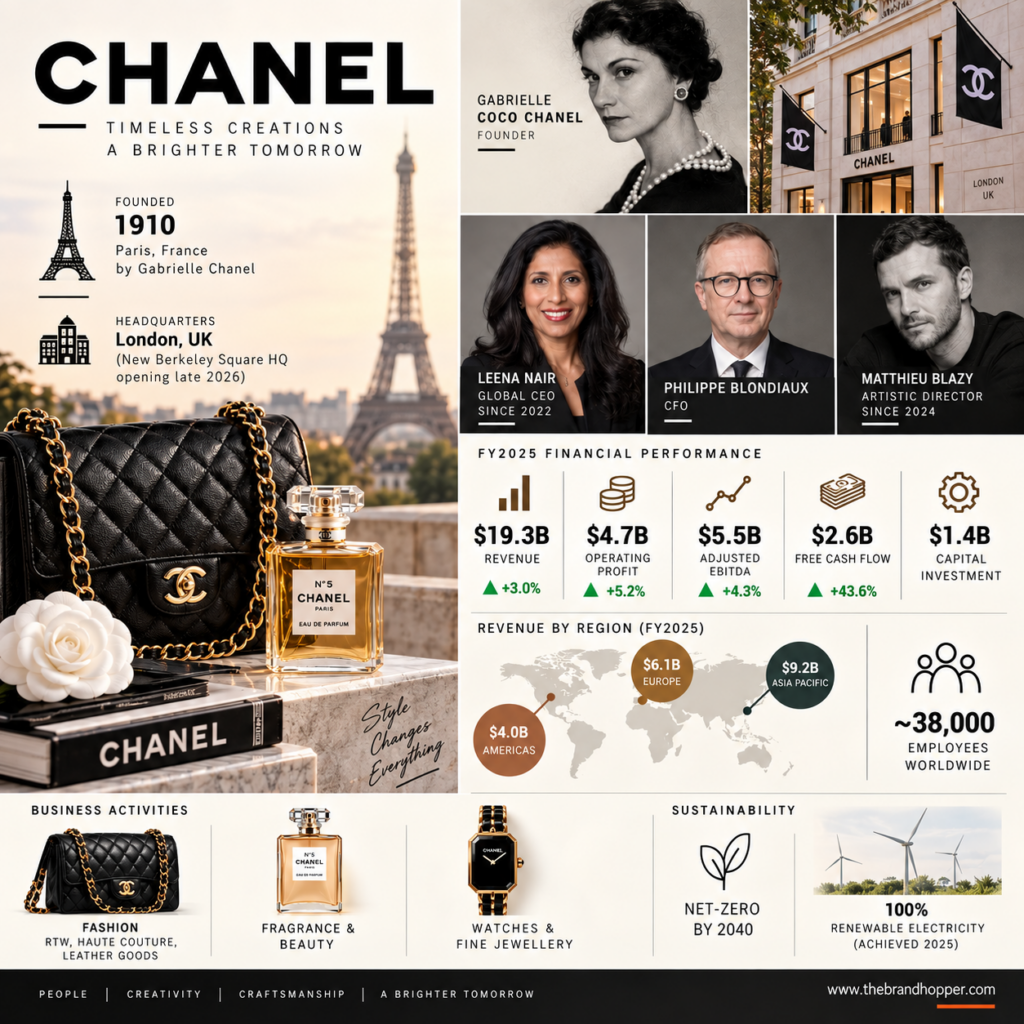
That language has been spoken for over 115 years. Founded by Gabrielle “Coco” Chanel in 1910, Chanel is today one of the world’s most valuable private luxury companies. In FY2025, the House reported revenues of $19.3 billion—up 3% from $18.7 billion in FY2024—demonstrating resilience in a challenging global luxury environment.
The driving force behind this performance: a new creative era under Matthieu Blazy, who was appointed Artistic Director of Fashion Activities in December 2024 and debuted his Spring Summer 2026 collection at the Grand Palais in Paris in October 2025.
This article covers Chanel’s full marketing strategy—its STP model, core marketing approaches, 4Ps marketing mix, landmark campaigns, and the FAQs that readers ask most.
Founding History of Chanel: The Rise of an Iconic House
Gabrielle Bonheur Chanel was born on August 19, 1883, in Saumur, France. After the death of her mother, her father—a travelling street vendor—placed her in a convent orphanage in Aubazine. The nuns taught her to sew, a skill that would eventually change fashion history.
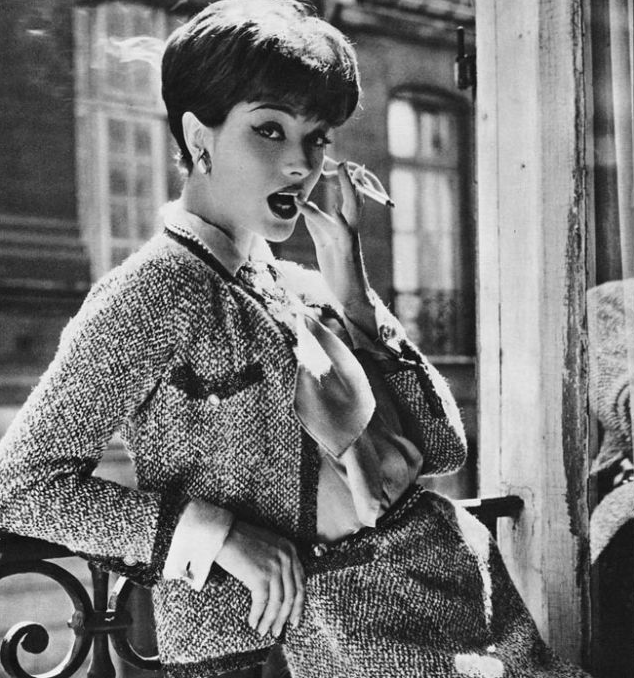
In her early twenties, Chanel moved to Vichy and later Paris, working as a cabaret singer. It was during this period that she acquired the nickname “Coco”—the exact origin is disputed, but widely attributed to two songs she performed, “Qui qu’a vu Coco?” and “Ko Ko Ri Ko.”
In 1910, Coco Chanel opened her first millinery shop at 21 Rue Cambon in Paris with financial backing from Arthur Capel, her companion. The hats she designed—simple, elegant, without the excessive ornamentation fashionable at the time—attracted immediate attention from Parisian society.
By 1913, Chanel had expanded into clothing, opening a boutique in Deauville. She used jersey fabric—previously used for men’s underwear—for women’s sportswear. The comfort and simplicity were radical in an era of corseted, restrictive fashion.
Throughout the 1920s, Chanel introduced a string of innovations that still define the House today. The Chanel suit—a collarless jacket with a fitted skirt—became an icon of professional elegance. The “little black dress” (1926) democratised the concept of the elegant going-out dress.
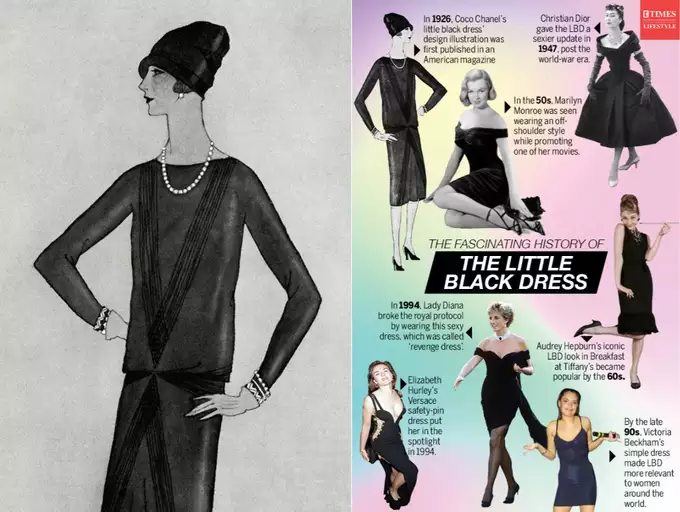
In 1921, Coco Chanel collaborated with Russian perfumer Ernest Beaux to create Chanel No. 5—named after the fifth sample Beaux presented. It was the first perfume to bear a designer’s name. It remains one of the world’s best-selling fragrances over a century later.
Chanel closed her business during World War II and spent time in Switzerland. Her return to fashion in 1954—at age 70—was initially mocked by the French press but embraced by American buyers. Her relaunch confirmed that her design instincts were timeless.
Coco Chanel died in 1971, while still working. The brand passed through a transitional period before Karl Lagerfeld was appointed Creative Director in 1983. Lagerfeld modernised the House while honouring its codes—the quilted bag, the interlocking Cs, the camellia—for 36 years until his death in 2019.
Virginie Viard, who had worked alongside Lagerfeld for decades, served as Creative Director from 2019 until June 2024. In December 2024, Chanel appointed Matthieu Blazy—formerly of Bottega Veneta—as Artistic Director of Fashion Activities. His debut SS2026 show at the Grand Palais in October 2025 was described as “a masterclass” by Harrods’ head of fashion-buying.
Today, Chanel Limited is a private company headquartered in London, owned by brothers Alain and Gerard Wertheimer—grandsons of Pierre Wertheimer, who was Coco Chanel’s original business partner. The Wertheimer family controls the company in its entirety.
Chanel Segmentation, Targeting & Positioning (STP)
Segmentation
Chanel segments its global market primarily by income tier and lifestyle aspiration. Its core segment is affluent consumers—individuals with disposable income sufficient for luxury purchases—who prioritise quality, heritage, and social signalling over price.
Within the luxury segment, Chanel further segments by product category: Ready-to-Wear and Haute Couture (fashion-forward affluent consumers), Leather Goods (investment-minded buyers seeking timeless pieces), Fragrance & Beauty (a broader accessible luxury segment), and Watches & Fine Jewellery (high-net-worth collectors).
Fragrance and Beauty serve as an important “entry-level luxury” segment—consumers who cannot yet afford a Chanel bag but can access the brand through a lipstick or perfume. This accessibility funnel is deliberate: today’s fragrance buyer may be tomorrow’s handbag customer.
Geographically, Chanel’s largest segment is Asia Pacific ($9.2 billion in FY2025), particularly Japan, South Korea, and Mainland China. Europe ($6.1 billion) and the Americas ($4.0 billion) complete the picture. Chanel opened 40+ new boutiques in 2025, spanning Japan, Mainland China, the Middle East, and Mexico.
Targeting
Chanel’s primary target is the aspirational luxury consumer: educated, globally mobile, culturally aware, and willing to pay significant premiums for craftsmanship, heritage, and exclusivity. This consumer is typically aged 28–55, though Chanel’s ambassador strategy deliberately skews younger.
Chanel targets different consumer groups with precision through its product lines. Haute Couture targets ultra-high-net-worth women who attend its twice-yearly Paris shows. Ready-to-Wear targets affluent professional women. The Fragrance & Beauty line targets a much broader audience—including consumers in their early twenties who aspire to the Chanel world.
Chanel’s digital and social media strategy targets a younger generation: Millennials and Gen Z who are the luxury consumers of today and tomorrow. Campaigns featuring ambassador Angèle (CHANCE EAU SPLENDIDE) or social content from Matthieu Blazy’s SS2026 debut are calibrated for this audience.
Chanel does not mass-target. Its distribution is deliberately limited—it does not sell through multi-brand retailers or mass e-commerce platforms. This selective targeting preserves exclusivity and justifies premium pricing.
Positioning
Chanel’s positioning rests on four pillars: heritage (over 115 years of unbroken design excellence), exclusivity (limited distribution, premium pricing, controlled supply), femininity (a brand created by a woman for women, defined by Coco Chanel’s own revolutionary vision), and modernity (each era’s creative director reinterprets the Chanel codes for contemporary culture).
The brand positions itself not as “expensive” but as “beyond price”—an aspiration and a culture, not merely a product category. This emotional positioning creates an irrational premium: a Chanel Classic Flap bag appreciates in value over time, functioning as an investment asset rather than a depreciating consumer good.
Chanel’s positioning is deliberately anti-trend. Where fast fashion brands chase each season’s microtrends, Chanel emphasises timelessness. The Chanel suit, the 2.55 bag, the camellia brooch, and Chanel No. 5 are all positioning anchors that communicate “this will never go out of style.”
Under Matthieu Blazy, Chanel’s positioning is evolving to embrace a new kind of modernity—one that respects the House’s codes while introducing a more contemporary, sometimes playful energy. His Métiers d’art show in a New York City subway (December 2025) exemplified this: elevated craftsmanship meeting pop culture.
Marketing Strategies of Chanel
1. Exclusivity and Controlled Scarcity
Chanel’s most fundamental marketing strategy is not a campaign—it is a business model decision: deliberate scarcity. Chanel controls how many bags it produces, how many boutiques it opens, and where its products are sold.
Chanel does not sell through multi-brand retailers or mainstream e-commerce platforms. You cannot buy a Chanel bag on Amazon or ASOS. This distribution control is itself a brand signal: Chanel is not for everyone, and that exclusivity makes everyone want it more.
Waitlists for the Classic Flap bag and the Boy Chanel bag are both a logistical reality and a marketing tool. A consumer who waits months for a product develops an emotional investment that no campaign can replicate. The wait becomes part of the ownership narrative.
Chanel has also managed price increases strategically as a scarcity signal. The Classic Flap, which cost approximately $4,900 in 2019, now retails for over $10,000+ in many markets. Rather than suppressing demand, these increases have amplified secondary market prices and reinforced the bag’s investment-asset positioning.
The CHANEL 25 handbag—a new launch that was a standout performer in FY2025—demonstrates this strategy in action. Introduced with controlled supply and an aspirational campaign, it generated significant consumer excitement and drove positive fashion performance for the year.
2. Storytelling and Brand Identity
Chanel is as much a story as it is a brand. The legend of Coco Chanel—an orphaned girl who liberated women from corsets, built a fashion empire, was exiled during wartime, and returned at 70 to reclaim her crown—is among the most compelling origin narratives in any industry.
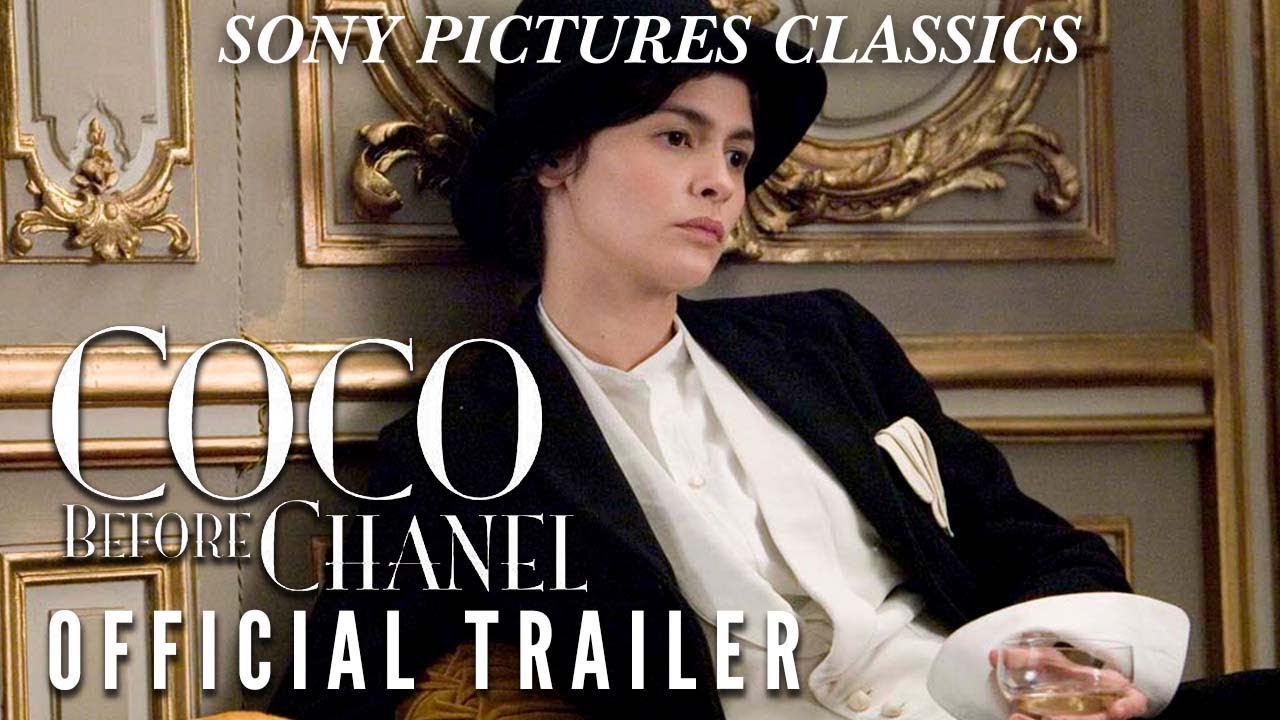
Chanel actively markets this story. Films like “Coco Before Chanel” (2009, starring Audrey Tautou) and documentaries about the House’s archives reinforce brand mythology. These are not Chanel productions, but the brand benefits from the cultural conversation they generate.
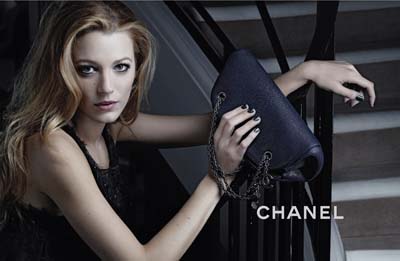
Chanel’s own storytelling manifests in advertising campaigns that privilege aesthetics over information. Chanel ads rarely mention price or product specifications. Instead, they evoke a world: Parisian, feminine, effortlessly elegant, slightly mysterious.
The visual identity is fastidiously maintained. The interlocking CC monogram, the camellia flower, the quilted diamond pattern, and the Chanel No. 5 bottle are icons that appear across every touchpoint—from the smallest lipstick packaging to the facade of a flagship boutique. This visual consistency is itself a form of storytelling that communicates permanence and quality.
Each new creative director adds a chapter to the story without erasing previous chapters. Karl Lagerfeld modernised but never abandoned the codes. Virginie Viard preserved. Matthieu Blazy is now writing his chapter—blending Chanel’s heritage with a more inclusive, culturally curious modernity. This layered narrative gives the brand a depth that no amount of advertising spend can manufacture.
3. Celebrity Endorsements and Brand Ambassadors
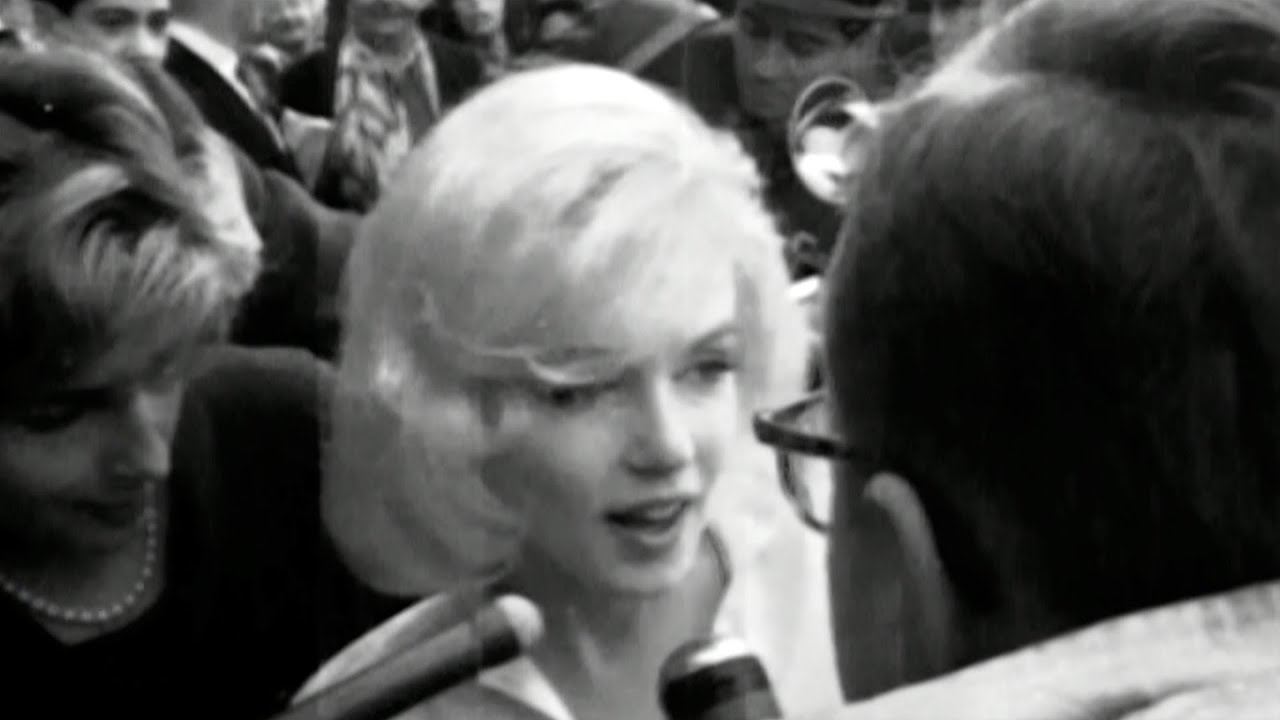
Chanel has strategically associated itself with some of the most iconic women in cultural history. Marilyn Monroe famously said she wore “nothing but Chanel No. 5” to bed—a quote that became perhaps the most valuable unsolicited celebrity endorsement in marketing history.
The formal ambassador programme has included Nicole Kidman (Chanel No. 5 campaign, 2004—the most expensive perfume commercial ever made at $33 million), Keira Knightley, Audrey Tautou, Kristen Stewart, and Margot Robbie. Each ambassador embodies a facet of the “Chanel woman”: independent, elegant, and contemporary.
For FY2025, the most prominent ambassador activation was Angèle—the Belgian pop star—fronting the launch of CHANCE EAU SPLENDIDE, Chanel’s first new women’s fragrance in eight years. The campaign connected the playful, optimistic character of CHANCE with a contemporary cultural figure who resonates strongly with younger audiences.
Chanel carefully selects ambassadors based on alignment with brand values, not merely popularity. An ambassador must embody effortless chic—not try-hard glamour. This curatorial approach to celebrity partnership ensures that every association reinforces rather than dilutes brand positioning.
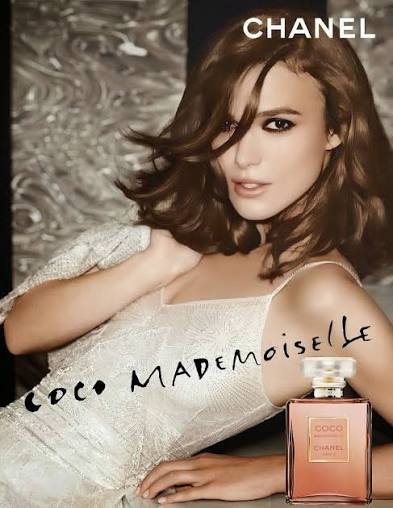
Red carpet strategy is equally deliberate. Chanel regularly dresses celebrities for the Cannes Film Festival, the Met Gala, and major awards ceremonies. These appearances generate editorial coverage in fashion publications and social media content that reaches hundreds of millions of impressions at minimal cost to the brand.
4. The Power of Iconic Products: Chanel No. 5 and Beyond
Chanel No. 5 is more than a perfume—it is a marketing case study in longevity. Introduced in 1921, it has been continuously bestselling for over a century without a formula change. Its minimalist rectangular bottle with the simple “N°5” label is among the most recognisable objects in the world.
The fragrance’s marketing has evolved across eras. Ernest Beaux created the scent; Coco Chanel named it; Marilyn Monroe immortalised it; Andy Warhol pop-art-ified it; Nicole Kidman starred in Baz Luhrmann’s cinematic 2004 campaign. Each era adds a new cultural layer without diminishing the original.
Chanel regularly releases limited edition versions of No. 5—collector bottles, special packaging, anniversary editions—which generate media coverage, collector behaviour, and gifting demand beyond the standard product cycle. These limited editions are a masterclass in managing a heritage product to feel perpetually relevant.
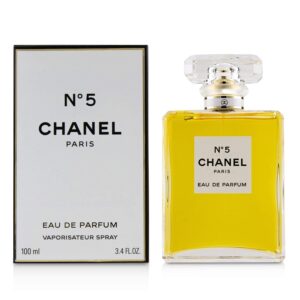
In FY2025, CHANCE EAU SPLENDIDE—Chanel’s first new women’s fragrance in eight years—demonstrated the brand’s ability to create new iconic products from scratch. Created by in-house Perfumer-Creator Olivier Polge, it launched through immersive events including the takeover of “Chance Street” in London’s Shoreditch, blending luxury with playful street culture.
The Chanel Classic Flap bag (originally the 2.55, redesigned by Lagerfeld) performs a similar role in leather goods. It is not just a handbag—it is a financial asset. Its value appreciation on the secondary market has consistently outperformed traditional investments including gold and the S&P 500 over the past decade. This financial narrative has become a powerful marketing argument for the brand.
In Watches & Fine Jewellery, the J12 watch celebrates its 25th anniversary with the J12 BLEU—a new collection featuring exclusive matte blue ceramic, developed over five years. This launch demonstrates Chanel’s ability to create genuine product innovation within heritage product lines.
5. Artistic Collaborations and Spectacular Fashion Shows
Chanel’s fashion shows are not product presentations—they are cultural events. Each season, Chanel transforms the Grand Palais in Paris into a themed world: a supermarket, a rocket launch pad, an ancient forest, a casino. The theatricality is calculated marketing: every image from a Chanel show is shared millions of times on social media.
Matthieu Blazy’s debut SS2026 show (October 2025) operated at exactly this register. Staged at the Grand Palais with giant glowing planets, it attracted global media coverage and positioned Blazy’s Chanel immediately as fashion news. His follow-up Métiers d’art show in a New York City subway (December 2025) took the Chanel universe to an unexpected urban setting—generating a new wave of cultural conversation.
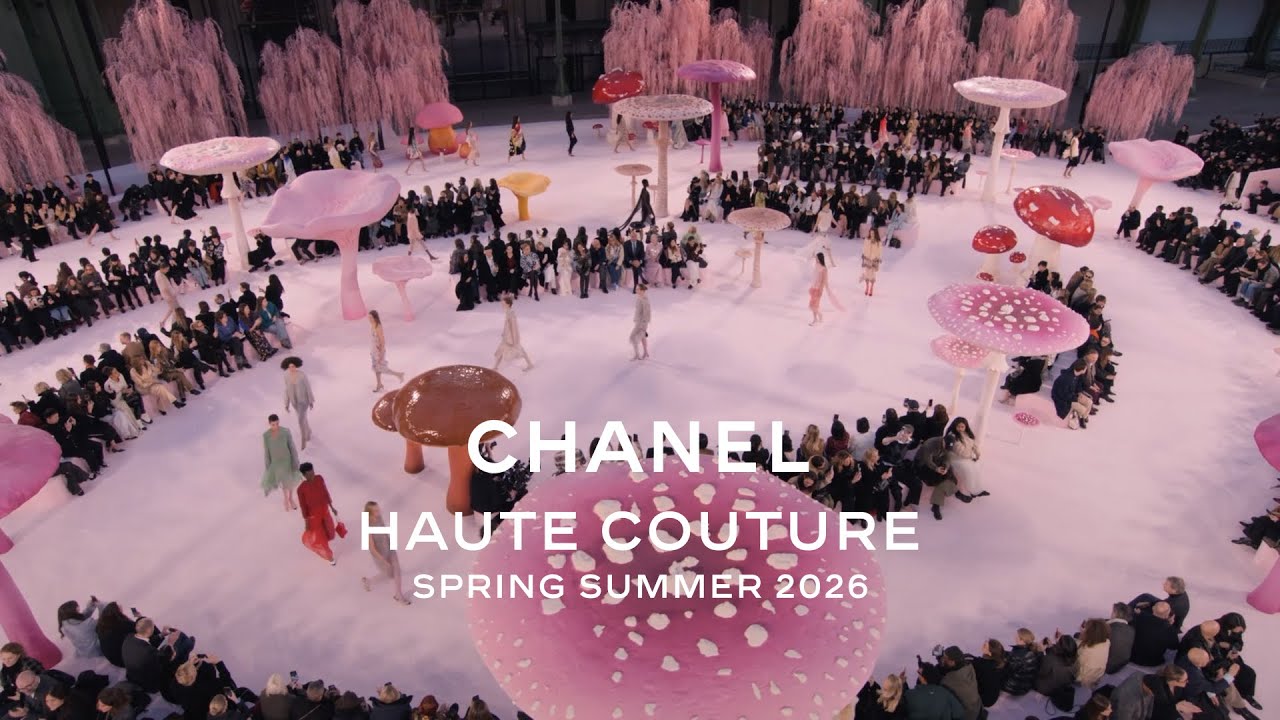
Chanel’s fashion show strategy serves multiple marketing objectives simultaneously. It generates editorial coverage in Vogue, WWD, and global fashion press. It provides content for six months of social media. It reinforces Chanel’s status as the reference point for fashion authority. And it creates FOMO among consumers who were not in the front row.
By live-streaming shows and releasing meticulously edited behind-the-scenes films, Chanel ensures that its message reaches a global audience far beyond the 600-seat venue. The live stream audience for a Chanel show regularly reaches millions of viewers worldwide.
Artistic collaborations extend Chanel’s reach beyond fashion. The House has partnered with photographers, filmmakers, architects, and cultural institutions across its 115-year history. In 2025, the CHANEL Culture Fund led 50 long-term cultural projects across five continents—from museum partnerships to emerging artist grants. This cultural investment builds brand credibility among the educated, culturally engaged consumers Chanel targets.
The reopening of La Pausa—Gabrielle Chanel’s Mediterranean villa in Roquebrune-Cap-Martin—following a multi-year restoration in June 2025 is another example of this strategy. La Pausa is both a piece of heritage and a marketing asset: a physical location that tells the Chanel story and hosts exclusive client experiences.
6. Experiential Marketing and Client Intimacy
Chanel does not just sell products—it creates experiences. This experiential approach begins in its boutiques, which are designed as immersive environments rather than transactional retail spaces. The flagship on Rue Cambon in Paris, where Coco Chanel lived and worked, is a pilgrimage destination for fashion lovers worldwide.
New boutiques opened in 2025 were designed as experiential destinations. The Plaza 66 boutique in Shanghai, the Las Vegas and Toronto locations, and openings in Bangkok and Sydney all reflect a retail philosophy that prioritises client experience over floor space efficiency.
Private client events—invitation-only shows, trunk shows, and private appointments—create the ultimate Chanel experience. A client who receives a personal invitation to a private Haute Couture fitting at Rue Cambon does not need a marketing campaign to deepen her relationship with the brand. The experience itself is the marketing.
The launch of CHANCE EAU SPLENDIDE through a takeover of “Chance Street” in London’s Shoreditch is a recent example of experiential marketing at scale. Rather than running standard beauty counter sampling, Chanel created a physical, shareable, surprising pop-up that turned a fragrance launch into a cultural moment for the neighbourhood—and generated organic social media content from thousands of visitors.
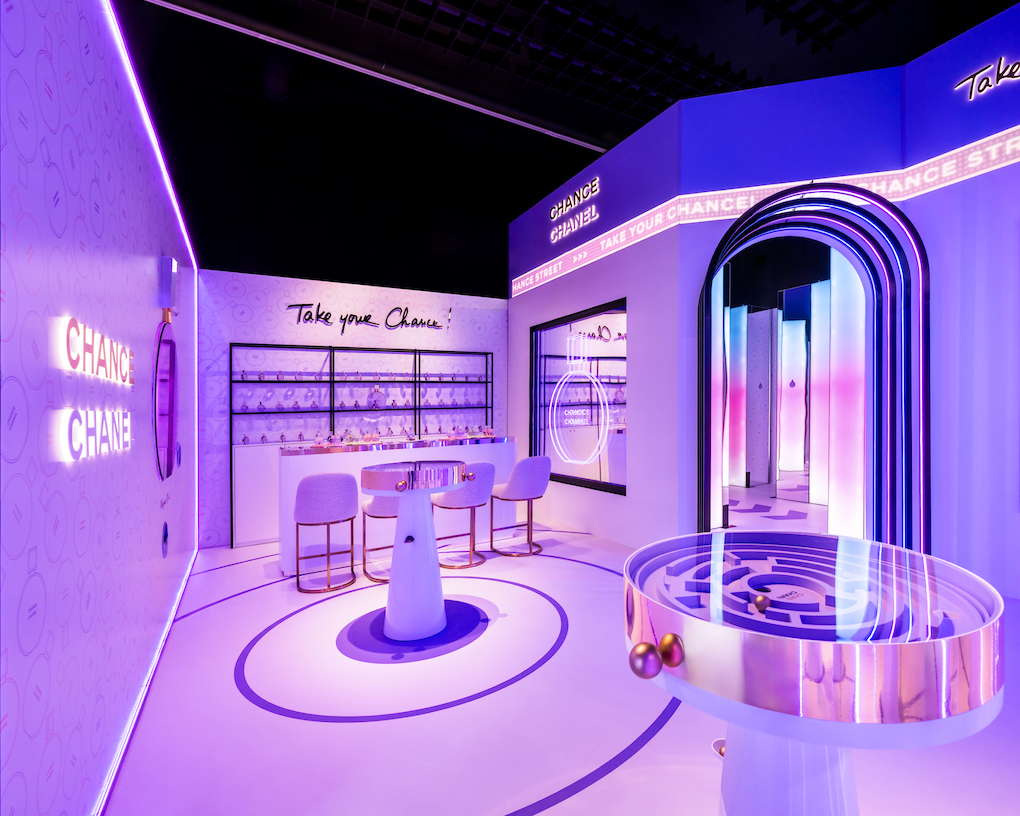
Chanel’s exclusive events around the world—film screenings, art installations, private concerts—serve the dual purpose of rewarding existing clients and generating aspirational coverage for those who were not invited. The goal is always to make the outside feel the inside.
7. Digital Engagement and Social Media Strategy
Chanel has over 59 million followers across social media platforms, making it one of the most followed luxury brands globally. Its primary platforms are Instagram, YouTube, and increasingly TikTok—each serving a distinct role in the brand’s digital strategy.
Instagram is Chanel’s editorial channel: a curated visual world of campaign imagery, fashion show content, behind-the-scenes glimpses, and product close-ups. The account @chanelofficial is one of the most carefully managed accounts in luxury—every image is a considered artistic decision, not a casual post.
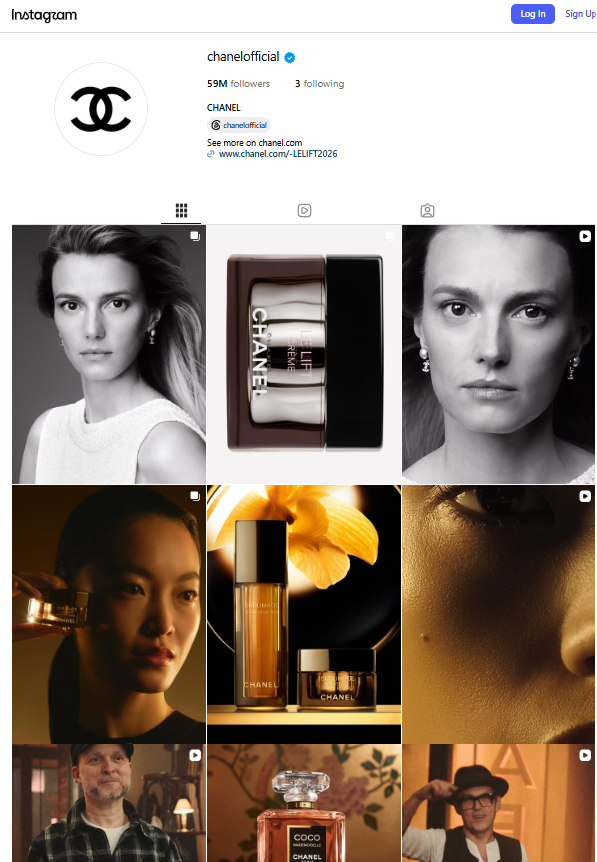
YouTube serves as Chanel’s long-form content platform. Campaign films, mini-documentaries about the Métiers d’art ateliers, interviews with creative directors and perfumers, and fashion show recordings live on YouTube as permanent brand content. Some films have accumulated tens of millions of organic views.
Chanel manages social media with the discipline of a magazine editor. It does not chase algorithmic trends or post daily for the sake of volume. Frequency is lower than mass-market brands; quality per post is higher. This scarcity of digital content mirrors the scarcity of product: both signal luxury.
User-generated content is carefully curated. Chanel monitors and selects UGC—customers sharing their Chanel purchases, attending Chanel events, or styling Chanel pieces—and occasionally reposts or acknowledges this content. This approach makes customers feel seen while extending Chanel’s reach through their social networks.
Chanel’s e-commerce strategy is deliberately limited but growing. The brand launched e-commerce for Fragrance & Beauty in Mexico and Argentina in FY2025, and rolled out a new Fragrance & Beauty app. Online sales remain restricted to lower-ticket categories—fragrances, beauty, eyewear—rather than extending to handbags, which remain boutique-only. This digital scarcity is intentional.
Ephemeral content—Instagram Stories, Reels, and behind-the-scenes—gives Chanel a way to be present daily without compromising its editorial standards. A quick backstage clip from a fashion show, a perfumer discussing ingredients, a craftsperson assembling a flap bag: these moments humanise the brand without demystifying it.
8. Sustainability and Responsible Luxury
Chanel’s sustainability strategy is not a marketing add-on—it is embedded in the business model. The House has set a net-zero emissions target for its full value chain by 2040 (a decade ahead of the Paris Agreement’s 2050 timeline), validated by the Science-Based Targets initiative (SBTi).
In FY2025, Chanel achieved 100% renewable electricity across its own operations. This milestone—reported publicly and auditable through third-party verification—is a credibility anchor for all sustainability communications. Scope 3 emissions decreased by 10% year-on-year, and Chanel published its first Climate Transition Plan.
Chanel’s approach to sustainable supply chains is uniquely tied to its ownership of its Métiers d’art—the specialist artisanal workshops that supply materials and craft components for its products. Over $700 million was invested in FY2025 to acquire and develop suppliers in leather goods, textiles, and Watches & Fine Jewellery. Owning the supply chain gives Chanel direct control over environmental and labour standards.
NEVOLD—launched in June 2025—is a new entity dedicated to circularity in natural textiles and leather. It brings together start-ups and established organisations to develop high-quality recycled materials and accelerate industrial-scale recycling solutions. This kind of supply chain innovation is both a genuine sustainability contribution and a powerful marketing narrative.
The Grasse flower fields in France—which supply Jasmine and Rose for Chanel fragrances—progressed from Regenerative Organic Certified Bronze to Silver in 2025. This very specific, verifiable progress demonstrates Chanel’s commitment to regenerative agriculture rather than generic “sustainability” claims.
Fondation CHANEL—an independent UK-registered charity—receives $125 million per year from Chanel to fund programmes supporting women’s safety, economic autonomy, and climate resilience globally. This philanthropic commitment reinforces Chanel’s founding principle: a brand created by a woman, for women, with a genuine stake in women’s advancement.
9. Pricing Strategy as Brand Architecture
Chanel’s pricing is not a reflection of production cost—it is a brand positioning tool. The Classic Flap bag costs thousands of dollars to purchase and significantly less to manufacture. The difference represents heritage, exclusivity, craftsmanship, and desire.
Chanel has implemented significant price increases over the past five years, partly to manage demand, partly to protect margins against currency fluctuations, and partly to position its handbags as investment assets. A Classic Flap bag purchased in 2019 and resold in 2025 typically fetches more than its original retail price.
The price increase strategy serves a secondary marketing function: it makes Chanel products more aspirational and more newsworthy. Price increase announcements consistently generate press coverage and trigger buying surges among existing clients who rush to purchase before the new price takes effect.
Across price tiers, Chanel maintains a deliberate architecture. Fragrance and beauty products begin at accessible luxury price points (a Chanel lipstick from ~$40, No. 5 from ~$100), allowing mass market aspiration. Ready-to-Wear occupies a significantly higher tier. Haute Couture is essentially priceless—a bespoke commission.
This tiered pricing architecture is a marketing system. The consumer who buys a Chanel lipstick today is being initiated into the brand. If her income grows, she may upgrade to a fragrance, then accessories, then ready-to-wear. The lipstick is not just a product—it is the top of a luxury funnel.
10. Heritage and Innovation in Balance
Perhaps Chanel’s most sophisticated marketing strategy is its management of the tension between heritage and innovation. Too much heritage becomes a museum; too much innovation destroys the brand codes that underpin the premium. Chanel walks this line with deliberate care.
The Chanel codes—the camellia, the quilted leather, the interlocking Cs, the chain strap, the boxy jacket, the two-tone shoe—are not frozen in amber. Each new creative director reinterprets them. Lagerfeld added irony. Viard added softness. Blazy is adding modernity and a celebration of craftsmanship.
The 2025 Haute Couture collection paying tribute to Gabrielle Chanel’s original vision—inspired by nature, freedom, and simplicity—demonstrates this balance perfectly. It looked back and forward simultaneously: 110 years of heritage animated by a contemporary eye.
Chanel’s investment in the Métiers d’art—the specialist craft workshops—is both operational and brand-strategic. Each workshop represents a craft technique: plissage at Lognon, millinery at Michel, featherwork at Lemarié, embroidery at Lesage. These ateliers are featured in campaigns and documentaries, making Chanel’s craftsmanship visible and tangible for consumers who otherwise only see the finished product.
Chanel’s CHANEL Open Lab—launched in 2025 as a collaborative innovation platform with Stanford, Columbia, and NYU students—signals that the House is investing in tomorrow’s ideas as deliberately as it protects yesterday’s codes. Heritage and future: both are Chanel.
Marketing Mix (4Ps) of Chanel
Product
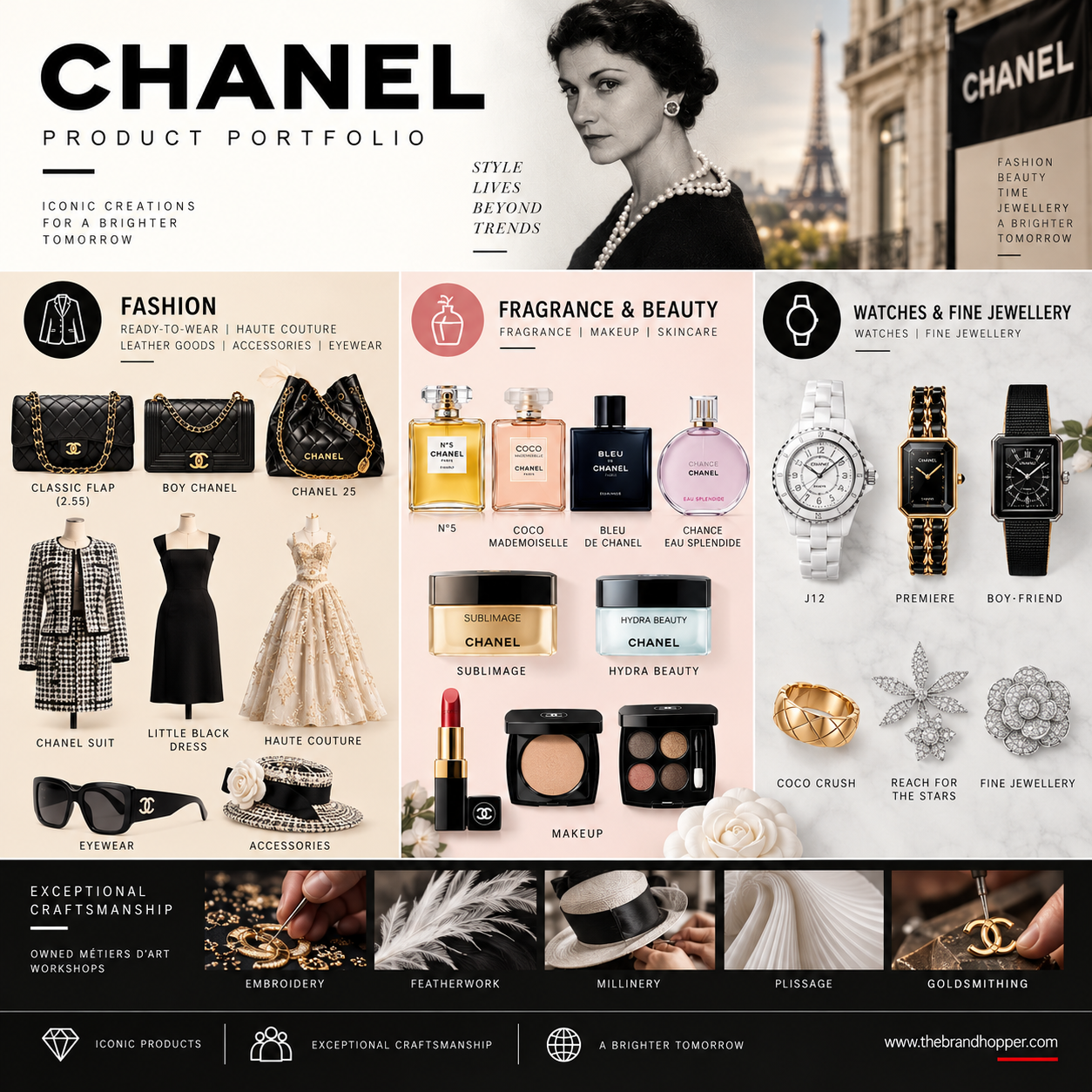
Chanel’s product portfolio spans three major business activities: Fashion (Ready-to-Wear, Haute Couture, Leather Goods, Fashion Accessories, and Eyewear), Fragrance & Beauty (Fragrance, Makeup, and Skincare), and Watches & Fine Jewellery.
Fashion flagship products include the Classic Flap bag (2.55), the Boy Chanel bag, the Gabrielle bag, and the new CHANEL 25 bag (a standout performer in FY2025). Ready-to-Wear centres on the Chanel suit, the little black dress, and seasonally updated tweed collections. Haute Couture is presented twice yearly in Paris.
Fragrance & Beauty is led by Chanel No. 5, COCO MADEMOISELLE, BLEU DE CHANEL, and the new CHANCE EAU SPLENDIDE (FY2025). The Skincare range, anchored by SUBLIMAGE and HYDRA BEAUTY, is a growing category. The Makeup range competes with premium beauty brands across lipstick, foundation, and eyeshadow.
Watches & Fine Jewellery features the J12 (celebrating 25 years with the J12 BLEU), PREMIERE, and Boy.Friend watches, alongside fine jewellery collections including COCO CRUSH and REACH FOR THE STARS (2025 High Jewellery debut in Kyoto).
All Chanel products are produced with exceptional quality standards. The ownership of Métiers d’art workshops—covering embroidery, featherwork, millinery, plissage, goldsmithing, and more—gives Chanel unmatched control over craftsmanship at every level of the product.
Price
Chanel’s pricing strategy is premium-tier luxury pricing. The Classic Flap bag currently retails above $10,000 in most markets. Ready-to-Wear pieces range from approximately $3,000 to $10,000+. Haute Couture commissions are bespoke and priced accordingly.
Entry price points exist in Fragrance & Beauty to allow brand access: Chanel No. 5 starts at approximately $100; lipsticks from approximately $40. This accessibility funnel is strategically maintained—the beauty range brings significantly more consumers into the Chanel world than fashion alone could.
Price increases are a regular and deliberate feature of Chanel’s handbag strategy. The increases are announced with minimal fanfare and absorbed by the market—often triggering purchase surges. This acceptance of price increases is evidence of the brand’s exceptional pricing power.
Chanel does not offer discounts, outlet channels, or clearance sales for its core fashion and leather goods products. Price integrity is treated as a core brand value. Fragrance & Beauty products may be included in selective retail promotions—but never the fashion and leather goods line.
Place (Distribution)
Chanel operates a network of standalone boutiques in the world’s most prestigious retail locations: Avenue Montaigne and Rue Cambon in Paris, Fifth Avenue in New York, New Bond Street in London, Ginza in Tokyo, Sloane Street, Rodeo Drive, and equivalent addresses in every major luxury market.
Chanel opened over 40 new boutiques in FY2025, with particular investment in Japan, Mainland China, the Middle East, and Mexico. The brand also opened over 25 new dedicated Fragrance & Beauty boutiques globally, reflecting the growing importance of the beauty category.
Chanel products are not available in multi-brand retailers or mainstream e-commerce platforms. The brand controls its entire distribution—a significant strategic decision that maintains exclusivity and protects pricing. In luxury retail, where you sell is as important as what you sell.
E-commerce is selectively available for Fragrance & Beauty in established markets, and was expanded to Mexico and Argentina in FY2025. The new Fragrance & Beauty app launched in FY2025 provides a digital boutique experience for beauty consumers globally. Fashion and Leather Goods remain boutique-exclusive.
The new Chanel global headquarters in Berkeley Square, London—scheduled to open by end of 2026—is both a strategic and symbolic investment. Berkeley Square is one of London’s most prestigious addresses, and the new HQ will house global operations in a purpose-designed space that reflects Chanel’s brand values.
Promotion
Chanel’s promotion strategy is built around aspiration, not information. Its advertising campaigns—in print, digital, and video—do not list product features or prices. They evoke a world: beautiful, feminine, Parisian, timeless, and just out of reach.
Fashion shows are Chanel’s most powerful promotional events. Each show is a global media event, generating editorial coverage across every fashion publication and hundreds of millions of social impressions. The show IS the promotion for the season’s collection.
Celebrity partnerships and ambassador campaigns—from the Angèle x CHANCE EAU SPLENDIDE campaign to Margot Robbie wearing Chanel at awards ceremonies—generate earned media that compounds the effect of paid advertising across traditional and digital channels.
Chanel invests in long-form content as promotion: short films, documentary series about the Métiers d’art ateliers, and podcast seasons (CHANEL Connects, which returned for Season 5 in 2025). These are not advertisements—they are cultural contributions that build brand depth over time.
Limited edition product launches—No. 5 collector editions, collaboration capsules, and the CHANCE EAU SPLENDIDE launch with its Shoreditch “Chance Street” activation—create promotional moments that generate organic media coverage and consumer urgency beyond standard advertising.
Key Campaigns and Marketing Milestones
Chanel No. 5: The Film (2004) – The Most Expensive Perfume Ad Ever Made
In 2004, Chanel commissioned Baz Luhrmann to direct a campaign film for Chanel No. 5 starring Nicole Kidman. Produced at a reported cost of $33 million—the most expensive perfume advertisement ever made at the time—it was a cinematic short film rather than a conventional advertisement.
The film ran for only three weeks in cinemas and on television, but generated coverage worth multiples of its production cost. It repositioned Chanel No. 5 for a new generation while reinforcing its legendary status.
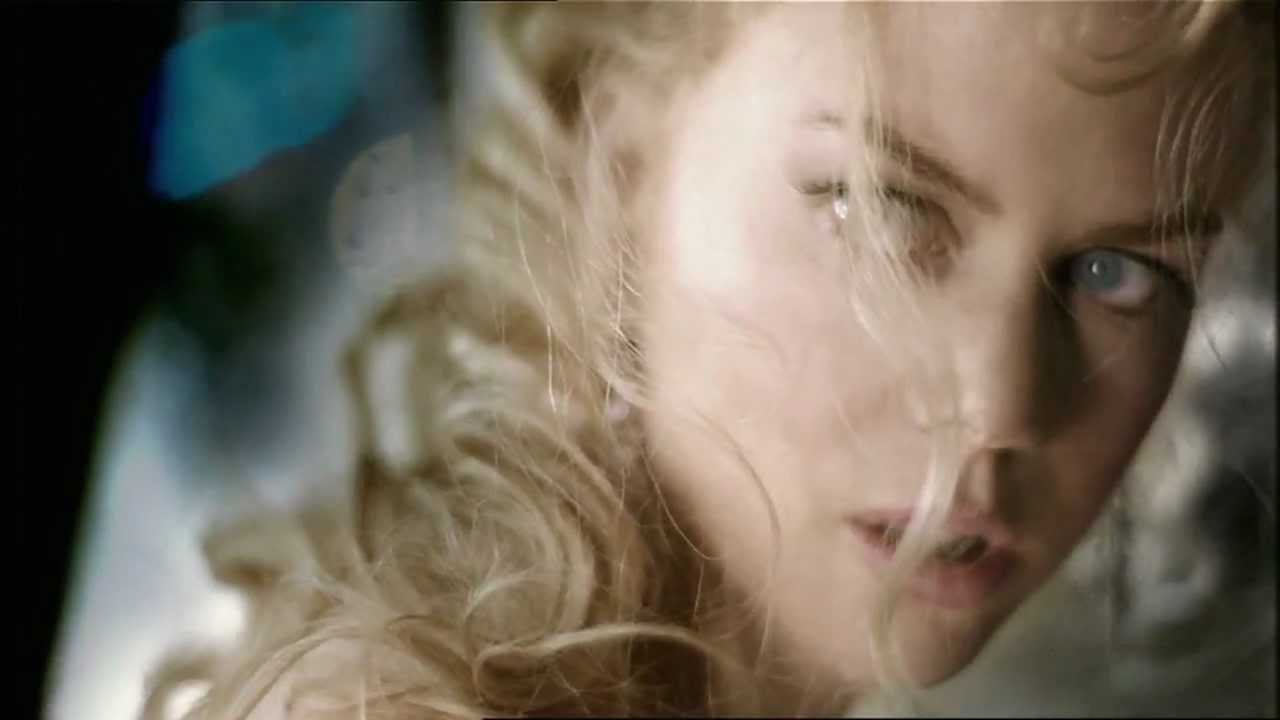
This campaign established the blueprint for luxury fragrance advertising: invest in genuine cinematic quality, cast at the highest level, and create something worth talking about beyond its commercial intent.
CHANCE EAU SPLENDIDE with Angèle (2025) – A New Era Fragrance
CHANCE EAU SPLENDIDE—Chanel’s first new women’s fragrance in eight years—was launched in 2025 with a campaign featuring Belgian pop star Angèle. Created by in-house Perfumer-Creator Olivier Polge, the scent was designed to bring a playful, modern energy to the CHANCE family.
The launch activation included the takeover of “Chance Street” in London’s Shoreditch—a pop-up that transformed a street into an immersive CHANCE experience. This unexpected, street-level execution created organic social media content and demonstrated that Chanel can meet younger audiences in their cultural territory without losing luxury positioning.
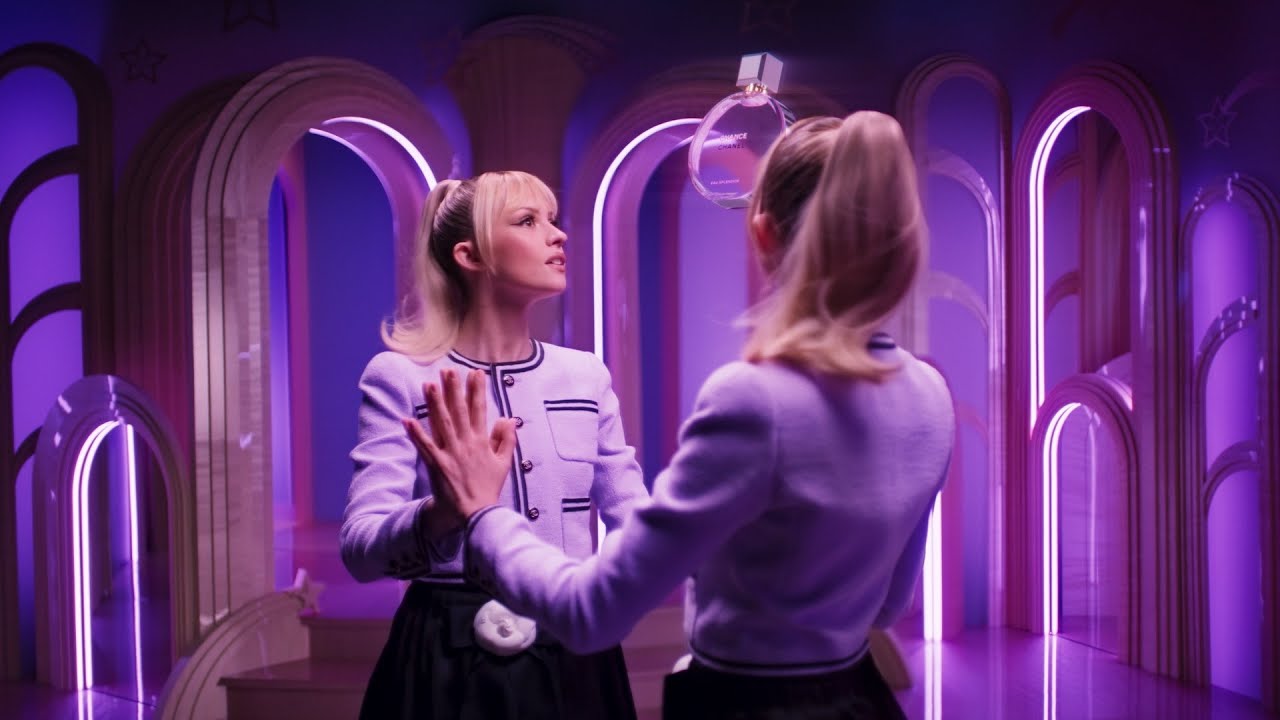
The campaign’s choice of Angèle—a contemporary music figure with a massive social following—signals Chanel’s intent to recruit younger luxury consumers while remaining authentically within the brand world.
Matthieu Blazy’s Grand Palais Debut (October 2025)
The most anticipated fashion marketing event of 2025 was Matthieu Blazy’s debut as Chanel’s Artistic Director of Fashion. Staged at the Grand Palais in Paris—Chanel’s spiritual home—the SS2026 show featured giant glowing planets and collections that blended the House’s classic codes with Blazy’s more contemporary sensibility.
The show was described by Harrods’ head of fashion-buying as “a masterclass” and generated global press and social media coverage that delivered immediate commercial momentum. New Ready-to-Wear and the CHANEL 25 handbag campaign were highlighted as performance drivers in FY2025.
The follow-up Métiers d’art show in a New York City subway (December 2025) extended Blazy’s narrative—”elevated craftsmanship meeting pop culture in a love story between CHANEL and New York”—generating a second wave of global coverage and establishing a clear creative identity for the new era.
J12 BLEU – 25th Anniversary Launch
The J12 watch celebrates its 25th anniversary with the J12 BLEU—a collection developed over five years of R&D, featuring an exclusive matte blue ceramic unique to Chanel. The launch demonstrated the brand’s ability to invest in genuine product innovation within a heritage range and market it as a milestone rather than an update.
CHANEL J12 also became the first official Timekeeping Partner of the Boat Race in the UK in 2025—a cultural alignment that gave the brand presence in a prestigious British sporting tradition and reinforced its values of “collective endeavour and excellence.”
Frequently Asked Questions (FAQs)
Q1: What is Chanel’s marketing strategy?
A: Chanel’s marketing strategy is built on ten interconnected pillars: controlled exclusivity and scarcity (limited distribution, boutique-only fashion); iconic storytelling (the Coco Chanel origin narrative and brand mythology); celebrity endorsements and ambassador partnerships; the power of iconic products (Chanel No. 5, Classic Flap bag, J12 watch); spectacular fashion shows and artistic collaborations; experiential marketing (private events, pop-up activations); curated digital and social media presence (50M+ followers across platforms); sustainability and responsible luxury (net-zero target 2040); pricing as a brand signal (premium pricing architecture); and the balance of heritage and innovation under each creative director.
Q2: What is Chanel’s revenue?
A: Chanel reported FY2025 revenues of $19,269 million ($19.3 billion), up 3.0% reported and 1.8% at comparable exchange rates, versus $18,699 million ($18.7 billion) in FY2024. Operating profit was $4,712 million (up 5.2%). Free cash flow rose 43.6% to $2,646 million. By region: Europe $6.1 billion, Asia Pacific $9.2 billion, Americas $4.0 billion. Source: Chanel Limited Financial Results for the Year Ended 31 December 2025.
Q3: Who is Chanel’s current Creative Director?
A: Matthieu Blazy was appointed Artistic Director of Fashion Activities at Chanel in December 2024, succeeding Virginie Viard. The Franco-Belgian designer previously served as Creative Director at Bottega Veneta, where he significantly elevated the brand’s commercial and critical standing. He debuted his first Chanel collection—SS2026—at the Grand Palais in Paris in October 2025, to widespread critical acclaim, and showed his first Métiers d’art collection in a New York City subway in December 2025.
Q4: Who owns Chanel?
A: Chanel Limited is a private company owned by brothers Alain and Gerard Wertheimer, grandsons of Pierre Wertheimer who was Coco Chanel’s original business partner. The Wertheimer family acquired full control of the brand decades ago and continues to own 100% of the company. Chanel is not publicly listed—it publishes audited financial results voluntarily. CEO Leena Nair leads the company’s global operations.
Q5: What are Chanel’s most famous products?
A: Chanel’s most famous products include: Chanel No. 5 (introduced 1921—the world’s most famous perfume, still a bestseller after 100+ years); the Classic Flap bag (redesigned by Karl Lagerfeld from the original 2.55, now retailing above $10,000 and appreciating in resale value); the Chanel suit (collarless jacket and fitted skirt, first introduced in the 1920s); the little black dress (introduced 1926); COCO MADEMOISELLE and BLEU DE CHANEL fragrances; the J12 watch (celebrating its 25th anniversary with the J12 BLEU in 2025); and the new CHANEL 25 bag and CHANCE EAU SPLENDIDE fragrance (2025 launches).
Q6: How does Chanel use social media?
A: Chanel uses social media with the editorial discipline of a luxury magazine, not the frequency of a mass market brand. Its @chanelofficial Instagram has over 59 million followers and posts curated campaign imagery, fashion show content, and behind-the-scenes glimpses. YouTube hosts long-form campaign films, Métiers d’art documentaries, and fashion show recordings—some of which accumulate tens of millions of organic views. Chanel deliberately avoids chasing algorithmic trends; the scarcity of its digital content mirrors the scarcity of its products. The Fragrance & Beauty app was rolled out in FY2025 as a new digital channel.
Q7: What is Chanel’s sustainability strategy?
A: Chanel has committed to net-zero greenhouse gas emissions across its full value chain by 2040, validated by the Science-Based Targets initiative (SBTi). In FY2025, Chanel achieved 100% renewable electricity in its own operations, Scope 3 emissions decreased by 10%, and the company published its first Climate Transition Plan. Chanel owns its Métiers d’art supply chain—over $700 million invested in FY2025—giving direct control over environmental standards. NEVOLD, launched in 2025, develops circularity solutions for natural textiles and leather. Fondation CHANEL receives $125 million/year to support women’s safety and economic autonomy globally.
Q8: What is the price of a Chanel bag?
A: Chanel handbag prices vary significantly by model and market. The Classic Flap bag (the 2.55) currently retails above $10,000 in most markets—up from approximately $4,900 in 2019. The Boy Chanel bag retails in a similar range. The new CHANEL 25 bag, launched in FY2025, is positioned as a contemporary alternative within the same premium tier. Entry-level Chanel leather goods (card holders, wallets, small leather accessories) start at approximately $500–$1,000. Prices are not publicly listed and vary by market, currency, and VAT.
Q9: What is Chanel’s distribution strategy?
A: Chanel operates an exclusive boutique-only distribution model for its Fashion and Leather Goods lines. Products are not sold through multi-brand retailers or mainstream e-commerce platforms. The brand opened 40+ new boutiques in FY2025 across Japan, Mainland China, the Middle East, and Mexico, and also opened 25+ dedicated Fragrance & Beauty boutiques. Fragrance & Beauty e-commerce is available in established markets including the US, UK, France, and was expanded to Mexico and Argentina in FY2025. Fashion and Leather Goods remain boutique-exclusive, preserving scarcity and pricing integrity.
Q10: Who is Chanel’s CEO?
A: Leena Nair has been Global Chief Executive Officer of Chanel since January 2022. She was recruited from Unilever, where she served as Chief Human Resources Officer. Nair is one of the few female CEOs leading a major luxury house and brings a focus on organisational development, sustainability, and brand purpose alongside commercial growth. Under her leadership, Chanel has maintained revenue resilience through the global luxury slowdown of 2024 ($18.7B) and returned to growth in FY2025 ($19.3B).
Q11: What are Chanel’s three main business activities?
A: Chanel operates across three main business activities: (1) Fashion—comprising Ready-to-Wear, Haute Couture, Leather Goods (Classic Flap, Boy Chanel, CHANEL 25), Fashion Accessories, and Eyewear. (2) Fragrance & Beauty—comprising Fragrance (Chanel No. 5, COCO MADEMOISELLE, BLEU DE CHANEL, CHANCE EAU SPLENDIDE), Makeup, and Skincare (SUBLIMAGE, HYDRA BEAUTY). (3) Watches & Fine Jewellery—comprising the J12 (celebrating 25 years with J12 BLEU), PREMIERE, and Boy.Friend watches, and Fine Jewellery including COCO CRUSH and the 2025 REACH FOR THE STARS High Jewellery collection.
Q12: What is Chanel Haute Couture?
A: Chanel Haute Couture is the pinnacle of the House’s fashion offering: made-to-measure, bespoke garments produced twice yearly at the ateliers on Rue Cambon in Paris and presented at the Grand Palais. Haute Couture pieces are handcrafted by specialist artisans—often from the Métiers d’art workshops Chanel owns—and can take hundreds of hours to complete. FY2025 marked 110 years of Haute Couture at the House, celebrated with a collection inspired by Gabrielle Chanel’s original vision: nature, freedom, and simplicity. Haute Couture serves as the creative heart of the brand—setting the tone for all other product lines.
Conclusion
Chanel’s marketing strategy is a masterclass in luxury brand management—built over 115 years, refined by successive creative visionaries, and validated by consistent commercial results even in challenging market environments.
The brand’s $19.3 billion in FY2025 revenues, achieved in a year when the global luxury sector faced significant headwinds, reflects the commercial power of its marketing model: exclusivity that creates desire, storytelling that builds emotional depth, product innovation that justifies premiums, and distribution control that protects brand integrity.
The appointment of Matthieu Blazy marks the beginning of a new chapter. His debut SS2026 show and Métiers d’art subway show in New York demonstrate that Chanel can evolve its creative identity without abandoning the codes that have made it irreplaceable.
For marketers studying luxury branding, Chanel offers a fundamental lesson: exclusivity is not just a price point—it is a total system. From the number of boutiques opened, to the celebrities selected as ambassadors, to the frequency of social media posts, every decision signals scarcity, desire, and timelessness.
Coco Chanel once said: “Fashion fades; only style remains the same.” Over a century later, her House continues to embody that principle—and to profit from it.
Also Read: Marketing Strategies, Marketing Mix and STP of Moncler
To read more content like this, subscribe to our newsletter