Last Updated on September 16, 2026 by Team TBH
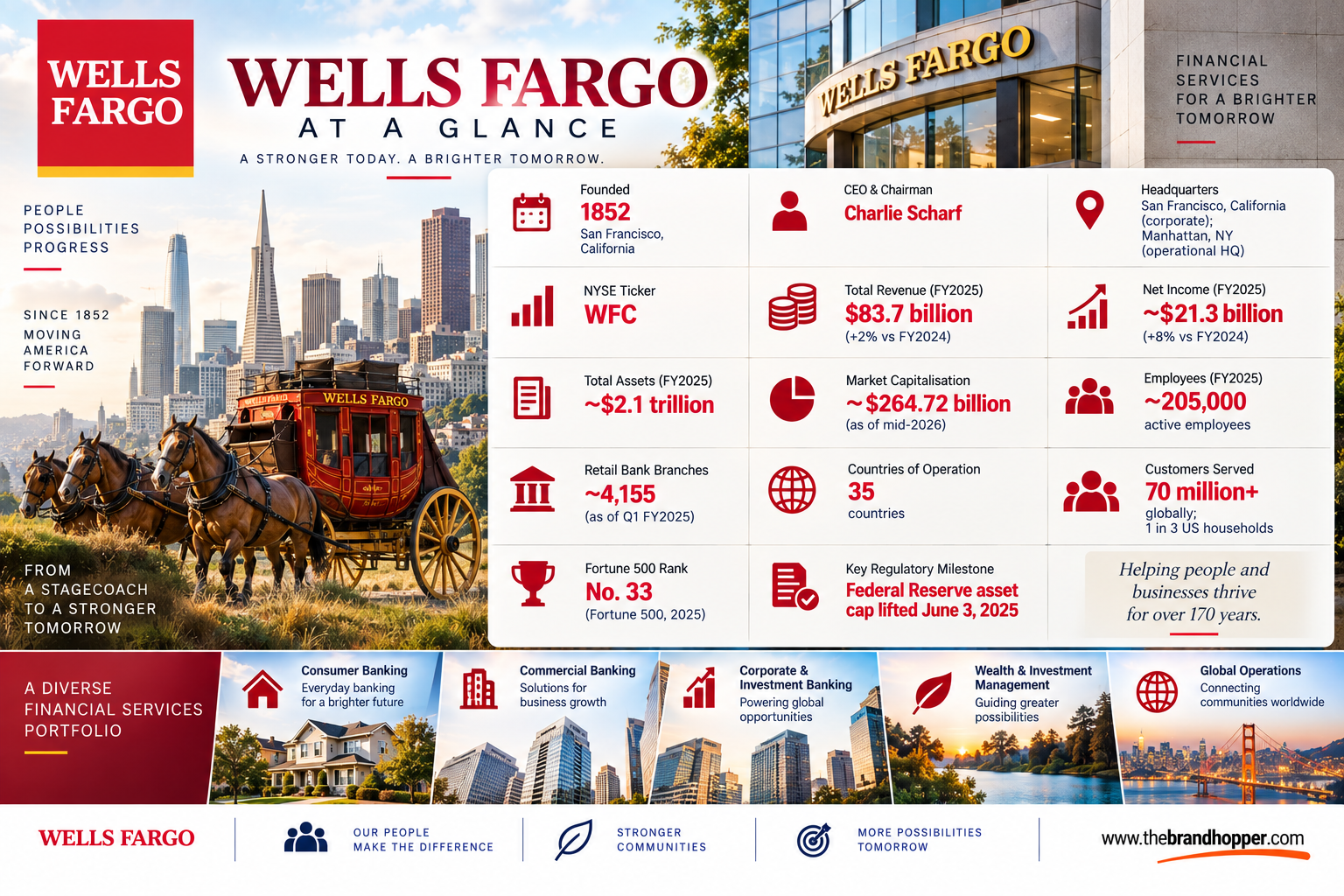
Wells Fargo & Company (NYSE: WFC) stands as one of the most storied institutions in American financial history. Founded in 1852 during the California Gold Rush, Wells Fargo has evolved over more than 170 years from a frontier express and banking service into a $2.1 trillion financial powerhouse serving more than 70 million customers across 35 countries. Today it serves one in three American households, holds the title of the fourth-largest US bank by total assets, and ranks third in the market value of its common stock among all US banks — a testament to a decade-long transformation under CEO Charlie Scharf.
The year FY2025 marked a historic inflection point for Wells Fargo. On June 3, 2025, the Federal Reserve lifted the seven-year-old asset growth cap that had constrained the bank since the infamous account fraud scandal of 2016. Thirteen consent orders terminated since 2019, $83.7 billion in total revenue, a record $21.3 billion in net income, and an improved M&A ranking — all signal that Wells Fargo’s comeback is not just complete but gaining momentum.
This article traces the full arc of Wells Fargo’s story: from Henry Wells and William Fargo’s pioneering vision in 1852, through the stagecoach empire, the banking evolution, the Wachovia acquisition, the regulatory reckoning, and into the bold growth chapter that is now underway.
The Founding Story: Henry Wells, William Fargo, and the California Gold Rush (1852)
The story of Wells Fargo begins not in a bank vault but in the chaos and opportunity of the California Gold Rush. In March 1852, Henry Wells (1805–78) and William George Fargo (1818–81), two visionary entrepreneurs who had previously co-founded the American Express Company, established Wells, Fargo & Company alongside other partners. Their mission was clear: to serve the banking and express requirements of a rapidly transforming West Coast economy flooded with prospectors, merchants, and settlers.
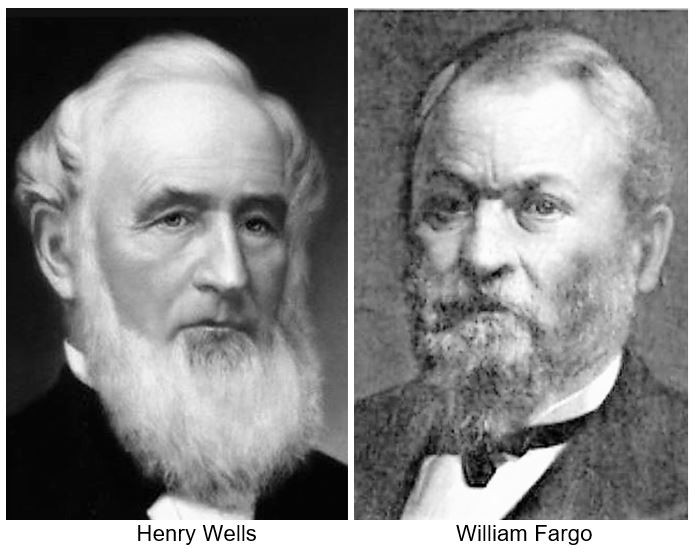
From day one, Wells Fargo offered two interlocking services that defined its character. On the banking side, it bought and sold gold dust, bullion, and foreign exchange — becoming a trusted financial intermediary for miners who had no safe place to convert their gold into usable currency. On the express side, it accepted items for shipment and delivered letters, packages, and financial documents between the gold fields and the coast with speed and reliability that rivals could not match. The company’s model was built on one principle that Henry Wells himself articulated: serve all customers with civility, regardless of creed, colour, or gender — a remarkably progressive stance for the mid-nineteenth century.
By the mid-1850s, Wells Fargo had established offices in more than a dozen California towns, and its legendary green treasure chest — bolted behind the driver’s seat of every stagecoach — became the most trusted container in the American West for gold bars, coins, financial papers, and personal belongings. Armed express messengers guarded those chests with the kind of professionalism that turned “Wells Fargo” into a synonym for security.
Building the World’s Greatest Stagecoach Empire (1855–1869)
In the decade after 1855, Wells Fargo expanded aggressively into the staging business, acquiring overland lines running from Missouri and the Midwest to the Rockies and the Far West. The company’s most celebrated chapter came during the final six months of the Pony Express in 1861, when Wells Fargo operated the western portion of the route between Salt Lake City and San Francisco — proving that its logistical capabilities could meet the nation’s most demanding communications challenge.
The pivotal year was 1866. A landmark consolidation united virtually all major Western stagecoach lines under the Wells Fargo banner, giving the company what historians describe as the largest stagecoach empire in world history. At its peak, Wells Fargo operated the iconic nine-passenger Concord coach (built in Concord, New Hampshire) — a vehicle robust enough to cross mountain passes and desert plains while carrying passengers, mail, and gold bullion. The company would display these coaches in public parades and civic events well into the twenty-first century, cementing its identity as a distinctly American institution.
The completion of the first transcontinental railroad in 1869 changed everything. As iron rails replaced dirt roads, stagecoach demand fell sharply across the main corridors. But Wells Fargo adapted: its coaches continued to serve communities beyond the railroad’s reach, in some cases well into the early twentieth century. The company’s express and banking operations grew alongside the railroad network rather than being replaced by it, demonstrating an early talent for adapting to technological disruption that would prove prophetic over the following century.
Few names commanded more respect on the frontier than Wells Fargo. Its agents and messengers earned a national reputation for both courage — getting the express through regardless of conditions — and integrity. One such guard was the legendary gunman Wyatt Earp. The company would later build museums across the United States to preserve and celebrate this colourful heritage, most notably the Wells Fargo History Museum in San Francisco.
From Express to Bank: The Financial Transformation (1905–1969)
As the express business matured and rail dominated logistics, Wells Fargo strategically pivoted its core identity towards banking. In 1905, its California banking operations were separated from the express business and merged with the Nevada National Bank (established 1875) to form the Wells Fargo Nevada National Bank. This was a foundational structural decision: the company that had become famous for moving gold across the frontier now turned its expertise towards managing and multiplying it.
A series of consolidations followed across the early twentieth century. In 1923, the Wells Fargo Nevada National Bank merged with the Union Trust Company (founded 1893) to create the Wells Fargo Bank & Union Trust Company. By 1954, the name was shortened to the clean, familiar Wells Fargo Bank. In 1960, Wells Fargo merged with the American Trust Company (founded 1854) to form the Wells Fargo Bank American Trust Company.
The modern corporate structure took shape in 1969 when Wells Fargo & Company was established as a holding company, acquiring all shares of Wells Fargo Bank, N.A. This structure gave the institution the financial and regulatory flexibility to pursue the ambitious growth strategy that would define the following five decades. By the early twenty-first century, Wells Fargo Bank had expanded to thousands of retail branches across the United States, offering a comprehensive range of banking, mortgages, insurance, and financial management services through subsidiaries, affiliates, and retail outlets around the world.
It is worth noting that the express side of the original Wells Fargo story continued on a separate path. In 1918, the domestic express operations were absorbed by American Railway Express Company (later Railway Express Agency, which went bankrupt as REA Express in 1975). The international division was purchased by American Express in 1924. A security services division — including Wells Fargo Armored Service Corp., Wells Fargo Guard Services, and Wells Fargo Alarm Services — was sold in 1967 and eventually merged with Loomis Armored Inc. in 1997 to form Loomis, Fargo & Co., later acquired by Swedish firm Securitas AB.
Growth Through Acquisition: Norwest (1998) and Wachovia (2008)
The modern Wells Fargo was shaped by two defining acquisitions. The first came in 1998, when Wells Fargo & Company merged with Minneapolis-based Norwest Corporation. Although Norwest was the formal acquirer in the transaction, the combined company adopted the Wells Fargo name and relocated its corporate headquarters to San Francisco, while the banking subsidiary merged with Wells Fargo’s Sioux Falls-based bank. The deal created a significantly larger institution with a powerful presence across the Midwest, expanding Wells Fargo’s reach far beyond the West Coast.
The second — and far more transformative — acquisition came in the fire of the 2008 global financial crisis. Wachovia Corporation, a Charlotte-based bank with enormous exposure to subprime mortgages, was teetering on the edge of failure. Wells Fargo agreed to acquire Wachovia for $14.8 billion in stock on October 3, 2008, outmaneuvering a competing bid from Citigroup. The deal became one of the most dramatic corporate courtroom battles of the crisis: a New York judge issued a temporary restraining order on October 4, and an appeals court overturned it on October 5. After FDIC-brokered talks between Citigroup and Wells Fargo collapsed — Citigroup was unwilling to absorb losses beyond $42 billion — Wells Fargo secured the transaction and Citigroup later claimed $60 billion in alleged breach-of-exclusivity damages.
The Wachovia acquisition transformed Wells Fargo into a true coast-to-coast banking institution, adding vast retail branch networks across the Southeast and East Coast, a significant mortgage portfolio, and a large commercial banking operation. Wells Fargo was subsequently placed 7th on the Forbes Global 2000 list and 37th on the Fortune 500 list in the years following the acquisition, reflecting the enormous scale gain.
The Account Fraud Scandal and the Federal Reserve Asset Cap (2016–2018)
No account of Wells Fargo’s history is complete without an honest examination of its most damaging chapter. Beginning in 2011 and continuing through 2016, it emerged that Wells Fargo employees had secretly opened millions of unauthorised bank and credit card accounts without customer consent — driven by an aggressive sales culture and cross-selling incentive structure that rewarded volume over ethics. The Consumer Financial Protection Bureau (CFPB), the Office of the Comptroller of the Currency (OCC), and the Los Angeles City Attorney collectively fined Wells Fargo $185 million in September 2016. Investigations subsequently revealed that approximately 3.5 million potentially fraudulent accounts had been opened.
The fallout was severe. CEO John Stumpf resigned in October 2016. Multiple senior executives were clawed back of tens of millions in compensation. Congressional hearings attracted intense public scrutiny. The bank eventually paid more than $3 billion in combined regulatory and legal settlements. Most significantly, on February 2, 2018, the Federal Reserve took the extraordinary step of imposing a consent order that capped Wells Fargo’s total assets at approximately $1.95 trillion — preventing the bank from growing its balance sheet until it had demonstrably fixed its risk management and governance failures. This was the first time in history that the Federal Reserve had imposed such an asset growth restriction on a major bank.
The asset cap proved to be more costly than any fine. While competitors like JPMorgan Chase and Bank of America grew their balance sheets aggressively in the years following, Wells Fargo was locked in place — unable to fully capitalise on the low-rate environment, rising loan demand, or new business opportunities. Estimates of cumulative lost revenue during the seven-year cap period run into the tens of billions of dollars.
Charlie Scharf’s Transformation: A Systematic Rebuild (2019–2025)
Charlie Scharf joined Wells Fargo as Chairman and CEO in October 2019, arriving from Visa Inc. where he had served as CEO since 2016. Scharf brought a clear-eyed diagnosis: the bank had not been run well, its risk infrastructure was far behind peers, and accountability mechanisms were inadequate. His turnaround strategy rested on three pillars — risk and regulatory remediation, operational efficiency, and business-line growth.

Under Scharf’s leadership, Wells Fargo terminated thirteen consent orders since 2019, including seven in FY2025 alone. The bank invested billions in compliance technology, strengthened its board oversight framework, overhauled its incentive structures, and built what regulators came to recognise as a materially improved risk management culture. These were not cosmetic repairs but structural rebuilds: new data systems, new risk committees, new executive accountabilities, and new product governance processes.
Simultaneously, Scharf reshaped the business portfolio. The bank exited low-return business lines (including its student loan portfolio and correspondent lending operations), invested in higher-return areas like credit cards, wealth management, and investment banking, and launched a systematic headcount reduction programme that brought the employee base from approximately 217,000 at the start of FY2024 to approximately 205,000 by the end of FY2025. The efficiency ratio — a key measure of cost management — improved materially year-on-year.
The board recognised Scharf’s achievement in FY2025 by approving total compensation of $40 million — the highest pay package in his tenure — citing specifically the resolution of the Federal Reserve asset cap, the termination of multiple consent orders, and stronger growth across consumer and commercial businesses.
The Historic June 2025 Milestone: Federal Reserve Lifts the Asset Cap
On June 3, 2025, the Federal Reserve formally lifted the $1.95 trillion asset growth cap imposed on Wells Fargo in February 2018. After seven years, one of the most consequential regulatory constraints ever placed on an American bank was removed.
In a statement, CEO Charlie Scharf said: “Strong financial performance, removal of the asset cap imposed by the Federal Reserve, termination of multiple consent orders, and stronger growth in both our consumer and commercial businesses make me proud of our FY2025 results.” The announcement sent Wells Fargo’s share price sharply higher and prompted a wave of analyst upgrades, with many projecting that the unlocking of the balance sheet would add significant incremental revenue capacity in the years ahead.
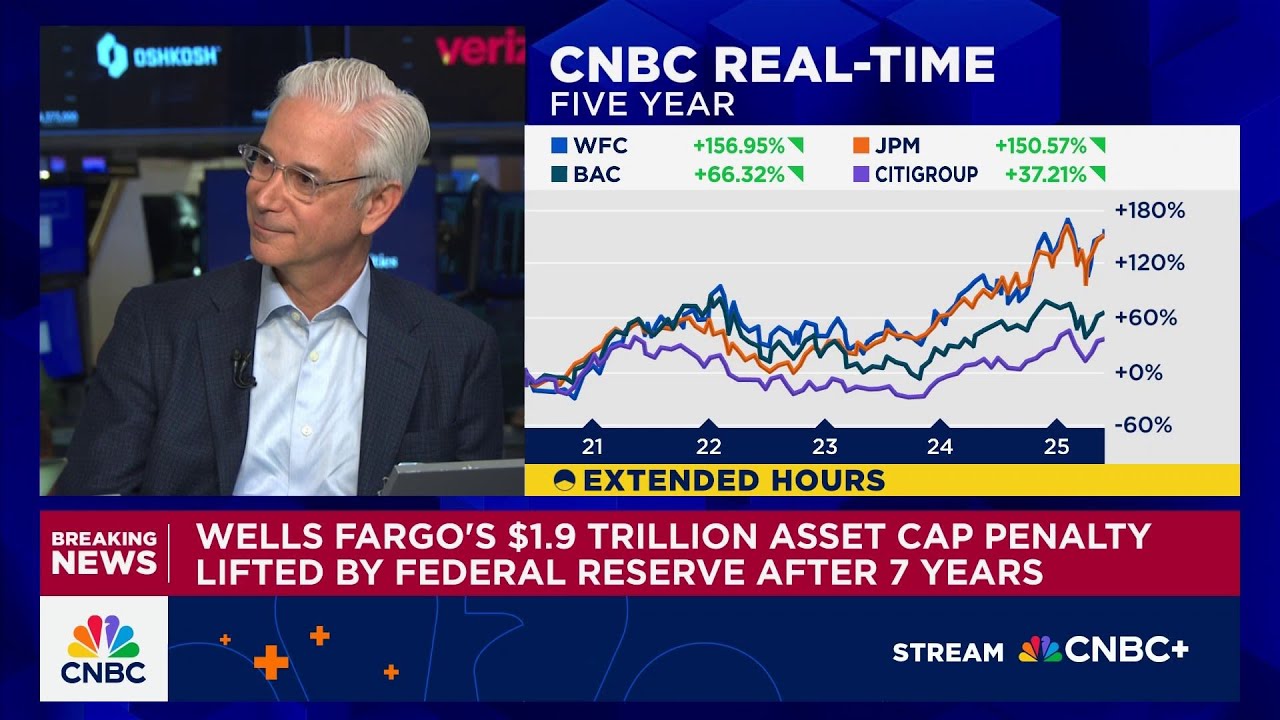
The significance of this milestone cannot be overstated. With the cap lifted, Wells Fargo can now grow its loan book and deposit base without the hard ceiling that had held it back since 2018. The bank can compete more aggressively in commercial real estate, leveraged lending, and large corporate credit markets where the asset cap had previously forced it to turn away business. Management has emphasised, however, that the growth will be disciplined — focused on higher-return, lower-risk opportunities rather than volume for its own sake. As of November 2025, CEO Scharf confirmed that the bank is not under pressure to pursue acquisitions and will prioritise organic growth and operational excellence.
FY2025 Financial Performance: A Landmark Year
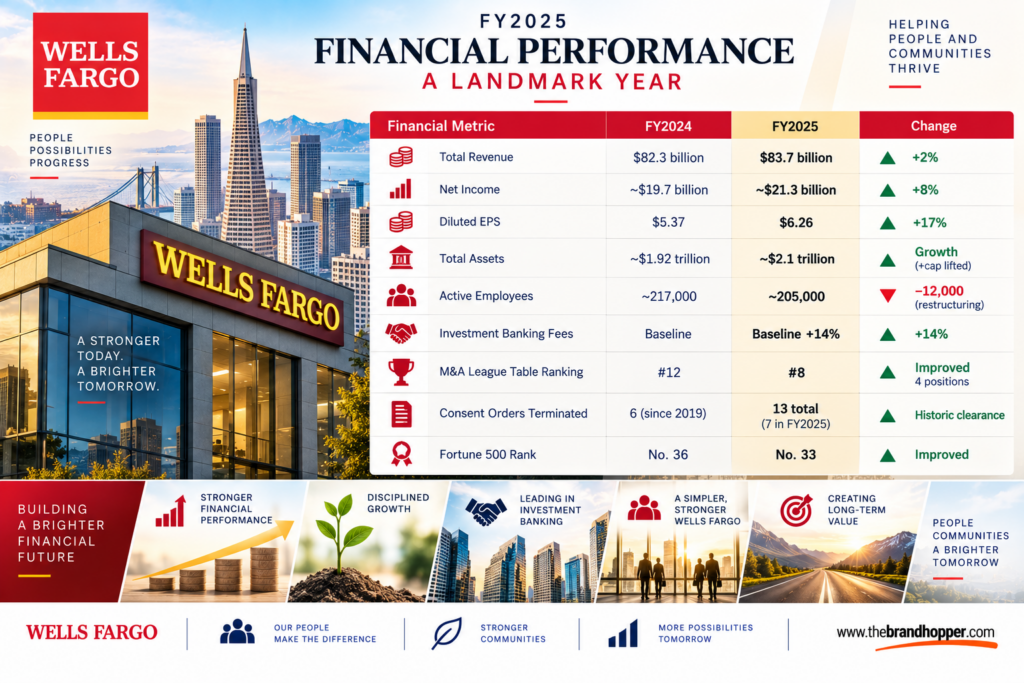
FY2025’s $83.7 billion in total revenue represented a 2% increase over FY2024, driven by stable net interest income and meaningful growth in noninterest income — particularly in investment banking fees (+14%), wealth management, and card revenue.
The 17% rise in diluted EPS (from $5.37 to $6.26) reflects both earnings growth and a consistent share buyback programme that reduced the diluted share count. The Q4 FY2025 quarter itself generated net income of $5.36 billion on revenues of $21.29 billion (+4% year-on-year), demonstrating accelerating momentum as the year closed.
Business Segments: The Four Pillars of Wells Fargo
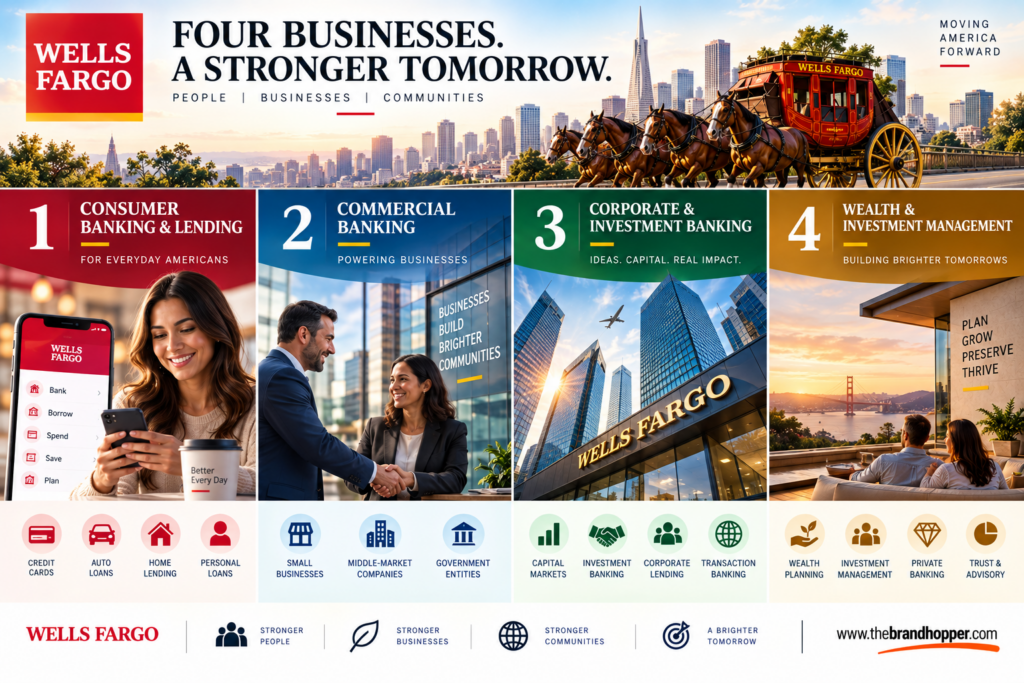
Wells Fargo operates through four reportable operating segments, each serving distinct customer groups and generating distinct financial profiles. Together they create the diversified revenue base that underpins the bank’s resilience across economic cycles.
1. Consumer Banking and Lending
Consumer Banking and Lending is the largest and most visible segment, encompassing the retail banking branches, credit cards, auto loans, home lending, and personal loans that serve millions of everyday American customers. Wells Fargo serves approximately one in three US households through this segment — a customer penetration rate that rivals any bank in the country. Products are distributed through ~4,155 retail branches, a national ATM network, digital platforms, call centres, and direct digital onboarding channels.
Strategic priorities in FY2025 included continuing investment in core credit card capabilities (the bank significantly increased its card advertising spend), modernising auto loan servicing systems, and improving home lending sales and fulfilment efficiency through enhanced digital capabilities. Consumer Banking and Lending has been a key beneficiary of the digital transformation programme, with customers increasingly engaging with the bank through mobile channels rather than branches.
2. Commercial Banking
The Commercial Banking segment serves middle-market companies, small businesses, and government entities with a comprehensive suite of credit, treasury management, and risk management products. Wells Fargo is the largest middle-market banking provider in the United States — a leadership position built over decades of relationship banking with businesses generating between $5 million and $2 billion in annual revenues.
Commercial Banking also serves more than 10% of US small businesses, giving the bank an unmatched position in the SME segment. In FY2025, the segment benefited from the asset cap lift, which removed constraints on new loan commitments and enabled relationship managers to pursue previously off-limits commercial credit opportunities. The bank has also invested in technology to improve cash management, trade finance, and digital treasury platforms for its business clients.
3. Corporate and Investment Banking
Corporate and Investment Banking (CIB) covers capital markets, investment banking, corporate lending, and transaction banking for large corporations, financial institutions, and government entities. This segment has been one of CEO Scharf’s most deliberate growth investments: since 2020, Wells Fargo has systematically hired senior bankers in priority sectors including technology, healthcare, energy, and financial sponsors to build the advisory capabilities that the bank historically lacked versus peers.
The results are visible. In FY2025, Wells Fargo grew its investment banking market share, grew investment banking fees by 14%, and improved its M&A advisory ranking from 12th to 8th globally. The electronic trading business also received significant investment, with new fixed income and equity product capabilities added during the year. CIB is expected to be a disproportionate growth driver in the post-asset-cap era, as a larger balance sheet enables the bank to provide bigger credit facilities alongside its advisory mandates.
4. Wealth and Investment Management
Wealth and Investment Management (WIM) serves high-net-worth and ultra-high-net-worth individuals, family offices, and institutional clients through Wells Fargo Advisors, The Private Bank, and Abbot Downing (for ultra-high-net-worth families). The segment also includes Wells Fargo Asset Management, which manages assets across equity, fixed income, and alternative strategies for institutional and retail clients.
In Q4 FY2025, WIM demonstrated its resilience: net interest income rose 16% to $993 million, and noninterest income grew 9% to $3.367 billion. FY2025 investments in this segment included the continued modernisation of Advisor Gateway (a platform enabling advisors to serve clients across all channels), a broadened unified managed account platform, and continued investment in the client digital experience for account opening and fund movement. These investments are building towards a full-service wealth platform that can compete more directly with Merrill Lynch and Morgan Stanley’s wealth divisions.
Digital Transformation: Building the Bank of Tomorrow
Wells Fargo’s digital transformation is one of the most ambitious in US banking. The bank has invested billions of dollars in modernising its technology infrastructure, building new digital products, and deploying artificial intelligence across both customer-facing and back-office functions.
Mobile banking is central to this strategy. Mobile active users grew 25% over the 24-month period leading into Q1 FY2026, reaching approximately 33.5 million. The Wells Fargo Mobile app consistently earns top ratings — 4.9 stars in the Apple App Store based on more than 10 million customer reviews, a benchmark that places it among the highest-rated banking apps in the United States. The app supports a comprehensive suite of self-service features including account management, fund transfers, mobile check deposit, credit card controls, and investment portfolio viewing.
At the heart of Wells Fargo’s AI strategy is Fargo, the bank’s AI-powered virtual assistant built on Google Cloud’s conversational AI infrastructure. Since its launch, Fargo has surpassed 1 billion customer interactions — a milestone that illustrates both the scale of customer adoption and the depth of utility the assistant provides across tasks ranging from balance inquiries and bill payment to fraud alerts and product recommendations. Wells Fargo has committed to scaling Fargo’s capabilities further, with AI increasingly embedded in back-office loan processing, fraud detection, and compliance monitoring.
In early FY2026, Wells Fargo announced that it has reached major digital milestones, with the bank explicitly positioning AI and mobile banking at the centre of its customer engagement strategy. The firm continues to invest in real-time payment infrastructure, open banking connectivity, and personalisation engines that use transaction data to surface relevant products and services at the right moment in a customer’s financial life.
Global Footprint and Core Products
Wells Fargo operates in 35 countries and is classified by the Financial Stability Board as a systemically important financial institution (SIFI) — a designation reserved for banks whose failure could destabilise the global financial system. This classification subjects Wells Fargo to the highest level of regulatory scrutiny and capital requirements, but it also signals the bank’s irreplaceable role in the global financial architecture.
The bank’s primary US subsidiary, Wells Fargo Bank, N.A., is a national bank headquartered in Sioux Falls, South Dakota, and chartered in Wilmington, Delaware. International operations span trade finance and correspondent banking in Europe, Asia Pacific, and Latin America, with key offices in London, Hong Kong, Singapore, and Toronto.
Wells Fargo’s core products span the full spectrum of financial services: personal and business checking and savings accounts, home mortgages and home equity products, credit and debit cards, personal and auto loans, small business lending, commercial loans and lines of credit, treasury management, foreign exchange, interest rate and commodity risk management, securities underwriting, M&A advisory, equity and fixed income trading, private banking, trust and estate services, brokerage and retirement accounts, and insurance products.
Brand Identity and Marketing Strategy
The Wells Fargo brand is built on one of the most distinctive visual and narrative identities in American banking. The stagecoach — with its six-horse team and iconic green silhouette — is among the most recognisable brand symbols in US financial services, immediately signalling heritage, reliability, and the frontier spirit of getting things done no matter what. The brand’s FY2025 marketing strategy has shifted to reflect the post-asset-cap growth narrative: from a bank recovering from scandal to a bank back on the offensive.
Under Scharf, Wells Fargo significantly increased its advertising investment in FY2024 and FY2025, with particular emphasis on the credit card and consumer banking businesses where it was looking to grow market share. The bank’s “This Is Wells Fargo” campaign and its digital-first messaging have sought to reconnect with younger, mobile-native customers who may only know the brand through the scandal years. Celebrity partnerships, sports sponsorships (notably the PGA Tour), and community reinvestment communications have all formed part of the brand rehabilitation effort.
The bank has also leaned into transparency as a brand differentiator: publishing detailed consent order termination updates, releasing regular employee and customer trust surveys, and featuring Scharf prominently in media and analyst events to signal accountability at the top. In a world of banking commodities, Wells Fargo’s heritage brand and transformational story represent a genuine competitive differentiation opportunity.
Competitive Position: The Big Four US Banks
Wells Fargo is one of the “Big Four” US banks alongside JPMorgan Chase, Bank of America, and Citigroup. Each institution serves the full spectrum of customers — individuals, businesses, and institutions — but each carries a distinct strategic identity.
| Bank | Key Differentiator | Wells Fargo’s Relative Position |
| JPMorgan Chase | Global investment banking leader; largest US bank by assets | WFC competes in IB (M&A rank now #8) and consumer; smaller in global capital markets |
| Bank of America | Deep retail banking + Merrill Lynch wealth platform | WFC competes directly in consumer banking and wealth management; broader middle-market presence |
| Citigroup | Global transaction banking and institutional services | WFC stronger in US retail banking and middle-market; CIB growing to compete on corporate advisory |
| Wells Fargo | Middle-market banking leader; consumer scale; growing IB | Unique 170-year heritage brand + post-cap-lift growth catalyst; third by US market cap |
The asset cap lift marks the most significant competitive development for Wells Fargo since the 2008 Wachovia acquisition. With the constraint removed, the bank can now pursue loan growth, larger credit facilities in CIB, and expanded wealth management AUM — all of which had been restricted during the seven-year remediation period. Analysts broadly expect Wells Fargo to take market share from peers in the commercial banking and CIB segments over the next three to five years.
Environmental, Social and Governance (ESG) Commitments
Wells Fargo has outlined ambitious environmental and social commitments as part of its long-term stakeholder strategy. The bank has committed to facilitating $500 billion in sustainable financing by 2030, covering renewable energy project finance, green bonds, social bonds, and sustainability-linked loans. It has also pledged to align its own operations with net-zero greenhouse gas emissions by 2050.
On the social side, Wells Fargo has directed billions of dollars into community development finance, affordable housing, and small business support in underserved communities, reflecting both regulatory requirements and a genuine recognition that its historically broad retail footprint creates a social responsibility unique among its peers. The bank’s Open Doors programme and philanthropic giving through the Wells Fargo Foundation further reinforce this community-centred identity.
Governance improvements under Scharf have been perhaps the most consequential ESG development. The board has been significantly refreshed, with independent directors now comprising a strong majority. Risk committee oversight has been strengthened, executive compensation clawback provisions have been broadened, and a comprehensive culture programme — including regular employee trust and ethics surveys — has been embedded across the organisation.
Also Read: HDFC Bank – India’s Most Valuable Brand
Future Growth Strategy: What Comes Next for Wells Fargo
With the regulatory remediation chapter formally closed, Wells Fargo enters a new strategic era. CEO Scharf has articulated a “growth with discipline” framework that targets four major opportunity areas.
First, credit card and consumer lending growth. Wells Fargo has historically underperformed peers in credit card market share relative to its massive retail branch and digital customer base. The investment in card capabilities — products, rewards, marketing, and digital account management — positions the bank to close this gap meaningfully over the next three to five years.
Second, wealth management expansion. As mass-affluent and high-net-worth customer segments grow, Wells Fargo’s Advisor Gateway modernisation and unified managed account platform create the infrastructure to attract and retain more assets under management. Scharf has suggested this is one of the most significant untapped opportunities in the franchise.
Third, investment banking market share capture. Having improved its M&A ranking from 12th to 8th in FY2025, and with ongoing senior banker hiring in priority sectors, Wells Fargo is building toward a top-five IB position. The larger balance sheet post-asset-cap lifts will help: corporate clients want their advisory bank to also be a major credit provider, and Wells Fargo can now credibly offer both.
Fourth, international banking. While Wells Fargo’s international presence is significantly smaller than JPMorgan Chase or Citigroup, the bank has been selectively expanding its trade finance, foreign exchange, and correspondent banking capabilities to support its multinational US corporate clients as they expand globally. A measured expansion of the international footprint is likely a medium-term strategic priority.
CEO Scharf has been explicit that acquisitions are not a near-term priority. The focus is on organic growth, operational excellence, and earning back the competitive position that the seven-year asset cap cost the bank. With the balance sheet now unconstrained, the return on this internal investment is expected to compound significantly over the remainder of the decade.
Key Takeaways
1. Wells Fargo’s 170+ year history is one of the most remarkable transformation stories in American business — from Gold Rush express to a $2.1 trillion financial services giant.
2. FY2025 was a landmark year: $83.7 billion in total revenue (+2%), ~$21.3 billion in net income (+8%), $6.26 diluted EPS (+17%), and the historic lifting of the Federal Reserve asset cap after seven years.
3. The asset cap lift on June 3, 2025 opens a new growth chapter. Wells Fargo can now compete without a balance sheet ceiling for the first time since 2018.
4. CEO Charlie Scharf has completed one of the most significant bank turnarounds in modern US history, terminating 13 consent orders since 2019 — including 7 in FY2025 alone.
5. Digital transformation is accelerating: 33.5 million mobile active users (growing 25% over 24 months), Fargo AI assistant surpassing 1 billion interactions, and a 4.9-star mobile app from 10 million+ reviews.
6. Investment banking is a growing strength: M&A ranking improved from 12 to 8 in FY2025, with investment banking fees up 14%.
7. The four business segments — Consumer Banking, Commercial Banking, Corporate & Investment Banking, and Wealth & Investment Management — form a diversified revenue engine that positions Wells Fargo for compound growth in the years ahead.
Frequently Asked Questions (FAQs)
Q1. When was Wells Fargo founded and who founded it?
A: Wells Fargo was founded in March 1852 in San Francisco, California, by Henry Wells (1805–78) and William George Fargo (1818–81), along with other partners. Both founders had previously co-founded the American Express Company. They established Wells, Fargo & Company to provide banking and express delivery services to California’s booming Gold Rush economy, initially offering to buy gold dust, sell financial drafts, and transport valuables between the West and East Coasts.
Q2. What is Wells Fargo’s total revenue and net income for FY2025?
A: Wells Fargo reported total revenue of $83.7 billion for FY2025, a 2% increase over FY2024’s $82.3 billion. Net income was approximately $21.3 billion (+8%), and diluted earnings per share rose 17% to $6.26 (from $5.37 in FY2024). Q4 FY2025 alone generated net income of $5.36 billion on revenues of $21.29 billion, up 4% year-on-year. Total assets reached approximately $2.1 trillion by year-end FY2025. Source: Wells Fargo Q4 FY2025 Earnings Release; Wells Fargo FY2025 Annual Report.
Q3. What was the Wells Fargo asset cap and when was it lifted?
A: The Federal Reserve imposed an asset growth cap on Wells Fargo on February 2, 2018, limiting the bank’s total assets to approximately $1.95 trillion as a punitive measure following the account fraud scandal. This was an unprecedented regulatory action — the first time the Federal Reserve had imposed such a restriction on a major US bank. The cap was lifted on June 3, 2025, after Wells Fargo demonstrated comprehensive improvements in board effectiveness, risk management, and operational controls. The seven-year cap is estimated to have cost the bank tens of billions of dollars in foregone revenue and competitive positioning.
Q4. How many customers and employees does Wells Fargo have?
A: Wells Fargo serves more than 70 million customers globally across 35 countries, including approximately one in three US households. In the United States, it is the largest middle-market banking provider and serves more than 10% of small businesses. As of end of FY2025, Wells Fargo had approximately 205,000 active employees — down from approximately 217,000 at the start of FY2024 — reflecting a systematic efficiency programme under CEO Charlie Scharf that reduced headcount while improving per-employee productivity.
Q5. What are Wells Fargo’s four main business segments?
A: Wells Fargo operates through four reportable operating segments: (1) Consumer Banking and Lending, which includes retail banking, home lending, auto loans, credit cards, and personal loans for individuals and small businesses; (2) Commercial Banking, which provides credit, treasury management, and financial services to middle-market companies and government entities; (3) Corporate and Investment Banking (CIB), covering capital markets, investment banking, corporate lending, and transaction services for large corporations and institutions; and (4) Wealth and Investment Management, serving high-net-worth individuals and institutions through Wells Fargo Advisors, The Private Bank, and Abbot Downing.
Q6. How has Wells Fargo’s investment banking performance changed?
A: Wells Fargo has made significant progress in growing its investment banking business under CEO Charlie Scharf. In FY2025, investment banking fees increased 14% year-on-year, and the bank improved its M&A advisory ranking from 12th to 8th globally. This reflects a deliberate strategy of hiring senior bankers in priority sectors — technology, healthcare, energy, and financial sponsors — and investing in electronic trading and new capital markets capabilities. With the Federal Reserve asset cap now lifted, Wells Fargo can offer larger credit facilities alongside advisory mandates, making it more competitive for complex corporate transactions.
Q7. What is the Fargo AI assistant and how is it used?
A: Fargo is Wells Fargo’s AI-powered virtual assistant, built on Google Cloud’s conversational AI platform. Since its launch, Fargo has surpassed 1 billion customer interactions, handling a wide range of tasks including account balance inquiries, bill payment reminders, transaction searches, fraud alerts, and product recommendations. The Wells Fargo Mobile app, which hosts Fargo, carries a 4.9-star rating in the Apple App Store based on more than 10 million customer reviews. In FY2026, Wells Fargo announced that it has reached major digital milestones and is scaling AI across customer service, fraud detection, and back-office processing. Source: Wells Fargo Newsroom (March 2026).
Q8. How does Wells Fargo compare to the other Big Four US banks?
A: Wells Fargo is one of the “Big Four” US banks alongside JPMorgan Chase, Bank of America, and Citigroup. By total assets (~$2.1 trillion as of FY2025), Wells Fargo ranks fourth among US banks. By market capitalisation (~$264.72 billion as of mid-2026), it ranks third among US banks. Wells Fargo’s strongest competitive positions are in middle-market commercial banking (where it is the US market leader), consumer banking scale (1 in 3 US households), and a rapidly growing investment banking franchise. Its largest opportunity area — credit card market share — remains a strategic investment priority where it currently underperforms peers relative to its customer base.
Q9. What happened during the Wells Fargo account fraud scandal?
A: Between approximately 2011 and 2016, Wells Fargo employees opened an estimated 3.5 million unauthorised bank accounts and credit cards without customer knowledge or consent, driven by an aggressive cross-selling culture with volume-based incentive structures. The scandal was exposed publicly in September 2016, resulting in a $185 million fine from the CFPB, OCC, and Los Angeles City Attorney. CEO John Stumpf resigned in October 2016, and the bank ultimately paid more than $3 billion in combined regulatory and legal settlements. The Federal Reserve imposed a $1.95 trillion asset cap in February 2018, which was not lifted until June 2025 after comprehensive governance and risk management reforms under CEO Charlie Scharf.
Q10. What is Wells Fargo’s strategy for the coming years?
A: With the Federal Reserve asset cap lifted and regulatory remediation completed, Wells Fargo has entered a new growth chapter. CEO Charlie Scharf’s “growth with discipline” strategy focuses on four priority areas: (1) Credit card and consumer lending market share growth, backed by significantly increased marketing investment; (2) Wealth management expansion, through Advisor Gateway modernisation and a unified managed account platform; (3) Investment banking market share capture, targeting a top-five global M&A ranking; and (4) Selective international banking expansion to support multinational US corporate clients. Scharf has confirmed that the bank is not under pressure to pursue acquisitions, favouring organic growth and operational excellence as the primary value drivers. Source: Wells Fargo CEO statements, November 2025.
Conclusion
Wells Fargo’s 170-year arc from a frontier express company to a $2.1 trillion banking giant is one of the great chapters in American corporate history. The stagecoach that once carried gold across the Sierra Nevada has given way to an AI assistant that handles over a billion customer interactions and a mobile app trusted by 33.5 million active users. The scale has changed beyond recognition; the commitment to getting it done — reliably, for every customer — has not.
FY2025 confirmed that Wells Fargo’s transformation from the account fraud scandal is not just complete but accelerating. Revenue of $83.7 billion, net income of ~$21.3 billion, the historic lifting of the Federal Reserve asset cap, thirteen consent orders terminated, and an investment banking franchise climbing the global rankings: these are the metrics of a bank that has rebuilt itself and is now competing at full strength.
For investors, customers, and observers of American financial services, the most important Wells Fargo story is the one now beginning. With a $2.1 trillion balance sheet unconstrained for the first time in seven years, a world-class digital platform, and a management team that has already demonstrated it can solve hard problems, the question is no longer whether Wells Fargo can recover. The question is how far it can go.
To read more content like this, subscribe to our newsletter