Last Updated on August 3, 2026 by Team TBH
Caterpillar Inc. (CAT) is the world’s largest manufacturer of construction and mining equipment, but it operates in a fiercely competitive global market. From Japan’s Komatsu to China’s XCMG, from Sweden’s Epiroc to America’s own John Deere, a diverse set of rivals challenges Caterpillar across every product category—excavators, bulldozers, mining trucks, wheel loaders, cranes, and underground drilling systems.
This deep-dive identifies and analyses Caterpillar’s 15 most significant competitors, using the latest verified financial data, to help you understand the global competitive landscape in the heavy equipment industry.
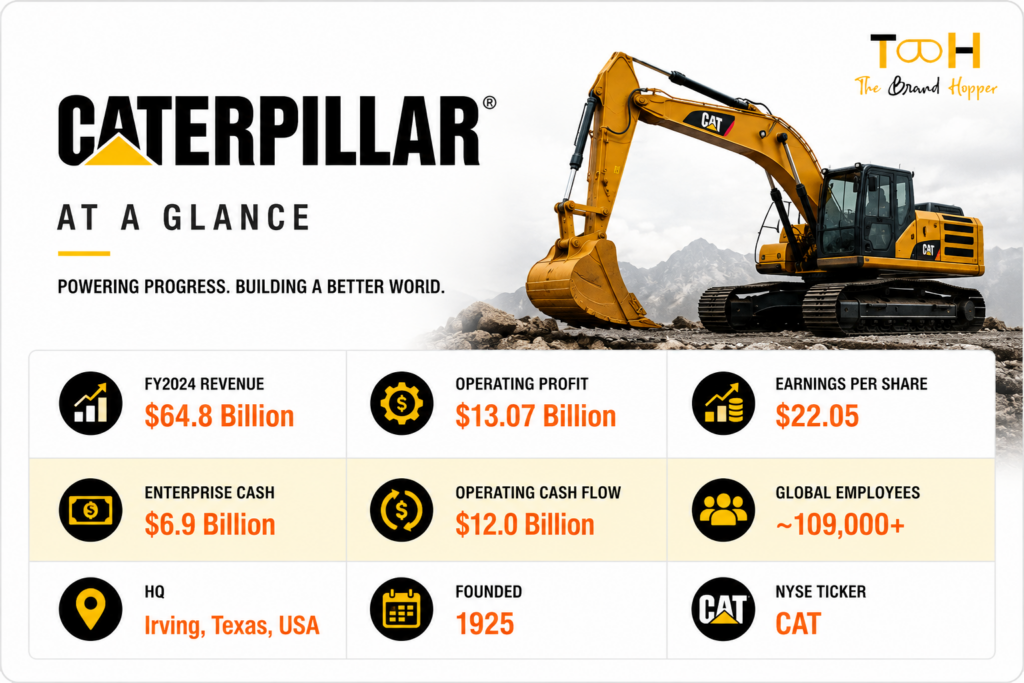
Caterpillar’s FY2024 revenue of $64.8 billion marked a 3% decline compared to $67.1 billion in FY2023, reflecting softer demand across construction industries. Despite the top-line dip, CAT’s operating discipline held firm, with an operating profit margin of approximately 20.2%—one of the strongest in the industry.
Want to understand how CAT markets its dominance? Read our in-depth look at the Marketing Strategy of Caterpillar.
The Global Heavy Equipment Market: Why Competition Is Intensifying
The global construction equipment market is navigating a complex cycle. After a post-pandemic surge, demand softened in 2024 across North America and Europe—with most major OEMs reporting revenue declines of 10–20%. At the same time, Chinese manufacturers like XCMG and Sany have dramatically expanded their international footprints, offering aggressive pricing and rapidly improving quality. The result is a competitive environment where Caterpillar’s incumbency advantages in dealer networks, financing (Cat Financial), and brand trust matter more than ever.
Meanwhile, demand for mining equipment—driven by the energy transition and surging demand for copper, lithium, and other critical minerals—remains structurally robust, providing a growth counterweight for companies like Caterpillar, Epiroc, and Sandvik.
Caterpillar’s Top 15 Competitors: In-Depth Analysis
Below, we analyse each major competitor across five dimensions: financial scale, product portfolio, geographic strength, technological positioning, and competitive differentiation versus Caterpillar.
1. Komatsu Ltd.
Official Website: www.komatsu.jp/en
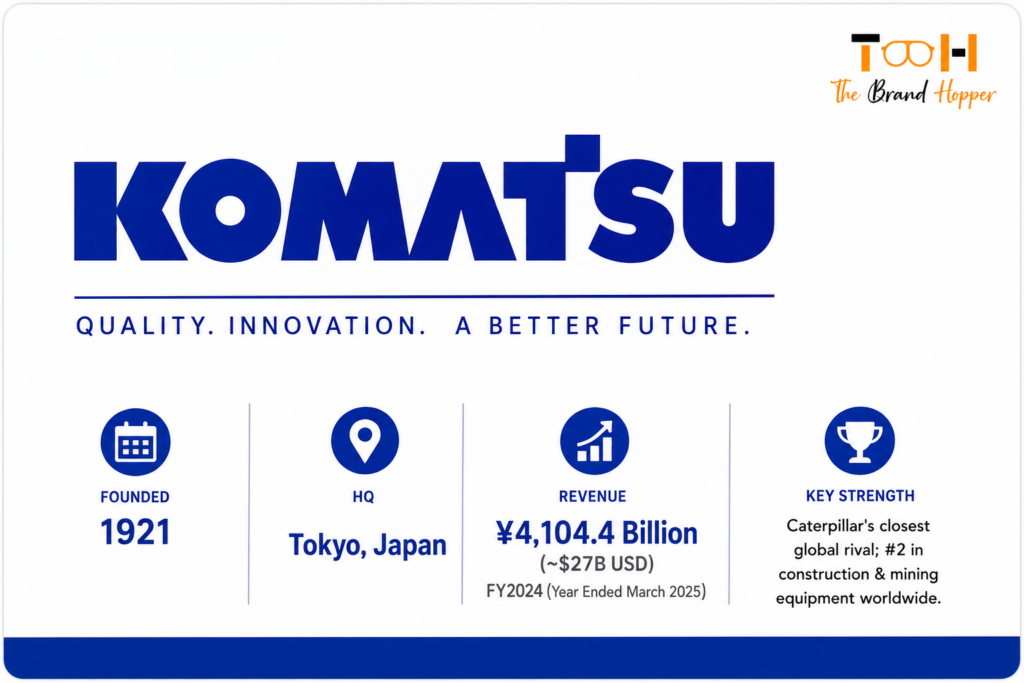
Komatsu is Caterpillar’s most direct global competitor, matching it product-for-product across excavators, bulldozers, mining trucks, and wheel loaders. For the fiscal year ended March 2025, Komatsu reported record net sales of ¥4,104.4 billion, a 6.2% increase year-over-year, with its Construction, Mining & Utility Equipment segment—the core business—generating ¥3,798.2 billion. Operating income for the group reached ¥657.1 billion at a 16.0% margin, reflecting strong demand from mining customers and disciplined cost management.
Komatsu’s key competitive advantages include its Smart Construction digital ecosystem (drones, GPS, and data analytics for job site optimisation), strong dealer networks across Asia-Pacific and the Americas, and a dedicated commitment to electrification and autonomous haulage systems. Its Autonomous Haulage System (AHS) has now logged over 5 billion tonnes of material moved at mining sites globally.
Where Komatsu challenges Caterpillar most fiercely: In Japan and Southeast Asia, Komatsu holds commanding market share. In large mining trucks and ultra-class hydraulic excavators, Komatsu’s 930E-series and PC8000 models are direct rivals to CAT’s 797F and 6090.
2. John Deere (Deere & Company)
Official Website: www.deere.com
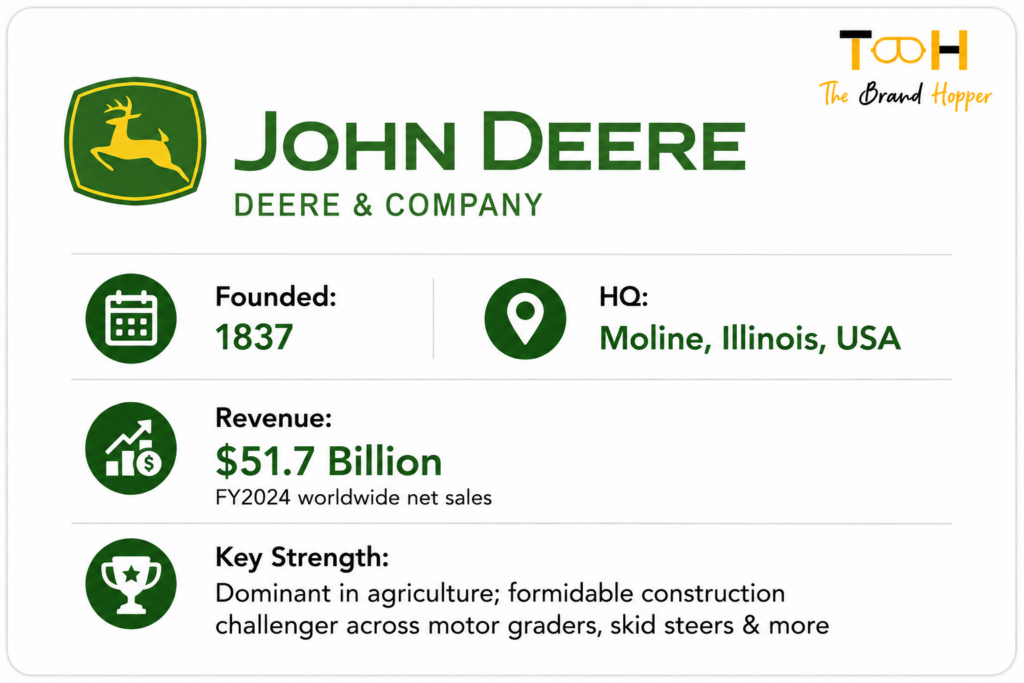
John Deere is better known for green tractors than yellow excavators, but its Construction & Forestry segment competes directly with Caterpillar in backhoe loaders, motor graders, skid steers, compact track loaders, and forestry machinery. Deere’s FY2024 worldwide net sales were $51.7 billion, down roughly 16% from FY2023’s record $60.7 billion, primarily due to a significant downcycle in agricultural equipment. The Construction & Forestry segment reported net sales of approximately $11.6 billion.
Deere’s competitive edge lies in its precision technology platform (John Deere Operations Center), integrated financial services (John Deere Financial), and the world’s deepest agricultural dealer network—which also serves construction customers. The company has invested heavily in autonomous and electric machinery, with its autonomous tractor and electric compact equipment proving early commercial success.
Caterpillar and Deere overlap most in compact construction equipment, motor graders, and articulated dump trucks. In the United States, Deere’s retail presence in rural and suburban construction markets gives it an edge in segments where dealer proximity and financing matter most.
3. Volvo Construction Equipment (Volvo CE)
Official Website: www.volvogroup.com
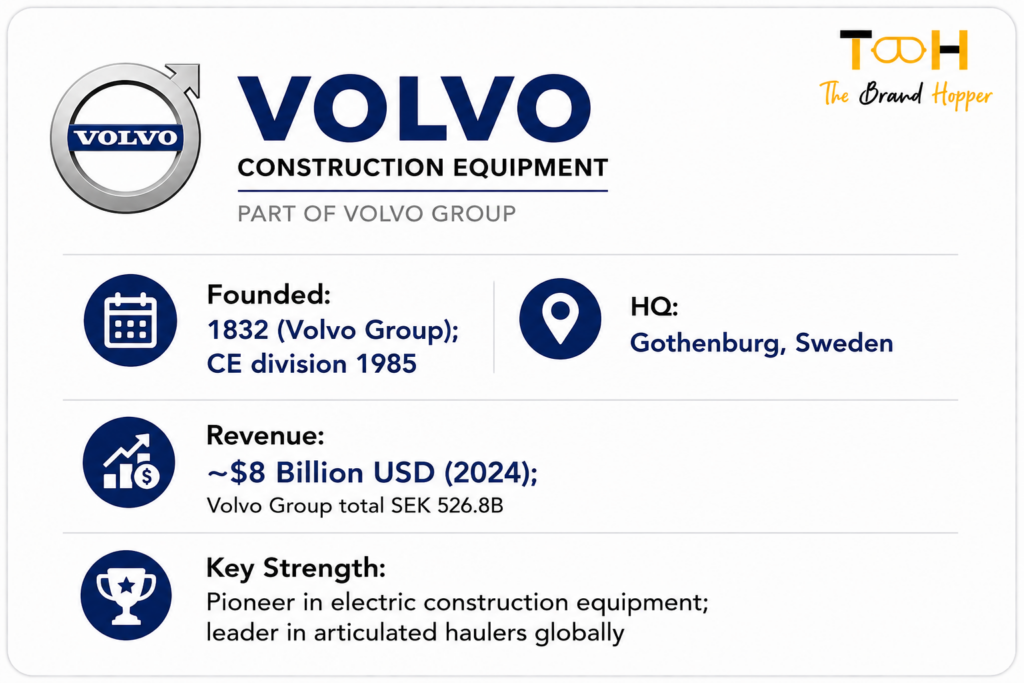
Volvo Construction Equipment is a division of the Volvo Group, one of the world’s largest manufacturers of trucks, buses, and construction equipment. Volvo CE competes with Caterpillar across articulated haulers, excavators, wheel loaders, and compaction equipment. In 2024, Volvo CE revenues declined approximately 16%—mirroring an industry-wide downturn in Europe and North America driven by higher interest rates dampening infrastructure investment.
Where Volvo CE genuinely differentiates: electrification. The company launched the world’s first series-produced electric excavators and wheel loaders, and its EC230 Electric and L120 Electric models have garnered strong early adoption in Scandinavian markets. Volvo CE has committed to achieving 35% of its sales from electric and hydrogen machines by 2030.
Volvo CE also has strong positions in articulated dump trucks—the Volvo A60H is the world’s largest articulated hauler—and road machinery. Its dealer network spans over 140 countries, giving it genuinely global reach to challenge CAT in key European and Latin American markets.
4. Liebherr Group
Official Website: www.liebherr.com
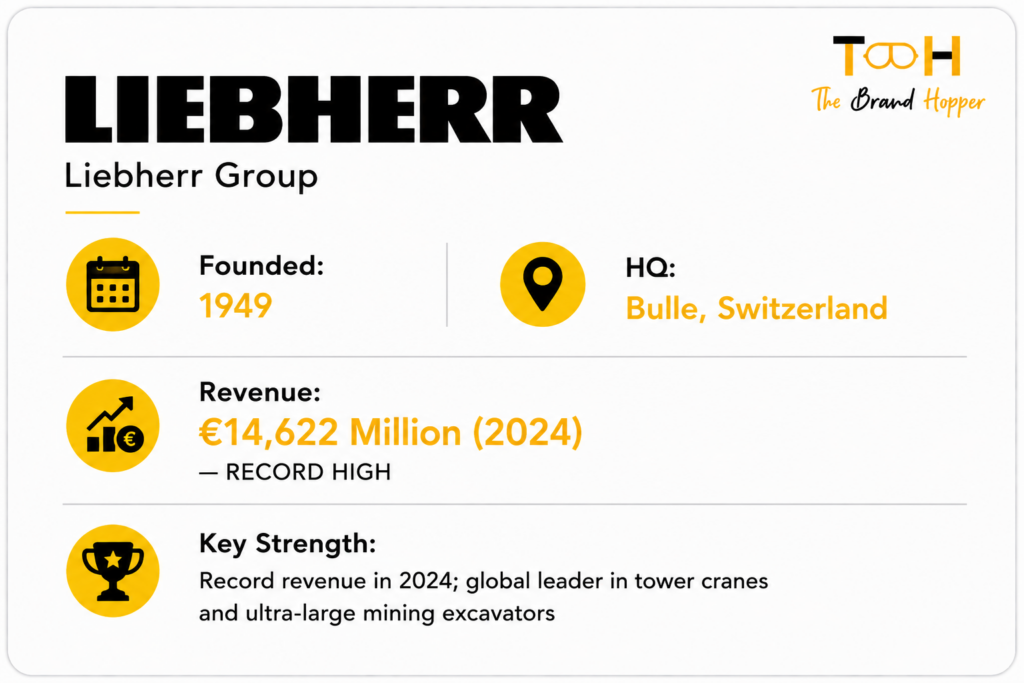
Liebherr, the privately-owned Swiss-German engineering giant, posted record group revenue of €14,622 million in 2024, a 4.1% increase—making it one of the few heavy equipment makers to grow during an industry-wide downturn. Its construction machinery and mining divisions (generating approximately €9.9 billion together) compete directly with Caterpillar in hydraulic excavators, wheel loaders, bulldozers, and mining trucks. Liebherr invested €666 million in R&D in 2024 and employed 54,728 people globally.
Liebherr’s most formidable products in the Caterpillar overlap zone include the R 9800 mining excavator (one of the world’s largest), its PR 776 mining dozer, and the T 284 mining truck—direct competitors to CAT’s 795 series trucks and D11 dozer. Liebherr also leads globally in tower cranes (Liebherr-Werk Biberach), a segment where Caterpillar has no presence.
Being privately-held gives Liebherr the flexibility to invest through downturns without quarterly earnings pressure—a structural advantage when competing with publicly-traded Caterpillar for long-cycle mining contracts.
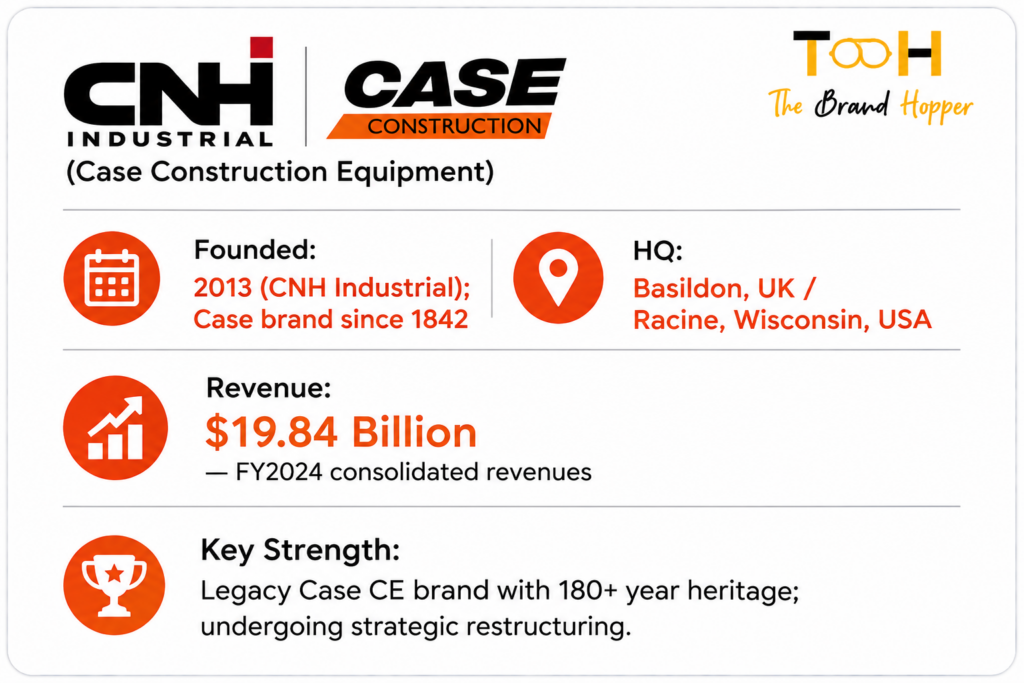
5. CNH Industrial (Case Construction Equipment)
Official Website: www.cnh.com
CNH Industrial’s Construction Equipment segment (primarily the Case CE brand) competes with Caterpillar in backhoe loaders, compaction equipment, skid steers, telescopic handlers, and motor graders. CNH’s FY2024 consolidated revenues were $19.84 billion, a decline of approximately 20% from FY2023, driven by broad industry destocking and weaker demand. Net income fell to $1.259 billion. The company is executing a strategic separation of its Agriculture and Construction segments.
Case Construction Equipment has a heritage stretching back over 180 years and maintains strong brand equity particularly in North America, Latin America, and select European markets. Its Case 821G wheel loader and 580 Super N backhoe loader are iconic product lines with loyal customer bases built over decades.
CNH’s challenge: its construction segment is smaller and less profitable than Caterpillar’s, and the company has been investing in restructuring. However, an independent Case CE entity could, if properly capitalised, become a more focused competitor in its core segments.
6. Hitachi Construction Machinery (Hitachi CM)
Official Website: www.hitachicm.com
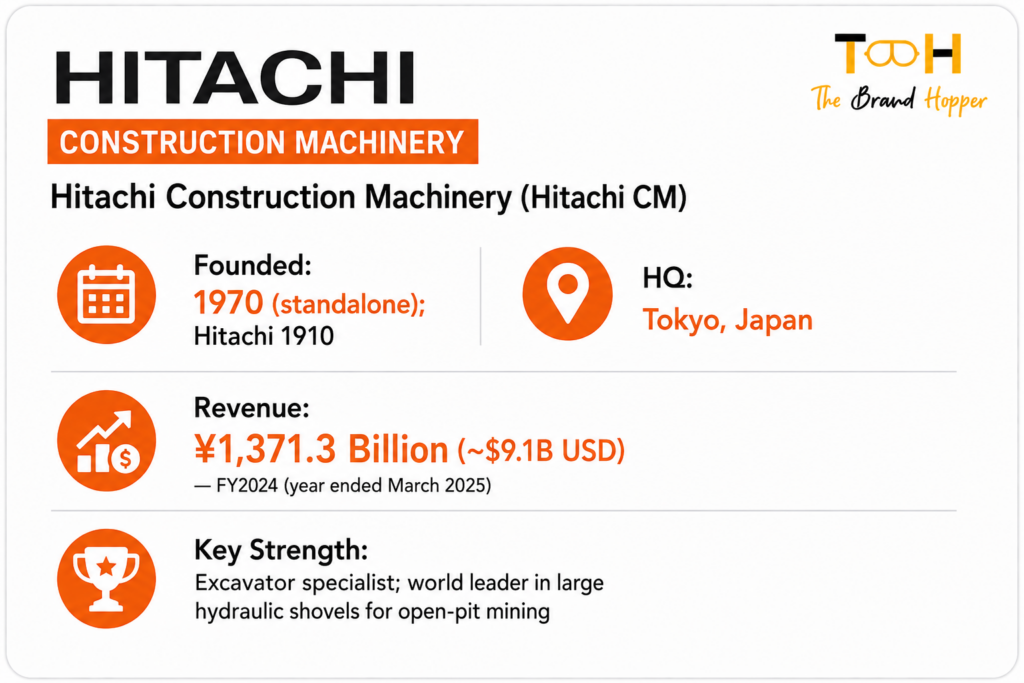
Hitachi Construction Machinery is a dedicated specialist in excavators, wheel loaders, and mining equipment. For the fiscal year ended March 2025, Hitachi CM reported revenues of ¥1,371.3 billion (a modest 2% decline) with operating income of ¥154.7 billion at an 11.3% operating margin.
Hitachi’s EX-series ultra-large excavators—including the EX8000-6 (820-tonne operating weight)—are among the most technically sophisticated in the world and compete directly with Caterpillar’s 6090 FS and 6060FS mining shovels. In Japan and parts of Asia, Hitachi excavators are among the top-selling brands.
Hitachi CM is also investing significantly in electric and hydrogen-powered construction machinery, with prototype electric excavators and haul trucks already undergoing customer trials. Its solutions division—including telematics and machine guidance—is growing rapidly as mining customers demand more data-driven operations.
7. Kubota Corporation
Official Website: www.kubota.com
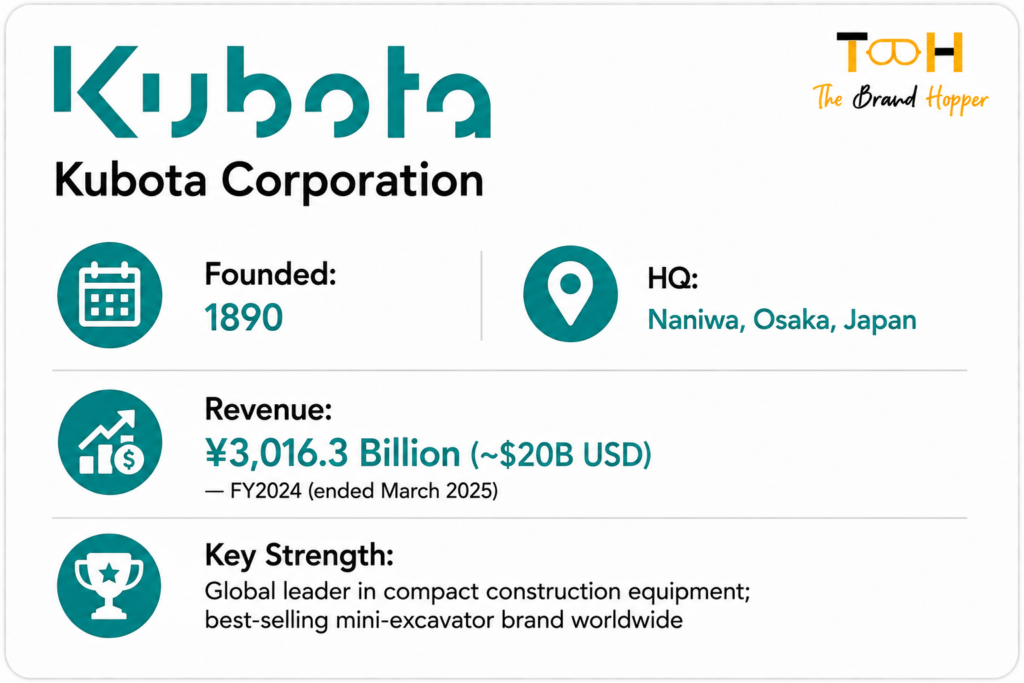
Kubota is best known for its orange tractors, but its construction machinery division—particularly mini-excavators and compact track loaders—competes directly with Caterpillar’s compact equipment lineup. In FY2024, Kubota reported revenues of ¥3,016.3 billion (roughly flat vs prior year), while operating profit surged 53.4% to ¥315.6 billion, reflecting improved margins from pricing actions and product mix.
Kubota’s KX series mini-excavators are among the best-selling compact excavators in the world, with strong brand loyalty among landscapers, utility contractors, and rental companies. The company’s U-series zero-tail-swing excavators are particularly popular in urban European markets where working space is constrained.
While Kubota doesn’t compete with Caterpillar in large mining or heavy construction equipment, it is a genuine threat in the compact and sub-compact segments that CAT also serves through its 300 and 400 series machines. As rental penetration of compact equipment grows globally, Kubota’s competitive position becomes increasingly strategic.
8. Doosan Bobcat
Official Website: www.doosanbobcat.com
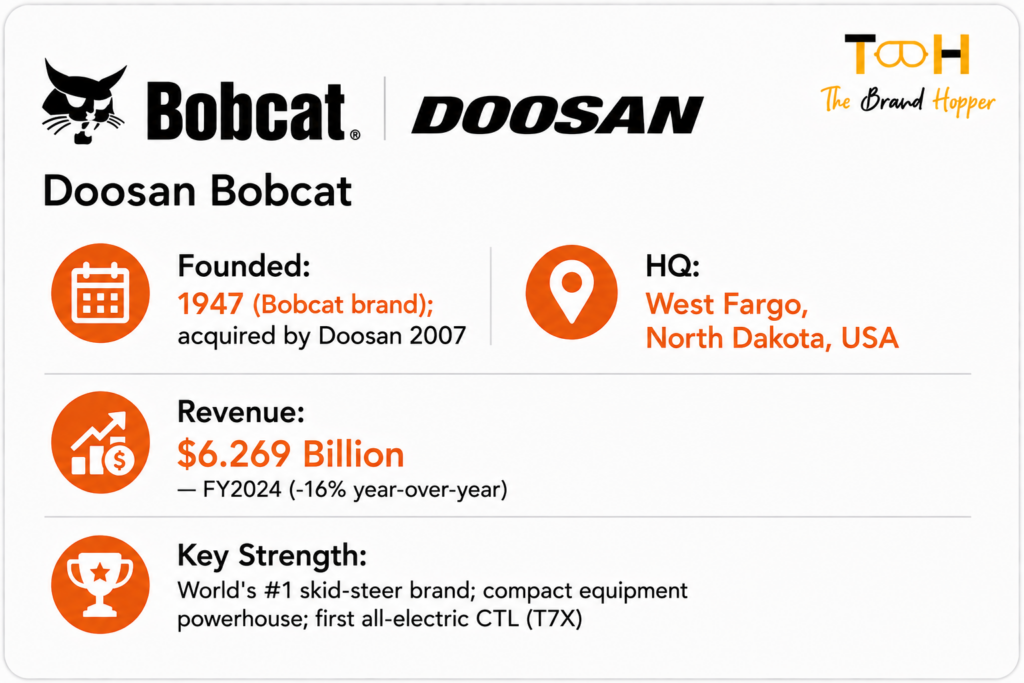
Doosan Bobcat is the world’s leading manufacturer of compact equipment, best known for its ubiquitous Bobcat skid-steer loaders, compact track loaders, and compact excavators. FY2024 revenues were $6.269 billion, down 16% from the prior year, with operating profit of $639 million at a 10.2% margin—reflecting the same North American construction equipment demand slowdown that impacted most peers.
Bobcat competes with Caterpillar’s 200 and 300 series compact machines directly. In the rental channel—which accounts for a significant portion of compact equipment demand in North America—Bobcat’s brand recognition and product breadth give it genuine share-of-wallet advantages. Its Doosan Portable Power division also competes with CAT in portable generator and air compressor solutions.
Doosan Bobcat has been accelerating electrification with its T7X all-electric compact track loader (the world’s first fully electric CTL) and E10e electric mini-excavator, positioning itself as an EV pioneer in the compact segment ahead of traditional heavy equipment OEMs.
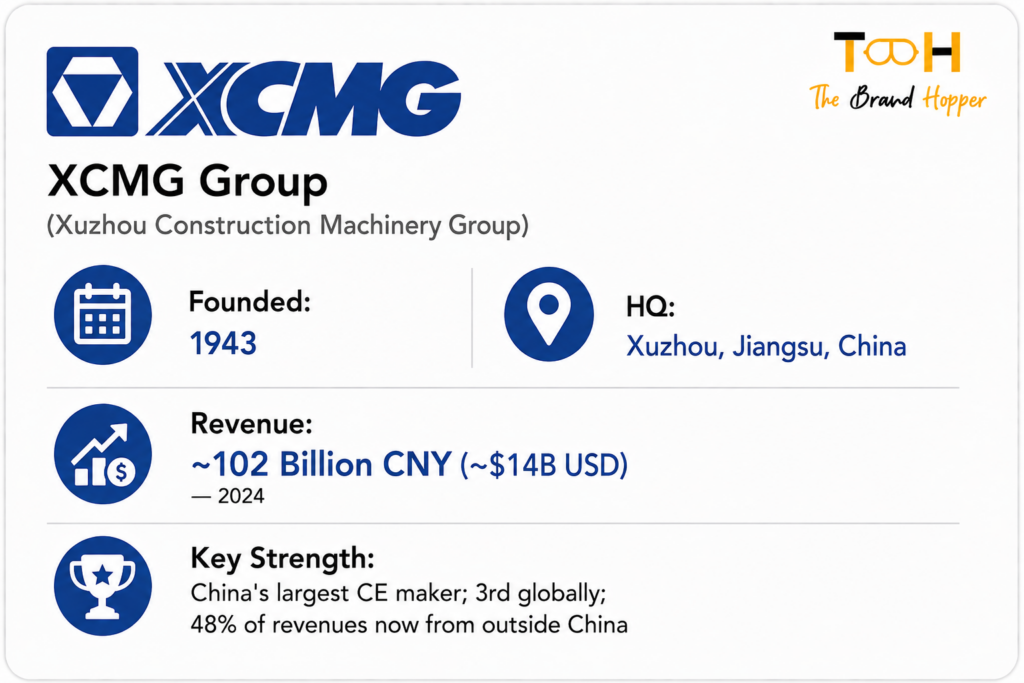
9. XCMG Group (Xuzhou Construction Machinery Group)
Official Website: https://www.xcmgglobal.com/
XCMG is China’s largest and the world’s third-largest construction equipment manufacturer, with 2024 revenues of approximately 102 billion yuan (roughly $14 billion USD) and a 5.8% global market share. A landmark achievement: 48% of XCMG’s revenues came from international markets—a clear indicator that Chinese OEMs are no longer fringe players but mainstream global competitors to Caterpillar.
XCMG manufactures an extraordinarily broad product range: excavators, cranes (mobile, crawler, tower), road machinery, concrete equipment, aerial work platforms, mining equipment, and port machinery. Its XGT15000-600S tower crane is the world’s largest. In developing markets across Africa, the Middle East, Southeast Asia, and Latin America, XCMG’s combination of competitive pricing, improving quality, and Chinese government-backed financing has made it a formidable challenger to Caterpillar’s dealer network advantages.
XCMG’s electrification push is also notable: the company has launched dozens of new-energy construction machines, including electric excavators, electric loaders, and electric road rollers, positioning itself for the next cycle as markets shift toward lower-emission equipment.
10. Sany Heavy Industry
Official Website: sanygroup.com/en
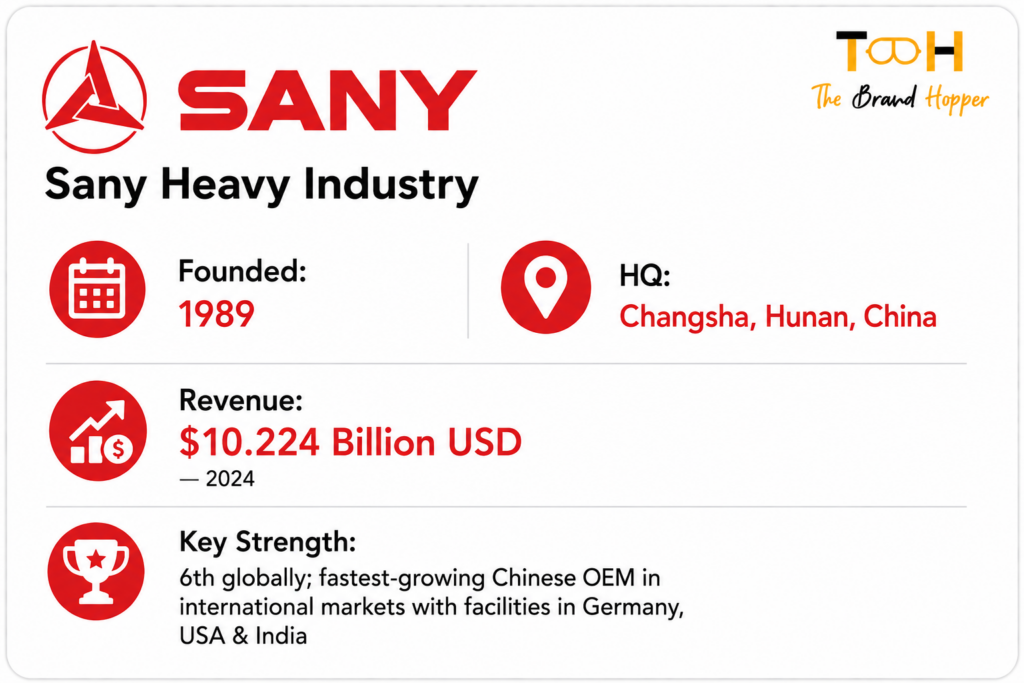
Sany Heavy Industry is China’s second-largest construction equipment manufacturer and ranked 6th globally, with 2024 revenues of approximately $10.224 billion and a 4.2% global market share. Like XCMG, Sany has aggressively expanded its international presence, with dedicated facilities in Germany, the United States, India, Brazil, and Indonesia enabling localised manufacturing and service.
Sany’s crawler cranes and concrete pumps are globally recognised for competitive pricing and reliability. Its SY-series excavators have penetrated Southeast Asian markets rapidly. Sany’s SCC4000A all-terrain crane and SY2000C excavator represent the technical upper bound of Chinese engineering capability and compete credibly with Western and Japanese equivalents.
Sany’s collaboration with innovative companies and its commitment to electric machinery (SY35U electric excavator, SRSC45 electric reach stacker) position it as an increasingly sophisticated competitor well beyond the ‘cheap Chinese alternative’ perception that once characterised its positioning.
11. Epiroc AB
Official Website: epiroc.com
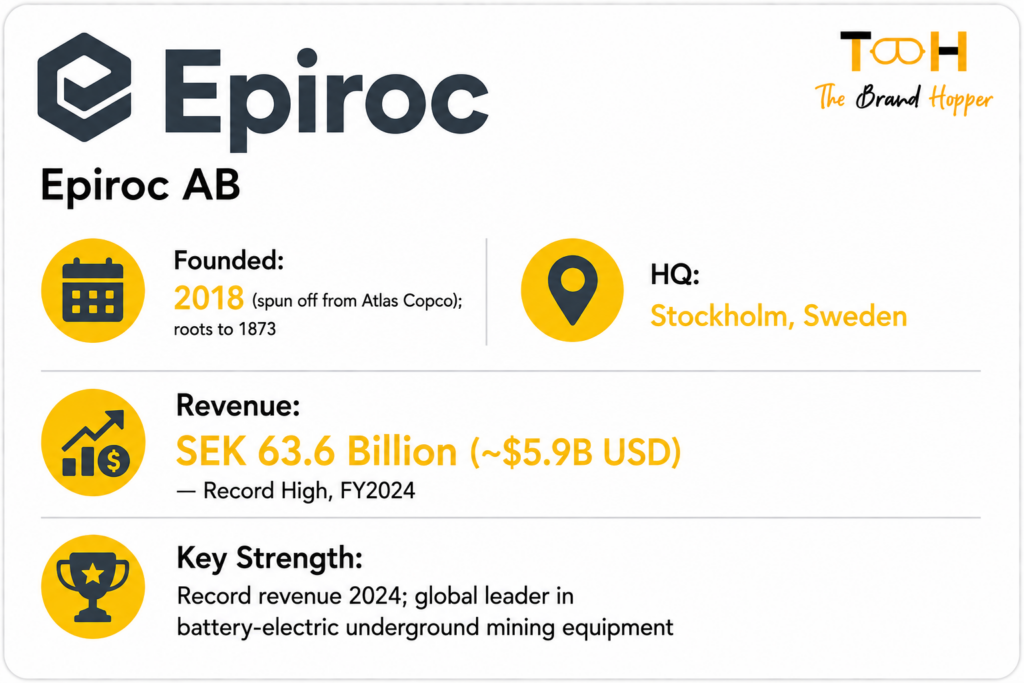
Epiroc, spun off from Atlas Copco in 2018, is a pure-play mining and infrastructure equipment specialist. In FY2024, it achieved record-high revenues of SEK 63.6 billion (approximately $5.9 billion), up 5% organically, with an adjusted operating margin of 19.8%—among the best in the industry. The company invested over SEK 2 billion in innovation in 2024.
Epiroc’s product portfolio—drill rigs, rock reinforcement equipment, load-haul-dump (LHD) vehicles, underground trucks, and demolition tools—competes with Caterpillar’s underground mining product lines. Epiroc’s Minetruck MT65 and Scooptram ST18 are market-leading underground vehicles widely deployed in gold, copper, and potash mines globally.
Epiroc is the global leader in battery-electric mining equipment, with over 500 battery machines operating in mines worldwide—far ahead of any competitor including Caterpillar. Its ‘Electrification and Automation’ strategy is a central long-term investment thesis for mining companies seeking to decarbonise underground operations, giving Epiroc a durable structural advantage in the fastest-growing segment of mining equipment.
12. Sandvik AB (Mining & Rock Solutions)
Official Website: sandvik.com
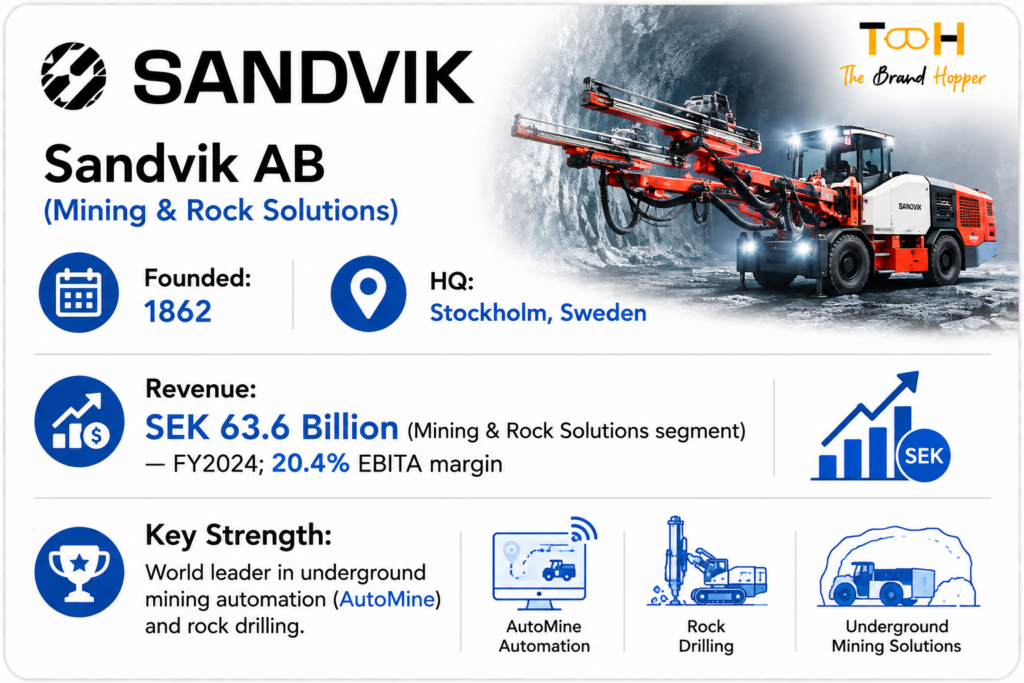
Sandvik Mining & Rock Solutions is the world’s leading provider of rock drilling equipment, cutting tools, and digital solutions for the mining industry. In FY2024, this segment generated revenues of SEK 63,607 million with an adjusted EBITA margin of 20.4%—one of the highest margins in the heavy equipment sector globally. Total Sandvik Group revenues were SEK 123 billion with adjusted EBITA of SEK 23.6 billion at a 19.2% margin.
Sandvik’s competitive overlap with Caterpillar is primarily in surface and underground drilling equipment, where its Leopard and Pantera surface drill rigs compete with CAT’s CMD series. Sandvik also manufactures underground loaders (Toro series) and trucks that challenge Caterpillar’s AD45B and R1700 LHD units. What truly differentiates Sandvik is AutoMine—its flagship autonomous mining system—which enables fully automated underground fleets and is deployed at mines on six continents.
Sandvik’s 2024 performance reflected a nuanced market: while equipment revenues declined as some mining customers delayed capital purchases, parts, services, and consumables demand remained robust—a testament to its large installed base and the recurring revenue it generates.
13. Terex Corporation
Official Website: terex.com
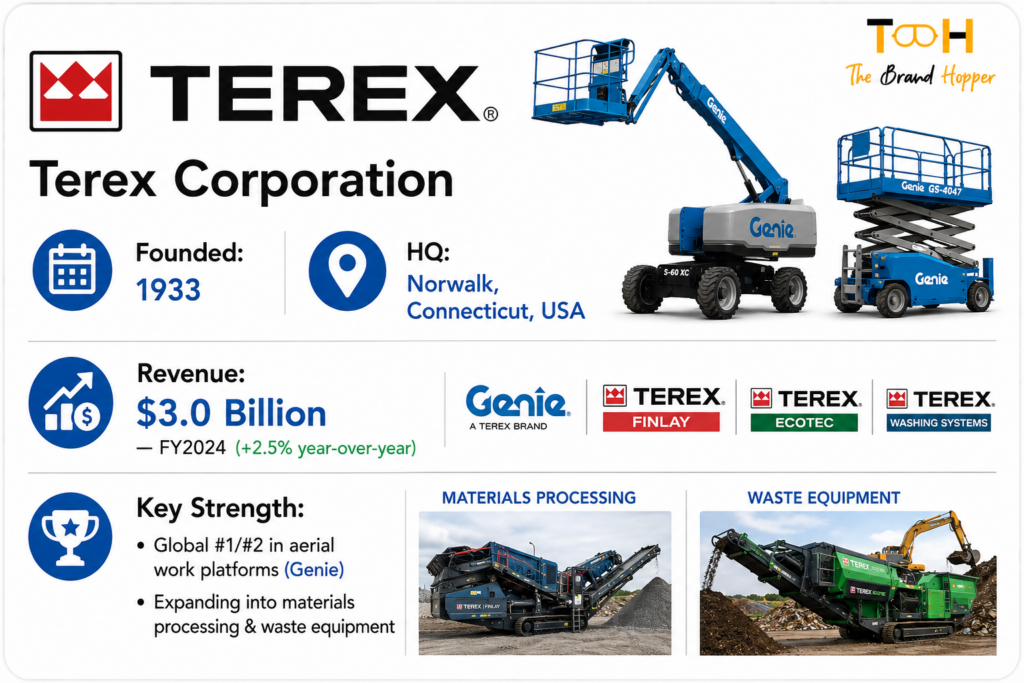
Terex Corporation is a focused equipment manufacturer operating in two primary segments: Aerial Work Platforms (AWP—including the Genie brand) and Materials Processing (crushing, screening, and washing equipment). FY2024 revenues were $3.0 billion, up 2.5% year-over-year, with Terex completing its acquisition of Environmental Solutions Group (ESG) to expand into waste and recycling equipment. The AWP segment alone generated $2.03 billion.
Terex’s Genie-brand scissor lifts, boom lifts, and telehandlers compete with Caterpillar’s access equipment offerings in the aerial work platform market. In materials processing, Terex’s Powerscreen and Finlay brands compete with Caterpillar’s aggregate processing systems.
Though significantly smaller than Caterpillar in absolute scale, Terex’s focused position in AWP and materials processing allows it to devote concentrated R&D to a narrower product set—and Genie remains a genuine #1 or #2 brand globally in aerial work platforms, a category where Caterpillar does not maintain the same brand dominance it enjoys in earthmoving.
14. HD Hyundai Construction Equipment
Official Website: hd-hyundaice.com
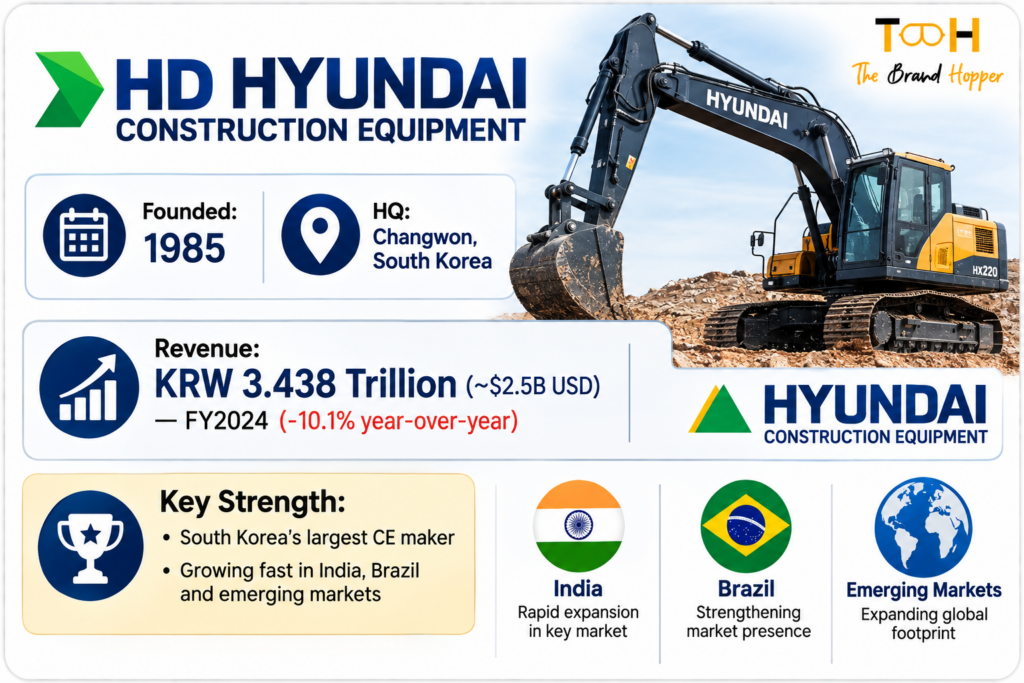
HD Hyundai Construction Equipment—a subsidiary of HD Hyundai—is South Korea’s largest construction equipment manufacturer. FY2024 revenues were KRW 3.438 trillion (approximately $2.5 billion), a 10.1% decline year-over-year, as advanced markets in North America and Europe weakened. However, the company saw continued growth in India, Brazil, and China.
HD Hyundai CE’s HX and R-series excavators compete directly with Caterpillar’s 300 and 320 series in mid-range and large-size excavators. The company manufactures a complete line from mini-excavators to 800-tonne ultra-large mining hydraulic excavators, as well as wheel loaders, backhoe loaders, skid steers, and articulated dump trucks across its global manufacturing plants in South Korea, India, and China.
HD Hyundai CE’s growth markets strategy—particularly its joint venture operations and dealer development in India and Southeast Asia—positions it as a serious challenger to both Caterpillar and Komatsu in markets where brand loyalty is less entrenched and price competitiveness matters significantly.
15. The Manitowoc Company
Official Website: https://www.manitowoc.com/
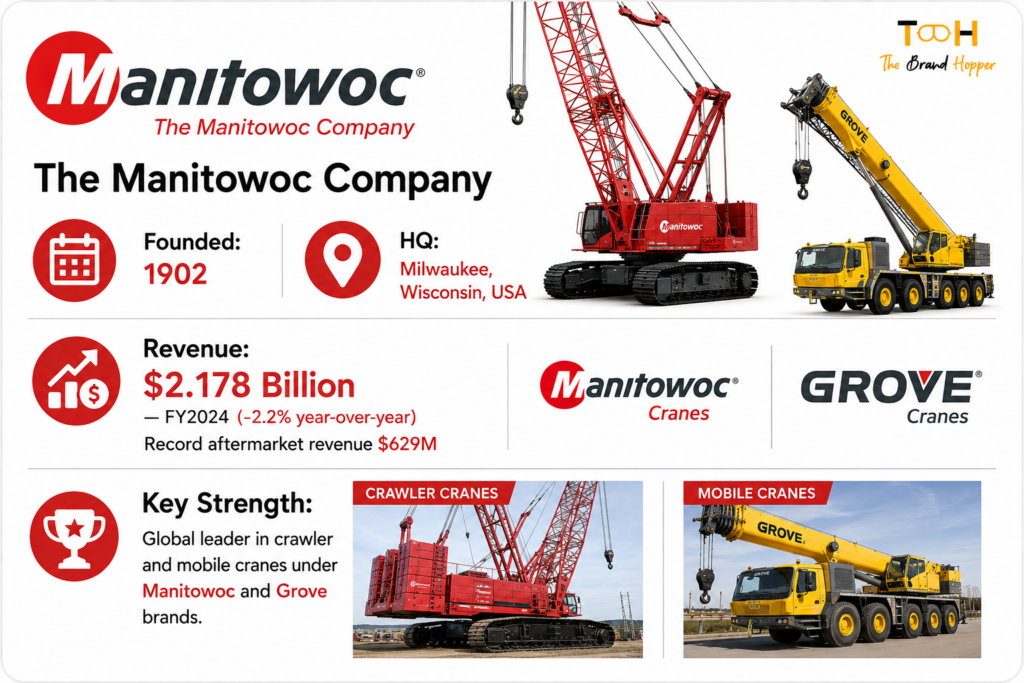
The Manitowoc Company is a pure-play crane manufacturer—one of the few remaining dedicated crane specialists globally—operating through its iconic Manitowoc (lattice boom crawler cranes) and Grove (all-terrain and rough terrain mobile cranes) brands. FY2024 full-year net sales were $2.178 billion, a modest 2.2% decline from FY2023, with aftermarket revenues reaching a record $629.1 million—a sign of the value embedded in its large installed base. Order backlog at year-end was $650.2 million.
Manitowoc’s overlap with Caterpillar is in the lifting and material handling category. For large-scale construction projects requiring heavy lift cranes—offshore wind installation, petrochemical plant construction, bridge building—Manitowoc’s Manitowoc 21000 and Grove GMK7550L are often the equipment of choice on sites that also operate Caterpillar earthmovers.
Manitowoc’s strategic focus on aftermarket parts, services, and digital customer support (through its CraneSTAR telematics system) is building a more resilient recurring revenue stream—a strategy mirroring Caterpillar’s own playbook of leveraging installed base for parts and service revenue that smooths earnings through equipment cycles.
Head-to-Head: Caterpillar vs. Top Competitors at a Glance
The following table summarises the key financial and operational metrics for Caterpillar and its 15 major competitors, based on the most recently available annual data.
| Company | HQ | Revenue (Latest FY) | Key Segment | Primary Market |
| Caterpillar | USA | $64.8B (FY2024) | Construction, Mining, Energy | Global |
| Komatsu | Japan | ¥4,104B (~$27B) | Construction & Mining | Global |
| John Deere | USA | $51.7B (FY2024) | Agriculture & Construction | Americas, Global |
| Volvo CE | Sweden | ~$8B (2024) | Construction Equipment | Europe, Americas |
| Liebherr | Switzerland | €14.6B (2024) | Construction, Cranes, Mining | Global |
| CNH Industrial | UK/USA | $19.84B (FY2024) | Agriculture & Construction | Global |
| Hitachi CM | Japan | ¥1,371B (~$9.1B) | Excavators, Mining | Asia, Global |
| Kubota | Japan | ¥3,016B (~$20B) | Agriculture & Compact CE | Global |
| Doosan Bobcat | USA | $6.27B (FY2024) | Compact Equipment | North America, Global |
| XCMG | China | ~102B CNY (~$14B) | Full-line CE & Cranes | China, Emerging Markets |
| Sany | China | $10.2B (2024) | Cranes, Excavators, Concrete | China, Global |
| Epiroc | Sweden | SEK 63.6B (~$5.9B) | Underground Mining | Global Mining |
| Sandvik | Sweden | SEK 63.6B (mining) | Mining Drilling, Automation | Global Mining |
| Terex | USA | $3.0B (FY2024) | AWP, Materials Processing | N. America, Europe |
| HD Hyundai CE | S. Korea | KRW 3.4T (~$2.5B) | Excavators, Loaders | Asia, Americas |
| Manitowoc | USA | $2.18B (FY2024) | Crawler & Mobile Cranes | Global |
Key Competitive Dynamics Shaping the Industry
1. The Chinese OEM Surge
XCMG and Sany have collectively moved from domestic Chinese players to genuinely global competitors in under a decade. With 48% and growing percentages of revenue coming from outside China, and with local manufacturing plants on multiple continents, these companies are no longer competing solely on price. They are investing in quality, technology, and aftermarket service infrastructure that increasingly mirrors Western OEM standards. For Caterpillar, the long-term threat is not in premium mining equipment (where brand trust and service depth matter enormously) but in mid-range construction equipment in price-sensitive developing markets.
2. Electrification and Decarbonisation
Every major competitor is investing in electric and hydrogen-powered machines. Volvo CE and Doosan Bobcat were early movers. Epiroc leads in underground battery-electric machines with 500+ deployed globally. Komatsu has operating electric dump trucks. Caterpillar has its R1700 XE battery LHD and Cat 301.9 mini-excavator, with broader electrification programmes across its portfolio. The competitive question is who builds the most compelling total-cost-of-ownership argument for electric machines—where lower fuel and maintenance costs must offset higher purchase prices over machine lifetimes.
3. Digital and Autonomous Systems
Caterpillar’s Command for Hauling autonomous mining system has logged billions of tonnes autonomously. But Komatsu’s AHS, Epiroc’s AutoMine, and Sandvik’s AutoMine are all credible, deployed alternatives. As mines demand more automation, the ability to integrate equipment with mine management systems, real-time data platforms, and fleet management software becomes as important as the physical machinery. Caterpillar’s VisionLink and Cat App compete directly with Komatsu’s Modular Mining, Sandvik’s OptiMine, and Epiroc’s Mobilaris digital solutions.
4. Aftermarket and Services as Competitive Moat
Across the industry, aftermarket parts and services generate margins far superior to equipment sales—often 40–50%+ gross margins versus 15–25% for new equipment. Caterpillar generates roughly 35–40% of its revenues from parts, services, and Cat Financial. Competitors like Sandvik (where services account for nearly half of revenue) and Epiroc have explicitly built high-service business models. As Manitowoc’s record aftermarket revenue in 2024 demonstrated, even smaller players are pivoting toward the services model.
What Makes Caterpillar Competitive Despite Strong Rivals?
Despite the breadth and quality of competition analysed above, Caterpillar maintains several structural advantages that make it exceptionally difficult to displace:
Unmatched dealer network: CAT’s ~160 independent dealers operating approximately 2,900 outlets worldwide provide parts availability, field service, and customer relationships that no competitor has replicated at comparable scale.
Cat Financial: Caterpillar’s financing arm manages a $24 billion portfolio and provides credit solutions to customers globally—bundling equipment, parts, and financing into a single solution that most competitors cannot match.
Integrated energy solutions: With its Energy & Transportation segment (generating roughly $7.8 billion in FY2024), Caterpillar sells reciprocating engines, turbines, and generator sets to oil & gas, power generation, and marine customers—diversification that insulates it from construction cycle volatility.
Brand and resale value: CAT-branded equipment consistently commands premium resale values at auction, which feeds back into lower total cost of ownership calculations for fleet operators—a virtuous cycle that reinforces new equipment purchase preference.
Scale in manufacturing and R&D: With $64.8 billion in revenue, CAT’s R&D budget and manufacturing economies of scale are unmatched except by Komatsu or the Chinese giants—enabling investment in next-generation technologies at a pace smaller competitors struggle to match.
Frequently Asked Questions (FAQs)
Q: Who is Caterpillar’s biggest competitor?
A. Komatsu Ltd. of Japan is consistently regarded as Caterpillar’s most direct and formidable competitor. Komatsu is the world’s second-largest construction and mining equipment manufacturer, competing product-for-product with Caterpillar in excavators, bulldozers, wheel loaders, and ultra-class mining trucks. In terms of annual revenues, Komatsu’s approximately $27 billion (FY2024) makes it the nearest rival to Caterpillar’s $64.8 billion globally.
Q: How does Caterpillar compare to Komatsu in market share?
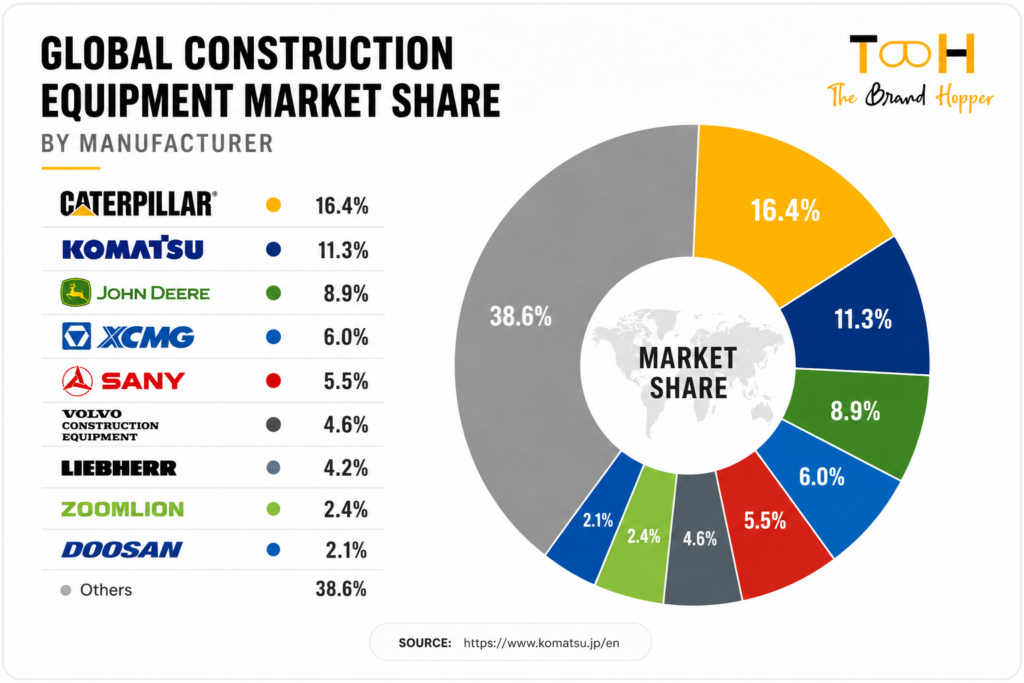
A. Caterpillar holds approximately 13–16% of the global construction equipment market by revenue (estimates vary by source and year), while Komatsu holds approximately 10–12%. Both have declined slightly in global share as Chinese manufacturers XCMG (5.8%) and Sany (4.2%) have grown aggressively internationally, but Caterpillar and Komatsu remain the clear #1 and #2 globally across the full spectrum of heavy equipment.
Q: Are Chinese equipment brands like XCMG and Sany serious threats to Caterpillar?
A. Yes, increasingly so—but the nature of the threat is nuanced. In developing markets (Africa, Southeast Asia, Latin America, Middle East), XCMG and Sany are serious competitive threats due to competitive pricing, improving quality, and Chinese government-backed financing. In premium segments (ultra-large mining trucks, advanced autonomous systems), Caterpillar’s service depth, parts availability, and technology leadership remain significant. The medium-term risk is that as Chinese OEM quality and aftersales networks mature, the premium/value differentiation narrows.
Q: Does Caterpillar compete with John Deere?
A. Yes. Caterpillar and John Deere compete across several construction equipment categories, particularly motor graders, backhoe loaders, skid steers, compact track loaders, and articulated dump trucks. However, John Deere’s primary revenue comes from agricultural equipment (tractors, combines, sprayers), where Caterpillar has no presence. The competitive overlap is most acute in North American construction markets.
Q: Which Caterpillar competitor leads in electric construction equipment?
A. Volvo CE and Doosan Bobcat (with its all-electric T7X compact track loader) were early movers in electric construction equipment. For underground mining electrification, Epiroc is the clear industry leader with 500+ battery machines deployed globally. Sandvik is a close second in underground applications. Caterpillar has been methodical rather than first-to-market, prioritising commercial viability and total cost of ownership over prototype announcements.
Q: Why did most Caterpillar competitors report declining revenues in 2024?
A. The construction equipment industry experienced a demand correction in 2024 across North America and Europe following the post-pandemic surge years of 2021–2023. Higher interest rates dampened residential construction and infrastructure spending in many markets. Agricultural equipment also experienced a significant downcycle (affecting John Deere and CNH). Mining equipment demand remained relatively resilient, benefiting Caterpillar’s and Komatsu’s mining divisions.
Q: What is Caterpillar’s revenue breakdown by segment?
A. In FY2024, Caterpillar’s $64.8 billion revenue breaks down approximately as: Construction Industries (~$21 billion), Resource Industries/Mining (~$11 billion), and Energy & Transportation (~$14 billion), with the remainder from Financial Products and All Other segments. This diversification across construction, mining, and energy is a key structural advantage over more concentrated competitors.
Q: What is the difference between Epiroc and Sandvik—and how do they compete with Caterpillar?
A. Epiroc was spun off from Atlas Copco in 2018 and focuses on mining and infrastructure equipment: drill rigs, underground loaders, rock reinforcement tools, and automation systems. Sandvik Mining & Rock Solutions also makes underground equipment (drill rigs, loaders, trucks) but places greater emphasis on digital automation, rock tools, and cutting equipment. Both overlap with Caterpillar in underground mining equipment. The key difference: Caterpillar dominates surface mining trucks (797, 795 series) and large earthmoving; Epiroc and Sandvik are stronger in underground drilling and blast-hole drilling applications.
Conclusion
Caterpillar faces robust and well-capitalised competition across every dimension of its business. Komatsu remains its most direct peer in scale and breadth. John Deere and CNH Industrial compete in construction segments while diversified into agriculture. Liebherr, with record revenues, demonstrates that private companies can outmanoeuvre public OEMs through long-term investment. Chinese giants XCMG and Sany are rewriting the emerging market competitive script. European specialists Epiroc and Sandvik are leading the next wave of autonomous, electric underground mining—a fast-growing segment of the equipment universe.
Yet Caterpillar’s combination of global dealer depth, Cat Financial, diversified segments (construction, mining, energy), and its massive parts and services business creates a competitive moat that remains formidable. The companies most likely to gain share from CAT over the next five years are: XCMG and Sany in price-sensitive developing markets; Epiroc in underground mining electrification; and Komatsu in autonomous surface mining haulage. For premium, full-service, large-scale projects globally.
To read more content like this, subscribe to our newsletter