Last Updated on October 1, 2026 by Team TBH
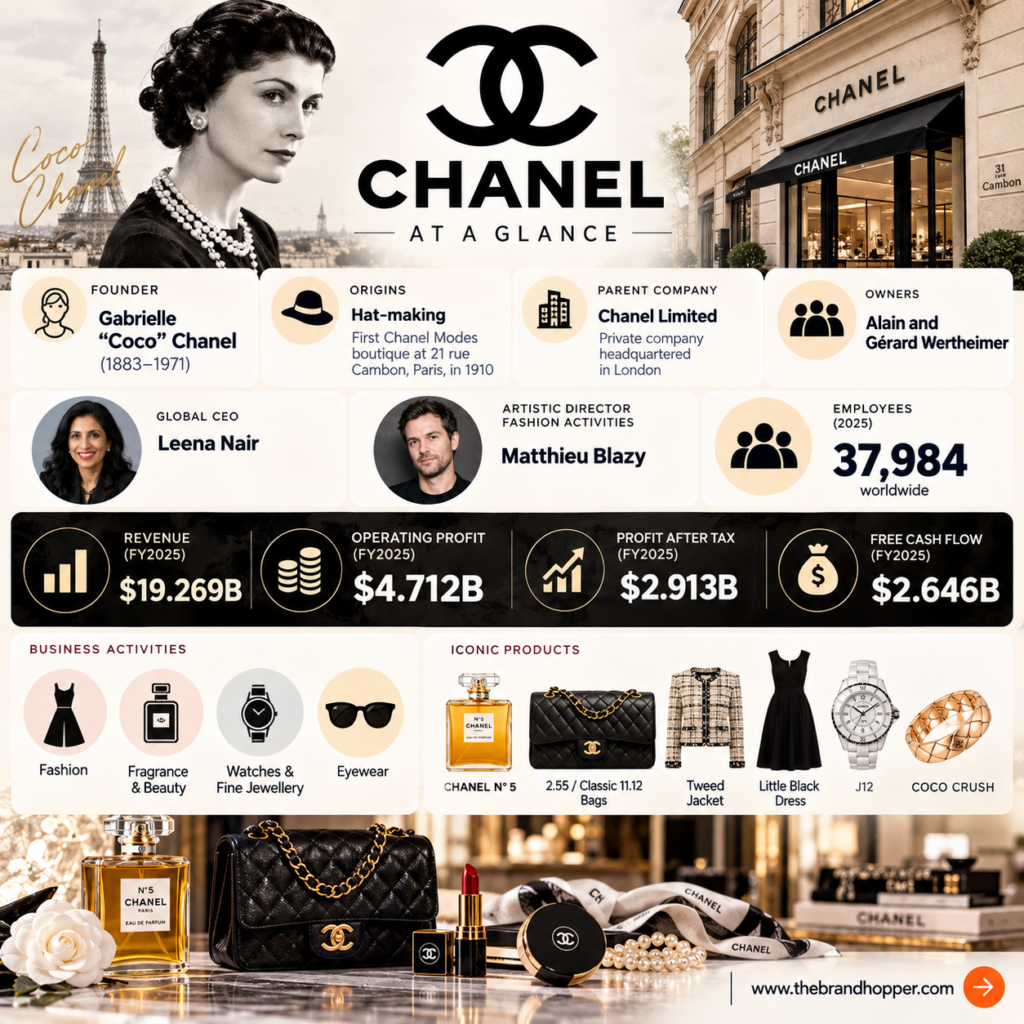
Few brands can claim to have changed how women dress, smell and carry themselves. CHANEL can. What began with Gabrielle “Coco” Chanel’s millinery business in Paris is today a privately owned luxury house generating $19.3 billion in annual revenue, with a global network of boutiques and a portfolio spanning fashion, fragrance and beauty, watches, fine jewellery and eyewear.
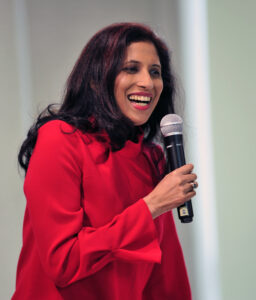
CHANEL is also one of the rare major luxury houses that is not publicly listed. It is controlled by the Wertheimer family, led by Global CEO Leena Nair, while Matthieu Blazy serves as Artistic Director of Fashion Activities. His arrival has opened a new creative chapter for the House.
In this guide, we break down CHANEL’s history, ownership, latest financials, business activities, iconic products, marketing mix (4Ps), SWOT, success factors and how it compares with other prominent luxury houses.
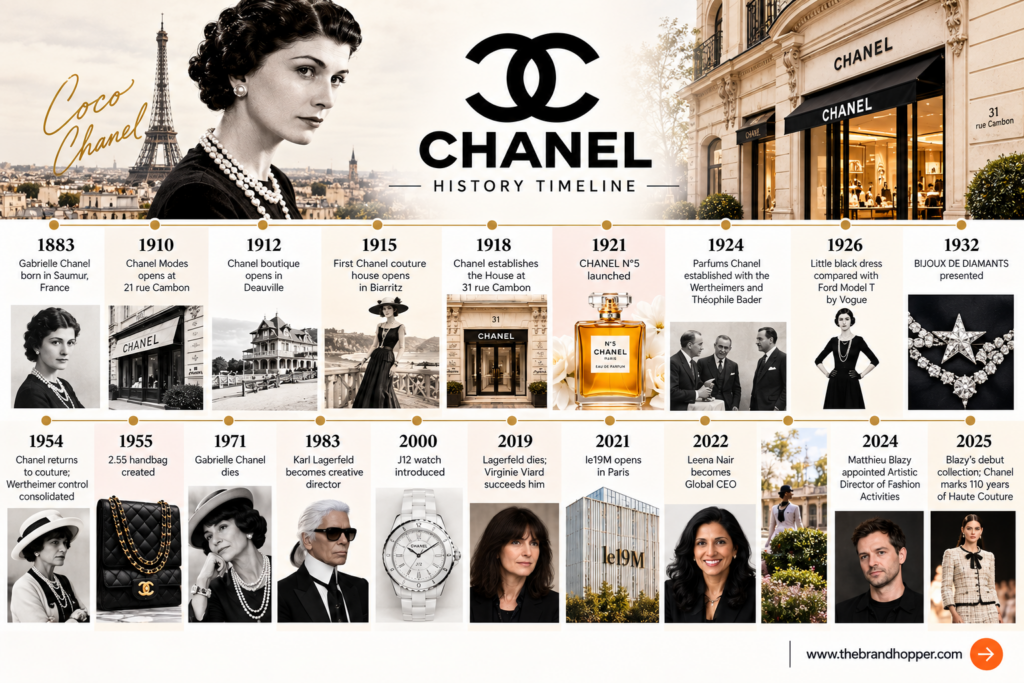
History of Chanel
1. Coco Chanel’s Early Life
Gabrielle Bonheur Chanel was born on 19 August 1883 in Saumur, France. After her mother’s death, she spent part of her childhood at the Aubazine abbey, where she learned to sew.
Her early work as a seamstress and later experience as a milliner became the foundation for the fashion house she would build. The nickname “Coco” emerged during her early years as a singer and performer.
2. From Hats to a Fashion House (1909–1920s)
Chanel’s first hat boutique, Chanel Modes, opened at 21 rue Cambon in Paris in 1910. She subsequently opened a boutique in Deauville in 1912, where she introduced sportswear using jersey fabric in 1913.
In 1915, Chanel opened her first couture house in Biarritz. In 1918, she established herself at 31 rue Cambon, the address that remains central to the House’s identity.
In 1921, Chanel launched CHANEL N°5, created by perfumer Ernest Beaux. Its abstract fragrance composition and minimalist bottle helped challenge the conventions of contemporary perfumery.
In 1924, Parfums Chanel was established with Pierre and Paul Wertheimer and Théophile Bader. The partnership created the commercial infrastructure that would help N°5 become an international success.
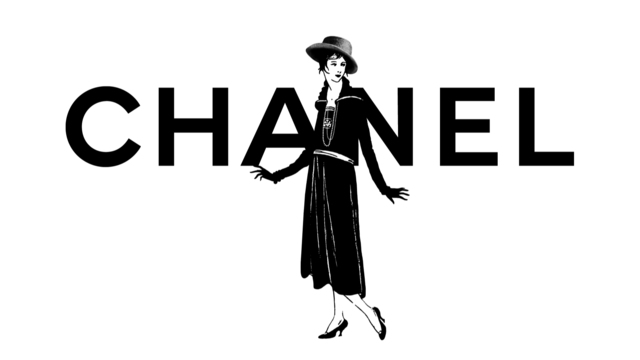
In 1926, American Vogue famously compared Chanel’s little black dress with the Ford Model T, reflecting the cultural impact of the simple black dress.
3. The 1930s and the War Years
In 1932, Chanel presented BIJOUX DE DIAMANTS, her first and only High Jewellery collection. The collection established several motifs that would later become part of Chanel’s jewellery vocabulary.
When World War II began in 1939, Chanel closed her couture house while the boutique at 31 rue Cambon continued selling perfume and accessories.
The war years remain one of the most controversial chapters of Gabrielle Chanel’s biography. Her relationship with German intelligence officer Hans Günther von Dincklage and her wartime activities have been extensively documented by historians.
Chanel was questioned following the Liberation but was not formally charged. She subsequently spent years in Switzerland before returning to Paris and reopening her couture business in 1954.
4. The Comeback and Enduring Icons (1954–1971)
In 1954, at the age of 71, Chanel returned to couture. The Wertheimer family also consolidated control over the business during this period, providing financial support for her comeback.
In February 1955, Gabrielle Chanel created the 2.55 handbag, named after its February 1955 creation date. Its quilted body and chain strap became enduring Chanel signatures.
In 1957, Chanel introduced the iconic two-tone shoes, developed with shoemaker Massaro. The beige-and-black combination was designed to visually lengthen the leg while making the foot appear smaller.
Gabrielle Chanel continued working until her death at the Ritz in Paris on 10 January 1971.
5. The Lagerfeld Era (1983–2019)
Karl Lagerfeld became Chanel’s creative director in 1983 and remained the dominant creative force at the House until his death in 2019.
Lagerfeld repeatedly reinterpreted Chanel’s core codes — including tweed, quilting, pearls, camellias and the interlocking CC — while turning runway shows into major cultural events.
Chanel also expanded beyond fashion. The House entered watchmaking with the Première in 1987 and later introduced the J12 in 2000, while continuing to build its jewellery activities and specialist craft ecosystem.
Chanel began acquiring specialist Métiers d’art companies in the 1980s, gradually creating a network of workshops whose expertise supports the House’s fashion and jewellery creations.
6. Modern Chanel: From Viard to Blazy
Following Lagerfeld’s death in 2019, Virginie Viard became the House’s creative leader until her departure in June 2024.
In January 2022, former Unilever executive Leena Nair became Chanel’s Global CEO.
In December 2024, Chanel appointed Matthieu Blazy as Artistic Director of Fashion Activities, responsible for Haute Couture, Ready-to-Wear and Accessories. He joined the House in 2025.
Blazy presented his first Chanel collection for Spring-Summer 2026 at the Grand Palais in October 2025. His first Métiers d’art collection followed in December 2025 with a show staged in a New York City subway station.
In 2026, Chanel continued Blazy’s creative chapter with its Haute Couture and Cruise activities, including a return to Biarritz, where Gabrielle Chanel opened her first couture house in 1915.
Who Owns Chanel? Ownership & Leadership
CHANEL is privately owned by the Wertheimer family. The current co-owners are brothers Alain and Gérard Wertheimer, whose family has controlled the House for decades.
The relationship began with Pierre Wertheimer’s partnership with Gabrielle Chanel in the 1920s. The family consolidated control over Chanel’s fashion and fragrance operations in 1954, while Alain and Gérard became the co-owners of the House in 1996.
Chanel Limited is the private parent company of the Chanel group and is headquartered in London. The creative heart of the House remains closely associated with 31 rue Cambon in Paris.
Because Chanel is privately held, it does not publish the quarterly earnings reports required of publicly listed companies. It publishes annual financial results.
| Role | Person |
|---|---|
| Global Executive Chairman & co-owner | Alain Wertheimer |
| Co-owner | Gérard Wertheimer |
| Global Chief Executive Officer | Leena Nair |
| Global Chief Financial Officer | Philippe Blondiaux |
| President, Fashion Activities | Bruno Pavlovsky |
| Artistic Director, Fashion Activities | Matthieu Blazy |
| In-House Perfumer-Creator | Olivier Polge |
Leena Nair became Global CEO in January 2022. She has emphasised long-term brand building, client experience, people development and investment in Chanel’s global creative and retail ecosystem.
Matthieu Blazy is responsible for Chanel’s Haute Couture, Ready-to-Wear and Accessories collections.
Chanel Financial Performance
After a difficult 2024, Chanel returned to growth in 2025. The company’s official results reported positive performance across all three main business activities.
Key Financials – FY2025
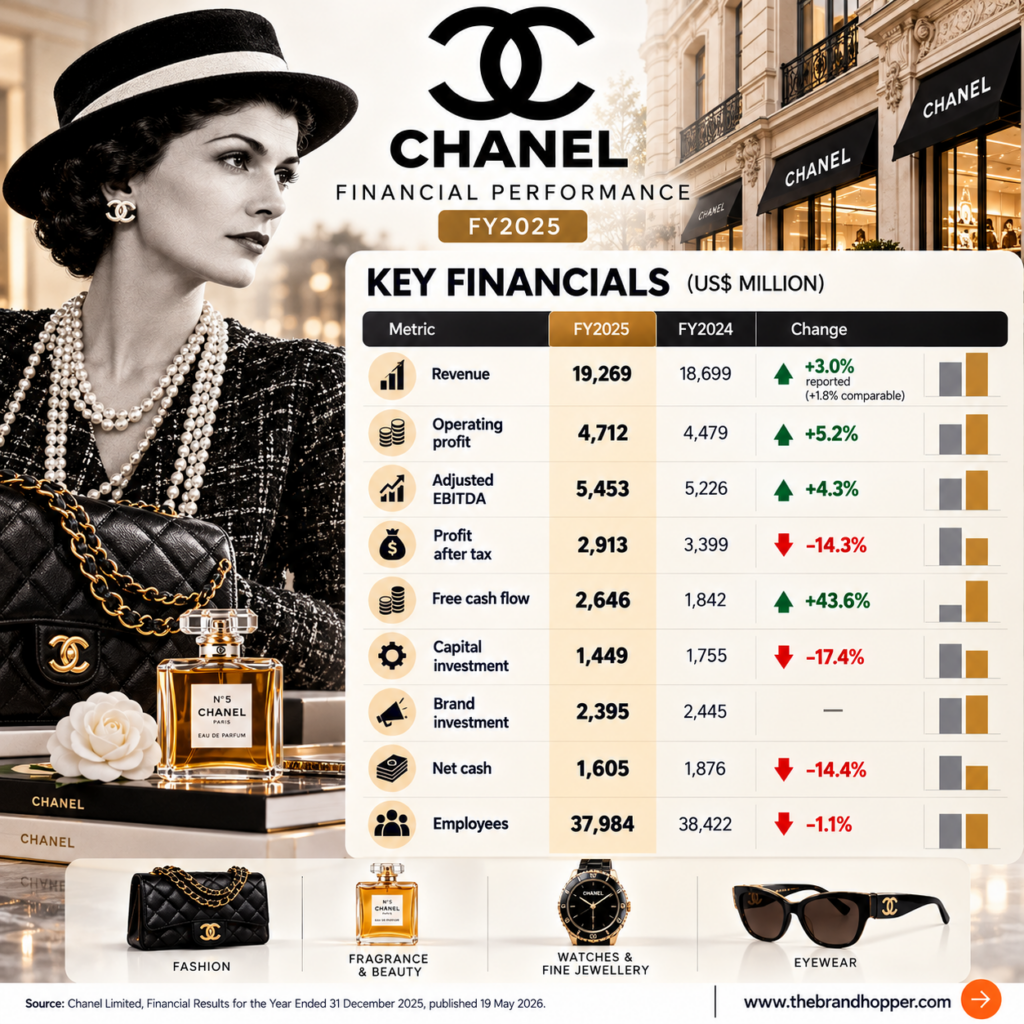
Chanel’s operating margin was approximately 24.5% in FY2025. Profit after tax fell despite higher operating profit, with the company reporting an effective tax rate of 33.5%, compared with 27.7% in 2024.
Revenue by Region – FY2025
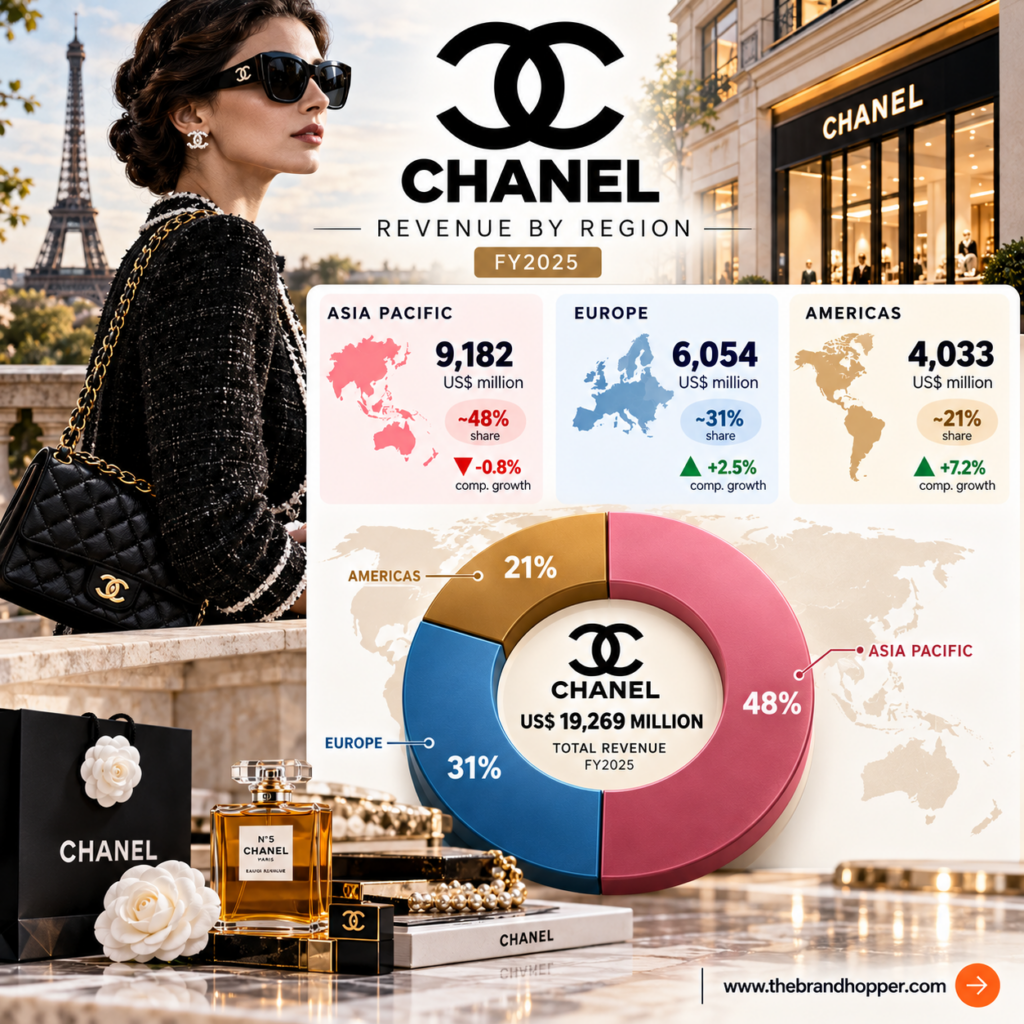
Asia Pacific remained Chanel’s largest region by revenue in 2025, although comparable sales declined slightly. The Americas recorded the fastest comparable growth at 7.2%, followed by Europe at 2.5%.
Fashion remains Chanel’s largest business activity. Reuters, citing Bloomberg reporting on Chanel’s first-half 2026 performance, said Fashion represented roughly 60% of total revenue.
Chanel Revenue Trend
| Financial year | Revenue | Operating profit |
|---|---|---|
| FY2023 | ~$19.7 billion | ~$6.4 billion |
| FY2024 | $18.7 billion | $4.48 billion |
| FY2025 | $19.3 billion | $4.71 billion |
Chanel’s 2024 revenue fell 4.3% on a comparable basis, while operating profit fell 30%. The company nevertheless maintained heavy investment in its retail network, brand and manufacturing ecosystem.
Momentum in 2026: Chanel does not officially publish half-year financial results. However, Reuters reported in August 2026 that Bloomberg had reported approximately 16% comparable revenue growth in H1 2026, citing a person familiar with the company’s performance.
The same report said Fashion grew broadly in line with the group, Watches & Fine Jewellery grew around 35%, all regions recorded growth, and U.S. sales increased by more than 25%. Chanel declined to comment on the reported figures, so they should be treated as reported estimates rather than company-confirmed financial results.
Business Segments of Chanel
CHANEL organises its business around three principal activities — Fashion, Fragrance & Beauty, and Watches & Fine Jewellery — alongside eyewear and its specialist craft ecosystem.
1. Fashion
Fashion covers Haute Couture, Ready-to-Wear, leather goods, shoes, costume jewellery and accessories.
In FY2025, Fashion performance was led by Ready-to-Wear and strong client reception for the CHANEL 25 handbag.
2025 also marked 110 years of Chanel Haute Couture, while Matthieu Blazy’s first Spring-Summer 2026 collection debuted at the Grand Palais in October.
2. Fragrance & Beauty
This activity covers fragrance, makeup and skincare.
Fragrance and skincare were particularly important to the segment’s FY2025 performance. CHANCE EAU SPLENDIDE, created by Olivier Polge and fronted by ambassador Angèle, was Chanel’s first new women’s fragrance in eight years.
Chanel also launched BLEU DE CHANEL L’EXCLUSIF, opened more than 25 new dedicated Fragrance & Beauty boutiques, introduced a new Fragrance & Beauty app and expanded beauty e-commerce into Mexico and Argentina.
A new Chanel fragrance manufacturing facility in France opened in February 2026.
3. Watches & Fine Jewellery
Chanel designs and manufactures watches and fine jewellery, including the J12, Première, Boy·Friend and COCO CRUSH collections.
FY2025 growth was supported by the desirability of COCO CRUSH and strong performance in the United States. Chanel also launched the J12 BLEU collection after five years of research and development, featuring exclusive matte blue ceramic.
In 2025, CHANEL J12 became the first Title Sponsor and Official Timekeeper of The Boat Race in the UK.
The House also launched its first High Jewellery collection in Kyoto, REACH FOR THE STARS, and opened Watches & Fine Jewellery boutiques in Sydney, Bangkok and Hong Kong.
4. Eyewear
CHANEL eyewear extends the House’s design codes into sunglasses and optical frames. The category operates alongside Chanel’s broader Fashion and Fragrance & Beauty ecosystem.
The Métiers d’art – Chanel’s Hidden Backbone
Since the 1980s, Chanel has acquired specialist companies with expertise in areas such as embroidery, millinery, shoemaking, featherwork, jewellery and other crafts.
These specialist businesses form the Métiers d’art ecosystem. The Paris-based le19M, opened in 2021, brings together 11 Maisons d’art and around 700 artisans.
In FY2025, Chanel invested more than $700 million in areas including leather goods and Watches & Fine Jewellery expertise, including acquisitions of long-standing suppliers.
Chanel’s Iconic Products
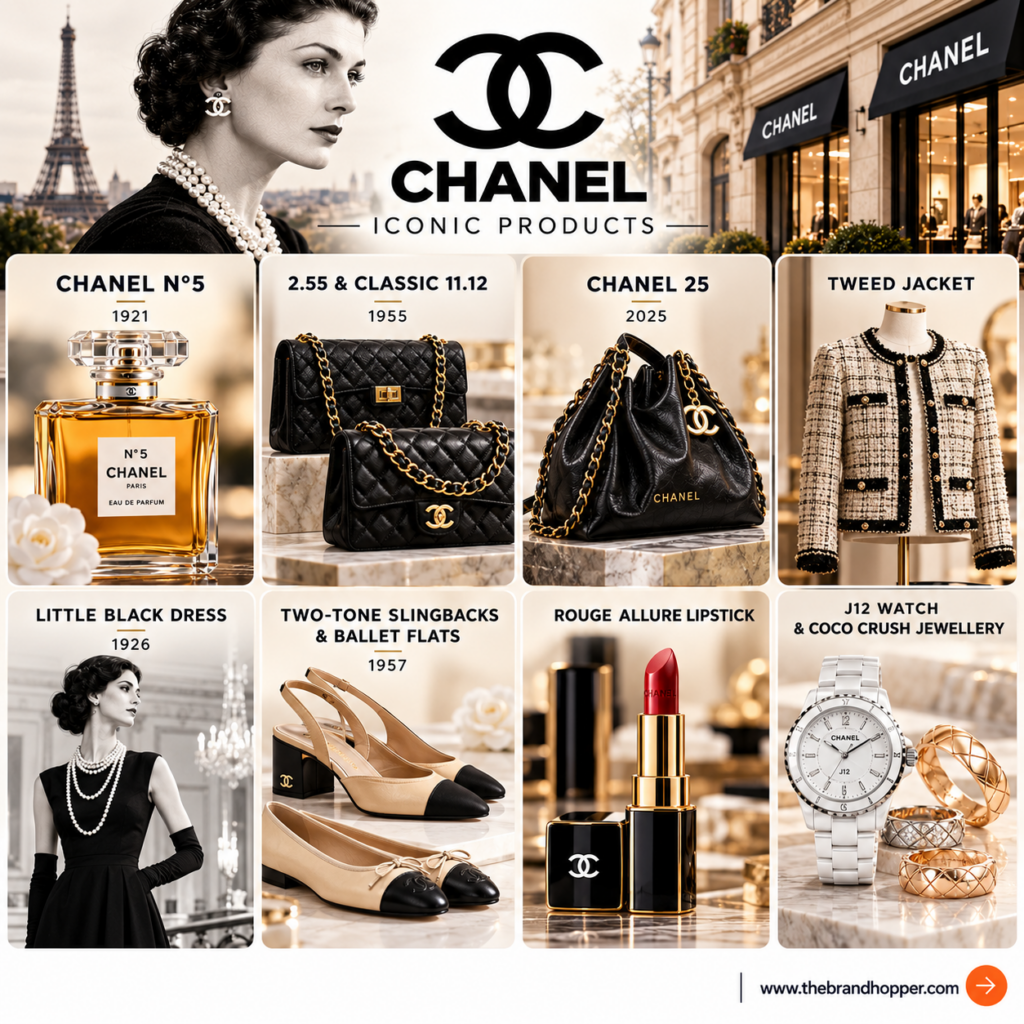
CHANEL N°5 – Launched in 1921 and created by Ernest Beaux, N°5 remains one of the world’s most recognisable fragrances. Its floral-aldehydic identity and distinctive bottle have made it one of Chanel’s defining cultural assets.
The 2.55 and the Classic 11.12 Bag – Gabrielle Chanel created the 2.55 in February 1955, incorporating quilting, a chain strap and the Mademoiselle turn-lock. The later Classic 11.12 introduced the interlocking CC clasp and became another defining Chanel handbag.
The CHANEL 25 Handbag – Introduced in 2025, the CHANEL 25 became an important new product for the House and was specifically identified by Chanel as a driver of Fashion performance in FY2025.
The Tweed Jacket – Chanel’s tweed jacket remains one of the House’s most recognisable fashion signatures, combining tailored construction with elements drawn from menswear and British-inspired materials.
The Little Black Dress – Chanel’s 1926 black dress helped establish the little black dress as a major fashion archetype. The concept continues to be reinterpreted by successive Chanel designers.
Two-Tone Slingbacks and Ballet Flats – Chanel’s beige-and-black two-tone shoes were introduced in 1957 and became another enduring House code.
Rouge Allure Lipstick – A flagship Chanel makeup line recognised for its black-and-gold packaging and refillable/portable formats across its range.
J12 Watch and COCO CRUSH Jewellery – The J12 helped establish ceramic as a defining Chanel watch material, while COCO CRUSH has become one of the House’s important jewellery franchises.
Target Audience & Segmentation of Chanel
Chanel operates across several luxury price levels. Its highest-value customers include affluent and ultra-high-net-worth clients, while fragrance, makeup, skincare and eyewear provide more accessible entry points into the House.
The customer base is not limited to women. Chanel reaches male consumers through BLEU DE CHANEL, watches, eyewear, beauty and selected fashion products, while its overall Fashion business remains centred on women’s collections.
| Segmentation basis | How Chanel segments |
|---|---|
| Demographic | Affluent consumers across age groups; historically strong female audience with growing male participation in fragrance, watches, eyewear and fashion |
| Geographic | Global, with Asia Pacific the largest 2025 revenue region and the Americas the fastest-growing comparable region |
| Psychographic | Consumers interested in heritage, craftsmanship, design, exclusivity and cultural relevance |
| Behavioural | Repeat clients, collectors, gift buyers and consumers entering through fragrance, makeup, skincare or accessories |
Chanel’s portfolio effectively operates as a brand pyramid.
- Top tier – Haute Couture and High Jewellery: highly exclusive products and personalised relationships.
- Core luxury tier – Ready-to-Wear, handbags, watches and fine jewellery: the main expression of Chanel’s luxury positioning.
- Entry tier – fragrance, makeup, skincare and eyewear: products that introduce consumers to the House at lower absolute price points.
The different layers reinforce one another. The cultural prestige of Couture and High Jewellery supports the desirability of more accessible Chanel products, while the beauty business gives the House substantial global reach.
Marketing Mix of Chanel (4Ps)
Chanel’s marketing mix is built around product desirability, prestige pricing, controlled distribution and storytelling-led promotion.
1. Product Strategy of Chanel
Chanel’s portfolio is broad, but its identity remains anchored in a relatively consistent set of House codes.
These include tweed, quilting, chains, camellias, pearls, black and white, the lion, the number 5 and the interlocking CC. The House continually reinterprets these codes rather than abandoning them.
| Category | Key lines and products | Role in the portfolio |
|---|---|---|
| Haute Couture | Seasonal Haute Couture collections | Creative and craftsmanship showcase |
| Ready-to-Wear | Seasonal, Cruise and Métiers d’art collections | Core Fashion expression |
| Leather goods | 2.55, Classic 11.12, Boy, Chanel 19, Chanel 22, CHANEL 25 | Major luxury category and brand icon |
| Shoes & accessories | Slingbacks, ballet flats, jewellery, belts, small leather goods | Fashion extensions and entry points |
| Fragrance | N°5, Coco Mademoiselle, Chance, BLEU DE CHANEL, Les Exclusifs | Global scale and recruitment |
| Makeup & skincare | Rouge Allure, Les 4 Ombres, Sublimage, N°1 DE CHANEL | Repeat purchase and daily brand contact |
| Watches | J12, Première, Boy·Friend | Technical and luxury positioning |
| Fine & High Jewellery | COCO CRUSH, Camélia, Comète, High Jewellery | High-value craftsmanship and exclusivity |
| Eyewear | Sunglasses and optical frames | Additional category and brand visibility |
i. Heritage icons as the backbone. Products such as N°5, the 2.55, Classic 11.12 and tweed jacket have remained central to Chanel’s identity for decades.
ii. Creating new icons regularly. Chanel continues to introduce products that can become new House codes. The CHANEL 25, CHANCE EAU SPLENDIDE and J12 BLEU were among the products Chanel specifically highlighted in its FY2025 results.
iii. Product as a demand engine under Blazy. Matthieu Blazy’s first Chanel collections introduced new interpretations of familiar House codes. Chanel’s official FY2025 results cited strong creative momentum heading into 2026, while independent reporting subsequently linked his first collections with strong H1 2026 sales.
iv. Craftsmanship built into the product. Chanel’s network of specialist Maisons d’art gives the House direct access to rare craftsmanship and specialist production expertise. The company invested more than $700 million in 2025 in areas including leather goods and Watches & Fine Jewellery expertise.
v. Innovation and R&D. Chanel invests in new manufacturing techniques, beauty research and emerging technologies. In 2025, it launched the CHANEL Open Lab, a collaborative platform for developing concepts and prototypes with external innovators, including students from Stanford, Columbia and NYU.
vi. Packaging as part of the product. Packaging is an important part of Chanel’s visual identity. The company is also reducing its environmental footprint: the CHANCE EAU SPLENDIDE bottle and cap were made 20% lighter and achieved more than 95% recyclability, while the HYDRA BEAUTY MICRO SÉRUM redesign halved plastic use.
vii. A careful approach to menswear. Chanel does not currently operate a dedicated men’s fashion line, but reaches male consumers through fragrance, grooming, watches, eyewear and selected fashion pieces.
2. Pricing Strategy of Chanel
Chanel follows prestige pricing, with prices designed around brand positioning, craftsmanship, product scarcity and market conditions rather than simply production cost.
Limited public discounting. Chanel’s core Fashion business is not positioned around seasonal promotional markdowns. The House’s strategy prioritises full-price luxury retail and controlled distribution.
Regular price increases. Chanel has raised prices on major handbag lines several times in recent years. In the U.S., the Classic 11.12 currently retails for $11,700, according to Chanel’s own website.
The Classic 11.12 was raised to approximately $11,300 in August 2025 and to $11,700 in April 2026, according to contemporary price reporting.
- Tiered price architecture. Chanel offers a broad price ladder:
-
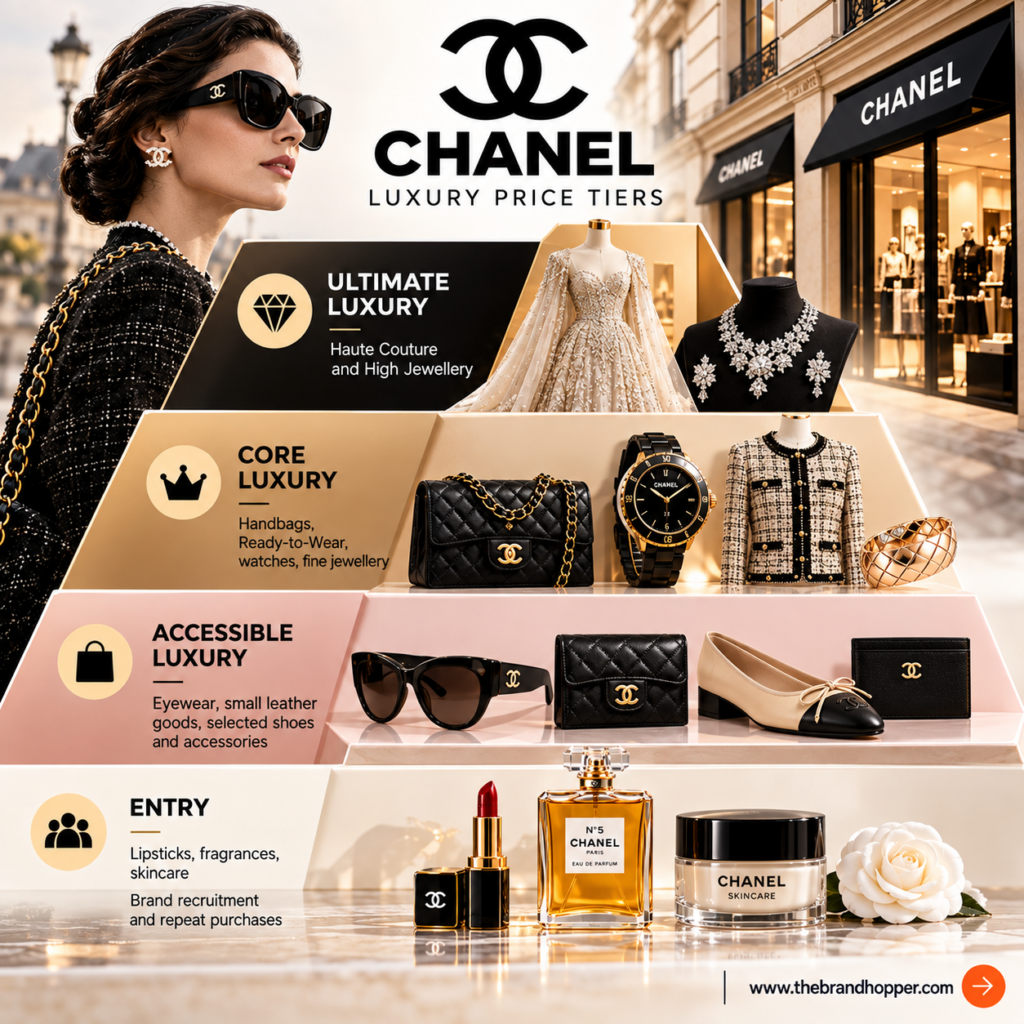
Chanel Luxury Price Tiers Infographic
Price harmonisation across regions. Chanel manages pricing across markets to account for currencies, taxes, local market conditions and international price differences.
The company’s approach to pricing should not automatically be interpreted as proof that Chanel products are financial “investments.” Retail price increases and resale performance are separate measures.
3. Place (Distribution) Strategy of Chanel
Chanel treats distribution as part of the luxury experience.
i. Boutique-led retail. Fashion, handbags, watches and fine jewellery are strongly centred around Chanel’s own boutique network, allowing the House to control much of the retail environment, service and product presentation.
ii. Prime flagship locations. Major Chanel stores are located in luxury shopping districts such as rue Cambon in Paris, New Bond Street in London, Fifth Avenue in New York, Ginza in Tokyo and major luxury districts in Asia.
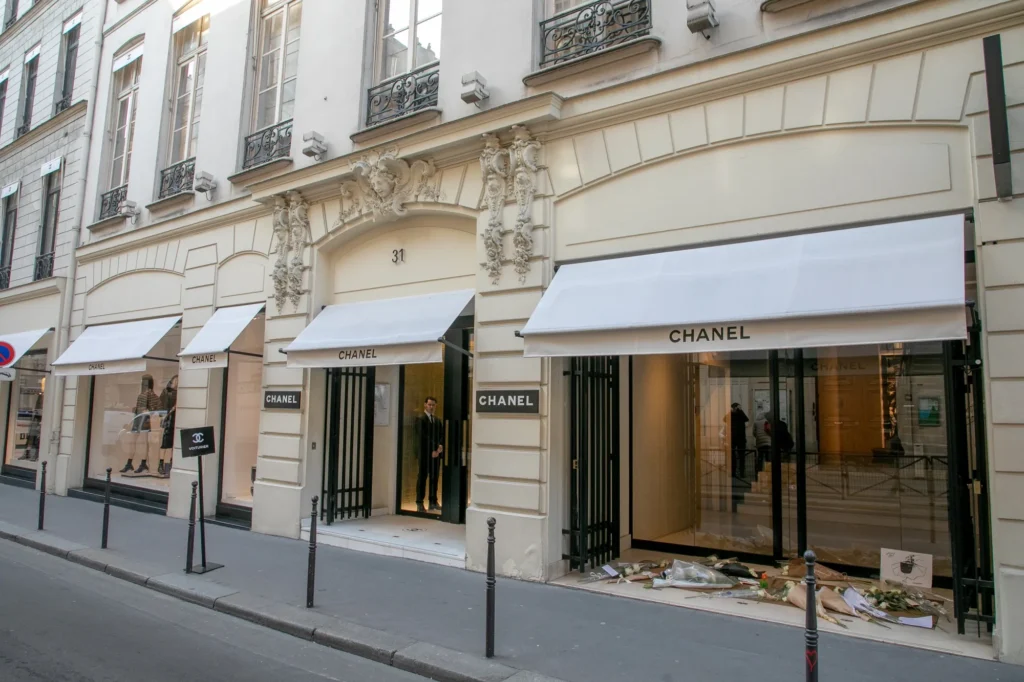
iii. Steady network expansion. Chanel opened more than 40 boutiques in FY2025, spanning established markets such as Japan and Mainland China as well as newer markets including the Middle East and Mexico.
Major completed projects included Plaza 66 in Shanghai, Hong Kong, Las Vegas, Toronto and Fukuoka.
iv. A wider model for Fragrance & Beauty. Beauty has a broader distribution footprint than Chanel Fashion. In FY2025, Chanel opened more than 25 dedicated Fragrance & Beauty boutiques and expanded beauty e-commerce into Mexico and Argentina.
v. Selective e-commerce. Chanel’s digital commerce presence varies by category and market. Fragrance, beauty and selected other products are available online, while core Fashion and handbag purchases remain strongly boutique-led.
vi. Managing scarcity in-store. Chanel controls product allocation and availability for highly sought-after products. This allows the House to manage inventory and maintain a controlled client experience.
| Channel | What is sold | Strategic purpose |
|---|---|---|
| Chanel fashion boutiques | Ready-to-Wear, handbags, shoes, accessories | Brand experience and controlled retail |
| Watches & Fine Jewellery boutiques | Watches, fine and high jewellery | Specialist service |
| Fragrance & Beauty boutiques | Fragrance, makeup, skincare | Beauty experience and services |
| Department stores & authorised partners | Primarily fragrance and beauty | Broader reach |
| Travel retail | Primarily fragrance and beauty | International customer reach |
| chanel.com and apps | Selected categories and services | Digital discovery, commerce and appointments |
4. Promotion Strategy of Chanel
Chanel’s promotion is centred on heritage, culture, creativity and aspiration, rather than discount-led advertising.
i. Runway shows as global media events. Chanel uses major fashion shows to communicate both its products and its cultural identity. Matthieu Blazy’s first Chanel show took place at the Grand Palais in October 2025, followed by his New York Métiers d’art show in December.
ii. Ambassadors and “friends of the House.” Chanel works with actors, musicians and models as House Ambassadors and campaign faces.
In 2026, Pedro Pascal became a Chanel House Ambassador, while Indian model Bhavitha Mandava was also named a House Ambassador.
Angèle fronted the CHANCE EAU SPLENDIDE campaign, while Chanel’s wider ambassador network continues to connect the House with entertainment, fashion and culture.
iii. Cinematic fragrance campaigns. Chanel frequently uses short films, celebrity talent and cinematic storytelling to market N°5, Coco Mademoiselle, Chance and BLEU DE CHANEL.
iv. Red carpets and celebrity dressing. Chanel uses major film festivals, awards ceremonies and cultural events as high-visibility platforms for its fashion and jewellery.
v. Digital and social media. Chanel uses Instagram, YouTube, TikTok and other digital platforms to distribute campaigns, runway content, craftsmanship stories and behind-the-scenes material.
vi. Owned content and cultural storytelling. The CHANEL Connects podcast returned for its fifth season, while Chanel launched its first CHANEL ARTS & CULTURE Magazine in 2025.
vii.Experiential marketing and pop-ups. The CHANCE STREET activation in London’s Shoreditch ran from April 25 to May 5, 2025, supporting the launch of CHANCE EAU SPLENDIDE.
viii. Partnerships and sponsorships. In 2025, CHANEL J12 became the first Title Sponsor and Official Timekeeper of The Boat Race in the UK.
ix. Exhibitions and heritage. Chanel uses its archives and cultural assets as part of its storytelling. La Pausa, Gabrielle Chanel’s Mediterranean villa, reopened in June 2025 after restoration, while Espace Gabrielle Chanel opened at the Power Station of Art in Shanghai later that year.
- Heavy, consistent brand investment. Chanel invested $2.395 billion in brand activities, including client engagement, in FY2025. This spending remained high despite the previous year’s luxury slowdown.
Also Read: The Magic of LVMH: Exploring the Success Story Of Luxury Empire
Chanel Marketing Strategies Explained
Beyond the 4Ps, several long-term strategies explain how Chanel has built and maintained its luxury positioning.
1. Founder Storytelling and Brand Heritage
Chanel’s founder story remains central to the House. Gabrielle Chanel’s work in jersey, tailoring, jewellery, fragrance and accessories created many of the codes that still appear in Chanel products.
How it works: heritage gives products historical meaning. Chanel continues to connect modern products and campaigns with the founder through archives, exhibitions, runway locations, films and product codes.
2. Creative Renewal Without Losing the Codes
Heritage brands need to balance continuity with creative renewal. Chanel has repeatedly used creative leadership changes to reinterpret its existing codes rather than abandon them.
How it works: Matthieu Blazy’s appointment introduced a new creative perspective while retaining the House’s established vocabulary. His first Chanel collection debuted in October 2025.
Reported H1 2026 results subsequently showed approximately 16% comparable revenue growth, although Chanel did not officially confirm those half-year figures.
3. Scarcity and Controlled Exclusivity
Chanel maintains controlled distribution and limited availability for many high-demand products. This is particularly visible in handbags, Haute Couture and High Jewellery.
How it works: controlled availability can reinforce exclusivity and encourage consumers to engage directly with Chanel’s boutiques and advisors.
4. Prestige Pricing and Regular Price Increases
Chanel regularly adjusts prices across its major handbag categories. The U.S. Classic 11.12 is currently priced at $11,700 on Chanel’s website.
How it works: pricing communicates positioning and helps the House maintain premium margins while adapting to inflation, currency movements and market conditions. It should not automatically be interpreted as evidence that a handbag is an appreciating financial asset.
5. Fragrance and Beauty as the Entry Funnel
Fragrance, makeup and skincare give consumers a lower absolute-price entry point into the Chanel universe.
How it works: these products are available through dedicated boutiques, e-commerce, travel retail and selected partners, allowing Chanel to combine global reach with a controlled brand environment.
The FY2025 results specifically identified Fragrance and Skincare as key drivers of Fragrance & Beauty performance.
6. Celebrity Ambassadors and Friends of the House
Chanel maintains relationships with actors, musicians and models who participate in campaigns, fashion shows, red-carpet appearances and cultural events.
How it works: ambassadors help Chanel connect its heritage with contemporary entertainment and different demographic and geographic audiences.
The 2026 appointments of Pedro Pascal and Bhavitha Mandava illustrate how the House is expanding its ambassador network.
7. Runway Spectacle and Destination Shows
Chanel uses fashion shows as storytelling platforms rather than treating them solely as product presentations.
How it works: distinctive venues and cultural references create editorial and social-media coverage around each collection. Blazy’s first Métiers d’art show in a New York subway station is a recent example.
8. Digital Storytelling Without Discounting
Chanel uses digital platforms primarily for storytelling, product discovery, campaigns and customer engagement.
How it works: digital content extends the brand experience beyond physical boutiques while maintaining the House’s emphasis on luxury presentation.
9. Flagship Boutiques and Experiential Retail
Chanel continues to invest heavily in its boutique network. It opened more than 40 boutiques in FY2025 and completed major retail projects across Shanghai, Hong Kong, Las Vegas, Toronto and Fukuoka.
How it works: physical retail provides Chanel with control over presentation, service and the customer relationship.
10. Clienteling and Relationship Marketing
Personalised service is an important component of Chanel’s luxury retail model. Advisors can help clients discover products, arrange appointments and provide after-sales services.
How it works: relationship-based retail can encourage repeat purchases and cross-category engagement without relying on mass-market promotional tactics.
11. Vertical Integration and Craftsmanship as a Marketing Story
Chanel has built an extensive ecosystem of specialist suppliers and Maisons d’art.
How it works: craftsmanship is both a production capability and a communication asset. Chanel can tell the story of embroidery, jewellery, leatherwork, millinery and other specialist techniques through collections, exhibitions and cultural programming.
12. Cultural Patronage and Purpose-Led Branding
Chanel invests heavily in arts, culture and women’s autonomy.
In 2025, the CHANEL Culture Fund supported 50 long-term cultural projects across five continents. La Pausa reopened following restoration, and Espace Gabrielle Chanel opened in Shanghai.
Chanel also maintained $125 million per year in funding for Fondation CHANEL, an independent UK-registered charity supporting women’s safety, economic and social autonomy, and climate resilience.
How it works: cultural and social programmes extend Chanel’s presence beyond commercial advertising and connect the House with artists, institutions and social initiatives.
13. Expansion into New and Emerging Markets
Chanel continues to invest in established markets while expanding in regions such as the Middle East and Mexico.
How it works: the company combines new boutiques, digital commerce, client experience and local cultural activities to deepen its presence.
In FY2025, Chanel opened more than 40 boutiques across established and newer markets.
14. Long-Term Thinking Enabled by Private Ownership
Chanel’s private ownership allows the company to make long-term investments without the quarterly reporting cycle of a publicly listed company.
How it works: the House can continue investing in boutiques, manufacturing, craftsmanship, people and brand-building through periods of weaker demand.
In FY2025, Chanel invested $1.449 billion in capital expenditure and $2.395 billion in brand activities.
SWOT Analysis of Chanel
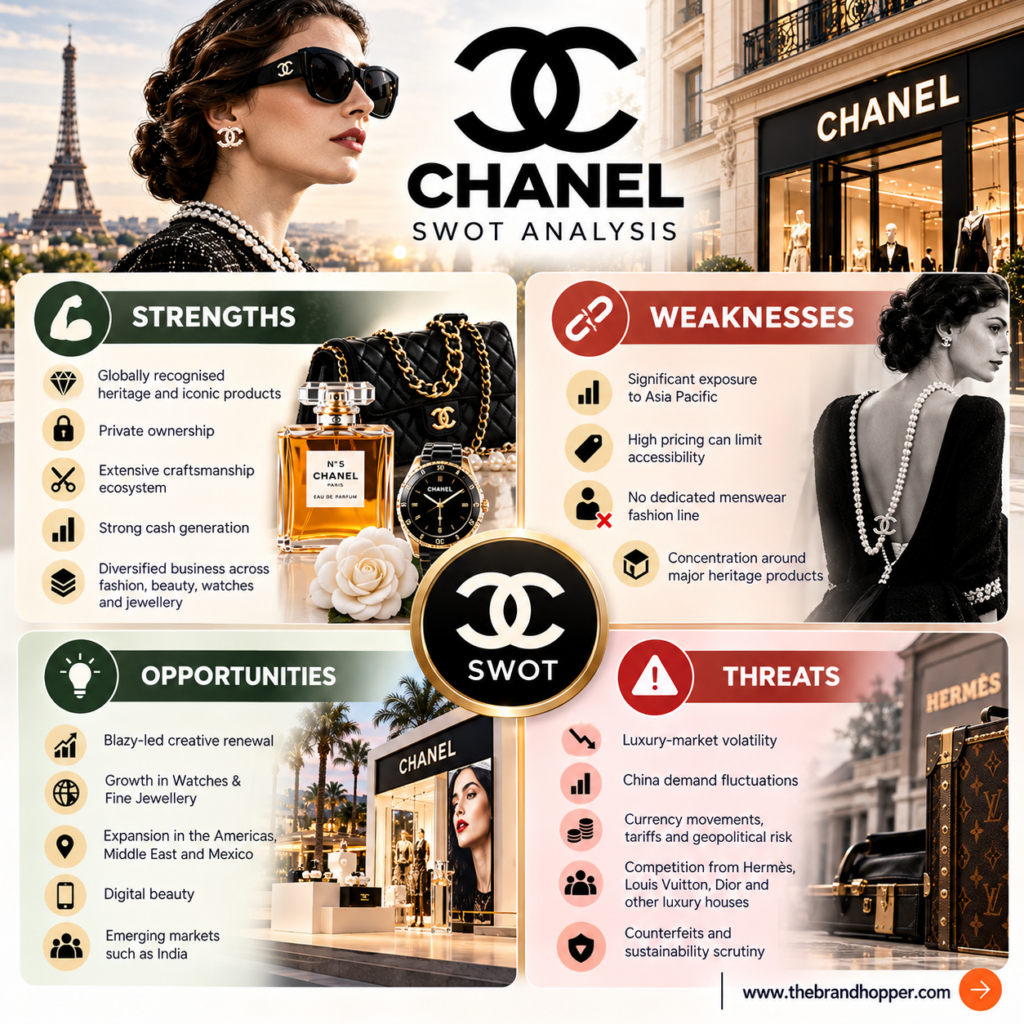
Success Factors of Chanel
i. Timeless, innovative design. Chanel repeatedly turns functional design ideas into long-lasting product codes.
ii. A clear, consistent brand identity. The CC, camellia, quilting, tweed, black-and-white palette and number 5 create recognisable brand assets.
iii. Craftsmanship. Chanel’s investment in specialist workshops and suppliers helps preserve technical expertise across fashion and jewellery.
iv. Controlled distribution. A substantial company-controlled retail network allows Chanel to manage the customer experience.
v. Pricing power. Chanel has demonstrated an ability to increase prices across major product categories while maintaining a large global customer base.
vi. Financial independence. Private ownership allows Chanel to pursue long-term investment programmes without public-market quarterly reporting requirements.
vii. Creative renewal. The transition from Lagerfeld to Viard and then Blazy demonstrates Chanel’s ability to change creative leadership while retaining core House codes.
Chanel vs Other Prominent Luxury Brands
Chanel is among the world’s largest luxury brands and competes with houses such as Hermès, Louis Vuitton, Dior and Gucci.
| Brand | Ownership | Signature icons | Positioning |
|---|---|---|---|
| Chanel | Private, Wertheimer family | N°5, 2.55/Classic 11.12, tweed | Fashion, beauty, jewellery and heritage |
| Hermès | Public, family-controlled shareholder structure | Birkin, Kelly, silk scarves | Craftsmanship and leather goods |
| Louis Vuitton | LVMH | Monogram, Speedy, trunks | Travel heritage and broad luxury portfolio |
| Dior | LVMH | Bar Jacket, Lady Dior, Sauvage | Couture, fashion and beauty |
| Gucci | Kering | Horsebit, Jackie, GG | Italian fashion and leather goods |
What distinguishes Chanel is the combination of private ownership, a diversified luxury portfolio, strong control over its retail experience, a major fragrance and beauty business, and unusually strong continuity of brand codes.
In FY2025, Chanel returned to comparable revenue growth of 1.8%, while its Americas business grew 7.2% on a comparable basis.
Sustainability & Social Impact
- Published its first Climate Transition Plan in 2025, setting out actions toward net-zero greenhouse-gas emissions across its value chain by 2040.
- Chanel’s Scope 3 emissions fell 10% in 2025, while combined Scope 1 and 2 emissions declined 2.6%.
- Chanel achieved 100% renewable electricity in its own operations by year-end 2025.
- Its Grasse flower fields progressed from Regenerative Organic Certified® Bronze to Silver.
- Launched NEVOLD in June 2025, an independently operated entity focused on circularity and recycling solutions for natural textile and leather materials.
- Maintained $125 million per year of funding for Fondation CHANEL to support women and girls.
Challenges & Future Outlook
Chanel’s major challenge is maintaining growth while protecting its exclusivity. Asia Pacific represented roughly 48% of FY2025 revenue but recorded a 0.8% comparable decline, demonstrating the importance of the region to the House’s future performance.
The House also needs to balance regular price increases with customer demand and navigate competition across handbags, fashion, beauty, watches and jewellery.
At the same time, Chanel enters the next phase with significant financial resources and continued investment. FY2025 ended with $1.605 billion of net cash and $2.646 billion of free cash flow, while the House continued expanding boutiques, manufacturing capacity and its craftsmanship ecosystem.
The creative transition under Matthieu Blazy is another major variable. Chanel’s official 2025 results highlighted strong creative momentum, while independent reporting pointed to approximately 16% comparable revenue growth in H1 2026. Because Chanel has not confirmed those half-year numbers, they should be treated as reported rather than official company results.
Chanel is also continuing to invest in its London infrastructure. Its FY2025 results said work was continuing on the new global headquarters at Berkeley Square, with an expected opening by the end of 2026.
FAQs
Q. Who owns Chanel?
Chanel is privately owned by Alain and Gérard Wertheimer. Their family has controlled the House since the twentieth century, with Pierre Wertheimer’s relationship with Gabrielle Chanel beginning in the 1920s.
Q. Who is the CEO of Chanel?
Leena Nair has been Chanel’s Global Chief Executive Officer since January 2022.
Q. Who is the creative director of Chanel?
Matthieu Blazy is Chanel’s Artistic Director of Fashion Activities. He was appointed in December 2024 and joined the House in 2025.
Q. What is Chanel’s annual revenue?
Chanel reported $19.269 billion in revenue for FY2025, up 3.0% on a reported basis and 1.8% on a comparable basis.
Q. Where is Chanel headquartered?
Chanel Limited is headquartered in London, while 31 rue Cambon in Paris remains one of the House’s most important historic and creative addresses.
Q. Why does Chanel not typically go on sale?
Chanel’s core luxury positioning does not revolve around public promotional discounting. The House instead relies on controlled distribution, product desirability and pricing discipline.
Q. Can you buy Chanel bags online?
Chanel’s e-commerce availability varies by market and category. Fragrance, beauty and selected products are available online, while core handbags and much of Fashion remain strongly boutique-led.
Q. What is Chanel’s most famous product?
CHANEL N°5, launched in 1921, is arguably the House’s most internationally recognised product, alongside the 2.55 and Classic 11.12 handbags, tweed and other signature fashion codes.
Q. What is Chanel’s marketing strategy?
Chanel combines heritage storytelling, product innovation, prestige pricing, controlled distribution, cultural marketing, celebrity ambassadors, runway spectacle and experiential retail.
Q. Who are Chanel’s main competitors?
Chanel competes with major luxury houses including Hermès, Louis Vuitton, Dior and Gucci, as well as other global luxury brands across specific product categories.
Conclusion
Chanel’s history demonstrates how a luxury brand can continually reinterpret its identity without abandoning its core codes. Gabrielle Chanel established the foundations through fashion, fragrance and functional design; Karl Lagerfeld later transformed those codes for a global audience; and the House is now entering a new creative phase under Matthieu Blazy, with Leena Nair leading the business.
With $19.3 billion in FY2025 revenue, $4.7 billion in operating profit, private ownership, a large specialist craft ecosystem and continued investment across boutiques, manufacturing, technology and culture, Chanel remains one of the world’s most significant independent luxury houses.
The reported acceleration in the first half of 2026 adds another important chapter, although those figures have not been officially published by Chanel. The combination of heritage, controlled distribution, product innovation, cultural storytelling and long-term investment remains central to how the House creates and protects luxury value.
Also Read: The Art of Luxury: Chanel Marketing Strategies and Marketing Mix
To read more content like this, subscribe to our newsletter