
Last Updated on November 5, 2026 by Team TBH
Huggies is a global baby-care brand owned by Kimberly-Clark. Introduced in 1978, the brand has expanded beyond disposable diapers into a broader portfolio that includes baby wipes, training pants, swim pants and products for different stages of early childhood.
Huggies operates in a competitive global diaper market, where it competes with brands such as Pampers, owned by Procter & Gamble, as well as regional manufacturers. Market-size estimates vary according to the products and geographies included. One 2026 industry estimate values the global baby-diaper market at approximately $83.3 billion in 2025, forecasting a 7% CAGR between 2026 and 2033. These figures should be treated as third-party market estimates, not audited industry totals.
Kimberly-Clark reported $16.447 billion in net sales for FY2025. Its North America segment generated $10.753 billion, while International Personal Care generated $5.694 billion. The company reported 2.6% volume growth in North America for the year, although North American net sales declined 2.4%, partly reflecting its exit from the US private-label diaper business. These are segment-level figures and should not be presented as Huggies-only financial results.
A major corporate development followed in November 2026, when Kimberly-Clark completed its acquisition of Kenvue. The combination brings together brands including Huggies, Tylenol, Neutrogena and Johnson’s Baby under one corporate group. Kimberly-Clark described the transaction as creating a broader consumer health and wellness business; it does not mean that Huggies itself has merged with or absorbed those brands.
This article examines Huggies’ marketing strategies, notable campaigns and marketing mix through the 4Ps framework: Product, Price, Place and Promotion.
Marketing Strategies of Huggies
1. Product Innovation and Quality Leadership
Product performance is central to Huggies’ competitive positioning. The brand communicates benefits such as absorbency, leak protection, fit, softness and comfort—attributes that matter to parents when choosing diapers for newborns and growing babies.
Huggies’ product portfolio includes different diaper ranges for different stages and needs. In the United States, examples include Little Snugglers, Little Movers, Snug & Dry and OverNites, while Pull-Ups training pants, Goodnites and Little Swimmers serve related needs as children grow.
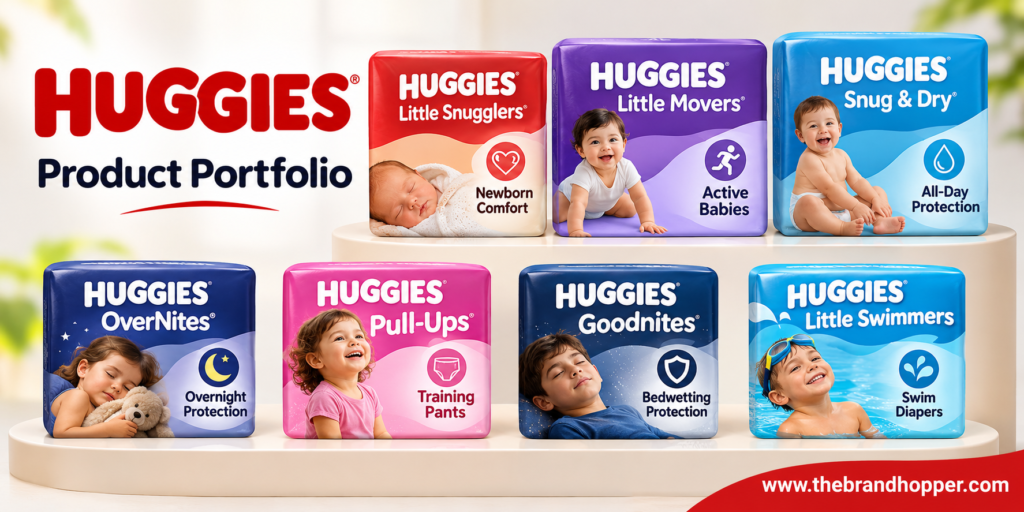
The features and product names available vary by country. Product claims such as hours of protection, absorbency comparisons and specific liner technologies should therefore be checked against the relevant country’s current product packaging and official product pages before publication.
Huggies also adapts its product portfolio to local markets. In India, Wonder Pants is an important pants-style diaper range, while other markets offer locally developed products and product variants to address different consumer preferences, price points and retail environments.
2. Emotional Brand Positioning: The Power of Hugs
Huggies has built much of its brand communication around the emotional connection between parents and babies. The idea of a hug provides a natural link between the brand name, the experience of caring for a child and the comfort that parents want their babies to feel.
The brand has used this positioning in campaigns such as “No Baby Unhugged” and “Hugs Change Everything.” These initiatives connect the emotional reassurance of physical affection with the brand’s broader promise of supporting parents and babies.
No Baby Unhugged
Huggies launched its “No Baby Unhugged” initiative in Canada in 2015. Developed with Ogilvy, the campaign highlighted the benefits of skin-to-skin contact and created hospital-based volunteer hugging programmes for newborns who could not always be held by their parents.
The programme was designed to provide additional human touch and comfort to babies in participating hospital units. It also helped Huggies distinguish itself from competitors by moving the diaper conversation beyond functional product demonstrations and towards a more emotional brand proposition.
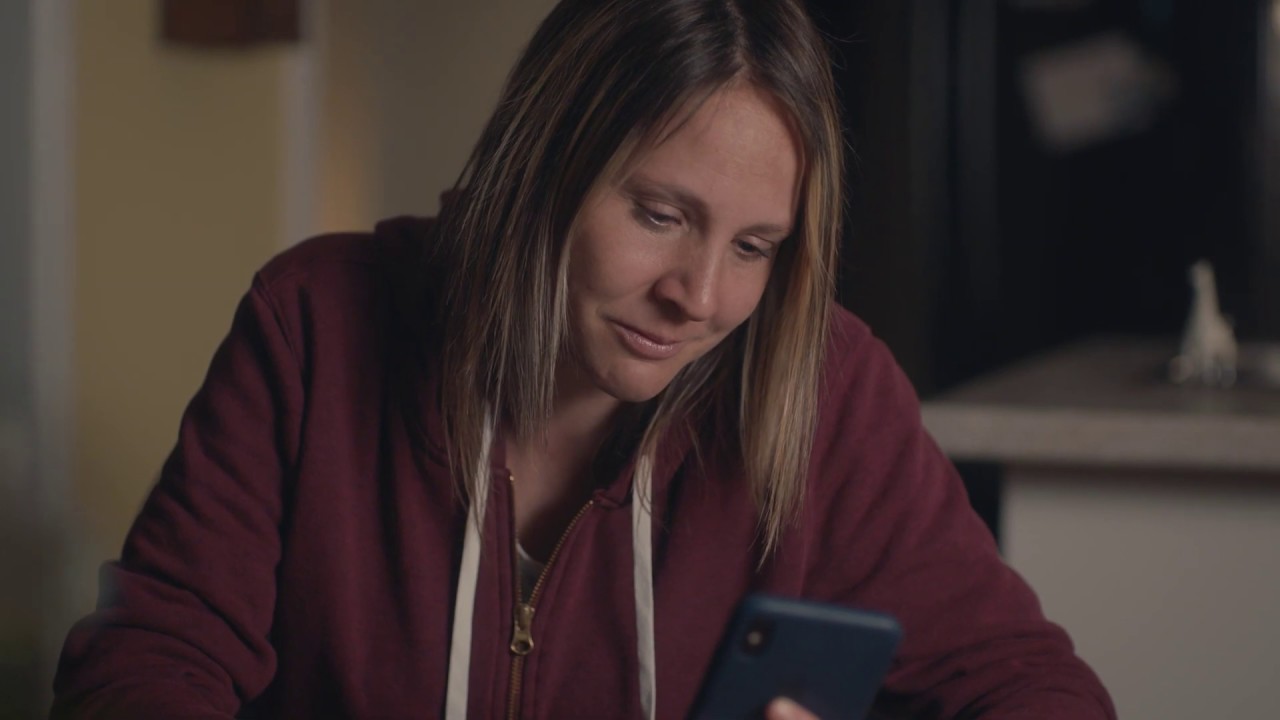
The campaign generated measurable commercial results in Canada. A published case study reported a 19.2% increase in Huggies newborn diaper dollar sales during the campaign measurement period, alongside improvements in brand perception. Ogilvy has stated that the initiative was adapted in more than 25 countries.
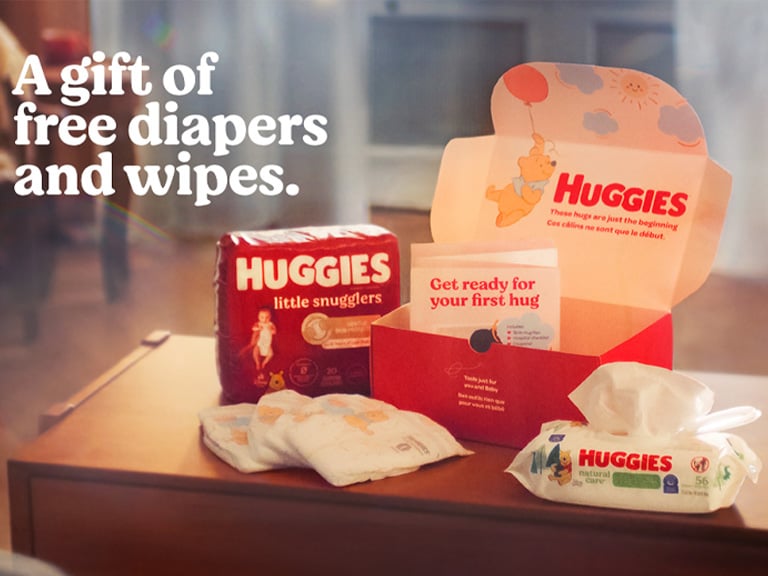
Huggies has also connected the initiative with product sampling and support for families. In Canada, the brand has offered a free Huggies Hug Box containing diapers and wipes to eligible expectant parents and new parents, subject to programme terms.
Hugs Change Everything and Sound of a Hug
Huggies Canada introduced the “Hugs Change Everything” platform as an extension of its emotional positioning. One notable execution was “Sound of a Hug,” launched in November 2024 in partnership with creative agency Zulu Alpha Kilo.
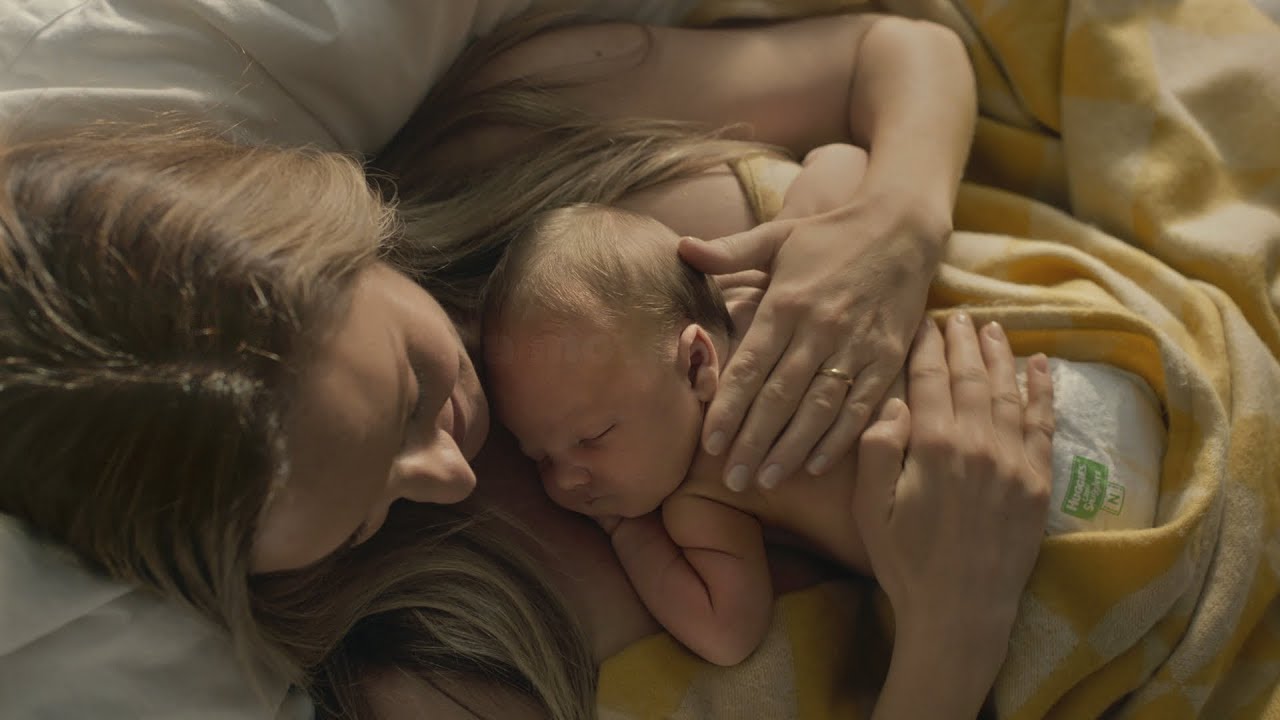
The digital experience allowed parents to create personalised baby sleep tracks inspired by a parent’s heartbeat. Parents could use the website or Amazon Alexa experience and customise the sound using elements such as music, background noise and preferences related to the baby’s needs.
The campaign offered more than 50,000 possible track combinations. It translated the emotional idea of a hug into a digital experience designed to help parents create a soothing environment for their babies.
3. Inclusivity and Representation in Marketing
Huggies has used inclusive representation to reflect the changing role of parents and caregivers. One notable example was the 2019 launch of Huggies Special Delivery, which received attention for featuring fathers, including Black fathers, in its packaging and marketing.
The campaign challenged the traditional convention of showing mothers as the default caregivers in baby-care advertising. Featuring fathers in product communication helped Huggies acknowledge the wider range of people involved in raising and caring for children.
The broader lesson is that baby-care marketing needs to represent different family experiences and caregiving roles. Brands in this category communicate not only with mothers but also with fathers, grandparents, guardians and other caregivers who participate in everyday childcare.
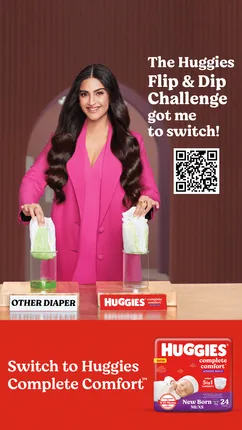
In India, Huggies has used celebrity partnerships to connect with young parents. In 2023, the brand partnered with actress Sonam Kapoor Ahuja for the second phase of its “We Got You, Baby” campaign, promoting the Huggies Complete Comfort range. The campaign included the #HuggiesFlipAndDipChallenge and was developed for television and digital platforms in multiple languages.
4. Integrated Marketing Communication (IMC)
Huggies uses a mix of advertising, digital communication, retail activity, sampling and parenting information to reach consumers at different stages of the purchase journey. The objective is to build familiarity with the brand before a baby is born and maintain relevance as the child grows.
Sampling and product information can be particularly important in the newborn segment, where parents are making early decisions about diaper brands. Huggies’ Canadian Hug Box is one example of a programme designed to introduce products to expectant parents and families with newborns.
The brand has also used television and digital video to communicate product benefits and emotional messages. Its “We Got You, Baby” campaign in India and the “Sound of a Hug” campaign in Canada demonstrate how the creative execution can vary by market while retaining a focus on parental care and reassurance.
Digital media, social platforms, retailer websites and in-store promotions provide additional opportunities to communicate product features and encourage trial. The exact media mix and promotional activity vary by country and retailer.
5. Digital Marketing and Social Media Strategy
Digital channels help Huggies reach expectant parents, new parents and caregivers with product information, parenting resources and campaign content. The brand maintains market-specific digital properties and social media activity, with platforms and content formats varying across countries.
The Huggies website also provides parenting information and practical resources. Content about diaper changing, diaper fit and everyday baby care can help the brand engage parents who are researching products and looking for guidance.
Huggies has used digital campaigns to encourage participation and sharing. The “Sound of a Hug” experience, for example, gave parents a personalised digital tool rather than relying only on conventional product advertising. In India, the #HuggiesFlipAndDipChallenge encouraged participation around the brand’s Complete Comfort diaper range.
Loyalty and promotional programmes should be described on a market-by-market basis. The older Huggies Rewards points programme in Canada was discontinued in 2020, so it should not be presented as a current global app-based programme that rewards users for scanning receipts. Current offers, samples and rewards should be verified on the relevant local Huggies website.
6. Sustainability and Corporate Social Responsibility
Sustainability is an important issue for disposable diaper manufacturers because diapers combine absorbent materials, plastics and other components that are difficult to recycle after use. Huggies’ parent company, Kimberly-Clark, has reported work on packaging design, materials and recycling initiatives as part of its broader environmental commitments.
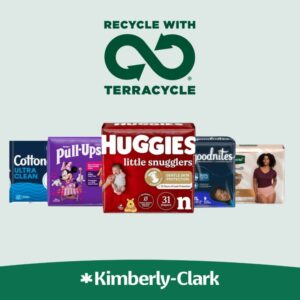
One relevant initiative is the Huggies partnership with TerraCycle in the United States. The programme allows consumers to send eligible plastic packaging from Huggies diapers and wipes, along with packaging from several other Kimberly-Clark brands, for recycling. It is a packaging-recycling programme; it does not mean that used disposable diapers themselves can be recycled through the scheme.
Huggies also connects its brand with social initiatives focused on newborn care and families. “No Baby Unhugged” is an example of a purpose-led programme that combined awareness of the benefits of physical contact with hospital-based volunteer support.
These initiatives help the brand communicate values beyond product performance. However, environmental claims should be specific about the material, product component, geography and programme involved rather than describing an entire diaper as environmentally friendly or fully recyclable.
7. Distribution and Retail Strategy
Huggies relies on broad retail availability to make its products accessible when parents need them. Depending on the market, the brand is sold through supermarkets, mass retailers, pharmacies, warehouse clubs, specialist baby stores and e-commerce platforms.
In the United States, major retail channels include Walmart, Target, pharmacies and online retailers. Huggies products are also available through e-commerce platforms such as Amazon, Walmart.com and Target.com, subject to product and retailer availability.
Online retail gives parents the convenience of comparing product sizes, pack quantities and prices, while recurring-order services offered by retailers can make it easier to replenish frequently used products. Retailer promotions and subscription options are controlled by the relevant retailer and should not be treated as Huggies-owned programmes.
In international markets, distribution is adapted to local retail structures. In India, Huggies products are available through modern retail, e-commerce and traditional retail outlets. In China and other markets, local e-commerce platforms and retail partnerships play an important role in product discovery and sales.
8. Global and Localised Marketing
Huggies operates within Kimberly-Clark’s international business. Kimberly-Clark says its products are sold in more than 150 countries, although brand and product availability varies by market. Huggies’ product range, pricing and campaign activity are therefore not identical across all countries.
The brand’s global positioning draws on common parental priorities such as comfort, protection and care. Local teams adapt the product portfolio, communication and distribution strategy to reflect differences in consumer preferences, purchasing power, climate, retail infrastructure and cultural context.
The “No Baby Unhugged” initiative demonstrates how a campaign developed in Canada could be adapted in other markets. Ogilvy reports that the campaign was adapted in more than 25 countries, while its original hospital volunteer programme was developed around Canadian healthcare partnerships.
In India, Huggies has promoted pants-style diapers and used celebrity-led communication to support product launches. The 2023 “We Got You, Baby” campaign featuring Sonam Kapoor Ahuja promoted the Complete Comfort range and used a social-media challenge to demonstrate product attributes.
Marketing Mix of Huggies (4Ps)
The 4Ps framework—Product, Price, Place and Promotion—provides a way to examine how Huggies develops its products, positions them in the market, makes them available and communicates with parents. The details below focus mainly on the US market where relevant; product names, pricing and availability differ internationally.
1. Product
Huggies offers diapers and related baby-care products for different stages of childhood. Its portfolio includes diaper ranges, training pants, swim pants and baby wipes.
| Product Line | Target User / Need | Key Proposition |
|---|---|---|
| Huggies Little Snugglers | Newborns and young babies | Newborn-focused fit and comfort |
| Huggies Little Movers | Active babies | Designed for babies who crawl and move |
| Huggies Snug & Dry | Everyday diapering | Everyday absorbency and leak protection |
| Huggies OverNites | Overnight use | Designed for overnight protection |
| Pull-Ups Training Pants | Potty-training toddlers | Training pants designed for the transition from diapers |
| Goodnites | Children experiencing bedwetting | Discreet overnight absorbent underwear |
| Huggies Little Swimmers | Swimming and water activities | Swim pants designed for use in water |
| Huggies Natural Care Wipes | Baby cleaning and care | Baby wipes for everyday cleaning |
| Huggies Wonder Pants (India) | Indian market | Pants-style diaper format |
Product availability and specifications vary by country. Premium ranges, product names and technical features should be checked against current local product listings before publication.
2. Price
Huggies uses a tiered pricing approach, with different products and pack sizes serving different consumer needs. Pricing can vary by country, retailer, diaper size, pack quantity, promotional offer and subscription arrangement.
Rather than assigning fixed global price-per-diaper figures, it is more accurate to compare products within the same market and at the same diaper size and pack quantity. A larger pack may have a lower unit price, while specialised products such as overnight diapers may carry a higher price per diaper.
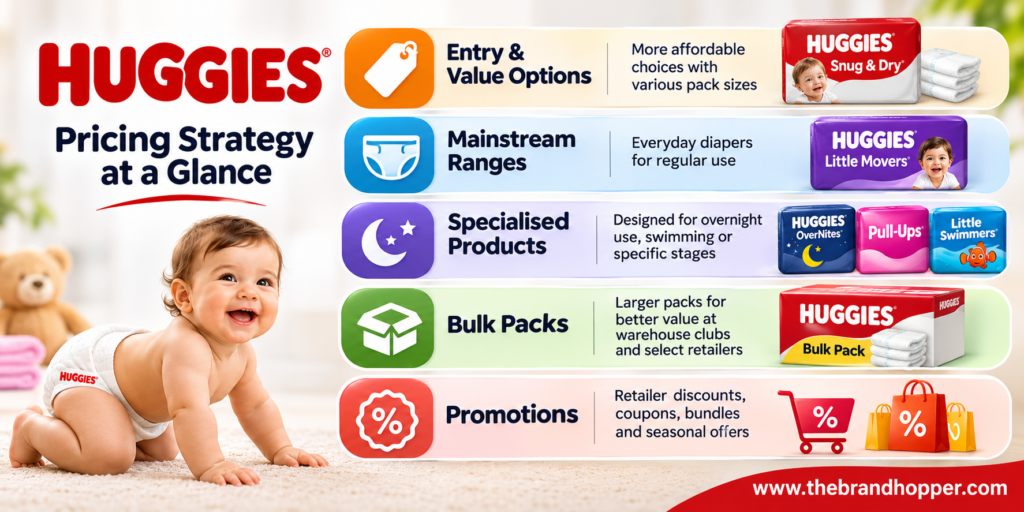
This tiered structure allows Huggies to serve households with different budgets and product preferences while competing with other major diaper brands.
3. Place (Distribution)
Huggies distributes its products through a combination of physical retail and e-commerce channels. The exact retail partners and product availability differ across countries.
- Mass retail: Walmart, Target and other supermarket and mass-merchandise chains in markets where Huggies is sold.
- Pharmacies and drugstores: Pharmacy chains and local drug retailers.
- Warehouse clubs: Bulk packs through warehouse retailers, depending on the market.
- Specialist baby retailers: Baby-product stores and specialist online retailers.
- E-commerce: Amazon and major local online retailers.
- India: Modern retail, traditional stores and e-commerce platforms.
- China: Local retail and major e-commerce platforms, subject to product availability.
- Sampling: Market-specific newborn sampling and product-introduction programmes.
4. Promotion
Huggies combines emotional storytelling, product demonstrations, digital campaigns, sampling and retail promotions to communicate its brand proposition.
| Channel | Campaign / Activity | Objective |
|---|---|---|
| Emotional brand campaigns | “No Baby Unhugged” | Build emotional connection and communicate the benefits of touch |
| Brand platform | “Hugs Change Everything” | Reinforce the brand’s hug-based positioning |
| Digital experience | “Sound of a Hug” (Canada, 2024) | Use a personalised digital experience to engage parents |
| Television and digital advertising | “We Got You, Baby” (India) | Promote Huggies products and build awareness |
| Social media | #HuggiesFlipAndDipChallenge | Encourage participation and product engagement |
| Inclusive packaging | Fathers featured in Special Delivery marketing | Reflect a wider range of caregivers |
| Product sampling | Huggies Hug Box in Canada | Encourage product trial among eligible new and expectant parents |
| Sustainability communication | Huggies–TerraCycle packaging programme in the US | Promote recycling of eligible plastic packaging |
| Retail promotions | Retailer discounts and special offers | Encourage trial and repeat purchase |
| Parenting content | Diapering and baby-care resources | Provide useful information and build brand familiarity |
Frequently Asked Questions
1. What is Huggies’ core marketing strategy?
Huggies combines product-performance communication with emotional brand positioning. Its marketing focuses on benefits such as comfort, fit and leak protection, while campaigns such as “No Baby Unhugged” and “Hugs Change Everything” connect the brand with the emotional experience of caring for a baby.
2. What is the “No Baby Unhugged” campaign?
“No Baby Unhugged” is a Huggies campaign launched in Canada in 2015. It promoted the benefits of skin-to-skin contact and supported hospital-based volunteer hugging programmes for newborns who could not always be held by their parents. A published campaign case study reported a 19.2% increase in Huggies newborn diaper dollar sales during the campaign measurement period.
3. What is Huggies’ “Sound of a Hug” campaign?
“Sound of a Hug” was a Huggies Canada digital campaign launched in November 2024 with creative agency Zulu Alpha Kilo. It allowed parents to create personalised baby sleep tracks inspired by a parent’s heartbeat through a website and an Amazon Alexa experience.
4. How does Huggies approach sustainability?
Huggies’ sustainability-related initiatives include work on product materials and packaging, as well as a US partnership with TerraCycle to recycle eligible plastic packaging from diapers and wipes. The TerraCycle programme covers packaging, not used disposable diapers themselves.
5. What is Huggies’ pricing strategy?
Huggies follows a tiered pricing approach through different product ranges, pack sizes and specialised products. Actual prices vary by market, retailer, diaper size, pack quantity and promotions, so price comparisons should be made using current local retail listings.
6. How is Huggies performing in the market?
Kimberly-Clark reported FY2025 net sales of $16.447 billion. North America contributed $10.753 billion in net sales, while International Personal Care contributed $5.694 billion. These figures cover Kimberly-Clark business segments and should not be interpreted as Huggies brand revenue. The company completed its acquisition of Kenvue on November 2, 2026.
7. How does Huggies market to diverse audiences?
Huggies has used inclusive representation in its marketing, including featuring fathers in its Special Delivery packaging and advertising. In India, its partnership with Sonam Kapoor Ahuja for the “We Got You, Baby” campaign is an example of adapting celebrity partnerships and product communication to a local market.
8. How does Huggies use digital marketing and e-commerce?
Huggies uses digital advertising, social media, online parenting resources and interactive campaigns to engage parents. Its “Sound of a Hug” experience is an example of using digital technology to extend a brand idea beyond conventional advertising. E-commerce retailers also make Huggies products available for online purchase and, where offered by retailers, recurring delivery.
Conclusion
Huggies has built its brand by combining functional product benefits with emotional communication. Its marketing recognises that parents evaluate diapers not only on price and absorbency but also on comfort, fit, reliability and the reassurance that comes with choosing a trusted baby-care brand.
Campaigns such as “No Baby Unhugged” and “Sound of a Hug” show how Huggies has used the idea of a hug to create distinctive brand experiences. Product innovation, inclusive representation, localised campaigns and broad retail availability further support its position in the competitive baby-care category.
Kimberly-Clark’s acquisition of Kenvue, completed in November 2026, places Huggies within a larger consumer health and wellness portfolio that includes brands such as Johnson’s Baby, Neutrogena and Tylenol. While the long-term implications for Huggies’ strategy will depend on how the combined company manages its brands and operations, Huggies’ established positioning around baby care, product performance and parental trust remains central to its marketing.
Also Read: Top 18 Unilever Competitors: Full FMCG Rival Analysis
To read more content like this, subscribe to our newsletter