Last Updated on September 10, 2026 by Team TBH
In the vast landscape of the music industry, Spotify has emerged as the defining force of an era — revolutionizing how billions of people listen to, discover, and interact with audio. Founded in 2006 by Daniel Ek and Martin Lorentzon in Stockholm, Sweden, Spotify began as a bold answer to rampant music piracy and a fragmented listening experience. Nearly two decades later, it has grown into the world’s largest audio streaming platform, serving 751 million monthly active users across 185+ markets, with 290 million paying premium subscribers.
What makes Spotify’s story remarkable is not just its scale — it’s the relentless product innovation, the data-driven personalization, the creator-first ecosystem, and the cultural moments it manufactures year after year. Spotify Wrapped alone has become one of the internet’s most anticipated annual events. The company paid more than $11 billion to the music industry in a single year — the largest annual payout to music creators from any retailer in history.
This is the story of how Spotify disrupted an industry, survived countless challenges, outmaneuvered tech giants, and built something far bigger than a music app: a global audio technology platform that defines how the world listens.

The Birth of a Vision
The journey of Spotify began with a problem that was obvious to everyone but solved by almost no one. In the early 2000s, the music industry was being decimated by piracy. Sites like Napster, LimeWire, and The Pirate Bay made it effortless to download music for free, and no sustainable legal alternative had emerged that offered the same convenience. Music sales were collapsing. Labels were suing individual consumers. The industry was in crisis.
Daniel Ek, a Swedish tech entrepreneur who had already built and sold a web hosting company by his early twenties, saw an opportunity. Rather than viewing piracy as an enemy to fight, he viewed it as a signal about what consumers actually wanted: instant, unlimited access to music, from any device, with no friction. His insight was deceptively simple: if you could build a legal service that was more convenient than piracy, people would pay for it.
Together with Martin Lorentzon — co-founder of the digital marketing firm Tradedoubler — Ek founded Spotify in Stockholm in 2006. The pair spent two years negotiating licensing deals with major record labels before launching publicly in 2008 with an invitation-only beta in Europe. The core proposition was elegant: a free, ad-supported tier that streamed music instantly (no downloading), and a premium paid tier that removed ads and enabled offline listening. The model was designed to convert free users into paying customers over time — the freemium model that would define the streaming industry.
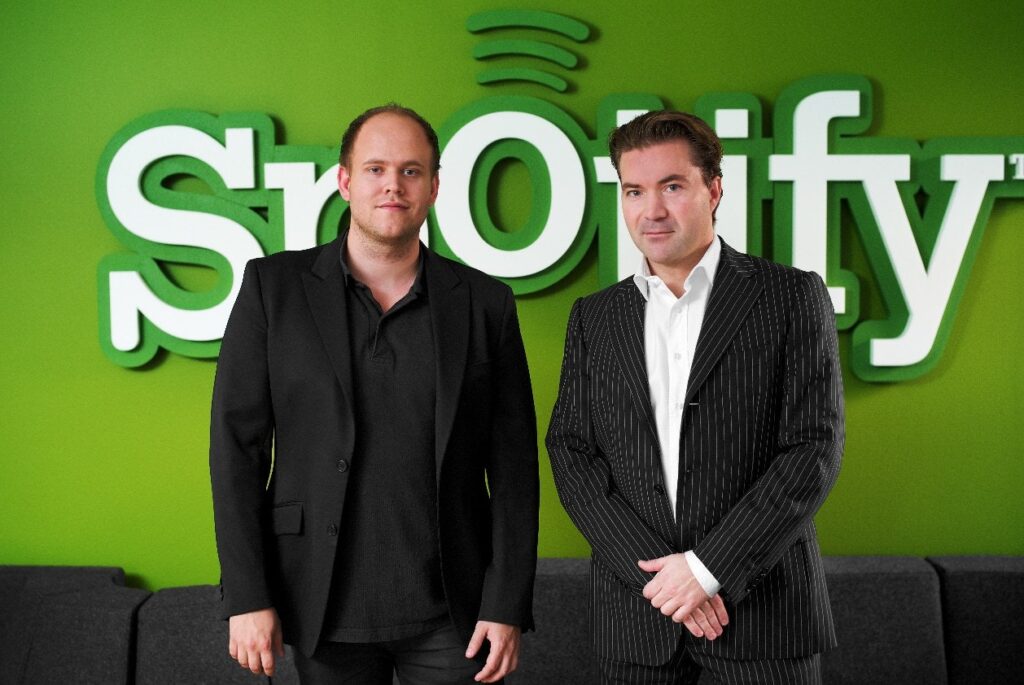
Spotify launched officially to European markets in 2008 and expanded to the United States in 2011 — a pivotal moment that gave it access to the world’s largest music market. By 2012, it had 15 million users and 4 million subscribers. The model was working. The growth was accelerating. And the music industry, once deeply skeptical of streaming, was beginning to see its royalty revenues recover for the first time in years.
Spotify’s Growth Timeline

Disrupting the Traditional Music Industry
Spotify’s success can be attributed fundamentally to its disruptive impact on the traditional music industry. In 2008, the industry was locked in a paradigm built on album sales, digital download purchases (iTunes’ pay-per-song model), and radio. None of these offered the instant, unlimited, personalized access that consumers were clearly willing to obtain illegally. Spotify did. And it did so legally, with industry licenses in place.
The shift Spotify catalyzed was profound. Physical album sales — already declining — continued their collapse, but digital streaming revenues grew exponentially to replace them. By 2019, streaming accounted for more than 50% of global recorded music revenues. By 2023, that figure had grown to over 67%. The Recording Industry Association of America (RIAA) data shows that US recorded music revenues have nearly tripled since their post-piracy nadir around 2014, driven almost entirely by streaming. Spotify is the largest single driver of that recovery.
But Spotify did not just save the music industry financially — it transformed the power dynamics within it. Before streaming, a small number of gatekeepers (radio programmers, record label executives, MTV producers) controlled which artists received exposure. Spotify’s algorithmic playlists and discovery features democratized that exposure, allowing independent artists to reach global audiences without major label backing. Today, independent artists and labels account for half of all royalties paid by Spotify — a structural change in the industry’s economics that would have been unimaginable in 2000.
The Rise of Rivals — Spotify’s Competitive Landscape
Spotify’s dominance has never gone unchallenged. The platform’s early success attracted competition from some of the most powerful technology companies in the world. Yet Spotify has maintained its position as the global leader through relentless product innovation and a first-mover advantage in markets that matter.
1. Apple Music
Apple Music launched in June 2015 as Spotify’s most immediate threat. Apple leveraged its existing iTunes user base, deep device integration with the iPhone, and exclusive deals with artists like Drake, Frank Ocean, and Taylor Swift (who initially pulled her catalog from Spotify in a royalty dispute). Apple Music has grown steadily but remains significantly smaller than Spotify — with approximately 88 million subscribers compared to Spotify’s 290 million — largely because it lacks a free tier, limiting its user funnel.
2. Amazon Music
Amazon Music (available in Prime and Unlimited tiers) benefits from bundling with Amazon Prime — one of the world’s most popular subscription products. Amazon Music Unlimited competes directly with Spotify Premium but has struggled to build the same level of product differentiation and cultural relevance. Amazon’s smart speakers (Echo/Alexa) provide strong hardware integration, but Spotify remains available on Alexa devices, neutralizing some of that advantage.
3. YouTube Music
YouTube Music — backed by the world’s most popular video platform — offers one of the largest music video catalogs alongside audio streaming. YouTube’s ad-supported tier is already familiar to hundreds of millions of users, making the transition to YouTube Music Premium a natural step. However, Spotify’s superior personalization algorithms and podcast/audiobook integration have kept it ahead in subscriber terms.
4. Deezer, Tidal, and Others
Niche competitors like Deezer (strong in France and Latin America), Tidal (known for hi-fi audio quality and artist ownership model), and SoundCloud (popular with unsigned artists and DJs) occupy specific audience segments. SoundCloud notably launched its SoundCloud Go paid tier in 2016 to compete more directly with Spotify, but its catalog — limited to half the major label content available on Spotify — has constrained its subscriber growth.
You can read it here: Top Competitors of Spotify: The Complete Streaming Rivalry Guide
User-Centric Experience — The Spotify Product Philosophy
A key factor in Spotify’s enduring dominance lies in its obsessive focus on user experience. From day one, the team focused on making music playback feel instantaneous — a deliberate engineering decision to make streaming feel as responsive as a local music library. This technical achievement, combined with an intuitive interface, made Spotify immediately more appealing than the clunky, slow streaming services that preceded it.
Spotify’s product philosophy can be summarized in one line: ‘make discovery effortless.’ The platform’s core proposition — that you should never have to decide what to listen to, because Spotify will know what you want — has driven every major feature investment. Discover Weekly (launched 2015) delivers a personalized 30-track playlist to each user every Monday, generated entirely by machine learning. Release Radar gives users a weekly update on new releases from artists they follow. Daylist — launched in 2023 — generates a unique playlist for each user that changes throughout the day based on listening patterns by time of day and day of week.
In 2025, Spotify introduced Prompted Playlists — a feature that lets Premium users describe in their own words exactly what kind of playlist they want to hear, using natural language. This brings AI-driven personalization to a new level of intimacy, essentially giving every user a personalized DJ who responds to natural conversation.
Extensive Music Library and Artist-Friendly Approach
Spotify’s music library contains over 100 million tracks from artists across every genre, language, and region of the world. Its catalog includes not just mainstream Western pop and rock but deep catalogs of Afrobeats, K-pop, Latin urbano, Bollywood, classical, jazz, and thousands of other genres — giving it genuine global relevance that competitors struggle to match.

The artist relationship has evolved significantly since Spotify’s early years, when royalty disputes with artists like Taylor Swift generated negative headlines. Today, Spotify has invested heavily in creator tools and payment transparency. Spotify for Artists gives musicians real-time analytics on streams, listener demographics, playlist placements, and concert discovery. The platform’s Loud & Clear initiative publishes annual royalty transparency reports, detailing exactly how streaming economics work — an unprecedented level of openness in the music industry.
In 2025, Spotify paid more than $11 billion to the music industry — the largest annual payment to music creators from any single retailer in history. Independent artists and labels accounted for half of all royalties distributed, reflecting the platform’s outsized importance in enabling artist careers outside the traditional major label system. Spotify also helped artists generate more than $1 billion in ticket sales by connecting fans with live shows through ticketing partnerships embedded directly in the app.
Freemium Model and Subscription Tiers
Spotify’s freemium model — combining a free ad-supported tier with paid subscription options — has been one of the most successful monetization strategies in consumer technology history. The model solves a fundamental challenge of subscription businesses: user acquisition cost. Instead of spending money to acquire subscribers, Spotify acquires millions of free users who naturally convert to paying customers over time as they experience the product and hit the limitations of the free tier.
1. Free (Ad-Supported) Tier
The free tier provides access to Spotify’s full music catalog with advertising interruptions, limited skips on mobile, and no offline playback. Advertising revenue from the free tier generated €1.84 billion in FY2025. The free tier functions as Spotify’s most powerful marketing tool — it places the product in users’ hands before asking for money, allowing the experience to sell itself. Approximately 36% of Spotify’s 751 million MAUs are premium subscribers — the remaining 64% on the free tier represent a massive conversion pipeline.
2. Premium Individual
The most popular subscription tier, offering ad-free listening, unlimited skips, offline downloads to listen without internet, higher audio quality (up to 320kbps OGG Vorbis), and access to new features like Prompted Playlists and AI DJ. Pricing varies by market — starting at £11.99/month in the UK and $11.99/month in the US, with Spotify having implemented several price increases in 2023-2024 across major markets to improve ARPU (average revenue per user).
3. Premium Duo and Family Plans
Spotify Duo allows two people in the same household to access individual Premium accounts at a discounted combined price. The Family Plan covers up to 6 accounts for household members, with a parental controls feature (Spotify Kids) for younger listeners. These plans have been significant drivers of subscriber growth, as they effectively lower the per-person cost while increasing Spotify’s household penetration.
4. Premium Student
A discounted rate for verified students, typically around half the individual plan price. The student tier serves as a crucial acquisition channel — converting young listeners into lifetime Spotify users who are likely to upgrade to full-price plans upon graduation.
5. Audiobooks in Premium
Launched in 2022 and expanded globally through 2025, audiobooks are now bundled into Premium subscriptions — giving subscribers access to hundreds of thousands of audiobook titles alongside music and podcasts at no additional cost. In 2025, Spotify expanded Audiobooks in Premium to Sweden, Denmark, Finland, Iceland, and Monaco, among other markets. Audiobooks represent Spotify’s most significant new content category since podcasting and are a key driver of engagement and ARPU expansion.
The Intelligent Marketing — Spotify Wrapped!
No discussion of Spotify’s success story is complete without a deep examination of Spotify Wrapped — arguably the most effective annual marketing campaign in the history of consumer technology.
Wrapped started in 2015 as ‘Your Year in Music’ — a simple year-end summary of each user’s top artists and songs. It didn’t immediately go viral. But in 2017, Spotify redesigned it as a visually stunning, shareable slideshow of personalized listening statistics, and everything changed. The feature began to generate extraordinary organic social sharing as users raced to compare their top artists, most-listened songs, and total listening hours with friends.

Every year since, Spotify has expanded Wrapped’s scope and sophistication. The Audio Aura feature in 2021 showed users their top two moods based on listening behavior. In 2022, Spotify added the Listening Personality — a Myers-Briggs-style personality type based on listening patterns. In 2023, an AI DJ voice-narrated the Wrapped summary. Each year, the campaign becomes more personalized, more visual, and more shareable.
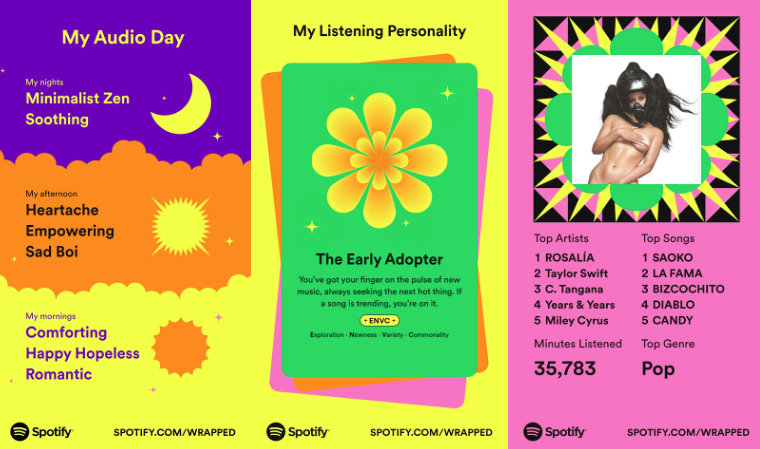
Spotify Wrapped 2025 — the 11th annual edition — was the biggest in the platform’s history. It engaged more than 300 million users and generated 630 million shares across social media globally, delivered in 56 languages. It was accompanied by the largest-ever artist participation, with personalized video messages from thousands of musicians to their top fans.
Why is Wrapped such a powerful strategy? According to Uxdesign.cc, Wrapped works because it inverts the traditional advertising model: instead of Spotify talking about itself, Wrapped makes the user the protagonist of their own story. Hyper-personalization at scale means that every one of 300 million users received a unique story — and many of them shared that story publicly, creating earned media worth hundreds of millions of dollars in free advertising.
Wrapped also serves a structural business function: it arrives in early December, generating a massive spike in app downloads at the beginning of the holiday gifting season — when Spotify gift cards and family plan upgrades are at their peak. According to marketing analytics firm MoEngage, Spotify saw a 21% increase in app downloads in the first week of December 2020. In 2017, only 30 million users accessed Wrapped; that figure grew to over 120 million shares across social platforms by 2022, and exceeded 630 million shares in 2025. Spotify has accomplished the rarest of things: it has manufactured a genuine cultural moment that recurs every year like clockwork.
Beyond Music — Podcasts, Audiobooks, and the Audio Platform Vision
One of Spotify’s most significant strategic bets since 2019 has been its expansion beyond music into all forms of audio — positioning itself not as a ‘music streaming app’ but as the world’s leading audio platform. This pivot, executed through acquisitions, original content investment, and creator tools, has fundamentally altered Spotify’s business model and competitive moat.
1. The Podcast Revolution
Spotify’s entry into podcasting began in earnest in 2019 with the acquisitions of Gimlet Media (producer of hit shows like Reply All and Homecoming) and Anchor (a free podcast creation and distribution tool). Further high-profile acquisitions followed: The Ringer (sports and culture podcasting), Parcast (true crime and mystery), and exclusive licensing deals with Joe Rogan, Alex Cooper (Call Her Daddy), Barack and Michelle Obama’s Higher Ground Productions, and others.
The strategy was expensive — Spotify spent hundreds of millions on exclusivity deals — and not all of them paid off. The Joe Rogan exclusivity ended in 2022-2023 as Spotify allowed Rogan’s content to be distributed more widely again, acknowledging that exclusivity alone was not the key metric. The company also restructured its podcast business in 2023-2024, laying off podcast staff and closing some original content studios, pivoting from producing content to creating the best infrastructure for podcasters to reach audiences.
Despite the restructuring, Spotify’s podcast catalog has grown to over 7 million titles as of 2025 — making it the world’s largest podcast platform. The Spotify Partner Program, launched to enable podcasters to monetize through ads and subscriptions, expanded to the Nordics in 2025, offering creators new revenue streams.
2. Audiobooks — The Next Frontier
Audiobooks represent Spotify’s most ambitious content expansion since podcasting. In 2022, Spotify acquired Findaway — a global audiobook distributor — and began integrating hundreds of thousands of audiobook titles into the Premium subscription. By 2025, Audiobooks in Premium had expanded to dozens of markets, with Spotify competing directly with Audible (Amazon’s dominant audiobook platform) for the attention of millions of avid readers.
Spotify’s innovations in the audiobook space go beyond catalog access. Audiobook Recaps (launched in beta in 2025) allow listeners to jump back into books they’ve paused with a short, personalized audio summary of what they’ve heard so far. Page Match — launched in early 2026 — allows users to scan a page of a physical book and instantly continue the story at exactly that point in the audiobook on Spotify. A partnership with Bookshop.org enables Premium users in the US and UK to purchase physical books directly through the Spotify app, creating a bridge between digital and physical book formats.
3. Music Videos and Live Events
In 2025, Spotify expanded its music video offering in beta to Premium users in the US and Canada, allowing fans to watch official music videos, live performances, and covers alongside audio content. This moves Spotify into YouTube’s territory for the first time and represents a potential significant new engagement and revenue category. Spotify has also pushed deeper into live events, hosting the Billions Club Live concert with Ed Sheeran (available exclusively on Spotify), and enabling users to follow favorite live music venues and explore upcoming lineups directly in the app.
Spotify’s AI Strategy — The Technology Driving the Next Era
Artificial intelligence is not new to Spotify — recommendation algorithms have been at the heart of the product since 2012. But the emergence of generative AI has opened a new chapter in what Spotify can do with audio, data, and creator tools.
1. AI DJ

Launched in 2023, Spotify’s AI DJ is a personalized AI voice guide that curates music and commentary specifically for each user. Drawing on Spotify’s decade-long dataset of user listening behavior, the AI DJ builds a real-time personalized radio experience — selecting tracks, explaining why it chose them, surfacing nostalgic favorites and unfamiliar discoveries, and adapting based on user reactions. It was initially available in the US and Canada and has since expanded globally.
2. Prompted Playlists
Introduced in 2025, Prompted Playlists allows Premium users to describe in natural language the playlist they want — ‘upbeat songs for an early morning run’, ‘melancholy indie folk for a rainy Sunday’, ’90s hip-hop that feels cinematic’ — and Spotify’s AI generates it instantly. This represents a fundamental shift from browse-and-discover to converse-and-receive, putting the power of the algorithm directly in the user’s hands.
3. About the Song
Launched in beta in early 2026, ‘About the Song’ is a new feature that provides listeners with rich contextual information about tracks they’re playing — the story behind the song, the recording context, the influences the artist was drawing on, and notes from the artist or producer. It transforms passive listening into an informed, enriching experience.
4. AI and the Creator Economy
Gustav Söderström, Spotify’s Co-CEO, has described the company as ‘the R&D department for the music industry’, with a mandate to embrace technological change faster than any other player. Spotify is actively exploring how AI can help creators produce, distribute, and monetize audio content more effectively — from AI-assisted podcast production tools to AI translation of podcasts into multiple languages, dramatically expanding the reach of creators across language barriers.
Continuous Innovation and Adaptation
Spotify’s product history is defined by a culture of rapid experimentation and willingness to kill features that don’t work while doubling down on those that resonate. This culture of iteration has produced some of the most copied features in consumer technology.
Discover Weekly — a weekly personalized playlist generated by collaborative filtering and NLP analysis of playlists across the platform — launched in 2015 and immediately became Spotify’s most beloved feature. It was so popular that competitors including Apple Music and YouTube Music built near-identical features within months. Collaborative Playlists allowed users to build shared playlists with friends, driving social engagement. Blend — launched in 2021 — creates a single playlist combining the tastes of two users, making music sharing a social act. Daylist — launched in 2023 — updates throughout the day with playlists tuned to the user’s specific time-of-day listening patterns, recognizing that people listen to different music at 7am versus 11pm.
Spotify has also invested in smart device integration — its Connect feature allows seamless switching between playback on phones, tablets, smart speakers, TVs, and car systems from within the app. The platform is available on every major smart speaker and streaming device, ensuring that Spotify becomes the default listening experience regardless of what hardware the user owns.
Strategic Partnerships and Global Expansion
Spotify’s global expansion has been enabled by an extensive network of strategic partnerships with telecommunications companies, device manufacturers, automotive brands, and cultural institutions. Bundling deals with telecoms (offering Spotify Premium as part of mobile data packages) have driven subscriber growth in markets where direct credit card payments are challenging, including Southeast Asia, Latin America, and Africa.
Device partnerships with Samsung, Sony, and automotive brands including Volkswagen, BMW, and Ford have made Spotify the default music experience for hundreds of millions of device owners. The integration of Spotify into Tesla’s infotainment system — available directly from the car’s touchscreen without a phone — made Spotify accessible to one of the world’s most technologically engaged consumer groups.
Spotify’s partnership with FC Barcelona — extended through 2030 in 2025 — is one of its most high-profile brand collaborations, putting the Spotify logo on one of the world’s most watched football kits and aligning the brand with global youth culture. The partnership gives Spotify unique access to FC Barcelona’s 400+ million global fan base and enables unique content experiences for music and football fans.
Geographically, Spotify has expanded far beyond its European origins. It launched in India in 2019 — the world’s fastest-growing music market — and has built significant presence across Southeast Asia, Latin America, and Sub-Saharan Africa. Its global footprint of 185+ markets gives it a structural advantage over rivals like Tidal, which operates in a fraction of those markets.
Data-Driven Insights and Personalization
Data is Spotify’s most powerful competitive moat — and the engine that drives virtually every feature the platform offers. Spotify has accumulated more than 17 years of data on how billions of people listen to music: what they play, when they play it, how long they listen before skipping, what they listen to after a particular track, what moods and activities they associate with different types of music, and how their tastes evolve over time.
This behavioral dataset is incomprehensibly large and deeply personal. Spotify’s machine learning algorithms — built and refined by a team of thousands of data scientists and engineers — use this data to power Discover Weekly, Release Radar, AI DJ, Daily Mixes, Mood Playlists, and dozens of other automated personalization features. The platform processes millions of signals per second to ensure that every playlist, recommendation, and autoplay experience is precisely tuned to each individual user.
Spotify also monetizes its data through its advertising platform, Spotify Advertising. Advertisers can target listeners based on listening habits, mood signals, time of day, activity (commuting, working out, cooking), device type, and demographic data — creating a highly targeted advertising medium that competes with social media in precision. The ad-supported tier generated €1.84 billion in revenue in FY2025, with significant room to grow as Spotify improves its ad tech infrastructure.
Beyond its own users, Spotify shares data insights with the broader music industry through initiatives like Spotify for Artists and the Loud & Clear transparency report. Artists can see in real time where their listeners are located, what other artists they listen to, which playlists are driving their streams, and which age groups and genders make up their fanbase — information that was previously inaccessible without expensive market research.
Spotify’s Business Model and Revenue Streams
Spotify operates a dual-revenue business model combining subscription fees from Premium users and advertising revenue from Free tier users. This model gives the company both recurring subscription revenue (highly predictable and scalable) and ad revenue (tied to broader advertiser demand cycles).

1. Premium Subscriptions
Premium subscriptions are Spotify’s primary revenue driver, accounting for 89.3% of total FY2025 revenue at over €15 billion. Revenue from subscriptions grows through three levers: subscriber volume growth (adding new paying users), ARPU (average revenue per user) expansion through price increases and premium tier upsells, and geographic mix improvement (more subscribers from higher-ARPU markets like the US, UK, and Western Europe). Spotify implemented price increases across major markets in 2023-2024, contributing to significant ARPU improvement.
2. Advertising Revenue
The free tier generates revenue through audio ads (played between songs), video ads, display and overlay ads in the app, and sponsored playlists. Spotify’s advertising business generated €1.84 billion in FY2025. The company has been investing heavily in its programmatic advertising technology, the Spotify Audience Network (SPAN), which extends Spotify’s audio ad inventory beyond the Spotify platform to third-party podcast networks — creating a significant ad revenue opportunity in the fast-growing podcast advertising market.
3. Marketplace Revenue
A newer and growing revenue stream, Spotify’s Marketplace allows music labels and distributors to pay for promotional services — such as having an artist featured on editorial playlists or Discovery Mode (a feature where artists trade a lower royalty rate in exchange for algorithmic promotion). This creates a third-party revenue stream that sits between subscriptions and advertising, and has attracted both excitement (as a new revenue source) and controversy (as critics argue it disadvantages independent artists).
From Losses to Profitability — Spotify’s Financial Transformation
Spotify’s path to profitability was famously long and painful. The company went public in 2018 at a direct listing valuation of approximately $26 billion — despite having never turned an annual profit. Critics questioned whether the business model could ever generate sustainable earnings, given the fixed royalty costs that consume the majority of every dollar of streaming revenue.
The breakthrough came in 2024, when Spotify posted its first full year of meaningful operating profitability, driven by a combination of subscriber base growth, price increases across major markets, gross margin expansion (by improving podcast economics and adding higher-margin audiobook revenue), and a significant cost restructuring that included a 17% workforce reduction in December 2023. In FY2025, Spotify’s full-year operating income reached approximately €2.2 billion ($2.5 billion) — a remarkable transformation from a company that had posted operating losses every year of its public existence through 2022.
Q4 2025 gross margin reached 33.1%, up 83 basis points year-over-year — continuing a multi-year trend of margin improvement. The company has demonstrated that music streaming can be a genuinely profitable business at sufficient scale, provided the operator can expand beyond music into higher-margin content categories (podcasts, audiobooks) and extract advertising revenue from the free user base.
The Future of Spotify
Spotify enters its next chapter in a position of extraordinary strength — but also in a moment of genuine technological disruption. With 751 million monthly active users and 290 million paying subscribers, the platform is the undisputed leader in audio streaming. Yet the landscape is shifting rapidly, and Spotify’s management has consistently signalled that it sees the platform’s addressable opportunity as far larger than music streaming.
Daniel Ek, speaking as Founder and Executive Chairman, articulated this vision clearly in the Q4 2025 earnings release: “Today, what we’ve really built is a technology platform for audio — and increasingly, for all the ways creators connect with audiences. The next wave of technology shifts — AI, new interfaces, wearables, new ways of interacting with content — these will reshape how people discover and experience audio and media.”
The company has framed 2026 as the “Year of Raising Ambition” — a deliberate escalation of strategic goals following the “Year of Accelerated Execution” in 2025. Key growth vectors include: audiobook expansion (competing directly with Audible for the massive book-listening market); music video integration (competing with YouTube for music video audiences); live music discovery and ticketing (a multi-billion dollar adjacent market); AI-powered creator tools; further global expansion in high-growth markets; and wearable device integration for seamless audio experiences outside the smartphone paradigm.
Spotify’s competitive advantage in any of these areas rests on the same asset that has powered its growth from the beginning: an unparalleled dataset of human listening behavior, compounding in richness and precision with every stream, every skip, every save, and every share. That data advantage — combined with a product culture built around removing friction from the listening experience — is what has enabled Spotify to survive competition from Apple, Amazon, and Google, each with resources many times its own. It is likely to be the same advantage that powers its next decade of growth.
Frequently Asked Questions (FAQs)
Q: Who founded Spotify and when?
A: Spotify was founded by Daniel Ek and Martin Lorentzon in Stockholm, Sweden in 2006. The platform was developed in response to the music piracy crisis of the early 2000s. It launched in a private beta in 2008 and expanded to the United States in 2011. Daniel Ek currently serves as Founder and Executive Chairman, while Alex Norström and Gustav Söderström serve as Co-CEOs.
Q: How many users does Spotify have?
A: As of Q4 FY2025, Spotify has 751 million monthly active users (MAUs) — an 11% year-over-year increase and the highest quarterly MAU net additions in Spotify’s history. Of those, 290 million are paying Premium subscribers (+10% YoY). Spotify operates in 185+ countries and markets globally.
Q: How much revenue does Spotify make?
A: Spotify generated total revenue of approximately €17,185 million (~$19.4 billion) in FY2025, representing approximately 15% growth year-over-year. Premium subscriptions accounted for over €15 billion (89.3% of revenue), while ad-supported revenue was €1.84 billion. Full-year operating income reached approximately €2.2 billion ($2.5 billion) — marking Spotify’s era of sustained profitability.
Q: Is Spotify profitable?
A: Yes. Spotify achieved sustained profitability in 2024 for the first time in its history as a public company. In FY2025, full-year operating income reached approximately €2.2 billion ($2.5 billion). Q4 2025 gross margin was 33.1%. The path to profitability was driven by subscriber growth, multiple rounds of price increases, gross margin expansion from higher-margin podcast and audiobook revenue, and a significant cost restructuring in 2023.
Q: How does Spotify make money?
A: Spotify’s revenue comes from three main streams: (1) Premium subscriptions — monthly fees from 290 million+ paying subscribers; (2) Advertising — audio, video, and display ads shown to free-tier users (€1.84B in FY2025); and (3) Marketplace services — promotional tools for labels and distributors including Discovery Mode and editorial playlist pitching. Premium subscriptions account for ~89% of total revenue.
Q: What is Spotify Wrapped and why is it so effective?
A: Spotify Wrapped is an annual year-end campaign that gives each user a personalized breakdown of their top artists, songs, genres, and listening statistics for the year, packaged in a visually engaging, shareable slideshow format. In 2025, Wrapped engaged 300 million+ users and generated 630 million social media shares globally in 56 languages — the biggest in Spotify’s history. Its power lies in making each user the protagonist of their own story, driving massive organic social sharing that generates enormous earned media value. It also drives app download spikes every December.
Q: What podcasts and audiobooks does Spotify have?
A: Spotify hosts over 7 million podcast titles, making it the world’s largest podcast platform. Its podcast portfolio includes both original and exclusive content (from partnerships with creators like the Obamas’ Higher Ground, sports publisher The Ringer, and others) as well as the entire open podcast ecosystem. For audiobooks, Spotify offers hundreds of thousands of titles bundled into Premium subscriptions, with innovations including Audiobook Recaps and Page Match (a feature that bridges physical book page numbers with audiobook timestamps).
Q: How does Spotify use AI?
A: AI is deeply embedded throughout Spotify’s product. Key AI features include: Discover Weekly and Release Radar (machine learning playlist generation based on listening behavior); AI DJ (a personalized AI voice guide that selects and narrates music in real time); Prompted Playlists (users describe what they want in natural language, AI generates it); Daylist (changes throughout the day based on time-of-day listening patterns); and About the Song (contextual information about tracks, launching in 2026). Spotify also uses AI for ad targeting, podcast recommendations, and creator analytics tools.
Q: Who are Spotify’s main competitors?
A: Spotify’s main competitors in music streaming are Apple Music (~88M subscribers), Amazon Music Unlimited, YouTube Music (backed by Google), Tidal, Deezer, and SoundCloud. In podcasting, it competes with Apple Podcasts, iHeartRadio, and Amazon Music (Wondery). In audiobooks, its primary competitor is Amazon’s Audible. Despite deep-pocketed rivals from Apple, Amazon, and Google, Spotify has maintained its global leadership position through superior personalization, a comprehensive free tier, and a broader audio platform (music + podcasts + audiobooks) than any competitor.
Q: How much does Spotify pay artists?
A: In 2025, Spotify paid more than $11 billion to the music industry — the largest annual payment to music creators from any single retailer in history. Independent artists and labels accounted for half of all royalties distributed. Spotify also helped artists generate more than $1 billion in concert ticket sales through its ticketing integration partnerships. Spotify’s per-stream royalty rates vary, but the company publishes detailed annual royalty data through its Loud & Clear initiative for transparency.
Conclusion
The Spotify success story is, at its core, a story about understanding what people actually want and building technology relentless enough to deliver it. Daniel Ek and Martin Lorentzon did not invent music streaming — but they built the product, negotiated the licenses, and grew the ecosystem that made streaming the default way the world listens to music. That achievement alone would have been remarkable. But Spotify has not stopped at music.
With 751 million monthly active users, $11 billion paid to the music industry, 7 million+ podcasts, hundreds of thousands of audiobooks, and an AI platform that gets smarter with every stream, Spotify has become something the founders probably never imagined possible: the operating system for the world’s listening life. And if the next chapter of AI-driven audio, wearable interfaces, and global creator economies plays out the way Spotify’s leadership believes it will, the company’s first 17 years may only be the beginning.
Also Read: History, Business Model and Revenue Streams of Spotify
To read more content like this, subscribe to our newsletter