Last Updated on July 27, 2026 by Team TBH
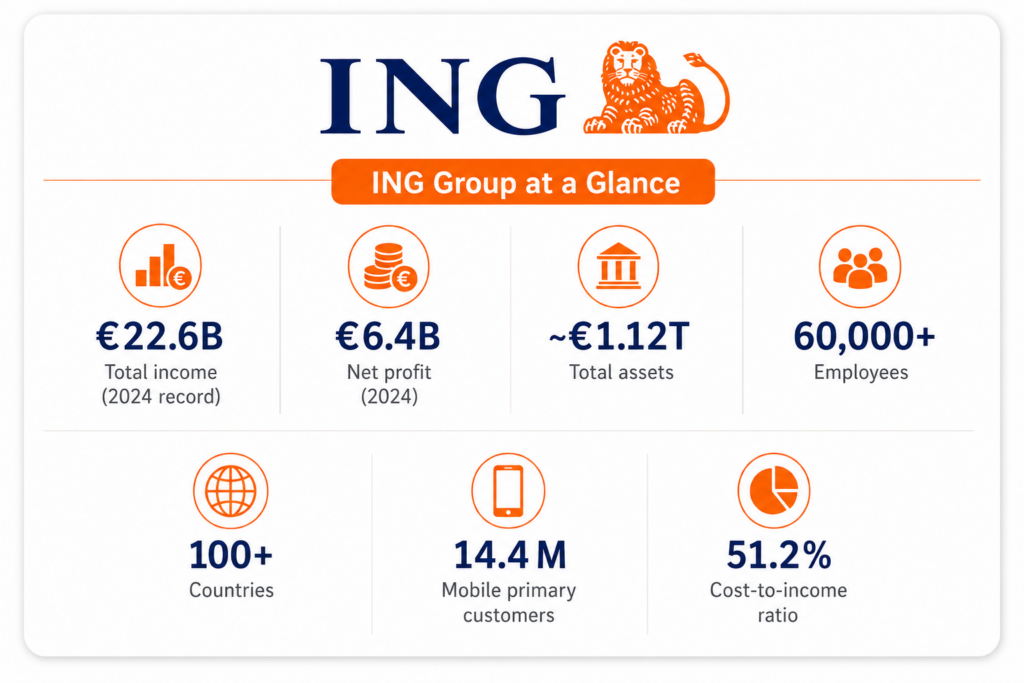
ING Group is one of Europe’s most recognised financial institutions — a Dutch banking and financial services giant with a presence in over 100 countries, more than 60,000 employees, and total income of a record €22.6 billion in 2024. Its net profit for the same year reached €6.4 billion, and it has grown its base of mobile primary customers to 14.4 million — a figure that underscores its successful pivot toward digital banking.
Yet for all its scale and digital sophistication, ING operates in one of the world’s most competitive industries. Global banks with trillion-dollar balance sheets, agile digital challengers, and entrenched domestic rivals all contest the same customers, the same deposits, and the same lending relationships. This article provides a comprehensive analysis of ING’s top competitors — who they are, how they compete, and what makes each a meaningful rival to ING’s continued growth.
Understanding ING Group
ING (Internationale Nederlanden Groep) was founded in 1991 through the merger of Nationale-Nederlanden and Nederlandse Middenstandsbank (NMB). Today it operates as a pure-play bank after divesting its insurance operations following the 2008 financial crisis, during which ING received a Dutch government bailout and subsequently restructured significantly.
ING’s model rests on three pillars: Retail Banking (consumer and SME clients across the Netherlands, Belgium, Germany, and other home markets), Wholesale Banking (serving corporates, financial institutions, and governments globally), and a growing digital platform strategy that has made ING one of Europe’s most downloaded banking apps. In the Netherlands, ING holds approximately 40–45% of current accounts — the undisputed market leader in its home country.
Its assets under management have grown to €278 billion (up 16% year-on-year), and a cost-to-income ratio of 51.2% places it among the most operationally efficient large European banks. These strengths are the baseline against which all competitors must be measured.
ING’s Top Competitors
1. HSBC

| HQ: London, UK | Total Assets (2025): .23 trillion | Revenue (2024): ~0.9B | Operates in: 60+ countries |
HSBC is the largest European bank by total assets and one of ING’s most significant rivals in wholesale banking, trade finance, and transaction banking. With .23 trillion in assets and operations spanning Asia, Europe, the Middle East, and the Americas, HSBC competes with ING across the segments where both banks have the deepest institutional footprints — corporate lending, capital markets, and cash management for multinational clients.
Where ING leads on digital agility and cost efficiency, HSBC leads on sheer geographic reach and balance sheet scale. HSBC’s strength in Asia — particularly Hong Kong, mainland China, and Southeast Asia — gives it access to trade corridors and corporate relationships that ING’s more European-centric wholesale banking cannot match at the same depth. Both banks also compete in sustainable finance — vying for green bond issuance mandates and sustainability-linked loan arranging roles — a market where ING holds a recognised European leadership position.
In retail banking, HSBC has selectively retreated from markets where it lacks scale, while ING has done the opposite, using its digital-first model to grow primary customer relationships across Belgium, Germany, and other European markets. The deepest retail overlap lies in digital savings and expatriate banking, where both brands serve internationally mobile customers.
2. BNP Paribas

| HQ: Paris, France | Total Assets (Q1 2025): ~.95 trillion | Operates in: 65+ countries |
BNP Paribas is Europe’s largest bank by assets and one of ING’s most direct institutional rivals. Like ING, BNP Paribas operates a dual model — retail banking primarily in France, Belgium, Italy, and Luxembourg, alongside a major wholesale and capital markets business. The two banks compete fiercely for Eurozone corporate clients, syndicated loan mandates, and structured finance transactions.
BNP Paribas’ competitive advantages include its larger investment banking platform (BNP Paribas CIB is a top-tier European capital markets franchise) and its broader retail footprint in Southern Europe. ING holds a cost and digital efficiency edge — its standardised pan-European digital banking platform serves customers at a meaningfully lower cost per transaction than BNP’s more fragmented retail network.
The most contested bilateral battleground is Belgium, where BNP Paribas Fortis (BNP’s Belgian subsidiary) is the country’s largest bank and ING Belgium is a strong second. Both compete intensively for Belgian retail customers, mortgage market share, and SME banking relationships — one of the defining bilateral rivalries in European retail banking.
3. Deutsche Bank

| HQ: Frankfurt, Germany | Revenue 2025: €32.1B | Net Profit 2025: €7.1B (record) | Profit Before Tax 2025: €9.7B (record) |
Deutsche Bank is ING’s most significant competitor in Germany — ING’s largest direct banking market outside the Netherlands. ING operates one of Germany’s most popular digital direct banks (formerly ING-DiBa), holding millions of German retail customers and significant mortgage lending volumes. Deutsche Bank competes for the same German retail wealth through its personal banking division and its DWS asset management arm.
Deutsche Bank’s 2025 results represent a remarkable turnaround: profit before tax reached a record €9.7 billion (up 84% year-on-year), revenues grew 7% to €32.1 billion, and net profit doubled to €7.1 billion — following completion of a €2.5 billion operational efficiency programme. A financially stronger Deutsche Bank is a more formidable competitor, particularly in German corporate and investment banking and in leveraged and trade finance across continental Europe.
In wholesale banking — particularly in Germany, Central and Eastern Europe, and structured lending — Deutsche Bank and ING Wholesale Banking regularly compete for the same corporate mandates. Deutsche Bank’s global footprint and product breadth in investment banking exceed ING’s, but ING’s deeper sector expertise in energy, infrastructure, and food & agribusiness creates defensible competitive niches.
4. Barclays
| HQ: London, UK | Total Assets: ~.08 trillion | Key strength: Investment banking, European wholesale, sustainable finance |
Barclays competes with ING primarily in European wholesale banking and sustainable finance. In wholesale banking, Barclays Investment Bank is a significant player in fixed income, debt capital markets, and corporate advisory — arenas where ING’s Wholesale Banking also operates actively. Both banks are competing aggressively for sustainability-linked lending mandates and green bond arranger roles as European corporates accelerate ESG transitions, creating direct rivalry for a fast-growing pool of fee income.
In retail banking, Barclays’ UK focus does not directly overlap with ING’s primary retail geographies in the Netherlands, Belgium, and Germany. However, both compete for UK digital banking customers — where ING’s UK savings product has been a price-competitive challenger to Barclays’ deposit rates. Barclays’ digital banking brand Chase UK also competes indirectly with ING’s digital-first positioning among UK consumers.
5. ABN AMRO

| HQ: Amsterdam, Netherlands | NL Current Account Share: ~20% | Focus: Netherlands, Belgium, Germany retail and SME banking |
ABN AMRO is ING’s most direct domestic competitor, contesting the same Dutch retail customers, mortgage seekers, and SME banking relationships. Together with ING and Rabobank, ABN AMRO forms the ‘big three’ of Dutch banking, collectively controlling approximately 74% of total Dutch banking assets. ING holds ~40–45% of current accounts; Rabobank ~30%; ABN AMRO ~20%.
ABN AMRO differentiates through its private banking franchise — MeesPierson is one of the Netherlands’ oldest and most prestigious private banks — and its clearing services business. It has invested in digital mortgage origination to directly challenge ING’s strength in the Dutch mortgage market, where rates, processing speed, and digital convenience are the primary competitive battlegrounds.
6. Rabobank

| HQ: Utrecht, Netherlands | NL Current Account Share: ~30% | Distinctive model: Cooperative bank; dominant in global food & agricultural lending |
Rabobank is structurally unique among ING’s Dutch competitors: it is a cooperative bank, owned by its local member banks rather than public shareholders. This structure gives Rabobank exceptional customer loyalty among Dutch agricultural and rural communities, and a capital allocation philosophy that prioritises long-term value over quarterly earnings targets. In Dutch customer satisfaction surveys, Rabobank consistently outperforms ING — a loyalty gap that ING’s digital-first model has not yet fully closed.
Rabobank dominates the global food and agribusiness (F&A) lending market — a niche where neither ING nor ABN AMRO can meaningfully compete. Its F&A wholesale banking franchise serves agricultural clients, food processors, and commodity traders worldwide in a category built on decades of specialised sector expertise. In retail and SME banking, Rabobank and ING compete directly for Dutch mortgages, business loans, and savings products — a rivalry intensified by the oligopolistic Dutch banking market structure.
7. Citigroup
| HQ: New York, USA | Revenue 2024: 1.1B | Operations: 160+ countries | Key overlap: Transaction banking, treasury solutions, trade finance |
Citigroup is a meaningful competitor to ING in wholesale and institutional banking, particularly in transaction banking — helping multinational corporations manage cash, payments, trade finance, and foreign exchange across borders. ING Wholesale Banking is a recognised European leader in transaction banking; Citi’s Treasury and Trade Solutions (TTS) unit is the closest global equivalent, operating at significantly larger scale.
Both banks serve the same population of multinational corporations with global supply chains. The competition for primary bank status — and the ancillary fee income and lending relationships that flow from it — is intense and structurally ongoing. Citi’s 1.1 billion in 2024 revenue and presence in 160+ countries gives it a geographic depth advantage that ING’s Wholesale Banking, despite its European strength, cannot fully match at a global level.
8. Santander
| HQ: Santander, Spain | Major retail markets: Spain, UK, Brazil, Mexico | Digital banking brand: Openbank |
Santander competes with ING primarily in the pan-European retail and consumer finance market. In Spain and Portugal, where ING has a direct banking presence, both banks compete for deposit accounts, mortgage customers, and digital banking primacy. Santander’s Openbank digital brand directly targets the same digitally active retail customers that ING’s app-first model serves — offering no-fee current accounts and competitive savings rates.
Santander’s earnings diversification is a structural advantage ING’s more Europe-centric model lacks. Brazil and Mexico together contribute a significant portion of Santander’s group profits, providing a geographic earnings buffer through European economic cycles. This global breadth also funds product development and digital investment at a scale that ING’s narrower geographic base constrains.
9. Digital Challengers — Revolut, Bunq, and Neobanks
| Revolut has surpassed 1.2 million Dutch users. Bunq, founded in the Netherlands, directly targets ING’s tech-savvy retail base with no-fee accounts and sustainability messaging. These challengers do not lend at scale — but they are capturing fee income and primary account relationships that ING must actively work to retain. |
Beyond traditional bank rivals, ING faces growing pressure from digital-only banks targeting its most valuable retail segment: young, digitally active customers who form the foundation of its mobile primary customer growth strategy.
Revolut: 50M+ global customers; 1.2M+ Dutch users; competes on FX fees, multi-currency accounts, and a rapidly expanding product suite now backed by a European banking licence.
Bunq: Founded in the Netherlands, positioning itself as Europe’s ‘sustainable bank’ — a direct contest of ING’s own ESG credentials. No-fee current accounts and an app-first design target exactly the customers ING is deepening relationships with.
N26 and Monzo: Both operate in ING’s core European retail geographies with zero-fee current accounts and real-time spending analytics — features ING has replicated but that neobanks popularised first.
Head-to-Head Competitor Comparison
| Competitor | HQ | Scale / Revenue | Primary Overlap with ING | ING’s Edge |
| HSBC | London, UK | .23T assets (2025) | Wholesale banking, trade finance, sustainable finance | Digital efficiency; European retail depth |
| BNP Paribas | Paris, France | ~.95T assets (2025) | Belgium retail, Eurozone corporates, capital markets | Lower cost base; standardised digital platform |
| Deutsche Bank | Frankfurt, Germany | €32.1B revenue (2025) | Germany retail & wholesale banking | ING Germany digital leadership; SME relationships |
| Barclays | London, UK | ~.08T assets | European wholesale, debt capital markets, ESG finance | Sustainability finance track record |
| ABN AMRO | Amsterdam, Netherlands | ~20% NL current accounts | Dutch retail, mortgages, SME lending | Larger NL market share; pan-European reach |
| Rabobank | Utrecht, Netherlands | ~30% NL current accounts | Dutch retail, mortgages, SME lending | Public equity capital; pan-European digital reach |
| Citigroup | New York, USA | 1.1B revenue (2024) | Transaction banking, treasury solutions, trade finance | European relationship depth; sustainability focus |
| Santander | Santander, Spain | Major European retail bank | Spain/Portugal retail, digital savings, consumer finance | Northern Europe strength; German digital scale |
| Revolut / Bunq | UK / Netherlands | 50M+ global users (Revolut) | Retail current accounts, savings, digital banking | Regulated bank status; lending products; trust |
What Keeps ING Competitive
Despite facing rivals with larger balance sheets, broader investment banking platforms, and in some cases deeper domestic franchises, ING maintains several durable competitive advantages.
1. Digital-First Platform: ING’s standardised pan-European digital banking platform drives a cost-to-income ratio of 51.2% — competitive with the best-run European banks.
2. Sustainability Leadership: ING consistently ranks among Europe’s leading banks in sustainability-linked lending and green bonds — resonating with both corporate clients and retail customers.
3. Mobile Customer Growth: 4 million mobile primary customers, with 1.1 million added in a single year, demonstrates ING’s ability to deepen digital engagement and offset neobank competition.
4. Wholesale Banking Expertise: ING Wholesale Banking leads in energy transition, infrastructure, real estate, and food & agriculture — niche expertise that generalist competitors cannot replicate quickly.
5. Capital Generation: A record net profit of €6.4 billion in 2024 and strong capital ratios give ING substantial financial firepower for organic growth, share buybacks, and strategic investment.
Frequently Asked Questions
Q: Who is ING’s biggest competitor?
A: ING’s biggest competitors vary by segment. Globally, HSBC and BNP Paribas are the largest rivals by assets. In the Netherlands, Rabobank (~30% current accounts) and ABN AMRO (~20%) are the primary domestic competitors. In Germany, Deutsche Bank competes for retail and corporate banking. In wholesale banking, Citigroup, Barclays, and BNP Paribas CIB are key rivals for corporate mandates and transaction banking.
Q: How does ING compare to ABN AMRO and Rabobank in the Netherlands?
A: ING is the Netherlands’ largest bank, holding approximately 40-45% of Dutch current accounts and the largest domestic asset share. Rabobank holds ~30% and dominates agricultural and SME lending through its cooperative structure. ABN AMRO holds ~20% and differentiates via private banking (MeesPierson) and clearing services. Together, the three banks control approximately 74% of total Dutch banking assets.
Q: What makes ING different from its European competitors?
A: ING’s primary differentiators are its digital-first banking model, cost efficiency (cost-to-income ratio of 51.2%), and its standardised pan-European retail banking platform — which allows it to serve millions of customers across multiple countries at a lower per-customer cost than rivals operating legacy branch networks. Its sustainability leadership in green and ESG-linked lending is also a growing differentiator.
Q: Is ING under threat from neobanks like Revolut?
A: Yes, though the threat is focused rather than existential. Revolut has 1.2M+ Dutch users and 50M+ global customers, competing for ING’s under-35 retail segment with zero-fee accounts and superior FX rates. Bunq also competes with ESG messaging mirroring ING’s own positioning. ING’s response has been to accelerate its mobile primary customer strategy — growing that base to 14.4 million. The primary risk is deposit attrition among fee-sensitive younger customers.
Q: What is ING’s total revenue and net profit?
A: ING reported total income of €22.6 billion in 2024 — a record. Net profit was €6.4 billion (€6,392 million). Total assets stand at approximately €1.12 trillion, making ING the 10th-largest bank in Europe by assets. Assets under management reached €278 billion, up 16% year-on-year.
Q: Does ING compete with US banks like Citigroup?
A: Yes, primarily in wholesale and transaction banking. ING Wholesale Banking competes with Citigroup, JPMorgan, and other global banks for corporate lending mandates, trade finance relationships, and debt capital markets transactions involving European and international corporates. ING does not operate US retail banking, so there is no overlap with US consumer banking franchises.
Conclusion
ING Group occupies a distinctive position in global banking: large enough to compete with European banking giants for wholesale mandates and institutional relationships, agile enough to defend its retail market share against digital challengers, and disciplined enough to generate record profits while investing in its digital platform.
Its key competitors span multiple dimensions — HSBC and Citigroup from the global wholesale universe; BNP Paribas, Deutsche Bank, and Barclays from European institutional banking; ABN AMRO and Rabobank from the Dutch domestic market; Santander from European retail; and Revolut and Bunq from the digital challenger category. Each exploits a different potential vulnerability in ING’s competitive position, ensuring ING cannot afford complacency on any front.
ING’s response — doubling down on digital efficiency, sustainability leadership, and mobile customer primacy — is a coherent and evidence-backed strategy. With record profits, a growing customer base, and a cost structure that outperforms many larger peers, ING enters the next competitive cycle from a position of genuine strength.
Also Read: Top 10 Competitors and Alternatives of Citigroup
Also Read: Who are BNP Paribas Competitors in Financial Services Industry?
To read more content like this, subscribe to our newsletter