
Last Updated on October 26, 2026 by Team TBH
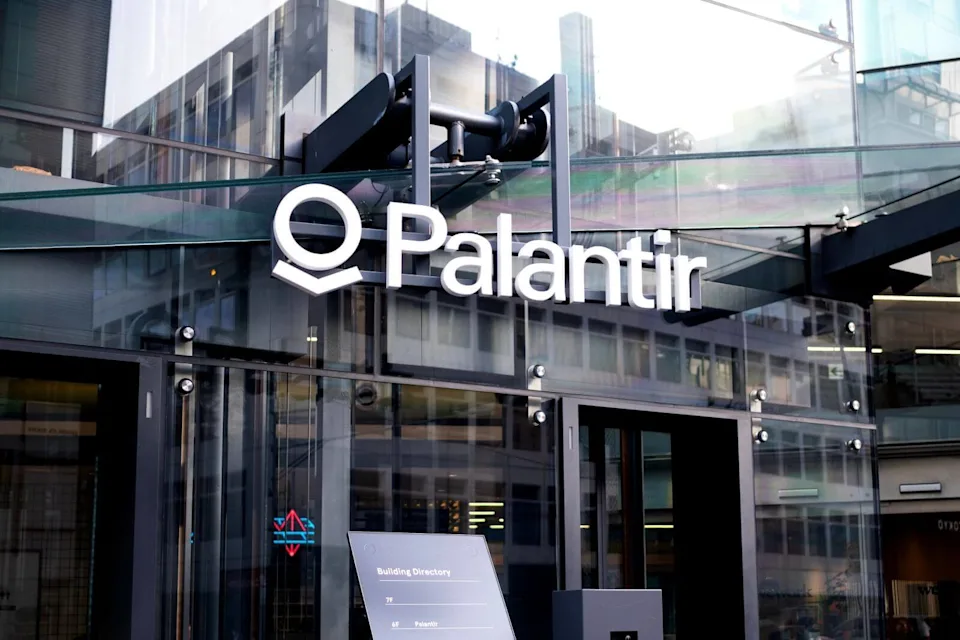
Palantir Technologies has built a distinctive position in enterprise technology through its combination of data integration, analytics, operational software and artificial intelligence. Its platforms serve government, defense and commercial customers, helping organizations connect complex datasets and use them to support decisions and operational workflows.
With its Gotham, Foundry and Artificial Intelligence Platform (AIP) products, Palantir operates across several overlapping markets. However, it does not compete with every company in the same way: some vendors provide cloud infrastructure, others specialise in data engineering or enterprise AI, and companies such as Anduril compete in defence programmes involving autonomous systems.
The competitive landscape is becoming more crowded as hyperscalers, data-platform providers, enterprise software vendors and defense technology startups expand their AI capabilities. Understanding the differences is essential for procurement teams, investors and enterprise buyers evaluating alternatives to Palantir.
This guide examines 17 significant competitors across government intelligence, enterprise data analytics, cloud AI, cybersecurity, industrial software and autonomous systems.
What Makes Palantir a Market Leader?
Founded in 2003, Palantir develops software that helps governments and businesses integrate complex data, model their operations and make better-informed decisions. Its two established platforms, Gotham and Foundry, serve different but sometimes overlapping customer needs.
Palantir Gotham focuses on government, defense, intelligence and related mission-critical use cases. Palantir Foundry supports commercial and other organizations by integrating data from disparate systems into an operational model that connects information to business entities, decisions and workflows.
The company’s Artificial Intelligence Platform (AIP), introduced in 2023, enables organizations to connect large language models and other AI systems to their data and operational processes. AIP emphasizes permissions, governance and human oversight, making it relevant to organizations that need to deploy AI in sensitive or regulated environments.
Palantir reported $4.48 billion in revenue for FY2025. In the second quarter of 2026, revenue reached $1.935 billion, up 93% year over year, while US commercial revenue grew 149% to $764 million. The company raised its full-year 2026 revenue guidance to approximately $8.15 billion.
Palantir’s contract metrics also indicate significant demand. At the end of Q2 2026, the company reported $13.1 billion in total remaining deal value and $4.9 billion in remaining performance obligations. These are different measures of contracted business and should not be treated as guaranteed future revenue.
Its combination of data integration, operational workflows and AI deployment distinguishes Palantir from vendors that focus primarily on cloud infrastructure, data storage or individual business applications. However, the extent of that advantage depends on each customer’s technical requirements, implementation budget and existing systems.
Palantir’s Top Competitors
1. Snowflake

Snowflake pioneered the cloud data platform model, providing services for storing, processing and sharing structured and semi-structured data across cloud environments. Its architecture separates compute from storage, allowing customers to scale workloads according to their needs.
Snowflake reported $4.47 billion in product revenue for FY2026, up 29% year over year. Total revenue, including professional services and other revenue, was approximately $4.68 billion. The company also reported a 125% net revenue retention rate and $9.77 billion in remaining performance obligations at the end of FY2026.
Snowflake’s competitive overlap with Palantir is strongest in the data platform and AI infrastructure layers. Palantir builds an operational ontology—a structured model of how an organization’s data relates to its real-world operations—while Snowflake provides data storage, processing and sharing infrastructure on which analytics and AI applications can operate.
Some enterprises can use both platforms simultaneously, with Snowflake managing data workloads and Palantir supporting operational applications and decision-making. Snowflake’s AI capabilities, including Cortex AI, extend its role beyond conventional data warehousing.
Snowflake’s strength is its cloud-native data architecture and ecosystem. Palantir differentiates itself through its emphasis on operational integration, governed workflows and mission-specific applications.
Best for: Enterprises that need scalable cloud data infrastructure, data sharing and analytics, potentially alongside an operational AI platform.
2. Databricks
Databricks built its platform around the open-source Apache Spark ecosystem and the lakehouse architecture. Its products combine data engineering, analytics, data science and machine learning in an environment designed for teams building and deploying data-intensive applications.
The company’s Lakehouse Platform uses technologies such as Delta Lake and Unity Catalog to support data management and governance. Its AI offerings also help customers develop, evaluate and deploy models, including generative AI applications.
By September 2025, Databricks had reported an annualized revenue run rate of approximately $4.8 billion, growing around 55% year over year, with net revenue retention of roughly 140%. It also announced a funding round at a reported $62 billion valuation during 2025. These are dated private-company disclosures, not audited FY2025 revenue figures or current valuation estimates.
The competitive tension with Palantir concerns how organizations develop, govern and operationalize AI. Databricks is particularly strong in data engineering, model development and machine learning, while Palantir focuses on integrating data models into operational workflows and decision-making.
Organizations building custom models may use Databricks for development and a separate platform for deployment into business processes. Others may use Databricks alone, depending on their operational requirements.
Databricks’ open-source heritage and developer-oriented tools appeal to technical teams seeking flexibility. Palantir’s more integrated approach appeals to organizations seeking a managed environment for connecting data, AI and operational decisions.
Best for: Organizations building data pipelines, developing custom machine-learning models and managing AI workloads at scale.
3. Microsoft

Microsoft competes with Palantir across several layers through Azure, Microsoft Fabric, Microsoft 365 Copilot and its government cloud services. Its broad enterprise presence gives it access to customers already using Microsoft productivity, database, identity and infrastructure products.
Microsoft Fabric combines data engineering, data science, real-time analytics and business intelligence in a unified platform. Its integration with Microsoft 365, Teams and Power BI creates natural adoption pathways for organizations that want to extend their existing technology environment into AI.
For fiscal year 2026, Microsoft reported $331.8 billion in total revenue and $214.4 billion in Microsoft Cloud revenue. Azure and other cloud services revenue grew 41%, while Intelligent Cloud remained a major reporting segment. These figures describe different parts of Microsoft’s business and should not be conflated.
Microsoft’s government cloud capabilities and participation in the Joint Warfighting Cloud Capability (JWCC) contract give it a presence in government and defense environments that also use Palantir. Specific security authorizations and deployment eligibility depend on the service, region and workload.
The key distinction is that Microsoft provides a broad horizontal technology ecosystem, while Palantir focuses on operational data integration and mission-specific applications. Microsoft offers extensive AI and data building blocks; Palantir emphasizes a connected operational model through which users can apply AI to real-world processes.
Microsoft is therefore a significant competitor, but not a direct substitute for Palantir in every deployment. The choice depends on the required workflow, data architecture, security requirements and the amount of integration work an organization is prepared to undertake.
Best for: Organizations seeking integrated cloud infrastructure, productivity software, analytics and enterprise AI within the Microsoft ecosystem.
4. Anduril Industries

Founded in 2017 by Palmer Luckey and other technology entrepreneurs, Anduril Industries develops autonomous defense systems, including uncrewed vehicles, sensors and command-and-control software. Its Lattice platform connects information from compatible systems to help operators monitor situations and coordinate responses.
Anduril’s business combines software with physical defense products. Its portfolio includes autonomous aerial and maritime systems, counter-drone technologies and surveillance equipment, making it different from software-first platforms such as Palantir.
Anduril competes with Palantir in selected defense software and operational decision-support programmes. Both companies have challenged traditional defense procurement models, but their primary product strategies differ: Palantir emphasizes data integration and software workflows, while Anduril combines AI software with autonomous hardware.
The two companies can also be complementary. A defense operation may require data integration and intelligence software alongside sensors, drones and autonomous systems, rather than choosing only one vendor.
Anduril is privately held, so revenue, valuation and contract figures need to be attributed to dated company disclosures or reliable reporting. The original article’s estimates of approximately $2.2 billion in 2025 revenue, a $61 billion valuation in 2026 and a $20 billion Pentagon contract should not be presented as confirmed current figures without verifying the relevant announcements and contract terms.
Best for: Defense organizations seeking autonomous hardware, sensor integration and AI-enabled command-and-control systems.
5. C3 AI
C3 AI positions itself as an enterprise AI software provider, offering applications and platform tools for use cases such as predictive maintenance, supply chain optimization, fraud detection and anti-money-laundering operations. Rather than focusing solely on a general-purpose data platform, it provides solutions designed around specific business problems.
C3 AI works with major cloud providers, including Microsoft Azure, AWS and Google Cloud. These relationships can help it deploy applications within customers’ existing cloud environments and enterprise systems.
C3 AI reported $250.3 million in FY2026 revenue, including $227.1 million in subscription revenue. Its FY2026 gross margin was 31% under GAAP accounting, and the company continued to report a net loss. These figures supersede the original article’s FY2025 revenue figure of $389 million when discussing the latest fiscal year.
C3 AI overlaps with Palantir in enterprise AI applications that connect data to operational insights. Its pre-built applications may offer a faster path for standard use cases, while Palantir’s ontology and application-development approach can support more customized operational environments.
Both companies have pursued government and defense opportunities, although their product portfolios and commercial scale differ. C3 AI’s financial performance and path to profitability remain important considerations for customers, investors and partners.
Best for: Organizations seeking enterprise AI applications for defined industrial, operational or analytical problems.
6. Amazon Web Services (AWS)

Amazon Web Services is a major cloud infrastructure provider. Through Amazon Bedrock, SageMaker, Amazon Q and its database and analytics services, AWS offers a broad collection of tools for building and deploying AI applications.
Amazon Bedrock enables customers to work with supported foundation models from multiple providers. SageMaker supports machine-learning development, training and deployment, while Amazon Q provides generative AI assistance across selected AWS and business applications.
AWS generated approximately $128.7 billion in revenue in 2025, up 20% year over year. This is AWS segment revenue, not Amazon’s total company revenue. AWS also reported strong growth in the second quarter of 2026, with segment sales reaching $42.2 billion.
AWS’s government cloud offerings support sensitive workloads, subject to the relevant service’s authorizations and deployment conditions. Palantir products can run in cloud environments, so the two companies may be both partners and competitors.
AWS competes with Palantir when customers choose between assembling an AI application from cloud services and adopting an integrated operational platform. The trade-off is flexibility versus the engineering effort required to connect infrastructure, data, models and business workflows.
AWS provides a broad set of building blocks, while Palantir emphasizes a more integrated approach to operational AI. The best option depends on existing infrastructure, internal engineering capability, security needs and the desired level of customization.
Best for: Organizations seeking scalable cloud infrastructure and flexible AI development tools.
7. Google Cloud

Google Cloud competes with Palantir through BigQuery, Vertex AI and Looker. These products support cloud data warehousing, model development, business intelligence and analytics.
Google’s research background and Gemini model family are important parts of its AI offering. Vertex AI enables organizations to build and deploy AI applications, while BigQuery supports analytics and machine learning on large datasets.
Google Cloud generated $58.7 billion in revenue in 2025, compared with approximately $43.2 billion in 2024. These are segment-level revenue figures rather than revenue from AI products alone.
Google Cloud has also pursued public-sector and defense-related business, while Google’s acquisition of Mandiant strengthened its cybersecurity capabilities. However, its government deployment eligibility depends on the specific service and security requirements.
Google Cloud and Palantir overlap in data integration, analytics and AI-enabled applications. Google offers broad cloud and AI infrastructure, whereas Palantir focuses on connecting data to operational workflows and decisions through its platforms.
Organizations can use Google Cloud services to develop AI applications, Palantir to operationalize data and workflows, or a combination of both.
Best for: Organizations building cloud-native analytics and AI solutions on Google’s infrastructure.
8. Salesforce
Salesforce competes with Palantir in commercial enterprise AI through its CRM platform, Data Cloud, Agentforce and MuleSoft. These products connect customer information and enterprise applications to AI-powered workflows.
Agentforce, introduced in 2024, supports AI agents for sales, customer service and other business processes. Data Cloud helps unify customer data across Salesforce products and connected systems, while MuleSoft supports integration with external applications.
Salesforce reported $41.5 billion in FY2026 revenue, for the fiscal year ended January 31, 2026. Its extensive installed base provides a distribution advantage, especially among businesses already using Salesforce for sales, service and marketing.
The competitive dynamic reflects different starting points. Salesforce is built around customer-facing applications and is extending into enterprise AI, while Palantir starts with data integration and operational decision support and connects those capabilities to applications.
Palantir’s ontology can model relationships across operational data, while Salesforce’s strengths lie in CRM data and workflows. The two platforms can overlap in AI-agent deployments but are not interchangeable for every enterprise process.
Best for: Organizations that want to extend AI into CRM, customer service and Salesforce-centred workflows.
9. Splunk (Cisco)
Cisco completed its acquisition of Splunk in March 2024 for approximately $28 billion. Splunk’s platform helps organizations analyse machine-generated data, monitor IT systems and detect cybersecurity threats.
Splunk is widely associated with security information and event management (SIEM), security operations centres and IT observability. Cisco’s networking and security products can complement these capabilities by providing additional telemetry and security context.
The competitive overlap with Palantir is concentrated in cybersecurity, intelligence analysis and operational data monitoring. Palantir supports broader cross-functional workflows, while Splunk focuses more directly on security analytics and IT operations.
Because Splunk is now part of Cisco, its historical standalone revenue and annual recurring revenue should be labelled as historical. Cisco’s consolidated revenue is not Splunk revenue, and the original article’s $28 billion figure refers to the acquisition value rather than annual revenue.
Splunk and Palantir may compete in security-related use cases while serving different purposes in the wider technology stack.
Best for: Security teams and IT operations teams requiring log analytics, threat detection and observability.
10. Alteryx
Alteryx pioneered self-service analytics automation, helping business analysts prepare data, build repeatable workflows and conduct advanced analysis with less dependence on traditional software development.
Its Designer product supports drag-and-drop data workflows, while its wider platform includes capabilities for analytics, data preparation and machine learning. These features are relevant to teams that need repeatable analytical processes across finance, healthcare, manufacturing and other industries.
Alteryx was taken private in 2024 in a transaction involving Clearlake Capital and Insight Partners. Consequently, its pre-acquisition revenue figures should be treated as historical rather than as current audited financial results.
Alteryx overlaps with Palantir Foundry in data preparation, analytics and workflow development. Palantir’s approach is more oriented towards an organization-wide operational model, while Alteryx emphasizes analytics productivity and repeatable workflows.
Alteryx’s AI capabilities, including assistance with analytics workflow creation, may appeal to organizations that want to automate data analysis without adopting a broader operational AI platform. Whether it is a suitable alternative depends on the complexity of the use case and the need to connect analysis to live operations.
Best for: Business analysts and data teams automating data preparation and repeatable analytics.
11. IBM
IBM has expanded its enterprise AI and hybrid-cloud offerings through watsonx. The portfolio supports AI development, deployment and governance, while IBM Consulting helps customers integrate AI into existing enterprise systems.
IBM’s long-standing relationships in financial services, healthcare and government give it a substantial presence in regulated environments. Its broader portfolio includes enterprise software, consulting, infrastructure and services.
IBM reported $67.5 billion in total revenue for FY2025. This figure represents the entire company, not watsonx or AI revenue alone; AI-related business metrics should be distinguished from total revenue.
IBM competes with Palantir in enterprise AI, data governance and deployments requiring strong security and compliance controls. Its consulting organisation can support implementation across complex legacy environments, while Palantir emphasizes an integrated operational software platform.
The distinction is not simply that one company has more advanced AI than the other. The right choice depends on whether a customer prioritizes consulting-led implementation, hybrid-cloud integration, data modelling, operational workflows or a combination of these requirements.
Best for: Large organizations seeking enterprise AI, hybrid-cloud capabilities, governance and implementation support.
12. ServiceNow
ServiceNow has expanded from IT service management into a broader enterprise workflow platform. Its Now Assist products introduce generative AI into IT, HR, customer service and other workflows, while its AI-agent capabilities support additional automation.
ServiceNow reported approximately $13.3 billion in 2025 revenue, with subscription revenue accounting for most of the total. Its large enterprise customer base and established workflow integrations are important competitive advantages.
ServiceNow and Palantir overlap in the use of AI to improve operational processes. ServiceNow focuses on orchestrating structured enterprise workflows, while Palantir focuses on connecting data, operational models and decision-making across a broader range of business and mission environments.
Organizations may use ServiceNow as the system for managing service workflows and Palantir as a platform for broader operational data integration. The products can therefore complement one another as well as compete for selected use cases.
ServiceNow’s strength is its workflow ecosystem; Palantir’s is its combination of data integration, ontology and operational AI capabilities.
Best for: Organizations automating IT, employee and other structured enterprise workflows.
13. Booz Allen Hamilton

Booz Allen Hamilton occupies a different competitive position from software-first companies. It provides consulting, systems integration, technology development and mission support to US government and defense customers.
Its work spans cybersecurity, data analytics, AI and national security. Booz Allen’s cleared workforce, experience with federal procurement and long-standing agency relationships can be significant advantages in complex government programmes.
Booz Allen reported approximately $12 billion in FY2025 revenue, with a record backlog of around $39.4 billion cited in its FY2025 reporting. The original article also cited approximately $800 million in AI-related revenue, but this figure should be tied to the precise definition and reporting period used by the company before publication.
Booz Allen’s Mercury platform and wider AI investments create overlap with Palantir in selected intelligence and national security analytics use cases. However, Mercury and Palantir Gotham should not be treated as identical products without comparing their actual capabilities and deployment requirements.
The two companies can also work together: government service providers may implement or support third-party platforms, including Palantir products. Booz Allen’s service-heavy business model differs from Palantir’s software-focused model, which affects how their revenue, margins and scalability should be compared.
Best for: Government agencies seeking technology consulting, systems integration and mission support.
14. Scale AI

Scale AI built its business around preparing and labelling data used to train AI models. It has expanded into model evaluation, AI safety testing, red-teaming and government AI programmes.
Its services are relevant to organizations developing foundation models and AI applications, where the quality of training data and evaluation processes can influence model performance. Scale AI’s government work also places it in the broader national security AI ecosystem.
The original article cited approximately $870 million in revenue for 2024, an annualized run rate of $1.5 billion by year-end and a $25 billion valuation in a 2025 tender offer. These are historical private-company figures and should remain dated rather than being presented as current revenue or valuation.
Scale AI competes with Palantir in selected government AI programmes, but the primary offerings differ. Scale AI focuses on data preparation, evaluation and AI development services, while Palantir focuses on deploying data and AI into operational environments.
The companies can be complementary across the AI lifecycle: one can support training and evaluating models, while the other provides the operational platform in which AI-supported decisions and workflows are used.
Best for: Organizations needing AI training data, model evaluation and support for AI development programmes.
15. Cognite

Cognite is a Norwegian industrial software company known for Cognite Data Fusion, a platform designed to integrate and contextualise industrial data. Its target sectors include oil and gas, manufacturing, energy and other asset-intensive industries.
Cognite Data Fusion helps organizations connect information from industrial assets, operational technology, process historians and enterprise systems. The platform supports use cases such as predictive maintenance, asset performance management and operational efficiency.
Cognite has been reported to have more than $100 million in annual recurring revenue, but that figure should be treated as an estimate unless confirmed by a dated company disclosure. Customer examples in the industrial sector include companies such as Aker BP and Shell; specific product deployments should be confirmed from the relevant customer or vendor announcement.
Cognite competes with Palantir Foundry in industrial data integration and operational analytics. Its industrial focus can be advantageous where connecting equipment data and operational technology is the central requirement, while Palantir provides a broader platform across industrial, commercial and government use cases.
For an industrial operator, the choice may depend on the complexity of its operational technology, the need to connect plant data to business processes and the extent of cross-enterprise integration required.
Best for: Industrial businesses seeking to connect operational data and improve asset performance.
16. Dataiku
Dataiku provides a collaborative platform for data preparation, analytics, machine learning and AI governance. It is designed for data scientists, data engineers and business users who need to work together across AI projects.
Its Everyday AI platform supports data preparation, model development, deployment and monitoring. Dataiku’s vendor-neutral approach allows organisations to work across different cloud and technology environments, depending on the selected deployment and integration options.
The original article cited an estimated $200 million or more in annual recurring revenue and a $6.3 billion valuation from an earlier funding round. These are historical private-company figures and should not be treated as current audited financial data without further confirmation.
Dataiku overlaps with Palantir Foundry in enterprise data science, governance and AI deployment. Dataiku’s strength is collaborative model development and flexibility across technology stacks, while Palantir places greater emphasis on connecting data models to operational workflows.
Dataiku may suit organisations seeking a collaborative AI development environment without adopting Palantir’s full operational platform. Palantir may be a better fit where AI needs to operate across complex, interconnected business processes and live operational data.
Best for: Cross-functional teams developing, deploying and governing machine-learning and AI applications.
17. SAS Institute
SAS Institute is a privately held analytics software company founded in 1976. Its SAS Viya platform supports statistical analysis, data management, machine learning and AI, with established use in financial services, healthcare, government and retail.
SAS has long-standing relationships with large enterprises and regulated industries. Its statistical modelling heritage, analytics tooling and emphasis on governance remain relevant where auditability, model validation and regulatory requirements are important.
The original article cited approximately $3.5 billion in annual revenue and more than 83,000 customers across 147 countries. These figures should be attributed to a specific company disclosure and reporting period before being presented as current metrics.
SAS competes with Palantir in enterprise analytics, AI governance and selected regulated-industry use cases. SAS has deep statistical and analytical capabilities, while Palantir focuses on integrating operational data and embedding AI into workflows and decisions.
SAS has also invested in cloud deployment, Python and R integration, and generative AI capabilities through its own platform and technology partnerships. The relevant comparison is therefore not simply legacy analytics versus modern AI, but the fit between each platform’s analytics, governance and operational capabilities.
Best for: Organizations requiring mature statistical analytics, model governance and established enterprise analytics tools.
Palantir vs. Top Competitors: At a Glance
| Company | Primary market | Financial reference | Key strength relative to Palantir |
|---|---|---|---|
| Snowflake | Cloud data platform | FY2026 product revenue: $4.47B | Data sharing and cloud-native storage |
| Databricks | Unified data and AI | Approximately $4.8B ARR, reported in 2025 | Lakehouse architecture and model development |
| Microsoft | Enterprise AI and cloud | FY2026 revenue: $331.8B | Broad ecosystem, Fabric and Azure |
| Anduril | Defense AI and autonomy | Private-company figures require dated verification | Autonomous hardware and Lattice |
| C3 AI | Enterprise AI applications | FY2026 revenue: $250.3M | Pre-built industry AI applications |
| AWS | Cloud infrastructure | 2025 segment revenue: $128.7B | Scale, Bedrock and cloud services |
| Google Cloud | Cloud AI and analytics | 2025 segment revenue: $58.7B | BigQuery, Vertex AI and AI research |
| Salesforce | CRM and enterprise AI | FY2026 revenue: $41.5B | CRM data and Agentforce |
| Splunk / Cisco | Security analytics | Splunk acquisition value: approximately $28B | Security operations and observability |
| Alteryx | Analytics automation | Historical pre-acquisition revenue: approximately $900M | Self-service analytics workflows |
| IBM | Enterprise AI and hybrid cloud | FY2025 total revenue: $67.5B | Consulting, hybrid cloud and governance |
| ServiceNow | Enterprise workflow AI | 2025 revenue: approximately $13.3B | Workflow automation and installed base |
| Booz Allen Hamilton | Government AI and IT | FY2025 revenue: approximately $12B | Cleared personnel and government relationships |
| Scale AI | AI data infrastructure | Historical estimates vary by period | Training data and model evaluation |
| Cognite | Industrial AI | Reported estimates of $100M+ ARR | Industrial data integration |
| Dataiku | Collaborative machine learning | Historical ARR estimates of $200M+ | Collaborative AI development |
| SAS Institute | Statistical analytics | Historical revenue estimate: approximately $3.5B | Statistical modelling and regulatory experience |
These figures cover different reporting periods and financial measures. Product revenue, ARR, segment revenue, total company revenue and acquisition value are not directly comparable.
Infographic: Palantir’s Competitive Landscape
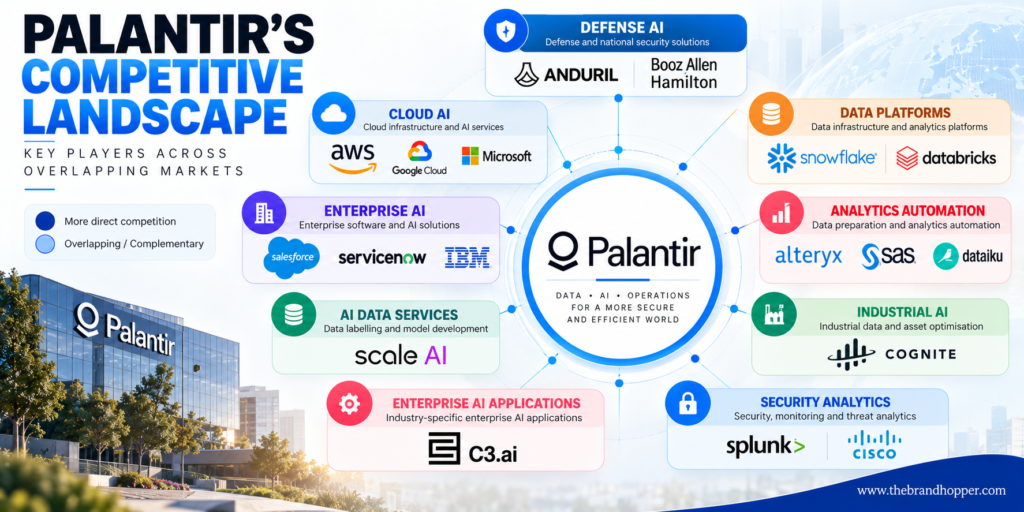
How to Choose: Palantir vs. Its Competitors
The right AI and data analytics platform depends on an organization’s use case, industry, security requirements, existing infrastructure and implementation resources. A vendor’s scale or AI capabilities alone do not determine whether it is the best choice.
Choose Palantir when you need to integrate data from many systems, build an operational model of your organization and connect AI to complex workflows with governance and human oversight. Its platforms are relevant to government intelligence, defense operations and commercial environments where data integration and operational decision-making are central.
Choose cloud hyperscalers such as AWS, Google Cloud or Microsoft Azure when you need flexible infrastructure and a broad set of AI building blocks. These platforms can support extensive customization, although organizations may need engineering resources to connect data, models, permissions and operational workflows.
Choose Snowflake or Databricks when the primary requirement is cloud data management, data sharing, engineering or model development. These products can also serve as foundations for operational applications, including those built with Palantir.
Choose Salesforce or ServiceNow when AI needs to extend workflows already managed in CRM or enterprise service-management systems. Their installed bases and workflow-specific capabilities may reduce the need to introduce a separate platform for those use cases.
Choose Anduril when autonomous defense hardware, sensors and AI-enabled command software are central to the mission. Its hardware-plus-software model is different from Palantir’s software-first approach, although the companies may compete or complement each other depending on the programme.
Choose C3 AI, Alteryx, Dataiku or SAS when your requirements are more specifically centred on pre-built AI applications, analytics automation, collaborative model development or statistical analytics. Evaluate the amount of customization and operational integration required before treating any of these products as a full substitute for Palantir.
Frequently Asked Questions
Q1. Who is Palantir’s biggest competitor?
A: Palantir does not have a single biggest competitor across every market. In commercial data and AI, Microsoft, Snowflake and Databricks overlap with parts of its offering; in defense, Anduril and government technology providers such as Booz Allen compete in selected programmes.
Q2. Is Snowflake a direct competitor to Palantir?
A: They overlap in enterprise data and AI, but Snowflake primarily provides a cloud data platform, while Palantir focuses on operational data models and applications. Many organizations can use both simultaneously.
Q3. How does Anduril compare with Palantir in defense?
A: Anduril develops autonomous defense systems, sensors and command software, while Palantir focuses on data integration, intelligence analysis and operational decision support. They can compete in selected defense programmes but may also serve complementary roles.
Q4. Is Microsoft a threat to Palantir?
A: Microsoft is a significant competitor through Azure, Fabric and its enterprise AI ecosystem. Its broad product portfolio and existing customer relationships are advantages, while Palantir differentiates itself through its integrated approach to operational data and mission-specific workflows.
Q5. Does Palantir compete with AWS and Google Cloud?
A: Yes, particularly when customers are deciding whether to build AI applications from cloud services or adopt a more integrated operational platform. However, Palantir products can also operate in cloud environments, making the relationship complementary in some deployments.
Q6. How does C3 AI differ from Palantir?
A: C3 AI emphasizes enterprise AI applications for specific industry use cases. Palantir offers a broader operational platform that connects data, AI and workflows across organizations, although the degree of overlap depends on the selected products and use cases.
Q7. Is Palantir profitable?
A: Yes. Palantir reported GAAP net income of approximately $1.63 billion for FY2025 and GAAP net income of approximately $1.06 billion in Q2 2026. Its reported financial performance should be assessed using current financial statements and with GAAP and adjusted metrics kept separate.
Q8. What industries use Palantir?
A: Palantir serves government and defense customers as well as commercial organizations. Its platforms have applications in healthcare, manufacturing, energy, financial services, supply chains and other environments where integrating complex data can improve operational decisions.
Q9. What is the difference between Palantir Gotham and Foundry?
A: Gotham focuses on government, defense and intelligence use cases. Foundry supports data integration, operational modelling and application development across commercial and other organizational environments, while AIP connects AI models to these data and workflow environments.
Q10. Can small and mid-sized companies use Palantir?
A: Potentially, depending on their requirements, budget and technical environment. Palantir’s AIP bootcamps and deployment approaches can accelerate initial implementation, but buyers should still evaluate licensing, integration, governance and ongoing operating costs against alternatives such as Dataiku or Alteryx.
Conclusion
Palantir occupies a distinctive position at the intersection of data integration, operational software and enterprise AI. Its competitors span cloud infrastructure, data engineering, enterprise applications, analytics automation, industrial software and defense technology.
Snowflake and Databricks focus on data and AI foundations; Microsoft, AWS and Google Cloud offer broad cloud ecosystems; Salesforce and ServiceNow extend AI into enterprise workflows; and Anduril combines AI with autonomous defense hardware. C3 AI, IBM, Booz Allen, Scale AI, Cognite, Dataiku, Alteryx and SAS address additional use cases across enterprise applications, government services, AI development, industrial data and analytics.
For organizations evaluating these platforms, the key question is not simply which vendor has the most advanced AI or the largest revenue. It is which combination of data integration, security, operational depth, workflow support and deployment flexibility best meets the organization’s requirements.
Palantir’s FY2025 revenue of $4.48 billion and strong Q2 2026 growth demonstrate its momentum. Its long-term competitive position will depend on continued product execution, customer adoption, measurable operational outcomes and its ability to compete with vendors expanding their AI capabilities.
Also Read: The Inspiring Success Story and History of PayPal
To read more content like this, subscribe to our newsletter