Last Updated on August 11, 2026 by Team TBH
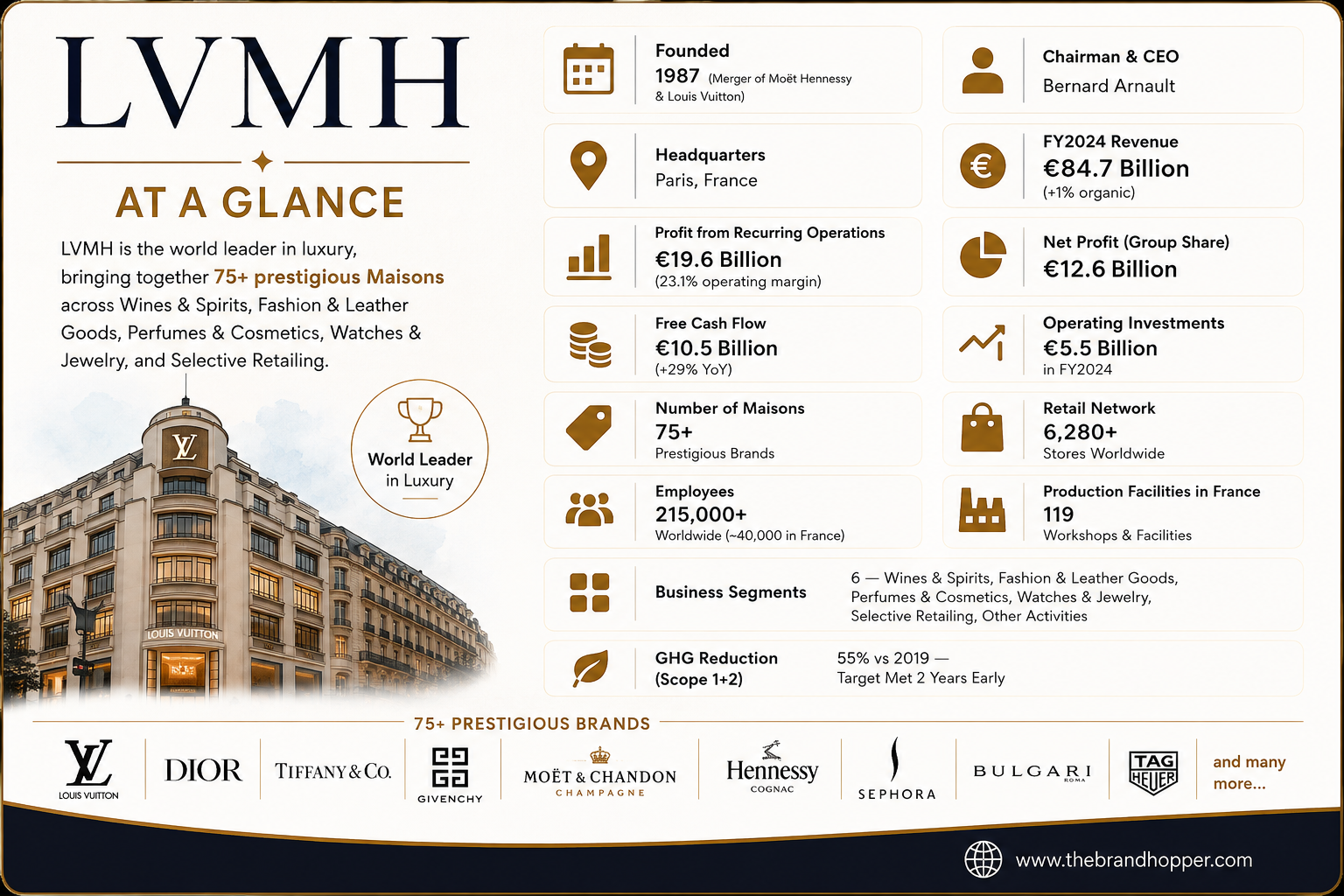
LVMH Moët Hennessy Louis Vuitton is a French multinational luxury goods conglomerate founded in 1987 through the merger of Moët Hennessy and Louis Vuitton. Headquartered in Paris and led by Chairman and CEO Bernard Arnault, LVMH has grown into the world’s undisputed leader in luxury goods — a position it reinforces year after year through exceptional craftsmanship, strategic acquisitions, and marketing that consistently sets the global standard for what luxury means.
In FY2024, LVMH recorded revenue of €84.7 billion and profit from recurring operations of €19.6 billion — maintaining an operating margin of 23.1%, which significantly exceeds pre-Covid levels. The Group’s 75+ prestigious Maisons (brands) span six business sectors across a retail network of more than 6,280 stores worldwide, employing 215,000+ people. What makes LVMH’s story exceptional is not just its scale, but the marketing architecture that sustains desire for every one of its brands across every market on earth.
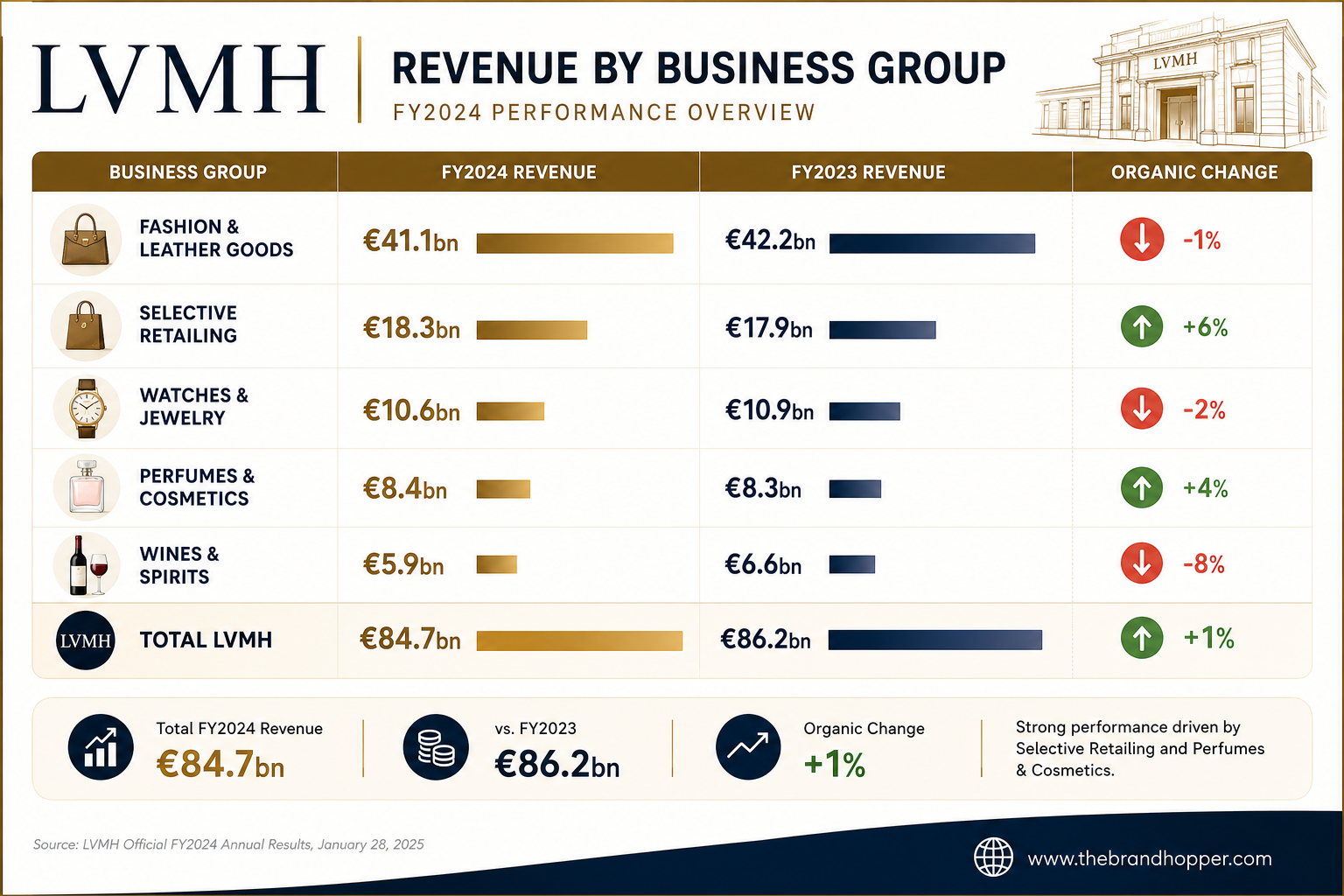
LVMH Revenue by Business Group
Founding History of LVMH
Moët Hennessy
Moët Hennessy’s heritage dates to 1743, when Claude Moët established a wine trading business in Épernay, France. His grandson Jean-Rémy Moët later expanded operations, exporting Champagne to European royal courts. Separately, in 1765, Irishman Richard Hennessy founded a cognac distillery in Cognac, France, that would become one of the industry’s most celebrated names. In 1971, the two companies merged to form Moët Hennessy — instantly creating the world’s leading producer of both champagne and cognac, with legendary brands such as Moët & Chandon, Veuve Clicquot, Dom Pérignon, and Hennessy under its umbrella.
Louis Vuitton
In 1854, Louis Vuitton opened a workshop in Paris specializing in high-quality trunks and travel cases. His flat-topped, stackable design — made with LV’s iconic Monogram canvas — revolutionised travel goods and became a status symbol among the European elite. By the late 19th century, the Louis Vuitton brand had become synonymous with luxury, craftsmanship, and exclusivity, laying the foundations of what would become the most valuable luxury brand on earth.
The Birth of LVMH (1987)
In 1987, Moët Hennessy and Louis Vuitton merged to form LVMH, with Bernard Arnault seizing control as Chairman and CEO and beginning an extraordinary 35-year expansion through strategic acquisitions. The merger created the world’s largest luxury conglomerate, and under Arnault’s leadership it grew through a relentless acquisition strategy targeting ‘sleeping beauties’ — brands with dormant greatness that LVMH could reawaken. Christian Dior was consolidated in 1987; TAG Heuer and the Bulgari stake followed; and in a landmark moment, Tiffany & Co. was acquired in January 2021 for approximately $15.8 billion — the largest acquisition in the history of luxury goods.
Key LVMH Acquisitions
| Year | Acquisition / Milestone | Approx. Value |
| 1987 | Moët Hennessy + Louis Vuitton merger; Givenchy acquired | — |
| 1993 | Berluti; Kenzo; Guerlain (1994) | — |
| 1999 | TAG Heuer; Chaumet; Sephora | — |
| 2000 | Fendi | ~€1.3bn |
| 2011 | Bulgari | ~€4.3bn |
| 2013 | Loro Piana | ~€2.0bn |
| 2017 | Full consolidation of Christian Dior Couture | ~€12.1bn |
| 2018 | Belmond (hotels & resorts) | ~$2.6bn |
| 2021 | Tiffany & Co. | ~$15.8bn |
LVMH Brands: The Six Business Groups
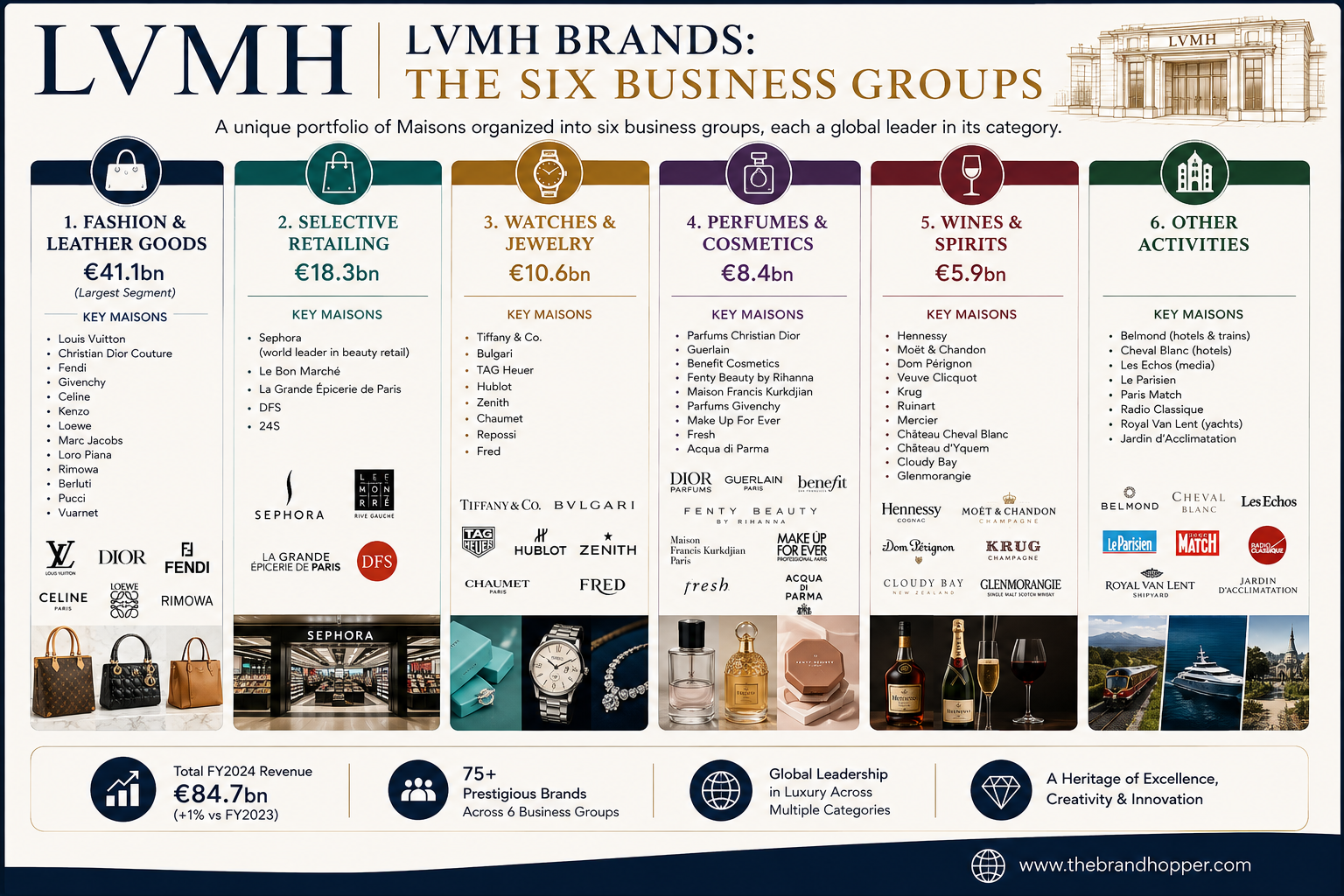
| Business Group | Key Maisons |
| Fashion & Leather Goods (€41.1bn, largest segment) | Louis Vuitton, Christian Dior Couture, Fendi, Givenchy, Celine, Kenzo, Loewe, Marc Jacobs, Loro Piana, Rimowa, Berluti, Pucci, Vuarnet |
| Selective Retailing (€18.3bn) | Sephora (world leader in beauty retail), Le Bon Marché, La Grande Épicerie de Paris, DFS, 24S |
| Watches & Jewelry (€10.6bn) | Tiffany & Co., Bulgari, TAG Heuer, Hublot, Zenith, Chaumet, Repossi, Fred |
| Perfumes & Cosmetics (€8.4bn) | Parfums Christian Dior, Guerlain, Benefit Cosmetics, Fenty Beauty by Rihanna, Maison Francis Kurkdjian, Parfums Givenchy, Make Up For Ever, Fresh, Acqua di Parma |
| Wines & Spirits (€5.9bn) | Hennessy, Moët & Chandon, Dom Pérignon, Veuve Clicquot, Krug, Ruinart, Mercier, Château Cheval Blanc, Château d’Yquem, Cloudy Bay, Glenmorangie |
| Other Activities | Belmond (hotels & trains), Cheval Blanc (hotels), Les Echos (media), Le Parisien, Paris Match, Radio Classique, Royal Van Lent (yachts), Jardin d’Acclimatation |
Marketing Strategies of LVMH
LVMH’s marketing strategies are a masterclass in luxury brand management — combining heritage storytelling, experiential marketing, digital innovation, strategic celebrity partnerships, and carefully controlled scarcity to sustain desire across 75+ brands and 180+ countries. Below are the eleven core marketing strategies that power LVMH’s dominance.
1. Brand Portfolio Strategy: The Art of Managed Diversity
LVMH’s most distinctive marketing strength is its ability to manage a diverse portfolio of 75+ Maisons without diluting the identity of any single brand. Rather than deploying a monolithic corporate brand, LVMH operates as a federation of independent luxury Maisons, each with its own CEO, creative director, heritage narrative, and consumer archetype. Louis Vuitton is positioned as a global luxury pioneer rooted in the art of travel; Fendi is bold, Italian, and playfully irreverent; Celine is austere and intellectual; Loro Piana is quietly understated and deeply crafted. This ‘constellation strategy’ eliminates brand cannibalization while maximizing total luxury market coverage.
The decentralized structure is both LVMH’s greatest operational challenge and its most powerful competitive advantage. It allows individual Maisons to respond quickly to cultural shifts, attract the best creative talent, and build authentic brand stories free from corporate homogenization. At the group level, LVMH provides shared services, cross-portfolio synergies (luxury raw material sourcing, retail real estate, logistics) and financial discipline — creating scale benefits that no independent luxury brand can achieve alone. This portfolio architecture also provides resilience: when Fashion & Leather Goods faces macro headwinds (as in FY2024, -1% organic), Sephora’s exceptional +6% growth and Perfumes & Cosmetics’ +4% growth balance the overall result.
| Portfolio Insight
75+ Maisons across 6 business groups Each brand has its own CEO, creative director, and marketing identity Decentralized model enables creative agility + group-level scale benefits |
2. Premium Positioning: Exclusivity as Architecture
LVMH’s brands are positioned at the absolute apex of their respective categories — and the pricing strategy is designed to reinforce that positioning rather than drive volume. Louis Vuitton entry-level leather goods begin at several hundred euros; a piece from the Capucines collection costs €5,000+; and bespoke trunks from the Asnières workshops can reach six figures. This is not luxury inflation — it is a deliberate architecture of aspiration. The entry price creates mass-market desire; the mid-tier delivers accessible luxury for the emerging affluent; and the apex tier (high jewelry, haute couture, special-order leather goods) signals to ultra-high-net-worth consumers that there is always a higher level to reach.
LVMH’s brands never discount on core permanent collections. The luxury goods sector’s pricing discipline is unlike any other consumer industry: rather than clearing inventory through promotions, LVMH’s brands destroy unsold goods or repurpose materials — preserving brand equity at the cost of margin. This discipline is why a pre-owned Louis Vuitton Neverfull retains (and often appreciates) its value years after purchase. At Tiffany & Co., this strategy has been executed with particular brilliance: the global ‘With Love, Since 1837’ campaign combined with an aggressive store renovation program and the launch of high jewelry collections has resulted in high jewelry revenue quadrupling and operating profit doubling since LVMH’s 2021 acquisition.
3. Celebrity and Influencer Strategy: Beyond Endorsement
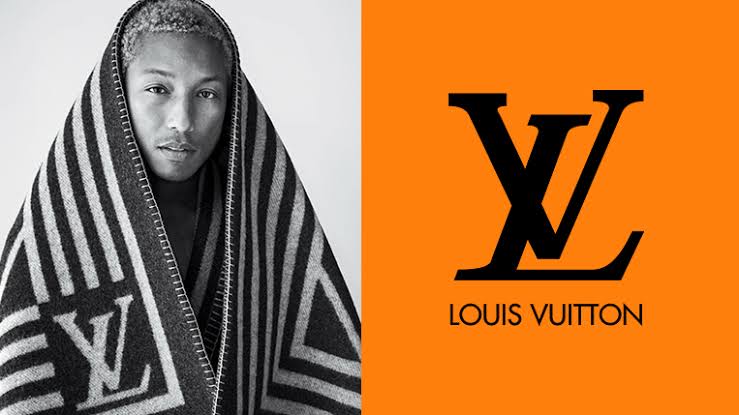
LVMH pioneered the transformation of celebrity partnerships from transactional endorsement deals to deep creative collaborations that generate cultural authority. The appointment of Pharrell Williams as Louis Vuitton’s Men’s Creative Director in February 2023 is the defining example: Pharrell is not merely a brand ambassador — he is the creative architect of the Maison’s menswear identity, bringing his network of cultural relationships (from Nigo to Tyler the Creator), his understanding of streetwear and luxury convergence, and his authentic connection to hip-hop culture. His debut show at Paris’ Pont Neuf drew worldwide media attention; his subsequent collections at UNESCO headquarters and the Louvre have each been cultural moments in their own right.
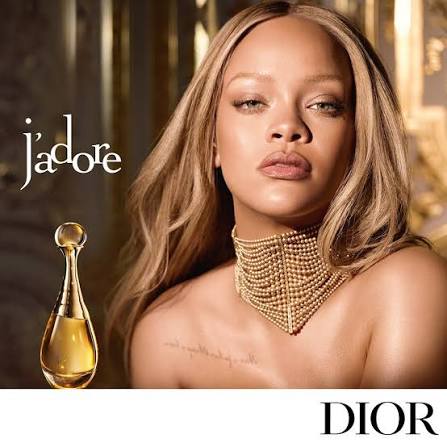
At Dior, the appointment of Rihanna as the face of the iconic women’s fragrance J’adore brought the brand’s olfactory crown jewel to a new generation of consumers, while Miss Dior Parfum achieved major commercial success. Dior Sauvage, meanwhile, remains the world’s best-selling fragrance — a position reinforced by campaigns featuring Johnny Depp that drove global cultural conversation. Tiffany & Co.’s ‘With Love, Since 1837’ campaign engaged Rosé (BLACKPINK), Anya Taylor-Joy, and Hailey Bieber to connect with younger, digitally-native luxury consumers across social media. These are not simply influencer partnerships — they are brand co-creations, where the celebrity’s cultural identity becomes inseparable from the brand’s.
4. Flagship Stores and the Retail Experience
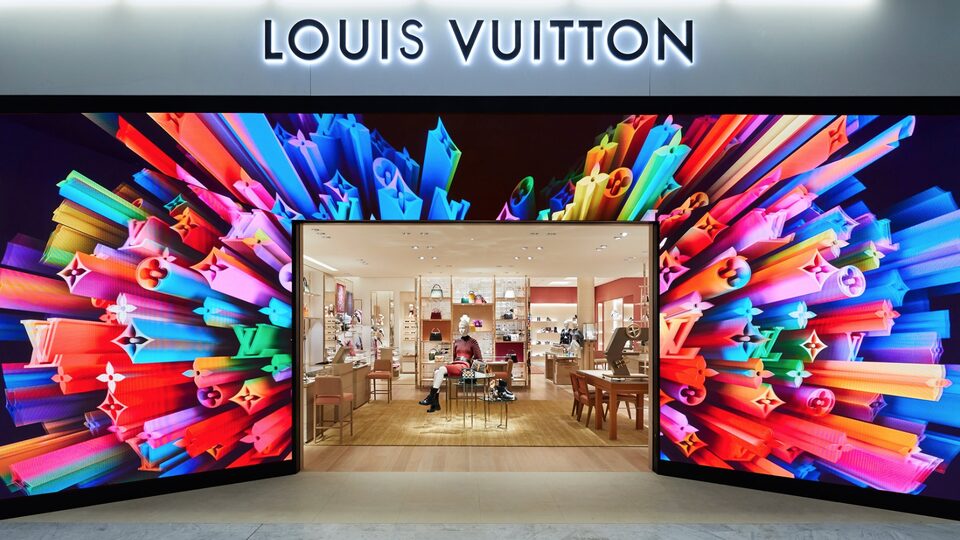
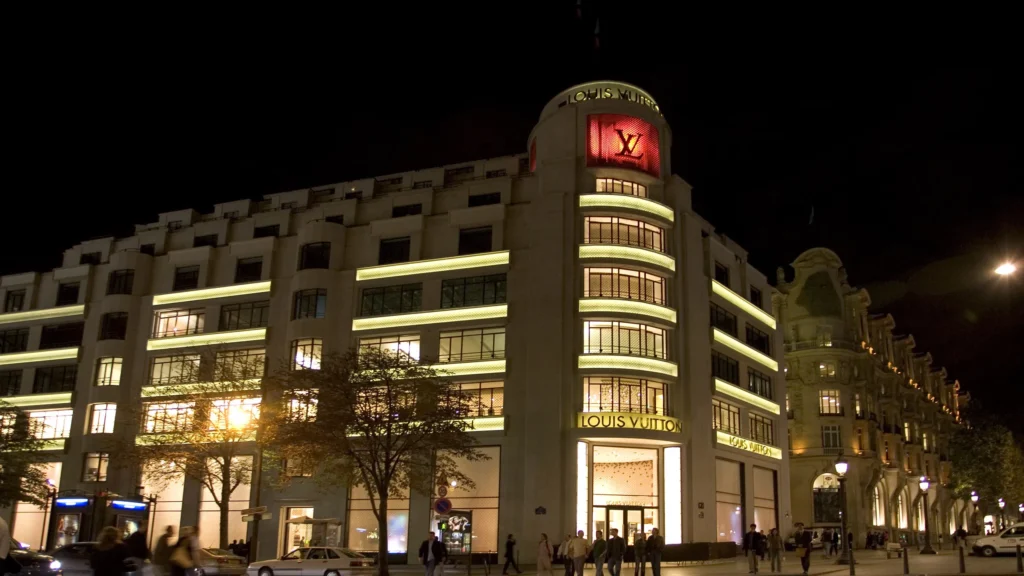
LVMH’s retail strategy treats flagship stores not as points of sale but as brand temples — physical manifestations of a Maison’s identity, history, and aesthetic universe. The Louis Vuitton flagship at 57th Street in New York, which opened with significant fanfare, was described as offering an ‘immersive experience in the world of Louis Vuitton’ — complete with commissioned art installations, private client lounges, and personalized monogramming services that transform a purchase into a memory. The Paris Louis Vuitton Maison on Avenue des Champs-Élysées reopened after a decades-long renovation costing approximately $890 million, restoring it as one of the most visited retail spaces in the world.
Tiffany & Co.’s The Landmark on New York’s Fifth Avenue became the world’s premier luxury store by revenue in 2024 following its extensive renovation — the first in the Maison’s new store concept to be completed. The store features a full-floor restaurant, a dedicated high jewelry suite, and interactive storytelling about Tiffany’s history and craftsmanship. This physical transformation signals what LVMH delivers through its retail network of 6,280+ stores: each new store is not a replicated formula but an original statement of a brand’s values in a specific city and cultural context. Guerlain’s boutiques in Paris and Tokyo function as olfactory art galleries; Berluti’s stores double as gentlemen’s ateliers.
5. Digital Presence and E-Commerce: Luxury at the Speed of Now
LVMH navigates the tension between luxury’s traditional emphasis on exclusivity and scarcity and the democratizing impulse of digital platforms with more sophistication than any competitor. Its decentralized model means each Maison controls its own digital strategy: Louis Vuitton curates a prestigious e-boutique and builds its community through social channels; Sephora operates a powerful omnichannel platform with approximately 2,900 stores in 36 countries, AR-powered virtual try-on tools, a best-in-class loyalty program (Beauty Insider), and a major Kohl’s shops-in-shop partnership that expanded its North American footprint. Sephora delivered double-digit growth in both revenue and profit in FY2024 — underscoring the power of luxury-quality retail experience at accessible beauty price points.
LVMH’s digital innovation investments include: its multi-brand e-commerce platform Lyst (investment); expansion on Tmall Luxury Pavilion for the China market; the LVMH Retail Lab innovation lab; and the 24S multi-brand e-commerce platform (La Samaritaine’s curated digital extension). In 2024, online channels represented approximately 18% of LVMH group revenue — a figure that will grow as the Group continues to invest in frictionless digital-physical luxury journeys.
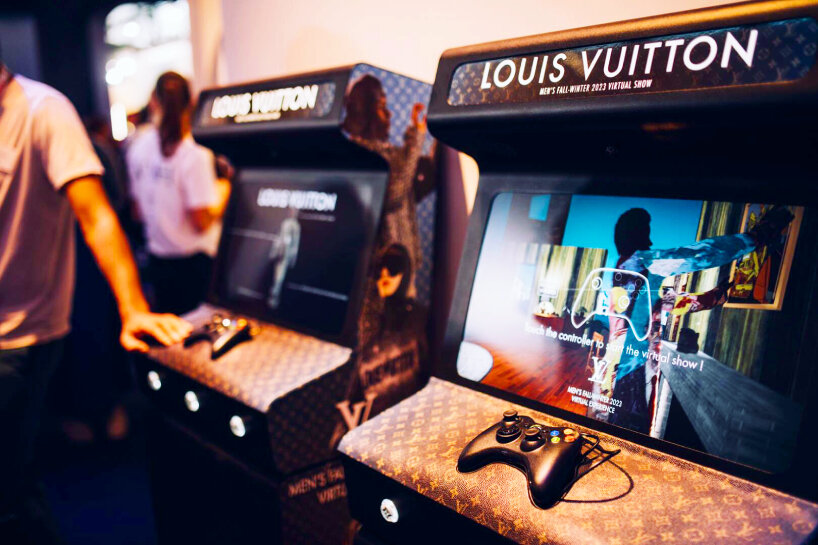
LVMH’s DARE (Dare, Act, React, Explore) intrapreneurship program and its La Maison des Startups incubator (based at Station F in Paris) reflect its commitment to digital transformation. The Group has invested in AI-powered personalization (Sephora’s Color IQ technology; virtual try-on tools), blockchain-based authentication (the AURA consortium, shared with Richemont and Prada), and data-driven client relationship management that allows individual Maisons to identify, attract, and retain their highest-value customers.
6. Heritage and Craftsmanship Storytelling
Heritage is LVMH’s most durable competitive asset — and its communication of heritage is a marketing discipline that few organizations can replicate. Each Maison’s story is unique: Louis Vuitton’s trunks once transported the luggage of Napoleon III’s court; Hennessy’s cognac has been aged in the same forests of Limousin for over 250 years; Loro Piana’s cashmere comes from specific herds of vicuña in the Andes, sheared at most every two to three years. These are not marketing constructs — they are genuine provenance stories that LVMH’s storytelling apparatus amplifies into brand mythology.
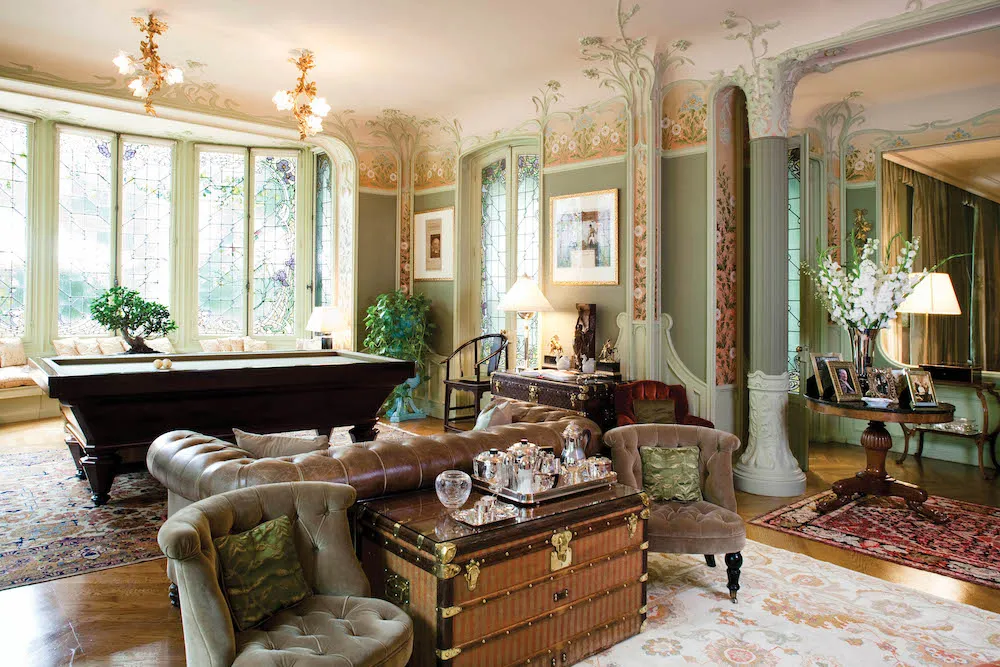
LVMH’s artisanal workshops are both production facilities and marketing assets. Louis Vuitton’s historic Asnières workshop — the original 1859 family home — produces bespoke trunks by hand and serves as a tangible symbol of the brand’s unbroken craft lineage. The Group’s 119 production facilities in France collectively sustain 280+ professions in craftsmanship, preserving savoir-faire techniques that might otherwise disappear. Louis Vuitton repairs 600,000 products per year — a circular commitment that reinforces heritage and quality simultaneously. Loro Piana celebrated its centenary in 2024, decorating all Harrods window displays and delivering record performance. This is heritage as living brand expression, not nostalgia.
The Fondation Louis Vuitton — housed in Frank Gehry’s spectacular glass-and-steel ‘cloud’ building in the Bois de Boulogne, Paris — has attracted 11 million visitors since its opening in 2014. In 2024 it celebrated its 10th anniversary. The Foundation commissions contemporary art exhibitions and permanent installations that connect the Louis Vuitton brand with the global art world — reinforcing its positioning as a patron of creativity rather than merely a commercial entity. This cultural positioning elevates Louis Vuitton above every competitor in luxury fashion.
7. Limited Editions and Exclusivity: The Architecture of Desire
Scarcity is one of luxury’s most powerful demand levers, and LVMH has refined its use into an art form. Limited editions serve multiple functions simultaneously: they generate press coverage, reward loyal clients, create collectible items that appreciate in value, introduce cultural conversation, and reinforce the brand’s commitment to creative experimentation. Louis Vuitton’s artist collaborations — from Jeff Koons (Masters collection) to Yayoi Kusama (Infinity dots, one of LV’s most successful collaborations ever) to Pharrell’s Tiffany Titan jewelry collection for TAG Heuer — each follow a precise playbook: announce with high visual impact, build anticipation through controlled information release, launch with an event or runway moment, and limit availability.
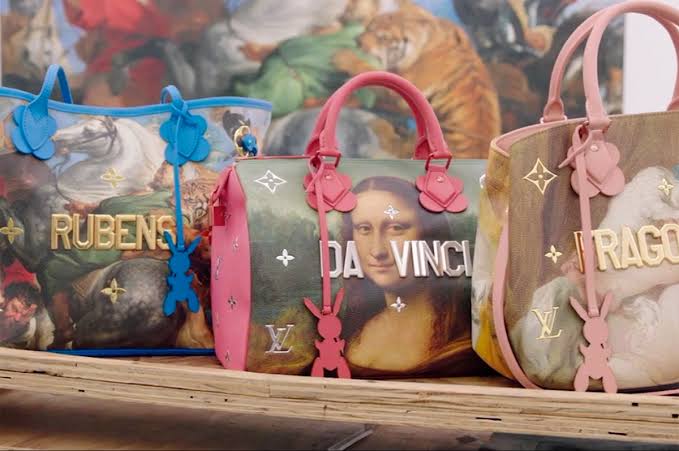
At Tiffany & Co., the ‘Tiffany Titan by Pharrell Williams’ jewelry collection was exceptionally well received and demonstrated how LVMH uses its creative director partnerships as limited-edition creative moments rather than merely licensing exercises. Dom Pérignon’s collaborations with artists such as Lady Gaga (Vintage 2008) and their ongoing creative partnership philosophy transform bottles of champagne into collectors’ objects — priced accordingly. The LVMH Vins d’Exception program for rare vintage wines creates ultra-exclusive allocations that function as investment-grade assets. These limited releases are never arbitrary: each is calculated to deepen the brand mythology, stimulate demand for the entire line, and deliver press value that multiplies the marketing investment.
8. Event Sponsorships, Fashion Shows & Sports Partnerships
LVMH elevated its event marketing strategy to unprecedented heights with its Premium Partnership of the Paris 2024 Olympic and Paralympic Games — the first time in Olympic history that a luxury conglomerate served as a Premium Partner. The sponsorship, valued at approximately $163 million, delivered far more than logo placements. Chaumet, LVMH’s high jewellery Maison founded in 1780, made history as the first jeweller ever to design and create Olympic medals — each hexagonal medal embedded 18 grams of original Eiffel Tower iron, making every medal a piece of French heritage. Louis Vuitton designed and handcrafted the trunks that transported the Olympic and Paralympic medals and torches — a natural extension of the Maison’s two-century tradition of crafting trunks for exceptional journeys. Berluti created the uniforms for France’s Olympic delegation at the opening ceremony, while Sephora served as Official Partner of the Olympic Torch Relay, activating at 46 stores along the relay route.
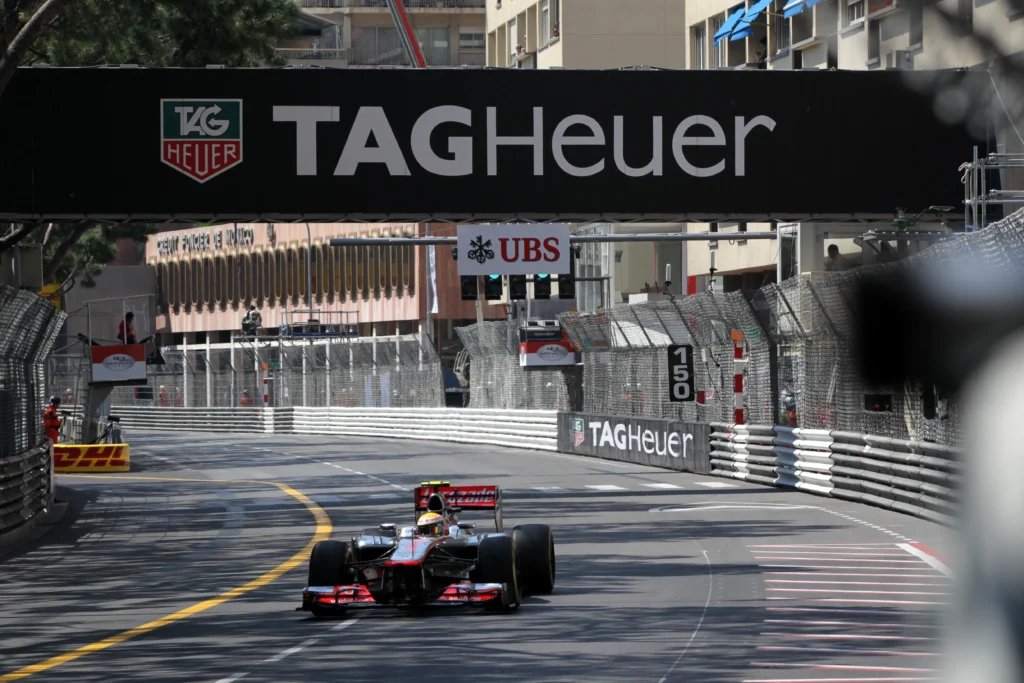
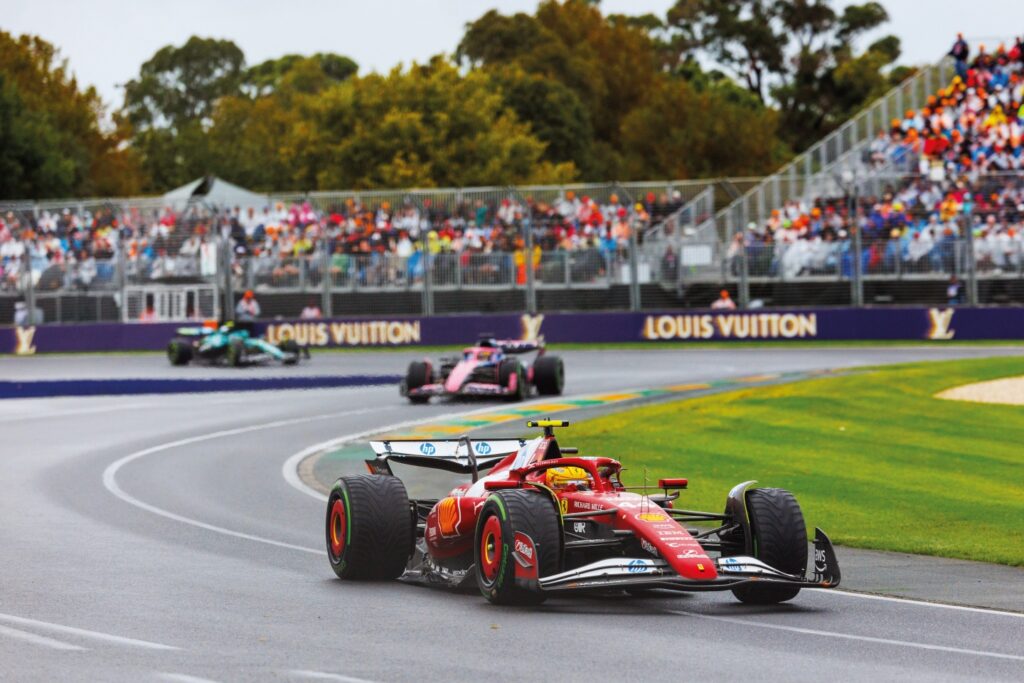
In 2024, LVMH announced a historic 10-year global partnership with Formula 1 — representing one of the largest sports sponsorship agreements ever signed by a luxury brand. Valued at an estimated $1.5 billion, the partnership positions Louis Vuitton, Moët Hennessy, and TAG Heuer as the defining luxury presences at every Formula 1 race worldwide. TAG Heuer returned as Formula 1’s Official Timekeeper from the 2025 season, and the Grand Prix de Monaco — the jewel of the F1 calendar — welcomed a title sponsor for the first time in its 95-year history: the TAG Heuer Grand Prix de Monaco. The Louis Vuitton Australian Grand Prix marked the formal launch of the partnership. This alliance delivers LVMH unmatched access to Formula 1’s 1.5+ billion global fans — a younger, digitally-engaged audience that its brands are actively cultivating.
LVMH’s fashion shows are not industry presentations — they are cultural events staged with the ambition of haute couture and the reach of global media. Pharrell Williams’ Louis Vuitton Men’s Pre-Fall 2024 show in Hong Kong and his Spring-Summer 2025 men’s show at UNESCO headquarters in Paris each generated hundreds of millions of social impressions. Nicolas Ghesquière’s Women’s collections for Louis Vuitton regularly transform Paris landmarks (the Louvre, the Pont de l’Alma, the Musée d’Orsay) into theatrical backdrops. These shows serve as the highest-profile expression of LVMH’s ‘creativity as a marketing strategy’ philosophy.
9. Strategic Acquisitions: Finding Sleeping Beauties
Bernard Arnault’s stated philosophy of acquiring ‘sleeping beauties’ — brands with authentic heritage and dormant potential — is perhaps the most significant differentiator in LVMH’s strategy. The Group has made 37+ major acquisitions since 1987, carefully targeting brands that possess genuine craftsmanship credentials and cultural authority that can be amplified by LVMH’s operational expertise and global distribution. The pattern is consistent: identify an undervalued brand, invest heavily in its creative and retail execution, expand its geographic reach, and allow its heritage story to be told to a global audience.
The Tiffany & Co. acquisition — completed in January 2021 at approximately $15.8 billion — is LVMH’s most recent and arguably most transformative example. Under LVMH, Tiffany has undergone a comprehensive transformation: the global ‘With Love, Since 1837’ campaign reconnected the brand with its romantic heritage; the high jewelry segment launched landmark collections including Tiffany Titan by Pharrell Williams and the Bone cuff; operating profit has doubled; high jewelry revenue has quadrupled. The Landmark store on Fifth Avenue became the world’s #1 luxury store by revenue in 2024. LVMH’s acquisition of Belmond in 2019 ($2.6 billion) added a portfolio of iconic hotels, trains, and river cruises to its ‘Other Activities’ segment — providing a physical hospitality dimension to the luxury universe it creates.
10. Sustainability as a Brand Pillar: LIFE 360
LVMH’s LIFE 360 (LVMH Initiatives For the Environment) program is one of the most comprehensive corporate sustainability frameworks in the luxury sector — and LVMH communicates it with the same discipline and creativity that it applies to its product storytelling. Launched in 2021 with measurable targets for 2023, 2026, and 2030, LIFE 360 is structured around five strategic pillars: Creative Circularity, Biodiversity, Climate, Traceability & Transparency, and Engaging Stakeholders.
The results are exceptional. Against a 2026 target of 50% reduction in Scope 1 and 2 greenhouse gas emissions versus 2019, LVMH achieved a 55% reduction by end of 2024 — beating its own target by two full years. This is not incremental corporate sustainability; it is genuinely structural change. On circularity, 31% of materials used in LVMH Maisons’ products and packaging are now sourced through recycling processes. Louis Vuitton alone repairs 600,000 products per year, while Rimowa offers a lifetime guarantee on its luggage. By year-end 2024, LVMH had regenerated or restored 3.8 million hectares of flora and fauna habitat (target: 5 million by 2030).
From a brand marketing perspective, sustainability positions LVMH as a steward of the natural resources that make luxury possible — the mahogany forests of Central Africa, the Mongolian cashmere plateaux, the grape-growing regions of Champagne and Cognac. LVMH’s LIFE 360 Business Partners program extends sustainability requirements into its supply chain, creating a cascade of impact across the 3,500+ suppliers who serve its Maisons. The Group also supported the restoration of Notre-Dame Cathedral in Paris and operates the Institut des Métiers d’Excellence (IME), which has trained 3,300+ apprentices in heritage crafts since 2014.
| LIFE 360 Key Results
Scope 1+2 GHG emissions: -55% vs 2019 (target was -50% by 2026 — achieved 2 YEARS EARLY) 31% of materials sourced through recycling processes 3.8 million hectares of habitat regenerated or restored (target: 5M by 2030) Louis Vuitton repairs 600,000 products/year; Rimowa offers lifetime guarantee 910+ nonprofits supported in 2024; ~65,000 LVMH employees in community partnerships |
11. Cultural Investment and Philanthropy
LVMH’s cultural philanthropy is a marketing strategy as much as a genuine commitment — and the two are not in contradiction. By funding great cultural institutions, LVMH aligns its brands with human achievement at the highest level. The Fondation Louis Vuitton has attracted 11 million visitors since opening in 2014, commissioning exhibitions by Basquiat, Hockney, Morozov, and Hermès — placing Louis Vuitton at the centre of the global art conversation. LVMH’s support for the restoration of Notre-Dame Cathedral, announced after the 2019 fire, contributed to one of France’s most emotionally significant cultural recovery moments, reopening in December 2024 — an occasion directly cited by Bernard Arnault in the FY2024 results statement.
Les Journées Particulières — LVMH’s open-door initiative that invites the public behind the scenes of its Maisons’ workshops, ateliers, and heritage sites — generates enormous goodwill and media coverage while simultaneously building the brand mythology that sustains premium pricing. In 2024, LVMH supported 910+ nonprofits and charitable foundations globally, with approximately 65,000 employees participating in community partnership programs serving more than 1,900,000 people. The Group paid €6 billion in corporate tax worldwide, €3 billion of which in France — facts that Bernard Arnault regularly highlights as part of LVMH’s social contract with France and Europe.
Marketing Mix of LVMH (4Ps)
1. Product
LVMH’s product strategy is governed by an uncompromising commitment to exceptional quality, creativity, and craftsmanship — the ‘three pillars’ referenced in the Group’s annual communications. Across 75+ Maisons, products range from entry-level leather goods and cosmetics to one-of-a-kind haute couture gowns and high jewellery suites worth millions of euros. R&D investment is continuous: Parfums Christian Dior regularly releases innovative fragrances (Sauvage remains the world’s best-selling fragrance); TAG Heuer introduces new movement technology; Louis Vuitton creates travel innovations for the modern world — from tech-integrated luggage to lightweight high-performance materials. Innovation and heritage are never seen as opposing forces; they are treated as complementary imperatives.
2. Price
LVMH’s pricing strategy is designed to maintain the exclusivity and aspirational appeal of its brands. Prices are set at a premium level that reflects the exceptional quality of materials, the scarcity of artisanal production, and the cultural authority of each Maison’s heritage. Crucially, LVMH’s brands do not discount their core permanent collections — a discipline that preserves resale value and signals confidence in the enduring desirability of their products.
The pricing architecture across each Maison is multi-tiered: accessible entry-level products attract aspirational consumers, while limited editions and high jewellery or haute couture apex products sustain the brand’s ultra-luxury positioning. Price increases are applied periodically — often in response to inflation in raw materials or labor — and are accepted by the market because the brands’ desirability exceeds the price sensitivity of their core customers.
3. Place
LVMH’s distribution strategy is built on selectivity and control. Its 6,280+ stores worldwide are chosen with extreme care — located in the world’s premier luxury retail destinations (Avenue Montaigne, 5th Avenue, Bond Street, the Ginza) — with each flagship store designed as an immersive brand world. LVMH’s selective retailing arm (Sephora, Le Bon Marché, DFS) provides curated multi-brand environments that maintain luxury positioning while reaching broader audiences. E-commerce has been integrated progressively — Louis Vuitton, Dior, and other Maisons operate their own e-boutiques with selective product availability. The Group never makes its luxury products available through unauthorized channels, auction platforms, or discount retailers — protecting brand equity absolutely.
4. Promotion
LVMH’s promotional strategy integrates paid media (print advertising in Vogue, Harper’s Bazaar, Le Monde), earned media (fashion shows, cultural events, brand collaborations), owned channels (brand e-boutiques, social media, Maison newsletters), and experiential marketing (flagship store activations, pop-up installations, cultural events). Celebrity partnerships and creative director appointments generate earned media at a scale that no advertising budget alone can buy. Fashion shows are both creative statements and global promotional events — Louis Vuitton’s shows regularly generate hundreds of millions of organic social impressions. The Olympic and Formula 1 partnerships in 2024 and 2025 respectively represent a new dimension of promotional reach, connecting LVMH’s brands with the world’s largest live sports audiences.
STP Analysis of LVMH: Segmentation, Targeting and Positioning
Segmentation
LVMH segments its consumers across three primary dimensions: income and wealth (Ultra-High-Net-Worth Individuals / HNWIs / affluent aspirational); geography (Europe, North America, Japan, China/Asia, Rest of World — each with distinct luxury purchasing behaviors and cultural drivers); and psychographics (heritage connoisseurs, creative innovators, social status signallers, experience seekers, and gift-givers). LVMH’s decentralized Maison structure means each brand effectively segments and serves a distinct sub-cluster within the broader luxury consumer universe — Louis Vuitton targets a broad affluent global audience; La Prairie and Loro Piana serve a much narrower ultra-high-net-worth clientele; Sephora targets beauty enthusiasts across income levels.
Targeting
LVMH targets its marketing efforts differently by Maison and by geography. Fashion brands (Louis Vuitton, Christian Dior) invest heavily in high-end editorial, fashion shows, and celebrity partnerships to reach global fashion-conscious consumers. Spirits brands (Hennessy, Moët) target celebration occasions — partnering with sports events, music culture, and hospitality venues. Beauty brands (Sephora, Dior Beauty) use social media, beauty influencers, and experiential retail to target younger, digitally-engaged consumers. Watches and jewelry brands (Tiffany, Bulgari) use high-profile cultural events, sports partnerships (Formula 1 for TAG Heuer), and collector communications to target high-value gifting occasions and personal milestone purchases.
Positioning
LVMH’s brands are positioned as luxury and exclusive — with each Maison occupying a distinct position within that universe. Louis Vuitton positions itself as the world’s most innovative luxury travel and lifestyle brand, rooted in a 170-year heritage of craftsmanship but in relentless creative pursuit of modernity. Christian Dior embodies Paris couture at its most aspirational — the spirit of ‘New Look’ femininity reimagined for every generation. Tiffany & Co. owns romantic love and American luxury heritage. TAG Heuer is the watch of champions — precise, bold, and athletic. Bulgari is Italian luxury at its most baroque and joyful. Taken together, the portfolio covers every luxury occasion, desire, and archetype — giving LVMH an unrivalled positioning breadth.
Also Read: Louis Vuitton — Success Factors of the Top Luxury Brand
Porter’s Five Forces Analysis of LVMH
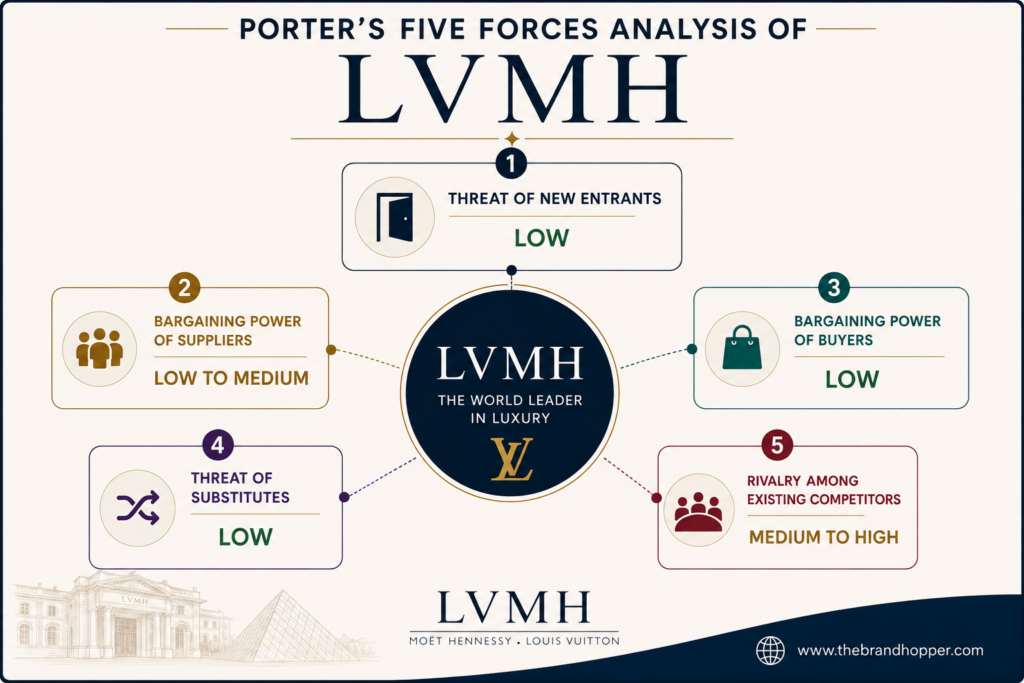
Threat of New Entrants — LOW
The luxury goods industry presents among the highest barriers to entry of any sector. Building a genuine luxury brand requires decades — sometimes centuries — of heritage, impeccable craftsmanship credentials, distribution in the world’s most exclusive retail locations, and the cultural authority that comes from association with the worlds of art, fashion, and culture. LVMH’s 75+ Maisons collectively represent centuries of accumulated brand equity that no amount of capital spending can instantly replicate. The cost of establishing flagship stores in premium global locations, funding high-fashion shows, and attracting world-class creative talent creates structural barriers that protect all established luxury houses.
Bargaining Power of Suppliers — LOW TO MEDIUM
LVMH’s scale and purchasing power give it significant advantages in supplier negotiations, but its dependence on rare, high-quality natural materials (vicuña fiber, Limousin oak for Hennessy barrels, Champagne appellation grapes, alligator leather) creates selective supplier concentration risks. To mitigate this, LVMH has invested in backward integration — owning champagne vineyards (Château d’Yquem, Château Cheval Blanc), sourcing merino wool through its own regenerative agriculture programs in Australia, and building direct relationships with artisanal suppliers through multi-year contracts. The LIFE 360 Business Partners program further strengthens these relationships by supporting suppliers’ own sustainability transformations.
Bargaining Power of Buyers — LOW
In the ultra-luxury segment, the bargaining power of buyers is structurally low. Luxury goods are price-inelastic at their target consumer tier: a client purchasing a €30,000 Bulgari high jewelry piece is not comparison-shopping for cheaper alternatives — they are purchasing the emotional, social, and aesthetic value of that specific brand at that specific price. LVMH’s most loyal clients (VICs — Very Important Clients) receive personalized service, early access to limited editions, and experiences that create switching costs beyond mere product satisfaction. The power dynamic is further compressed by controlled scarcity: waiting lists for certain Louis Vuitton and Hermès products mean that buyers must wait for supply, not the other way around.
Threat of Substitutes — LOW
The threat of substitutes in luxury is uniquely low because the product itself is often the symbol, not merely the utility. A Swatch watch may tell time more efficiently than a Hublot; a high-street handbag may carry one’s belongings as effectively as a Louis Vuitton Neverfull. But neither delivers the social signal, the craftsmanship narrative, the brand community, or the emotional satisfaction of ownership that LVMH’s brands provide. The rise of ‘affordable luxury’ brands (Coach, Michael Kors) and DTC challenger brands (Polène in leather goods, Daniel Wellington in watches) represents a competitive adjacency, but they do not occupy the same psychological space as LVMH’s core portfolio.
Rivalry Among Existing Competitors — MEDIUM TO HIGH
The luxury goods industry is highly competitive, with LVMH’s three principal rivals — Kering (Gucci, Saint Laurent, Balenciaga), Richemont (Cartier, Van Cleef & Arpels, IWC), and Hermès — all maintaining formidable positions in specific categories. Hermès, in particular, operates as LVMH’s most direct competitor in ultra-premium leather goods and has outperformed the market in recent years through its even stricter scarcity model and artisanal production constraints. However, LVMH’s scale advantage, portfolio diversity, and investment capacity provide resilience that no single-brand or smaller multi-brand competitor can match. The competitive intensity most often plays out in talent recruitment, flagship retail location competition, and the race for cultural relevance through creative partnerships.
Also Read: Elevating Luxury: Exploring Marketing Strategies of Louis Vuitton
Conclusion
LVMH’s marketing strategy is best understood not as a single playbook but as a living philosophy — one built on the conviction that creativity, quality, and heritage, consistently expressed and relentlessly elevated, create enduring brand value that outlasts any economic cycle. With €84.7 billion in FY2024 revenue, 75+ Maisons, 215,000 employees, and a retail network spanning 6,280+ stores, LVMH is not simply the world’s largest luxury conglomerate — it is the primary architect of what global luxury means in the 21st century.
Whether it is Pharrell Williams reimagining Louis Vuitton menswear for the hip-hop generation, Chaumet embedding pieces of the Eiffel Tower into Olympic medals, TAG Heuer returning as Formula 1’s Official Timekeeper for the next decade, or LVMH’s Maisons restoring Notre-Dame Cathedral, every strategic move is a reflection of a coherent marketing vision: luxury is not about price — it is about desire, craft, culture, and the belief that human creativity at its finest deserves to be preserved, celebrated, and experienced.
Frequently Asked Questions (FAQs)
Q: What is LVMH’s annual revenue?
A: LVMH recorded revenue of €84.7 billion in FY2024 (reported growth -2%, organic growth +1%), with profit from recurring operations of €19.6 billion and a 23.1% operating margin. The Group’s largest segment is Fashion & Leather Goods (€41.1bn), followed by Selective Retailing (€18.3bn) and Watches & Jewelry (€10.6bn). This data is sourced from LVMH’s official FY2024 annual results press release, published January 28, 2025.
Q: How many brands does LVMH own?
A: LVMH owns 75+ prestigious Maisons (brands) across six business sectors: Wines & Spirits, Fashion & Leather Goods, Perfumes & Cosmetics, Watches & Jewelry, Selective Retailing, and Other Activities. Key brands include Louis Vuitton, Christian Dior, Fendi, Tiffany & Co., Bulgari, Sephora, Hennessy, Moët & Chandon, TAG Heuer, Hublot, Guerlain, and Fenty Beauty by Rihanna, among many others.
Q: What was LVMH’s role in the Paris 2024 Olympics?
A: LVMH served as a Premium Partner of the Paris 2024 Olympic and Paralympic Games — the first luxury conglomerate ever to hold this status. Chaumet designed and created the Olympic medals (first jeweller in history to do so), with each medal containing 18 grams of original Eiffel Tower iron. Louis Vuitton designed the trunks transporting the medals and torches. Berluti created the French delegation’s opening ceremony uniforms. Sephora served as Official Partner of the Olympic Torch Relay. The sponsorship was valued at approximately $163 million.
Q: What is the LIFE 360 sustainability program?
A: LIFE 360 (LVMH Initiatives For the Environment) is LVMH’s environmental strategy, launched in 2021, structured around five pillars: Creative Circularity, Biodiversity, Climate, Traceability & Transparency, and Engaging Stakeholders. Key achievements include a 55% reduction in Scope 1 and 2 GHG emissions versus 2019 (two years ahead of the 2026 target), 31% of materials sourced through recycling processes, and 3.8 million hectares of biodiversity habitat regenerated or restored.
Q: How has LVMH transformed Tiffany & Co. since acquiring it?
A: Since completing the acquisition in January 2021, LVMH has fundamentally repositioned Tiffany through a combination of creative reinvention and operational investment. High jewelry revenue has quadrupled since acquisition; operating profit has doubled. The global ‘With Love, Since 1837’ campaign engaged Rosé, Anya Taylor-Joy, and Hailey Bieber to attract younger consumers. The Pharrell Williams ‘Tiffany Titan’ collection was exceptionally well received. Tiffany’s Landmark flagship store on Fifth Avenue in New York became the world’s #1 luxury store by revenue in 2024.
Q: Who is Bernard Arnault and what is his role at LVMH?
A: Bernard Arnault is the Chairman and CEO of LVMH Moët Hennessy Louis Vuitton and one of the world’s wealthiest individuals. Born in 1949 in Roubaix, France, Arnault took control of LVMH in 1989 and has since overseen its transformation from a two-brand company into the world’s largest luxury conglomerate with 75+ Maisons. His philosophy of acquiring ‘sleeping beauties’ — brands with dormant potential — and his commitment to decentralized creative management have defined LVMH’s extraordinary growth trajectory.
Q: What is LVMH’s Formula 1 partnership about?
A: In 2024, LVMH announced a historic 10-year global partnership with Formula 1, officially launching at the Formula 1 Louis Vuitton Australian Grand Prix in 2025. TAG Heuer returned as Formula 1’s Official Timekeeper from the 2025 season for 10 years, and the Grand Prix de Monaco — the world’s most prestigious motor race — welcomed TAG Heuer as its title sponsor for the first time ever. The partnership is estimated at approximately $1.5 billion and positions Louis Vuitton, Moët Hennessy, and TAG Heuer as Formula 1’s defining luxury presences.
Q: What are LVMH’s key competitive advantages over Kering, Richemont, and Hermès?
A: LVMH’s primary competitive advantages include: (1) Portfolio breadth — 75+ Maisons across 6 luxury sectors provides diversification unavailable to single-group rivals; (2) Scale — €5.5 billion in operating investments and the world’s largest luxury retail network; (3) Selective Retailing (Sephora) — a direct consumer relationship asset no competitor matches; (4) Brand architecture expertise — LVMH’s decentralized management model attracts the world’s best creative talent; (5) Financial strength — €10.5 billion in free cash flow in FY2024 enables continued investment in brand development, acquisitions, and flagship retail throughout economic cycles.
To read more content like this, subscribe to our newsletter