
Last Updated on October 24, 2026 by Team TBH
Duke Energy Corporation is one of the largest US investor-owned electric utilities, with regulated operations across the Southeast and Midwest. Its scale, generation fleet, transmission and distribution infrastructure, and long-term investment programme make it an important participant in the US energy transition.
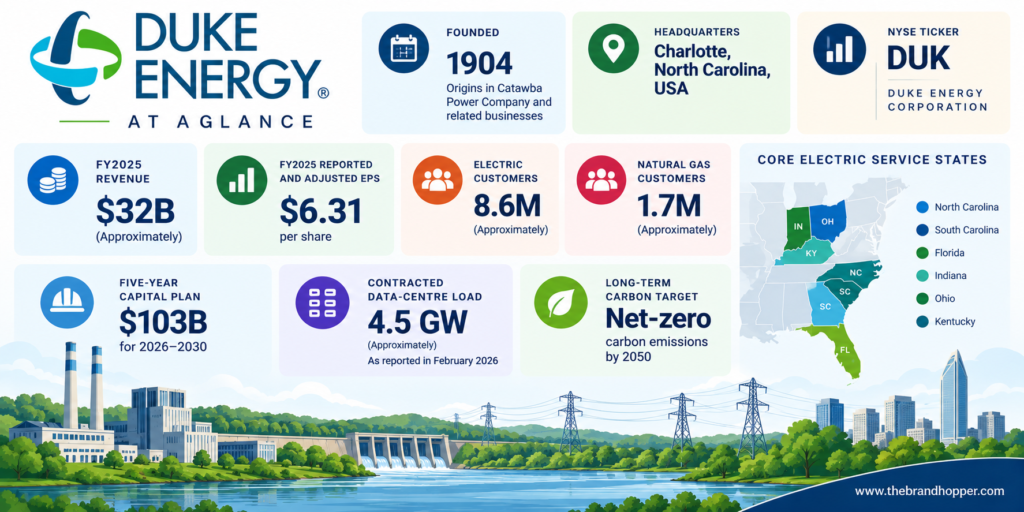
Duke reported approximately $32 billion in revenue for fiscal 2025 and earnings per share of $6.31. In February 2026, the company announced a $103 billion capital plan for 2026–2030, reflecting expectations of rising electricity demand and the need for investment in generation, transmission and distribution infrastructure.
The company also reported approximately 4.5 GW of contracted data-centre load. This reflects growing demand from energy-intensive digital infrastructure, although contracted capacity should not be confused with electricity already being consumed or projects already operating.
Duke’s strategy includes modernising the grid, replacing retiring generation, expanding cleaner energy resources and maintaining system reliability. Its long-term goal is net-zero carbon emissions by 2050, with interim milestones described in its clean energy transition strategy.
Duke operates primarily in regulated retail electricity markets, where customers generally do not choose between competing electric utilities in the same way they choose between consumer brands. As a result, its competitors include adjacent utilities, companies competing for wholesale power and renewable-energy contracts, and industry peers that provide useful benchmarks for investment and operations.
Top Competitors of Duke Energy
1. NextEra Energy
NextEra Energy is a major US electric utility and clean-energy company headquartered in Juno Beach, Florida. Its principal businesses include Florida Power & Light, a regulated utility, and NextEra Energy Resources, which develops and operates renewable generation, energy storage and other power assets.
NextEra’s scale in wind, solar and storage makes it an important competitor in the market for renewable-energy development and large corporate power agreements. Its renewable portfolio and project pipeline also make it a useful benchmark for Duke as both companies respond to increasing electricity demand.
The companies have some geographic overlap in Florida through their utility operations, but the market structure remains regulated. NextEra Energy Resources is also a competitor in wholesale power and renewable-energy development rather than a direct alternative for every Duke retail customer.
Competitive relevance: Renewable generation, energy storage, large-load customers and Florida utility operations.
2. Southern Company
Southern Company is one of Duke Energy’s closest large-scale utility peers. Headquartered in Atlanta, Georgia, it operates regulated electric and gas utilities, including Georgia Power, Alabama Power and Mississippi Power, alongside generation and other energy businesses.
Southern Company reported approximately $29.6 billion in operating revenue for fiscal 2025 and net income attributable to the company of approximately $4.3 billion. Its operations serve a large customer base across the southeastern United States, making it a relevant comparison for Duke’s investment strategy, reliability planning and demand growth.
Southern’s generation portfolio includes nuclear power. Vogtle Unit 4 entered commercial operation in 2024, following Unit 3 in 2023, expanding the company’s nuclear generation capacity. The project also illustrates the cost, schedule and construction risks associated with large nuclear developments.
Southern and Duke compete for industrial investment, data-centre development and skilled energy-sector workers across parts of the Southeast. Their regulated retail service territories are not interchangeable, however, and the companies’ relative performance should be assessed using comparable financial and operating measures.
Competitive relevance: Southeastern utility operations, nuclear generation, industrial load growth and grid investment.
3. Exelon Corporation
Exelon is a major US regulated electric and gas utility holding company. Its utility businesses include Commonwealth Edison in Illinois, PECO in Pennsylvania, Baltimore Gas and Electric in Maryland, Pepco, Delmarva Power and Atlantic City Electric.
After spinning off Constellation Energy in 2022, Exelon became primarily focused on regulated transmission and distribution rather than owning a large competitive generation business. It reported approximately $24.3 billion in revenue for fiscal 2025, with operations serving millions of electric and gas customers in several major metropolitan regions.
Exelon’s investment priorities include grid modernisation, reliability, electrification and infrastructure upgrades to support changing demand. Its urban and suburban networks provide a useful comparison with Duke’s grid investment needs, even though Exelon does not operate a utility franchise throughout Duke’s core territory.
The two companies are also relevant to discussions about transmission policy, utility regulation and the affordability of major infrastructure programmes. Their participation in regional electricity markets and transmission systems varies by subsidiary and location, so claims about direct market overlap should be made at the service-territory level.
Competitive relevance: Regulated transmission and distribution, urban grid reliability, infrastructure investment and utility regulation.
4. American Electric Power
American Electric Power operates regulated electric utilities and one of the largest high-voltage transmission networks in the United States. Headquartered in Columbus, Ohio, AEP serves customers across several states, including Ohio, Indiana, Kentucky, West Virginia, Virginia and Texas.
AEP is an important Duke peer because both companies are investing in infrastructure to support electrification, industrial growth and increased electricity consumption. AEP’s transmission network is a major strategic asset for connecting generation resources and moving electricity across regions.
In February 2026, AEP reported strong 2025 earnings and highlighted rapidly growing electricity-load opportunities. Its capital investment plans have also increased in response to projected demand, including from data centres and other large customers.
AEP and Duke have adjacent or overlapping regional market exposure in parts of the Midwest, including Indiana, Ohio and Kentucky, although their regulated service territories are distinct. They also compete indirectly to attract large industrial customers and investment to their respective regions.
Competitive relevance: Transmission infrastructure, industrial demand, data centres and Midwest utility operations.
5. PG&E Corporation

PG&E Corporation is the parent company of Pacific Gas and Electric Company, a major investor-owned utility serving northern and central California. Its operations cover electricity and natural gas distribution across a large and geographically varied service area.
PG&E reported approximately $24.9 billion in operating revenue for fiscal 2025. Its system faces distinct challenges, including wildfire risk, grid resilience, electricity affordability and California’s decarbonisation requirements.
The company has invested in measures such as covered conductors, vegetation management, monitoring systems and other grid-hardening technologies. Its experience offers useful lessons for Duke as it prepares its own network for hurricanes, ice storms, flooding and other extreme-weather events.
PG&E does not have a direct regulated service-territory overlap with Duke. It is best viewed as an operational and strategic benchmark for wildfire mitigation, infrastructure resilience, electrification and the integration of distributed energy resources.
Competitive relevance: Grid resilience, wildfire mitigation, electrification and clean-energy integration.
6. Dominion Energy
Dominion Energy is a major regulated utility headquartered in Richmond, Virginia. Its core operations are centred on electric and gas utility services, particularly in Virginia and South Carolina, with additional operations and customers in other areas.
Dominion reported approximately $16.5 billion in operating revenue for fiscal 2025. Its strategic priorities include grid reliability, generation investment and meeting electricity demand that is growing rapidly in Virginia, including from data centres.
The company’s Coastal Virginia Offshore Wind project is a major offshore wind development, with a planned capacity of approximately 2.6 GW. Project timelines, costs and operational status should be checked against the latest company disclosures because construction and commissioning schedules can change.
Dominion’s Virginia service territory is particularly relevant to Duke’s strategy because both companies face rising demand from large electricity users. Their retail service territories are largely distinct, so competition is more often associated with attracting investment, procuring generation and developing energy infrastructure than with customers switching between utilities.
Competitive relevance: Virginia data-centre demand, offshore wind, generation planning and utility infrastructure.
7. Xcel Energy
Xcel Energy is a regulated utility company headquartered in Minneapolis, Minnesota. It serves electric and natural gas customers across several states, including Minnesota, Colorado, Wisconsin, Texas, New Mexico, Michigan, North Dakota and South Dakota.
Xcel is widely recognised for its investment in wind generation and its efforts to reduce carbon emissions from electricity production. Its resource plans combine renewable energy development, transmission investment, conventional generation and other measures intended to maintain reliability while the generation mix changes.
The company reported approximately $2.0 billion in GAAP net income for fiscal 2025, with ongoing earnings of approximately $2.24 billion. Earnings measures should not be confused with revenue; comparisons with Duke should use the same financial metric and reporting period.
Xcel and Duke do not operate interchangeable retail franchises. Xcel is more appropriately treated as a benchmark for renewable deployment, integrated resource planning, utility regulation and the management of rising electricity demand.
Competitive relevance: Renewable generation, emissions-reduction planning, grid modernisation and regulatory strategy.
8. Eversource Energy

Eversource Energy operates electric and natural gas utilities in Connecticut, Massachusetts and New Hampshire. Its service territory includes densely populated communities with significant requirements for grid maintenance, reliability and electrification.
Eversource’s strategic priorities include distribution infrastructure, transmission investment and the integration of cleaner energy resources. Its experience provides a useful comparison for Duke on utility planning, rate cases and the challenges of maintaining reliable service while investing in ageing infrastructure.
Eversource previously invested in offshore wind projects but exited those investments through transactions completed in 2023 and 2024. This experience demonstrates the commercial risks associated with offshore wind contracts, project financing, construction costs and changing market conditions.
The company reported full-year 2025 GAAP earnings of approximately $1.69 billion and recurring earnings of approximately $1.77 billion. These are earnings figures, not revenue, and should not be substituted for revenue in a comparison table.
Competitive relevance: Grid modernisation, transmission, utility regulation and offshore wind investment lessons.
9. Entergy Corporation
Entergy is a regulated utility company headquartered in New Orleans, Louisiana. It serves customers across Arkansas, Louisiana, Mississippi and Texas and operates a generation portfolio that includes nuclear power plants.
The company’s Gulf Coast service area includes major industrial customers in sectors such as chemicals, manufacturing and liquefied natural gas. New industrial facilities and data centres can create substantial demand for generation, transmission and distribution investment.
Entergy’s energy strategy includes grid improvements, generation planning and carbon-reduction initiatives. Its nuclear fleet is an important part of its electricity portfolio, while additional generation and infrastructure investments are intended to support reliability and customer growth.
Entergy reported approximately $1.76 billion in net income for fiscal 2025. This figure is not its revenue; the distinction matters when comparing the company’s financial scale with Duke Energy and other utilities.
Although Entergy and Duke serve different territories, they face comparable questions about industrial load growth, energy affordability, generation replacement and the reliability of infrastructure exposed to extreme weather.
Competitive relevance: Gulf Coast industrial demand, nuclear generation, resilience investment and utility planning.
10. WEC Energy Group
WEC Energy Group is a regulated utility holding company headquartered in Milwaukee, Wisconsin. Its businesses include We Energies, Wisconsin Public Service and other electric and natural gas utilities serving customers across several Midwestern markets.
WEC reported approximately $9.8 billion in consolidated revenue for fiscal 2025. Its investment priorities include generation, distribution infrastructure, renewable energy and reliability improvements designed to meet customer needs while maintaining regulated returns.
WEC has also emphasised disciplined capital allocation and dividend growth. Those financial characteristics make it relevant to utility investors comparing the earnings stability, capital intensity and financing needs of companies such as WEC and Duke.
WEC is not a direct competitor to Duke across most retail markets. Its value as a comparator lies in regulated utility operations, infrastructure investment, resource planning and the management of customer affordability.
Competitive relevance: Capital allocation, regulated utility returns, grid modernisation and renewable investment.
11. Ameren Corporation
Ameren serves electric and natural gas customers in Missouri and Illinois through its regulated utility businesses. Its operations include electricity generation and transmission, as well as distribution networks that serve residential, commercial and industrial customers.
Ameren is investing in grid modernisation, transmission capacity and generation resources as electricity demand and decarbonisation requirements evolve. Its resource planning must balance the cost of replacing or upgrading existing generation with reliability and affordability for customers.
Ameren’s regulatory experience is useful for understanding how utilities in the Midwest structure infrastructure investment and seek cost recovery through state utility commissions. The company’s service territory does not substantially overlap Duke’s, so it is more accurately treated as a regional peer than a direct retail competitor.
Ameren reported approximately $1.46 billion in GAAP net income for fiscal 2025. That figure should be distinguished from revenue when comparing financial scale across the sector.
Competitive relevance: Midwest utility regulation, grid investment, generation planning and affordability.
12. Public Service Enterprise Group

Public Service Enterprise Group, commonly known as PSEG, is a New Jersey-based energy company whose businesses include Public Service Electric and Gas Company (PSE&G) and nuclear generation operations. PSE&G provides electric and natural gas service to customers in New Jersey.
PSEG’s regulated utility business invests in transmission, distribution, energy efficiency and infrastructure replacement. Its nuclear assets also contribute to electricity supply in the PJM region, where generation reliability and capacity requirements are important market considerations.
PSEG reported approximately $12.2 billion in total annual revenue for fiscal 2025. Its strategy includes a multi-year regulated capital investment programme aimed at improving infrastructure and supporting customer demand.
PSEG and Duke operate in different core retail territories. PSEG is a useful peer for comparing regulated infrastructure, nuclear generation, capital plans and the relationship between investment, earnings growth and customer rates.
Competitive relevance: Regulated infrastructure, nuclear power, transmission and capital investment.
13. Consolidated Edison
Consolidated Edison, or Con Edison, is a major regulated utility serving New York City and Westchester County, with additional operations through its other utility businesses. Its electricity and gas networks support one of the most densely populated metropolitan areas in the United States.
Con Edison’s infrastructure requires substantial investment in underground cables, substations, distribution equipment and reliability improvements. Its experience managing a dense urban grid offers a useful comparison for Duke as cities such as Charlotte and Raleigh grow and electricity demand changes.
Con Edison sold its former Clean Energy Businesses to RWE in 2023, reinforcing its focus on regulated utility operations. This transaction is important context when assessing the company’s current business mix and comparing it with utilities that own larger competitive generation portfolios.
Con Edison reported net income of approximately $2.02 billion for fiscal 2025. It is not a direct geographic competitor to Duke, but it is a relevant benchmark for urban-grid reliability, infrastructure investment and utility regulation.
Competitive relevance: Urban grid infrastructure, reliability, electrification and regulated utility operations.
14. Sempra

Sempra is an energy infrastructure company with businesses spanning regulated utilities and energy infrastructure in the United States and Mexico. Its portfolio includes Southern California Gas, San Diego Gas & Electric, Oncor Electric Delivery and Sempra Infrastructure.
Sempra reported approximately $13.7 billion in consolidated revenue for fiscal 2025. Its businesses cover a range of activities, including regulated electricity and natural gas delivery, transmission and distribution, and energy infrastructure projects.
Oncor, Sempra’s Texas electric transmission and distribution subsidiary, serves a large and growing customer base in Texas. Electricity demand from population growth, industrial investment and data centres makes the state an important market for grid infrastructure expansion.
Sempra’s diversified business mix differs from Duke’s more concentrated regulated utility structure. The company is therefore best treated as a strategic peer in infrastructure investment and large-load growth rather than a direct competitor across Duke’s retail service territory.
Competitive relevance: Electric transmission and distribution, data-centre demand, energy infrastructure and capital investment.
15. PPL Corporation
PPL Corporation operates regulated electric and natural gas utilities in Pennsylvania, Kentucky and Rhode Island. Its subsidiaries include PPL Electric Utilities, Louisville Gas and Electric, Kentucky Utilities and Rhode Island Energy.
PPL reported approximately $9.04 billion in operating revenue for fiscal 2025. Its capital investment priorities include grid reliability, modernisation, transmission and distribution upgrades, and infrastructure needed to support changes in electricity consumption.
PPL’s Kentucky utilities are relevant to Duke’s Midwest operations because both companies operate in the broader regional energy market and must manage the transition of generation resources while maintaining reliable and affordable service.
PPL’s regulatory experience and investment plans make it a useful peer for analysing utility capital spending and earnings growth. It is not a direct retail competitor across all of Duke’s service territories.
Competitive relevance: Kentucky utility operations, grid modernisation, regulated capital investment and customer affordability.
16. CenterPoint Energy

CenterPoint Energy is a regulated electric and natural gas utility company headquartered in Houston, Texas. Its Houston Electric business serves a large metropolitan area, while its natural gas distribution operations extend into several other states.
CenterPoint’s investment priorities include strengthening the electric grid, improving storm resilience and upgrading infrastructure to support population growth and changing demand. Its Houston service area is particularly exposed to severe weather, making grid resilience and emergency restoration important strategic concerns.
In July 2026, CenterPoint announced that its ten-year capital investment plan had increased to approximately $66.7 billion. This is a forward-looking investment plan rather than completed spending, and it should be described separately from annual revenue or current assets.
CenterPoint and Duke have different core electric service territories. CenterPoint is a useful comparison for storm hardening, distribution infrastructure and the financing of major utility investment programmes.
Competitive relevance: Grid resilience, electric distribution, infrastructure investment and demand growth.
17. Avangrid
Avangrid is an energy company owned by Spain’s Iberdrola. It operates regulated electric and gas utilities in the northeastern United States and has renewable-energy development activities.
Its utility businesses serve customers in states including New York, Maine, Connecticut and Massachusetts, with other operations subject to changes in the company’s portfolio. Its renewable-energy activities have included onshore and offshore wind projects, although project development, construction and commercial operation are separate milestones.
Avangrid’s connection to Iberdrola gives it access to the parent company’s international experience in regulated utilities and renewable energy. Its strategic relevance to Duke is strongest in clean-energy development, project procurement, and the broader competition for investment and electricity supply contracts.
Iberdrola completed its acquisition of the remaining shares of Avangrid in 2024, taking the company private. Consequently, Avangrid should not be described as a currently independently listed public company.
Competitive relevance: Renewable-energy development, regulated utility operations and clean-energy project procurement.
How to Choose a Duke Energy Alternative
The right comparison depends on the reason for evaluating Duke Energy. An investor, a large industrial customer, a policymaker and a renewable-energy developer may each define “alternative” differently.
For investors, the most useful measures include earnings growth, debt, capital expenditure, regulatory exposure, dividend policy and the risks associated with new generation and transmission projects. Revenue alone does not show whether a utility is generating attractive returns or managing its investment programme efficiently.
For large industrial customers and data-centre operators, relevant considerations include available grid capacity, connection timelines, reliability, tariffs, access to renewable-energy contracts and the local regulatory environment. A utility’s announced data-centre pipeline should not be treated as secured revenue unless the company has disclosed the relevant contract or commitment.
For organisations seeking renewable electricity, companies such as NextEra Energy and Avangrid may be relevant through generation development and power-purchase arrangements. Availability depends on the market, project status, contract structure and the customer’s electricity procurement options.
For policymakers and utility analysts, useful indicators include reliability measures such as SAIDI and SAIFI, electricity rates, capital investment, generation mix, emissions targets and the execution of resource plans. Comparisons should use consistent definitions and reporting periods.
Frequently Asked Questions
Q1. Who is Duke Energy’s biggest competitor?
A: There is no single answer across all measures. Southern Company is a close peer by revenue and southeastern utility operations, while NextEra Energy is a major competitor in renewable-energy development and has a regulated utility business in Florida. AEP, Dominion and other regional utilities are relevant depending on the market and activity being compared.
Q2. How does Duke Energy’s revenue compare with its competitors?
A: Duke Energy reported approximately $32 billion in revenue for fiscal 2025. Southern Company reported approximately $29.6 billion, Exelon approximately $24.3 billion and PG&E Corporation approximately $24.9 billion. These are consolidated revenue figures, and differences in business mix can affect how meaningful the comparison is.
Q3. Is Duke Energy the largest utility in the United States?
A: The answer depends on the measure used. Utilities can be ranked by revenue, market capitalisation, number of customers, electricity delivered, generation capacity or regulated rate base. Duke is among the largest US utilities by revenue, but it should not be described as the largest across every category.
Q4. Which utility company leads in renewable energy?
A: There is no universally applicable leader across all renewable-energy measures. NextEra Energy is a major developer and operator of wind, solar and storage, while other companies may lead on renewable electricity as a share of their own generation, installed capacity or particular technologies. The comparison should specify the metric, geography and reporting period.
Q5. What is Duke Energy’s capital investment plan?
A: Duke announced a $103 billion capital plan covering 2026–2030. The plan is intended to support grid infrastructure, generation and rising electricity demand. It represents planned investment over five years, not spending already completed.
Q6. How many states does Duke Energy serve?
A: Duke Energy’s core electric utility operations serve customers in North Carolina, South Carolina, Florida, Indiana, Ohio and Kentucky. Its natural gas operations have a different footprint and should not automatically be assumed to cover the same states or customer base.
Q7. Who are Duke Energy’s main competitors in the Carolinas?
A: Duke’s regulated retail electricity businesses have established service territories, so residential customers generally do not choose between Duke and another utility in the same way they would choose a retail supplier in a competitive market. Relevant competitors and peers include adjacent utilities, wholesale power generators, renewable-energy developers and companies seeking large industrial or data-centre investment.
Q8. What is Duke Energy’s net-zero target?
A: Duke Energy has a long-term target of net-zero carbon emissions by 2050. The company’s interim milestones and implementation plans should be checked against its latest disclosures, since emissions targets, generation plans and regulatory approvals can evolve.
Q9. How does Dominion Energy compare with Duke Energy?
A: Duke is larger by consolidated revenue, while Dominion has significant exposure to Virginia’s electricity demand, including data centres, and a major offshore wind project. Both companies are investing in infrastructure and generation, but their regulatory territories, customer bases and business mixes differ.
Q10. What trends are reshaping competition among US utilities?
A: Major trends include rising electricity demand from data centres and manufacturing, transmission expansion, renewable generation and storage, nuclear power, grid resilience, electrification and affordability. The pace at which utilities secure approvals, finance investments and bring projects online will influence their costs, reliability and financial performance.
Conclusion
Duke Energy is a major US utility with a large regulated service footprint and a substantial capital investment programme. Its $103 billion plan for 2026–2030 reflects the need to modernise infrastructure, support electricity demand and adapt its generation mix.
The 17 companies covered in this article provide different kinds of comparison. Southern Company and AEP are useful utility peers; NextEra Energy and Avangrid are important in renewable-energy development; PG&E and CenterPoint provide lessons in grid resilience; and Exelon, PSEG, WEC, PPL and other regulated utilities offer benchmarks for capital allocation, regulation and operations.
These companies should not be treated as interchangeable alternatives to Duke Energy. Their service territories, generation portfolios, regulatory frameworks and business models differ, and many do not compete directly for the same retail customers.
For investors, industrial customers and energy-sector analysts, the most useful assessment combines financial results with grid reliability, investment execution, customer affordability, demand growth and generation strategy. Tracking these factors provides a more accurate picture of Duke Energy’s competitive position than revenue rankings alone.
Also Read: Sempra Energy’s Top Competitors in Public Utility Industry
To read more content like this, subscribe to our newsletter