
Last Updated on August 13, 2026 by Team TBH
BlackRock, Inc. is the world’s largest asset management company, overseeing more than $11.6 trillion in assets under management (AUM) as of Q1 2025 — a figure that surpasses the GDP of every nation on earth except the United States and China. Built on the twin pillars of its iShares ETF franchise and Aladdin risk-technology platform, BlackRock has redefined what it means to be a financial institution in the twenty-first century. Yet even at this scale, BlackRock operates in a fiercely competitive industry where a dozen multi-trillion-dollar rivals fight for the same institutional mandates, advisor shelf space, and retail flows.
The asset management industry manages an estimated $120+ trillion in global AUM. Competition is waged on price, performance, technology, distribution reach, and increasingly, alternatives and private markets capabilities. This article profiles the 18 most significant competitors that challenge BlackRock across its core businesses: passive indexing, active management, ETFs, alternatives, and risk technology. Each profile covers the competitor’s AUM, founding story, strategic strengths, and specific areas where it poses the greatest threat to BlackRock’s market position.
BlackRock at a Glance
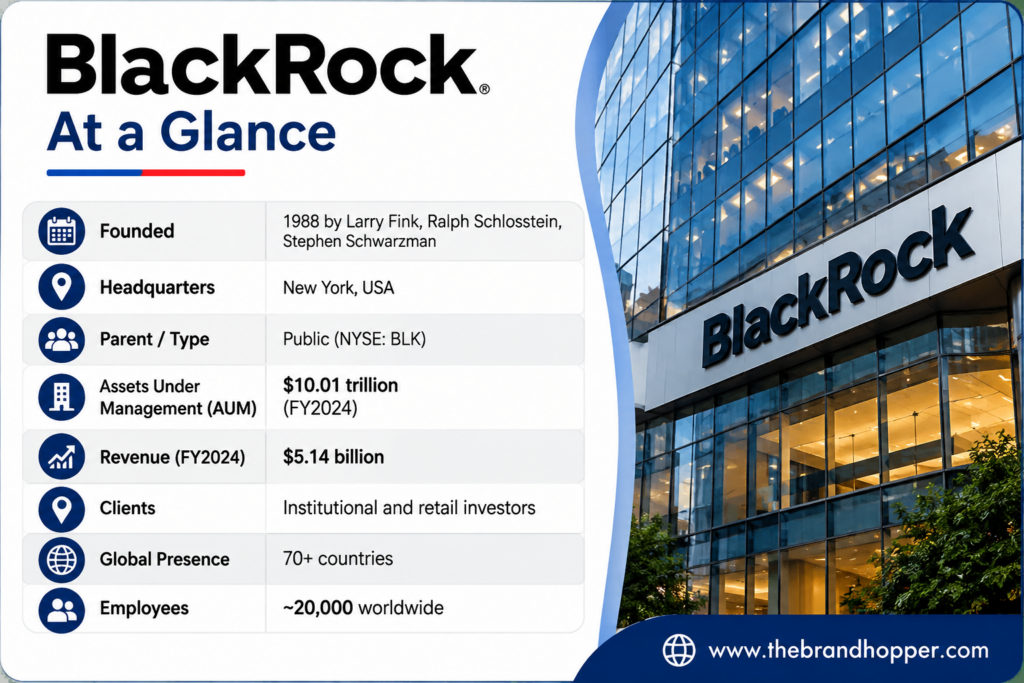
| Strategic Context: BlackRock’s three 2024 acquisitions — GIP ($12.5B infrastructure), HPS ($12B private credit), and Preqin ($3.2B private markets data) — mark a decisive strategic pivot from public markets dominance toward full-spectrum private markets coverage, reshaping the competitive landscape across asset classes. |
AUM Comparison: BlackRock vs. 18 Biggest Competitors
| Rank | Firm | AUM (Approx.) | HQ | Key Strength |
| #1 (subject) | BlackRock | $11.6 trillion+ | New York, USA | iShares ETFs, Aladdin, Alternatives |
| #2 | Vanguard | ~$10.1 trillion | Malvern, USA | Low-cost passive, mutual ownership |
| #3 | Fidelity Investments | ~$5.9 trillion | Boston, USA | Active + passive, zero-fee funds |
| #4 | State Street (SSGA) | ~$5.7 trillion | Boston, USA | SPDR ETFs, ESG stewardship |
| #5 | JPMorgan AM | $4.60 trillion | New York, USA | Active ETFs, bank integration |
| #6 | Goldman Sachs AM | $3.14 trillion AUS | New York, USA | Alternatives, insurance AM |
| #7 | UBS Asset Mgmt | ~$2.9 trillion | Zurich, Switzerland | Real assets, European scale |
| #8 | Capital Group | >$2.7 trillion | Los Angeles, USA | American Funds, active ETFs |
| #9 | Amundi | ~€2.38 trillion | Paris, France | European ETF leader (Lyxor) |
| #10 | PIMCO | $2.26 trillion | Newport Beach, USA | Active fixed income, credit |
| #11 | BNY Mellon IM | ~$2.0 trillion | New York, USA | Multi-boutique, LDI, custody |
| #12 | Invesco | ~$1.86 trillion | Atlanta, USA | QQQ ETF, real estate |
| #13 | Morgan Stanley IM | ~$1.7–1.81 trillion | New York, USA | Direct indexing (Parametric) |
| #14 | Franklin Templeton | ~$1.68 trillion | San Mateo, USA | Legg Mason, global distribution |
| #15 | T. Rowe Price | ~$1.776 trillion | Baltimore, USA | Active equity, target-date funds |
| #16 | Northern Trust AM | ~$1.6 trillion | Chicago, USA | Passive, factor ETFs, ESG |
| #17 | Nuveen (TIAA) | ~$1.4 trillion | Chicago, USA | Muni bonds, farmland, ESG |
| #18 | Schwab IM (CSIM) | >$1 trillion | San Francisco, USA | Captive brokerage distribution |
| #19 | Dimensional (DFA) | ~$770 billion | Austin, USA | Factor/evidence-based ETFs |
Note: AUM figures are the most recent publicly available and sourced from company reports, press releases, and regulatory filings. Figures are subject to market fluctuation.
The 18 Biggest BlackRock Competitors: In-Depth Profiles
Competitor #1: The Vanguard Group

Website: https://investor.vanguard.com/
Vanguard is the undisputed pioneer of low-cost index investing and BlackRock’s most formidable rival in the passive-management space. Founded in 1975 by John C. Bogle, Vanguard created the first index mutual fund available to retail investors and has spent five decades building a singular proposition: ownership costs that are a fraction of the industry average. With roughly $10.1 trillion in AUM, Vanguard manages more assets than any firm on earth apart from BlackRock itself.
What sets Vanguard apart structurally is its mutual ownership model — the funds own the management company, meaning cost reductions flow directly to shareholders rather than to external equity holders. This has allowed Vanguard to drive average expense ratios down to single-digit basis points on many flagship funds. The Vanguard 500 Index Fund, S&P 500 ETF (VOO), and Total Stock Market ETF (VTI) are among the largest and most-held funds in the world.
Vanguard’s challenge to BlackRock is most acute in the ETF market. Although BlackRock’s iShares family holds the top spot in global ETF AUM, Vanguard’s ETFs consistently win on price, recording record inflows as fee-conscious advisors and self-directed investors migrate toward ultra-low-cost wrappers. In fixed income, Vanguard’s Total Bond Market Index Fund and Total International Bond ETF rival BlackRock’s AGG in scale. Vanguard continues to expand its advisory services business, building robo-advisory and human-advice hybrid offerings that compete with BlackRock’s Aladdin Wealth platform.
Key Competitive Differentiators vs. BlackRock
- Mutual ownership model drives structural cost advantage
- Pioneer of index investing with unmatched brand trust among retail investors
- No third-party shareholders — all economies of scale passed to fund holders
- Dominant in retirement-plan default options (target-date series)
Competitor #2: Fidelity Investments

Website: https://www.fidelity.com/
Fidelity Investments, the private financial services giant led by the Johnson family, is one of the most diversified asset management companies in the world. With approximately $5.9 trillion in AUM, Fidelity competes with BlackRock across active equity, fixed income, and passive index strategies, while also operating one of the nation’s largest retail brokerage and 401(k) administration businesses.
The breadth of Fidelity’s platform distinguishes it sharply from single-channel competitors. Through Fidelity Contrafund, Magellan, and a suite of sector funds, it retains a loyal base of active-management devotees even as the industry tilts toward passive. In 2018, Fidelity drew industry-wide attention by launching the first zero-expense-ratio index funds — a direct shot at Vanguard and BlackRock’s iShares — demonstrating its willingness to compete aggressively on price.
Fidelity’s Institutional Asset Management arm serves pension funds, endowments, and sovereign wealth funds with bespoke solutions, placing it directly in competition with BlackRock’s institutional business. On the technology side, Fidelity has built WealthscapeSM, a digital custodial and advisory platform for independent registered investment advisors that rivals Aladdin’s middleware role in institutional workflows. Privately held, Fidelity can invest across cycles without quarterly earnings pressure, a structural advantage that allows longer-horizon bets on new capabilities such as digital assets and AI-driven research tools.
Key Competitive Differentiators vs. BlackRock
- Private ownership allows long-horizon investment without earnings pressure
- Zero-expense-ratio index funds create unmatched pricing power
- End-to-end platform: brokerage, 401(k), active management, and technology
- Deep retail franchise with 40+ million individual investor accounts
Competitor #3: State Street Global Advisors (SSGA)

Website: https://www.ssga.com/
State Street Global Advisors, the investment management division of State Street Corporation, rounds out the “Big Three” passive-management oligopoly alongside BlackRock and Vanguard. With approximately $5.7 trillion in AUM, SSGA is the world’s third-largest asset manager and the originator of the SPDR (Spider) brand — which introduced the first US-listed ETF, SPDR S&P 500 (SPY), on January 22, 1993.
The SPY remains one of the most actively traded securities in the world, making SSGA an indispensable presence in institutional hedging, asset allocation, and tactical trading. Its SPDR ETF lineup spans broad market, sector, fixed-income, real asset, and thematic strategies across more than 140 products globally. State Street’s scale in custody and fund administration gives it a natural distribution advantage — many of the world’s largest pension funds are already custodying assets with State Street Bank, making it easier to channel them into SPDR vehicles.
SSGA competes directly with BlackRock in the institutional ESG space through its Responsible Investment franchise and its high-profile stewardship campaigns. The “Fearless Girl” statue campaign, highlighting gender diversity on corporate boards, generated global recognition and positioned SSGA as a leading advocate for ESG engagement. SSGA’s factor (smart beta) strategies under the SPDR brand — including SPDR MSCI StrategicFactors ETFs — compete with BlackRock’s iShares factor suite for institutional and advisor mandates.
Key Competitive Differentiators vs. BlackRock
- Home of SPY — the world’s most-traded ETF and the birthplace of the ETF industry
- Deep integration with State Street’s custodial and fund administration business
- Pioneer in institutional ESG stewardship and proxy voting advocacy
- Extensive factor/smart-beta lineup competing across institutional and retail channels
Competitor #4: JPMorgan Asset Management

Website: https://am.jpmorgan.com/
JPMorgan Asset Management (JPMAM) is the institutional and retail investment arm of JPMorgan Chase, the world’s largest bank by market capitalisation. With $4.60 trillion in AUM as of Q3 2025, JPMAM stands among the world’s five largest asset managers and competes with BlackRock across virtually every asset class — from money market funds and fixed income to global equities, real assets, and private markets.
The firm’s competitive edge rests on the integration of global banking intelligence with investment management. Proprietary economic research, access to primary deal flow in private markets, and cross-referral from JPMorgan’s corporate banking, wealth management, and securities businesses create a closed-loop advantage that pure-play managers cannot easily replicate. JPMorgan’s J.P. Morgan Private Bank serves ultra-high-net-worth clients with bespoke multi-asset portfolios, complementing the institutional and retail businesses.
In ETFs, JPMorgan has emerged as one of the fastest-growing providers in the active ETF segment. The JPMorgan Equity Premium Income ETF (JEPI) became the largest actively managed ETF in the world within just a few years of launch, highlighting the firm’s ability to translate investment expertise into mass-market products. This places JPMAM in direct competition with BlackRock’s iShares active ETF strategy. On the private markets side, JPMorgan’s alternatives platform spans infrastructure, real estate, transportation, and credit, a segment where BlackRock has aggressively expanded through its acquisitions of Global Infrastructure Partners and HPS Investment Partners.
Key Competitive Differentiators vs. BlackRock
- Backed by world’s largest bank — proprietary economic data and deal flow advantage
- Fastest-growing active ETF franchise, led by JEPI which became the world’s largest active ETF
- Cross-bank synergies across investment banking, private bank, and corporate advisory
- Scale in alternatives (real estate, infrastructure, private credit) rivals BlackRock
Competitor #5: Goldman Sachs Asset Management (GSAM)
Website: https://am.gs.com/
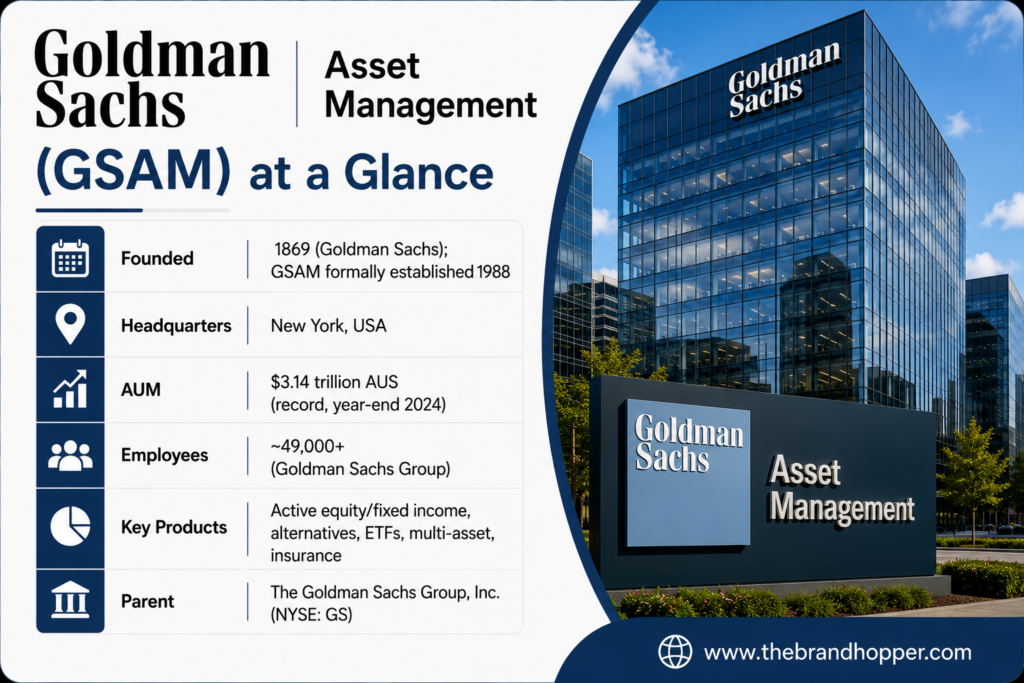
Goldman Sachs Asset Management reported a record $3.14 trillion in assets under supervision (AUS) at year-end 2024, cementing its position as one of the largest active investment managers globally. GSAM serves institutional investors, sovereign wealth funds, central banks, insurance companies, and high-net-worth individuals with a full spectrum of active strategies, alternatives, and increasingly, passive ETF solutions.
GSAM’s strategic evolution has been marked by a deliberate push into alternatives and private markets, where margins are higher and sticky. The firm’s alternatives platform spans private equity, infrastructure, private credit, real estate, and hedge fund strategies, competing directly with BlackRock’s growing alternatives business. In insurance asset management, GSAM has become a leading provider of outsourced investment management to global insurance companies, leveraging Goldman’s fixed-income and credit expertise.
In recent years, GSAM has grown its ETF presence significantly, building out a lineup of active and thematic ETFs that complement its traditional funds business. Its Fundamental Equity product range, fixed-income platforms, and multi-asset solutions are delivered through both institutional mandates and sub-advisory relationships. GSAM’s ability to leverage Goldman Sachs’ network — including investment banking relationships, proprietary data, and global macro research from its well-regarded economists — gives it distinctive sourcing advantages in private markets that few competitors, including BlackRock, can match. See also:
See also: Top Goldman Sachs Competitors on The Brand Hopper
Key Competitive Differentiators vs. BlackRock
- Record $3.14 trillion AUS; deepening alternatives and private markets capabilities
- Proprietary investment banking and macro research drives differentiated market intelligence
- Leading insurance asset management provider leveraging fixed-income credit expertise
- Growing active ETF and thematic fund franchise alongside its institutional core
Competitor #6: Capital Group
Website: https://www.capitalgroup.com
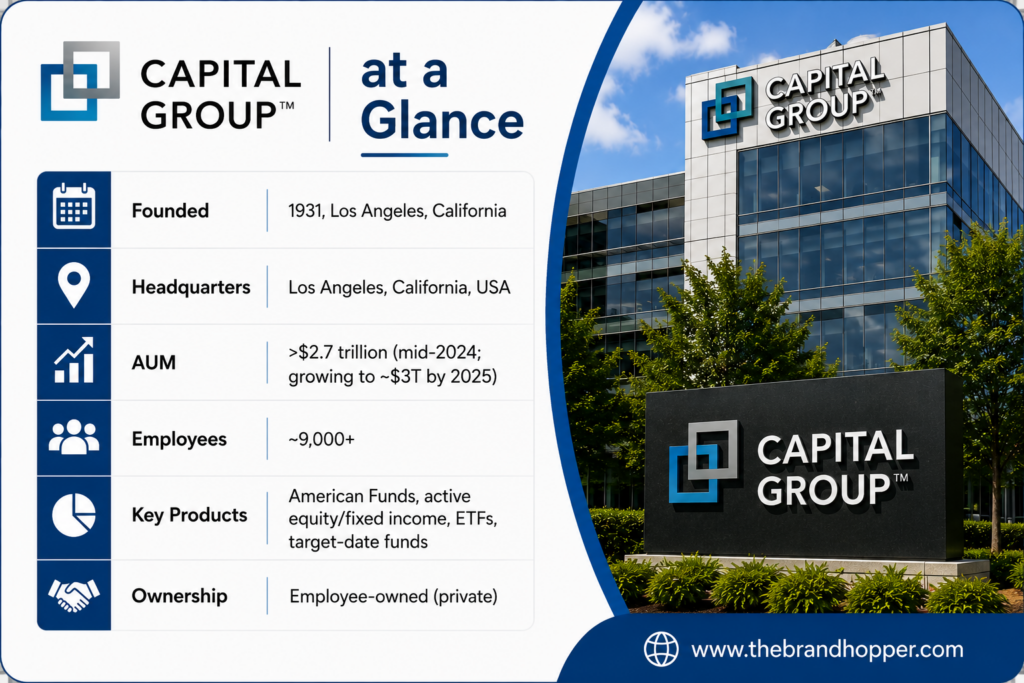
Capital Group, home of the American Funds family, has been one of the world’s most respected active investment managers since its founding in 1931. With over $2.7 trillion in AUM — growing toward $3 trillion by 2025 — Capital Group is one of the largest privately held asset managers in the world and the dominant active manager serving the US financial advisor and retirement market.
Capital Group’s investment approach is built around a proprietary “Multiple Portfolio Counselor System,” in which teams of portfolio managers independently run portions of each fund, blending their views into a whole that aims to reduce key-person risk while preserving the benefits of active management. This methodology has produced long-term track records in funds like the American Funds Growth Fund of America and The Income Fund of America that have built extraordinary loyalty among long-term investors.
The firm entered the ETF market in 2022 with a full lineup of active ETFs under the Capital Group brand, representing a strategic pivot to capture assets shifting from traditional mutual fund wrappers into the tax-efficient ETF structure. This direct-to-advisor ETF push places Capital Group in competition with BlackRock’s active ETF growth strategy. Capital Group remains employee-owned, allowing it to maintain a long-term orientation without short-term public-market pressure, a structural characteristic it shares with Fidelity and Vanguard.
Key Competitive Differentiators vs. BlackRock
- Multiple Portfolio Counselor System reduces key-person risk in active funds
- Deep loyalty among US financial advisors through the American Funds brand
- Entered ETF space with active ETF lineup, directly challenging BlackRock iShares active strategy
- Private employee ownership enables long-term investment orientation
Competitor #7: UBS Asset Management
Website: https://www.ubs.com
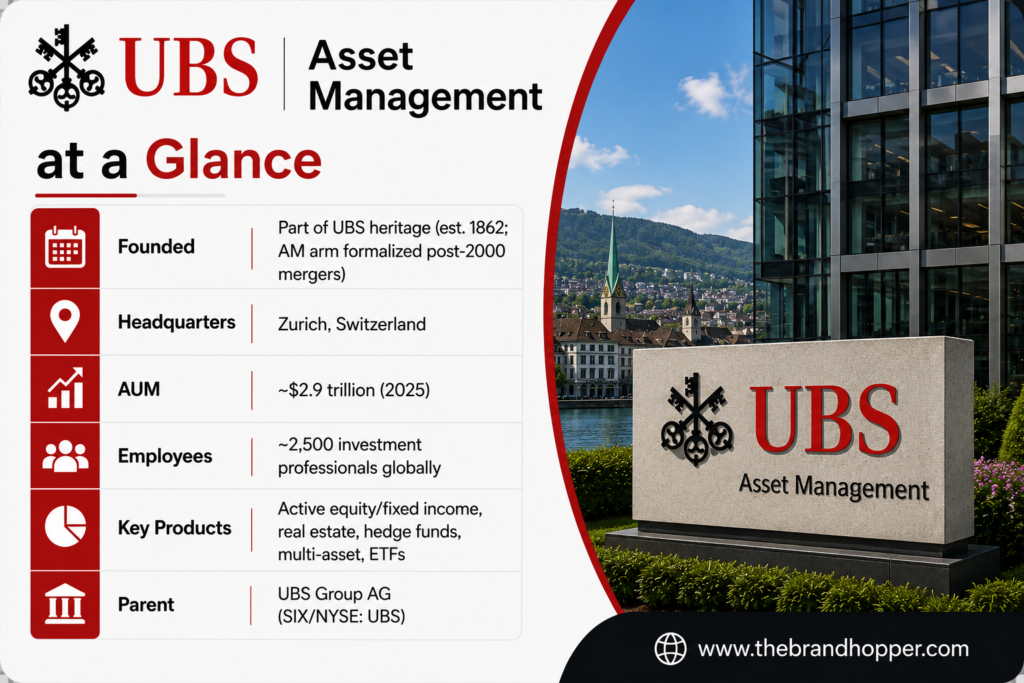
UBS Asset Management, the investment management division of Swiss banking giant UBS Group, manages approximately $2.9 trillion in AUM and ranks among the world’s leading managers of institutional assets. After UBS’s emergency acquisition of Credit Suisse in 2023, UBS became one of the dominant wealth management and asset management franchises in Europe, with a particularly strong presence in Asia Pacific and among sovereign wealth funds and central banks.
UBS Asset Management’s competitive strengths lie in real estate and infrastructure (through its Real Estate & Private Markets unit), systematic/quantitative strategies (via O’Connor and its systematic alpha business), and multi-asset solutions. Its real estate arm manages approximately $150 billion in real assets across direct property, infrastructure, and private equity globally, placing it in competition with BlackRock’s growing real assets franchise.
The integration of Credit Suisse Asset Management has added capabilities in systematic fixed income and Swiss franc-denominated products. UBS Asset Management competes with BlackRock particularly among European and Asian institutional investors seeking real assets, alternatives, and global equity mandates with a European headquartered counterparty. UBS’s unified wealth-plus-asset-management platform creates cross-selling synergies with UBS Wealth Management’s $3.9 trillion in invested assets globally.
Key Competitive Differentiators vs. BlackRock
- Strengthened by Credit Suisse integration — now dominant European asset manager
- Leading real estate and infrastructure investor with ~$150B in real assets
- Preferred counterparty for European and Asian sovereign wealth funds and central banks
- Unique synergy with UBS Wealth Management’s $3.9T invested asset base
Competitor #8: Amundi
Website: https://about.amundi.com
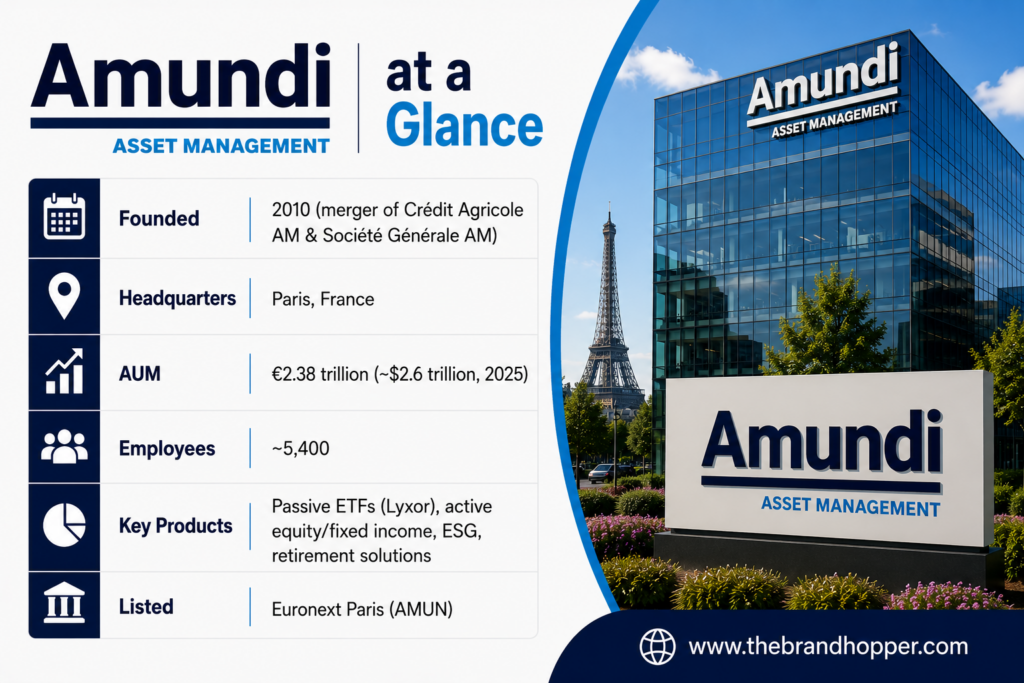
Amundi is Europe’s largest asset manager with approximately €2.38 trillion (∼$2.6 trillion) in AUM, and the sixth-largest manager in the world. Headquartered in Paris, Amundi was created in 2010 from the merger of Crédit Agricole Asset Management and Société Générale Asset Management. It is publicly listed on Euronext Paris and 70% owned by Crédit Agricole. In 2021, Amundi acquired the Lyxor ETF business from Société Générale, significantly boosting its passive and ETF capabilities.
Amundi is the market leader in European-domiciled ETFs through the combined Amundi ETF and Lyxor brands, competing directly with BlackRock’s iShares franchise in a segment where European regulatory tailwinds (UCITS ETFs) continue to drive growth. Its scale in French and European retail distribution, deep relationships with banking partners (Crédit Agricole’s retail network spans 50+ countries), and expanding presence in Asia through a joint venture with Agricultural Bank of China differentiate it from US-centric competitors.
Amundi has positioned ESG as a core strategic pillar, committing to integrating ESG analysis across 100% of its open-ended funds and offering one of Europe’s broadest dedicated sustainable finance product ranges. This places it in direct competition with BlackRock’s Sustainable Investing platform. In fixed income, Amundi’s scale in sovereign and credit strategies across European markets, emerging market debt, and global macro makes it a formidable competitor for institutional mandates from European pension funds, insurers, and sovereign wealth funds.
Key Competitive Differentiators vs. BlackRock
- Europe’s largest asset manager and leader in European-domiciled UCITS ETFs
- Lyxor acquisition bolsters passive platform to compete with iShares in Europe
- Strategic ESG integration across 100% of open-ended funds
- Distribution strength through Crédit Agricole’s global retail banking network
Competitor #9: PIMCO
Website: https://www.pimco.com
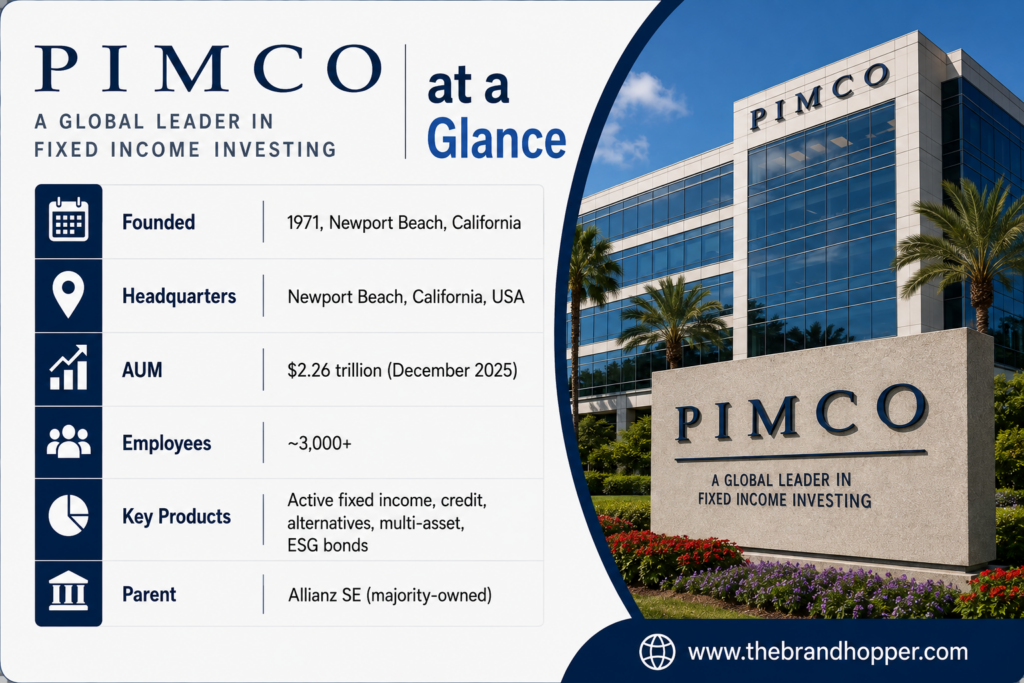
PIMCO (Pacific Investment Management Company) is the world’s pre-eminent active fixed-income manager with $2.26 trillion in AUM as of December 2025. Founded in 1971 by Bill Gross and Bill Thompson, PIMCO built its reputation on the Total Return Fund — once the world’s largest mutual fund — and has since expanded into credit, alternative strategies, multi-asset, and ESG fixed-income solutions. PIMCO is majority-owned by Allianz SE, the German insurance and financial services conglomerate.
PIMCO occupies a virtually unassailable position in active fixed-income management. While BlackRock competes in fixed income through its massive iShares AGG ETF and active bond strategies, PIMCO’s brand and track record in alpha-generating fixed income is widely regarded as superior among institutional allocators. Its macro research capabilities, led by the Investment Committee and supported by a network of global economists, are broadly considered among the finest on Wall Street.
In recent years, PIMCO has diversified meaningfully into alternative credit and private markets, building out its PIMCO Alternatives platform to compete with the growing private credit segment. PIMCO Prime Real Estate (formerly PIMCO Bravo) and its corporate credit strategies position it as a full-spectrum credit manager beyond traditional bonds. PIMCO’s active ETF lineup, including the PIMCO Enhanced Short Maturity Active ETF (MINT), one of the largest active bond ETFs, extends its institutional expertise into the retail and advisor channels in competition with BlackRock’s iShares.
Key Competitive Differentiators vs. BlackRock
- World’s dominant active fixed-income manager with unmatched institutional brand equity
- Macro research depth and track record recognized as best-in-class for bond alpha generation
- Expanding private credit and alternatives to complement core fixed-income leadership
- Active ETF lineup bridges institutional expertise to retail/advisor distribution
Competitor #10: BNY Mellon Investment Management
Website: https://www.bny.com/investments
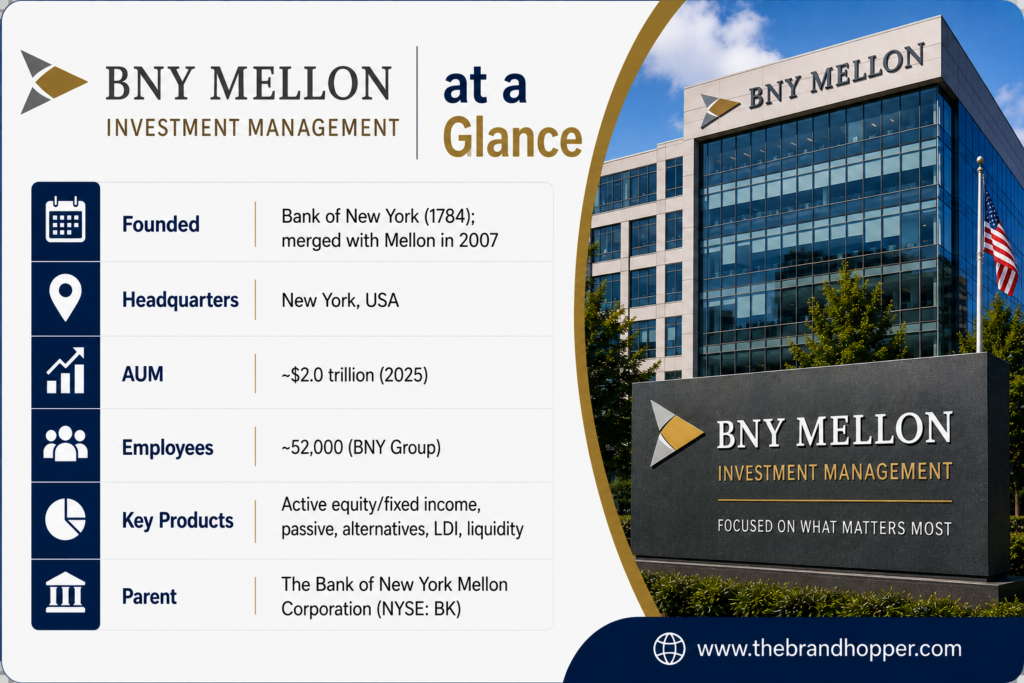
BNY Mellon Investment Management is the asset management arm of BNY (The Bank of New York Mellon Corporation) — the world’s largest custodian bank with over $50 trillion in assets under custody and administration. BNY Mellon IM manages approximately $2.0 trillion in AUM through a multi-boutique model, housing specialist investment managers including Insight Investment, Newton Investment Management, Dreyfus, and Mellon Investments Corporation.
The multi-boutique structure is BNY Mellon IM’s defining competitive characteristic. Each affiliate maintains its own investment culture, philosophy, and decision-making independence while benefiting from BNY’s distribution infrastructure, operational support, and parent’s credibility. Insight Investment, the UK-based liability-driven investing (LDI) and absolute return specialist, is BNY Mellon IM’s largest affiliate and a leading provider of LDI solutions to UK pension funds — a segment where BlackRock also competes through its own LDI platform.
The strategic advantage of operating within BNY’s custodial network is substantial: many of the world’s largest institutional investors already hold assets in custody with BNY, creating natural cross-sell opportunities for investment management. BNY Mellon IM competes with BlackRock across multi-asset, fixed income, liquidity, and equity mandates, while leveraging BNY’s reputation as the longest-established financial institution in the United States (founded 1784 by Alexander Hamilton) for institutional investor trust.
Key Competitive Differentiators vs. BlackRock
- Multi-boutique model preserving specialist investment cultures (Insight, Newton, Mellon)
- Parent BNY is world’s largest custodian bank with $50T+ in assets under custody
- Insight Investment is a leading LDI provider for UK pension funds
- Cross-sell advantage from BNY’s custodial relationships with global institutional investors
Competitor #11: Invesco
Website: https://www.invesco.com/corporate
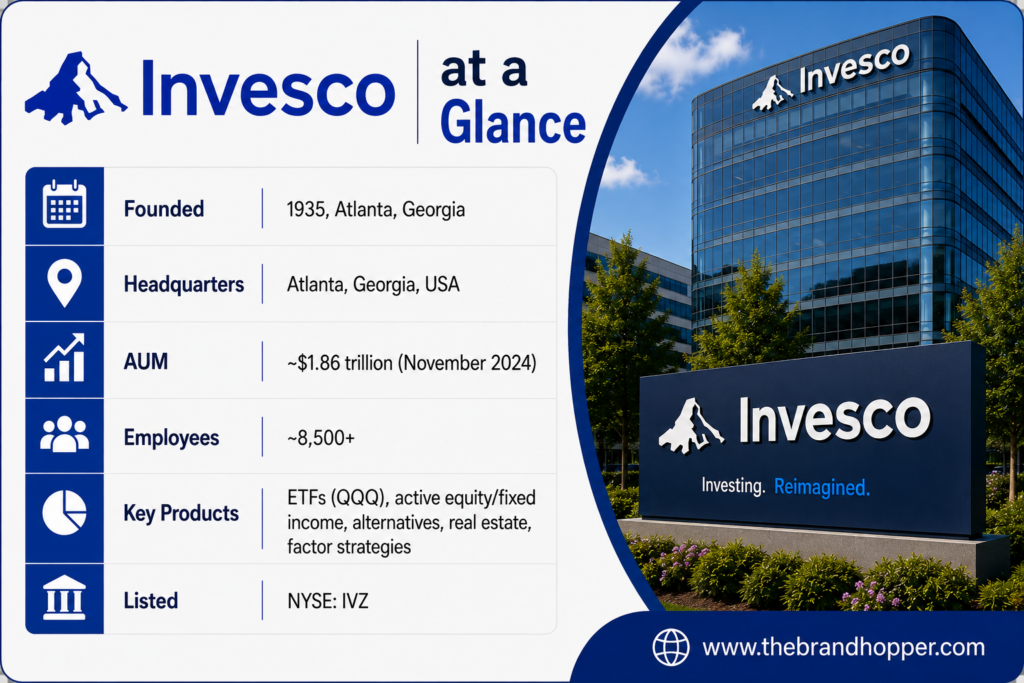
Invesco is a leading independent global asset manager with approximately $1.86 trillion in AUM, headquartered in Atlanta with a strong international presence in Europe and Asia Pacific. While Invesco manages a wide range of active and passive strategies, it is perhaps best known for a single product: the Invesco QQQ Trust (QQQ), which tracks the Nasdaq-100 Index and is consistently one of the five most traded ETFs in the world. QQQ’s extraordinary popularity — driven by the Nasdaq’s tech-heavy composition and high retail and institutional engagement — generates significant fee revenue and brand recognition for Invesco.
Invesco has been one of the most active acquirers in the asset management industry. The 2019 acquisition of OppenheimerFunds added a large active equity and fixed-income platform, while the earlier acquisition of PowerShares (now Invesco) built its ETF franchise. Invesco competes with BlackRock in factor and smart-beta strategies through its Invesco Factor ETF series, and in real estate through Invesco Real Estate, one of the largest real estate investment managers globally.
Internationally, Invesco has strong market positions in the UK and Europe (where it is among the top 10 managers) and in Asia, particularly China, where it has a joint venture with Great Wall Fund Management Co. Its factor strategies (including low-volatility, quality, and equal-weight ETFs) represent a direct competitive challenge to BlackRock’s iShares factor ETF lineup, as both firms compete for allocations from institutions and model portfolio builders.
Key Competitive Differentiators vs. BlackRock
- Home of QQQ — one of the world’s most-traded ETFs and the definitive Nasdaq-100 vehicle
- Leading real estate investment manager competing with BlackRock’s real assets business
- Broad factor/smart-beta ETF lineup competing with iShares for institutional model portfolios
- International scale across UK, Europe, and China through joint ventures
Competitor #12: Morgan Stanley Investment Management (MSIM)
Website: https://www.morganstanley.com/im
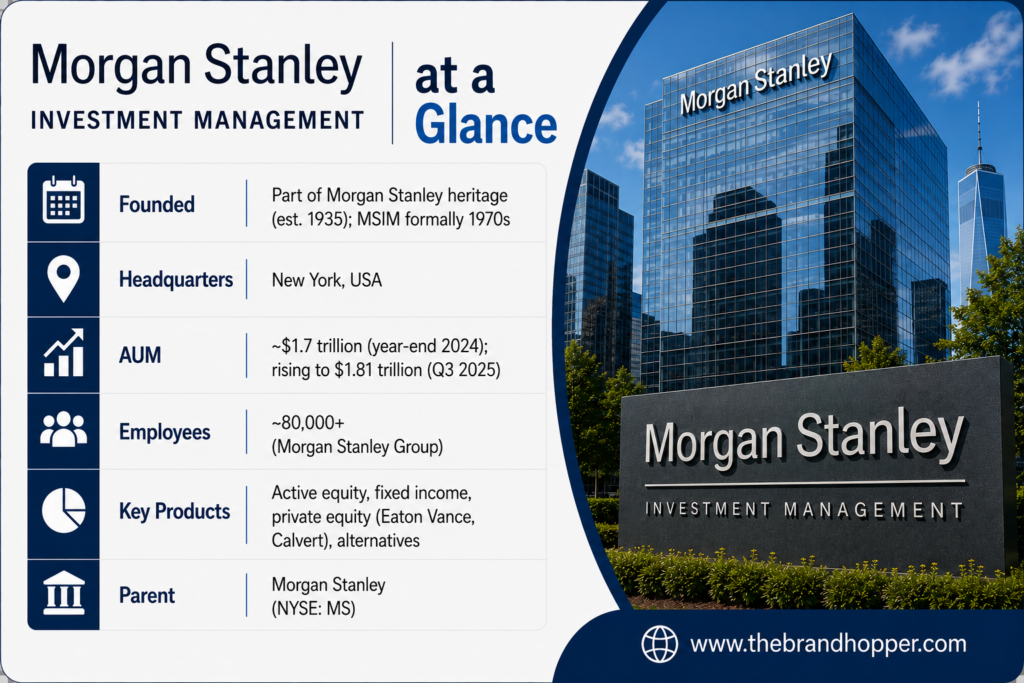
Morgan Stanley Investment Management (MSIM) manages approximately $1.7 trillion in AUM (rising to $1.81 trillion as of Q3 2025), bolstered significantly by Morgan Stanley’s 2021 acquisition of Eaton Vance — a $7 billion deal that transformed MSIM from a mid-size active manager into a major multi-boutique force. Eaton Vance brought with it Calvert Research and Management, the pioneering ESG and responsible investment manager, and Parametric Portfolio Associates, the leader in custom indexing and direct indexing.
The Eaton Vance acquisition reshaped MSIM’s competitive positioning dramatically. Parametric, with its direct-indexing capabilities, has emerged as one of the highest-growth businesses in asset management as advisors seek tax-efficient personalised equity portfolios for wealthy clients. This places MSIM in direct competition with BlackRock’s own direct-indexing offering (Aperio, acquired in 2021) in a segment expected to reach multi-trillion-dollar scale over the coming decade.
MSIM also operates a substantial alternatives and private markets platform, including global private equity, real estate, and credit strategies. Its institutional business serves pension funds, sovereign wealth funds, and insurance companies globally, often in competition with BlackRock across multi-asset mandates. Through Calvert, MSIM has a leading sustainable-investing identity that competes head-on with BlackRock Sustainable Investing in the institutional ESG allocation segment.
Key Competitive Differentiators vs. BlackRock
- Parametric is a leader in direct indexing — direct competitor to BlackRock’s Aperio
- Eaton Vance acquisition created multi-boutique scale with specialist investment cultures
- Calvert provides leading ESG/responsible investment identity competing with BlackRock Sustainable
- Backed by Morgan Stanley’s Wealth Management platform serving 3M+ client relationships
Competitor #13: Franklin Templeton
Website: https://www.franklintempleton.com
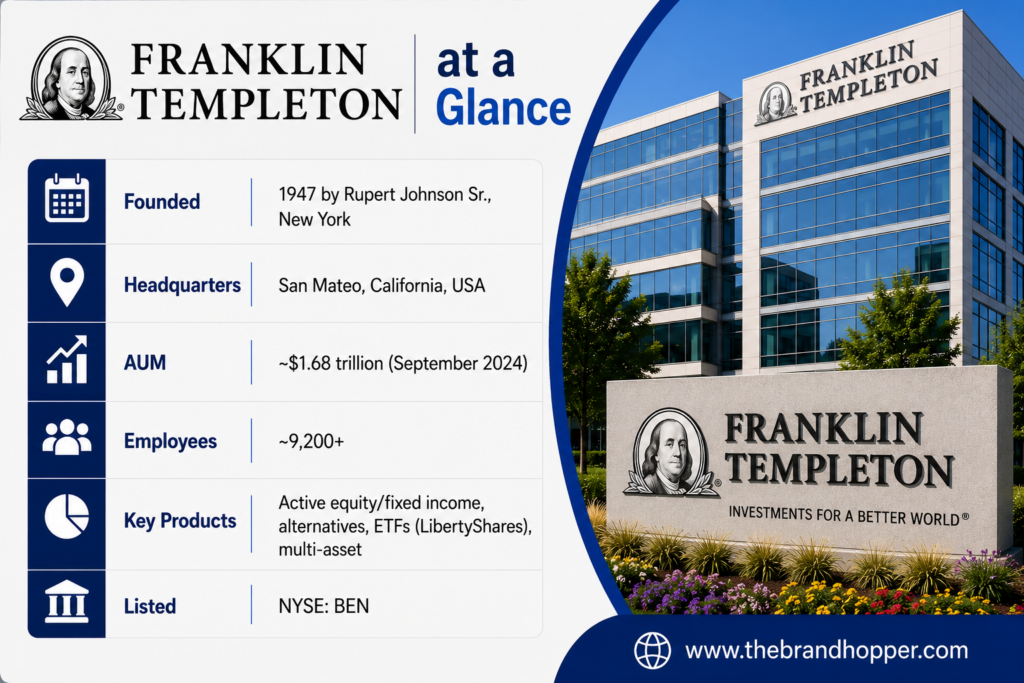
Franklin Templeton is one of the world’s largest independent, publicly listed asset management companies, with approximately $1.68 trillion in AUM. Founded in 1947, Franklin Templeton built its reputation on global equity and emerging market investing under the Templeton brand. Through decades of acquisitions, it has assembled one of the most diverse multi-specialist platforms in the industry, encompassing active equity, fixed income, alternatives, and multi-asset capabilities.
Franklin Templeton’s acquisition strategy has been among the most aggressive in the industry. The $4.5 billion acquisition of Legg Mason in 2020 doubled the firm’s size and brought in leading fixed-income managers including Western Asset Management, ClearBridge Investments, and Brandywine Global. More recently, Franklin Templeton acquired Putnam Investments and took a stake in Alcentra. These additions have made Franklin Templeton a genuine full-service manager competing with BlackRock across active equity, fixed income, alternatives, and distribution channels.
Franklin Templeton competes with BlackRock in the alternatives and multi-asset spaces through Clarion Partners (real estate), K2 Advisors (hedge funds), and Benefit Street Partners (private credit). Its LibertyShares ETF lineup offers a range of actively managed and smart-beta ETFs that compete with iShares in the advisor channel. The firm’s extensive global distribution network spanning 165+ countries gives it reach that few rivals other than BlackRock can match.
Key Competitive Differentiators vs. BlackRock
- Legg Mason acquisition created multi-specialist platform spanning active equity, fixed income, and alternatives
- Global distribution across 165+ countries rivals BlackRock’s international reach
- Alternatives platform (real estate, private credit, hedge funds) competes with BlackRock alternatives
- Western Asset Management and ClearBridge provide leading active fixed-income and equity capabilities
Competitor #14: T. Rowe Price
Website: https://www.troweprice.com/en/us
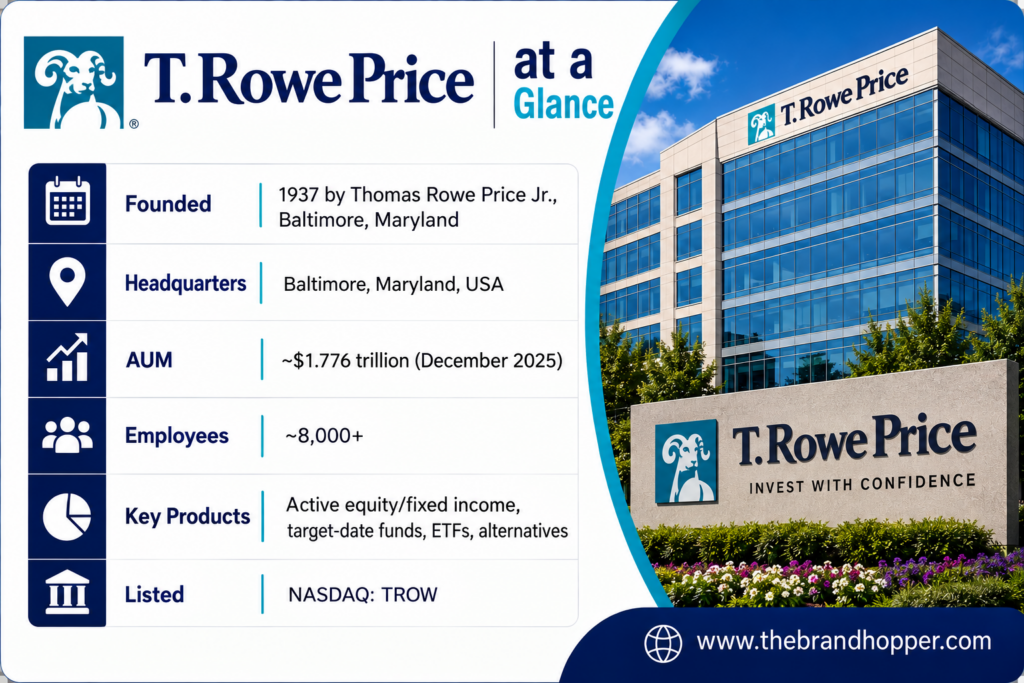
Rowe Price is a Baltimore-based independent investment management firm with approximately $1.776 trillion in AUM, renowned for its disciplined active management approach across equity and fixed income strategies. Founded in 1937 by Thomas Rowe Price Jr. — who pioneered the growth-stock investment philosophy — T. Rowe Price has built one of the strongest active management brands in the world, consistently attracting long-term institutional and retail investors who value fundamental research-driven strategies.
Rowe Price’s core competitive advantage is its deep, proprietary fundamental research platform. The firm employs approximately 400+ investment professionals globally and sources the majority of its investment insights from in-house research rather than external sell-side analysis. This research intensity — analogous to the philosophy of Warren Buffett’s value investing but applied to growth-oriented stocks — has produced long-term performance records in flagship funds like T. Rowe Price Blue Chip Growth and the Equity Income Fund that have sustained advisor and institutional loyalty through multiple market cycles.
Rowe Price is one of the largest managers of target-date retirement funds in the United States through its Retirement Funds series, competing with BlackRock’s LifePath target-date ETFs and Vanguard’s Target Retirement series for dominance in 401(k) plan default investments. As passive strategies have gained market share, T. Rowe Price has supplemented its active lineup with a growing suite of active ETFs, allowing advisors to access its equity and fixed-income strategies in a tax-efficient wrapper.
Key Competitive Differentiators vs. BlackRock
- Proprietary research platform of 400+ investment professionals drives consistent active alpha
- Major target-date fund provider competing with BlackRock LifePath in 401(k) defaults
- Longstanding growth-stock philosophy with multi-decade performance track record
- Growing active ETF lineup extends fundamental research expertise into the ETF channel
Competitor #15: Northern Trust Asset Management

Website: https://www.northerntrust.com
Northern Trust Asset Management (NTAM) manages approximately $1.6 trillion in AUM and is a leading provider of passive and factor-based investment solutions to institutional clients globally. Headquartered in Chicago and part of Northern Trust Corporation — one of the US’s oldest financial institutions (founded 1889) — NTAM is particularly strong in customised passive mandates, environmental, social, and governance (ESG) integration, and liability-driven investing (LDI) for pension funds and insurance companies.
NTAM competes with BlackRock most directly in three segments: passive/index management for large institutional clients who want custom benchmarks rather than off-the-shelf products; factor/smart-beta strategies through its FlexShares ETF platform; and ESG integration services for institutional investors managing climate and sustainability mandates. Northern Trust is consistently recognised as one of the leading ESG-aware custodians and managers, with its stewardship team actively engaging portfolio companies on governance, climate, and social issues.
The FlexShares ETF family, while smaller than iShares, has carved a niche in institutional-quality ETFs — products designed around the needs of institutional investors rather than retail traders. This positions NTAM’s ETF business as a specialist alternative to BlackRock’s iShares for institutional buyers who prioritise factor purity, ESG screening, and customisation over raw liquidity. Northern Trust’s custodial relationships with major sovereign wealth funds and public pensions also create cross-selling opportunities for investment management mandates.
Key Competitive Differentiators vs. BlackRock
- Leader in customised passive mandates and ESG-integrated factor strategies for institutions
- FlexShares ETF platform targets institutional buyers seeking factor purity over raw size
- Custodial relationships with sovereign wealth funds generate investment management cross-sell
- Strong LDI and pension-risk-transfer capabilities competing with BlackRock’s institutional solutions
Competitor #16: Nuveen (TIAA Investments)
Website: https://www.nuveen.com/
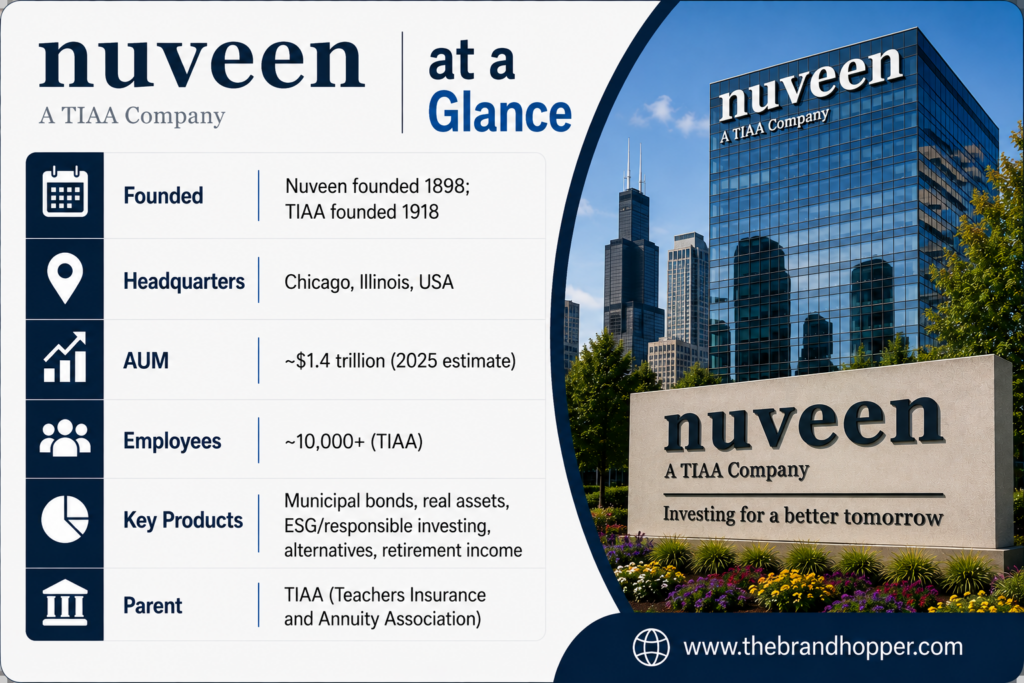
Nuveen, the investment management arm of TIAA (Teachers Insurance and Annuity Association), manages approximately $1.4 trillion in AUM and is one of the most distinctive institutional investment managers in the world. TIAA was founded in 1918 to provide retirement security for educators and non-profit employees, and today its investment arm Nuveen inherits a mission-oriented culture focused on responsible, long-term investing that aligns naturally with the growing ESG mandate of institutional allocators.
Nuveen’s competitive strengths are concentrated in three areas where it consistently ranks as a global leader: municipal bonds (where Nuveen manages the world’s largest municipal bond fund franchise), real assets and natural capital (including farmland, timberland, private real estate, and infrastructure through TIAA Farmland and Churchill Asset Management), and responsible investing (where Nuveen is among the earliest adopters of full ESG integration for institutional portfolios).
The combination of TIAA’s insurance and annuity expertise with Nuveen’s investment capabilities creates a distinctive offering in retirement income — a segment where BlackRock has been building its LifePath Paycheck solution and other in-plan retirement income strategies. Nuveen’s Churchill Asset Management provides private credit and private equity fund-of-funds capabilities that compete with BlackRock’s growing alternatives platform. Its farmland and natural capital strategies are increasingly sought by institutional investors seeking real-return diversifiers, a niche where Nuveen has a near-unique presence at scale.
Key Competitive Differentiators vs. BlackRock
- World’s largest municipal bond franchise, unmatched by any competitor including BlackRock
- Unique real asset platform: farmland, timberland, and natural capital at institutional scale
- Mission-aligned ESG investing backed by TIAA’s non-profit and educator heritage
- Retirement income expertise through TIAA’s annuity platform competing with BlackRock LifePath Paycheck
Competitor #17: Charles Schwab Investment Management (CSIM)
Website: https://www.schwabassetmanagement.com/
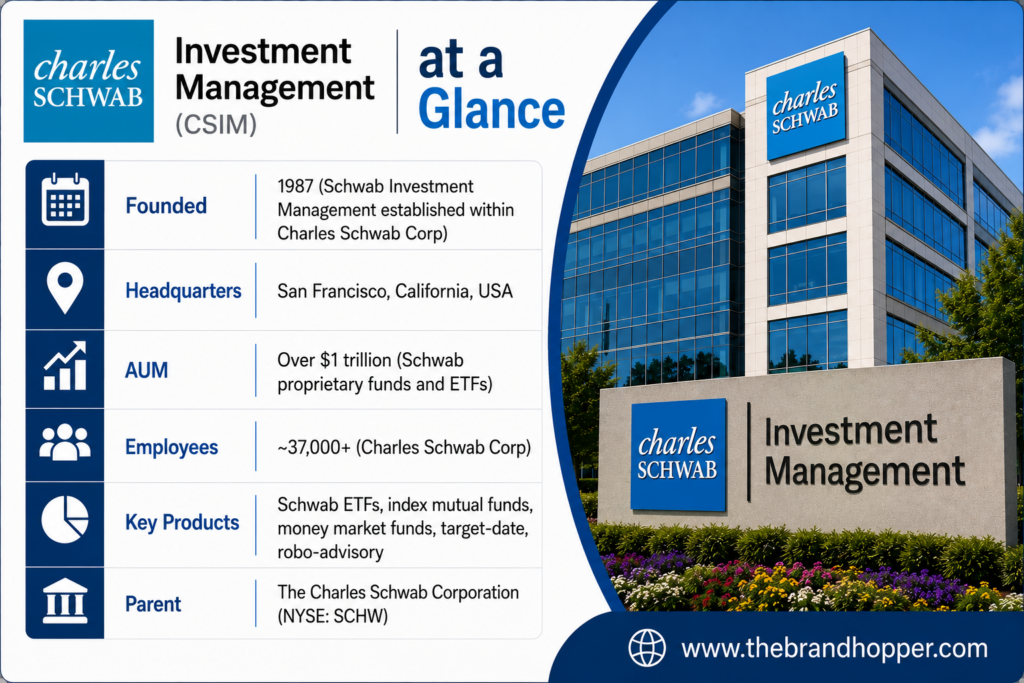
Charles Schwab Investment Management (CSIM) is the proprietary asset management arm of The Charles Schwab Corporation, one of the largest retail brokerage and wealth management firms in the United States with approximately $10 trillion in total client assets. CSIM manages over $1 trillion in proprietary funds and ETFs — primarily low-cost index products that are distributed predominantly through Schwab’s own brokerage platform, making it a formidable distribution-led competitor to BlackRock’s iShares and Vanguard’s ETF lineup.
Schwab’s competitive model in asset management is built on vertical integration: the firm benefits from a massive captive distribution network of approximately 35 million brokerage accounts. Schwab ETFs and the Schwab Intelligent Portfolios robo-advisory service are promoted as default or preferred options within Schwab’s ecosystem, giving CSIM a built-in flow advantage that pure-play asset managers cannot replicate. Schwab’s ETFs include a broad lineup of US and international equity, fixed-income, and sector products priced competitively against iShares.
The Schwab acquisition of TD Ameritrade in 2020 significantly expanded Schwab’s advisor and institutional channel, increasing the potential distribution universe for Schwab-affiliated products. As interest in low-cost, passive investing continues to grow among retail and advisor markets, CSIM’s position as the in-house asset manager of America’s largest retail brokerage gives it structural advantages in net flows that are difficult for even BlackRock to displace within the Schwab ecosystem.
Key Competitive Differentiators vs. BlackRock
- Captive distribution via 35+ million brokerage accounts — built-in flow advantage
- TD Ameritrade integration expanded advisor channel distribution
- Robo-advisory (Schwab Intelligent Portfolios) channels assets into proprietary products
- Vertical integration of brokerage and asset management creates unique competitive moat
Competitor #18: Dimensional Fund Advisors (DFA)

Website: https://www.dimensional.com
Dimensional Fund Advisors (DFA) is one of the most academically distinguished investment managers in the world, having built its entire investment philosophy on the empirical research of Eugene Fama (Nobel Laureate in Economics) and Kenneth French. Founded in 1981, Dimensional manages approximately $770 billion in AUM through a systematic, evidence-based approach that captures factor premiums — small-cap, value, profitability, and momentum — across global equity and fixed-income portfolios.
Dimensional occupies a distinctive niche between passive indexing and active management. Its portfolios are not pegged to commercial indices but are constructed to systematically overweight securities with higher expected returns based on factor research, while trading patiently to minimise cost. This approach, combined with rigorous tax management, has attracted a loyal base of fee-only registered investment advisors and institutional clients who value evidence-based investing over both benchmark-hugging passive and traditional active management.
In 2020 and 2021, Dimensional made a significant strategic shift by converting several of its core mutual funds into ETFs — one of the largest fund-to-ETF conversion programmes in industry history. This move has broadened Dimensional’s distribution significantly, allowing its factor strategies to be accessed by a wider advisor and institutional universe beyond its historically exclusive network. Dimensional’s ETF lineup now competes with BlackRock’s iShares factor ETF family for institutional factor allocations, though Dimensional retains a differentiated position through its deeper academic pedigree and patient trading methodology.
Key Competitive Differentiators vs. BlackRock
- Founded on Nobel Prize-winning factor research (Fama-French models) — unmatched academic pedigree
- Systematic factor capture without benchmark constraints — distinct from both passive and active
- Major ETF conversion (2020-21) broadened distribution from exclusive advisor network
- Patient trading methodology minimises implicit transaction costs — competitive advantage in factor capture
Competitive Landscape Analysis
The global asset management industry is undergoing simultaneous structural shifts on multiple fronts. Understanding how these dynamics shape BlackRock’s competitive position relative to its 18 key rivals is essential for institutional allocators, financial advisors, and industry observers.
1. The Passive Pricing War
The relentless compression of expense ratios in passive strategies has fundamentally altered competitive dynamics. Vanguard, BlackRock, and SSGA collectively manage over $21 trillion in index assets and have driven costs toward zero on core index products. Fidelity’s introduction of zero-expense-ratio funds in 2018 pushed the floor further. This war has reduced revenue per dollar of passive AUM dramatically and placed a premium on alternative revenue streams — most notably, technology licensing (Aladdin), securities lending income, and active/alternative mandates.
2. The Active Management Resilience
Contrary to predictions of passive’s complete dominance, active management has proven resilient in specific segments: active fixed income (PIMCO, T. Rowe Price), active equity (Capital Group, T. Rowe Price), and active ETFs (JPMorgan’s JEPI, Capital Group’s active ETF lineup). The shift toward active ETFs — which grew to over $900 billion globally by mid-2025 — has created a new battleground where BlackRock’s active ETF strategy competes with JPMorgan, Capital Group, and T. Rowe Price for advisor shelf space.
3. Private Markets as the New Frontier
The most significant competitive battleground over the next decade is private markets: private credit, infrastructure, private equity, and real assets. BlackRock’s acquisitions of GIP and HPS Investment Partners in 2024 signal its ambition to compete in private markets at the same scale it dominates public markets. Its competitors include not only traditional asset managers (PIMCO in credit, Franklin Templeton via Benefit Street Partners, Nuveen via Churchill) but also specialist alternative managers such as Apollo Global Management, Ares Management, and Brookfield Asset Management that are not covered in this article.
4. Technology as Competitive Moat
BlackRock’s Aladdin platform, which processes risk analytics on approximately $21.6 trillion in assets for 200+ institutions, creates a competitive moat that pure investment managers cannot replicate. Fidelity’s Wealthscape, JPMorgan’s proprietary banking data intelligence, and Morgan Stanley’s Parametric direct-indexing platform represent the most credible technology-driven competitive threats to Aladdin’s role in institutional workflows.
5. ETF Market Share
In the global ETF market, BlackRock’s iShares holds the top position by AUM, followed by Vanguard and SSGA. However, JP Morgan (JEPI), Invesco (QQQ), and Charles Schwab are among the fastest-growing ETF providers as the market expands. Amundi leads in European-domiciled UCITS ETFs. The active ETF segment is the highest-growth pocket, where JPMorgan, Capital Group, and T. Rowe Price are gaining the fastest.
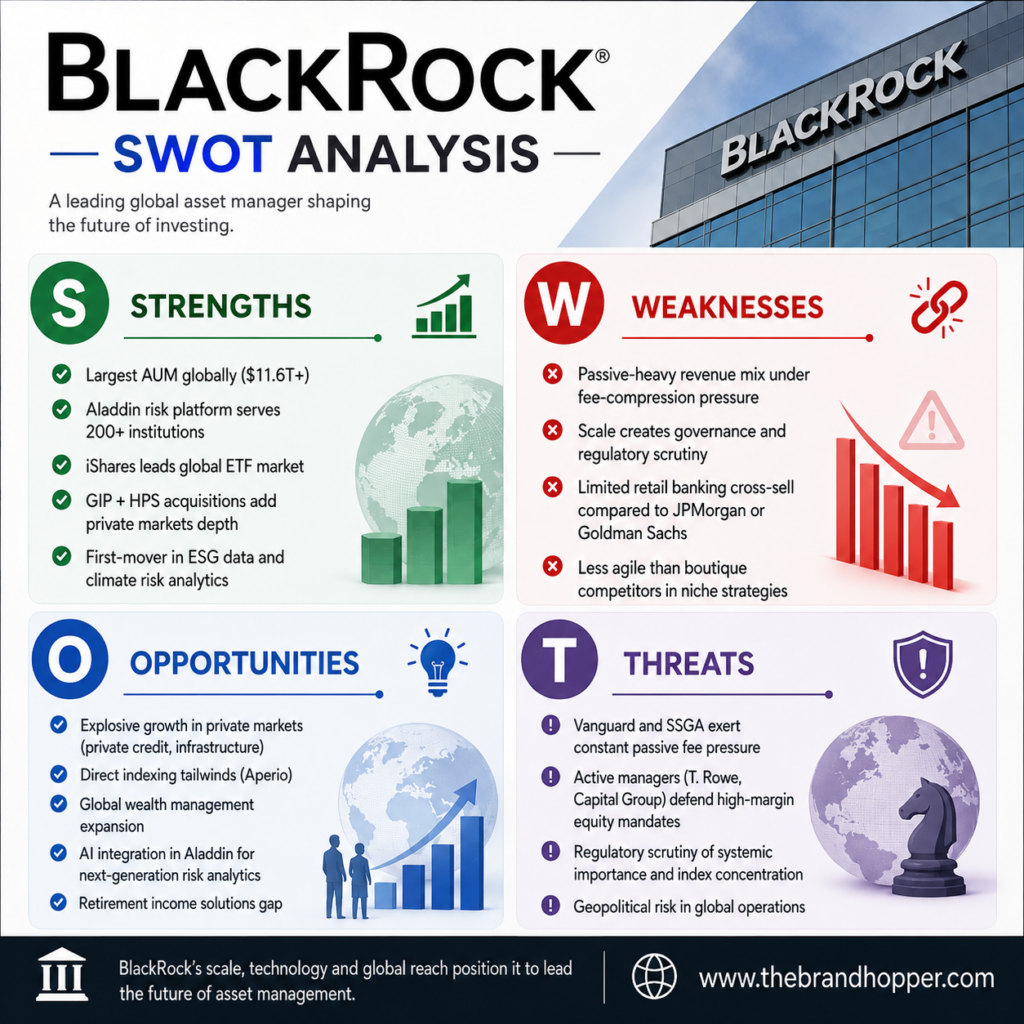
BLACKROCK SWOT ANALYSIS
BlackRock vs. Competitors: Head-to-Head by Business Segment
| Business Segment | BlackRock’s Position | Top Challengers |
| Passive ETFs / Index | Global leader (iShares) | Vanguard, SSGA, Schwab, Invesco (QQQ) |
| Active Fixed Income | Strong but not dominant | PIMCO, T. Rowe Price, Franklin Templeton |
| Active Equity | Moderate scale | Capital Group, T. Rowe Price, Fidelity, MSIM |
| Active ETFs | Growing rapidly | JPMorgan (JEPI), Capital Group, T. Rowe Price |
| Private Credit | Expanding (HPS 2024) | PIMCO, Apollo, Ares, Franklin (BSP), Nuveen |
| Infrastructure | Leading (GIP 2024) | Brookfield, Macquarie, UBS, Nuveen |
| Real Estate | Top 5 globally | Invesco RE, CBRE IM, JP Morgan, Nuveen |
| ESG / Responsible | Scale leader | Amundi, MSIM/Calvert, Nuveen, SSGA |
| Risk Technology | Dominant (Aladdin) | FactSet, MSCI, Bloomberg (no direct match) |
| Direct Indexing | Growing (Aperio) | Morgan Stanley (Parametric), Fidelity |
Emerging Challengers: Fintech and Specialist Disruptors
Beyond the traditional institutional and retail asset managers, BlackRock faces longer-term competitive pressure from a new generation of technology-enabled and specialist investment platforms. While none of these rivals approaches BlackRock’s scale today, they are reshaping the distribution and delivery of investment management in ways that could meaningfully affect BlackRock’s retail and advisor businesses over time.
1. Robo-Advisory Platforms
Betterment and Wealthfront represent the leading independent robo-advisory platforms in the United States. Betterment manages billions in assets through diversified, tax-optimised ETF portfolios, while Wealthfront has pioneered direct indexing for retail investors at lower minimums than traditional services. Both compete with BlackRock’s Aladdin Wealth platform and other institutional digital advisory solutions. While their AUM is modest compared to traditional managers, robo-advisors normalise the shift to low-cost ETF portfolios — a trend that generally benefits BlackRock’s iShares but reduces the market for active management.
2. Digital Assets
Grayscale Investments is the world’s largest digital asset manager, offering institutional and retail investors access to Bitcoin, Ethereum, and other crypto assets through regulated fund structures. Following the SEC’s approval of spot Bitcoin ETFs in early 2024 (in which BlackRock’s own IBIT became the fastest ETF to reach $10 billion in AUM), digital assets have emerged as a legitimate new asset class. BlackRock’s rapid entry into crypto ETFs signals that it views digital assets as a growth frontier, not a fringe trend — and places it in direct competition with Grayscale for institutional and retail digital asset mandates.
3. ESG Specialists
Impax Asset Management specialises in environmental markets and sustainable investing, managing approximately £44 billion (~$55 billion) in assets with a focus on the transition to a more sustainable global economy. While small relative to BlackRock, Impax and similar specialist ESG managers challenge BlackRock’s sustainable investing positioning among the most sustainability-conscious institutional investors who prefer pure-play ESG managers over diversified giants. These specialists often win mandates from foundations, endowments, and family offices that prioritise mission alignment over scale.
Conclusion: BlackRock’s Competitive Position in a Shifting Landscape
BlackRock occupies an extraordinary and largely unassailable position at the pinnacle of global asset management. Its $11.6 trillion AUM base, Aladdin technology platform, iShares ETF dominance, and rapidly expanding private markets franchise combine to create competitive advantages that are deeply structural and difficult for any single rival to match. Yet the asset management industry is far from static.
The 18 competitors profiled here represent the most formidable challengers in their respective segments: Vanguard and SSGA in passive pricing, PIMCO and T. Rowe Price in active fixed income and equity, JPMorgan and Capital Group in active ETFs, Goldman Sachs and Franklin Templeton in alternatives, and Morgan Stanley’s Parametric in direct indexing. No single competitor challenges BlackRock across all its fronts simultaneously — but collectively, these firms ensure that BlackRock must continue to earn its market leadership through constant innovation, disciplined execution, and strategic investment.
The next competitive chapter will be written in private markets. BlackRock’s GIP and HPS acquisitions have repositioned it as a full-spectrum public-and-private investment platform. How effectively it integrates these acquisitions, and whether it can replicate in private markets the dominance it achieved in public markets through iShares, will define its competitive trajectory for the decade ahead.
Frequently Asked Questions (FAQs)
Q1: Who is BlackRock’s biggest competitor?
Vanguard is BlackRock’s largest competitor by AUM, managing approximately $10.1 trillion. The two firms dominate the global passive ETF market through iShares (BlackRock) and Vanguard’s own ETF lineup. State Street Global Advisors (SSGA), the creator of the SPDR/SPY ETF, is the third member of the “Big Three” passive oligopoly.
Q2: What makes BlackRock different from its competitors?
BlackRock’s primary competitive differentiators are: (1) the Aladdin risk management technology platform, used by 200+ financial institutions globally; (2) iShares, the world’s largest ETF franchise by AUM; (3) scale across both active and passive strategies simultaneously; and (4) a rapidly expanding private markets platform following acquisitions of GIP and HPS Investment Partners.
Q3: Is BlackRock the largest asset manager in the world?
Yes. With over $11.6 trillion in AUM (Q1 2025), BlackRock is the world’s largest asset manager by a substantial margin, ahead of Vanguard (~$10.1T) and State Street Global Advisors (~$5.7T). BlackRock’s AUM has grown significantly through organic flows and strategic acquisitions including Global Infrastructure Partners, Preqin, and HPS Investment Partners.
Q4: How does Vanguard compete with BlackRock in ETFs?
Vanguard competes with BlackRock’s iShares ETF franchise primarily through lower expense ratios, enabled by its unique mutual-ownership structure in which funds own the management company. Vanguard’s VOO (S&P 500 ETF) and VTI (Total Stock Market ETF) consistently attract the largest annual net inflows of any ETFs globally. While iShares leads by total AUM, Vanguard leads in flow momentum among cost-conscious investors.
Q5: What is PIMCO’s role relative to BlackRock?
PIMCO ($2.26T AUM) is the world’s pre-eminent active fixed-income manager and competes with BlackRock’s fixed-income business — both iShares fixed-income ETFs and BlackRock’s active bond strategies. PIMCO’s strength in macro-driven active bond management is broadly considered superior to BlackRock’s in alpha generation, while BlackRock’s iShares AGG leads in low-cost passive fixed-income ETF assets.
Q6: What is Aladdin and why is it a competitive moat for BlackRock?
Aladdin (Asset, Liability, Debt, and Derivative Investment Network) is BlackRock’s proprietary risk management and operating platform, processing risk analytics on approximately $21.6 trillion in assets across 200+ financial institutions including pension funds, insurers, banks, and sovereign wealth funds. Aladdin creates a powerful competitive moat: institutions deeply embedded in Aladdin’s workflow become effectively “sticky” clients of BlackRock’s investment management business, and the platform generates recurring technology revenue that diversifies BlackRock’s income beyond investment management fees.
Q7: How has BlackRock expanded into private markets?
BlackRock has made three landmark acquisitions to build its private markets platform: (1) Global Infrastructure Partners (GIP), completed October 2024 for $12.5 billion, adding $115B+ in infrastructure AUM; (2) HPS Investment Partners, announced December 2024 for ~$12 billion in BlackRock equity, adding $115B+ in private credit; and (3) Preqin, announced June 2024 for ~$3.2 billion, adding private markets data intelligence. These moves position BlackRock to compete with PIMCO, Apollo, and Ares in private credit, and with Brookfield and Macquarie in infrastructure.
Q8: Which competitors challenge BlackRock in ESG investing?
BlackRock faces strong ESG competition from: Amundi (Europe’s largest manager and ETF leader in UCITS ESG funds), PIMCO (green bonds and ESG credit), Morgan Stanley Investment Management / Calvert (pioneering responsible investment), Nuveen/TIAA (mission-driven responsible investing heritage), and State Street Global Advisors (corporate governance stewardship and ESG engagement). BlackRock’s Sustainable Investing platform and ESG iShares ETF lineup remain among the largest globally, but its scale has also attracted political scrutiny from both ESG advocates and anti-ESG critics.
Also Read: Who are Macquarie’s Top Competitors in Finance Industry?
To read more content like this, subscribe to our newsletter