Last Updated on September 16, 2026 by Team TBH
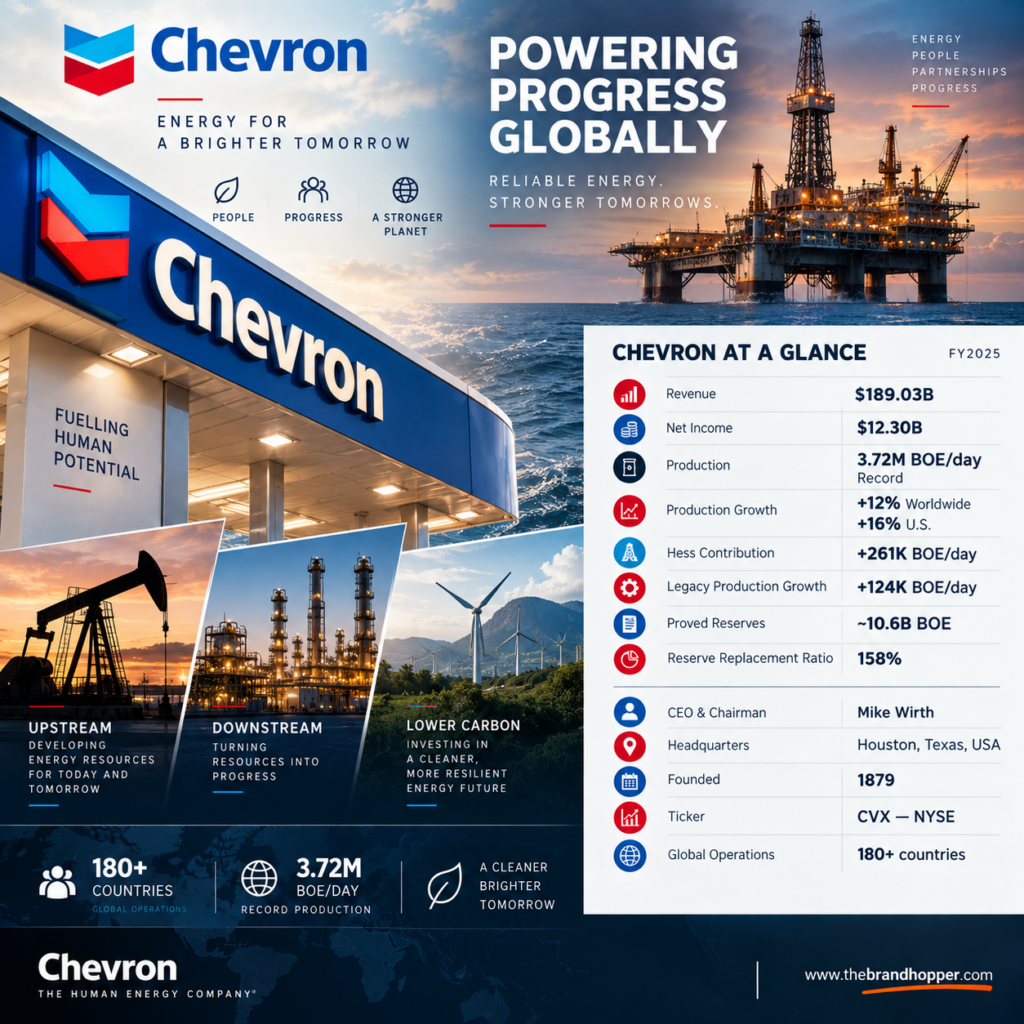
Chevron Corporation is one of the world’s leading integrated energy companies, with operations spanning exploration, production, refining, marketing, and chemicals. Headquartered in San Ramon, California, Chevron reported record worldwide production in FY2025 — a 12% year-on-year increase, with US production growing 16% to record levels — powered partly by the completed acquisition of Hess Corporation, which added 261,000 BOE/day of production to Chevron’s portfolio. FY2025 revenue was $189.03 billion, with net income of $12.48 billion reflecting lower average oil prices versus FY2024. Year-end proved reserves stood at 10.6 billion BOE with a reserve replacement ratio of 158%.
Yet in the hyper-competitive global energy market, Chevron faces formidable rivals at every level: supermajors commanding hundreds of billions in revenue, state-backed national oil companies (NOCs) with vast reserve bases, nimble US independents laser-focused on shale efficiency, and large-scale refiners dominating the downstream segment.
This article profiles Chevron’s 18 most significant competitors, drawing on the latest financial data, strategic priorities, and areas of direct competition. Whether you are an investor, energy analyst, or industry professional, this guide provides the most comprehensive view of the competitive landscape facing Chevron today.
Why the Global Energy Market Is Fiercely Competitive
The energy sector operates in an environment shaped by volatile commodity prices, massive capital requirements, geopolitical risk, and an accelerating energy transition. Oil and gas companies compete not only for reserves and production capacity but also for investor capital, talent, downstream market share, and, increasingly, low-carbon credibility. Average Brent crude prices fell approximately 14.5% in FY2025 to $69.06/barrel, creating a challenging revenue environment for all producers and intensifying competition for capital efficiency.
Chevron competes simultaneously with Western supermajors in global deepwater and LNG markets, with national oil companies in key resource basins, with US shale-focused independents in the Permian Basin, and with large refiners in downstream fuel markets. Understanding each competitor’s distinct strengths is essential for benchmarking Chevron’s strategic positioning in the years ahead.
Top Chevron Competitors
1. ExxonMobil
Website: ExxonMobil
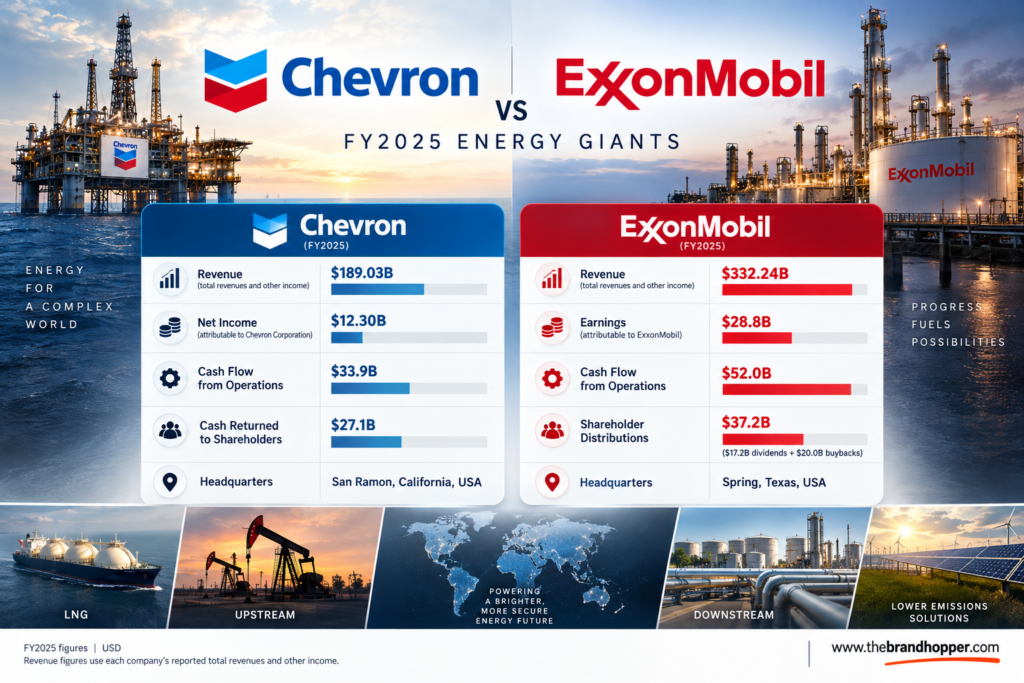
ExxonMobil is Chevron’s most direct rival and America’s largest publicly traded oil and gas company. With FY2025 revenue of $332.2 billion and net earnings of $28.8 billion, ExxonMobil commands nearly double Chevron’s financial scale. Its landmark acquisition of Pioneer Natural Resources — completed in May 2024 for approximately $60 billion — dramatically expanded its Permian Basin footprint to more than 1.4 million BOE/day, placing it in direct head-to-head competition with Chevron’s own Permian growth strategy. Full-year upstream earnings reached $21.4 billion in FY2025, and ExxonMobil distributed $37.2 billion to shareholders ($17.2 billion dividends + $20 billion share repurchases).
Under CEO Darren Woods, ExxonMobil pursues a “higher-return, lower-emission” strategy underpinned by a $15 billion structural cost reduction programme targeted for cumulative savings by 2027. Cash flow from operations reached $52.0 billion in FY2025, with free cash flow of $26.1 billion and capex of $29.0 billion. Beyond the Permian, ExxonMobil competes with Chevron in Gulf of Mexico deepwater, global LNG (PNG LNG; Mozambique interests), and chemicals through its ExxonMobil Chemical subsidiary.
ExxonMobil’s Guyana Stabroek block (operator, ~45% working interest) holds recoverable resources exceeding 11 billion BOE. This positions ExxonMobil as a long-term rival to Chevron in deepwater portfolio quality and international resource growth.
For a deeper look at ExxonMobil’s market strategy, see: Marketing Strategy and Marketing Mix of ExxonMobil.
2. Shell
Website: Shell
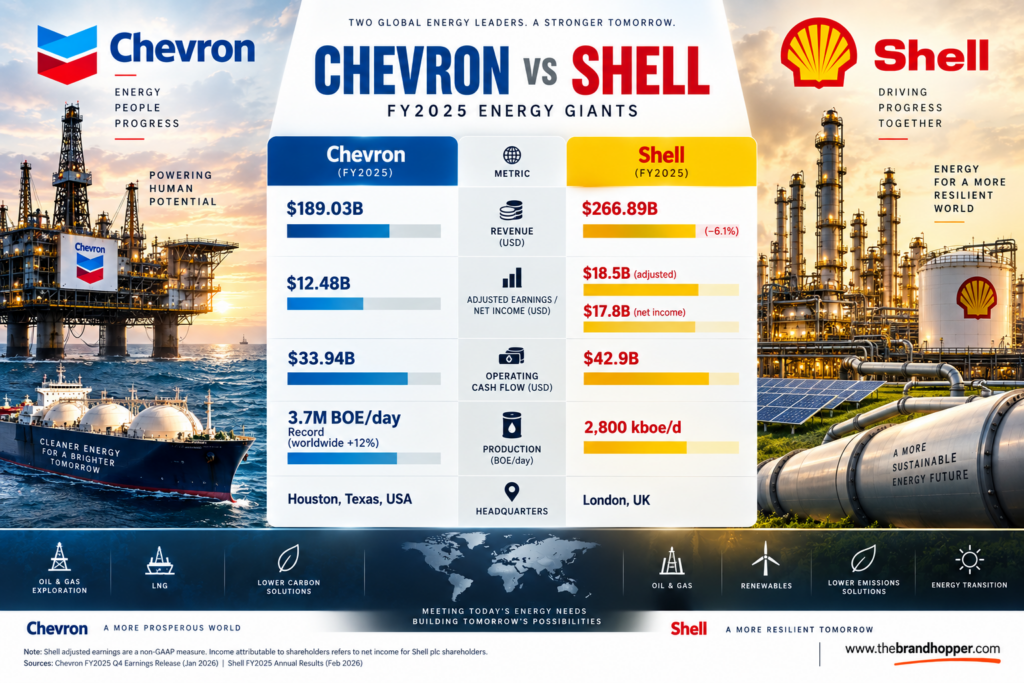
Shell Plc is a London-headquartered supermajor and the world’s largest trader of liquefied natural gas (LNG). FY2025 revenue was $266.89 billion (−6.1% vs FY2024), with adjusted earnings of $18.5 billion and net income of $17.8 billion. Production available for sale was 2,800 thousand boe/d in FY2025, with operating cash flow of $42.9 billion and free cash flow of $26.1 billion after $20.9 billion in capital expenditure. Shell returned $22.4 billion to shareholders in FY2025 ($13.9 billion buybacks + $8.5 billion dividends). CEO Wael Sawan’s “Powering Progress” strategy is doubling down on LNG and marketing profitability while selectively advancing low-carbon businesses.
Shell’s LNG leadership is a direct competitive pressure on Chevron, which is expanding its own LNG capacity through the Gorgon and Wheatstone projects in Australia. Both companies compete intensely for long-term LNG supply contracts with Asian utilities and industrial buyers. Shell’s global fuel retail network (40,000+ service stations) and premium lubricants brands (Shell Helix, Pennzoil) generate resilient downstream cash flows that Chevron’s more upstream-focused model does not fully replicate.
Shell competes with Chevron in Gulf of Mexico deepwater, North Sea E&P, and petrochemicals. Its Chemicals and Products segment — while undergoing rationalisation — creates overlap with Chevron’s Oronite additives and downstream chemicals businesses.
For a deeper look at Shell’s market strategy, see: Marketing Strategy and Marketing Mix of Shell Plc.
3. BP
Website: BP plc
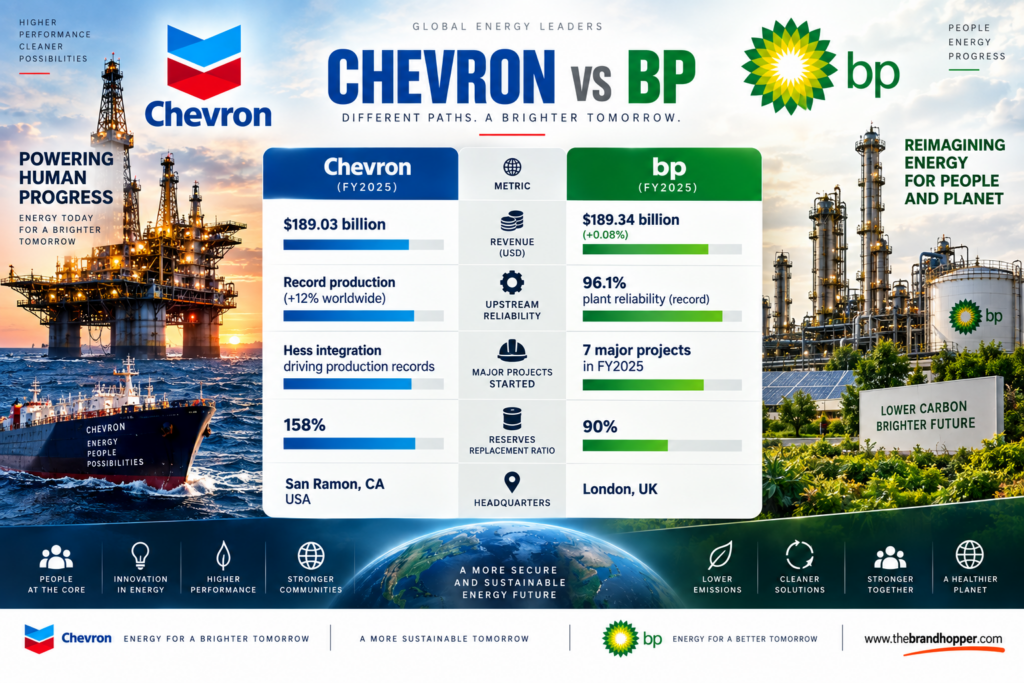
BP plc is a British supermajor executing a decisive pivot back to oil and gas under CEO Murray Auchincloss. FY2025 revenue was $189.34 billion (+0.08% vs FY2024). BP achieved record upstream plant reliability of 96.1% and record refining availability of 96.3% in FY2025, and started up seven major projects during the year. The reserves replacement ratio increased to 90%. BP has now announced expected divestment proceeds of more than $11 billion (completed and announced deals), including an agreement to sell a 65% stake in Castrol for approximately $6 billion net proceeds. Structural cost reduction targets have been raised to $5.5–6.5 billion by end-2027.
BP’s Gulf of Mexico deepwater operations, Azerbaijan ACG field (30%+ working interest), North Sea assets, and global LNG positions make BP a direct competitor to Chevron across multiple basins and commodity chains. Its “reset and grow” strategy signals a long-term intention to remain an integrated energy powerhouse, with selective low-carbon ambitions including offshore wind and renewable fuels.
BP’s Customers segment delivered its highest underlying earnings since 2019 in FY2025, with all customer businesses growing year-on-year — demonstrating the resilience of its downstream and retail operations even in a lower-oil-price environment.
4. TotalEnergies
Website: TotalEnergies
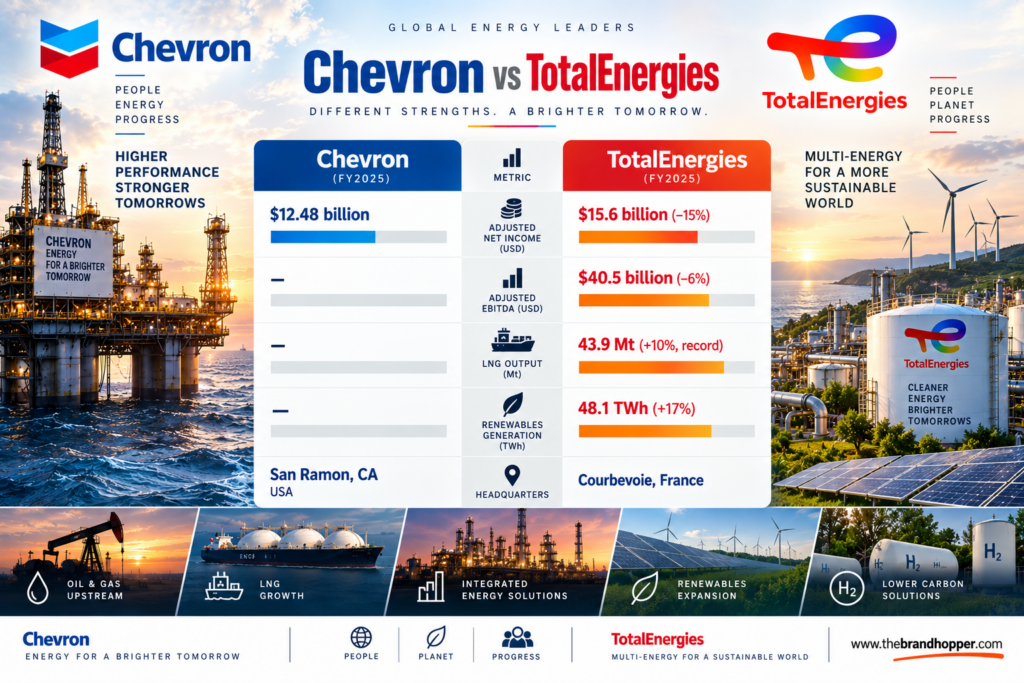
TotalEnergies SE is France’s integrated energy giant and one of the most disciplined capital allocators among the Western supermajors. In FY2025, TotalEnergies reported adjusted net income of $15.6 billion (−15% vs FY2024), adjusted EBITDA of $40.5 billion (−6%), and cash flow of approximately $28 billion (−7%). The declines reflect the global oil price drop, but TotalEnergies’ production growth remained strong: oil production reached 1,378 kb/d (+5%), gas 1,151 kboe/d (+3%), and LNG output grew 10% to 43.9 million tonnes — a record. Net electricity generation from renewables grew 17% to 48.1 TWh.
CEO Patrick Poyanné pursues a dual strategy of growing LNG and renewables simultaneously. TotalEnergies competes with Chevron most intensely in Africa (Nigeria, Angola, Mozambique LNG), in global LNG markets (where it is the third-largest trader globally), and increasingly in low-carbon energy. The company has approximately 100GW of renewable energy projects in its development pipeline while also growing upstream oil production through assets in Brazil (Lapa, Mero), Guyana, and the UAE.
TotalEnergies’ Exploration & Production segment generated adjusted net operating income of $8.4 billion and cash flow of $15.6 billion in FY2025, while Integrated LNG contributed $4.1 billion in adjusted net operating income and $4.7 billion in cash flow.
5. ConocoPhillips
Website: ConocoPhillips
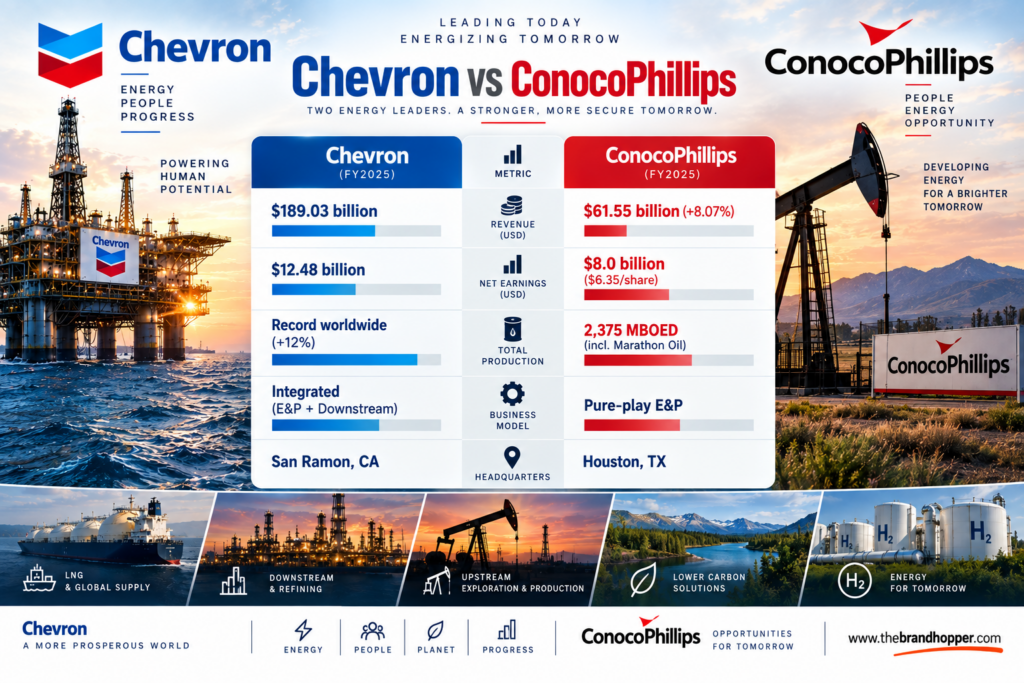
ConocoPhillips is the world’s largest publicly traded pure-play exploration and production company. FY2025 revenue was $61.55 billion (+8.07% vs FY2024), with net earnings of $8.0 billion ($6.35/share), down from $9.2 billion in FY2024 despite higher revenues, reflecting the lower average commodity price environment. Total production was 2,375 MBOED in FY2025 — an increase of 388 MBOED from the same period a year ago, primarily reflecting the successful integration of Marathon Oil (closed August 2024), which added approximately 640 MBOED/day of US onshore production and doubled ConocoPhillips’ synergy capture targets.
ConocoPhillips’ “cost of supply” discipline — targeting a sub-$35/BOE breakeven across its entire global portfolio — makes it one of the most resilient competitors across commodity price cycles. Internationally, it competes with Chevron in Norway (Ekofisk area), Australia (Australia Pacific LNG), Qatar (LNG equity stakes), and Canada (Surmont oil sands, 50% WI).
ConocoPhillips’ dramatically expanded Delaware and Midland Basin footprint (post-Marathon Oil) positions it as Chevron’s most direct US shale competitor. Both companies are pursuing Permian Basin growth as a core strategic pillar. On an adjusted basis, ConocoPhillips earned $7.7 billion ($6.16/share) in FY2025.
6. Equinor ASA
Website: Equinor
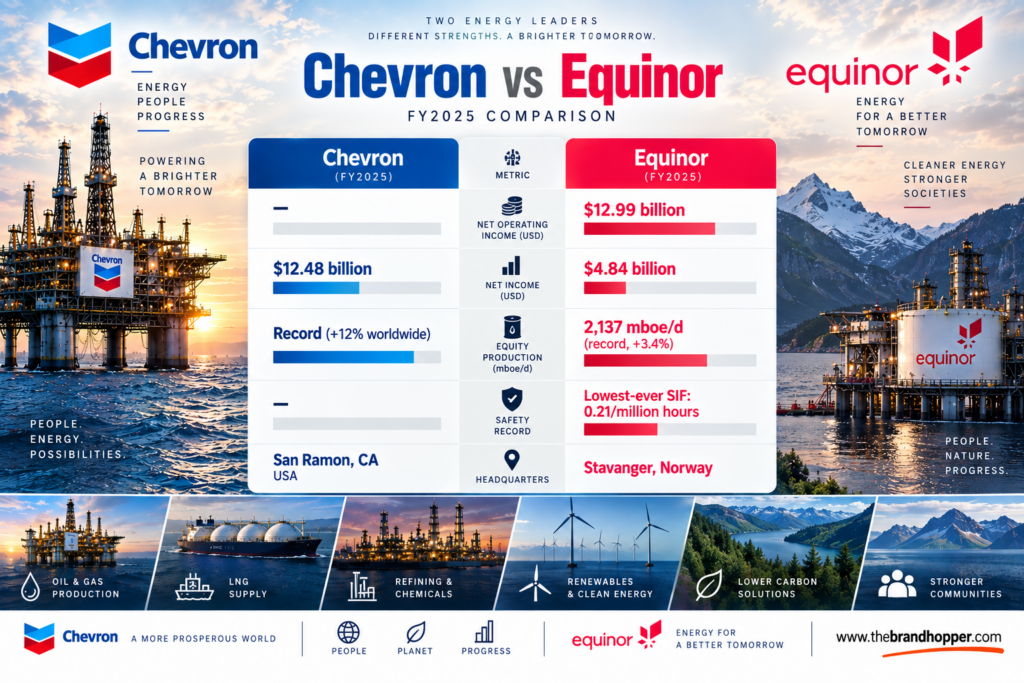
Equinor ASA, formerly Statoil, is Norway’s 67% state-owned energy company and Europe’s most important offshore oil and gas producer. In FY2025, Equinor delivered equity production of 2,137 mboe per day — a record high and a 3.4% increase year-on-year. Net operating income was $12.99 billion, net income $4.84 billion, and adjusted net income $3.22 billion ($1.33 adjusted EPS). Equinor recorded its lowest-ever serious incident frequency of 0.21 per million hours worked, and reduced operated scope 1 and 2 emissions by 34% from 2015 to 2025. For 2026, Equinor expects around 3% further production growth.
Equinor competes with Chevron in the Gulf of Mexico deepwater (both hold significant acreage in the Paleogene trend), in UK North Sea exploration, and in global LNG. New fields such as Johan Castberg and Halten East delivered substantial contributions to the record 2025 production, and strong NCS (Norwegian Continental Shelf) performance underpinned the full-year result.
Equinor’s offshore wind portfolio — including Empire Wind (USA), Hywind floating wind (UK), and Dogger Bank (UK, 3.6GW) — positions it as a long-term competitor in the energy transition space where Chevron currently has limited direct investment.
7. Eni S.p.A.
Website: Eni S.p.A.
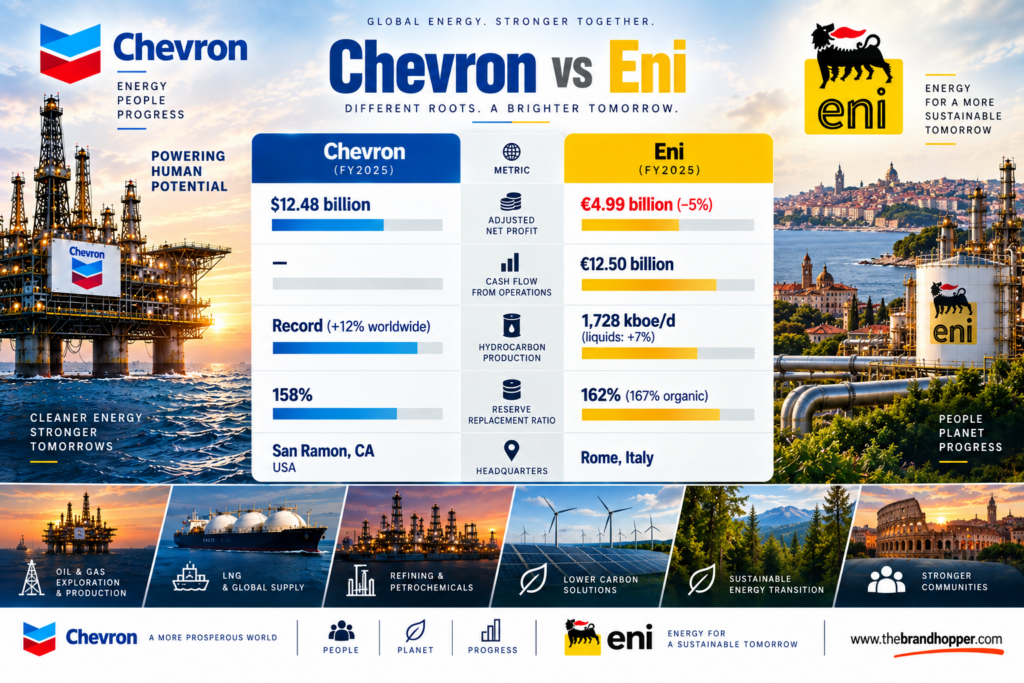
Eni S.p.A. is Italy’s integrated energy champion, headquartered in Rome and founded in 1953. In FY2025, Eni reported adjusted net profit of €4.99 billion (−5% vs FY2024), with proforma adjusted EBIT of €12.22 billion (−15%). Cash flow from operations reached €12.50 billion, and free cash flow €5.37 billion. Hydrocarbon production averaged 1,728 kboe/d — slightly above FY2024 levels, with 7% liquids growth (to 840 kb/d) in Côte d’Ivoire, Mexico, Angola, and Norway. The reserve replacement ratio reached 162% (167% organic). Eni also achieved a significant reduction in net debt to €9.4 billion and boosted its share buyback programme by 20%.
Eni’s distinctive “satellite model” has created three separately investable units: Plenitude (retail energy + renewables, with external investors including Singapore’s GIC), Enilive (biofuels and biorefining), and Eni Natural Resources (upstream E&P, partnered with KKR). This approach attracts outside capital and ring-fences the energy transition without burdening the core oil balance sheet.
Eni competes with Chevron in African deepwater E&P (Congo, Nigeria, Angola), Mediterranean gas markets, and LNG supply (Mozambique LNG, NLNG equity, Egypt LNG). Its Versalis chemicals arm and growing biofuels portfolio also overlap with Chevron’s downstream chemical and renewable fuel strategies.
8. Saudi Aramco
Website: Saudi Aramco
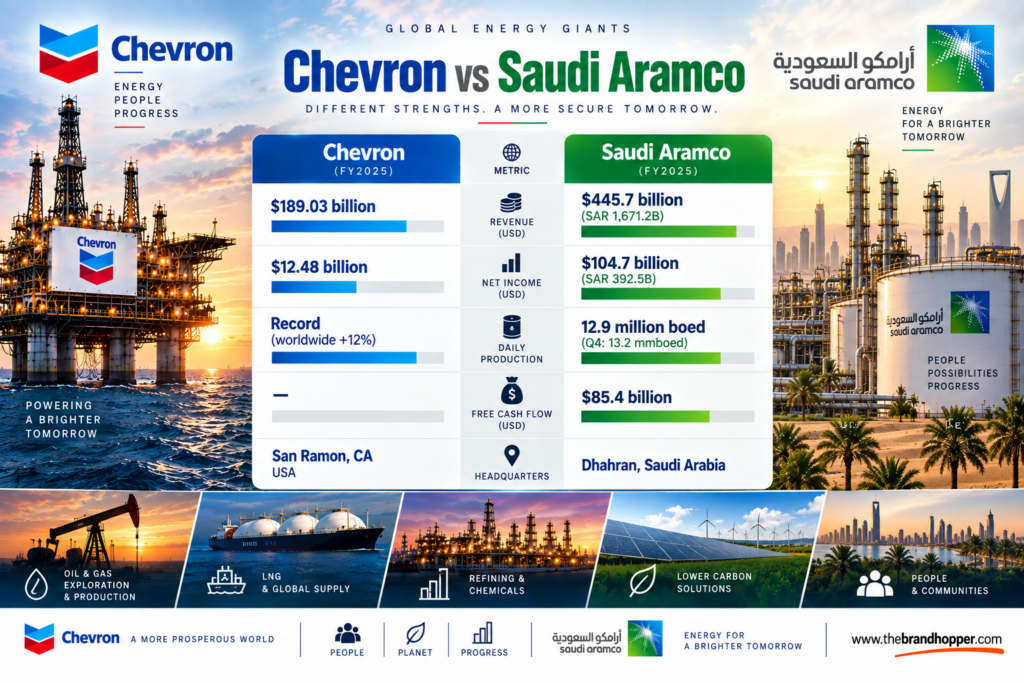
Saudi Aramco is the world’s largest oil company by production and, with FY2025 net income of $104.7 billion (SAR 392.5 billion), the most profitable company in the world. Revenue reached $445.7 billion (SAR 1,671.2 billion). Total hydrocarbon production averaged 12.9 million boe per day in FY2025, with Q4 2025 averaging 13.2 million boed. Cash flow from operating activities was $136.2 billion, and free cash flow reached $85.4 billion for the year. Majority owned by the Saudi Arabian government (approximately 98%), Aramco is listed on the Saudi Exchange (Tadawul). Its proven reserve base stands at approximately 268 billion BOE and its upstream cost of supply is approximately $3/barrel — the lowest in the world.
Aramco’s competitive impact on Chevron operates through multiple channels. As the world’s swing producer, its production decisions (often coordinated through OPEC+) directly shape global oil prices and thus the revenue environment for all producers. Aramco also competes through its SABIC petrochemicals subsidiary (targeting 4 million tonnes/day of petrochemicals capacity by 2035) and through a growing network of international refinery partnerships in Asia, Europe, and the Americas.
Aramco’s Vision 2030-aligned downstream investment in US Gulf Coast refining through its Motiva joint venture creates localised competitive overlap with Chevron’s Gulf Coast downstream assets. Aramco also competes directly with Chevron’s Gorgon and Wheatstone LNG in Asian spot and term crude markets.
9. PetroChina
Website: PetroChina
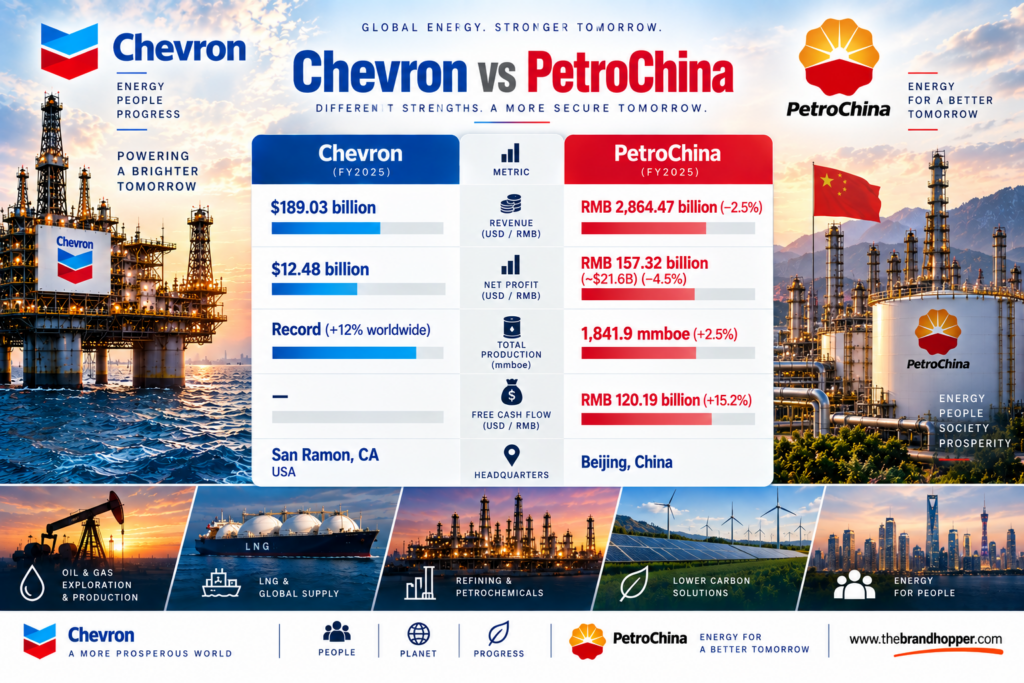
PetroChina is China’s largest oil and gas company and a listed subsidiary of CNPC (China National Petroleum Corporation). In FY2025, PetroChina reported revenue of RMB 2,864.47 billion (−2.5% vs FY2024) and net profit attributable to shareholders of RMB 157.32 billion (−4.5%), reflecting the challenging global oil price environment. Total hydrocarbon production grew 2.5% to 1,841.9 million BOE, with crude output stable at 948 million barrels (+0.7%) and gas production growing 4.5% to 152 billion cubic metres. Free cash flow reached RMB 120.19 billion (+15.2% year-on-year). The dividend payout ratio reached 54.7% — a five-year high — with total dividends of RMB 86.02 billion.
PetroChina operates one of the world’s most extensive oil and gas infrastructure networks, including over 90,000 kilometres of domestic pipeline and massive refining capacity exceeding 3.7 million BPD. Its Sichuan Basin tight gas and shale gas production is growing rapidly, aiming to reduce China’s LNG import dependence. PetroChina’s new energy business also showed strong growth in FY2025, as part of a strategic shift towards a lower-carbon portfolio.
PetroChina competes with Chevron primarily through the global LNG market. As China’s dominant LNG buyer, PetroChina’s long-term contract negotiations directly determine pricing and volume structures for LNG exports from Chevron’s Gorgon and Wheatstone projects in Australia.
10. Petrobras (Petróleo Brasileiro S.A.)
Website: Petrobras
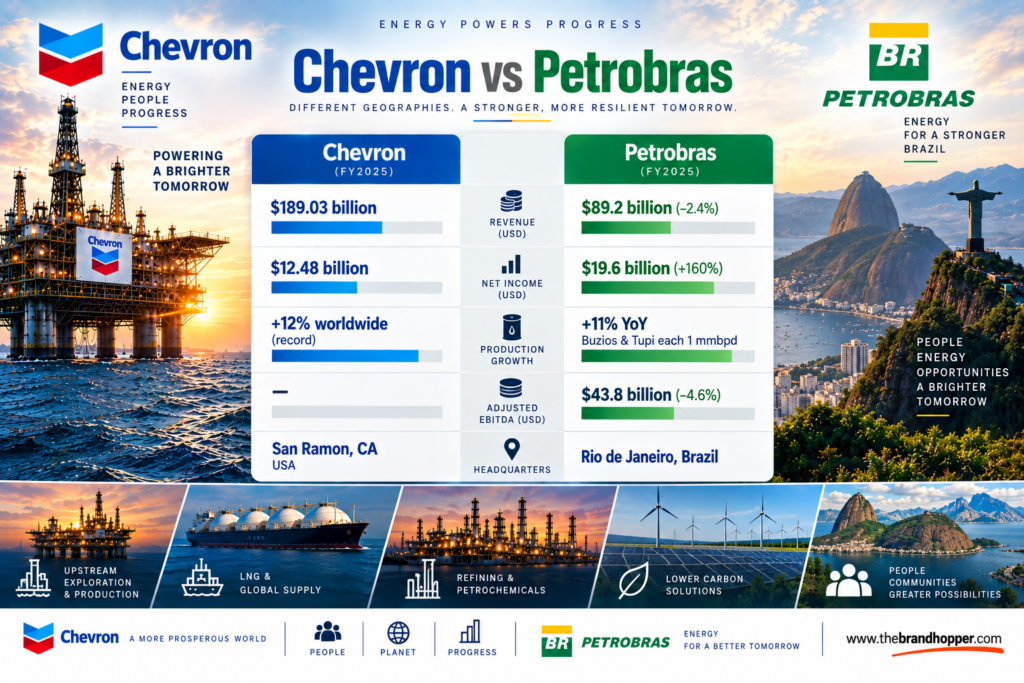
Petrobras is Brazil’s state-controlled energy company and the undisputed world leader in deepwater pre-salt oil production. FY2025 sales revenues were $89.2 billion (−2.4% vs FY2024), impacted by a 14.5% drop in average Brent crude to $69.06/bbl. However, net income attributable to shareholders surged to $19.6 billion (+160% vs $7.53 billion in FY2024), partly driven by foreign exchange gains from the strengthening Brazilian real. Excluding one-off effects, adjusted net income was $18.1 billion. Adjusted EBITDA was $43.8 billion (−4.6%). Petrobras achieved an 11% increase in total oil and gas production in FY2025, including milestones at the Buzios and Tupi/Iracema fields, each reaching 1 million barrels per day of production.
Petrobras competes with Chevron most directly in deepwater technology and operational capability. Chevron holds a working interest in Brazil’s Roncador field and other pre-salt assets. Petrobras’ engineering expertise — honed over five decades in ultra-deepwater environments at water depths exceeding 2,000 metres — is a formidable competitive benchmark for any deepwater operator globally.
In global crude markets, Petrobras’ Tupi-grade pre-salt crude (light sweet, low-sulphur) competes with Chevron-origin crude grades from TCO (Kazakhstan) and West Africa for the same Asian refinery buyer relationships.
11. Occidental Petroleum Corporation (OXY)
Website: Occidental Petroleum
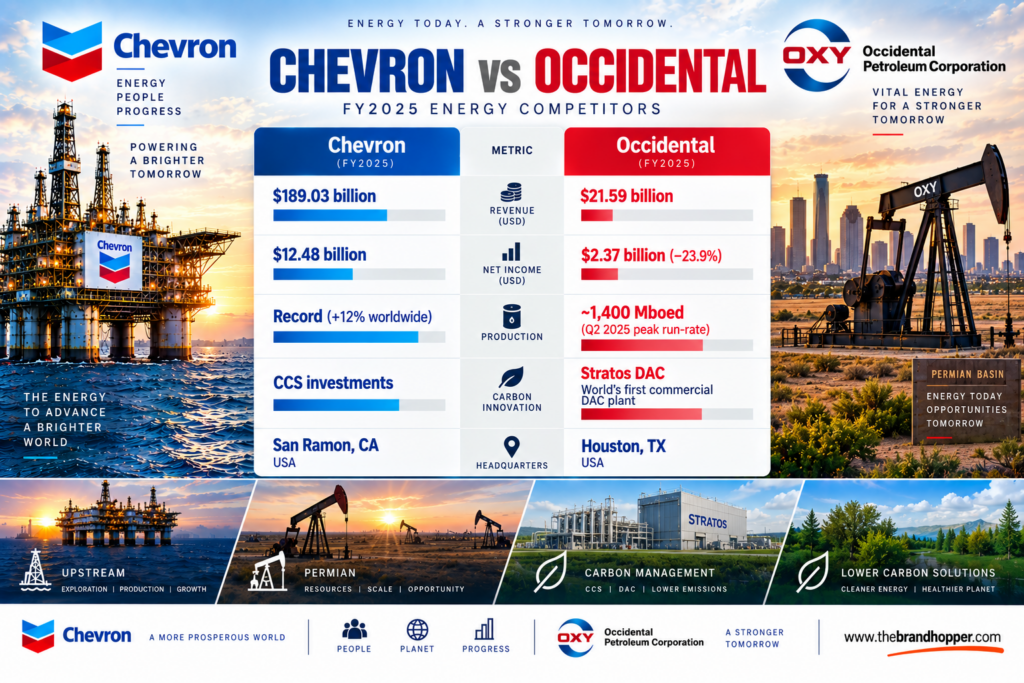
Occidental Petroleum is one of Chevron’s most direct Permian Basin rivals. Headquartered in Houston, Texas, and led by CEO Vicki Hollub, Occidental reported FY2025 revenue of $21.59 billion and net income of $2.37 billion (−23.9% vs FY2024), reflecting the lower oil price environment. Average global production reached approximately 1,400 thousand boe/d (Q2 2025 run-rate). A significant strategic event was the sale of Occidental Chemical Corporation (OxyChem), completed on January 2, 2026, which streamlines Occidental into a more focused upstream and midstream operator.
Occidental’s combined Permian Basin portfolio — spanning both the Midland and Delaware Basins, expanded through the $12 billion CrownRock acquisition completed in 2024 — places it in direct head-to-head competition with Chevron’s own Permian position. Warren Buffett’s Berkshire Hathaway holds approximately 28% of Occidental, providing a powerful financial endorsement.
Occidental is also a pioneer in direct air capture (DAC) carbon removal technology through its 1PointFive subsidiary. Its Stratos DAC plant in the Permian Basin — the world’s first commercial-scale direct air capture facility — positions Occidental as a first mover in a carbon removal market that could become commercially significant by the 2030s.
12. Repsol S.A.
Website: Repsol
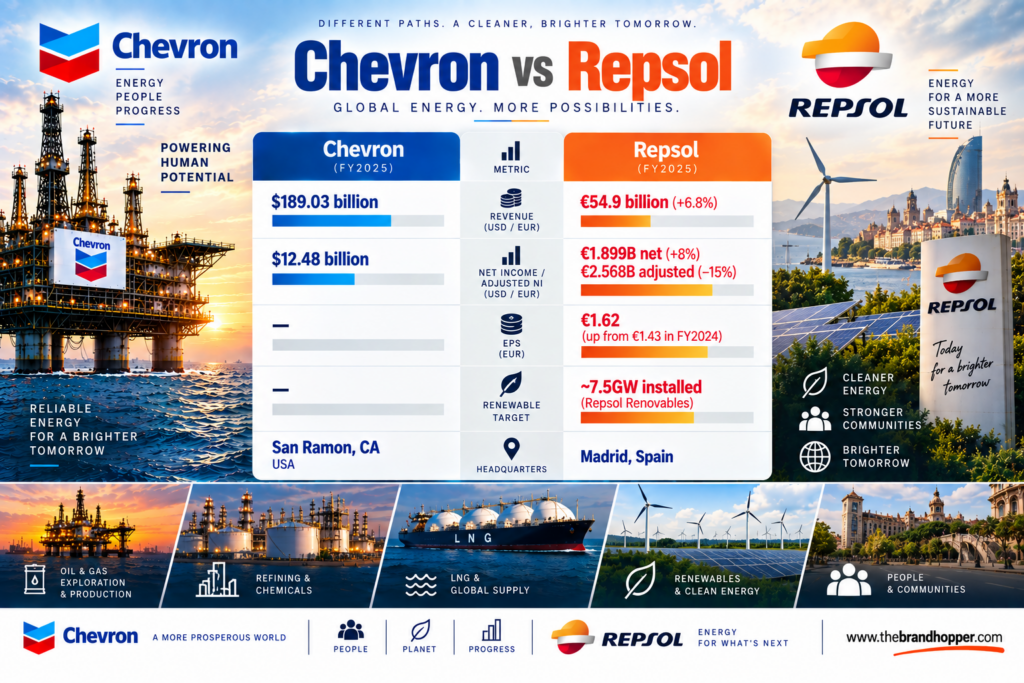
Repsol is Spain’s largest energy company, headquartered in Madrid and operating as a fully integrated international energy player in more than 35 countries. FY2025 revenue was €54.9 billion (+6.8% vs FY2024). Reported net income was €1.899 billion (+8%), while adjusted net income was €2.568 billion (−15%), reflecting the impact of declining oil prices on underlying profitability. Earnings per share rose to €1.62 from €1.43 in FY2024. Repsol refined 41.3 million tonnes of crude oil and produced 46.2 million tonnes of petroleum products in FY2025. CEO Josu Jon Imaz continues to execute a “multi-energy” strategy blending upstream oil and gas with a growing renewable energy platform.
Repsol competes with Chevron in several shared geographies: the Gulf of Mexico (deepwater Paleogene trend), Colombia and Trinidad (onshore and offshore E&P), the North Sea, and global LNG. Its Ecofining renewable fuels technology and growing sustainable aviation fuel (SAF) ambitions place Repsol in emerging competition with Chevron’s own renewable fuels strategy.
Repsol has committed to net-zero emissions by 2050 and targets approximately 7.5GW of installed renewable capacity through Repsol Renovables. Its six refining complexes in Spain and Portugal are being progressively adapted for bio-refining and SAF production.
13. Suncor Energy
Website: Suncor Energy
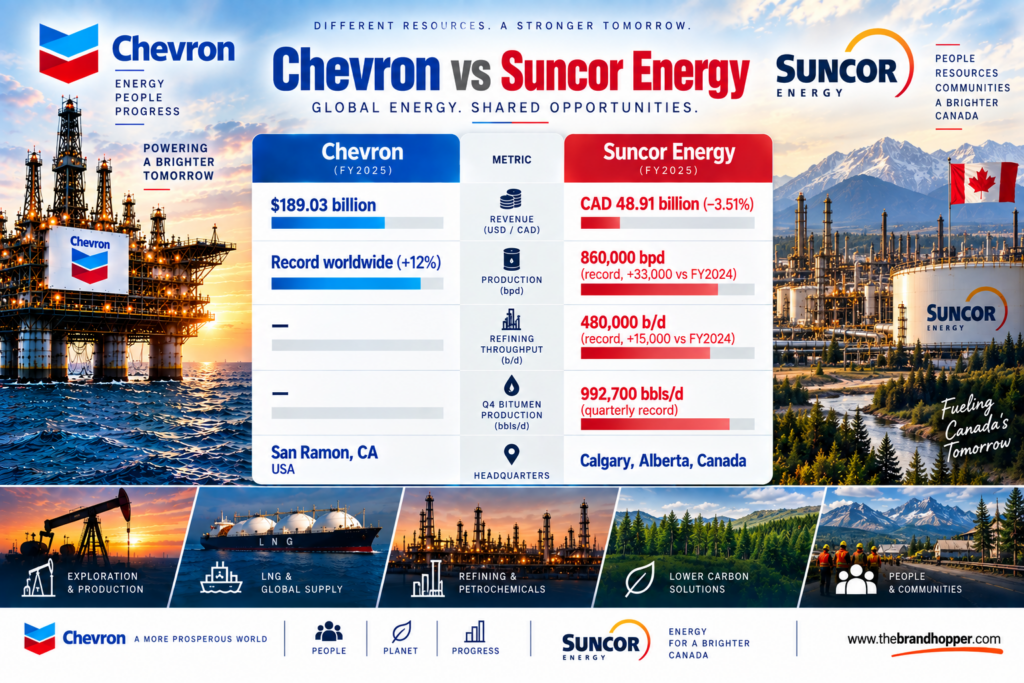
Suncor Energy is Canada’s largest integrated oil company and the dominant force in Alberta’s oil sands sector. FY2025 revenue was CAD 48.91 billion (−3.51% vs FY2024), reflecting lower oil prices. However, Suncor achieved record annual production of 860,000 barrels per day in FY2025 — 33,000 bpd more than in FY2024 — and a record refining throughput of 480,000 b/d (15,000 b/d higher than FY2024). Q4 2025 oil sands bitumen production set a quarterly record of 992,700 bbls/d. Suncor met or exceeded every single target from its three-year strategic plan announced in spring 2024 — a full year or more ahead of schedule — under CEO Rich Kruger’s operational turnaround.
Suncor competes with Chevron in North American crude oil supply chains, particularly for heavy and synthetic crude sales to US Gulf Coast and Midwest refineries. Its Petro-Canada retail fuel brand (~1,500 stations across Canada) and Fort Hills/Syncrude oil sands operations create a uniquely integrated Canadian value chain.
Suncor’s massive proven reserves base in the oil sands — estimated at over 7 billion barrels — represents a multi-decade competitive advantage in resource longevity and capital certainty.
14. EOG Resources
Website: EOG Resources
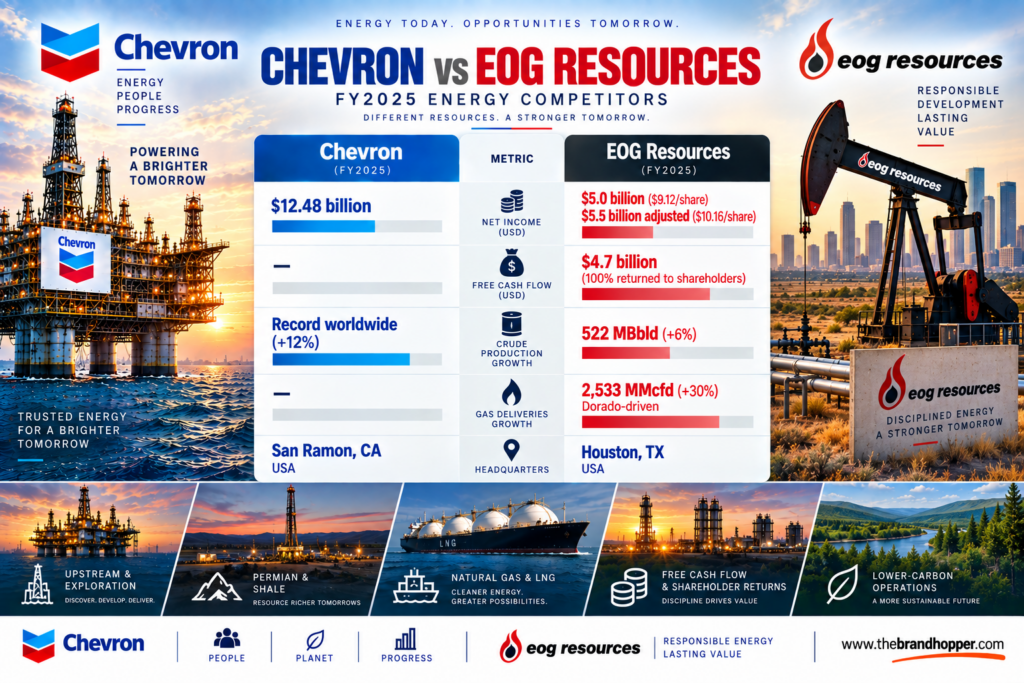
EOG Resources is widely regarded as one of the best-run oil and gas companies in the US. Headquartered in Houston, Texas, and led by CEO Ezra Yacob, EOG delivered FY2025 net income of $5.0 billion ($9.12/share) and adjusted net income of $5.5 billion ($10.16/share). Net cash from operating activities was $10.0 billion, adjusted CFO $11.0 billion, and free cash flow $4.7 billion — 100% of which was returned to shareholders through dividends and share repurchases. Crude oil and condensate production grew 6% to 522 MBbld; NGLs production grew 17% to 288 MBbld; and natural gas deliveries grew 30% to 2,533 MMcfd — driven by the Dorado dry gas play in South Texas.
EOG’s “premium returns” investment culture requires all wells to generate at least a 30% direct after-tax rate of return at $40 oil and $2.50 natural gas — a standard that creates highly capital-efficient operations in the Eagle Ford Shale (where EOG is the largest producer) and Delaware Basin (Permian), both direct competitive overlaps with Chevron.
EOG’s Dorado dry gas play in South Texas (natural gas cost of supply reportedly below $1.00/MMBTU) gives it a structural cost advantage in the US natural gas market as LNG export demand grows. International positions in Trinidad and Tobago, the UAE, and China add modest diversification.
15. Devon Energy
Website: Devon Energy
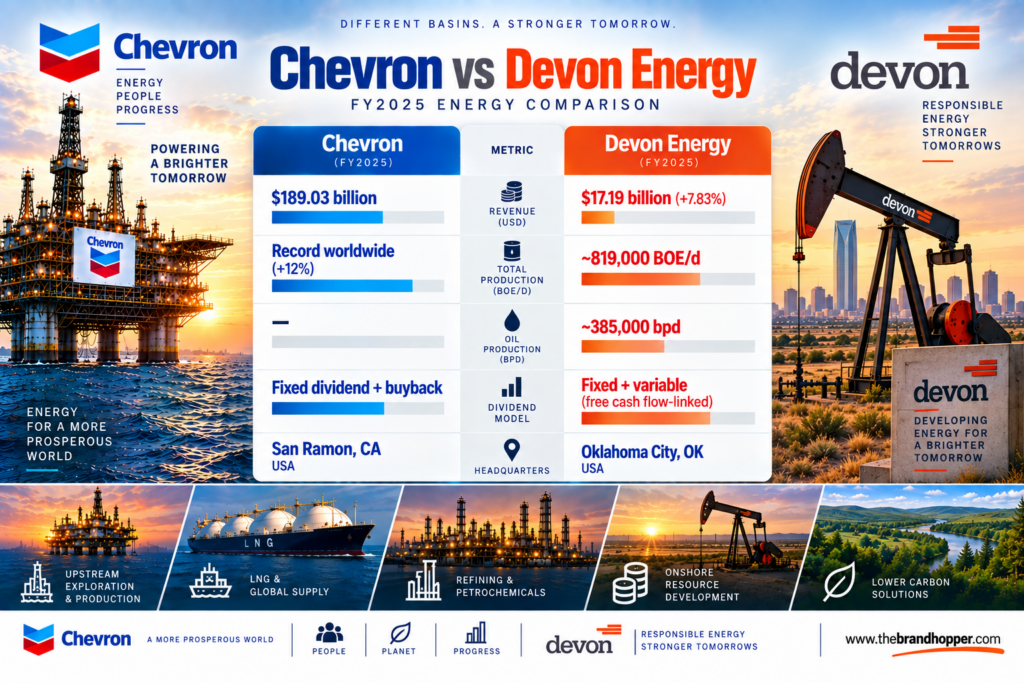
Devon Energy is one of the leading US onshore E&P independents, with its primary operational base in the Delaware Basin of the western Permian. Headquartered in Oklahoma City, Oklahoma, and led by CEO Clay Gaspar, Devon reported FY2025 revenue of $17.19 billion (+7.83% vs FY2024). Full-year production was approximately 819,000 BOE/d (guidance range: 810,000–828,000 BOE/d), with oil production of approximately 385,000 bpd. Q4 2025 net earnings were $562 million ($0.90/diluted share), with core earnings of $510 million ($0.82/share).
Devon competes directly with Chevron in the Delaware Basin, where both companies operate adjacent acreage positions. Devon’s variable dividend model — paying a fixed base dividend plus a variable quarterly cash dividend tied to free cash flow — attracts significant institutional interest and benchmarks directly against Chevron’s shareholder returns programme for energy investors seeking income.
Devon’s additional positions in the Anadarko Basin, Eagle Ford, and Williston Basin (North Dakota, added through the 2024 Grayson Mill Energy acquisition) create a geographically diversified US onshore portfolio that competes with Chevron for Permian and multi-basin shale capital.
16. Valero Energy Corporation
Website: Valero Energy
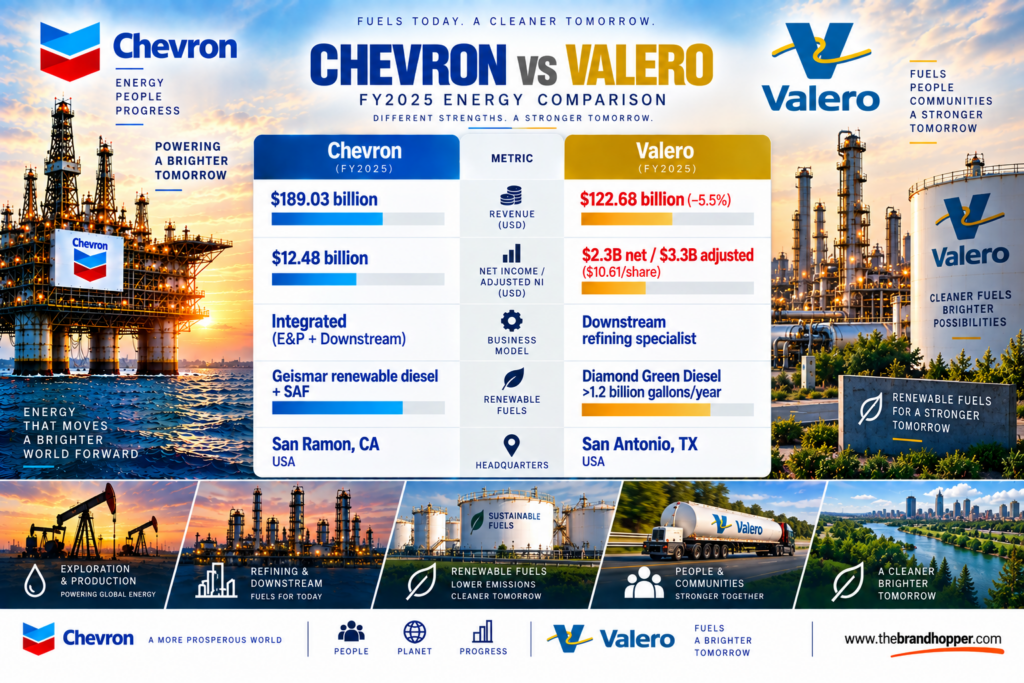
Valero Energy is the largest petroleum refiner in the United States by throughput capacity, processing approximately 3.2 million barrels per day across 15 petroleum refineries in the US, Canada, and the UK. Headquartered in San Antonio, Texas, and led by CEO Lane Riggs, Valero reported FY2025 revenue of $122.68 billion (−5.5% vs FY2024’s $129.88 billion). Net income was $2.3 billion ($7.57/share), while adjusted net income was $3.3 billion ($10.61/share). Notably, FY2025 was Valero’s best year on record for mechanical availability, personnel safety, and environmental performance, and it achieved record refining throughput and ethanol production.
Valero’s Diamond Green Diesel (DGD) venture — a 50/50 joint venture with Darling Ingredients — is the largest renewable diesel producer in the world, with three operational sites producing over 1.2 billion gallons per year of renewable diesel and sustainable aviation fuel (SAF). This directly competes with Chevron’s renewable fuels strategy at its Geismar, Louisiana facility.
Valero also operates 12 ethanol plants with approximately 1.5 billion gallons per year of production capacity. Its Port Arthur refinery in Texas is the largest single refinery in the US, and its complex refining capabilities directly compete with Chevron’s Richmond and Pascagoula refineries for crude slate and product market share.
17. Phillips 66
Website: Phillips 66
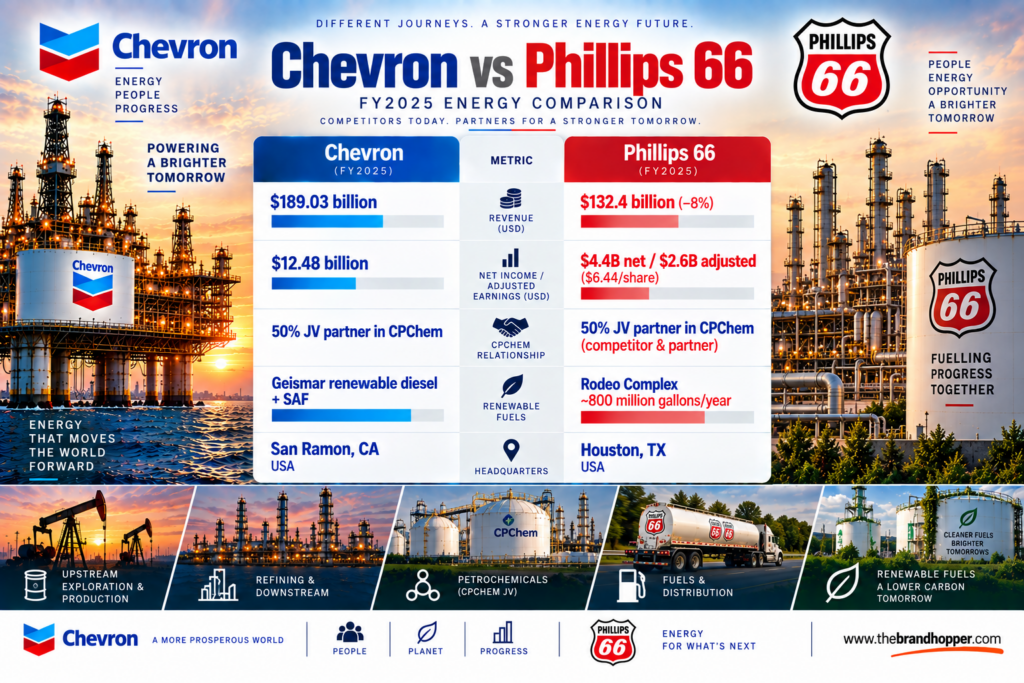
Phillips 66 was spun off from ConocoPhillips in 2012 and has since built one of North America’s most diversified downstream and midstream businesses. Headquartered in Houston and led by CEO Mark Lashier, Phillips 66 reported FY2025 revenue of $132.4 billion (−8% vs FY2024). Net income was $4.4 billion ($10.79/share), while adjusted earnings were $2.6 billion ($6.44/share). The company generated $5.0 billion in net operating cash flow and returned more than 50% of net operating cash flow ($3.1 billion) to shareholders. Phillips 66 achieved a record clean product yield of 88% and 99% crude capacity utilisation in its refining segment. NGL transportation and fractionation volumes grew 22% and 23% respectively — both records. The company reduced its debt by $2.0 billion in Q4 2025, ending the year with $19.7 billion in debt.
In a notable structural relationship, Chevron and Phillips 66 are equal 50/50 partners in Chevron Phillips Chemical Company LLC (CPChem) — one of the world’s largest petrochemicals manufacturers. This makes Chevron and Phillips 66 simultaneously competitors and strategic business partners, a dual dynamic uncommon at this scale in the energy industry.
Phillips 66’s Rodeo Renewable Energy Complex in California — converted from a conventional petroleum refinery to one of the world’s largest renewable fuels facilities (approximately 800 million gallons per year) — directly competes with Chevron’s renewable fuels programmes. Its DCP Midstream infrastructure also expands into the Permian Basin, overlapping with Chevron’s pipeline interests.
18. Marathon Petroleum Corporation
Website: Marathon Petroleum
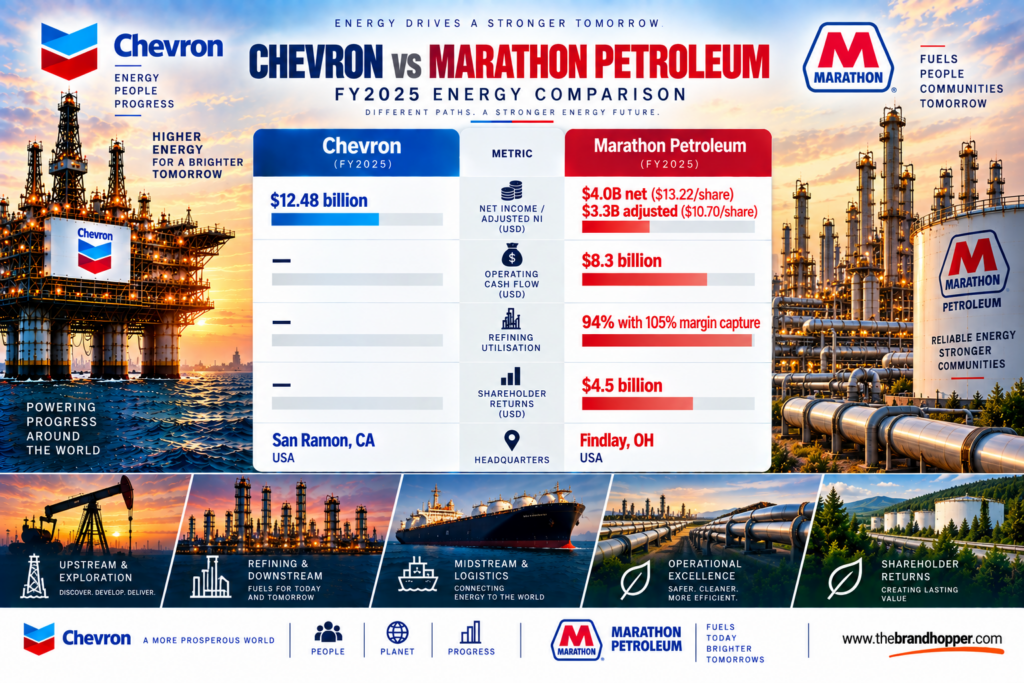
Marathon Petroleum Corporation (MPC) is one of the largest US petroleum refiners by throughput capacity, processing approximately 3.1 million barrels per day across 13 refineries concentrated in the Gulf Coast, Midwest, and West Coast. Headquartered in Findlay, Ohio, Marathon Petroleum reported FY2025 net income of $4.0 billion ($13.22/diluted share) and adjusted net income of $3.3 billion ($10.70/diluted share) — up from $3.4 billion and $10.08/share respectively in FY2024. Cash provided by operating activities was $8.3 billion for the full year. Refining utilisation was 94% with margin capture of 105%, demonstrating strong operational performance. The company achieved peer-leading capital returns of $4.5 billion in FY2025. Marathon also controls MPLX LP (approximately 65% owned) — a large publicly traded midstream MLP.
Marathon Petroleum competes with Chevron primarily in the downstream refining and fuels distribution segment. Its Galveston Bay Refinery in Texas City (~585,000 BPD capacity, second-largest US refinery) is a major buyer of crude oil — including grades produced or marketed by Chevron — and a significant price-setter in US refined product markets.
MPLX’s growing Permian Basin gathering and processing systems, DJ Basin assets, and Appalachian pipeline networks directly compete with Chevron’s midstream interests. Marathon Petroleum’s developing renewable fuels position (SAF and renewable diesel at El Paso and Dickinson facilities) mirrors Chevron’s own downstream energy transition roadmap.
Competitive Landscape Analysis
1. The Permian Basin: Ground Zero for US E&P Competition
The Permian Basin in west Texas and southeastern New Mexico is the single most intensely competitive oil-producing region in the world. Chevron’s record worldwide production in FY2025, boosted by the Hess acquisition, places it in direct competition with ExxonMobil (1.4+ million BOE/day post-Pioneer), ConocoPhillips (expanded to 2,375 MBOED post-Marathon Oil), Occidental Petroleum (~1,400 Mboed), Devon Energy (~819,000 BOE/d), and EOG Resources (522 MBbld crude, +6%).
Companies compete not only for production but for royalty land acreage, drilling services, pipeline capacity, and specialist completion engineers. The Permian will remain Chevron’s most intensely competitive battleground through the end of the decade.
2. LNG: The Global Battle for Long-Term Supply Contracts
Chevron’s Gorgon and Wheatstone LNG projects in Western Australia supply buyers across Asia. Shell (world’s largest LNG trader), TotalEnergies (LNG: 43.9 Mt in FY2025, +10%), ConocoPhillips (Australia, Qatar), and ExxonMobil (PNG LNG) all compete for the same long-term LNG supply agreements.
PetroChina’s growing domestic gas production simultaneously reduces China’s LNG import needs — the market Chevron’s Australian projects depend on most. As global LNG demand grows, competition for new supply projects and buyer relationships will intensify through the 2030s.
3. Downstream Refining: Scale Against Integration
In the US downstream market, Chevron competes with specialist refiners of enormous scale. Valero ($122.68B revenue, 3.2M BPD capacity, record throughput in FY2025), Marathon Petroleum ($4.0B net income, 94% utilisation rate, $8.3B OCF), and Phillips 66 ($132.4B revenue, record clean product yield 88%) collectively process over 8 million barrels per day. Their competitive advantage lies in operational efficiency, crude flexibility, and sheer scale.
Chevron’s downstream advantage comes from integration with its upstream crude supply, giving it preferential feedstock access and margin capture across the value chain.
4. The Energy Transition: A New Competitive Dimension
The shift toward lower-carbon energy is creating new competitive lines. TotalEnergies (electricity: +17% to 48.1 TWh in FY2025), Equinor (record-low emissions intensity, 30GW offshore wind target), Repsol (7.5GW renewable target), and Eni (Plenitude + Enilive satellite model) are all deploying material capital into renewables and low-carbon energy.
Valero’s Diamond Green Diesel (1.2B gallons/year) and Phillips 66’s Rodeo Complex (800M gallons/year) compete with Chevron’s Geismar renewable diesel facility in the growing US renewable fuels market. Occidental’s Stratos DAC plant represents first-mover positioning in commercial carbon removal — an area Chevron also has strategic interests in through its carbon capture investments.
Frequently Asked Questions (FAQs)
Q1. Who is Chevron’s biggest competitor?
A: ExxonMobil is widely considered Chevron’s largest and most direct competitor. Both are US-headquartered integrated oil and gas supermajors competing head-to-head across the Permian Basin, Gulf of Mexico deepwater, global LNG, and downstream refining and chemicals. ExxonMobil’s FY2025 revenue of $323.91 billion is nearly double Chevron’s $189.03 billion, and its net earnings of $28.8 billion exceed Chevron’s $12.48 billion more than twofold. However, Chevron achieved record worldwide production growth in FY2025 (+12%), powered by the Hess acquisition, demonstrating that competitive strength is not simply a function of income in any given year.
Q2. How does Chevron compare to Shell and BP in size and strategy?
A: Shell (FY2025 revenue $266.89 billion, adjusted earnings $18.5 billion) is larger than Chevron by revenue and outperformed on adjusted earnings in FY2025, with particular strength in LNG and downstream cash generation. BP ($189.34 billion FY2025 revenue, +0.08%) is broadly comparable to Chevron in revenue scale and is executing a strategic reset back to oil and gas from overextended renewable targets, achieving record upstream reliability of 96.1% in FY2025. Chevron’s FY2025 production record (+12%) demonstrates its capital deployment is translating directly into volume growth.
Q3. Is Saudi Aramco a competitor to Chevron?
A: Yes, in several important ways. Saudi Aramco’s FY2025 net income of $104.7 billion dwarfs all Western majors combined, underscoring its enormous financial firepower. It competes as a global crude oil supplier — its 12.9 mmboed production directly influences global prices and supply balances. Aramco’s OPEC+ production decisions shape the oil price environment all companies operate in. Its $445.7 billion in FY2025 revenue, $85.4 billion in free cash flow, and massive chemicals expansion (SABIC) create competitive pressure across multiple dimensions. However, Aramco is state-controlled with different primary objectives from a publicly traded, investor-accountable company like Chevron.
Q4. What are Chevron’s key competitive advantages over its rivals?
A: Chevron’s most significant competitive advantages include: record worldwide production in FY2025 (+12%), with US production up 16% to record levels — demonstrating industry-leading volume growth execution; the completed Hess acquisition adding 261,000 BOE/day of high-quality production; a strong Australian LNG platform (Gorgon and Wheatstone) generating long-term contracted cash flows; one of the strongest balance sheets and credit ratings in the sector; proved reserves of 10.6 billion BOE with a 158% reserve replacement ratio; and deep operational expertise across both Permian tight oil and international deepwater environments.
Q5. Why is ConocoPhillips considered a major Chevron competitor despite being much smaller?
A: ConocoPhillips ($61.55 billion FY2025 revenue, $8.0 billion net earnings) is a pure-play E&P company — its entire capital base competes directly with Chevron’s upstream division. Its total FY2025 production of 2,375 MBOED (including Marathon Oil) and sub-$35/BOE global cost of supply create substantial head-to-head competition with Chevron’s most important assets. Its Permian Basin, Norway, Australia, Qatar, and Canada assets create direct competition with Chevron across multiple key geographies.
Q6. How do US shale-focused companies like EOG Resources and Devon Energy compete with Chevron?
A: EOG Resources ($5.0 billion FY2025 net income, crude production +6% to 522 MBbld) and Devon Energy ($17.19 billion revenue, ~819,000 BOE/d production) compete with Chevron primarily in the Permian Basin and Eagle Ford Shale. Both employ proprietary completion techniques and data analytics that drive well costs down to levels competitive with Chevron’s own unit economics. EOG’s 100% FCF return to shareholders ($4.7 billion in FY2025) and Devon’s variable dividend model set direct benchmarks against Chevron’s shareholder returns programme for energy-focused institutional investors.
Q7. What makes Petrobras a unique and formidable competitor?
A: Petrobras is the global technology leader in ultra-deepwater pre-salt oil production. Its FY2025 production grew 11% year-on-year, including the Buzios and Tupi/Iracema fields each reaching 1 million barrels per day — milestones that demonstrate sustained execution in the world’s most prolific deepwater environment. Despite revenue of $89.2 billion (−2.4%), net income surged to $19.6 billion (+160%). Its adjusted EBITDA of $43.8 billion reflects the underlying profitability of its low-cost pre-salt portfolio even at average Brent of $69.06/bbl.
Q8. How do Valero, Phillips 66, and Marathon Petroleum compete with Chevron if they don’t produce oil?
A: These three downstream specialists compete with Chevron in US refined product markets (gasoline, diesel, jet fuel) and are all expanding into renewable fuels. Valero achieved record refining throughput in FY2025 and its Diamond Green Diesel JV produces 1.2+ billion gallons/year. Phillips 66 achieved a record clean product yield of 88% and operates the Rodeo Renewable Energy Complex at ~800 million gallons/year. Marathon Petroleum delivered 94% refining utilisation with 105% margin capture and $8.3 billion OCF. Their large existing refinery infrastructure gives them capital deployment advantages in the renewable fuels transition that Chevron’s newer facilities must match. Phillips 66 also shares a 50/50 CPChem chemicals JV with Chevron.
Q9. How is PetroChina relevant as a Chevron competitor given it primarily operates in China?
A: PetroChina competes with Chevron most critically through its influence on global LNG pricing. As China’s dominant LNG buyer, PetroChina’s long-term contract negotiations directly determine the price and volume structures for LNG exports from Chevron’s Gorgon and Wheatstone plants in Australia. PetroChina’s gas production grew 4.5% in FY2025 to 152 bcm, with total hydrocarbon production up 2.5% — and its growing domestic shale gas output aims to reduce China’s LNG import dependence over time, which would directly impact Chevron’s long-term LNG sales volumes.
Q10. How is the competitive landscape of the global energy sector likely to evolve?
A: Three forces will reshape the competitive landscape over the next decade. First, the Permian Basin consolidation wave — ExxonMobil-Pioneer, ConocoPhillips-Marathon Oil, Chevron-Hess — is creating fewer but far larger players, intensifying competition for the best remaining acreage and midstream infrastructure. Second, LNG will be a decisive global battleground: TotalEnergies (LNG +10% in FY2025), Shell (world’s largest LNG trader), and ConocoPhillips all compete aggressively for the long-term supply contracts that underpin Chevron’s Australian LNG revenues. Third, the energy transition will create new competitive lines in renewable fuels, hydrogen, carbon capture, and low-carbon products — where today’s rankings do not predict tomorrow’s winners. Companies that combine low-cost conventional energy production with credible, high-return low-carbon investment will lead the next cycle.
Conclusion
Chevron Corporation delivered a landmark FY2025 — record worldwide production (+12%), record US production (+16%), proved reserves of 10.6 billion BOE with a 158% reserve replacement ratio, and successful integration of the Hess acquisition — even as lower oil prices compressed revenue to $189.03 billion and net income to $12.48 billion. In a year when average Brent fell 14.5% to $69.06/barrel, Chevron’s production discipline and portfolio quality proved their worth.
The 18 competitors profiled in this article — from ExxonMobil ($323.91 billion revenue, $28.8 billion earnings) and Saudi Aramco ($104.7 billion net income) to Petrobras (+11% production) and Valero (record throughput) — each bring distinct competitive advantages and strategic philosophies that will shape the global energy market for years to come.
As the energy transition reshapes long-term demand, Permian Basin consolidation intensifies, and LNG markets evolve globally, Chevron’s ability to combine disciplined capital allocation, operational excellence, and selective low-carbon investment will determine its standing against this formidable peer group. Understanding these competitors is essential for any investor, analyst, or energy professional assessing Chevron’s long-term strategic positioning.
To read more content like this, subscribe to our newsletter