Last Updated on September 3, 2026 by Team TBH
MediaTek is one of the most recognizable names in the global semiconductor industry, and by its own account it is the world’s fifth-largest fabless chip company, powering more than two billion devices a year and appearing inside roughly one in three mobile phones sold worldwide.
The Hsinchu, Taiwan-headquartered company, founded in 1997 and listed on the Taiwan Stock Exchange (TWSE: 2454), didn’t get there by competing in just one lane.
Its Dimensity and Helio processors go head-to-head with Qualcomm’s Snapdragon line in smartphones. Its Genio platforms fight for design wins in IoT and edge devices. Its Wi-Fi and Bluetooth connectivity chips sit inside routers, laptops, and smart-home gadgets from dozens of brands. Its Pentonic chips power smart TVs. Its automotive cockpit platforms are chasing a foothold inside connected cars. And its custom ASIC and data-center silicon business puts it in the same conversation as some of the biggest names in AI infrastructure.
That breadth is exactly why “who competes with MediaTek” doesn’t have a one-line answer. Depending on which product category you’re looking at, MediaTek’s rivals range from trillion-dollar giants like Qualcomm and Samsung to specialized IoT connectivity players like Espressif and Nordic Semiconductor, to Chinese SoC makers like UNISOC, Rockchip, Allwinner, and Amlogic that compete fiercely on price and volume.
This article walks through the most important competitors MediaTek faces, organized so you can see exactly where each one overlaps with MediaTek’s business — and why the semiconductor industry’s competitive map keeps shifting as AI, automotive electrification, and edge computing reshape demand for chips.
A Quick Snapshot of the Competitive Landscape
Before diving into individual companies, it helps to understand the different battlegrounds MediaTek fights on, because very few competitors challenge MediaTek across all of them simultaneously:
In smartphone application processors, the main rivals are Qualcomm, Samsung’s in-house Exynos chips, UNISOC, and (in China specifically) Huawei’s HiSilicon unit.
In Wi-Fi, Bluetooth, and broadband connectivity, MediaTek runs into Broadcom, Qualcomm, Realtek, and NXP.
In IoT and embedded microcontrollers, the field widens considerably to include Nordic Semiconductor, Espressif Systems, STMicroelectronics, Renesas, Microchip Technology, Texas Instruments, and Infineon.
In automotive silicon, the established leaders are NXP, Infineon, Renesas, STMicroelectronics, Texas Instruments, and onsemi — all of which have decades-long relationships with car makers that MediaTek is still working to build.
And in budget tablet, smart TV, and set-top-box SoCs, Chinese fabless rivals Rockchip, Allwinner, and Amlogic compete directly with MediaTek’s entry-level product lines.
With that framing in place, here is a detailed look at MediaTek’s most significant competitors.
Top MediaTek Competitors and Alternatives
1. Qualcomm
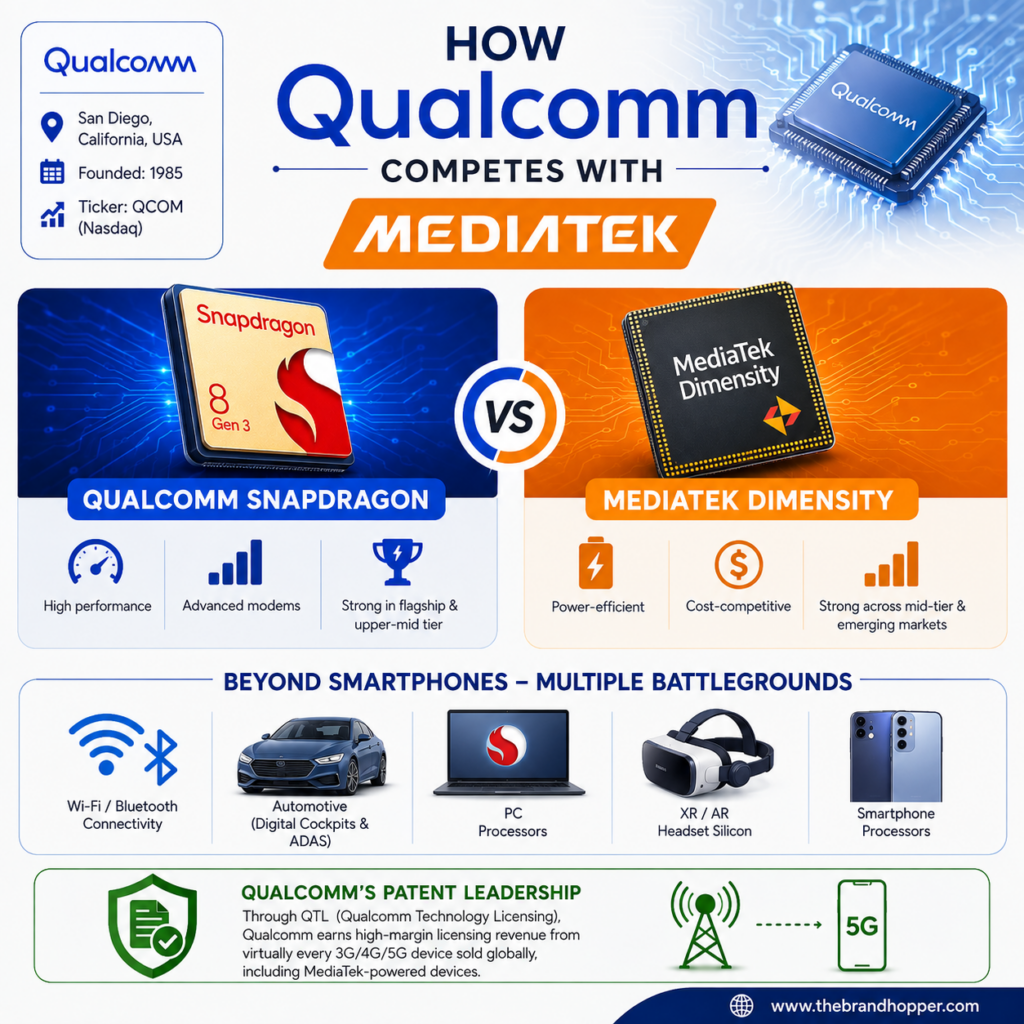
Qualcomm is MediaTek’s single most important rival, and the two companies have effectively defined the modern smartphone chipset market between them.
Qualcomm’s Snapdragon processors, built by its Qualcomm CDMA Technologies (QCT) segment, compete directly against MediaTek’s Dimensity line for design wins at Samsung, Xiaomi, OPPO, vivo, and other major phone brands, with the fiercest competition happening in the flagship and upper-mid-tier segments where Qualcomm has traditionally held an edge in raw performance and modem technology.
Beyond phones, Qualcomm also competes with MediaTek in Wi-Fi/Bluetooth connectivity, automotive digital cockpits and ADAS (through its Snapdragon Digital Chassis), PC processors, and XR/AR headset silicon.
Unlike MediaTek, Qualcomm also earns a substantial share of its profit from patent licensing (its QTL segment), giving it a second, high-margin revenue stream tied to essentially every 3G/4G/5G device sold globally, MediaTek included, since MediaTek is itself a licensee of Qualcomm’s cellular patents.
Qualcomm’s diversification push into automotive, IoT, and laptop chips mirrors MediaTek’s own expansion strategy, making the rivalry between them one of the most closely watched in the entire semiconductor industry.
2. Samsung Electronics (System LSI / Exynos)
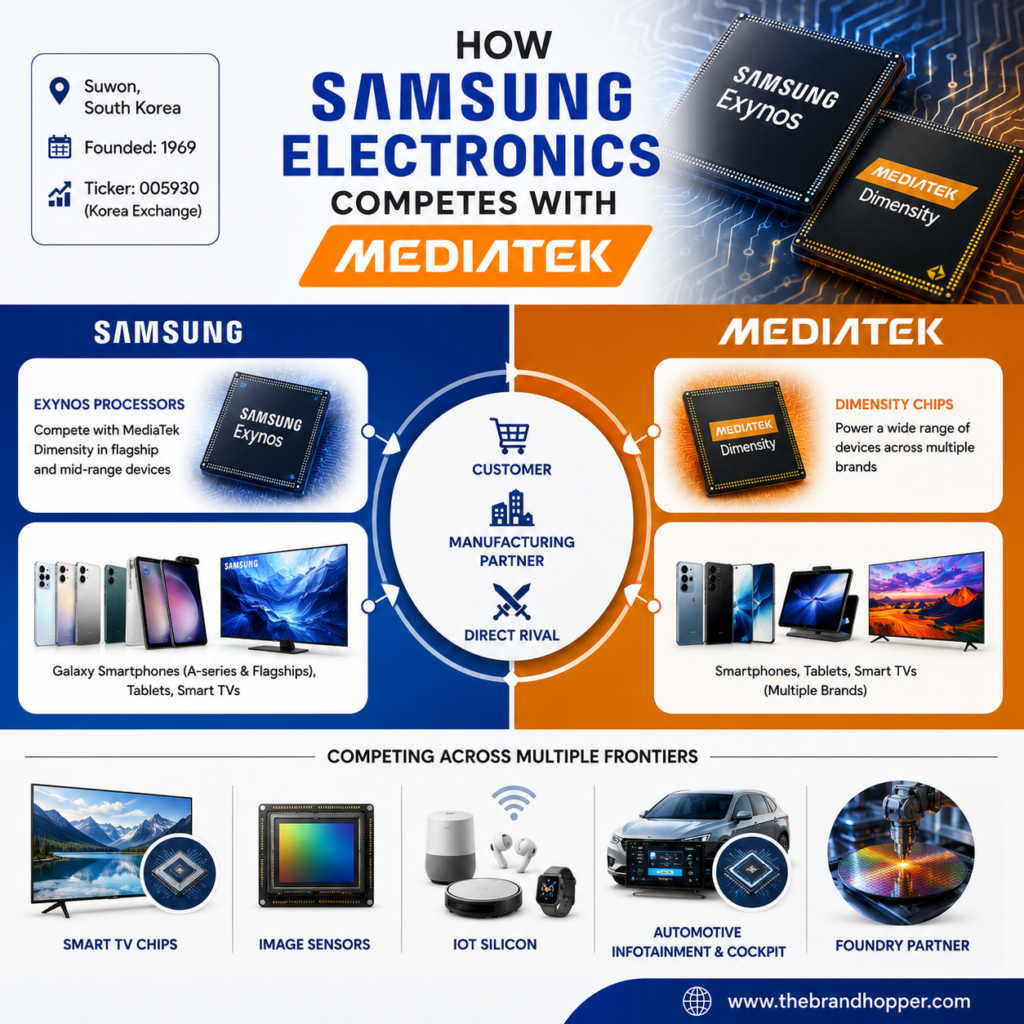
Samsung is unusual among MediaTek’s competitors because it’s simultaneously a customer, a manufacturing partner, and a direct rival.
Samsung buys MediaTek chips for some of its budget and mid-range Galaxy A-series phones, tablets, and smart TVs, while its own System LSI division designs the Exynos family of mobile processors that compete directly with MediaTek’s Dimensity line in Samsung’s own flagship and mid-range devices.
Samsung’s semiconductor arm doesn’t break out Exynos revenue separately from its broader Device Solutions business, which also includes memory chips and foundry services, so exact financial comparisons with MediaTek are difficult — but the strategic overlap is unmistakable.
Samsung also competes with MediaTek in smart TV chips, image sensors, and IoT silicon, and its Exynos Auto line targets the same automotive infotainment and cockpit market MediaTek is pursuing.
Because Samsung’s foundry business (Samsung Foundry) also manufactures chips for other fabless companies, including some MediaTek products historically, the relationship between the two companies is genuinely multidimensional rather than purely adversarial.
3. UNISOC (Spreadtrum)
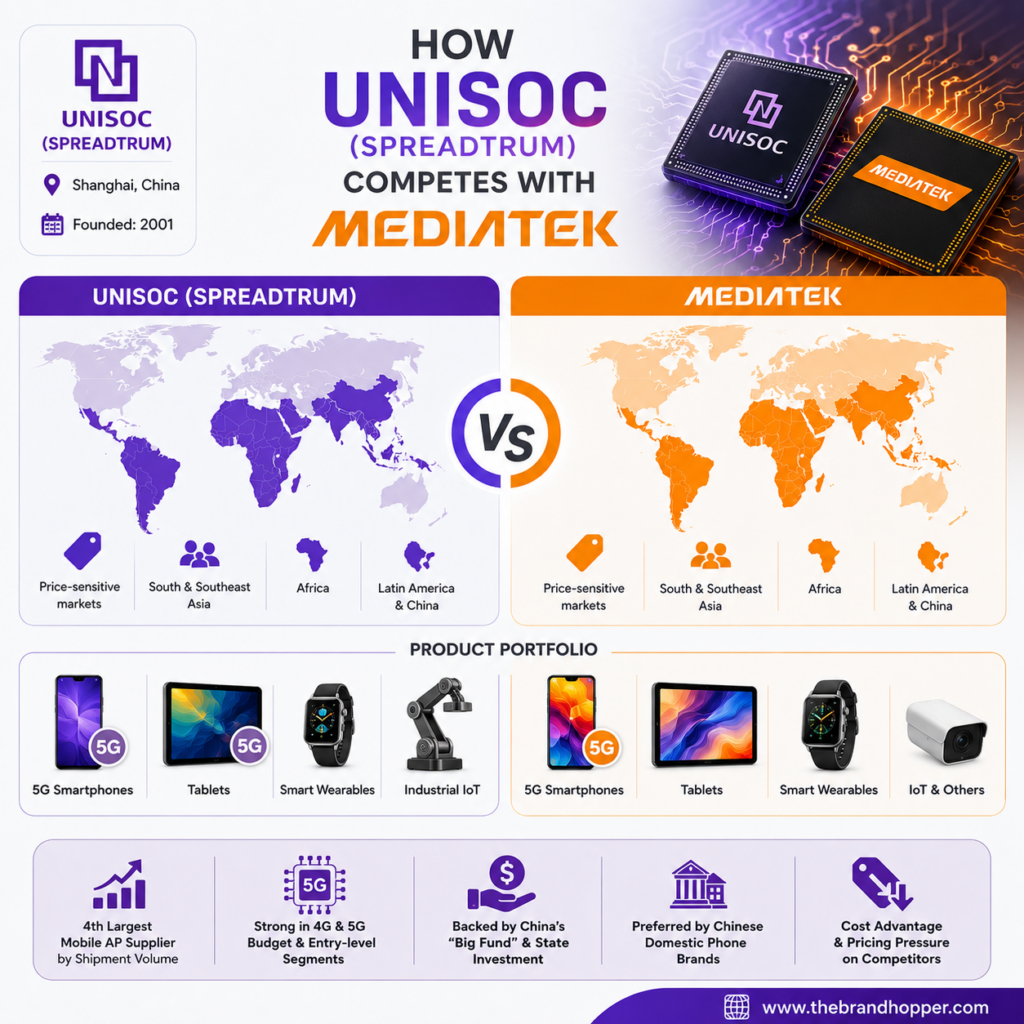
UNISOC is MediaTek’s most direct competitor in the entry-level and budget smartphone segment, particularly across price-sensitive markets in South and Southeast Asia, Africa, and Latin America, as well as within China itself.
UNISOC has consistently ranked as the world’s fourth-largest mobile application processor supplier by shipment volume, trailing MediaTek, Qualcomm, and Apple, and it has steadily moved upmarket from feature phones and 4G budget handsets into 5G smartphones, tablets, smart wearables, and industrial IoT chips.
Because Chinese government policy has actively encouraged domestic semiconductor self-sufficiency, UNISOC benefits from state-linked investment (including funding from China’s “Big Fund” semiconductor investment vehicle) and preferential positioning with Chinese domestic phone brands, giving it a durable cost and market-access advantage in the low end of the market that puts continuous pricing pressure on MediaTek’s cheaper Helio and entry Dimensity SKUs.
4. HiSilicon (Huawei)
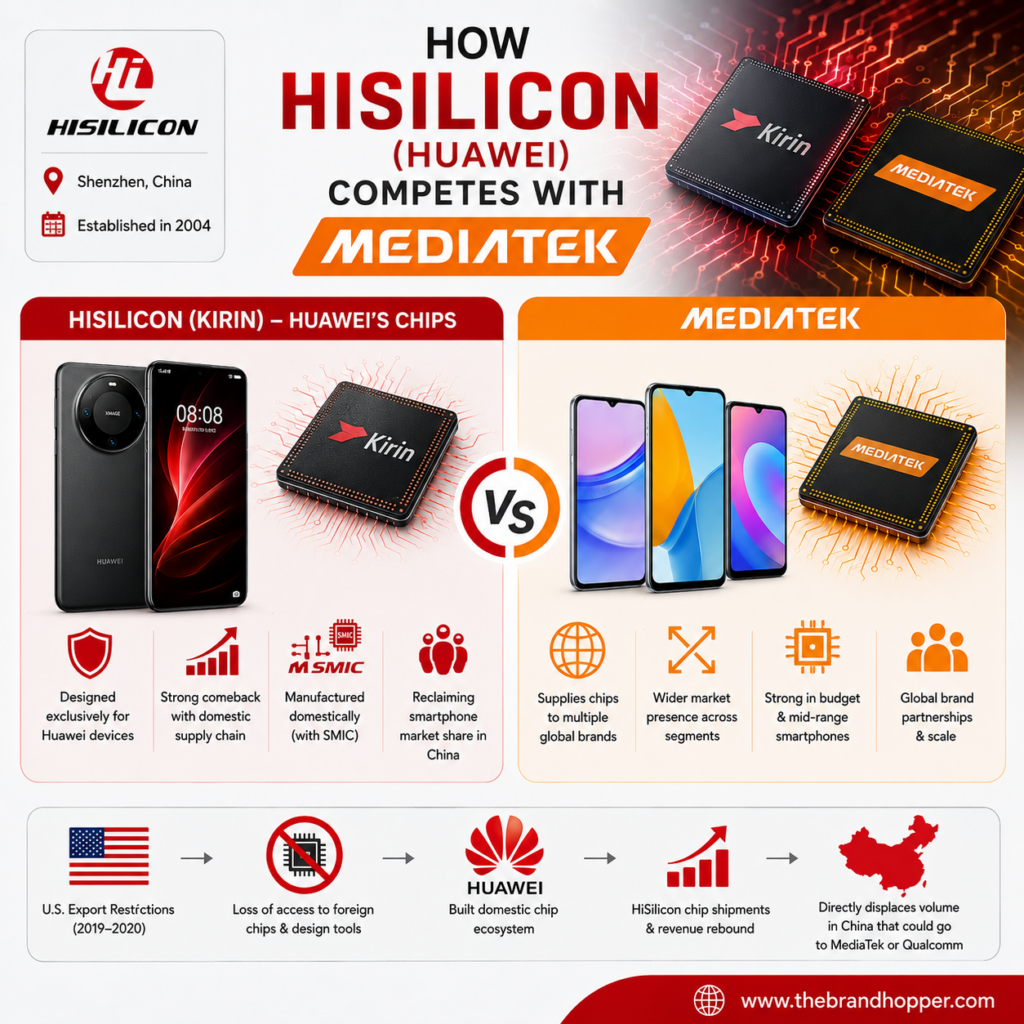
HiSilicon is Huawei’s wholly owned chip design subsidiary and the maker of the Kirin processors that power Huawei’s own smartphones — a business that MediaTek and Qualcomm both lost access to when Huawei was cut off from foreign chip supply chains and design tools under U.S. export restrictions imposed in 2019 and 2020.
Since then, Huawei has rebuilt a domestic chip supply chain in partnership with China’s SMIC foundry, and HiSilicon’s Kirin chips (fabricated domestically rather than at TSMC) have returned to Huawei’s flagship phones, driving a sharp rebound in HiSilicon’s chip shipments and revenue as Huawei has reclaimed smartphone market share inside China.
Because HiSilicon chips are designed exclusively for Huawei’s own hardware rather than sold to other phone brands, HiSilicon is a narrower competitive threat than Qualcomm or UNISOC in terms of addressable market, but within China it directly displaces volume that would otherwise likely go to MediaTek or Qualcomm, making it a strategically important rival to watch, especially as export-control policy continues to evolve.
5. Broadcom
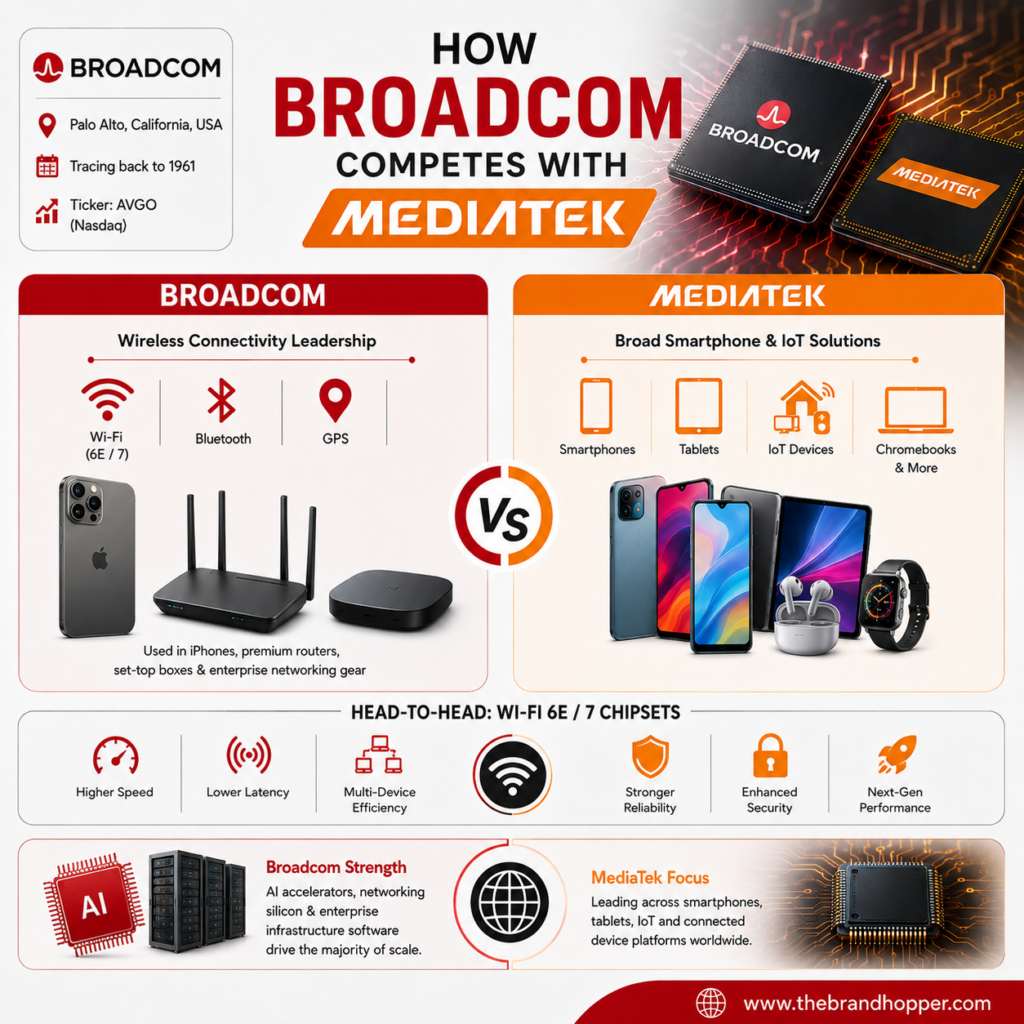
Broadcom competes with MediaTek primarily in wireless connectivity silicon — Wi-Fi, Bluetooth, and GPS combo chips — where Broadcom’s chips are famously embedded in Apple’s iPhones and a wide range of premium routers, set-top boxes, and enterprise networking gear.
Broadcom’s semiconductor solutions segment (which also includes custom ASICs, broadband, and networking chips for data centers) generates tens of billions of dollars a year, though the large majority of that scale now comes from AI accelerators, networking silicon for hyperscale data centers, and enterprise infrastructure software rather than from consumer wireless chips, which places Broadcom in a different weight class from MediaTek overall.
Even so, in the specific arena of Wi-Fi 6E/7 chipsets for premium consumer electronics and networking equipment, Broadcom remains one of MediaTek’s toughest and most technically capable rivals, and both companies are racing to bring next-generation Wi-Fi standards to market first.
6. Marvell Technology
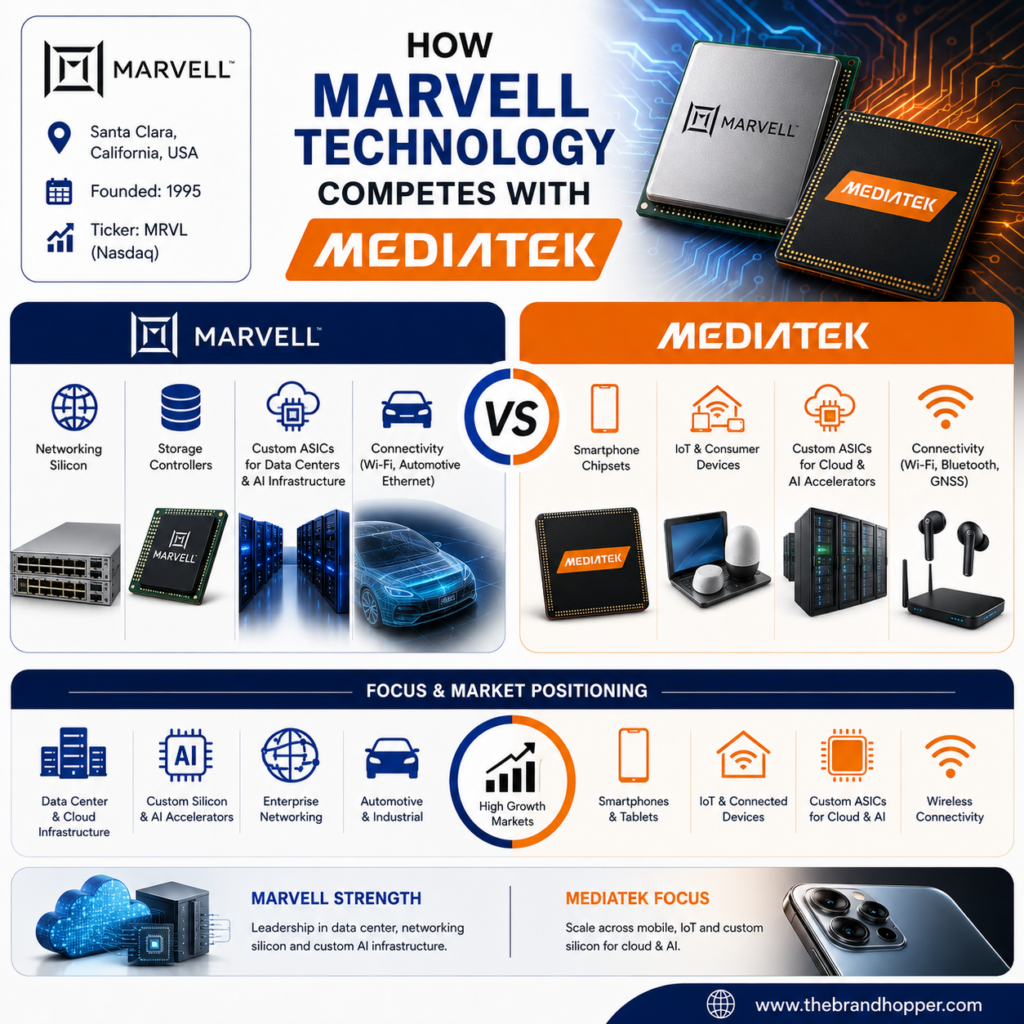
Marvell overlaps with MediaTek mainly in networking silicon, storage controllers, and increasingly in custom ASICs for data-center and AI infrastructure — a segment where MediaTek has also been expanding through partnerships with major cloud providers.
Historically, Marvell was also a smartphone chipset supplier before exiting that business, and it remains a significant player in Wi-Fi and automotive Ethernet connectivity through its acquisitions of Cavium and other networking specialists.
Marvell’s strategic pivot toward custom silicon for cloud and AI data centers puts it in more direct competition with MediaTek’s own ASIC design business, which has picked up marquee customers building custom AI accelerator chips, making this a rivalry that has grown more relevant to MediaTek’s future than its past.
7. Texas Instruments (TI)
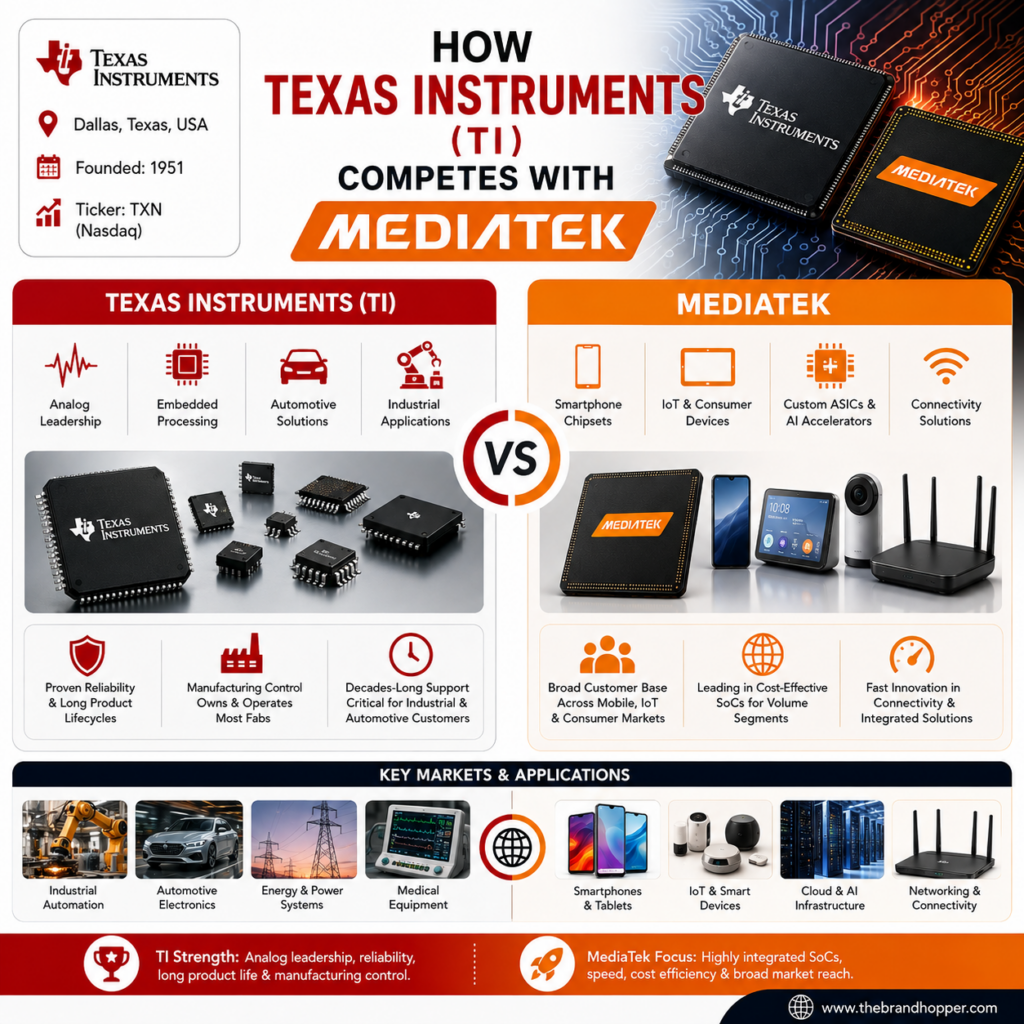
Texas Instruments is one of the world’s largest analog and embedded processing chipmakers, and while it doesn’t compete with MediaTek in smartphone application processors, it’s a significant rival in the industrial, automotive, and embedded microcontroller markets that MediaTek’s Genio and IoT chip lines are trying to penetrate.
TI’s vast catalog of power management ICs, analog signal chains, and microcontrollers gives it deep, long-standing relationships with industrial and automotive customers that value TI’s reputation for reliability and multi-decade product longevity — qualities that matter enormously in embedded and industrial design cycles where components need to remain available for many years.
TI’s scale in analog chips (which make up the large majority of its revenue) also gives it significant pricing power and manufacturing control, since TI owns and operates most of its own fabrication plants rather than relying on outside foundries the way MediaTek does.
8. NXP Semiconductors
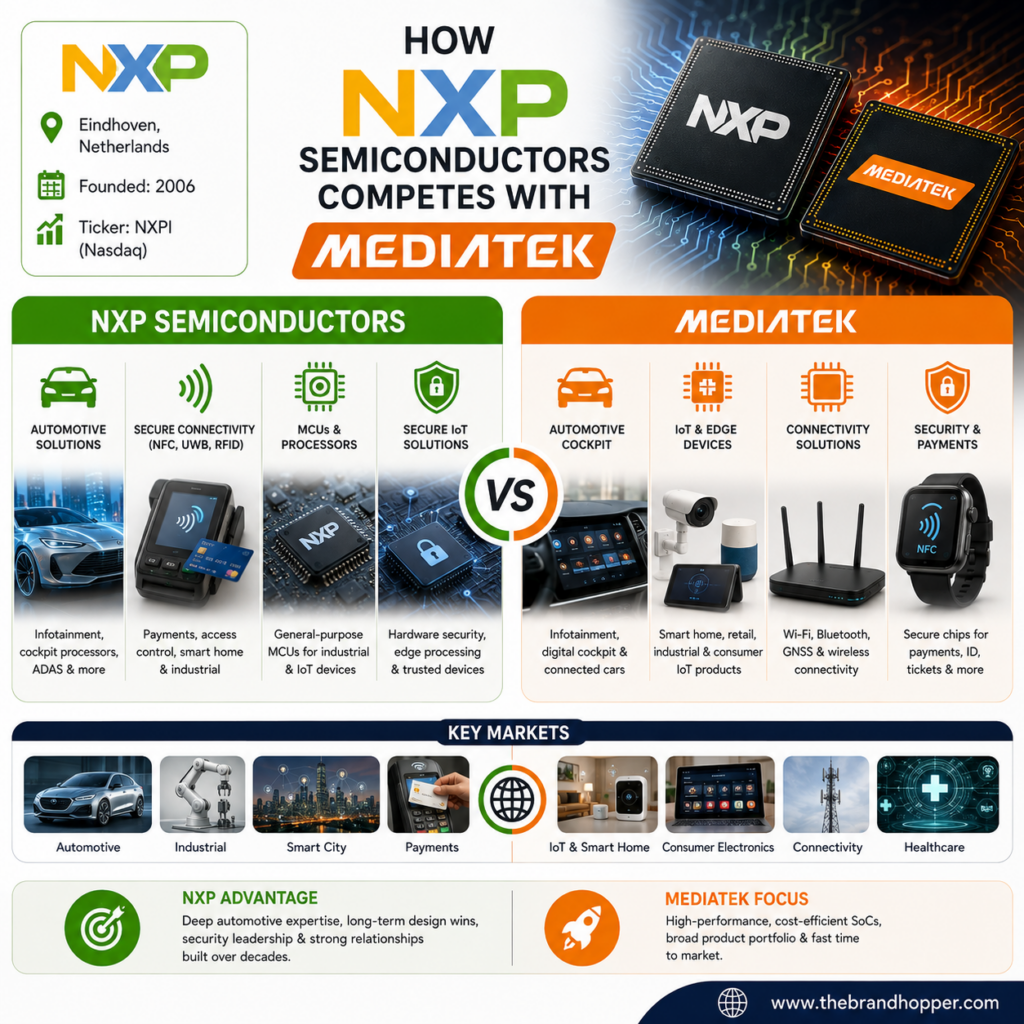
NXP is one of the automotive semiconductor industry’s dominant players and a co-inventor of near-field communication (NFC) technology, making it a competitor to MediaTek across automotive infotainment and cockpit processors, IoT edge devices, and secure connectivity chips (NFC, UWB, and RFID) used in payments, access control, and smart home products.
While MediaTek has been pushing into automotive cockpit silicon as a newer growth area, NXP already has entrenched relationships across virtually every major automaker built over many years, giving it a considerable incumbency advantage in a sector where design-in cycles are long and safety certification requirements are demanding. NXP also competes with MediaTek in general-purpose microcontrollers and secure IoT chips, rounding out a rivalry that spans several of MediaTek’s newer growth categories.
9. Realtek Semiconductor
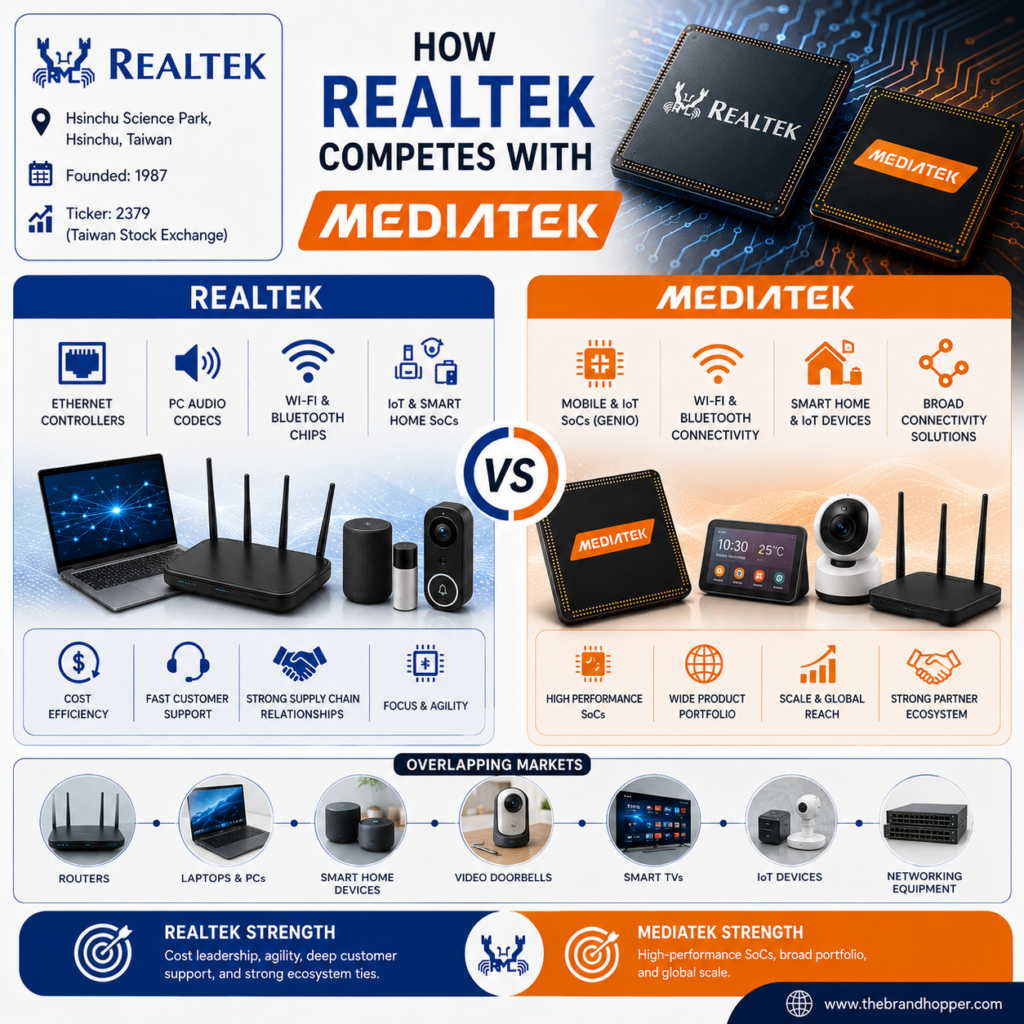
Realtek is a fellow Taiwanese fabless chipmaker and one of MediaTek’s closest neighbors, both geographically and competitively.
Realtek built its reputation on Ethernet controllers and PC audio codec chips that ship inside the vast majority of the world’s motherboards and laptops, and it has expanded aggressively into Wi-Fi and Bluetooth connectivity chips, where it competes directly with MediaTek, Broadcom, and Qualcomm for design wins in routers, smart home devices, and PCs.
Realtek has also pushed into smart-home and video-doorbell SoCs and low-power IoT chips, categories that increasingly overlap with MediaTek’s Genio and connectivity product lines.
As a smaller, more focused company than MediaTek, Realtek tends to compete on cost efficiency, fast customer support, and deep relationships with Taiwan’s PC and networking-equipment supply chain.
10. Nordic Semiconductor
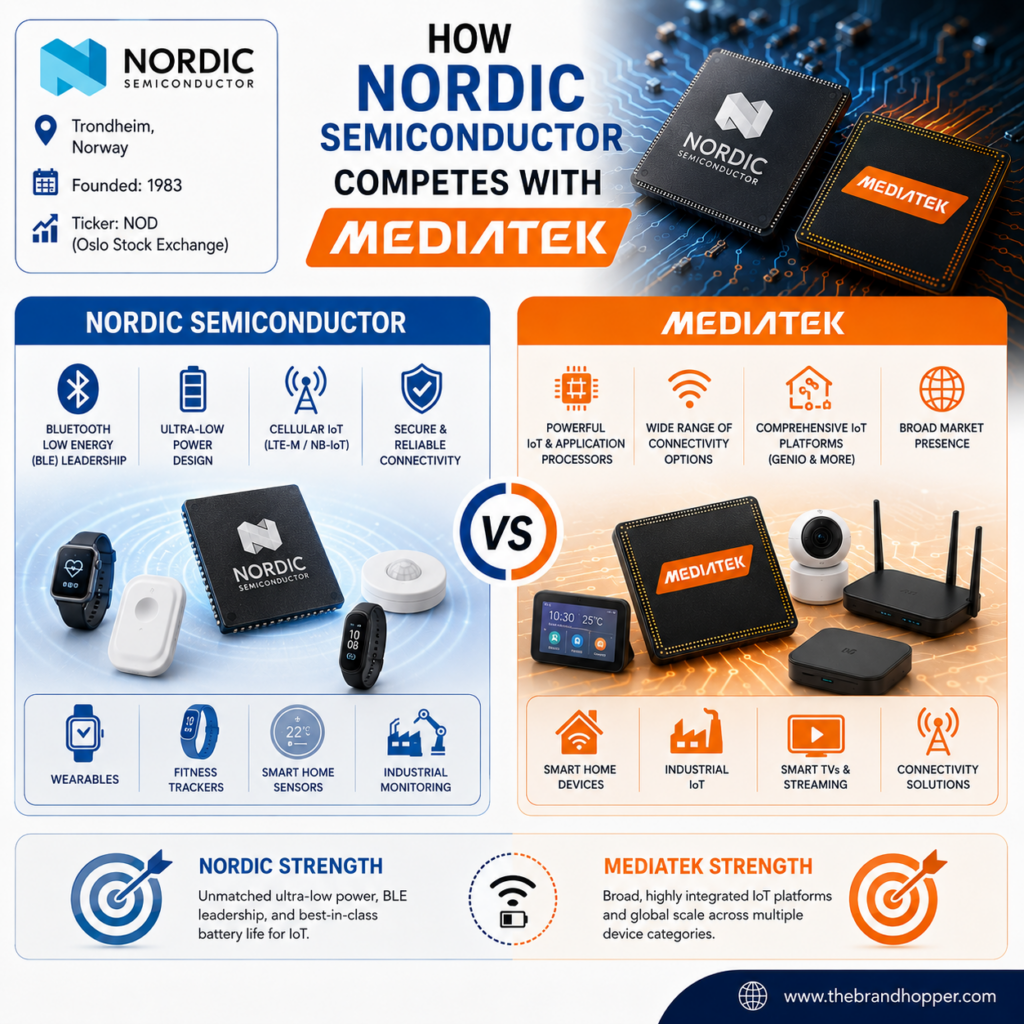
Nordic Semiconductor has built its business almost entirely around ultra-low-power wireless chips for the Internet of Things, with a particular stronghold in Bluetooth Low Energy (BLE) and cellular IoT protocols such as LTE-M and NB-IoT.
This makes Nordic a narrower but highly focused competitor to MediaTek’s IoT and connectivity chip lines, especially in wearables, fitness trackers, smart-home sensors, and industrial monitoring devices where extremely low power consumption matters more than raw processing power.
Nordic doesn’t compete with MediaTek in smartphones or smart TVs at all, but within the battery-powered IoT device category, it’s considered one of the technology leaders that MediaTek’s Genio and IoT connectivity teams have to measure themselves against.
11. Renesas Electronics
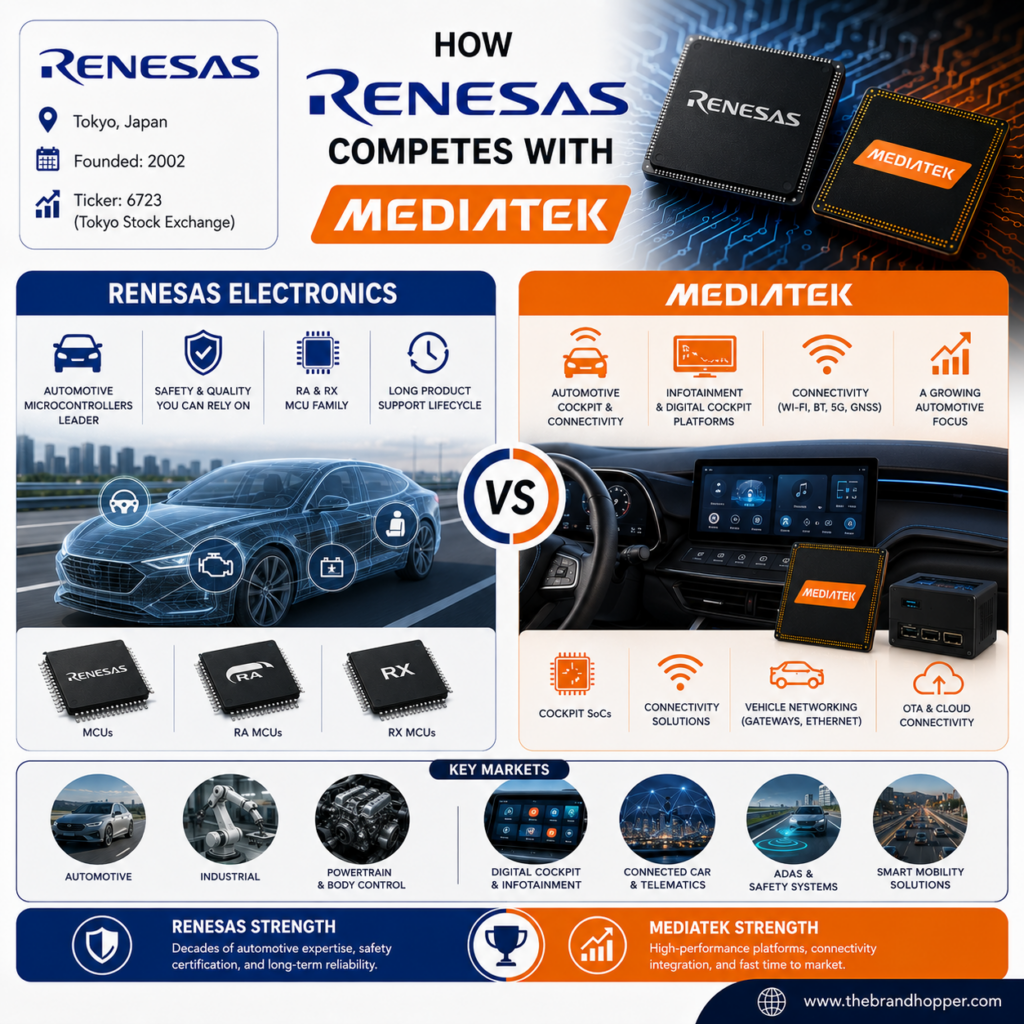
Renesas is one of the world’s largest suppliers of automotive microcontrollers and one of the most important competitors MediaTek faces as it tries to build out its own automotive business.
Renesas microcontrollers are deeply embedded in vehicle powertrain, body control, ADAS, and infotainment systems worldwide, and the company also has a strong industrial and general-purpose embedded chip business through its RA and RX microcontroller families.
Renesas’s decades of automotive safety certification experience and its reputation for extremely long product-support lifecycles give it durable advantages in a market segment where MediaTek is still a relative newcomer, even as MediaTek pushes its own automotive cockpit and connectivity platforms as a growth priority.
12. STMicroelectronics
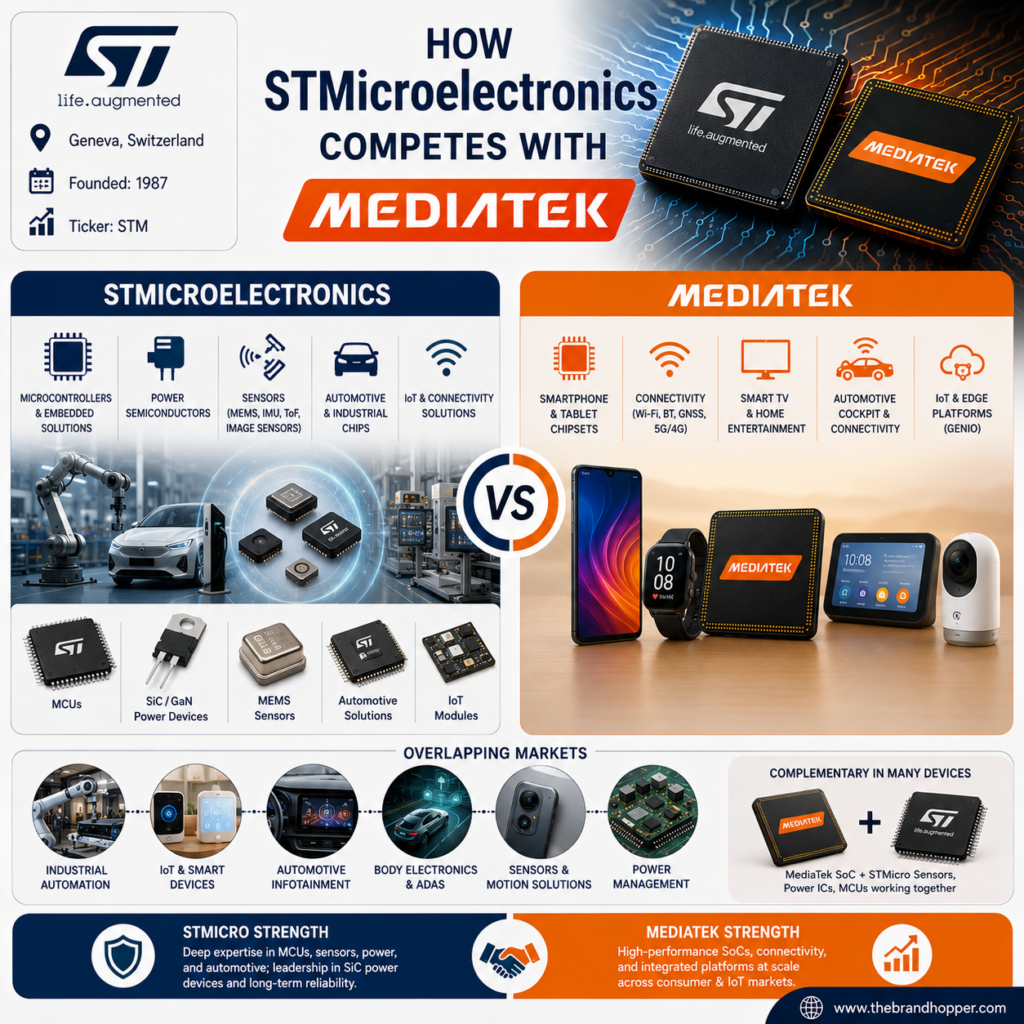
STMicroelectronics is a broad, diversified semiconductor maker with major businesses in microcontrollers, power semiconductors, sensors (including the MEMS accelerometers and gyroscopes found in most smartphones), and automotive chips.
Its overlap with MediaTek spans several categories: STMicro competes in IoT and embedded microcontrollers, in automotive infotainment and body-electronics silicon, and — notably — as a supplier of sensors and power-management components that often sit alongside MediaTek chips on the same device rather than replacing them outright.
STMicro’s particular strength in silicon carbide (SiC) power semiconductors for electric vehicles has become an increasingly important growth driver for the company and a category MediaTek doesn’t currently compete in directly, illustrating how competitive overlap between large diversified chipmakers can be partial rather than total.
13. Infineon Technologies
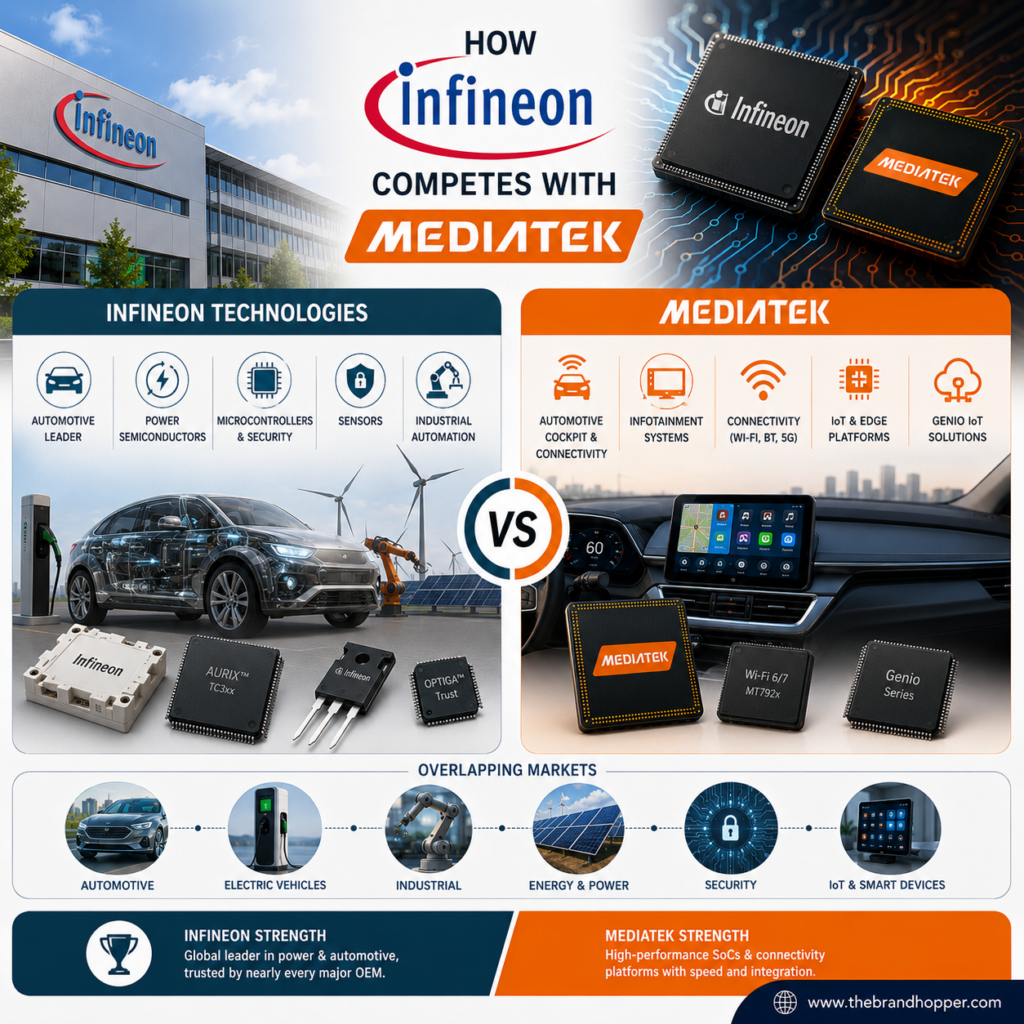
Infineon is Europe’s largest semiconductor company and the global leader in automotive semiconductors and power electronics, making it a formidable competitor in the automotive and industrial categories MediaTek is trying to expand into.
Infineon’s product range spans power semiconductors, automotive microcontrollers, security chips, and sensors, with a particular dominance in the power-management and power-conversion chips essential to electric vehicles, renewable energy systems, and industrial automation.
While Infineon doesn’t compete with MediaTek in smartphone processors, its automotive cockpit and connectivity silicon increasingly intersects with MediaTek’s own automotive push, and its scale and automotive-industry relationships — built over decades of supplying nearly every major car manufacturer — represent one of the highest barriers MediaTek faces in trying to grow its automotive revenue.
14. onsemi (ON Semiconductor)
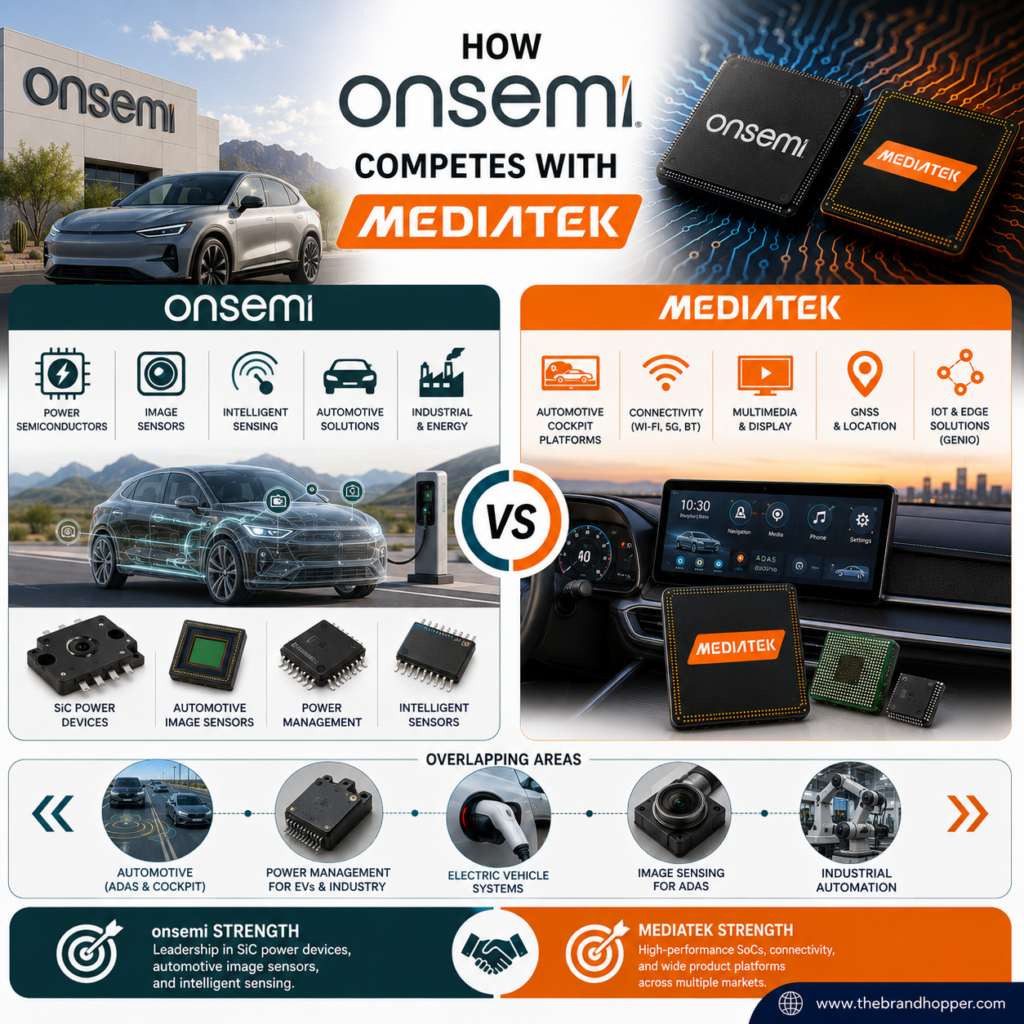
onsemi focuses heavily on power semiconductors, image sensors, and intelligent sensing technology, with a particularly strong position in automotive image sensors used for advanced driver-assistance systems (ADAS) and in power-management chips for electric vehicles and industrial applications.
Its competitive overlap with MediaTek is narrower than that of diversified giants like Infineon or NXP, concentrated mainly around automotive silicon and power-management components that sit near MediaTek’s automotive cockpit platforms in the broader vehicle electronics stack, but onsemi’s leadership in silicon carbide power devices and automotive-grade image sensors makes it a name MediaTek’s automotive division has to account for as it plots its own expansion into vehicle electronics.
15. Microchip Technology
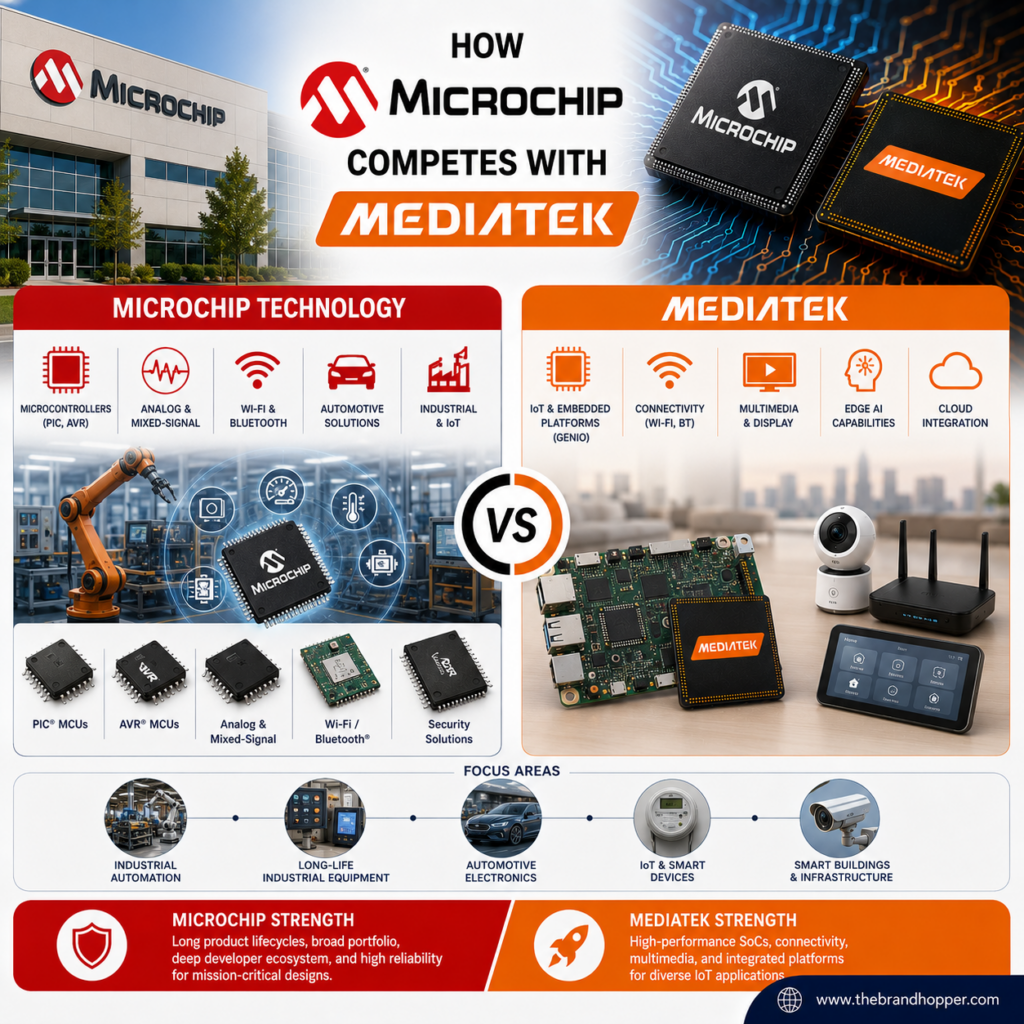
Microchip Technology is one of the world’s largest suppliers of general-purpose microcontrollers (including its long-running PIC and, following its acquisition of Atmel, AVR product families), alongside analog, mixed-signal, and Wi-Fi/Bluetooth connectivity chips for industrial, automotive, and IoT applications.
Its overlap with MediaTek centers on the embedded and industrial IoT space, where Microchip’s reputation for extremely long product lifecycles and broad developer ecosystem support (drawing on decades of goodwill among hobbyist and professional embedded engineers alike) makes it a trusted alternative to MediaTek’s newer Genio IoT platforms, particularly for customers building industrial equipment that needs component availability guaranteed for a decade or more.
16. Rockchip
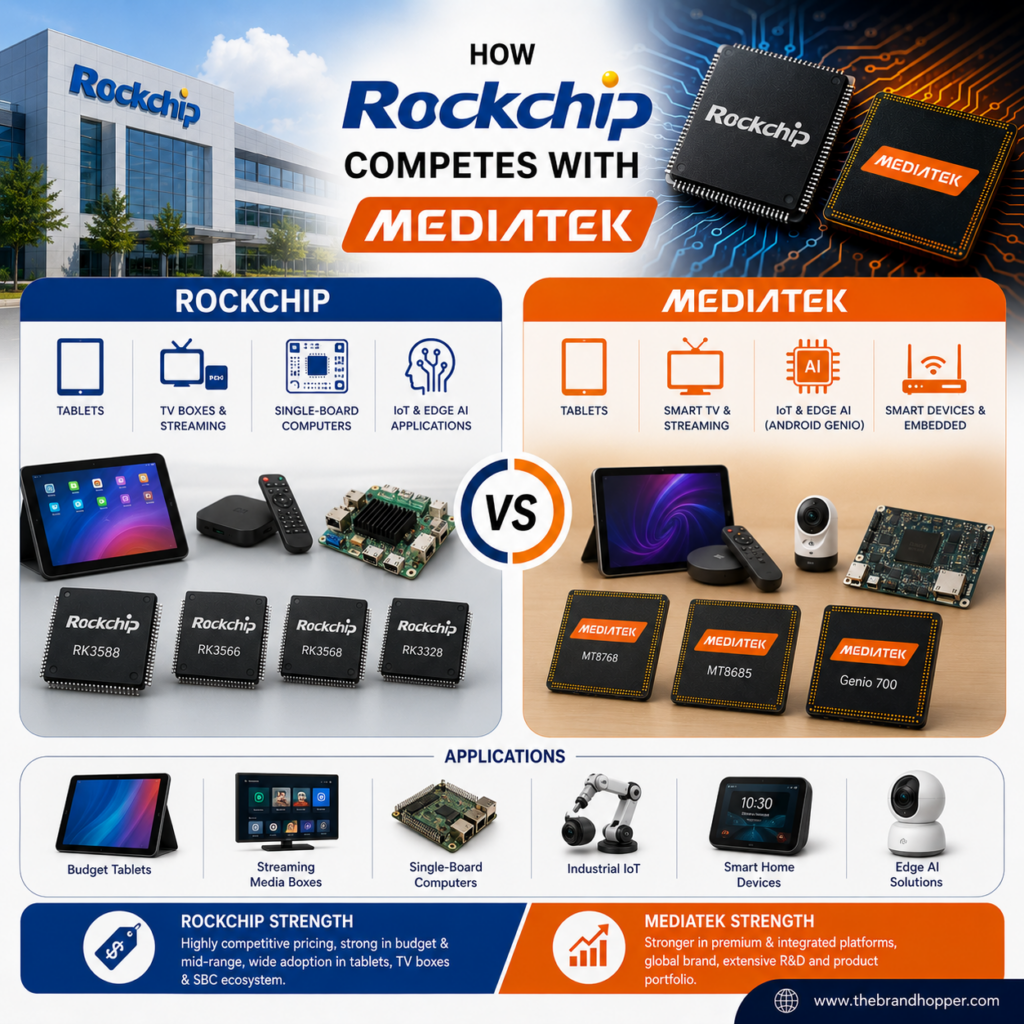
Rockchip is one of MediaTek’s most direct competitors in the budget and mid-range tablet, streaming-media-box, and IoT single-board-computer markets, building ARM-based SoCs that have powered a large share of the world’s low-cost Android tablets and set-top boxes.
Rockchip has also built a strong following among hobbyist and industrial single-board-computer makers, competing with MediaTek’s Genio chips for design wins in embedded and edge-AI applications.
As a China-based fabless designer with close ties to the domestic electronics manufacturing supply chain, Rockchip can typically offer extremely competitive pricing in cost-sensitive categories, applying steady downward pressure on MediaTek’s entry-level tablet and smart-device chip pricing.
17. Allwinner Technology
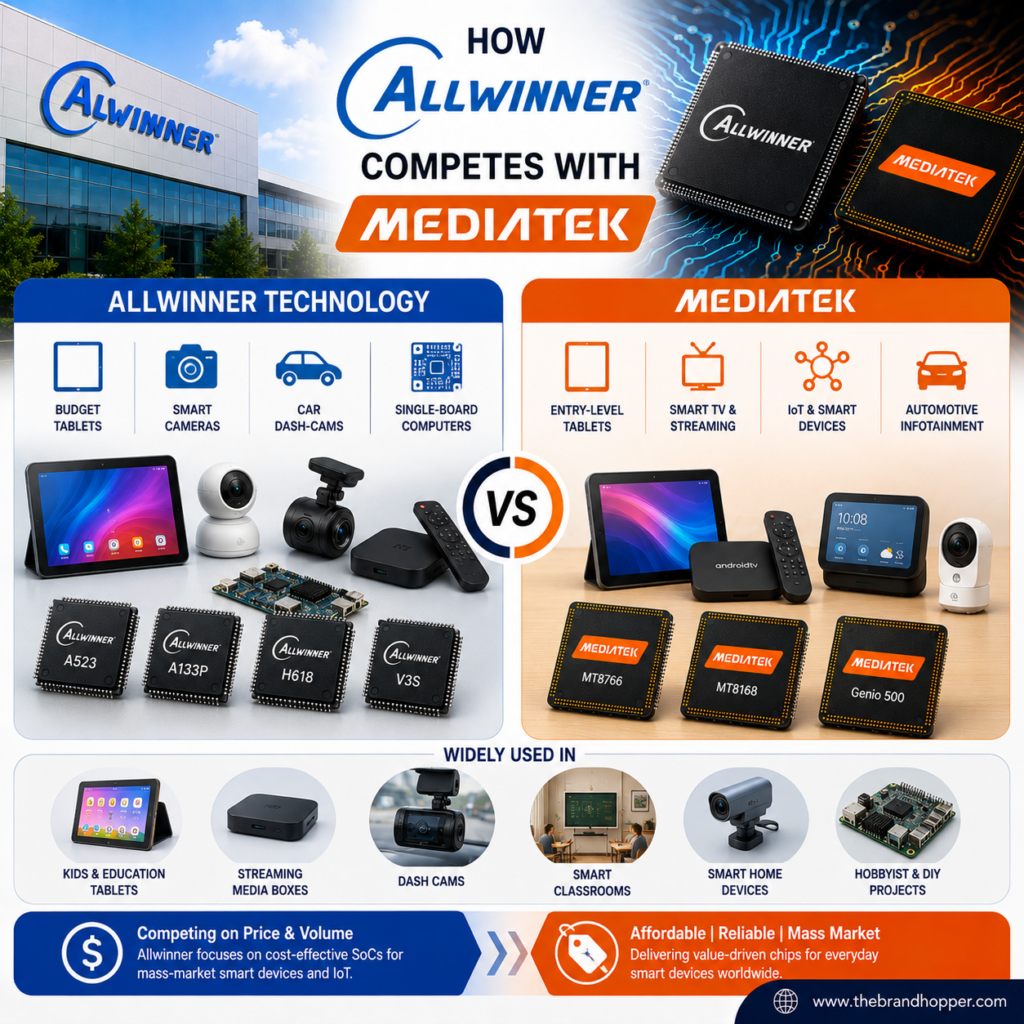
Allwinner Technology built its early reputation as the dominant supplier of application processors for budget Android tablets, at one point the top unit-shipment supplier globally for that category, and has since diversified into SoCs for smart cameras, car dash-cams, streaming boxes, and educational/hobbyist single-board computers.
Like Rockchip, Allwinner competes with MediaTek primarily on price and volume in the lower tiers of the tablet and smart-device market rather than on cutting-edge performance, and its low-cost chip strategy (with some processors historically selling for just a few dollars per unit) has made it a persistent source of pricing pressure in categories MediaTek also serves with its entry-level product lines.
18. Amlogic
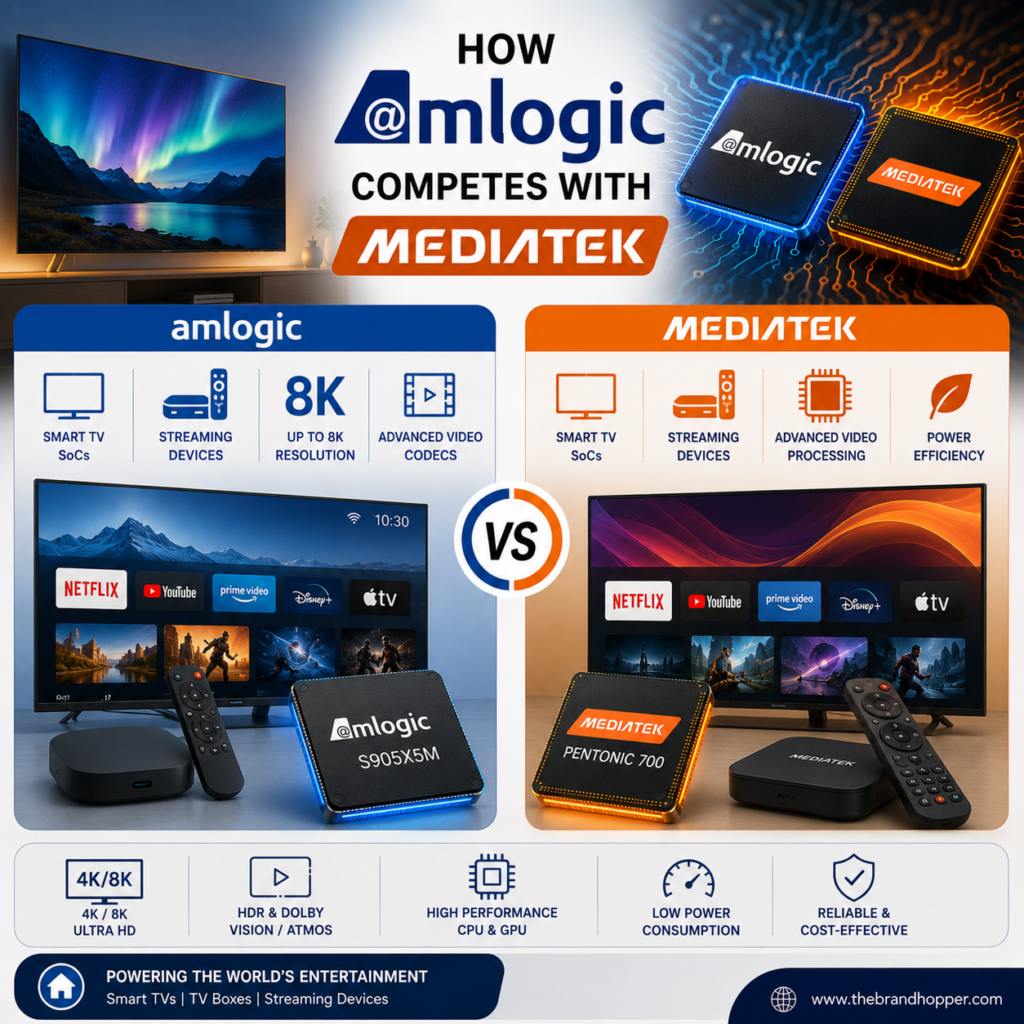
Amlogic is one of MediaTek’s most direct rivals in the smart TV and streaming-media SoC market — a segment where MediaTek’s Pentonic chip family is a major player.
Amlogic supplies application processors for smart TVs, Android TV boxes, and OTT streaming devices used by numerous global TV brands and streaming-device makers, and its chips support advanced video codecs and resolutions up to 8K, positioning it as a technically capable alternative to MediaTek in home entertainment silicon.
Because smart TV and set-top-box SoCs are a comparatively mature, price-competitive category, Amlogic and MediaTek compete heavily on video processing quality, power efficiency, and total cost per unit for TV brand customers.
19. Espressif Systems
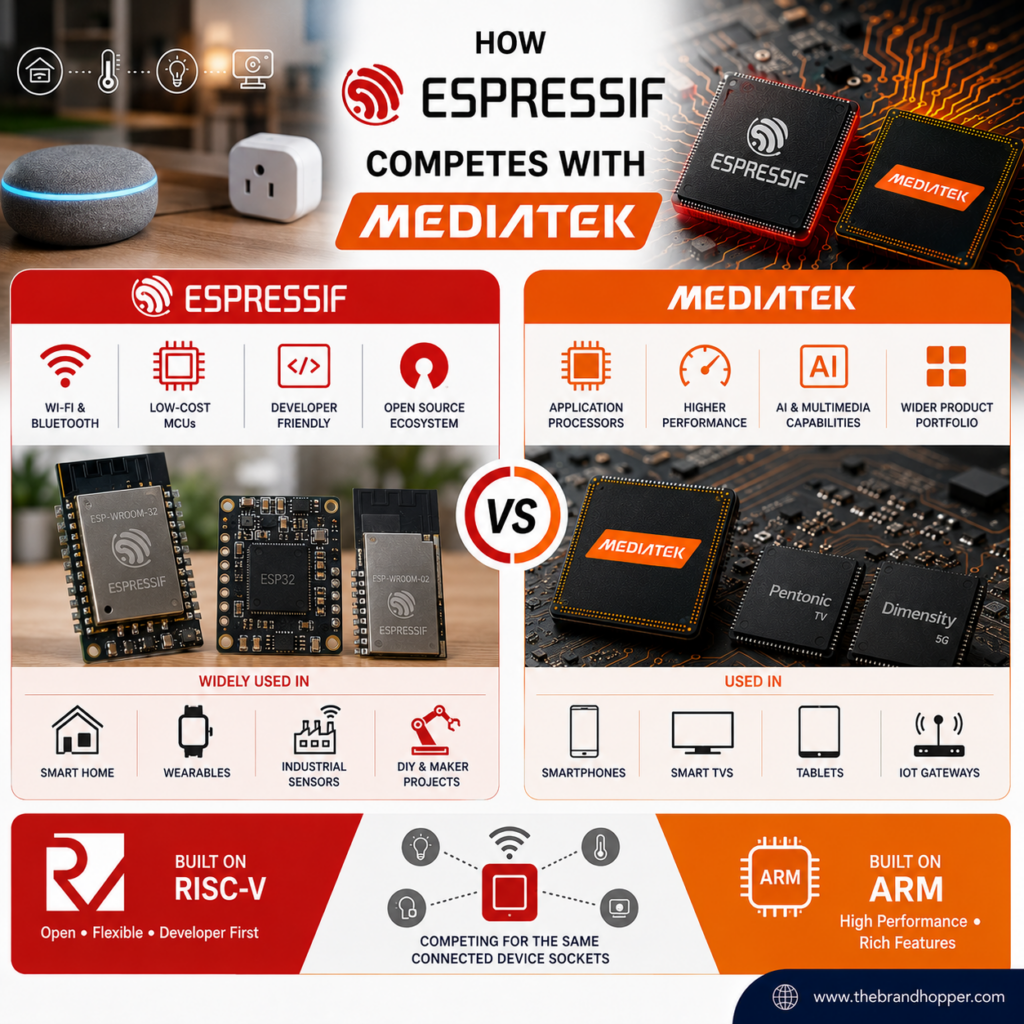
Espressif Systems occupies a specific but important niche that overlaps with MediaTek’s IoT connectivity ambitions: low-cost Wi-Fi and Bluetooth microcontroller modules, best known through its widely adopted ESP8266 and ESP32 chip families, which have shipped in well over a billion units across hobbyist, industrial, and consumer IoT products.
Espressif has fully committed to the open RISC-V instruction set architecture for its newer chip designs, distinguishing it from MediaTek’s largely Arm-based product portfolio and giving it a loyal following among developers who value Espressif’s open documentation and low barrier to entry.
While Espressif’s chips are far simpler and lower-cost than MediaTek’s application processors, the two companies compete for the same category of connected-device sockets in smart-home gadgets, wearables, and industrial sensors.
Other Notable and Indirect Competitors
Beyond the primary rivals detailed above, several other companies compete with MediaTek in narrower or more indirect ways worth knowing about.
Apple designs its own A-series and M-series chips exclusively for iPhones, iPads, and Macs; because Apple doesn’t sell chips to other manufacturers, it isn’t a traditional merchant-silicon competitor, but market-research firms still count Apple as one of the top smartphone application-processor suppliers by shipment volume, since every iPhone sold represents a design win MediaTek and Qualcomm can never win.
Google follows a similar in-house model with its Tensor chips, used exclusively in Pixel phones and manufactured by Samsung’s foundry.
Intel, having exited the smartphone modem business by selling its modem unit to Apple, no longer competes with MediaTek in mobile SoCs but remains a competitor in Chromebook and laptop-class processors, a category MediaTek has also targeted with its Kompanio chip line.
RF front-end specialists Qorvo and Skyworks Solutions compete with segments of MediaTek’s connectivity portfolio, while Cirrus Logic overlaps in audio and smart-codec chips.
Chinese SoC designers such as Actions Technology and Sunplus Technology also compete with MediaTek’s lower-tier chips in select consumer-electronics categories, particularly in China and other Asian markets.
Why This Competitive Field Keeps Shifting
A few durable forces explain why MediaTek’s list of competitors is both long and constantly evolving, and why it’s worth revisiting the categories above rather than memorizing a fixed ranking.
First, the smartphone chipset market has matured, pushing both MediaTek and Qualcomm to diversify aggressively into automotive, IoT, PCs, and AI infrastructure — categories where they now bump into entrenched incumbents like NXP, Infineon, Renesas, and Texas Instruments that have decades of automotive and industrial relationships MediaTek is still building.
Second, China’s semiconductor self-sufficiency push has strengthened domestic rivals like UNISOC, HiSilicon, Rockchip, Allwinner, and Espressif, giving MediaTek durable, state-supported competition in cost-sensitive segments and inside China’s own smartphone supply chain.
Third, the rise of on-device AI processing has turned neural processing unit (NPU) performance into a new competitive battleground across nearly every category MediaTek competes in, from flagship phones to smart TVs to industrial edge devices, forcing rivals from Qualcomm to Samsung to Rockchip to invest heavily in AI acceleration rather than competing on CPU and GPU specifications alone.
Finally, the growth of custom ASIC design for AI data centers has pulled MediaTek into competition with companies like Broadcom and Marvell in an entirely new arena far removed from its consumer-electronics roots, showing just how far the boundaries of “who competes with MediaTek” have expanded beyond the smartphone chipset rivalry that first made the company a household name in the semiconductor world.
Frequently Asked Questions
Q: Who is MediaTek’s biggest competitor?
A: Qualcomm is generally considered MediaTek’s most significant competitor because the two companies compete most directly across the widest range of product categories, especially smartphone application processors, where they are consistently ranked as the two largest suppliers globally by shipment volume.
Q: Does MediaTek compete with Apple?
A: Indirectly, yes. Apple designs its A-series and M-series chips only for its own devices and doesn’t sell chips to other phone or computer makers, so it isn’t a merchant-silicon competitor in the traditional sense. However, every iPhone represents a smartphone design win that MediaTek and Qualcomm cannot compete for, and market trackers include Apple when measuring overall smartphone application-processor market share.
Q: Which competitor is closest to MediaTek in size and business model?
A: Qualcomm is the closest match in overall business model and product breadth, given its similar mix of smartphone chipsets, connectivity silicon, automotive platforms, and IoT chips. Realtek, as a fellow Taiwanese fabless semiconductor company with overlapping connectivity and consumer-electronics chip lines, is the closest geographic and structural peer, albeit at a smaller scale.
Q: Who competes with MediaTek in budget and entry-level chips?
A: UNISOC, Rockchip, and Allwinner are the most persistent competitors in MediaTek’s lower-cost smartphone, tablet, and streaming-device chip tiers, largely on the strength of aggressive pricing and strong relationships with Chinese device manufacturers.
Q: Is MediaTek bigger than Qualcomm?
A: The two companies are frequently compared but measure “bigger” differently: MediaTek has, in various periods, led Qualcomm in smartphone chipset shipment volume, since MediaTek dominates the high-volume budget and mid-range tiers, while Qualcomm has historically generated substantially higher overall revenue thanks to its dominant position in premium flagship chipsets and its separate, high-margin patent-licensing business. Rankings by shipment share and by revenue can therefore point to different “leaders” depending on which metric is used.
Also Read: Top Qualcomm Competitors and Alternatives
To read more content like this, subscribe to our newsletter