Last Updated on July 28, 2026 by Team TBH
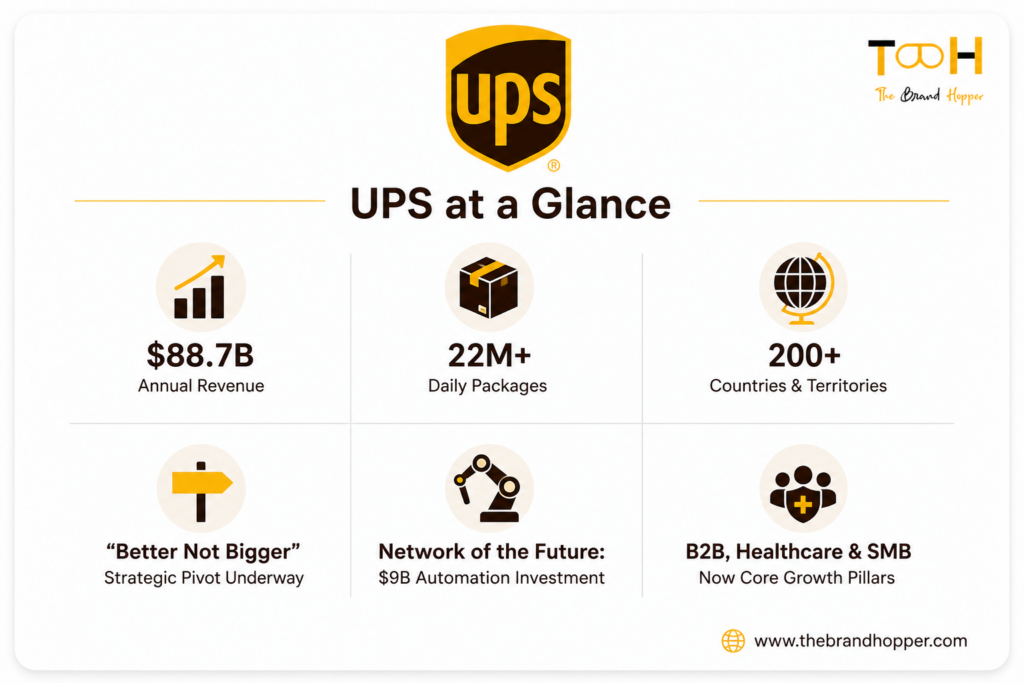
United Parcel Service (UPS) is the world’s largest package delivery company by revenue — a $88.7 billion global operation serving more than 200 countries and territories, moving approximately 22 million packages and documents every day. For over a century, the brown-clad giant has defined what reliable, scalable parcel delivery looks like. Yet the shipping industry is changing faster than at any previous moment in its history, and UPS is feeling the pressure from every direction.
FedEx, its oldest and most direct rival, has crossed $94 billion in annual revenue. DHL dominates the international express market with a 43%+ share of time-definite cross-border shipments. Amazon, once UPS’s largest single customer, has become its most disruptive competitor — delivering 6.7 billion packages in the most recent year and capturing nearly 28% of total U.S. parcel volume. Regional carriers, Southeast Asian super-apps, and Chinese logistics giants are reshaping segments UPS once took for granted.
This comprehensive guide examines the 10 most significant UPS competitors, what makes each a genuine threat, and how the competitive dynamics of global shipping are evolving. Whether you’re a shipper evaluating alternatives, an investor tracking the sector, or a logistics professional benchmarking the market, this is the intelligence you need.
Understanding UPS’s Competitive Position
Before mapping the competition, it’s worth understanding the strategic terrain UPS currently occupies. The company is executing a significant pivot under its “Better Not Bigger” strategy, deliberately shedding low-margin volume — most notably reducing its Amazon delivery relationship by more than 50% — while investing $9 billion in its “Network of the Future” programme to automate approximately 68% of its package volume by the mid-2020s.
The result: UPS’s average daily U.S. domestic package volume fell roughly 8.6% year-on-year, while revenue per piece rose 8.1% — a deliberate trade of scale for profitability. The company is aggressively cutting costs (including 48,000+ job reductions and 70+ building closures), targeting free cash flow of $6.5 billion, and reorienting toward higher-value verticals: B2B shipments, healthcare logistics, and small-to-medium business customers.
This strategic shift creates competitive openings. Amazon is routing that shed volume through its own network. Regional carriers are picking up SMB accounts. FedEx and DHL are competing for the premium enterprise segments UPS is doubling down on. The competitive map below reflects all of these dynamics.
Top UPS Competitors
1. FedEx

| Website: https://www.fedex.com | Revenue (FY2026): ~$94.7B | Global reach: 220+ countries | World’s largest cargo air fleet |
When it comes to UPS competitors, FedEx is the name that springs immediately to mind. Founded in 1971, FedEx has been the defining bilateral rivalry in global logistics for over five decades. The two carriers compete across virtually every segment — express, ground, freight, international, and e-commerce — and their combined dominance of U.S. parcel infrastructure gives them a structural duopoly that new entrants have struggled to challenge at scale.
FedEx’s most recent fiscal year revenues reached approximately $94.7 billion, surpassing UPS on a like-for-like basis. Its competitive differentiation rests on its commanding position in express delivery (FedEx Express operates the world’s largest cargo aircraft fleet), its SenseAware real-time monitoring platform for high-value shipments, and a brand synonymous with overnight delivery reliability. Where UPS leads in ground parcel density and B2B delivery, FedEx leads in time-definite express and overnight shipment.
FedEx is also undergoing its own transformation: its DRIVE programme targets $4+ billion in annual cost savings, it has been consolidating its air and ground networks into a single unified entity, and its sustainability roadmap commits to carbon-neutral operations by 2040. In international markets, FedEx’s TNT acquisition gave it a meaningful European ground network to pair with its air express dominance — directly contesting UPS’s European operations.
The UPS vs FedEx rivalry is not merely a business competition — it shapes pricing for every shipper in the U.S. market. Rate card moves by one carrier are typically mirrored within months by the other, and both companies invest heavily in customer lock-in through proprietary technology integrations. As UPS reshapes its volume mix, FedEx is an aggressive suitor for the enterprise accounts UPS is repositioning.
2. DHL

| Website: https://group.dhl.com/en.html | Revenue (Q1 2025): €20.8B | Operations: 220+ countries | #1 global time-definite international express (43%+ market share) |
When it comes to international logistics, DHL is simply in a different weight class. As part of Deutsche Post DHL Group, this German powerhouse commands over 43% of the global time-definite international (TDI) express market — a lead no competitor, including UPS, can match at the intercontinental level. DHL operates in more than 220 countries and territories, with particular depth in Europe, Asia-Pacific, Africa, and the Middle East, markets where UPS’s footprint is considerably thinner.
DHL’s Q1 2025 group revenue of €20.8 billion reflected 2.8% year-on-year growth, with its eCommerce division reaching €6.96 billion — a signal of its aggressive push into last-mile digital commerce fulfilment. Unlike UPS and FedEx, which operate primarily as carriers, DHL competes across a fuller spectrum of supply chain services: express delivery, freight forwarding, contract logistics, and e-commerce solutions are all significant revenue contributors.
DHL’s competitive edge over UPS is most pronounced in three areas: cross-border shipping expertise and customs clearance capability, a first-mover advantage in emerging markets (especially Sub-Saharan Africa and Southeast Asia), and its DHL Innovation Centers, which have established the company as one of logistics’s leading investors in automation, AI-powered demand forecasting, and robotics. Its DHL Resilience360 platform — offering supply chain risk intelligence — is a sophisticated tool that SME shippers rarely access from UPS.
One area where DHL has historically ceded ground to UPS: U.S. domestic delivery. DHL famously exited the U.S. domestic express market in 2008 after a costly failed attempt. Its U.S. presence today is focused on international express — which limits its ability to offer the integrated domestic-plus-international solutions UPS provides to American shippers. However, its dominance in transatlantic and transpacific express corridors makes DHL a preferred choice for multinational companies with globally distributed supply chains.
3. Amazon Logistics

| Website: https://logistics.amazon.com | Revenue: ~$40.5B | U.S. parcel volume share: 27.9% | Packages delivered (most recent year): 6.7 billion — surpassing USPS for first time |
Few competitive stories in modern business are as striking as Amazon’s transformation from UPS’s largest customer into one of its most formidable rivals. Amazon Logistics, the company’s in-house delivery network launched in 2014, has grown at a pace that has shocked the incumbents. In the most recent annual reporting period, Amazon delivered 6.7 billion packages in the United States — surpassing USPS’s 6.6 billion to become the single largest parcel carrier in America by volume. Its U.S. market share now stands at 27.9% of total parcel volume.
Amazon Logistics generated approximately $40.5 billion in revenue — making it larger than FedEx’s entire U.S. domestic express business and comparable in scale to the combined annual revenues of several mid-size global carriers. The network includes Amazon Air (its own air freight operation), its Delivery Service Partner (DSP) programme which deploys tens of thousands of independent contractor drivers, Amazon Flex for crowd-sourced last-mile delivery, and a growing network of fulfilment centres, sortation hubs, and delivery stations across the country.
What makes Amazon Logistics uniquely threatening to UPS is not just scale, but its data advantage. Amazon’s delivery network is optimised by the same AI systems that power its retail operation — route planning, package consolidation, and delivery time windows are continuously refined against a dataset of billions of consumer transactions. Its same-day and next-day delivery capabilities, enabled by this infrastructure, are forcing the entire logistics industry to compress delivery timelines in ways that disadvantage carriers operating on older network architectures.
The competitive calculus shifted further with UPS’s decision to actively shed Amazon volume as part of its “Better Not Bigger” strategy. UPS plans to cut the Amazon relationship by more than 50% by the second half of this decade — opening the door for Amazon Logistics to fully internalise volume that previously flowed to UPS. For the broader industry, the important question is whether Amazon will eventually open its delivery network to third-party shippers at scale, which would create a direct commercial competitor to UPS’s core ground parcel business.
4. U.S. Postal Service (USPS)

| Website: https://www.usps.com | U.S. packages delivered (most recent year): 6.6 billion | Unique asset: Only carrier required to serve every U.S. address | Amazon relationship: ~$6B annual revenue (contract up for renewal) |
Do not underestimate the postman. Despite its well-documented financial challenges and ongoing modernisation battles, the U.S. Postal Service remains a formidable competitor to UPS in specific and critically important niches. USPS delivered 6.6 billion packages in the most recent annual period — placing it neck-and-neck with Amazon for the title of highest-volume domestic carrier, and well ahead of UPS and FedEx on pure parcel count.
USPS’s structural advantages are unique and unmatched by any private carrier. Its universal service obligation requires it to deliver to every address in the United States — all 167 million delivery points — six days a week. This last-mile density makes USPS indispensable to shippers serving rural, remote, and lower-density addresses where UPS and FedEx charge residential surcharges or rural delivery premiums that USPS does not. For lightweight e-commerce packages (under 1 lb) shipped to residential addresses, USPS Priority Mail and First-Class Package Service frequently offer the most cost-effective option available.
The most consequential variable in USPS’s competitive outlook is its relationship with Amazon. Amazon was USPS’s single largest customer, contributing an estimated $6 billion in annual revenue — approximately 7.5% of total USPS sales. The contract governing this relationship is set to expire in October of this year. If Amazon significantly reduces its USPS volume (redirecting packages to its own network or UPS/FedEx), the revenue impact on USPS could be severe. How USPS responds — whether through rate competition, new enterprise partnerships, or further domestic infrastructure investment — will shape the competitive dynamics of last-mile delivery for years.
USPS’s modernisation programme under its 10-year Delivering for America plan includes new electric delivery vehicles, upgraded processing infrastructure, and expanded package delivery capacity. These investments have the potential to make USPS a more formidable competitor to UPS for the B2C e-commerce segment over the medium term — particularly as it deploys new package processing facilities and expands Sunday delivery.
5. XPO

| Website: https://www.xpo.com | Revenue (2025): $8.2B | North American LTL market share: ~9% | LTL segment revenue (Q3 2025): $1.26B |
XPO Logistics might not be a household name in the way that UPS or FedEx are, but in the less-than-truckload (LTL) freight market — one of the fastest-consolidating segments of North American logistics — XPO is a genuine force. Founded in 1989 and transformed through a series of aggressive acquisitions, XPO generated $8.2 billion in revenue for the full year 2025 and holds approximately 9% of the $53 billion North American LTL industry.
Where UPS competes primarily in small parcel and package delivery, XPO’s battleground is freight — the shipment of larger, heavier commercial cargo that doesn’t fit in a standard parcel envelope. XPO’s LTL business reported record performance in 2025, expanding margins for the second consecutive year and being cited as the only LTL carrier to achieve this while simultaneously gaining profitable market share — even in a historically soft freight market.
The competition with UPS intensifies in the supply chain solutions space. XPO’s contract logistics and freight brokerage operations overlap with UPS’s UPS Supply Chain Solutions division, and both companies are investing heavily in warehouse automation and AI-powered logistics management to serve large enterprise customers. XPO’s technology investments — in automated dock systems, carrier-facing apps, and AI-driven pricing — reflect an ambition to become the technology platform of choice for North American shippers, a position UPS is also contesting.
As e-commerce continues to blur the line between parcel and freight (heavier consumer goods, same-day bulky item delivery), XPO’s capabilities become increasingly relevant to the same customer conversations UPS is having. Its growth in e-commerce fulfilment and last-mile delivery for heavy items represents the clearest near-term overlap with UPS’s expansion priorities.
6. Aramex

| Website: https://www.aramex.com | Revenue (2025): $1.72B (AED 6.36B) | Logistics segment growth: 18% | Core markets: Middle East, Africa, South Asia |
Aramex might not be a familiar name in Western markets, but in the Middle East, Africa, and South Asia, it is one of the most recognised logistics brands in operation. Founded in Jordan in 1982, Aramex has built a network spanning more than 60 countries, with a model built on intra-regional expertise, local market knowledge, and an asset-light partnership approach that allows rapid market penetration without the capital requirements of owning infrastructure outright.
Aramex’s full year 2025 revenues reached AED 6.36 billion ($1.72 billion), with its logistics division growing 18% year-on-year — the strongest performing segment in the portfolio. The company’s December 2025 monthly revenues were the highest since the company’s founding, reflecting strong peak season demand across its intra-regional network. Its domestic express, freight forwarding, and e-commerce fulfilment products all contributed to performance in a year the company described as one of “upheaval and restructuring.”
Aramex’s competitive edge over UPS in its home markets is structural: deep regulatory relationships across Gulf Cooperation Council (GCC) countries, established customs clearance corridors for Middle Eastern cross-border trade, and a last-mile delivery model that includes crowd-sourced and motorcycle delivery options tailored to dense urban environments in cities like Dubai, Riyadh, and Cairo. Its ShopAndShip service, which allows consumers in the Middle East to shop from international retailers and consolidate shipments, addresses an unmet need that UPS’s standard express offering doesn’t specifically target.
As Middle Eastern e-commerce markets grow — driven by rising smartphone penetration, expanding digital payment infrastructure, and government diversification programmes like Saudi Vision 2030 — Aramex’s home-field advantage positions it as the default logistics partner for regional commerce in ways that global carriers like UPS cannot easily replicate without significant local investment.
7. SF Express

| Website: https://www.sf-international.com/cn/sc | Revenue (TTM): ~$41-44B | International network: 62 countries | E-parcel service: 225 countries & regions | Revenue growth (H1 2025): +9.26% YoY |
When it comes to the Chinese market — and increasingly in broader Asia — SF Express is the carrier to know. Founded in 1993 in Shunde, Guangdong Province, SF Express has grown to become China’s largest private express delivery company by revenue, operating a vertically integrated logistics network that includes its own airline fleet, automated sorting centres, cold chain solutions, and an international network now spanning 62 countries with e-parcel services reaching 225 countries and regions.
SF Express’s most recent half-year results showed revenue growth of 9.26% year-on-year and net profit growth of 19.37% — impressive performance in a competitive domestic market where Alibaba’s Cainiao, JD Logistics, and the major Chinese express players (STO, ZTO, Yunda) are all competing aggressively on price and speed. On a trailing twelve-month basis, SF Express generates revenue in the range of $41-44 billion, making it one of the largest logistics companies in the world — a scale that many Western industry observers underestimate.
SF Express’s technology investments are a particular differentiator. The company has deployed logistics drones for rural deliveries in China, operates advanced automated sorting facilities capable of processing hundreds of thousands of packages per hour, and is building out a low-altitude logistics network in Hong Kong and the Greater Bay Area in collaboration with drone technology subsidiaries. Its plans for cross-border drone delivery between Hong Kong and mainland Chinese cities represent a frontier capability that no Western carrier — including UPS — has matched commercially.
As SF Express continues to build out international capabilities, particularly along Belt and Road trade corridors and in Southeast Asia, it becomes a more meaningful competitive concern for UPS’s Asia-Pacific and international operations. Its structural advantage in the world’s largest e-commerce market, combined with its growing international reach, makes SF Express a competitor that UPS cannot afford to discount.
8. Purolator

| Website: https://www.purolator.com/en | Ownership: 91% Canada Post | EV fleet: 500+ electric vehicles deployed | Network: 100% Canadian postal code coverage via Canada Post partnership |
Oh Canada! When it comes to shipping in the Great White North, Purolator carries undisputed authority. As Canada’s leading integrated freight, package, and logistics solutions provider — 91% owned by Canada Post — Purolator gives UPS a formidable run in the Canadian market, combining the network depth of a national postal monopoly with the speed and service sophistication of a private express carrier.
Purolator’s core competitive advantage over UPS in Canada is geographic reach. Through its partnership with Canada Post, Purolator offers coverage of 100% of Canadian postal codes — including remote northern communities, First Nations territories, and rural areas where UPS and FedEx either cannot operate profitably or charge significant remote delivery surcharges. For Canadian businesses shipping across a vast and sparsely populated landmass, this universal reach is a material operational advantage that no U.S.-headquartered carrier can replicate without partnering with the national postal service.
Purolator has made significant sustainability investments that are reshaping its competitive positioning. The company has deployed more than 500 all-electric delivery vehicles across 12 sites in Canada, delivered over two million packages via EVs as of early 2025, and has committed to electrifying 60% of its last-mile vehicle fleet by 2030 as part of a broader $1 billion sustainability programme that includes EV charging infrastructure at 60+ terminals. Its fleet comprises Ford E-Transit, BrightDrop Zevo 600, and electric cargo bikes for urban density routing — positioning Purolator as one of the greenest delivery operations in North America.
For Canadian SMEs and large retailers, Purolator’s Purolator QuickShip® same-day delivery service, combined with its national network and sustainability credentials, creates a compelling alternative to UPS’s Canadian operations — particularly as ESG commitments become procurement criteria for large Canadian enterprises.
9. OnTrac

| Website: https://www.ontrac.com | Coverage: 31 states + DC (68% of U.S. population) | Background: Merged with LaserShip to form the largest regional parcel carrier in the U.S. |
Sometimes, being nimble beats being massive. OnTrac proves this point — and its story has evolved considerably since it was a purely regional Western U.S. carrier. Following its acquisition by East Coast delivery firm LaserShip for $1.3 billion, OnTrac merged its Western U.S. delivery network with LaserShip’s Eastern seaboard operation to form what is now described as the largest regional parcel carrier in the United States — a carrier capable of reaching 68% of the American population across 31 states and the District of Columbia.
OnTrac’s competitive proposition against UPS is straightforward: faster ground delivery times and more competitive pricing within its service area. By focusing exclusively on e-commerce last-mile delivery rather than operating a full logistics spectrum, OnTrac keeps its cost structure leaner than UPS’s and can offer next-day ground delivery to metropolitan markets that national carriers struggle to match on transit time without express pricing. For e-commerce brands shipping high-velocity SKUs to concentrated consumer markets, OnTrac’s density advantage within its coverage zone is a genuine service differentiator.
The merger with LaserShip has created national ambitions. The combined entity now covers both coasts and the Sun Belt — the highest-density e-commerce shipping corridors in the United States. As it continues to expand its footprint and invest in technology (route optimisation, delivery APIs, and merchant integration tools), OnTrac is positioning itself as a credible alternative to UPS and FedEx for the segment of e-commerce volume that prioritises speed and cost efficiency in domestic delivery over the network breadth that national carriers provide.
UPS should take particular notice: the merchants that OnTrac and LaserShip originally attracted were primarily those who felt UPS’s and FedEx’s rate structures were too aggressive for their margins. As those merchants grow, the question is whether they graduate to national carriers or remain loyal to the regional networks that earned their trust.
10. Gojek (GoTo)

| Website: https://www.gojek.io | Revenue (GoTo, full year): ~$1.1B | Driver partners: 3.1M+ | Markets: Indonesia, Vietnam, Singapore, Thailand | First full-year profitability achieved |
Last but certainly not least, Gojek — operating as part of GoTo Group — is a competitor that illustrates how the boundaries of the logistics industry are being permanently redrawn. Originally launched as a motorcycle taxi-booking service via a call centre in Indonesia, Gojek has evolved into Southeast Asia’s most comprehensive super-app, integrating ride-hailing, food delivery, payments, and on-demand logistics into a single platform used by tens of millions of consumers across the region.
GoTo Group posted full-year net revenue of approximately $1.1 billion in the most recent reporting period — a 24% year-on-year increase — and achieved its first full-year underlying profitability, with adjusted EBITDA surging 544% to Rp 2 trillion. Its on-demand services division, which encompasses GoSend (package delivery) alongside ride-hailing and food delivery, more than doubled its adjusted EBITDA in the same period. The 3.1 million driver partners active on Gojek’s platform represent a crowd-sourced last-mile logistics network of a scale that no traditional carrier in Southeast Asia has built from scratch.
Gojek’s model challenges UPS in a fundamentally different way from its other competitors. Rather than competing carrier-to-carrier on express or ground volume, Gojek has embedded logistics into a multi-service consumer platform that already owns daily engagement with millions of users. GoSend deliveries leverage the same driver network and real-time routing engine that handles ride-hailing — meaning marginal delivery capacity is essentially free at the platform level. This structural efficiency allows Gojek to offer on-demand, intra-city delivery at price points that traditional carriers simply cannot match.
As Southeast Asian e-commerce markets expand — the region’s digital economy is projected to grow substantially over the coming years — the logistics infrastructure that Gojek and its rivals (Grab, Lalamove, J&T Express) are building represents a direct threat to the market position that UPS and FedEx have established in the region’s established trade corridors. For any carrier thinking about Asia-Pacific growth, understanding Gojek’s model is essential context.
Head-to-Head: UPS Competitors Compared
| Competitor | HQ | Scale / Revenue | Core Strength vs UPS | UPS Advantage |
| FedEx | Memphis, USA | ~$94.7B revenue | Express delivery, air cargo dominance | Ground density, B2B relationships |
| DHL | Bonn, Germany | €20.8B (Q1 2025) | Int’l express (43%+ TDI share), emerging markets | U.S. domestic coverage, LTL freight |
| Amazon Logistics | Seattle, USA | ~$40.5B, 6.7B parcels | Last-mile density, AI optimisation, scale | Enterprise B2B; healthcare; SMB focus |
| USPS | Washington DC | 6.6B U.S. packages | Universal coverage, residential pricing | Speed, B2B, premium services, global |
| XPO | Greenwich, USA | $8.2B (2025) | LTL freight, supply chain solutions | Parcel scale, international network |
| Aramex | Dubai, UAE | $1.72B (2025) | Middle East / Africa last-mile, e-commerce | Global reach, premium express capability |
| SF Express | Shenzhen, China | ~$41-44B (TTM) | China & Asia e-commerce, drone tech | Western market presence, B2B contracts |
| Purolator | Mississauga, Canada | 91% Canada Post-owned | 100% Canadian postal coverage, EV fleet | International reach beyond Canada |
| OnTrac | Chandler, USA | Largest US regional carrier | E-commerce last-mile, 68% US population | National & international network depth |
| Gojek (GoTo) | Jakarta, Indonesia | ~$1.1B net revenue | SE Asia super-app, crowd-sourced delivery | Enterprise logistics, global infrastructure |
Key Industry Trends Shaping the Competitive Landscape
Understanding where individual competitors are heading requires situating them in the broader macro trends reshaping global logistics.
1. Global CEP Market Expansion: The global courier, express, and parcel (CEP) market is valued at approximately $476-531 billion and growing — with projections to nearly double by 2035, driven by e-commerce growth, supply chain regionalisation, and rising consumer delivery expectations. Every competitor in this analysis is racing to capture a share of this expanding pie.
2. Amazon’s Network Maturation: Amazon’s decision to significantly reduce its UPS volume relationship is a landmark competitive event. As Amazon internalises more of its own delivery, it both removes revenue from UPS and potentially opens its surplus delivery capacity to third-party shippers — which could create a structural competitor at scale.
3. Sustainability as Competitive Differentiator: From FedEx’s 2040 carbon-neutral pledge to Purolator’s 500+ EV fleet to DHL’s GoGreen logistics services, sustainability credentials are becoming a procurement requirement for enterprise shippers and a regulatory expectation in multiple markets. UPS’s own sustainability investments will need to keep pace.
4. Automation and AI Network Transformation: UPS’s $9B Network of the Future programme, XPO’s dock automation, DHL’s robotics investment, and SF Express’s automated sorting facilities all reflect the same fundamental truth: logistics is a technology business, and the companies that automate most effectively will hold durable cost and service advantages.
5. Regional Carriers Rising: OnTrac’s national expansion, J&T Express’s pan-Asian growth, and regional specialists globally are proving that density beats breadth in e-commerce last-mile delivery. National carriers that cannot match regional speed and cost within specific corridors risk losing the most price-sensitive and volume-intensive e-commerce accounts.
Frequently Asked Questions
Q: Who is UPS’s biggest competitor?
A: FedEx is traditionally considered UPS’s primary and most direct competitor — both are U.S.-headquartered carriers offering comparable full-service express, ground, freight, and international products, and both compete for the same enterprise shipper relationships. However, Amazon Logistics has emerged as a transformative new competitive force, surpassing UPS and FedEx in raw domestic parcel volume. For international express specifically, DHL — with over 43% of global time-definite international market share — is arguably UPS’s most formidable rival.
Q: How does UPS compare to FedEx in market share?
A: In global courier revenue, UPS leads with approximately 11% market share versus FedEx’s 7%. In U.S. ground parcel delivery, UPS holds a structural lead in B2B density; FedEx leads in express and time-definite domestic delivery. Both are significantly behind Amazon Logistics in raw domestic volume (27.9% share) but ahead in revenue per package and service breadth.
Q: Is Amazon Logistics bigger than UPS?
A: By U.S. parcel volume, yes: Amazon Logistics delivered 6.7 billion packages in the United States in the most recent annual period, making it the country’s largest carrier by volume. UPS processes approximately 22 million packages globally per day across all markets. However, UPS significantly exceeds Amazon Logistics in global revenue ($88.7B vs $40.5B), geographic reach (200+ countries vs primarily U.S.-focused), service breadth, and enterprise-grade capabilities.
Q: What is UPS’s “Better Not Bigger” strategy?
A: UPS’s “Better Not Bigger” strategy is a deliberate pivot away from volume growth toward profitability improvement. The company is shedding low-margin volume (most visibly from its Amazon delivery relationship, which it is reducing by more than 50%), investing $9 billion in network automation under its “Network of the Future” programme, cutting 48,000+ positions, closing 70+ facilities, and redirecting focus toward high-value segments: B2B shipments, healthcare logistics, and small-to-medium business customers. The goal is a higher revenue-per-package average and improved operating margins rather than maximum parcel count.
Q: Does USPS compete directly with UPS?
A: Yes, particularly in last-mile residential delivery and lightweight package shipping. USPS delivered 6.6 billion packages domestically — comparable to Amazon Logistics — and offers price advantages over UPS for lightweight, low-priority B2C shipments. Its universal service obligation gives it unique access to every U.S. delivery address, including rural and remote locations where UPS charges residential or remote surcharges. For heavier shipments, commercial volumes, time-definite delivery, and international services, UPS holds clear advantages over USPS.
Q: What are the best alternatives to UPS for e-commerce shipping?
A: The best alternative depends on your shipping profile: FedEx for express and overnight delivery; DHL for international shipments; Amazon Logistics (via Seller Fulfilled Prime or MCF) for Amazon marketplace sellers; USPS for lightweight residential packages; OnTrac for next-day ground delivery in the Western and Eastern U.S.; and regional carriers for high-density urban last-mile cost optimisation. Many high-volume shippers use a multi-carrier strategy, routing each shipment to the carrier offering the best combination of cost, speed, and service for that specific origin-destination pair.
Conclusion
The global shipping and logistics industry has never been more contested. UPS enters this competitive environment from a position of deliberate strategic reconfiguration — shedding volume, automating its network, and repositioning toward higher-margin enterprise segments. Each of the 10 competitors profiled in this article represents a distinct dimension of competitive pressure: FedEx and DHL contest the premium carrier positioning; Amazon Logistics disrupts from within the e-commerce ecosystem; USPS competes on last-mile coverage; XPO targets the freight and supply chain overlap; Aramex, SF Express, and Purolator dominate their home markets; and OnTrac and Gojek represent the new generation of digitally-native logistics challengers.
The dynamics driving this competition — e-commerce growth, AI-enabled logistics, sustainability mandates, and the relentless push for same-day delivery — will only intensify. For shippers, the benefit is a more competitive market offering more choices, better technology, and downward pricing pressure. For UPS, the path forward requires executing its transformation strategy flawlessly while defending its enterprise relationships against well-funded, strategically agile rivals on every front.
One thing is certain: the shipping industry’s next chapter will be shaped as much by which companies adapt most effectively to change as by which started from the strongest position. Buckle up — it’s anything but a slow delivery market.
Also Read: Who are FedEx’s Competitors in Logistics Industry?
To read more content like this, subscribe to our newsletter