
Last Updated on October 14, 2026 by Team TBH
Visa is one of the world’s leading payment technology companies, connecting consumers, merchants, financial institutions, and governments across more than 200 countries and territories. Its network supports electronic payments across credit cards, debit cards, prepaid cards, and digital wallets.
Founded in 1958, Visa has played a major role in the growth of digital commerce. Its business focuses on connecting participants in the payments ecosystem rather than directly issuing most cards or lending money to consumers.
At the heart of its operations is VisaNet, a global payment-processing network that supports transaction authorization, clearing, and settlement. Visa also invests in tokenization, fraud prevention, artificial intelligence, and real-time payments to improve payment security and efficiency.
For the fiscal year ended September 30, 2025, Visa reported $40.0 billion in net revenue, $20.1 billion in GAAP net income, and 257.5 billion processed transactions. Its total payments and cash volume reached approximately $16.7 trillion, highlighting the scale of its global network.
Despite its strong market position, Visa faces competition from traditional card networks, digital wallets, payment processors, and alternative payment systems. Mastercard competes directly in global card payments, while companies such as PayPal, Stripe, American Express, Apple Pay, and UnionPay compete in different parts of the broader payments ecosystem.
Understanding these competitors is important for businesses evaluating payment solutions, investors studying the payments industry, and consumers comparing payment methods. Here are 17 of Visa’s leading competitors and alternatives, including their business models, key strengths, and latest available financial performance.
Top Competitors and Alternatives of Visa
1. Mastercard
Website: mastercard.com
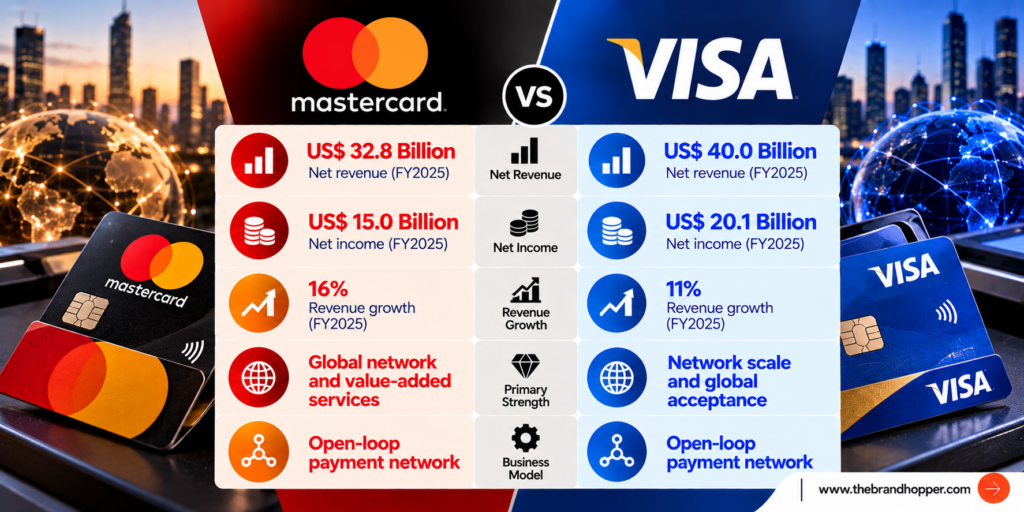
Mastercard is Visa’s closest direct competitor. Both operate global, open-loop payment networks that connect cardholders, issuing banks, acquiring banks, and merchants.
For FY2025, Mastercard reported $32.8 billion in net revenue, approximately $15.0 billion in net income, and diluted earnings per share of $16.52. Its value-added services and solutions business was an important growth driver, with currency-neutral revenue growth of approximately 23%.
Mastercard competes through its global acceptance network, cybersecurity capabilities, open-banking services, and business-to-business payment solutions. Like Visa, it generally does not issue cards directly to consumers or bear the lending risk associated with most card accounts.
2. PayPal
Website: paypal.com
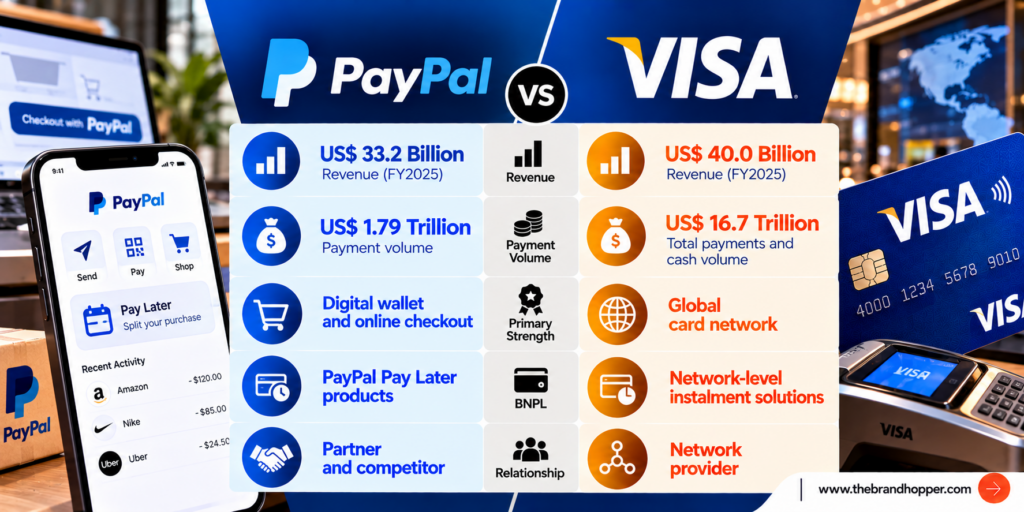
PayPal is a digital payments platform and wallet provider rather than a traditional card network. It enables consumers to pay online and transfer money, while merchants use its checkout, payment processing, and business services.
For FY2025, PayPal reported $33.2 billion in net revenue and $1.79 trillion in total payment volume. Its ecosystem includes PayPal checkout, Venmo, merchant services, and Buy Now, Pay Later (BNPL) products.
PayPal competes with Visa most directly at online checkout and in account-to-account transfers. It also partners with card networks when customers fund PayPal transactions using linked Visa cards.
3. Stripe
Website: stripe.com
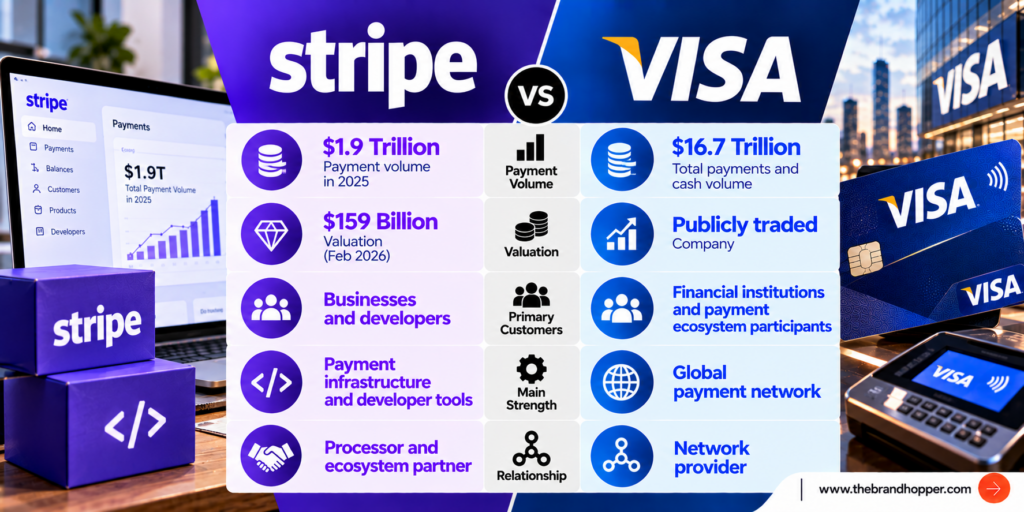
Stripe provides payment processing and financial infrastructure for businesses, from startups to large enterprises. Its products support online payments, subscriptions, billing, fraud prevention, and embedded financial services.
Stripe announced $1.9 trillion in total payment volume for 2025 and was valued at $159 billion in a February 2026 employee tender offer. As a private company, Stripe does not publish a comparable audited annual revenue figure, so revenue estimates should be treated cautiously.
Stripe primarily partners with Visa by processing payments made with Visa cards. It can also compete with card networks through products that support bank-based payments and other payment methods.
4. American Express
Website: americanexpress.com
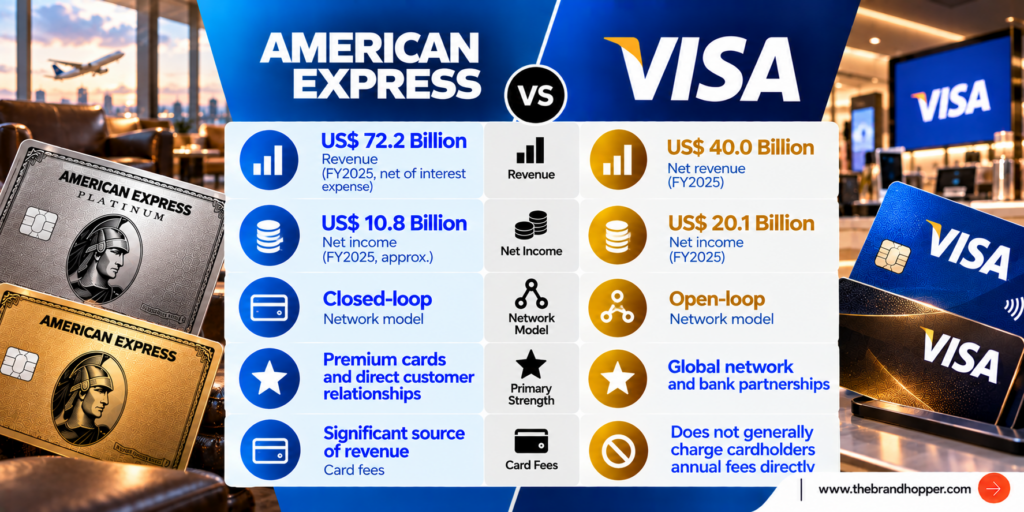
American Express operates a distinctive closed-loop payment model, combining card issuance, payment-network operations, and direct relationships with cardholders and merchants. Visa, by contrast, primarily operates a network through which financial institutions issue cards.
For FY2025, American Express reported $72.2 billion in revenues net of interest expense, net income of approximately $10.8 billion, and earnings per share of $15.38. Net card fee revenue reached a record approximately $10 billion.
Amex’s premium cards, travel benefits, Membership Rewards programme, and merchant services differentiate it from Visa. Its direct customer relationships can also provide useful spending data, although its revenue figures are not directly comparable with Visa’s network revenue.
5. Discover and the Capital One Network
Website: discover.com
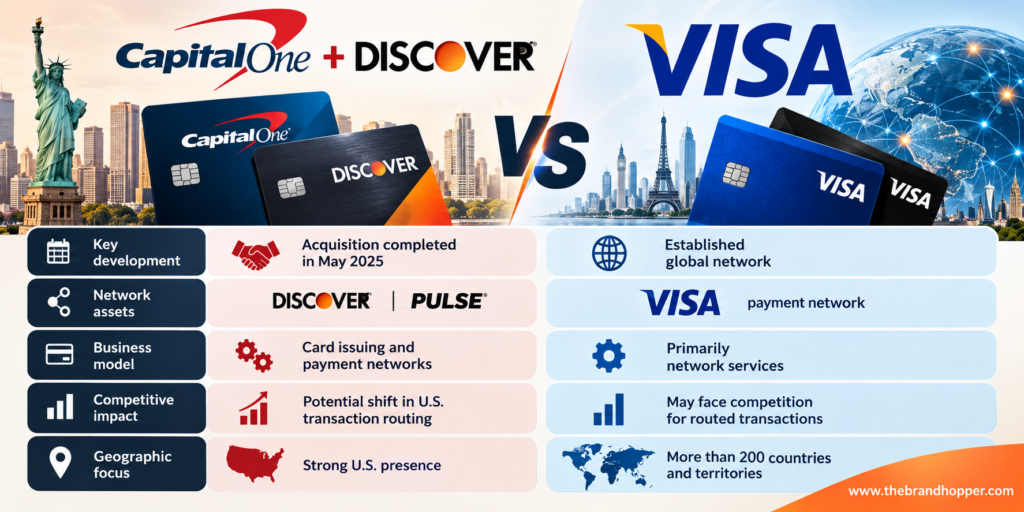
Discover operates a U.S.-focused card network alongside its credit-card products. Its network and the PULSE debit network became part of Capital One following the acquisition of Discover Financial Services.
Capital One completed its acquisition of Discover on May 18, 2025. The transaction gives Capital One ownership of the Discover network and creates opportunities to route more transactions through its own payment infrastructure.
The combined company is an important potential competitor to Visa and Mastercard in the U.S. card market. However, its scale and network model differ from Visa’s global reach, and any shift in transaction routing will depend on implementation and market adoption.
6. UnionPay International
Website: unionpayintl.com
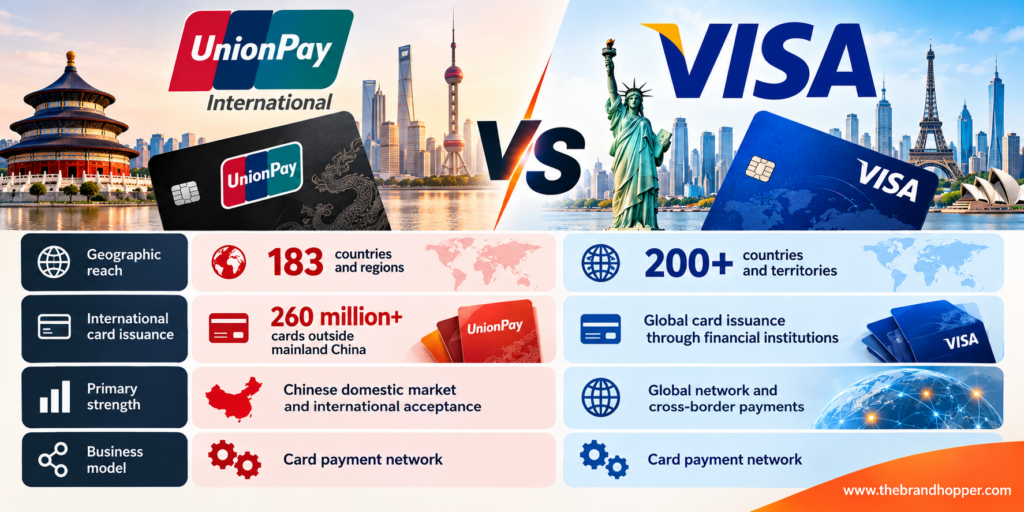
China UnionPay and its international arm, UnionPay International, operate one of the world’s largest card-payment networks. UnionPay has a particularly strong position in mainland China and is expanding acceptance and partnerships internationally.
UnionPay International states that its cards can be used in 183 countries and regions, with more than 260 million cards issued outside mainland China. These figures should not be confused with total UnionPay cards issued domestically.
UnionPay competes with Visa in cross-border card payments, particularly for Chinese travellers and merchants serving them. In China, mobile payment platforms and domestic payment infrastructure also play a major role in the competitive landscape.
7. Regional Payment Networks: RuPay and Interac
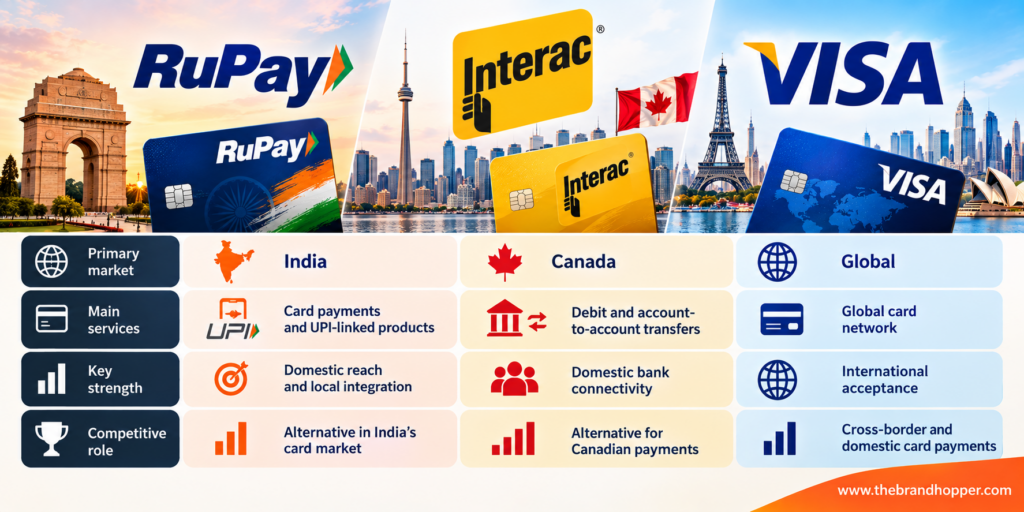
Regional payment networks provide domestic alternatives to global card networks. India’s RuPay, operated by the National Payments Corporation of India (NPCI), supports debit, credit, and prepaid cards, while Canada’s Interac supports debit payments and account-to-account transfers.
RuPay is particularly relevant to India’s domestic payments market, including government-supported financial inclusion programmes and UPI-linked credit-card use cases. Interac is deeply established in Canada through debit payments and Interac e-Transfer.
These networks do not directly match Visa’s international reach, but they illustrate how domestic payment infrastructure can compete with global card networks in specific markets.
8. Apple Pay
Website: apple.com/apple-pay
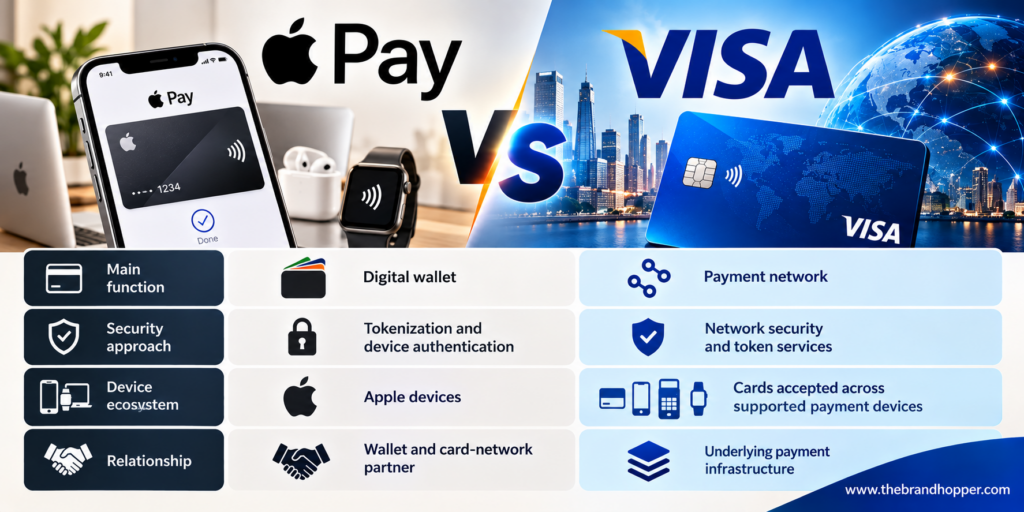
Apple Pay is a digital wallet that allows users to make contactless, in-app, and online payments using supported Apple devices. It uses tokenization to replace card details with device-specific credentials.
When a customer adds a Visa card to Apple Wallet, Apple Pay typically works with Visa’s underlying payment network. This makes Apple both a distribution partner and a competitor for control of the consumer payment experience.
Apple does not disclose comprehensive standalone revenue or transaction-volume figures for Apple Pay. Estimates of its global users, payment volume, and market share should therefore be treated as third-party estimates rather than official company results.
9. Google Pay and Google Wallet
Website: pay.google.com
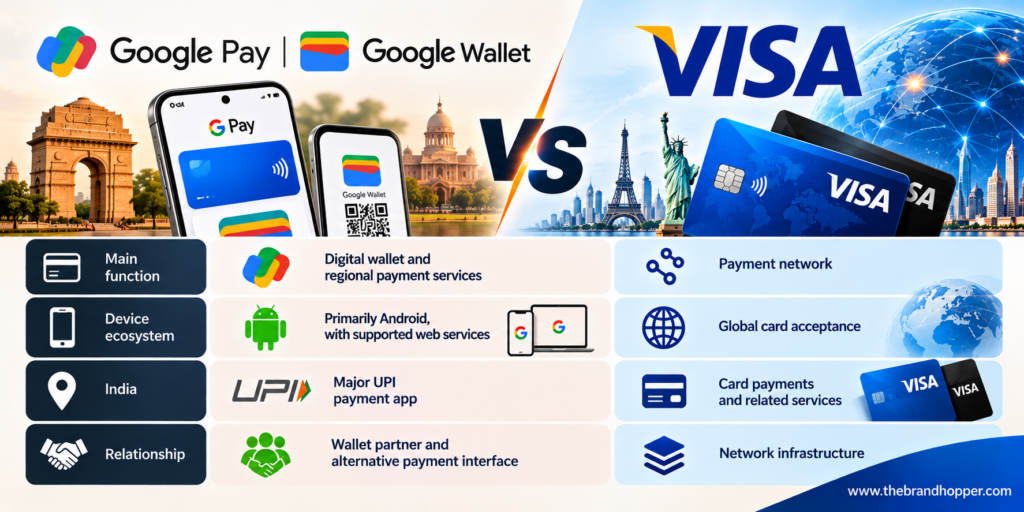
Google Wallet stores payment cards and other digital items, including loyalty cards, transit passes, and supported identification credentials. Google Pay is the payment brand used for certain online and regional payment services.
For contactless card payments, Google Wallet can tokenize supported Visa and other network cards. In India, Google Pay is also a major UPI payment app, which means some transactions take place through India’s bank-to-bank payment infrastructure rather than Visa’s card network.
Google does not publish a single, comprehensive global user or payment-volume figure for Google Wallet that is directly comparable with Visa’s reported metrics. Its competitive significance lies in its Android ecosystem, digital wallet interface, and payment services.
10. Alipay and Ant Group
Website: alipay.com
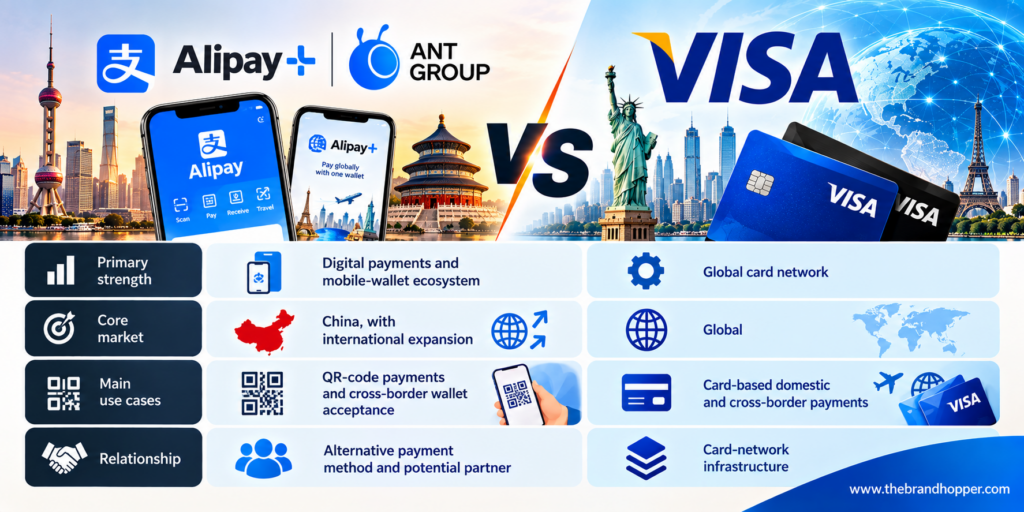
Alipay, operated by Ant Group, is a major digital payment platform in China. It has evolved from an online payment service into a broader ecosystem spanning payments, financial services, and digital commerce.
Alipay+ connects participating mobile payment providers with merchants in multiple markets, particularly supporting cross-border payments and international visitors. Alipay and Alipay+ are related but distinct offerings; their user and merchant figures should not be treated as interchangeable.
Alipay competes with Visa where consumers and merchants use wallet-based payments that bypass traditional card transactions. It can also complement international card networks through partnerships and cross-border acceptance arrangements.
11. WeChat Pay
Website: pay.weixin.qq.com
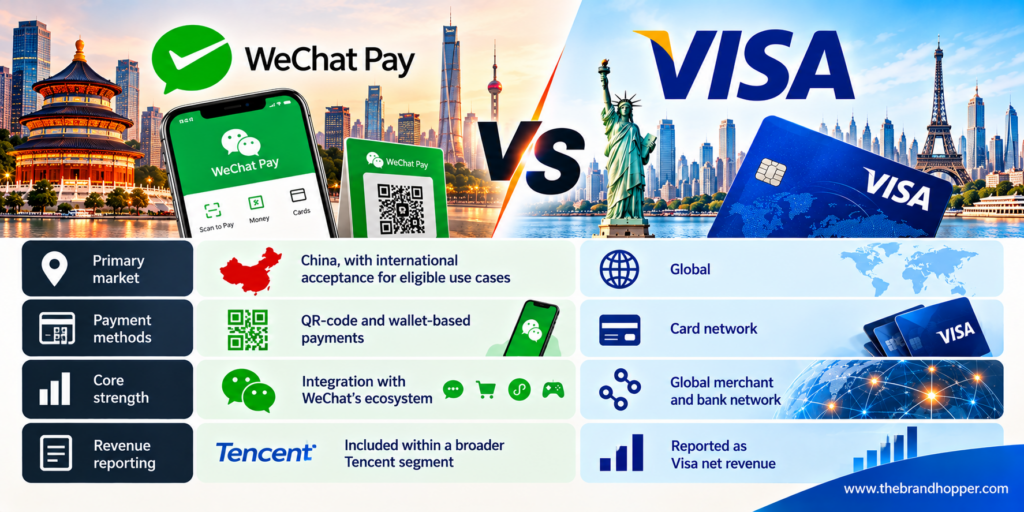
WeChat Pay is Tencent’s payment service integrated into the WeChat super-app. It supports QR-code payments, transfers, and payments within participating merchants and services.
In China, WeChat Pay competes with card networks for many everyday transactions. Its QR-code-based payment ecosystem can route transactions through domestic payment arrangements rather than Visa’s card network.
Tencent reports financial results for its broader Fintech and Business Services segment, which includes activities beyond WeChat Pay. Segment revenue should therefore not be presented as WeChat Pay’s standalone revenue.
12. Block: Square and Cash App
Website: block.xyz
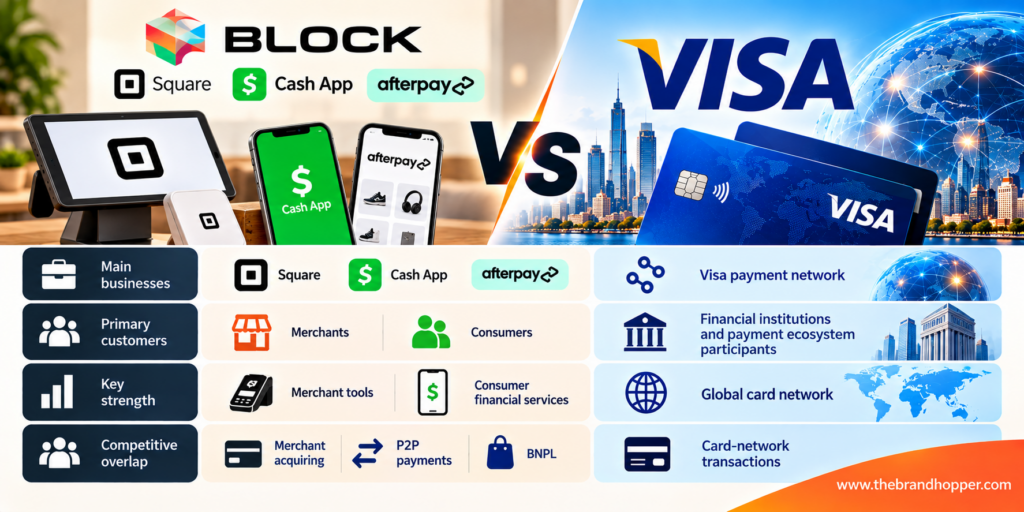
Block operates two major businesses: Square, which provides merchant payment acceptance and commerce tools, and Cash App, which offers consumer financial services. Its portfolio also includes Afterpay, a buy-now-pay-later service.
For FY2025, Block reported approximately $24.19 billion in net revenue. Bitcoin-related revenue contributes substantially to the headline total, so it should not be compared directly with Visa’s network revenue without accounting for differences in business models.
Square is both a partner and a competitor within the payments ecosystem. It helps merchants accept Visa cards, while Cash App transfers and Afterpay instalments offer alternative ways to make or finance payments.
13. Adyen
Website: adyen.com
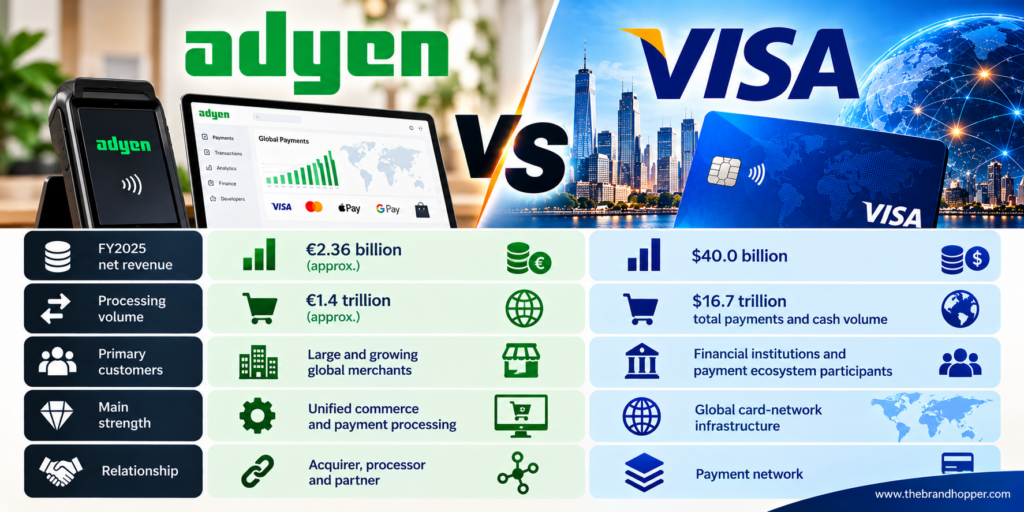
Adyen is a Dutch payment technology company that provides a unified platform for online, in-store, and in-app payments. It serves major global businesses and combines payment processing, merchant acquiring, risk management, and data analytics.
For FY2025, Adyen reported net revenue of approximately €2.36 billion, with growth of around 18% year over year. Its processing volume was approximately €1.4 trillion, illustrating its scale as a payments processor.
Adyen is primarily a Visa partner when processing Visa transactions for merchants. It also competes in merchant acquiring and payment infrastructure, where businesses choose how to accept and manage payments.
14. Fiserv
Website: fiserv.com
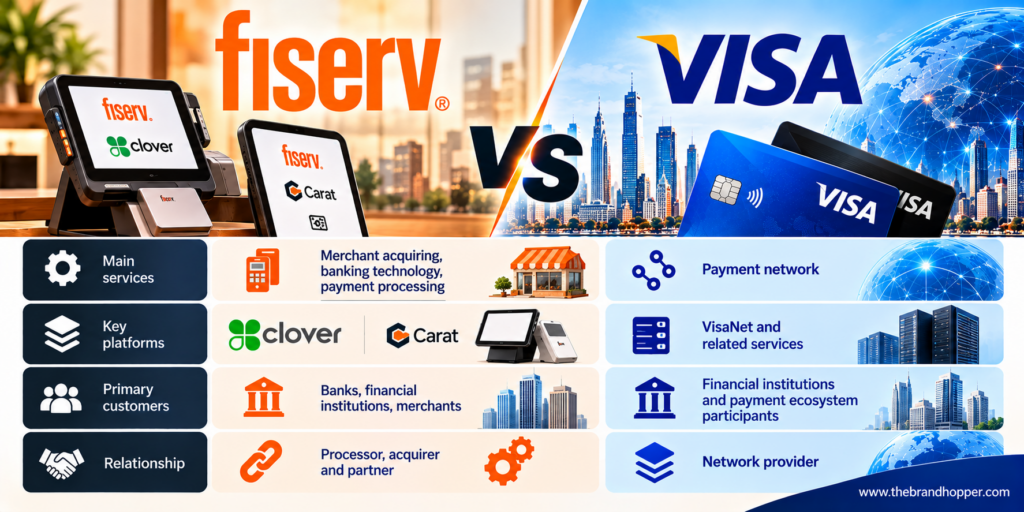
Fiserv provides financial technology, payment processing, merchant acquiring, and banking solutions. Its businesses include Clover, a merchant point-of-sale platform, and Carat, an enterprise commerce solution.
Fiserv’s merchant and financial-institution relationships make it an important part of the payment ecosystem. It helps businesses accept card payments, including Visa, while also competing with other providers for merchant technology and payment-processing contracts.
Fiserv’s revenue and processing figures should be compared carefully with Visa’s because the companies operate at different layers of the payments industry.
15. JCB: Japan Credit Bureau
Website: global.jcb
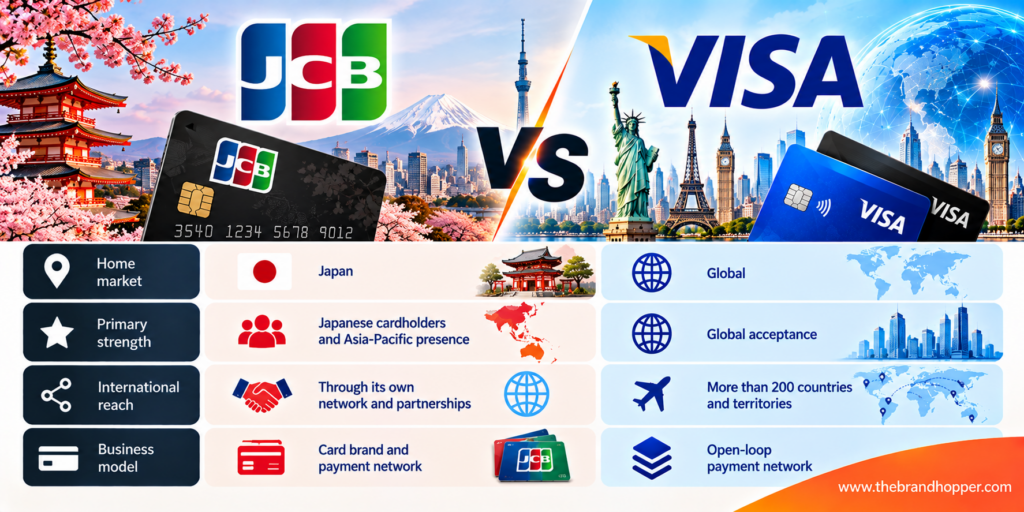
JCB is a Japanese payment-card brand with a strong domestic presence and international acceptance through partnerships. It offers card products and payment-network services to consumers, merchants, and financial institutions.
JCB has expanded beyond Japan through acceptance agreements and co-branding arrangements, particularly in Asia-Pacific. Its partnership with Discover has historically helped JCB cardholders use their cards at participating locations in the United States; Discover is now part of Capital One.
JCB competes with Visa for card issuance and spending, especially among Japanese consumers and in selected Asian markets. Its international reach is meaningful, although smaller than Visa’s overall global footprint.
16. Klarna
Website: klarna.com
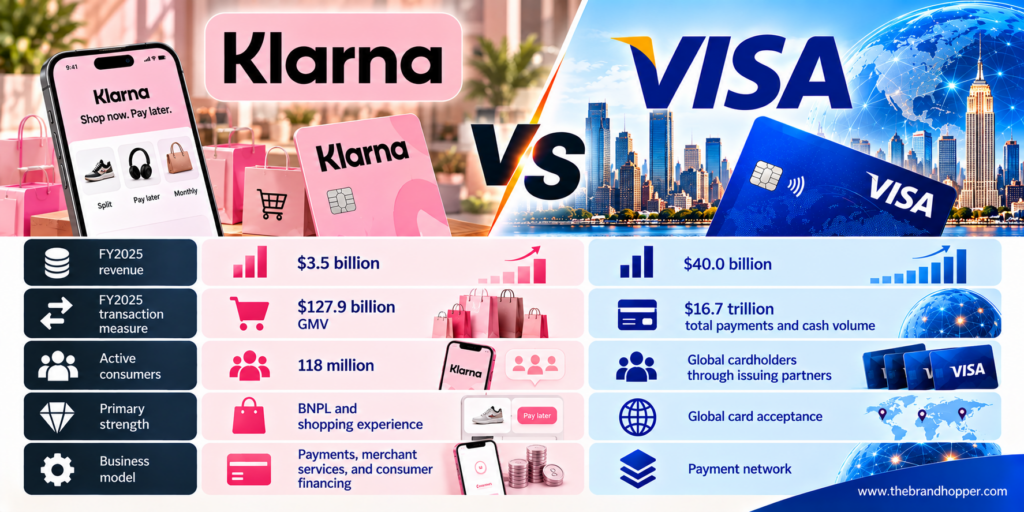
Klarna is a Swedish fintech company best known for buy-now-pay-later services and its shopping and payments app. It allows eligible consumers to use instalment and other payment options at participating merchants.
Klarna completed its New York Stock Exchange IPO in September 2025. For FY2025, it reported approximately $3.5 billion in revenue, $127.9 billion in gross merchandise volume, and 118 million active consumers, alongside 966,000 merchants.
Klarna competes with Visa when a shopper selects a BNPL option instead of paying with a traditional card. However, the two can also overlap through card products and checkout partnerships, and the extent of competition depends on how a particular transaction is funded.
17. Samsung Wallet
Website: samsung.com/us/samsung-wallet
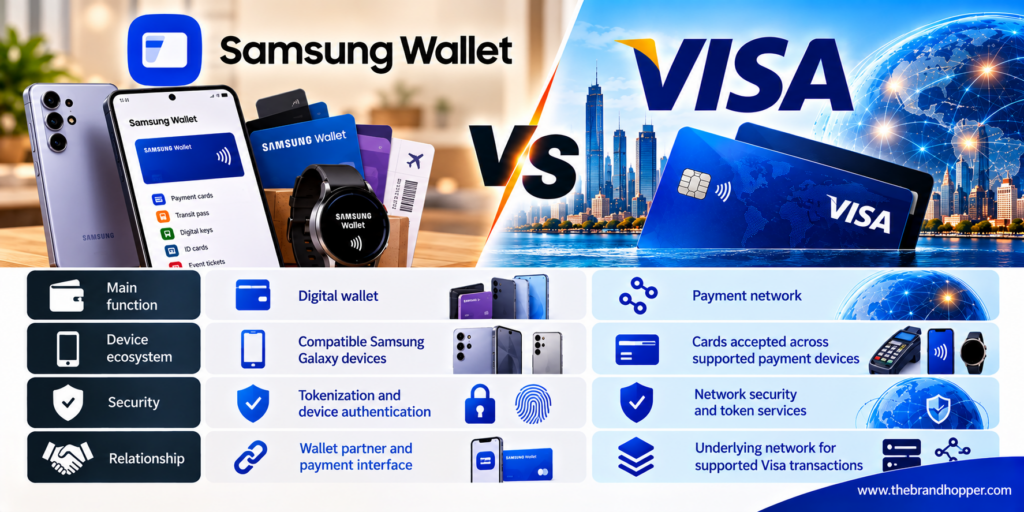
Samsung Wallet is Samsung’s digital wallet for compatible Galaxy devices. It combines payment-card functionality with supported digital items such as loyalty cards, transit passes, and digital keys.
For card payments, Samsung Wallet can use tokenized credentials from Visa and other participating networks. Samsung therefore acts as a digital-wallet partner while competing for control of the consumer-facing payment experience.
Samsung does not publish a consistent current global user count or transaction-volume figure that can be directly compared with Visa’s official annual results. Its relevance comes from the Galaxy device ecosystem and its role in contactless payments.
Frequently Asked Questions (FAQs)
Q1. Who is Visa’s biggest competitor?
A: Mastercard is Visa’s closest direct competitor because both operate global open-loop card-payment networks. UnionPay is also a major competitor, particularly in China, while digital wallets and alternative payment systems compete for specific payment use cases.
Q2. What is the difference between Visa and Mastercard?
A: Both connect cardholders, banks, and merchants without generally issuing cards or lending directly to consumers. Visa is larger by FY2025 net revenue, while Mastercard has also expanded its value-added services and cybersecurity offerings.
Q3. How does Visa make money?
A: Visa earns revenue primarily from service revenues, data-processing revenues, international transaction revenues, and other revenues. It generally does not earn interest from consumer card balances because issuing banks, rather than Visa, provide most Visa-branded credit cards.
Q4. Is PayPal a direct competitor to Visa?
A: PayPal is both a partner and a competitor. It supports card-funded payments that may use Visa’s network, but also offers wallet-based, bank-funded, and peer-to-peer transactions that can take place without Visa processing the payment.
Q5. What is the biggest threat to Visa’s business model?
A: There is no single biggest threat. Real-time bank-payment networks, digital wallets, alternative payment methods, regulatory changes, and competing card networks can all affect Visa’s transaction volumes or pricing in different markets.
Q6. How many countries does Visa operate in?
A: Visa’s network reaches more than 200 countries and territories. Network availability does not mean Visa has the same level of domestic-market access or acceptance in every country.
Choosing Between Visa and Its Competitors
Choosing between Visa and an alternative depends on the payment use case. Consumers may prioritize card acceptance, rewards, fees, mobile-wallet compatibility, or instalment options, while businesses may focus on processing costs, integration, fraud management, and settlement workflows.
Acceptance matters for international travel and everyday spending. Visa and Mastercard have broad global reach, while American Express, Discover, and regional networks may have different acceptance profiles depending on the country and merchant.
Digital experience also matters. Apple Pay, Google Wallet, and Samsung Wallet provide convenient interfaces for supported payment cards, while PayPal, Klarna, and other fintech services offer alternatives for online checkout or instalment payments.
For businesses, payment processors such as Stripe, Adyen, and Fiserv are not direct substitutes for Visa’s global card network. Instead, they provide infrastructure that helps merchants accept payments through Visa and other payment methods.
Ultimately, Visa remains a major part of the global payments ecosystem, but the competitive landscape includes several layers: card networks, digital wallets, payment processors, and domestic instant-payment systems. Understanding these differences is essential when comparing their scale, financial performance, and long-term competitive positions.
Also Read: Business Model of Visa – How Visa Makes Money
To read more content like this, subscribe to our newsletter