Last Updated on September 10, 2026 by Team TBH
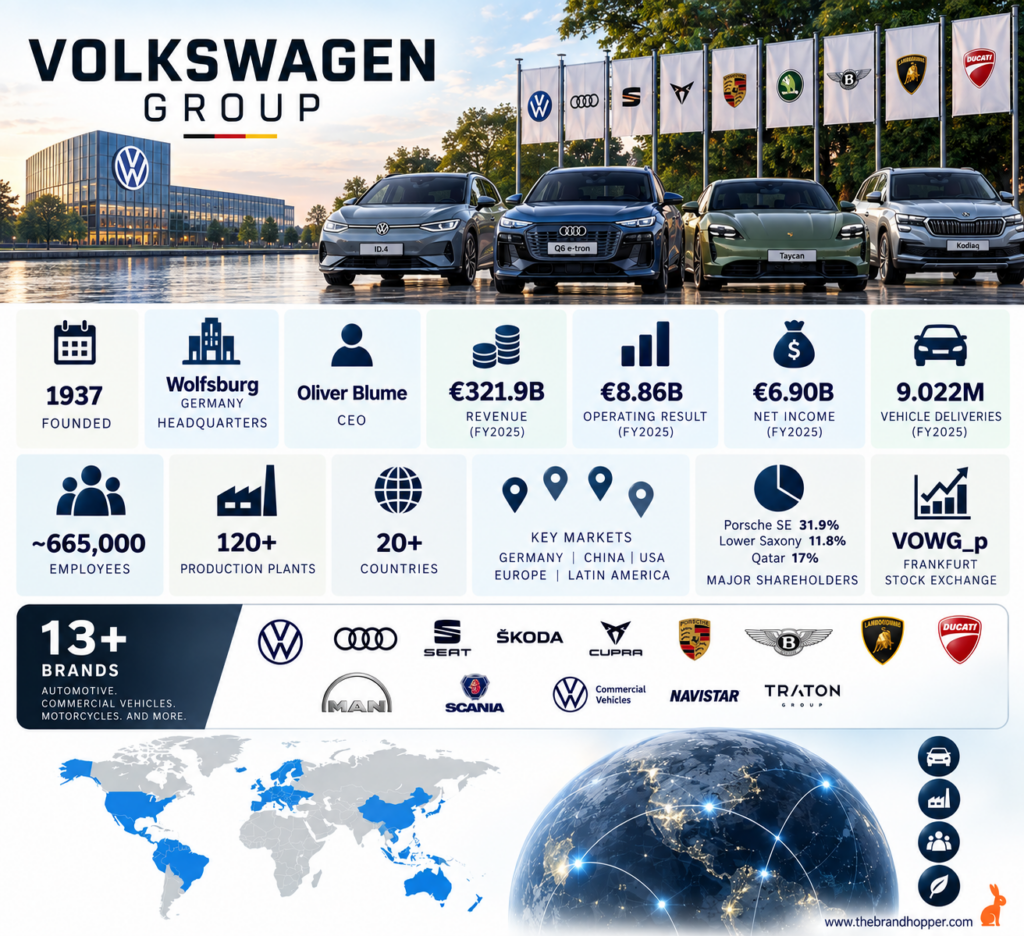
Volkswagen Group is one of the world’s largest and most complex automotive conglomerates, operating a portfolio of 13+ brands spanning budget city cars, mass-market family vehicles, commercial trucks, luxury sedans, high-performance sports cars, supercars, and even motorcycles. The company is headquartered in Wolfsburg, Germany, and has production facilities in more than 20 countries across Europe, the Americas, Asia-Pacific, and Africa.
In FY2025, Volkswagen Group generated revenue of €321.9 billion, delivered 9.022 million vehicles worldwide, and employed approximately 665,000 people globally. The group’s reach extends across three organized brand groups — Core, Progressive, and Sport Luxury — each with its own distinct strategy, target audience, and competitive positioning.
Despite facing significant headwinds in FY2025 — including US auto tariffs, a demanding transition to electric vehicles, restructuring costs, and softening demand in China — Volkswagen Group remains one of the defining forces in the global automotive industry. Its journey from a single affordable car designed for the German people in 1938 to a global empire worth hundreds of billions of euros is one of the most remarkable stories in industrial history.
History of Volkswagen
The history of Volkswagen can be traced back to the 1930s, when Germany was undergoing a period of rapid industrialization. In 1934, the German government commissioned Ferdinand Porsche, a celebrated automotive engineer, to design a car that would be affordable for the average German citizen. The result was the Volkswagen Beetle, which was introduced in 1938 and built at a purpose-built factory in what is now Wolfsburg, Germany. The state-owned enterprise behind it was called the Gesellschaft zur Vorbereitung des Deutschen Volkswagens mbH — meaning the Society for the Preparation of the German Volkswagen Ltd.
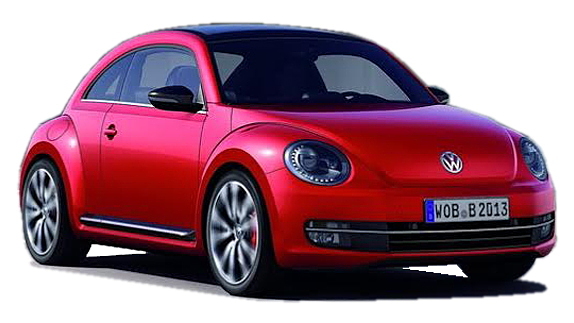
World War II disrupted production almost immediately. The Wolfsburg factory was redirected to military vehicle production, and after Germany’s defeat in 1945, the factory was placed under British military control. The British then oversaw the resumption of civilian vehicle production, and by 1948 the factory had been handed back to German authorities. Heinrich Nordhoff was appointed Managing Director in 1948 and became the visionary leader who scaled Volkswagen into an internationally recognized brand throughout the 1950s and 1960s.
In the 1960s and 1970s, Volkswagen began its transformation from a single-car company into a diversified automotive group. The Golf was introduced in 1974 and became one of the most successful and enduring cars in automotive history — entering its eighth generation in 2020. VW acquired SEAT (Spain) in 1986, Škoda (Czech Republic) in 1991, Bentley and Bugatti (both UK/France) in 1998, and Lamborghini (Italy) in 1998. These acquisitions laid the foundation for the diverse brand portfolio VW Group is known for today.
The early 2000s saw VW deepen its presence in China — which would become its largest single market — and expand into commercial vehicles through the acquisition of Scania (Sweden) and MAN (Germany), creating TRATON SE as its commercial vehicle subsidiary. Ducati (Italian motorcycles) was acquired in 2012. The Porsche merger was completed in 2011 when VW and Porsche Automobil Holding SE concluded a long-running takeover saga, making Porsche AG a wholly owned VW Group subsidiary (though Porsche AG was later taken public in 2022).
In September 2015, Volkswagen was engulfed in the biggest corporate scandal in its history — the Dieselgate emissions cheating scandal — which cost the company over $35 billion in fines, settlements, and remediation costs. The scandal triggered a fundamental rethink of the company’s strategy, accelerating VW’s pivot toward electric mobility. The resulting ‘New Auto’ strategy, launched under CEO Herbert Diess (2018–2022), set ambitious targets for battery electric vehicle (BEV) production and digital transformation.
Oliver Blume — who was simultaneously CEO of Porsche AG — succeeded Herbert Diess as VW Group CEO in September 2022. Under Blume, the group has pursued a more pragmatic approach to electrification, adjusting EV production targets in response to market realities while pushing restructuring programs to reduce costs. In 2024, VW announced one of the most significant restructuring plans in its history — including plant closures in Germany, wage reductions, and headcount reductions — as the group grappled with structurally higher costs, Chinese EV competition, and softening demand across key markets.
Volkswagen Group Brand Portfolio
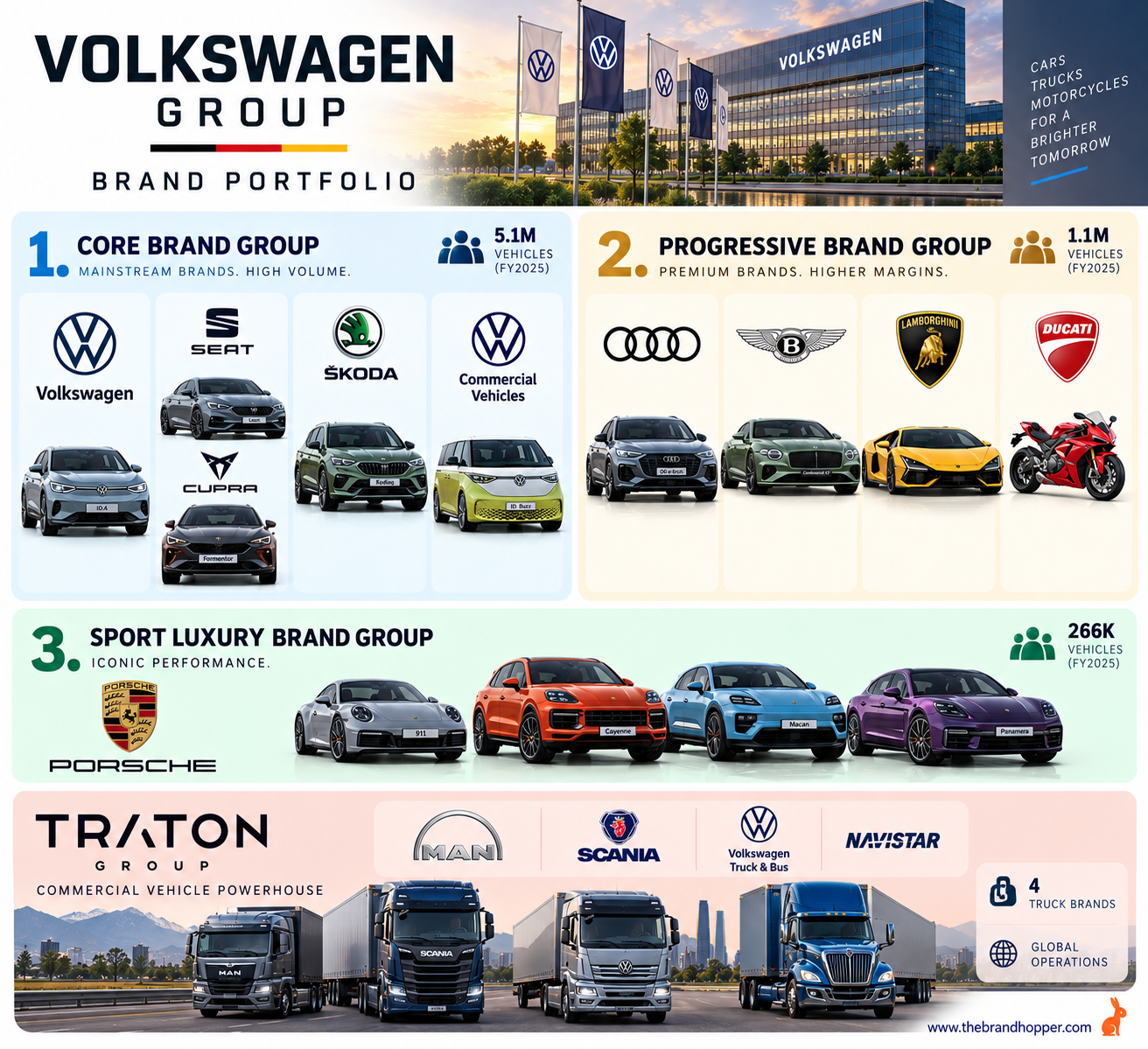
Volkswagen Group organizes its automotive brands into three distinct brand groups, each with a specific market positioning, price tier, and growth mandate. This architecture — introduced as part of the “New Auto” strategy — helps the group avoid internal brand cannibalization while allowing each brand to develop its own identity and customer base.
1. Core Brand Group
The Core Brand Group delivered 5.1 million vehicles in FY2025. It includes VW’s highest-volume brands, operating in the mainstream and affordable segments. The group’s mission is to maximize volume, drive down costs through platform sharing, and serve as the profitability foundation for the wider group.
i. Volkswagen Passenger Cars
The flagship and namesake brand. Known for the Golf, Passat, Tiguan, Polo, and the electric ID. family (ID.3, ID.4, ID.5, ID.7). VW Passenger Cars is the volume backbone of the group, sold in virtually every global market. The brand is undergoing a significant cost-restructuring program aimed at improving margins while accelerating its transition to battery electric vehicles.
ii. SEAT / CUPRA
Originally a Spanish brand known for affordable and sporty vehicles (Arona, Ateca, Leon), SEAT is in the process of transformation. The CUPRA sub-brand — launched as a performance arm in 2018 — has been elevated into an independent brand and is now the group’s youth-focused performance brand, with models like the Formentor, Born EV, and Tavascan EV. SEAT deliveries grew in FY2025, driven largely by CUPRA’s rising international profile.
iii. Škoda
A Czech brand known for producing practical, well-equipped, value-for-money vehicles — the Octavia, Fabia, Karoq, Kodiaq, and Enyaq EV. Škoda is consistently one of the most profitable brands in the group on a per-unit basis and has grown its market share significantly across Central and Eastern Europe. Deliveries grew in FY2025.
iv. Volkswagen Commercial Vehicles
Produces light commercial vehicles — the iconic Transporter (T-Series), Crafter (panel van), and Amarok (pickup truck). A critical brand for trade and logistics customers across Europe, with an increasingly electric lineup including the ID. Buzz (electric people-mover/van).
2. Progressive Brand Group
The Progressive Brand Group delivered approximately 1.1 million vehicles in FY2025. Its mandate is to lead in premium and ultra-premium segments, drive profitability through high margins, and pioneer technology that cascades down to Core brands.
i. Audi
Volkswagen Group’s premium flagship. Audi is one of the world’s most recognized luxury car brands, competing directly with BMW and Mercedes-Benz. The lineup spans the A3 to A8 sedans, Q3 to Q8 SUVs, TT and R8 sports cars, and a rapidly expanding BEV range including the e-tron GT, Q6 e-tron (84,000 units delivered in FY2025), and A6 e-tron (37,000 units in FY2025). Audi delivered 223,000 BEVs in FY2025. Audi also controls the Lamborghini and Ducati brands within the Progressive group.
ii. Bentley
A British ultra-luxury brand based in Crewe, England, producing handcrafted vehicles including the Continental GT, Bentayga SUV, and Flying Spur. Bentley is one of the most profitable luxury car brands in the world on a per-unit basis. The brand delivered fewer vehicles than the prior year in FY2025 but remains a key contributor to the group’s margin structure.
iii. Lamborghini
The iconic Italian supercar brand based in Sant’Agata Bolognese. Home to the Huracan, Urus (SUV), and Revuelto (successor to the Aventador — a plug-in hybrid). Lamborghini delivered vehicles in line with prior-year levels in FY2025, maintaining the brand’s exclusive, limited-supply positioning. Since 2021, Bugatti has been separated into Bugatti Rimac (an independent company in which Porsche AG holds ~45.5%), no longer a direct VW Group subsidiary.
iv. Ducati
Italy’s most famous motorcycle brand, based in Bologna. The Ducati lineup includes the Panigale (superbike), Monster (naked), Multistrada (adventure touring), Scrambler, and Diavel. Ducati sold 50,700 motorbikes in FY2025, maintaining its position as one of the world’s premium motorcycle manufacturers. It sits within the Progressive Brand Group under Audi’s oversight.
3. Sport Luxury Brand Group
Porsche is the sole member of the Sport Luxury Brand Group and holds a unique position within VW Group — it is both a wholly owned subsidiary of VW Group and a publicly listed company (Porsche AG IPO, October 2022), with VW Group retaining a 75% economic stake.
i. Porsche
Germany’s most iconic sports car brand, building the 911, Cayman, Boxster, Cayenne, Macan, and Panamera. In FY2025, Porsche Automotive sold 266,000 vehicles globally. FY2025 was a challenging year for Porsche, impacted by adjustments to its product strategy (reduced near-term EV ambitions, pausing the all-electric Macan EV ramp-up in some markets) and related restructuring charges. Despite lower deliveries, Porsche remains among the highest-margin automotive brands globally. The Cayenne, 911, and Macan drove the majority of volumes.
TRATON SE — Commercial Vehicle Powerhouse
TRATON SE is VW Group’s listed commercial vehicle subsidiary, headquartered in Munich. It comprises four major truck brands: MAN (Germany), Scania (Sweden), Volkswagen Truck & Bus (Latin America), and Navistar International (USA). Together, TRATON is one of the world’s top three commercial vehicle manufacturers by revenue, with operations across every major continent. TRATON SE is partially listed on the Frankfurt and Stockholm stock exchanges, with VW Group holding approximately 90% of shares.
Also Read: How Porsche Became a Global Icon: Exploring Marketing & Brand Strategies
How is Volkswagen Doing Financially?
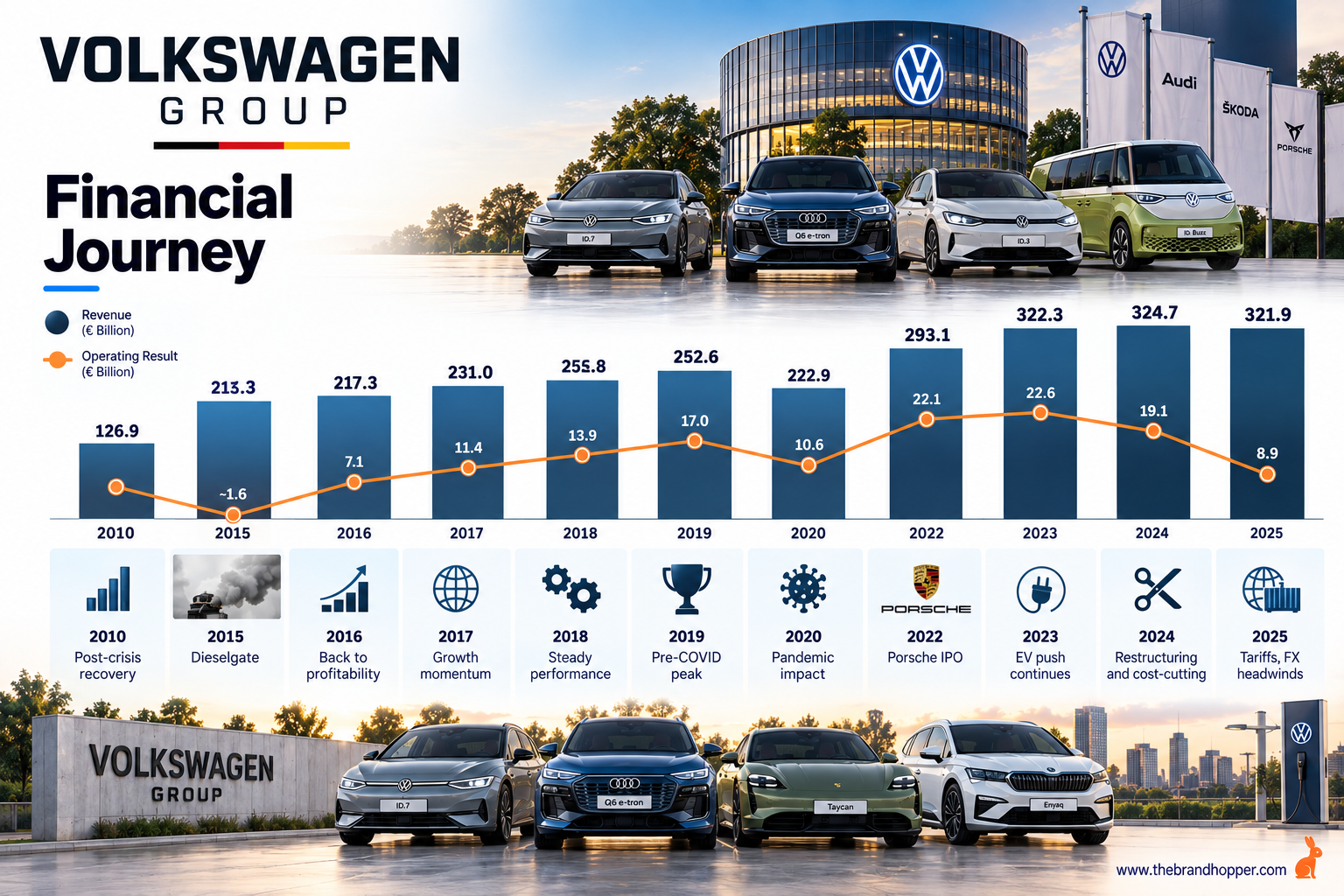
Volkswagen Group’s financial performance reflects its position as both one of the world’s most expansive automotive conglomerates and one most exposed to the industry’s structural pressures — electrification costs, China competition, and geopolitical trade friction. Here is a snapshot of the group’s financial journey:
Historical Financial Overview
FY2025 Deep Dive
Volkswagen Group’s FY2025 results reflected a challenging operating environment. Revenue of €321.9 billion was broadly stable year-over-year, but the operating result dropped 53.5% to €8.86 billion. The sharp decline in operating profit was driven by three primary factors: US auto import tariffs implemented in 2025, which significantly raised costs for vehicles imported into the American market; restructuring charges and expenses related to Porsche AG’s product strategy adjustments (including pausing certain all-electric vehicle launches); and unfavourable currency movements — particularly the US dollar and Chinese yuan weakening against the euro.
Net income after tax came in at €6.90 billion. Total vehicle deliveries reached 9.022 million units — essentially flat compared to 9.037 million in FY2024 — with gains at Škoda and SEAT/CUPRA offset by declines at VW Passenger Cars, Audi, Bentley, and Porsche. Electric vehicle momentum was a bright spot: Audi delivered 223,000 BEVs in FY2025, led by the Q6 e-tron (84,000 units) and A6 e-tron (37,000 units), while the VW ID. family continued its gradual ramp-up in Europe.
Despite the pressures, Volkswagen Group retains enormous industrial scale, a dominant presence across multiple vehicle segments, and the financial resources to sustain its electrification investments. The group’s 2025 restructuring program — which includes Germany plant efficiency measures and targeted headcount reductions — is designed to reduce the structural cost base and improve margin resilience over the medium term.
Dieselgate – The Major Scandal That Rocked Volkswagen
In September 2015, the United States Environmental Protection Agency (EPA) issued a notice of violation to Volkswagen AG, revealing that the company had installed illegal “defeat device” software in approximately 11 million diesel vehicles worldwide — including Volkswagen, Audi, and Porsche models. The software detected when vehicles were being tested for emissions and adjusted engine performance to pass the tests. Under real-world driving conditions, however, those same engines emitted up to 40 times the permitted level of nitrogen oxide (NOx), a major contributor to air pollution and respiratory disease.
The fallout was catastrophic and immediate. CEO Martin Winterkorn resigned within days of the revelation. The company’s share price collapsed by more than 35% in a matter of days. Volkswagen ultimately admitted to the deception and faced legal, financial, and regulatory consequences across multiple jurisdictions. In the United States alone, Volkswagen paid approximately $14.7 billion in a landmark settlement — covering vehicle buybacks, owner compensation, and environmental remediation. Total global costs from fines, settlements, legal fees, vehicle modifications, and buybacks exceeded $35 billion.
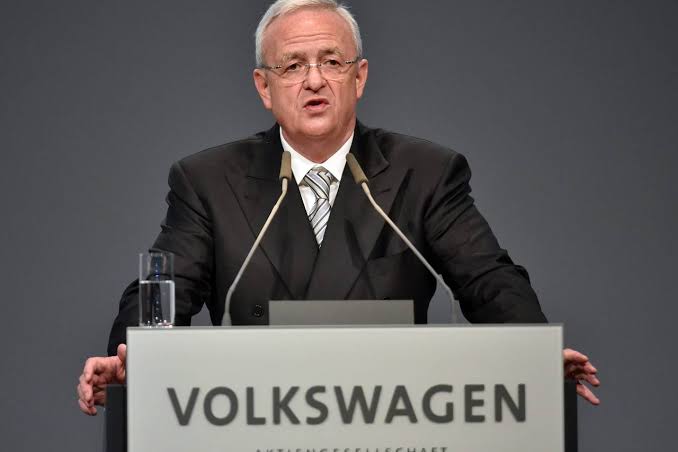
The scandal also resulted in criminal prosecutions. Former VW CEO Martin Winterkorn was charged with fraud in both the US and Germany. Dozens of executives and engineers faced criminal proceedings in multiple countries. In the US, Volkswagen’s US subsidiary pleaded guilty to three criminal felonies.
The legacy of Dieselgate fundamentally altered Volkswagen’s strategic direction. The scandal exposed the risks of the diesel technology pathway and accelerated the group’s pivot toward battery electric vehicles. The “Roadmap E” strategy — announced in 2016 — committed to launching 30 battery electric models by 2025 and investing €33 billion in EV development. This pivot ultimately gave rise to the MEB electric vehicle platform, which underpins the entire ID. family of electric vehicles. In a paradox of corporate history, the scandal that nearly broke Volkswagen may have been the catalyst that pushed it toward a leadership position in electric mobility.
Volkswagen’s Electric Vehicle & Transformation Strategy
Volkswagen Group has made the transition to electric mobility the defining mission of its current era. Across all brand groups, the company is investing hundreds of billions of euros in battery technology, EV platforms, software development, and charging infrastructure — a transformation in scale and complexity with few precedents in the history of manufacturing.
1. The MEB Platform
The Modular Electric Drive Matrix (MEB) is the standardized electric vehicle platform underpinning VW Group’s mass-market BEV strategy. MEB enables efficient, scalable production of electric vehicles across multiple brands and body styles. The VW ID.3, ID.4, ID.5, ID.7, Škoda Enyaq, CUPRA Born, CUPRA Tavascan, and Audi Q4 e-tron are all built on MEB. By sharing battery technology, electric motors, software architecture, and structural components across brands, VW Group dramatically reduces the per-unit cost of developing and manufacturing EVs.
2. The Premium Platform Electric (PPE)
For Audi and Porsche, VW Group developed the Premium Platform Electric (PPE) — a higher-performance architecture supporting faster charging, longer range, and more dynamic driving characteristics than MEB. The Audi Q6 e-tron and Porsche Macan Electric are the first PPE-based models, both launched in 2024. The PPE supports 800V architecture (enabling extremely fast charging), over-the-air software updates, and advanced driver assistance systems.
3. Software and CARIAD
VW Group established CARIAD — its in-house automotive software company — to develop the proprietary software platform that will run across all group vehicles. The ambition: to own the software stack that powers the car’s digital experience, from infotainment and digital cockpit to driver assistance systems and autonomous driving features. CARIAD has faced significant execution challenges and delays, resulting in leadership changes and a more collaborative approach with external software partners (including Rivian, for next-generation software architecture, and mobile phone chips from Qualcomm).
4. Battery and Gigafactory Strategy
Volkswagen Group is building a network of six battery gigafactories in Europe — in partnership with battery cell manufacturer PowerCo, a VW subsidiary. These are planned across Germany, Spain, Canada, and other locations. The goal is to manufacture battery cells in-house at scale, reducing reliance on Asian cell suppliers (primarily Samsung SDI, LG Energy Solution, and CATL) and dramatically cutting battery costs through volume and integration. Battery cost parity with internal combustion engines is considered the key milestone for mass EV adoption.
5. EV Targets — Recalibrated for Market Reality
In 2022-2023, VW Group set highly ambitious EV targets, including commitments for 50%+ BEV mix in Europe by 2030. However, in 2024-2025, the group — along with peers such as Ford, GM, and Mercedes-Benz — recalibrated these targets as actual BEV demand grew more slowly than forecast. Porsche paused ramp-up plans for some all-electric models, VW adjusted ID. production volumes, and the group acknowledged that the combustion-to-electric transition will take longer than the most bullish projections implied. The revised strategy balances BEV investment with continued profitability from combustion engine vehicles during the transition period.
Marketing Strategies of Volkswagen
Volkswagen Group’s marketing approach is a study in complexity and nuance. Across 13+ brands targeting vastly different audiences — from cost-conscious first-time car buyers to ultra-wealthy supercar collectors — the group’s brands must each maintain distinct identities while benefiting from shared platforms and technology. Here are the key strategies that define VW Group’s marketing across brands:
1. Brand Identity and Heritage Marketing
Volkswagen as a brand has one of the most powerful and emotionally resonant identities in the automotive world. The “Das Auto” campaign (used globally from 2007 to 2015) positioned VW as the definitive automobile company — an assertion of engineering excellence and heritage.
While “Das Auto” was quietly dropped in the wake of Dieselgate, Volkswagen has built its brand refresh around a new identity focused on accessibility, sustainability, and optimism. The 2020s brand platform — centered on the electric future — uses cleaner visual design, a refreshed logo, and messaging that connects VW’s people-first origins to a cleaner, more sustainable mobility future.
2. Emotional Storytelling
Volkswagen has a decades-long tradition of emotionally resonant advertising. The “Think Small” campaign of the 1960s, created by DDB Advertising, is widely regarded as one of the greatest advertising campaigns ever made. It used self-deprecating humor to reframe the Beetle’s compact size as a virtue. The approach — honesty over hype, wit over bombast — became a template for VW’s advertising voice that has endured through subsequent decades.
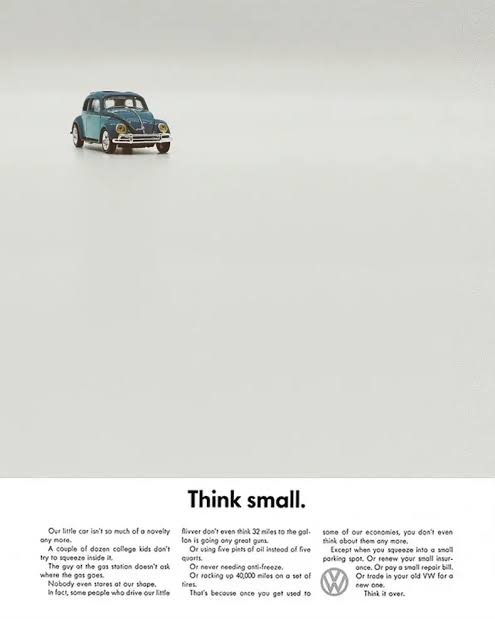
More recently, VW and its sub-brands have used storytelling to connect products to cultural moments. The ID. Buzz launch campaign deliberately referenced the heritage of the original VW Type 2 microbus — an icon of 1960s counterculture — to position the electric van as a car for a new generation of free thinkers. Porsche’s marketing has long leaned on the mythology of the 911, using documentary-style content, racing heritage, and aspirational lifestyle imagery to sustain the brand’s emotional premium.
If you wish to explore “Think Small” campaign, read our explainer case study – A Case Study on Volkswagen’s Think Small Campaign
3. Product Placement and Pop Culture
VW Group brands have a rich history of product placement. The Volkswagen Beetle’s role in the “Herbie” Disney franchise made it one of the most recognizable cars in popular culture.
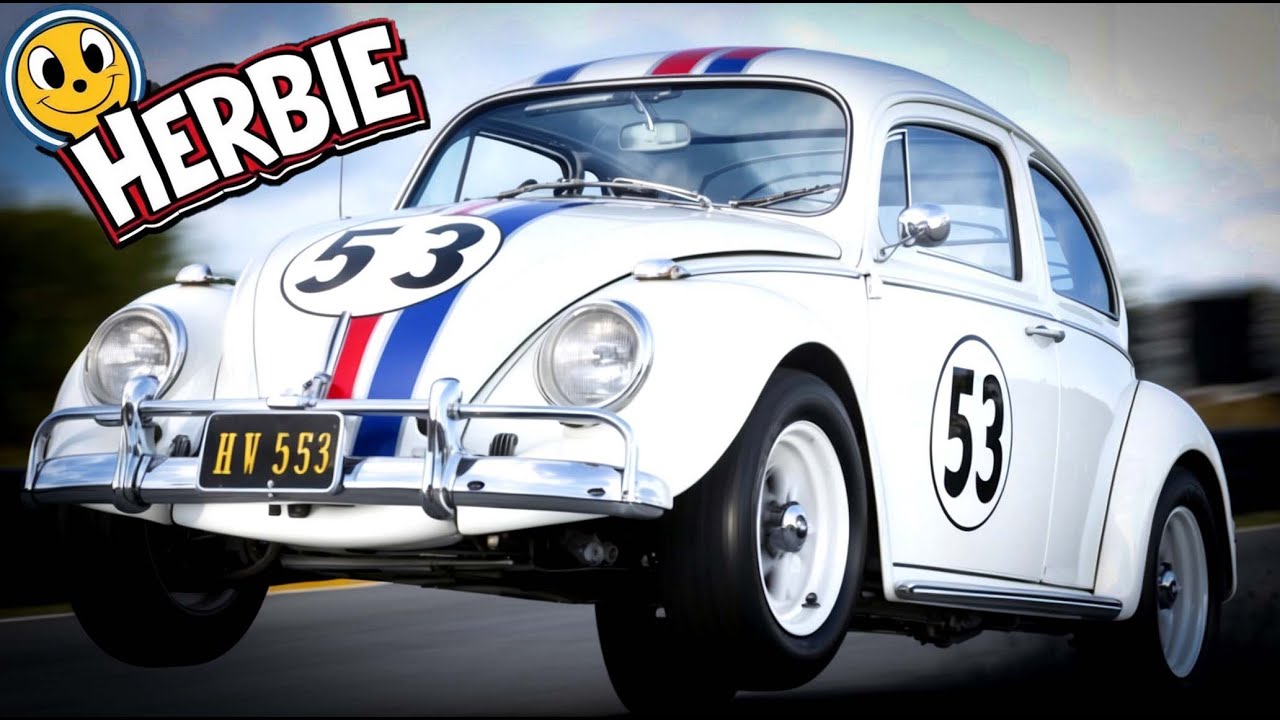
Audi’s cars have featured prominently in Iron Man and other Marvel Cinematic Universe films, reinforcing Audi’s positioning as the choice of technologically sophisticated, forward-thinking protagonists.
Lamborghini’s presence in hip-hop music, action films, and social media content keeps the brand aspirationally visible even among audiences who will never buy one.
4. Sponsorship and Global Events
Volkswagen Group’s brands are significant sponsors across sports, culture, and lifestyle. Volkswagen has sponsored the FIFA World Cup. Porsche is deeply embedded in motorsport — Le Mans, Formula E, and most recently the WEC Hypercar class — with the Porsche 963 hypercar. Audi returned to Le Mans in 2023.
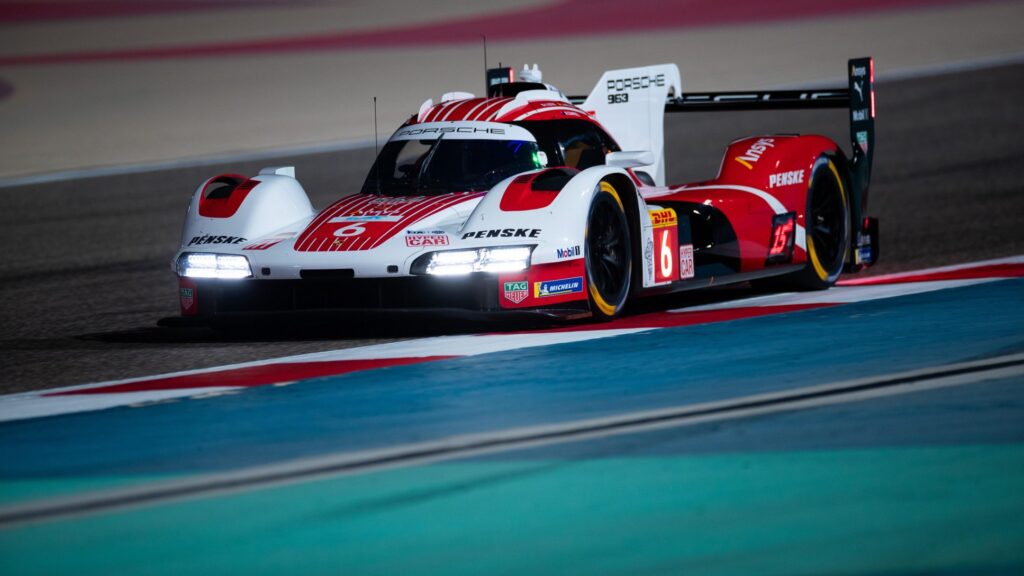
SEAT/CUPRA has been an official partner of FC Barcelona. Lamborghini’s Super Trofeo one-make racing series creates aspirational brand content and drives customer engagement among ultra-high-net-worth buyers. These sponsorships generate media value and reinforce each brand’s distinct positioning.
5. Digital Marketing and Social Media
All VW Group brands maintain active digital marketing operations across YouTube, Instagram, TikTok, and other platforms. Volkswagen’s “Electric for All” campaign used digital channels to demystify EV ownership for mainstream audiences — addressing range anxiety, charging questions, and total cost of ownership through a mix of educational content, social proof, and humour.
CUPRA has built its brand significantly through digital-native content aimed at younger audiences. Lamborghini consistently achieves some of the highest per-follower engagement rates among automotive brands on social media, despite — or because of — its extreme exclusivity.
6. Environmental Responsibility and Sustainability Marketing
Post-Dieselgate, environmental responsibility has become a non-negotiable pillar of VW Group’s communications strategy. The group’s “Way to Zero” initiative commits to becoming a climate-neutral company by 2050, with an interim goal of a 30% reduction in total carbon footprint per vehicle by 2025.
Volkswagen actively communicates its EV transition progress, renewable energy usage in manufacturing, and supply chain decarbonization. This is both a genuine strategic commitment and a reputational rehabilitation effort — VW needs consumers and regulators to associate the brand with clean mobility rather than its diesel past.
STP Analysis of Volkswagen Group
Volkswagen Group uses a sophisticated, multi-layered Segmentation, Targeting, and Positioning (STP) approach — unlike most companies which apply STP to a single brand, VW Group must apply it simultaneously across 13+ brands with distinct audiences.
Segmentation
VW Group segments its markets across multiple dimensions.
Geographically, the group tailors its brand lineup and product strategy to regional market conditions: China (the world’s largest auto market and VW’s single biggest sales region), Europe (mature market with strong EV adoption incentives), North America (pickup trucks and SUVs dominant), Latin America (price-sensitive with growing middle class), and emerging markets.
Demographically, the group’s brands span a remarkable income range — from a first-time car buyer for a Škoda Fabia to a billionaire buying a Bentley.
Psychographically, the group targets segments ranging from practical family-focused consumers (VW, Škoda), to dynamic lifestyle seekers (CUPRA, Porsche), to status-focused ultra-premium buyers (Bentley, Lamborghini).
Behaviourally, the group targets new-car buyers, brand loyalists, EV early adopters, and commercial fleet operators.
Targeting
Each VW Group brand has a precisely defined target customer.
Volkswagen Passenger Cars targets mainstream buyers seeking quality, reliability, and value-for-money in a German-engineered vehicle.
CUPRA targets 25–40-year-old urban drivers who want performance and distinction without an ultra-luxury price tag. Audi targets affluent professionals who prize refined luxury, advanced technology, and a prestigious badge.
Porsche targets driving enthusiasts and aspirational achievers for whom driving experience is an art form. Bentley targets ultra-high-net-worth individuals who want bespoke handcrafted luxury.
Lamborghini targets wealthy clients who want an extreme emotional experience and social status signal.
Positioning
Positioning across the VW Group brand architecture is deliberately orchestrated to avoid overlap. Volkswagen is positioned as ‘German engineering for everyone’ — reliable, well-built, accessible.
Škoda is ‘more car for your money’ — practical, efficient, great value. CUPRA is ‘Born to be different’ — a progressive performance brand with attitude.
Audi is ‘Vorsprung durch Technik’ (Progress through Technology) — sophisticated innovation and premium status.
Lamborghini is positioned on raw, visceral, unapologetic Italian supercar emotion — no other brand position comes close to its extremes.
Porsche occupies a unique position that combines everyday usability (Cayenne, Macan) with the world’s most beloved sports car heritage (the 911).
Competitors of Volkswagen Group
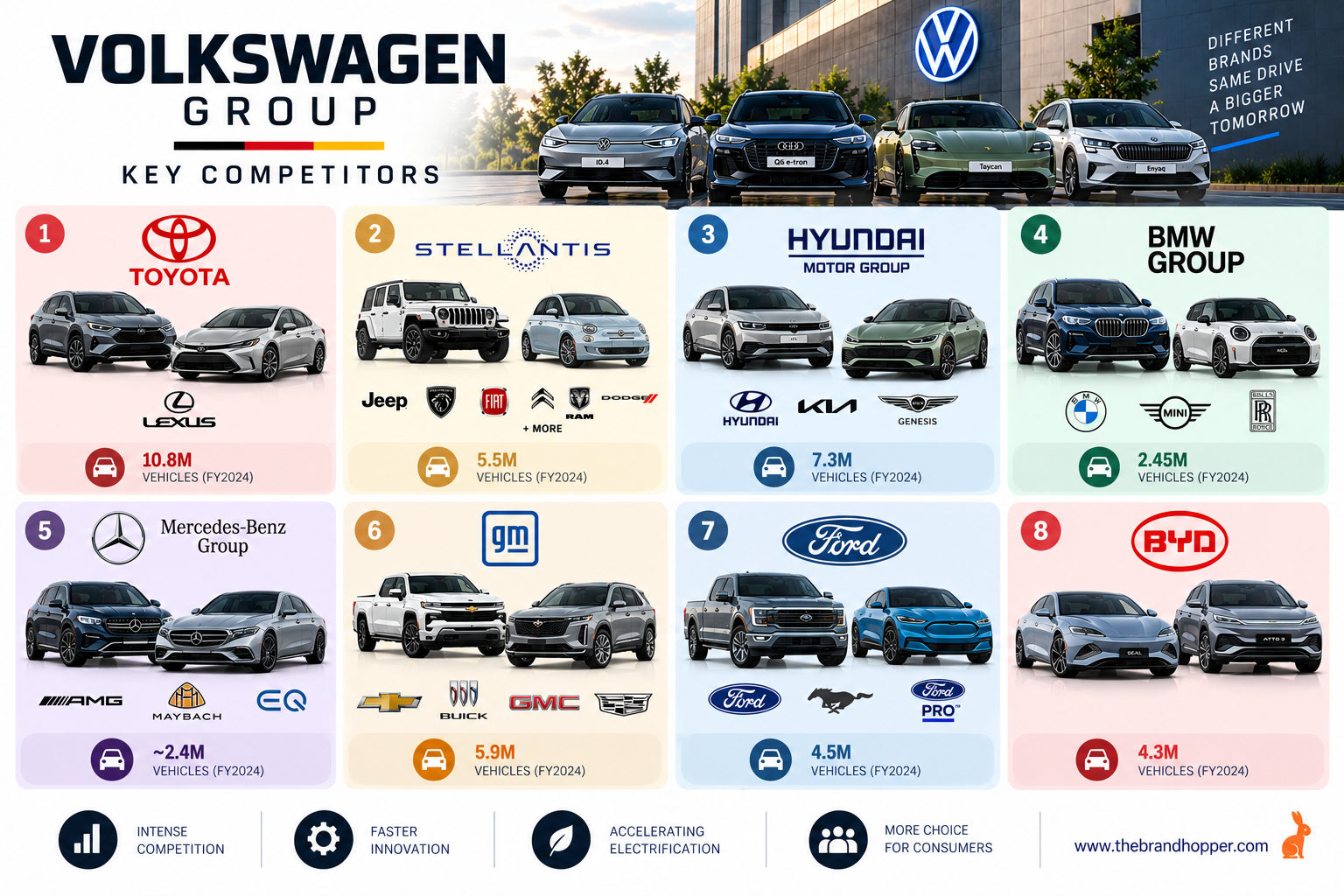
Volkswagen Group faces competition at every level of the automotive market — from mass-market giants to ultra-luxury specialists. The group’s unusual breadth means it competes with different companies in different segments simultaneously.
1. Toyota Motor Corporation
The world’s largest automaker by vehicle sales. Toyota’s global sales of 10.8 million vehicles in FY2024 outpaced VW Group’s 9.027 million. Toyota dominates the hybrid vehicle segment with the Prius and hybrid versions of its best-selling SUVs, and has taken a different strategic approach to full electrification — placing greater emphasis on hydrogen fuel cells alongside BEVs and hybrids. The Toyota–Lexus combination competes directly with VW Passenger Cars and Audi respectively.
2. Stellantis
Stellantis — formed from the 2021 merger of Fiat Chrysler Automobiles and PSA Group — operates 14 brands including Jeep, Peugeot, Citroën, Fiat, Alfa Romeo, Maserati, Ram, Dodge, and Chrysler. Stellantis is VW Group’s most direct European competitor in terms of breadth of brand portfolio, though both groups have faced profitability headwinds from the EV transition. Stellantis CEO Carlos Tavares resigned suddenly in December 2024 as the group struggled with declining sales.
3. Hyundai Motor Group
Hyundai Motor Group (Hyundai, Kia, Genesis) has emerged as one of VW Group’s most formidable competitors in the EV space. The Hyundai IONIQ 5 and Kia EV6 won global design awards and gained market share in multiple regions. In FY2024, Hyundai Motor Group sold approximately 7.3 million vehicles globally. Genesis — Hyundai’s luxury arm — competes with Audi and BMW in the premium segment.
4. BMW Group
BMW Group (BMW, MINI, Rolls-Royce) is VW Group’s most direct competitor in the premium and ultra-luxury segments. BMW competes with Audi model-for-model across most vehicle categories. In FY2024, BMW Group delivered approximately 2.45 million BMW-brand vehicles. BMW has been a leader in the premium EV space with its i3 and iX models, and MINI is undergoing a full electric transformation.
5. Mercedes-Benz Group
Mercedes-Benz Group (Mercedes-Benz cars, vans; plus former stake in MBUSA trucks) is VW Group’s other major German rival. Mercedes competes with Audi, VW, and Porsche across multiple segments. Mercedes-Benz has pursued an aggressive EQ electric lineup alongside its established AMG and Maybach ultra-luxury tiers. The Mercedes G-Wagen, S-Class, and GLE compete with Porsche’s Cayenne and Audi’s Q7/Q8 in premium SUV segments.
6. General Motors
General Motors (Chevrolet, Buick, GMC, Cadillac) is a major competitor in the Americas and China (where GM’s Buick brand remains particularly strong). GM has invested heavily in its Ultium EV platform and targets significant BEV volumes in the second half of the 2020s. Cadillac competes with Audi in the North American luxury market.
7. Ford Motor Company
Ford competes with VW’s commercial vehicle arm directly (Transit vs. Crafter) and with Volkswagen Passenger Cars in mainstream segments. Ford’s Mustang Mach-E and F-150 Lightning EV products are among the higher-profile BEV launches from a traditional American automaker.
8. BYD (Build Your Dreams)
BYD — the Chinese EV giant backed by Warren Buffett’s Berkshire Hathaway — is arguably the most transformative new competitive threat facing Volkswagen Group. BYD became the world’s largest EV manufacturer by deliveries in 2023, overtaking Tesla briefly, and has been aggressively expanding into Europe, Southeast Asia, and Latin America — VW Group’s core territories. BYD offers EVs at significantly lower price points than comparable VW or Audi models, leveraging vertical integration across battery cells, electric motors, chips, and vehicle assembly. VW’s response has included a strategic stake in Xpeng (Chinese EV startup) to accelerate software and EV capability development in China.
Frequently Asked Questions (FAQs)
Q: What brands does Volkswagen Group own?
A: Volkswagen Group owns 13+ brands organized into three groups. Core Brand Group: Volkswagen Passenger Cars, SEAT/CUPRA, Škoda, Volkswagen Commercial Vehicles, plus TRATON SE (MAN, Scania, Navistar). Progressive Brand Group: Audi, Bentley, Lamborghini, Ducati. Sport Luxury Brand Group: Porsche. Note: Bugatti is now part of Bugatti Rimac (an independent company in which Porsche holds ~45.5%), no longer a direct VW Group subsidiary.
Q: How much revenue does Volkswagen Group make?
A: In FY2025, Volkswagen Group generated revenue of €321.9 billion, broadly stable compared to €324.7 billion in FY2024. The operating result declined significantly to €8.86 billion in FY2025 (from €19.1 billion in FY2024), impacted by US auto tariffs, Porsche strategy adjustments, and currency headwinds. Net income after tax was €6.90 billion.
Q: How many vehicles does Volkswagen Group sell?
A: Volkswagen Group delivered 9.022 million vehicles worldwide in FY2025, broadly unchanged from 9.027 million in FY2024. The group has consistently sold between 9 and 10 million vehicles annually in recent years. The Core Brand Group (VW, Škoda, SEAT/CUPRA) accounted for approximately 5.1 million of those deliveries.
Q: What happened in the Volkswagen Dieselgate scandal?
A: In September 2015, US regulators revealed that VW had installed ‘defeat device’ software in approximately 11 million diesel vehicles that cheated emissions tests. Under real driving conditions, those vehicles emitted up to 40 times the permitted level of nitrogen oxide. VW’s CEO resigned, the company pleaded guilty to criminal charges, and the group ultimately paid over $35 billion in fines, settlements, and remediation costs globally. The scandal accelerated VW’s pivot to electric vehicles.
Q: Who owns Volkswagen Group?
A: Volkswagen Group’s major shareholders include Porsche Automobil Holding SE (Porsche family holding company), which holds approximately 31.9% of voting rights; the State of Lower Saxony (Germany) with ~11.8% of voting rights; and Qatar Investment Authority with approximately 17% economic interest. Volkswagen AG is publicly listed on the Frankfurt Stock Exchange.
Q: What is Volkswagen Group’s electric vehicle strategy?
A: VW Group is transitioning to electric mobility through the MEB platform (mass-market EVs for VW, Škoda, CUPRA, Audi Q4 e-tron), the Premium Platform Electric (PPE) for Audi Q6 e-tron and Porsche Macan Electric, and a planned network of six European battery gigafactories through its PowerCo subsidiary. The group has sold millions of BEVs across its brand portfolio and is targeting significant EV volume growth through the late 2020s, though timelines have been recalibrated from more aggressive earlier targets.
Q: Which country is Volkswagen headquartered in?
A: Volkswagen AG is headquartered in Wolfsburg, Lower Saxony, Germany — the same city that was purpose-built around the original Volkswagen factory in the late 1930s. The group maintains its global headquarters in Wolfsburg while its brand subsidiaries (Audi in Ingolstadt, Porsche in Stuttgart, Bentley in Crewe, Lamborghini in Sant’Agata Bolognese, etc.) are based in their historic home cities.
Q: Who is the CEO of Volkswagen Group?
A: Oliver Blume has been CEO of Volkswagen AG since September 2022, succeeding Herbert Diess. Blume simultaneously serves as CEO of Porsche AG — an unusual dual-role arrangement in the VW Group structure. Arno Antlitz serves as CFO of Volkswagen AG. Under Blume, the group has pursued a ‘Performance Programme’ cost-reduction strategy and recalibrated EV targets to better match market demand.
Q: How does Volkswagen compete with Chinese EV makers like BYD?
A: VW Group has responded to Chinese EV competition on multiple fronts. In China — its largest single market — VW took a strategic minority stake in Chinese EV startup Xpeng to accelerate software development. The group is also developing locally optimized EV models in partnership with SAIC and FAW specifically for the Chinese market. The ‘China for China’ strategy aims to shorten development cycles and reduce costs to compete with domestic brands like BYD, Nio, and Li Auto, which have rapidly gained market share at VW’s expense.
Q: What is TRATON SE and how does it relate to Volkswagen?
A: TRATON SE is Volkswagen Group’s commercial vehicle subsidiary, comprising the truck and bus brands MAN, Scania, Volkswagen Truck & Bus (Latin America), and Navistar International (USA). TRATON is partially publicly listed on the Frankfurt and Stockholm stock exchanges, with VW Group holding approximately 90% of shares. TRATON is one of the world’s three largest commercial vehicle groups by revenue, alongside Daimler Truck and Volvo Trucks.
Conclusion
Volkswagen Group stands at a crossroads that is both fascinating and challenging. Few companies in the world combine the scale, breadth, and heritage of VW Group — from the everyman’s car of 1938 to a portfolio that includes some of the most desired vehicles on earth. In FY2025, the group navigated one of its most difficult years in recent memory, with operating profit halved by US tariffs, electrification transition costs, and strategic resets at key brands.
Yet the fundamentals that made Volkswagen endure for nearly nine decades remain intact: engineering excellence, platform discipline, brand breadth, and the sheer scale of its global manufacturing network. The group’s investment in electric platforms (MEB, PPE), in-house battery cell production through PowerCo, and software via CARIAD — however challenging their execution — represent one of the most ambitious industrial transformations in the history of the automobile.
The story of Volkswagen Group is the story of the automobile itself — from a dream of mobility for all, through scandal and reinvention, toward an electric future that is still being written. For investors, consumers, and industry watchers, few companies offer more to study, debate, and watch unfold.
To read more content like this, subscribe to our newsletter