Last Updated on July 28, 2026 by Team TBH
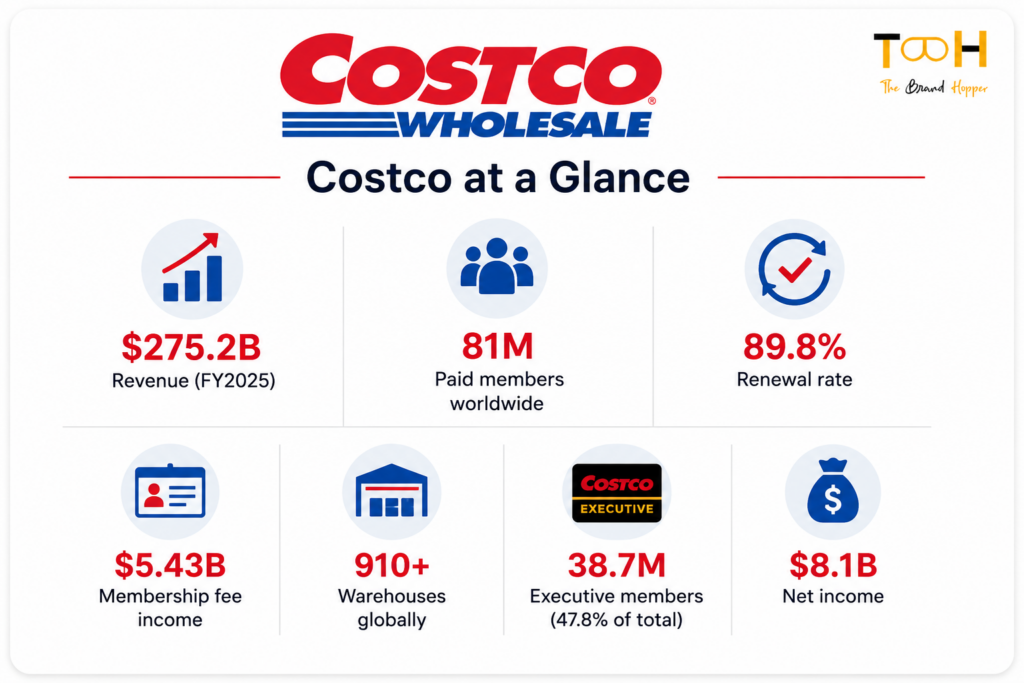
Costco Wholesale is one of the most remarkable retail businesses on earth. With $275.2 billion in annual revenue, 81 million paid member accounts worldwide, a member renewal rate of 89.8%, and $5.43 billion in membership fee income, Costco has built a model that many analysts consider nearly impossible to replicate at scale. Its 910-plus warehouses across the U.S., Canada, UK, Japan, South Korea, Australia, Spain, France, China, and beyond serve tens of millions of loyal shoppers who pay an annual fee just for the right to walk through the door — and come back, enthusiastically, year after year.
Yet for all its dominance, Costco does not operate in a vacuum. It faces competition from every direction: warehouse club rivals that mirror its model almost exactly; mass merchandising giants with trillion-dollar revenues; German discount grocers investing billions in American soil; e-commerce platforms that bring bulk buying to the smartphone screen; and specialty grocers winning over health-conscious consumers with curated, private-label offerings. Costco’s competitive landscape is both wider and more nuanced than most consumers realise.
This comprehensive guide covers 20 of Costco’s most significant competitors — from direct warehouse rivals to big-box home improvement chains, regional grocery champions to international hypermarket operators. For each, we examine what makes them a genuine competitive force, where their strength overlaps most directly with Costco, and where Costco’s model continues to hold a durable advantage.
Understanding Costco’s Competitive Position
Before mapping the competition, it’s essential to understand what makes Costco’s model so defensible — and where it is genuinely vulnerable. Costco’s genius lies in its membership flywheel: members pay upfront for access, which provides Costco with a predictable, high-margin revenue stream that effectively subsidises its ability to price merchandise at razor-thin margins. The company’s gross margin on merchandise hovers around 12-13% — far below typical supermarket or mass retailer margins — because it does not need merchandise profits to drive returns. The membership fee is the profit engine.
This model creates extraordinary loyalty (an 89.8% renewal rate is essentially unheard of in retail), but it also creates limitations. Costco requires consumers to buy in bulk, requires a membership purchase, operates fewer but larger locations, and offers a deliberately limited assortment (typically 3,500-4,000 SKUs vs. a typical supermarket’s 30,000+). These features are strengths for the right shopper — and explicit weaknesses that competitors actively exploit for everyone else.
The competitors below attack different vulnerabilities across Costco’s model, making the full picture of competition more complex than any single rival can represent.
Costco’s Top 20 Competitors and Alternatives
WAREHOUSE CLUBS — DIRECT RIVALS
1. Sam’s Club
| Website: https://www.samsclub.com | Revenue: $90B+ | Membership income growth: 12.5% (5th consecutive quarter of double-digit growth) | Owner: Walmart |
Sam’s Club is Costco’s closest structural competitor — a warehouse membership club that mirrors Costco’s core model with bulk discounts, private-label products, and a treasure-hunt atmosphere. As a Walmart subsidiary, Sam’s Club benefits from extraordinary supply chain leverage, shared distribution infrastructure, and the financial backing of the world’s largest retailer. It is a $90 billion business with ambitions to double its membership and more than double its sales and profit over the next eight to ten years.
What sets Sam’s Club apart from Costco right now is its digital-first transformation. Its Scan & Go mobile checkout technology — allowing members to scan items as they shop and bypass checkout entirely — combined with AI-powered exit arches that validate purchases has made Sam’s Club one of the most operationally advanced warehouse retailers in the world. Digitally engaged Sam’s Club members shop in-store three times more frequently, across twice as many categories, spend three times as much, and renew at a rate 10% higher than non-digital members. This data-driven engagement model is a strategic template that no competitor — including Costco — has yet fully replicated.
Sam’s Club’s membership income marked its fifth consecutive quarter of double-digit growth, up 12.5%, with Plus (premium tier) penetration rising 180 basis points year-over-year. E-commerce sales grew 24%, driven by club-fulfilled delivery where more than half of online orders ship from physical club locations. The competitive battleground: Sam’s Club typically carries a broader selection of national brands and charges slightly lower membership fees; Costco counters with the Kirkland Signature private label (widely considered the gold standard of store-brand quality), a stronger curated product mix, and a more established member community.
2. BJ’s Wholesale Club
| Website: https://www.bjs.com | Revenue (FY2025): $21.46B | Members: 8M (record) | Clubs: 263 across 21 states | Member renewal rate: 90% |
BJ’s Wholesale Club is the third member of the American warehouse club trio, holding a commanding regional position on the East Coast of the United States. Its full-year revenue reached $21.46 billion in fiscal 2025, with net sales growing 4.6%, and its member base hit a record 8 million — with a 90% tenured member renewal rate that rivals Costco’s own retention benchmark. Higher-tier (BJ’s Perks Rewards) memberships now account for 41% of total memberships, an all-time high that signals deepening engagement with its most valuable members.
Where BJ’s most directly competes with Costco is in grocery. BJ’s carries a notably wider selection of fresh produce, dairy, and deli products relative to its total assortment, making it more competitive for weekly grocery shoppers who want warehouse pricing without sacrificing fresh food selection. BJ’s also accepts manufacturer coupons — a policy Costco does not — and offers same-day delivery and curbside pickup services that broaden its convenience appeal.
BJ’s digital growth is impressive: digitally enabled comparable sales grew 31%, with a two-year stacked comp of 57%. The company opened seven new clubs in its most recent quarter and now operates 263 clubs and 199 gas stations across 21 states. Its membership fees are typically lower than Costco’s, and its geographic concentration on the East Coast — while limiting its national ambitions — means it faces Costco head-on in the densely populated markets where Costco’s own membership is most saturated.
MASS MERCHANDISERS & SUPERCENTERS
3. Walmart
| Website: https://www.walmart.com | Revenue (FY2026): $706.4B net sales | U.S. grocery market share: 23.6% | E-commerce growth: 24% to $150.4B globally |
Walmart is the most formidable all-around competitor in retail history — and in several key dimensions, it competes directly with Costco for the same household budget. With $706.4 billion in net sales and $713 billion in total revenue for fiscal year 2026 (and Amazon having surpassed it in revenue for the first time in history), Walmart commands a 23.6% share of the U.S. grocery market — the largest of any single retailer — and operates a domestic store network of approximately 4,700 supercenters and 600 neighbourhood markets that offers a degree of convenience Costco’s warehouse model cannot match.
Walmart’s supercenter format competes with Costco across virtually the entire grocery, household essentials, electronics, and clothing spectrum. Its ability to negotiate aggressively with suppliers by virtue of its sheer scale allows everyday prices that can undercut many of Costco’s per-unit bulk prices for shoppers who don’t want to buy in large quantities. Additionally, Walmart+ membership — priced lower than Costco’s membership fee — provides free delivery, fuel discounts, and Paramount+ streaming access, directly contesting the value proposition of a Costco membership.
Walmart’s global e-commerce sales hit $150.4 billion, growing 24% in fiscal 2026, and its digital grocery pickup and delivery capabilities have matured significantly. For consumers who prioritise convenience over the warehouse club experience, Walmart’s combination of everyday low prices, one-stop-shop breadth, and increasingly capable digital channels makes it the default alternative to a Costco membership for a substantial segment of the market.
4. Target
| Website: https://www.target.com | Revenue (FY2025): $104.78B | Stores: 1,900+ | Target Circle 360 same-day delivery: +30% growth |
Target competes with Costco not on warehouse scale or membership economics, but on the consumer’s wallet share across categories where both retailers are present: household essentials, grocery staples, electronics, apparel, home goods, and personal care. Target’s annual revenue of $104.78 billion makes it one of the largest mass retailers in the United States, and while it experienced a modest revenue decline in its most recent fiscal year, its strategic investments in same-day delivery, owned brand development, and loyalty programme growth are reshaping its competitive positioning.
Target’s key differentiator from Costco is format and curation. Where Costco’s warehouse environment prioritises volume and value over aesthetics, Target has cultivated a reputation for well-designed store environments, trend-forward private brands (like Good & Gather in grocery and A New Day in apparel), and a shopping experience that attracts style-conscious consumers who may not be drawn to the industrial warehouse feel. Target’s food and beverage sales have grown from $15 billion to $25 billion in recent years, making it an increasingly credible grocery competitor even if it hasn’t yet matched Costco’s grocery depth.
Target Circle 360 — its premium membership tier offering same-day delivery — grew over 30% in the most recent fiscal year and represents Target’s direct answer to the value proposition of Costco and Amazon Prime memberships. For shoppers who don’t want to buy in bulk but do want convenience and member pricing, Target Circle 360 is an increasingly compelling alternative.
E-COMMERCE & DIGITAL RETAIL
5. Amazon

| Website: https://www.amazon.com | Revenue (2025): $716.9B (surpassed Walmart for the first time) | Prime members: 240M worldwide | Prime subscription revenue: $49.6B |
Amazon surpassed Walmart in total annual revenue for the first time, posting $716.9 billion in net sales — an extraordinary milestone that reflects how comprehensively Amazon has reshaped not just e-commerce but the entire retail economy. For Costco, Amazon’s competitive relevance operates on multiple fronts simultaneously: it contests Costco’s value proposition through Prime membership benefits, its bulk-buying capability through Subscribe & Save and Amazon Business, its grocery market position through Whole Foods and Amazon Fresh, and its travel and services offerings through its expanding Prime perks ecosystem.
Amazon’s 240 million Prime members — paying an annual fee for a bundle of delivery, streaming, music, and shopping benefits — represent the closest structural analogue to Costco’s membership model in the digital world. Prime subscription revenue crossed $49.6 billion in the most recent annual period, growing 12% year-over-year. Prime Day spending totalled $24.1 billion across four days (up 30.3%), demonstrating the extraordinary purchasing power that Amazon can mobilise around its membership base — a dynamic that parallels Costco’s member loyalty flywheel, but operates at internet scale.
Amazon’s grocery ambitions are particularly relevant to Costco. The company describes itself as one of the top three U.S. grocers, with over $150 billion in gross grocery-related sales when including Amazon Fresh, Whole Foods, and Subscribe & Save grocery items. For consumers who don’t need to touch or inspect their household staples before purchasing, Amazon’s convenience advantage over Costco’s warehouse model is substantial. The primary Costco advantage Amazon cannot easily replicate: the in-warehouse discovery experience, the fresh food and bakery quality, and the social element of the Costco shopping trip itself.
TRADITIONAL GROCERY CHAINS
6. Kroger
| Website: https://www.kroger.com | Revenue (FY2025): $147.6B | Stores: 2,750+ | E-commerce: $16B (crossing the threshold in FY2025) | Households served: 63M annually |
Kroger is the largest traditional supermarket chain in the United States, and while its warehouse model differs entirely from Costco’s, it contests the same household grocery budget across tens of millions of American families. Its fiscal 2025 total sales of $147.6 billion reflect a business that touches approximately 63 million U.S. households annually — a reach that places it among the most significant food retailers in the world. Kroger’s e-commerce sales crossed $16 billion in fiscal 2025, up from $13 billion the prior year, reflecting successful investment in delivery and pickup infrastructure.
Kroger’s competitive differentiation from Costco operates on the convenience axis. With over 2,750 store locations under various banners (Kroger, Fred Meyer, Fry’s, Harris Teeter, Dillons, King Soopers and more), Kroger offers a neighbourhood grocery presence that Costco’s widely spaced warehouse format cannot match. For the weekly grocery shopper who needs fresh produce, deli items, and pharmacy services without buying a 48-pack of anything, Kroger is the natural first choice. Its loyalty programme, which captures over 95% of transactions, enables highly personalised digital promotions — a capability that reinforces customer retention in ways that Costco’s membership model achieves through a different mechanism.
Where Kroger increasingly contests Costco’s ground is in own-brand quality. Its Simple Truth organic private label and Kroger brand products cover grocery categories at competitive prices, and its digital coupon ecosystem provides price-sensitive shoppers with savings that can approach warehouse-club economics without the bulk commitment. Kroger’s fuel rewards programme — linked to grocery purchases — also competes with Costco’s high-volume, below-market fuel stations as a member perk.
7. Publix
| Website: https://www.publix.com | HQ: Lakeland, Florida | Revenue (nine months FY2025): $46.8B | Same-store sales growth: 6% | Stores: 1,400+ across Southeast US | Model: Employee-owned supermarket cooperative |
Publix Super Markets is one of the most remarkable businesses in American retail: an employee-owned supermarket cooperative that has consistently ranked among the highest-rated retailers in customer satisfaction surveys. Operating 1,400+ stores primarily across Florida, Georgia, Alabama, South Carolina, Tennessee, North Carolina, and Virginia, Publix reported nine-month revenue of $46.8 billion with comparable store sales growth of 6% — performance that puts it among the fastest-growing traditional grocery operators in the country.
Publix competes with Costco primarily for the Southeast U.S. grocery budget, a market where Costco has meaningful warehouse presence. Its competitive advantage lies in the shopping experience itself: clean, well-organised stores; legendary customer service (consistently rated #1 or #2 in retailer satisfaction surveys); exceptional fresh departments including its renowned deli and bakery; and private-label products that command strong consumer loyalty. For shoppers who value the supermarket experience and the ability to buy a single chicken breast rather than a six-pack, Publix is the clear alternative to Costco’s warehouse model.
Publix’s employee-ownership model also creates a cultural moat — its workforce retention and service standards are consistently superior to competitors, contributing to a brand equity that Costco (which also has strong employee satisfaction metrics) respects. The competitive battleground is most acute in Florida, where both retailers have significant footprints and compete for the premium household’s grocery loyalty.
8. H-E-B
| Website: https://www.heb.com | HQ: San Antonio, Texas | Revenue: $46.5B+ | Stores: 455+ across Texas and Mexico | Recognition: #1 U.S. Grocery Store (dunnhumby, 4th time in 8 years) |
H-E-B is, by many measures, the finest regional grocery operator in the United States. Generating more than $46.5 billion in revenue from 455+ stores across Texas and Mexico, H-E-B has been named the #1 grocery store in the U.S. by dunnhumby for the fourth time in eight years — a consistent excellence record that reflects its extraordinary command of the Texas grocery market. Founded in 1905 and still privately held by the Butt family, H-E-B operates without the shareholder pressure that constrains publicly traded competitors, allowing it to prioritise long-term brand investment and customer experience over quarterly earnings optimisation.
H-E-B competes with Costco most directly in Texas, where Costco operates a significant number of warehouses in the state’s major metropolitan markets. H-E-B’s competitive edge is local relevance and community connection — it stocks regionally specific products, sponsors local events, and invests in community relationships in ways that a nationally standardised warehouse retailer cannot replicate. Its HEB own-brand and Central Market premium food concepts offer curated grocery alternatives that attract the same quality-conscious households that Costco’s Kirkland Signature brand serves in the warehouse club format.
H-E-B’s aggressive 2025 expansion — breaking ground on flagship locations in Frisco, Plano, Mansfield, and Fort Worth — signals its determination to capture the fast-growing suburban Texas market. Costco is also expanding in these same high-growth Texas suburbs, making the bilateral contest for the Texas premium household a defining competition in American grocery retail.
DISCOUNT & VALUE GROCERY
9. Aldi
| Website: https://www.aldi.com | HQ: Germany (Aldi Süd) | U.S. investment: $9B through 2028 | New U.S. stores: 180+ planned | U.S. rank: 3rd largest grocery chain by store count | Store visits growth: +8% YoY |
Aldi is executing what may be the most aggressive physical expansion in American retail history. The German discount grocery giant — which operates an ultra-efficient, private-label-dominant model with a deliberately limited assortment — plans to open more than 180 new U.S. stores in the current year alone, having added more than 225 new stores in the prior year. It is targeting a U.S. store count of nearly 2,800 by the end of next year and 3,200 by 2028, backed by a $9 billion U.S. investment commitment covering new stores, distribution centres, and supply chain infrastructure.
Aldi’s competitive premise could not be more different from Costco’s, yet it attacks the same wallet: the value-seeking household looking for lower-cost grocery alternatives. Aldi achieves its rock-bottom prices through a radically simplified model — approximately 1,800 SKUs (vs. Costco’s 3,500-4,000 and a typical supermarket’s 30,000+), a 90%+ private-label assortment, no-frills store environments, and minimal staffing per location. The result is everyday prices on grocery staples that consistently undercut Costco’s per-unit bulk prices for households that don’t want large quantities.
Aldi’s store visit growth of 8% year-over-year outpaced Costco’s 5.9% growth in the same period — a notable data point that reflects genuine competitive capture of grocery dollars. Having attracted 17 million new U.S. customers in the most recent year, Aldi is rapidly building the consumer base that will define the next competitive chapter of U.S. grocery retail. It operates without a membership requirement, which removes the activation hurdle that every Costco alternative with a fee must overcome.
10. Trader Joe’s
| Website: https://www.traderjoes.com | HQ: Monrovia, California | Revenue: ~$21-25B estimated | Stores: 608 across 43 states | Sales per sq ft: ~$1,750 (highest in grocery) | Model: Private, no advertising, cult brand loyalty |
Trader Joe’s is one of the most studied cult brands in retail. With an estimated $21-25 billion in annual revenue — generated from just 608 stores across 43 states, all without a single dollar of traditional advertising spend — Trader Joe’s achieves a sales per square foot of approximately $1,750, far exceeding Walmart’s $400 and Target’s $300, and making it the most productive grocery footprint in the industry. It has grown its store count at a 12% CAGR and consistently outperforms the grocery sector: visit growth of nearly 12% in a recent half-year period, against an industry average of 1.8%.
Trader Joe’s competes with Costco for the same quality-conscious, value-seeking consumer — a shopper who is willing to try private-label products and prizes discovery, surprise, and curatorial excellence over a comprehensive product assortment. Both Trader Joe’s and Costco operate on a ‘less is more’ SKU philosophy: Trader Joe’s with approximately 4,000 products, of which around 80% are private label, and Costco with a similar count that includes its dominant Kirkland Signature brand. Both create ‘treasure hunt’ atmospheres where seasonal and rotating items drive repeat visits.
The key differences: Trader Joe’s requires no membership, charges no annual fee, and operates in smaller-format neighbourhood stores rather than vast warehouses. Its TikTok virality — fan communities mourning discontinued products, reviewing new arrivals, and generating organic social media content — creates a brand heat that Costco commands in its own right but through different cultural channels. For urban and suburban consumers without the car or storage space for bulk buying, Trader Joe’s is often the first Costco alternative they turn to.
11. Lidl
| Website: https://info.lidl/en | HQ: Germany | U.S. stores: ~192 | U.S. focus markets: New York Metro, Washington D.C., Atlanta | Model: Limited assortment discount grocer; electronic shelf labels; ~3,250 SKUs |
Lidl is Aldi’s fellow German discount grocery rival, and like Aldi, it is pursuing American grocery market share through a private-label-heavy, limited-assortment model that offers everyday low prices without a membership requirement. Lidl operates approximately 192 U.S. stores, concentrated in the Mid-Atlantic, Southeast, and recently expanding into New York City and other major metropolitan markets. Under CEO Joel Rampoldt — who earned Lidl US a Newsweek Best Supermarket award — the company has streamlined its SKU count from approximately 4,500 to 3,250 and implemented electronic shelf labels across stores to save labour hours while improving price update accuracy.
Lidl’s competitive approach to Costco is similar to Aldi’s: it wins on price for everyday grocery essentials, requires no membership, and operates in smaller, more conveniently located stores. While it lacks Costco’s bulk-quantity economics, its Lidl-branded products in fresh bread, meat, cheese, and pantry staples consistently receive strong consumer reviews and offer genuine quality at discount prices. Its weekly ‘Lidl Surprises’ middle-aisle rotating merchandise — including clothing, electronics, and seasonal items — creates the treasure-hunt shopping dynamic that Costco also employs, offering a format similarity that might surprise consumers who see them as fundamentally different retailers.
PREMIUM & SPECIALTY GROCERY
12. Whole Foods Market
| Website: https://www.wholefoodsmarket.com | Owner: Amazon | Stores: 500+ | New stores announced: 100+ planned | Strategic role: Amazon’s physical grocery presence; competes for premium organic household |
Whole Foods Market, acquired by Amazon and now a cornerstone of its grocery strategy, competes with Costco for the premium household’s food budget — the consumer who prioritises organic, sustainable, and high-quality food products and is willing to pay a premium for them. With 500+ locations across the U.S. and a 100+ new store expansion planned, Whole Foods is regaining momentum after years of brand dilution, with Amazon’s investment in digital integration (Prime member discounts, Whole Foods delivery within two hours) creating a seamless premium grocery ecosystem.
The overlap with Costco is specific but meaningful: both retailers attract higher-income, quality-conscious households; both offer strong private-label ranges (Whole Foods’ 365 Everyday Value vs. Costco’s Kirkland Signature); and both position themselves as destinations for premium food discovery. Where Whole Foods leads is in fresh, prepared foods, organic specialty items, and urban accessibility. Where Costco wins is in bulk economics — its Kirkland Signature organic olive oil, nuts, salmon, and wine routinely benchmark as the highest-quality options in their categories at dramatically lower per-unit costs than Whole Foods equivalents.
13. Sprouts Farmers Market
| Website: https://www.sprouts.com | HQ: Phoenix, Arizona | Revenue (FY2025): $8.8B (+14% YoY) | Comparable store sales growth: +7.3% | Model: Natural and organic grocery, health-focused |
Sprouts Farmers Market has quietly become one of the fastest-growing grocery chains in America. Its full-year revenue reached $8.8 billion in 2025, growing 14% year-over-year, with comparable store sales growing 7.3% and diluted earnings per share jumping 42% — performance that substantially outpaced most large grocery competitors in a difficult macro environment. Sprouts operates a fresh-forward, health-centric format: large produce sections, bulk bins (directly analogous to Costco’s bulk model but at individual-serving scale), vitamins and supplements, and a curated grocery assortment that appeals to health-conscious shoppers.
Sprouts competes with Costco primarily at the consumer value set level: both attract shoppers who read ingredient labels, prioritise natural and organic options, and are willing to pay a premium for quality. Costco’s Kirkland Signature organic range and its dominant vitamin and supplement section compete directly with Sprouts’ health-focused assortment — and in many cases at significantly lower prices due to Costco’s bulk economics. But Sprouts wins on format convenience (no membership, smaller stores, no bulk commitment), fresh produce quality and variety, and the overall health-lifestyle positioning of its brand.
HOME IMPROVEMENT WAREHOUSE RETAILERS
14. Home Depot
| Website: https://www.homedepot.com | HQ: Atlanta, Georgia | Revenue (FY2025): $164.7B | Stores: 2,300+ | Model: Home improvement warehouse; ~50% of sales from professional contractors |
Home Depot is not an obvious Costco competitor on the surface — one sells bulk groceries and household goods, the other sells lumber, power tools, and paint. But at the warehouse retail model level, both compete for the same home improvement, hardware, cleaning, and outdoor living budget that represents a meaningful share of Costco’s non-food merchandise revenue. Home Depot’s $164.7 billion in fiscal 2025 revenue makes it the fourth-largest retailer in the United States, and its warehouse store format — designed around the contractor and serious DIY homeowner — competes directly with Costco’s tool, garden, and home maintenance sections.
More specifically, Home Depot attracts the same household that shops at Costco for bulk cleaning supplies, storage solutions, and seasonal outdoor products. For bulkier home improvement items — flooring, lumber, appliances — Home Depot’s depth and expertise vastly exceed what Costco can offer from its merchandise aisles. Costco counters in specific categories: major appliances and electronics at warehouse pricing, bulk cleaning and garden supplies, and an increasingly strong furniture and mattress section. Where Home Depot is essential, Costco is occasionally competitive; the commercial overlap is in the mid-market home project budget.
15. Lowe’s
| Website: https://www.lowes.com | HQ: Mooresville, North Carolina | Revenue (FY2025): ~$86B | Stores: 1,700+ | Focus: DIY homeowners (vs. Home Depot’s contractor lean) |
Lowe’s is Home Depot’s nearest rival and Costco’s secondary home improvement competitor. With approximately $86 billion in fiscal 2025 revenue from 1,700+ stores, Lowe’s leans more heavily toward the do-it-yourself homeowner market — a profile that overlaps significantly with Costco’s core membership demographic. Where Home Depot emphasises professional contractor service and bulk trade supply, Lowe’s has historically invested in a more approachable, consumer-friendly store environment that mirrors the mainstream household’s home improvement experience.
Lowe’s competes with Costco for the outdoor living, garden, appliance, and home improvement budget among the same middle-to-upper-middle-income household demographic. Both retailers attract consumers who are willing to spend meaningfully on home improvement and garden during peak seasons, and Costco’s patio furniture, gardening supplies, and seasonal home goods sections regularly draw shoppers who might otherwise make the trip to Lowe’s for comparable products. The Costco value proposition wins when the shopper wants lower per-unit pricing and doesn’t need the expert staff assistance that a Lowe’s specialist can provide.
DOLLAR STORES & VALUE RETAIL
16. Dollar General

| Website: https://www.dollargeneral.com | HQ: Goodlettsville, Tennessee | Revenue: $10.6B+ (Q3 alone) | Stores: 20,000+ | Focus: Rural and suburban value shoppers; expanding fresh produce offering |
Dollar General may seem like an unlikely Costco rival — one serves rural America with $1 paper towels, the other serves suburban America with 36-packs of Bounty. But both compete for the same discretionary household budget among value-oriented consumers, and Dollar General’s grocery expansion strategy is bringing the two increasingly into the same competitive arena. With more than 20,000 stores — many in rural communities that have no nearby Costco warehouse — Dollar General is expanding its fresh produce offering to approximately 200 more stores, deepening its grocery footprint into territory where Costco is completely absent.
Dollar General’s most powerful competitive weapon against Costco is convenience and proximity. For the rural household or lower-income urban consumer, Dollar General’s neighbourhood location means zero travel time, zero membership fee, and zero bulk purchase commitment. While it cannot match Costco’s product quality or brand selection, it can meet basic grocery and household essential needs at accessible price points that make the Costco membership model economically irrelevant for a large segment of the American population.
17. Dollar Tree
| Website: https://www.dollartree.com | HQ: Chesapeake, Virginia | Revenue (FY2025): $19.41B (+10.43% YoY) | Model: Multi-price point discount retail; Dollar Tree 3.0 format; attracted 3M new households in FY2025 |
Dollar Tree’s transformation under its Dollar Tree 3.0 multi-price format has repositioned it from a pure single-price novelty store to a genuine value retail competitor serving a broadening consumer demographic. With 10.43% revenue growth in fiscal 2025 to $19.41 billion, and 60% of its 3 million new households coming from higher income brackets, Dollar Tree is demonstrating that value retail’s appeal transcends income levels in a high-cost environment — directly contesting the ‘Costco is the smarter shopper’s choice’ positioning.
Dollar Tree’s 5,300+ converted multi-price stores now carry a broader grocery and household essential assortment that increasingly overlaps with Costco’s everyday shopping mission, particularly for smaller households that find Costco’s bulk quantities inconvenient. While Dollar Tree lacks Costco’s quality tier and private-label prestige, its no-membership, walk-in convenience and expanding assortment capture household spend that might otherwise flow to warehouse club memberships among budget-constrained consumers.
REGIONAL SUPERSTORE OPERATORS
18. Meijer
| Website: https://www.meijer.com | HQ: Grand Rapids, Michigan | Revenue: ~$25B estimated | Stores: 260+ across Midwest | Model: Private supercenter; grocery + general merchandise under one roof | Founded: 1934 |
Meijer is the original American supercenter concept — founded in 1934 in Grand Rapids, Michigan, decades before Walmart adopted the format — and remains one of the most competitive regional retailers in the Midwest. Its 260+ stores across Michigan, Ohio, Indiana, Illinois, Wisconsin, and Kentucky combine full-service grocery with general merchandise, pharmacy, clothing, electronics, and automotive supplies under a single roof, offering a shopping experience that competes with both Costco and Walmart in the markets where it operates.
Meijer competes with Costco specifically in the Midwest markets where both operate. Its supercenter format offers the one-stop convenience that Costco’s warehouse cannot match for smaller-quantity shopping, while its mPerks loyalty programme (with one of the most sophisticated digital coupon ecosystems in grocery) provides personalised savings that reward regular shoppers. Meijer’s private-label range, extensive fresh food departments, and 24-hour operation in many locations offer convenience advantages that Costco’s daytime-focused warehouse hours cannot. For Midwest families who shop weekly rather than monthly, Meijer is frequently the natural alternative to making a dedicated Costco run.
19. Carrefour
| Website: https://www.carrefour.com/en | HQ: Massy, France | Revenue: ~€94B | Stores: 14,000+ in 40+ countries | Model: Global hypermarket and convenience; direct Costco competitor in Europe, Asia, and Latin America |
Carrefour is Costco’s most significant international competitor — a French-headquartered retail giant operating 14,000+ stores across more than 40 countries, with particularly strong footprints in France, Spain, Belgium, Brazil, Argentina, and parts of Asia. Its hypermarket format, which combines full grocery with general merchandise and specialty departments under one vast roof, is the European analogue to the American supercenter, and in markets where both Costco and Carrefour operate — France, Spain, Taiwan — the two compete directly for the same household budget.
In Spain, Carrefour and Costco compete head-to-head for the membership-club and large-format shopping market, with Costco’s 18 Spanish warehouses contesting Carrefour’s established hypermarket network. In France, where Costco operates a small number of warehouses, Carrefour’s deep local brand presence and supplier relationships give it a home-field advantage that Costco’s globally standardised model struggles to overcome. For Costco’s international growth strategy, Carrefour represents the incumbent it must displace in virtually every European and Latin American market it enters.
20. Makro / METRO
| Website: https://www.metroag.de/en | Owner: METRO AG (Germany) | Revenue (METRO AG): ~€29B | Stores: 700+ across 30+ countries | Model: B2B-focused cash-and-carry wholesale club; primary Costco competitor for small business members |
METRO AG’s Makro cash-and-carry wholesale clubs represent Costco’s closest international structural equivalent — a members-only warehouse format that offers bulk purchases at wholesale prices to small business owners, restaurateurs, and institutional buyers. Operating 700+ locations across more than 30 countries in Europe, Asia, and Africa, Makro/METRO competes directly with Costco in markets like the Netherlands, Spain, Turkey, Japan, and various Asian markets, targeting the same small business and hospitality sector customers that represent an important segment of Costco’s member base.
What distinguishes Makro/METRO from Costco is its explicit B2B orientation. Where Costco serves a hybrid B2C/B2B membership base, Makro’s membership and assortment are specifically designed around the needs of food service operators, convenience store buyers, and institutional purchasers. This creates a different but overlapping competitive dynamic: both retailers serve the same purchasing decision-maker (a business owner seeking bulk pricing) but with different format priorities. In markets where Costco is expanding internationally, Makro/METRO’s established wholesale relationships and sector-specific product expertise are the primary competitive barriers it must overcome.
Costco vs. Its 20 Competitors — Quick Reference
| Competitor | Type | Revenue / Scale | Membership Required? | Primary Competitive Angle |
| Sam’s Club | Warehouse Club | $90B business | Yes (lower than Costco) | Digital innovation; Scan & Go; national brand breadth |
| BJ’s Wholesale Club | Warehouse Club | $21.46B (FY2025) | Yes (lower than Costco) | East Coast density; grocery depth; coupon acceptance |
| Walmart | Mass Merchandiser | $706.4B net sales | No (Walmart+ optional) | Everyday low prices; grocery market dominance |
| Target | Mass Merchandiser | $104.78B (FY2025) | No (Circle 360 optional) | Style-forward curation; same-day delivery |
| Amazon | E-commerce | $716.9B (2025) | Yes (Prime) | Convenience; 240M Prime members; grocery expansion |
| Kroger | Grocery Chain | $147.6B (FY2025) | No | Scale; 2,750+ locations; $16B e-commerce |
| Publix | Grocery Chain | $46.8B (9-mo FY2025) | No | Customer service; Southeast dominance; employee-owned |
| H-E-B | Regional Grocery | $46.5B+ | No | #1 U.S. grocer (dunnhumby); Texas community ties |
| Aldi | Discount Grocery | Aldi Süd: €89B (group) | No | Private-label pricing; 8% visit growth; $9B U.S. push |
| Trader Joe’s | Specialty Grocery | ~$21-25B est. | No | $1,750 sales/sq ft; cult brand; no ad spend |
| Lidl | Discount Grocery | ~192 U.S. stores | No | Limited-SKU efficiency; European model in U.S. |
| Whole Foods | Premium Grocery | 500+ stores (Amazon) | No (Prime for perks) | Organic/premium; Amazon integration; expanding |
| Sprouts Farmers Market | Health Grocery | $8.8B (FY2025) | No | Natural/organic focus; 14% revenue growth |
| Home Depot | Home Improvement | $164.7B (FY2025) | No | Depth in home/tools; contractor relationships |
| Lowe’s | Home Improvement | ~$86B (FY2025) | No | DIY homeowner focus; home & garden overlap |
| Dollar General | Dollar Store | $10.6B+ (Q3 alone) | No | 20,000+ stores; rural reach; no membership |
| Dollar Tree | Dollar Store | $19.41B (FY2025) | No | Multi-price format; 3M new households attracted |
| Meijer | Regional Supercenter | ~$25B est. | No | Midwest one-stop; 24-hr operations; mPerks loyalty |
| Carrefour | Intl Hypermarket | ~€94B | No | Direct Costco rival in Europe, Asia, Latin America |
| Makro / METRO | Intl Wholesale | ~€29B (METRO AG) | Yes (business members) | B2B/food service wholesale; 700+ global locations |
What Keeps Costco Ahead of All 20 Rivals
With 20 significant competitors attacking from every angle, why does Costco continue to grow, delight members, and generate record financial results? The answer lies in a set of structural advantages that are genuinely difficult to replicate:
1. The Membership Flywheel: An 89.8% renewal rate means that once a consumer joins, they almost never leave. This predictable, high-margin membership income ($5.43 billion annually) allows Costco to price merchandise at margins that would bankrupt most retailers. Competitors without this model must earn their profit from product margin alone.
2. Kirkland Signature: Costco’s private label brand generates an estimated $60+ billion in annual sales — more revenue than most entire retail chains. Kirkland Signature products in categories from coffee and olive oil to clothing and pharmaceuticals consistently benchmark as the highest-quality product in their category at the lowest price. No competitor has built a private label programme with equivalent consumer trust at comparable scale.
3. Treasure Hunt Experience: Costco’s deliberately limited and rotating product assortment creates discovery-driven shopping that generates repeat visits not just for replenishment but for exploration. This experiential dimension is difficult to replicate in digital or traditional supermarket formats.
4. Employee Satisfaction: Costco is consistently ranked among the best U.S. employers, with wages and benefits that attract and retain exceptional staff. The resulting service quality is a meaningful differentiator in an industry where service is often poor.
5. International Growth Runway: With strong positions in Canada, UK, Japan, and South Korea, and growing presence in China, Spain, France, and Australia, Costco’s international expansion provides a durable organic growth engine that most domestic competitors cannot access at equivalent scale.
Frequently Asked Questions
Q: Who is Costco’s biggest competitor?
A: Costco’s most direct structural competitor is Sam’s Club, which mirrors its membership warehouse club model almost identically. In terms of sheer scale, however, Walmart is the most formidable competitive force — it commands a 23.6% share of the U.S. grocery market and offers similar product breadth without a membership requirement. Amazon, with 240 million Prime members and $716.9 billion in revenue, represents the most significant digital threat to Costco’s model.
Q: Is Sam’s Club cheaper than Costco?
A: Sam’s Club typically charges a lower annual membership fee than Costco, and in many product categories offers competitive pricing that matches or undercuts Costco. However, Costco is widely regarded as having higher product quality — especially in its Kirkland Signature private label range — and tends to outperform Sam’s Club on member satisfaction and renewal rate benchmarks. The ‘cheapest’ option depends on your specific shopping needs and which products you buy most frequently.
Q: What is the best alternative to Costco for people who don’t want to pay a membership fee?
A: The best no-membership Costco alternatives depend on your shopping priorities. For everyday grocery value, Aldi and Lidl offer the lowest prices on grocery staples. For a wider selection with decent pricing, Walmart, Kroger, or Target are strong choices. For premium quality without bulk, Trader Joe’s or Whole Foods serve a similar quality-conscious shopper. For home improvement and tools, Home Depot or Lowe’s surpass what Costco offers in depth.
Q: How does Costco compare to Amazon for bulk shopping?
A: Costco and Amazon serve the bulk-buying need through fundamentally different models. Costco offers the physical warehouse experience with in-person product discovery, fresh food, fuel, pharmacy, and optical services — all requiring an annual membership and a warehouse visit. Amazon offers Subscribe & Save and Amazon Business for bulk household staple delivery with Prime membership, and the convenience of home delivery. For non-perishable, shelf-stable bulk items, Amazon increasingly matches Costco’s pricing; for fresh food, prepared food, and the warehouse shopping experience, Costco has no digital equivalent.
Q: Why is Costco’s renewal rate so high compared to competitors?
A: Costco’s 89.8% renewal rate reflects the genuine value members experience from their membership. The combination of Kirkland Signature product quality, below-market fuel prices at Costco gas stations, discounted services (travel, pharmacy, optical), the treasure-hunt shopping experience, and the perception of ‘getting more than you paid for’ creates strong behavioural loyalty. Once a household is in the Costco routine — bulk shopping monthly and stocking up on Kirkland products — the friction of cancelling and switching is higher than the $65-130 annual membership cost.
Q: Does Costco have any international competitors like Carrefour?
A: Yes. In its international markets, Costco faces direct competition from hypermarket and wholesale club operators who hold established home-market advantages. Carrefour competes directly in France, Spain, and several Asian markets. METRO AG’s Makro brand targets the same B2B and institutional member segments as Costco in Europe and Asia. In South Korea, E-Mart and Lotte hypermarkets contest Costco’s strong market position. In Japan, Aeon and Ito-Yokado offer comparable general merchandise hypermarket formats. International competition is structurally different from the U.S. market — incumbents hold deeper local supplier relationships and cultural familiarity that Costco must work to overcome.
Q: Is Aldi a threat to Costco?
A: Yes, though on a different axis from Sam’s Club or Amazon. Aldi does not target the bulk-warehouse shopper directly — it targets the value grocery shopper who is willing to swap national brands for private-label equivalents at significantly lower prices. As Aldi aggressively expands (180+ new U.S. stores planned) and attracts higher-income shoppers who previously shopped at Costco for grocery value, it creates a genuine risk of capture for Costco’s grocery volume, particularly for households where the Costco bulk quantities are more than they can use before products expire.
Conclusion
Costco’s competitive moat is real, deep, and carefully constructed over decades — but it is not impenetrable. Every one of the 20 competitors analysed in this guide exploits a genuine limitation in Costco’s model: Sam’s Club and BJ’s match its warehouse club format with membership fee advantages; Walmart and Target offer no-fee one-stop shopping with greater convenience; Amazon delivers bulk value to the smartphone without requiring a warehouse trip; Aldi and Trader Joe’s capture the value-grocery wallet without the bulk commitment; Sprouts and Whole Foods win the premium organic household; Home Depot and Lowe’s go deeper on home improvement; and Carrefour and Makro contest Costco’s international ambitions in their home markets.
What none of these competitors has yet built is the complete Costco package: the membership flywheel, the Kirkland Signature private label, the treasure-hunt atmosphere, the exceptional employee culture, the below-market fuel stations, the 89.8% renewal rate, and the $275 billion revenue base — all operating simultaneously, at scale, across 910+ global warehouses.
For shoppers, the 20 alternatives above represent genuine and often compelling choices depending on your shopping priorities. For investors, strategists, and retail professionals, the competitive landscape around Costco is a masterclass in how a unique business model creates defensible advantages — and why so many well-funded competitors have spent decades trying to replicate it without fully succeeding.
Also Read: Costco Wholesale: Success Factors and Marketing Strategies
To read more content like this, subscribe to our newsletter