Last Updated on October 23, 2026 by Team TBH
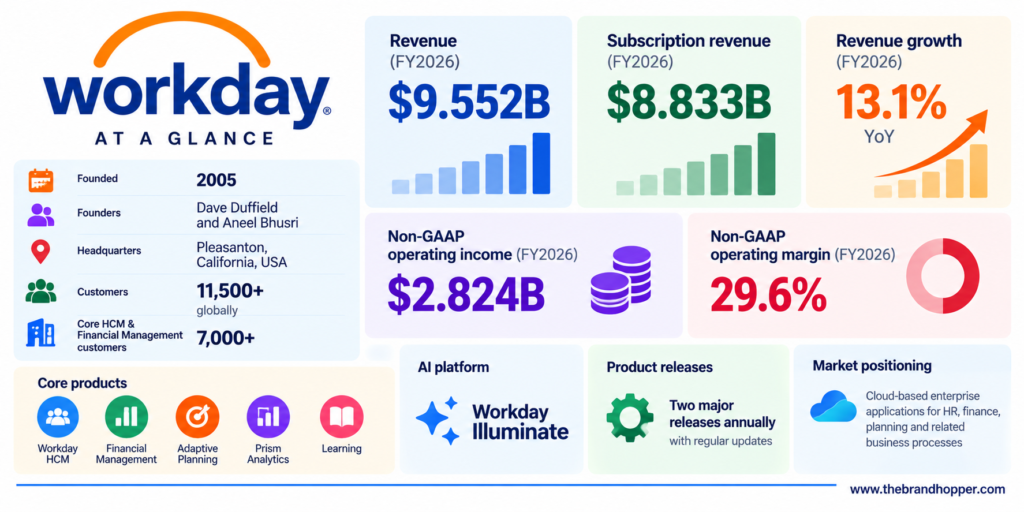
Workday is a major provider of cloud-based human capital management (HCM), financial management, planning, and enterprise software. For its fiscal year ended January 31, 2026, the company reported $9.552 billion in total revenue, including $8.833 billion in subscription revenue, reflecting year-over-year growth of 13.1% and 14.5%, respectively.
Workday serves large global organisations as well as medium-sized businesses. Its integrated approach to HR, finance, planning, analytics, and artificial intelligence makes it a significant option for organisations seeking to consolidate enterprise applications.
However, Workday is not necessarily the best choice for every organisation. Companies with smaller HR teams, limited implementation budgets, complex frontline scheduling requirements, or existing investments in SAP, Oracle, or Microsoft may find other platforms better aligned with their needs.
Workday implementations can require substantial consulting, data migration, process redesign, and internal project resources. The actual cost and timeline depend on the organisation’s size, modules, integrations, geographic footprint, and implementation partner, so there is no single implementation cost or deployment timeline that applies to every customer.
This guide examines Workday competitors and alternatives across enterprise HCM, payroll, workforce management, talent development, and small-business HR software. Each profile explains the platform’s core strengths, its differences from Workday, and the types of organisations most likely to benefit from it.
What Makes Workday a Market Leader?
Workday was founded in 2005 by Dave Duffield and Aneel Bhusri, who sought to build enterprise applications designed for the cloud. Its architecture and software-as-a-service delivery model helped establish it as a significant alternative to traditional enterprise systems.
A key advantage is Workday’s shared platform for HR, finance, planning, and analytics. Organisations can connect workforce data with labour costs, headcount planning, financial reporting, and other business processes without relying entirely on separate applications and custom integrations.
Workday also follows a regular product release schedule, with major releases in March and September and additional updates throughout the year. This allows customers to adopt new capabilities without managing conventional on-premises software upgrade projects.
Artificial intelligence is another major strategic focus. Workday Illuminate is designed to embed AI into business workflows, helping organisations automate tasks, improve decision-making, and extract insights from enterprise data.
Workday’s broader platform also includes financial management, workforce planning, analytics, and talent management. This makes it particularly relevant for large organisations that want to connect HR and finance processes within a single enterprise environment.
The platform is not automatically superior to every alternative. Organisations should compare its functionality, implementation requirements, integration capabilities, pricing, and suitability for their workforce rather than relying solely on Workday’s scale or reputation.
Top 17 Workday Competitors and Alternatives
1. SAP SuccessFactors

SAP SuccessFactors is one of Workday’s closest competitors in enterprise HCM. Its capabilities cover core HR, recruiting, onboarding, performance management, compensation, succession planning, learning, and workforce analytics.
Its strongest competitive advantage is integration with the wider SAP ecosystem. Organisations already using SAP S/4HANA and other SAP applications may find it easier to connect HR processes with finance, procurement, and operational systems by selecting SuccessFactors.
SAP reported total revenue of €36.8 billion and cloud revenue of €21.023 billion for calendar year 2025. These figures represent SAP as a whole, not SuccessFactors alone.
SAP is also investing in AI through SAP Business AI and Joule. The usefulness of these capabilities depends on the products licensed, the configuration deployed, and the organisation’s existing SAP environment.
Best suited for: Large global organisations already using SAP ERP, businesses with complex multinational HR requirements, and companies seeking tighter integration between HR and enterprise operations.
2. Oracle HCM Cloud
Oracle Fusion Cloud HCM is another major competitor in enterprise HR software. It covers core HR, talent management, recruiting, workforce management, compensation, benefits, and analytics.
Oracle’s principal advantage is its integration with the wider Oracle cloud applications ecosystem, including Oracle Fusion Cloud ERP and supply chain management. Organisations already using Oracle applications may benefit from a more consistent data and integration architecture.
Oracle also offers AI capabilities across its cloud applications. Buyers should evaluate which features are generally available in their region and product edition rather than treating all announced AI features as included by default.
Payroll capabilities and country coverage need careful evaluation. Native payroll processing, localised HR functionality, and integrations with external payroll providers are different capabilities, and availability varies by country and product configuration.
Best suited for: Large organisations using Oracle ERP, multinational businesses with complex financial and HR processes, and enterprises seeking an integrated Oracle cloud applications environment.
3. Microsoft Dynamics 365 Human Resources
Microsoft Dynamics 365 Human Resources provides tools for employee records, compensation, benefits, leave and absence management, compliance, and employee self-service. It can be extended through Microsoft’s Power Platform and integrated with other Microsoft business applications.
Its main advantage is the Microsoft ecosystem. Organisations already using Microsoft 365, Teams, Power BI, Azure, and Dynamics 365 applications may find opportunities to connect HR processes with their existing technology environment.
Microsoft publishes list pricing for Dynamics 365 Human Resources. In the US, its listed price is $135 per user per month, paid yearly, while Human Resources Self Service is listed at $4 per user per month. Actual costs depend on licensing eligibility, implementation, and any additional applications or services required.
Microsoft’s AI capabilities are evolving across its business applications. However, buyers should verify which Copilot features are available specifically for their Dynamics 365 Human Resources deployment rather than assuming every Microsoft AI feature is included.
Best suited for: Organisations already invested in Microsoft technology, businesses seeking HR functionality connected to Microsoft business applications, and companies that want to extend HR processes through Power Platform.
4. ADP (Workforce Now and Vantage HCM)

ADP is a major payroll and human capital management provider. Its products compete with Workday in different segments, particularly where payroll processing, tax compliance, benefits administration, and workforce administration are central requirements.
ADP Workforce Now serves small and midsize businesses, while ADP’s enterprise offerings address larger and more complex organisations. Product availability and the appropriate solution depend on workforce size, country coverage, and required functionality.
ADP reported revenue of approximately $20.56 billion for its fiscal year ended June 30, 2025, an increase of about 7% year over year. This is company-wide revenue rather than revenue generated exclusively by its HCM software products.
ADP’s established payroll operations and compliance services are important advantages for employers that need help managing tax withholding, payroll calculations, and regulatory changes. Workday also offers payroll and connects with payroll providers, so the right comparison is based on the countries and payroll processes a buyer needs to support.
ADP DataCloud provides workforce analytics and benchmarking capabilities. Buyers should assess the available benchmarks, data coverage, and reporting functions in the particular ADP product they are considering.
Best suited for: Organisations prioritising payroll administration, tax compliance, benefits, and workforce management, particularly in the United States.
5. UKG (Ultimate Kronos Group)
UKG is a significant competitor in workforce management and HCM. Formed in 2020 through the merger of Ultimate Software and Kronos, the company combines HR management capabilities with a strong heritage in timekeeping and workforce scheduling.
UKG Pro offers a broad HCM suite, while UKG Ready serves small and midsize organisations. UKG also provides dedicated workforce management products for employers that need advanced scheduling, time tracking, attendance, and labour planning.
UKG reports that more than 80,000 organisations use its products across 150 countries. This is the company’s overall customer footprint, not the customer count of a single UKG product.
Workday and UKG can compete directly for HCM requirements, but the best choice depends on workforce composition. Employers with large hourly or frontline workforces may place greater weight on scheduling, timekeeping, and labour rules than employers whose primary needs are financial management, talent processes, and workforce planning.
Best suited for: Healthcare, retail, manufacturing, hospitality, and other organisations with substantial hourly or shift-based workforces.
6. Dayforce

Dayforce, Inc., formerly known as Ceridian, provides HCM, payroll, workforce management, talent, and employee experience software. Its Dayforce platform is built around a common data model and calculation engine intended to connect time, pay, and workforce information.
The platform’s payroll and workforce management capabilities are particularly relevant for organisations with complex pay rules, multiple worker types, variable schedules, and changing labour requirements.
Dayforce’s approach can help employers connect timekeeping and scheduling data with payroll calculations. However, buyers should verify the exact capabilities, country availability, and configuration requirements for their workforce rather than assuming every process runs identically in real time across all jurisdictions.
The platform also offers employee financial wellness tools, including Dayforce Wallet in supported markets, which can give eligible workers access to earned wages between regular paydays.
Best suited for: Midmarket and enterprise employers with complex payroll, timekeeping, scheduling, and frontline workforce requirements.
7. Rippling
Rippling combines HR, payroll, IT management, and spend management on a connected platform. Its central proposition is that employee-related processes—such as hiring, payroll setup, device provisioning, application access, and expense management—can be coordinated through shared employee data and automated workflows.
The platform covers HR information, payroll, benefits, time and attendance, IT device management, identity and access management, and corporate spend tools. This breadth can be useful for businesses that want to reduce the number of separate systems used to manage employees.
In May 2025, Rippling announced a US$450 million Series G funding round at a valuation of US$16.8 billion. The company’s announcement described its expanding portfolio across HR, IT, and spend management.
Rippling is often a strong fit for fast-growing organisations that need to connect employee administration with IT and financial workflows. Its global hiring and payroll capabilities vary by country and service, so buyers should distinguish native payroll from partner-supported payroll and employer-of-record services.
Implementation time depends on the number of products, countries, integrations, and employee records being migrated. A single standard HR deployment should not be compared directly with a complex multinational Workday implementation.
Best suited for: Growing technology companies, distributed workforces, and midmarket organisations seeking connected HR, IT, and spend management.
8. Infor CloudSuite HCM
Infor provides enterprise applications and industry-focused cloud software, including HCM capabilities and workforce-related tools. Its wider portfolio serves sectors such as manufacturing, healthcare, distribution, and public services.
Infor’s strength lies in its broader industry software ecosystem. Organisations already using Infor ERP or other Infor applications may find value in integrating HR and workforce processes with operational systems.
Infor’s cloud applications use its technology platform and cloud infrastructure to support integration and data exchange across its product portfolio. The exact capabilities available depend on the product suite, deployment, and industry configuration.
Claims about a universal implementation cost advantage, exact country coverage, or a fixed percentage saving compared with Workday should be treated cautiously. These figures vary with scope and are not a reliable basis for choosing between vendors without comparable quotations.
Best suited for: Organisations in manufacturing, healthcare, distribution, and other industries that already use Infor applications or need HR systems connected with industry-specific enterprise processes.
9. ServiceNow HR Service Delivery
ServiceNow HR Service Delivery is not a complete replacement for Workday HCM. It is primarily an employee service management platform that can work alongside Workday or another HR system of record.
Its capabilities include employee case management, HR knowledge bases, service requests, employee portals, and workflows that connect HR with IT and other internal departments. This is particularly useful for organisations that receive large volumes of employee enquiries and need a consistent process for resolving them.
ServiceNow’s Now Assist products bring generative AI into supported workflows, including capabilities for summarising cases and assisting with knowledge and service processes. Feature availability depends on the product, licence, and deployment.
For organisations already using ServiceNow for IT service management, extending the platform to employee services may create a consistent support experience without replacing the underlying HR platform.
Best suited for: Large organisations seeking employee case management, service automation, and workflow orchestration across HR, IT, and other internal functions.
10. Paylocity
Paylocity provides cloud-based HCM, payroll, benefits, time and attendance, talent management, and related workforce tools. It is a relevant Workday alternative for many small and midsize businesses seeking an integrated HR platform.
Its product offering combines core HR and payroll with employee engagement and collaboration capabilities. The platform is designed for organisations that want broad workforce functionality without necessarily adopting a large-enterprise HCM and financial management suite.
Paylocity reported total revenue of approximately US$1.771 billion for its fiscal year ended June 30, 2026, an increase of 11% year over year. The company also reported recurring and other revenue of US$1.651 billion.
Paylocity may appeal to organisations prioritising payroll, mobile access, and day-to-day employee processes. Its functionality and implementation requirements should be assessed against the specific Workday modules being considered rather than comparing broad platform labels alone.
Best suited for: Small and midsize organisations looking for integrated HR, payroll, timekeeping, and employee experience tools.
11. Cornerstone OnDemand

Cornerstone OnDemand specialises in talent management, learning, skills development, and workforce development software. Its products are often evaluated by organisations that want learning and talent capabilities beyond those provided by their core HR system.
Cornerstone Learning supports employee training, learning administration, and compliance-related learning processes. Organisations can use these capabilities to manage learning programmes and track employee development across the business.
Cornerstone has expanded its product portfolio through acquisitions and product development. The availability of specific content libraries, skills tools, and learning features depends on the relevant product and subscription.
Cornerstone can complement Workday when an organisation uses Workday for core HR and payroll but prefers a dedicated platform for learning and talent development. It can also be evaluated as part of a broader HR technology architecture.
Best suited for: Organisations with substantial training, compliance learning, skills development, and talent management requirements.
12. BambooHR

BambooHR is an HR software platform designed primarily for small and midsize organisations. Its product includes employee records, reporting, hiring and onboarding, time-off management, and employee experience features, with additional capabilities available through plans and add-ons.
Its appeal is usability and accessibility for HR teams that do not have large HRIS or enterprise IT departments. Organisations moving away from spreadsheets or disconnected HR tools may find BambooHR easier to evaluate and administer than a comprehensive enterprise platform.
BambooHR now publishes pricing for its Core, Pro, and Elite plans. The listed prices are approximately US$10.25, US$17.50, and US$25 per employee per month, respectively, for organisations with more than 25 employees; flat monthly pricing applies to organisations with 25 or fewer employees. Actual costs depend on plan, headcount, discounts, and add-on products. <Cite refs={[“turn497601search0″,”turn497601search2”]}/>
Payroll and benefits features have geographic restrictions, so companies operating internationally should confirm that the platform supports their countries and requirements. BambooHR is not a direct substitute for every Workday financial management or multinational enterprise capability.
Best suited for: Small and midsize businesses seeking accessible core HR, employee records, onboarding, and reporting.
13. Leapsome

Leapsome is a people management platform focused on performance, engagement, learning, compensation, and related HR processes. It is designed to help organisations connect employee development with goals, feedback, and performance reviews.
The platform supports workflows such as performance reviews, goal tracking, employee surveys, learning, and compensation management. These tools can be particularly useful for businesses seeking a structured approach to employee development and organisational effectiveness.
Leapsome can complement Workday in organisations that use a separate system for core HR but want dedicated functionality for performance management and employee engagement. For smaller organisations, it may also be evaluated as part of a more focused HR technology stack.
Its fit depends on the breadth of core HR, payroll, reporting, and integration capabilities required. Buyers should also verify current feature availability, data residency options, and AI capabilities for their chosen plan.
Best suited for: Growth-stage and midsize organisations that prioritise performance management, employee engagement, learning, and continuous development.
14. Paychex Flex
Paychex Flex combines payroll, HR, benefits administration, time and attendance, and related workforce services. It is particularly relevant to US businesses that want payroll and HR support from a provider with a long operating history.
Paychex reported approximately US$5.572 billion in revenue for its fiscal year ended May 31, 2025. Its corporate figures published in 2026 report a larger customer base and higher revenue for FY2026, reflecting continued business growth.
A major distinction between Paychex and Workday is the range of payroll and HR outsourcing services Paychex can provide. Eligible customers may also consider professional employer organisation (PEO) services, which combine HR administration with other employer services under a specific contractual arrangement.
The appropriate product depends on business size, payroll complexity, benefits requirements, and whether the organisation wants software alone or a more service-led relationship. Pricing should be requested directly because it varies by workforce size, selected services, and business needs.
Best suited for: US small and midsize businesses that prioritise payroll, benefits administration, HR support, and compliance services.
15. Personio
Personio is an HR software platform built for small and midsize businesses, with a strong focus on European organisations. Its products cover employee records, recruitment, onboarding, time and absence management, and other HR workflows.
The platform’s European focus is relevant for businesses that need to account for local employment practices, data protection requirements, and country-specific HR processes. Payroll availability and functionality vary by country, so businesses should confirm the precise coverage required.
Personio currently reports that it serves 16,000 small and midsize businesses. This is a company-reported customer figure, not an independently audited market-share measure.
For European organisations with relatively straightforward HR needs, Personio can be a practical alternative to a large enterprise suite. Companies with extensive multinational payroll, complex financial management, or advanced enterprise planning needs should evaluate whether additional systems and integrations would be required.
Best suited for: European small and midsize organisations seeking HR, recruiting, and employee administration software tailored to their operating environment.
16. Gusto
Gusto is a US payroll, benefits, and HR platform aimed primarily at small businesses. It combines payroll processing and tax filing with benefits administration, onboarding, employee self-service, and related workforce tools.
Its appeal lies in straightforward setup and transparent published pricing. Gusto lists its Simple plan at US$49 per month plus US$6 per person, Plus at US$80 per month plus US$12 per person, and Premium at US$180 per month plus US$22 per person. Plan features and add-on charges vary.
Gusto’s services are primarily designed for the US market. Organisations with extensive international payroll, sophisticated enterprise workforce planning, or global financial management requirements will generally need to consider other products.
Gusto is not a direct functional substitute for Workday in large enterprises. It is useful in a comparison because it illustrates the different needs and price expectations of small businesses, where payroll and basic HR administration are often the primary requirements.
Best suited for: US small businesses and startups seeking payroll, tax filing, benefits, and basic HR management.
17. Lattice
Lattice is a people management platform focused on performance reviews, employee engagement, goals, development, and people analytics. It is particularly relevant for organisations that want to strengthen performance and feedback processes without adopting a full enterprise HCM suite solely for those needs.
Its tools support structured performance reviews, continuous feedback, goal tracking, manager one-to-ones, and employee development. These workflows can help organisations establish consistent approaches to employee growth and performance conversations.
Lattice has expanded beyond its original talent management focus with HRIS capabilities. However, organisations should verify the current scope of its core HR functions, integrations, payroll needs, and international coverage before treating it as a complete Workday replacement.
For companies already using Workday or another HCM platform, Lattice can also serve as a specialised layer for performance management and engagement. The right choice depends on whether the organisation needs a system of record, a dedicated talent platform, or both.
Best suited for: Technology companies and growth-stage organisations that prioritise performance management, continuous feedback, employee engagement, and people analytics.
Workday Competitors: Side-by-Side Comparison
| Platform | Best-Fit Organisation | Primary Strength | Main Difference from Workday | Pricing Approach |
|---|---|---|---|---|
| Workday | Midmarket and large enterprises | Integrated HR, finance, planning, and analytics | Broad enterprise platform | Custom quotation |
| SAP SuccessFactors | SAP-centric enterprises | Integration with SAP ERP and global HR | Strong fit for existing SAP environments | Usually quote-based |
| Oracle HCM Cloud | Oracle-centric enterprises | Integrated Oracle applications and HCM | Strong fit for existing Oracle environments | Usually quote-based |
| Microsoft Dynamics 365 Human Resources | Microsoft-centric organisations | Microsoft ecosystem and extensibility | HR-focused solution with Microsoft integrations | Published licence pricing |
| ADP | Small businesses to large enterprises | Payroll and compliance | Strong payroll and service expertise | Quote-based; varies by product |
| UKG | Frontline-heavy organisations | Workforce management and scheduling | Strong focus on timekeeping and labour management | Custom quotation |
| Dayforce | Midmarket and large employers | Payroll and workforce management | Connected payroll and workforce processes | Custom quotation |
| Rippling | Growing and distributed businesses | HR, IT, and spend management | Broad employee lifecycle automation | Product- and headcount-dependent |
| Infor CloudSuite HCM | Industry-focused enterprises | Infor ecosystem and industry applications | Relevant for existing Infor customers | Custom quotation |
| ServiceNow HR Service Delivery | Large enterprises | Employee case management and service workflows | Complements rather than replaces core HCM | Custom quotation |
| Paylocity | Small and midsize organisations | HR, payroll, and employee experience | Midmarket-oriented suite | Quote-based |
| Cornerstone OnDemand | Learning-focused enterprises | Learning and talent development | Specialist talent and learning platform | Quote-based |
| BambooHR | Small and midsize businesses | Core HR usability | Simpler HR administration | Published plan pricing |
| Leapsome | Growth-stage and midsize organisations | Performance, engagement, and development | Specialised people management | Plan- and quote-dependent |
| Paychex Flex | US businesses | Payroll and HR services | Service-led US payroll and benefits | Quote-based |
| Personio | European small and midsize businesses | HR workflows for European employers | European SMB focus | Quote-based |
| Gusto | US small businesses | Payroll and basic HR | Simple, transparent SMB pricing | Published plan pricing |
| Lattice | Growth-stage organisations | Performance management and engagement | Specialised talent and people management | Plan- and quote-dependent |
Prices should not be compared without accounting for product scope, employee count, implementation services, payroll coverage, integrations, and contract terms. Published licence prices also do not represent the full cost of ownership for a complex enterprise implementation.
How to Choose Between Workday and Its Competitors
Selecting an HR and financial management platform is a major technology decision. The right choice depends on business requirements, implementation resources, data sensitivity, integration needs, and the long-term operating model.
Start with your existing technology ecosystem
Existing systems can materially influence the choice. Organisations using SAP S/4HANA may find SAP SuccessFactors worth evaluating first, while Oracle customers may benefit from Oracle HCM’s integration with the Oracle applications ecosystem.
Businesses using Microsoft technologies may prefer Dynamics 365 Human Resources because of its connections with Microsoft’s wider application and development tools. Organisations that already use ServiceNow may also consider HR Service Delivery for employee support workflows, even if Workday remains the core HR system.
The best option is the one that meets requirements while minimising unnecessary integration work and operational complexity. Integration claims should be validated against the specific products and versions under consideration.
Match the platform to your workforce composition
Workforce composition is an important selection criterion. Employers with large hourly or shift-based populations should pay particular attention to scheduling, timekeeping, labour rules, overtime calculations, and frontline employee access.
UKG and Dayforce are relevant options where workforce management and payroll are major requirements. Workday may be a strong fit for organisations that prioritise integrated HR, finance, talent management, and workforce planning.
The right decision should be based on actual use cases, such as handling last-minute schedule changes, managing multiple pay rules, or coordinating workforce plans with financial budgets.
Assess implementation capacity honestly
Enterprise HCM implementations involve more than installing software. They can require data cleansing, process redesign, integrations, change management, testing, training, and coordination across HR, finance, payroll, and IT.
Organisations should obtain implementation plans and realistic timelines from vendors and implementation partners. A simple HR deployment for a midsize company should not be compared directly with a multinational rollout covering numerous countries and complex legacy systems.
If internal resources are limited, consider products designed for simpler deployment and administration. However, verify the proposed timeline against your actual scope rather than relying on a generic estimate.
Evaluate total cost of ownership, not just licence cost
Licence fees are only one component of HR software cost. Implementation services, integrations, data migration, support, training, internal administration, and ongoing system maintenance can materially affect total cost of ownership.
A comprehensive platform may justify its cost when an organisation uses its wider capabilities and benefits from integrated data and processes. A smaller or more specialised business may get better value from a focused product that meets its core requirements without additional complexity.
Request comparable multi-year quotations from shortlisted vendors. Include the same employee counts, modules, countries, integrations, service levels, and implementation assumptions in each estimate.
Factor in the AI roadmap, not just current features
AI is becoming an increasingly important part of HR software. Workday Illuminate, SAP Joule, Oracle’s AI capabilities, Microsoft’s AI services, and AI features from specialist HR vendors all aim to improve productivity and decision-making.
Buyers should distinguish features that are generally available from those that remain in preview, are limited to particular products, or require additional licences. They should also assess data privacy, access controls, auditability, accuracy, and human oversight for sensitive HR decisions.
The most valuable AI functionality is the functionality that solves a measurable business problem. Evaluate actual workflows and results rather than relying solely on product demonstrations or roadmap promises.
Frequently Asked Questions (FAQs)
Q1. Who are Workday’s biggest competitors?
A: SAP SuccessFactors and Oracle HCM Cloud are major competitors for large enterprise HCM contracts. UKG and Dayforce are important alternatives for organisations with complex workforce management, scheduling, and payroll needs.
ADP and Paychex are relevant when payroll and compliance services are central requirements, while Rippling is a strong candidate for organisations seeking integrated HR and IT workflows. BambooHR, Gusto, and Personio serve different needs in the small and midsize business market.
Q2. Is SAP SuccessFactors better than Workday?
A: Neither platform is universally better. SAP SuccessFactors may be a strong choice for organisations already using SAP ERP, while Workday may appeal to companies that want an integrated cloud platform for HR, finance, planning, and analytics.
The choice should be based on functional requirements, integrations, country coverage, implementation resources, user experience, and total cost of ownership.
Q3. What is the main weakness of Workday?
A: Workday can require substantial investment in implementation, configuration, integrations, and internal resources. Its cost and complexity may be difficult to justify for smaller organisations that need only basic HR and payroll functionality.
Some organisations may also prefer specialist workforce management or payroll platforms for particular requirements. The significance of these limitations depends on the organisation’s size, industry, workforce composition, and technology environment.
Q4. How does Rippling compare to Workday?
A: Rippling combines HR, IT, and spend management, with workflows designed to automate employee-related processes across these functions. Workday offers a broader enterprise focus spanning HCM, financial management, planning, and analytics.
Rippling may be suitable for growing organisations seeking connected employee administration and IT provisioning. Workday may be a better fit for larger organisations requiring extensive enterprise HR and finance capabilities.
Q5. Is Workday worth it for small businesses?
A: Workday may be more than a small business needs if the organisation requires only payroll, employee records, onboarding, and basic HR administration. Platforms such as Gusto and BambooHR may be more appropriate for those requirements.
However, employee count alone should not determine the decision. A smaller business with complex global operations or substantial financial management needs may have different requirements from a similarly sized domestic business.
Q6. What is Workday’s market share in HCM?
A: Workday is a major provider in enterprise HCM, but its market share depends on how the market is defined—for example, enterprise HCM software, payroll software, or the broader HR technology market.
The article does not assign Workday a specific market-share percentage because a reliable, current source using a clearly defined market measure has not been established here. Its reported customer base and Fortune 500 presence indicate enterprise reach but do not, by themselves, establish market share.
Q7. Does Workday have payroll capabilities?
A: Yes. Workday offers payroll capabilities and integrates with payroll providers for global payroll coverage. Its global payroll offering connects HR and payroll data with certified integrations covering more than 180 countries. This does not mean Workday natively calculates payroll in every one of those countries.
Organisations should check the distinction between native payroll processing, partner-supported payroll, and payroll data integrations for each country in which they employ staff.
Q8. How does UKG compare to Workday?
A: UKG is particularly relevant for workforce management, timekeeping, scheduling, and frontline employee processes. Workday is often evaluated for broader HCM, talent, financial management, and workforce planning requirements.
Some organisations may use both systems, with Workday serving as the core HR platform and UKG supporting workforce management. The appropriate architecture depends on functional requirements and the quality of available integrations.
Q9. What are the best Workday alternatives for midmarket companies?
A: The strongest alternatives depend on the organisation’s priorities. Rippling is worth evaluating for HR and IT automation; Paylocity for integrated HR and payroll; UKG or Dayforce for complex workforce management; and ADP for payroll and compliance.
BambooHR, Gusto, and Personio may be better fits for smaller organisations with simpler HR needs. Buyers should shortlist platforms based on required capabilities and validate implementation scope and cost before making a decision.
Q10. What AI capabilities do Workday’s competitors offer?
A: AI capabilities across HR software include candidate screening, employee self-service, case summarisation, skills identification, performance feedback assistance, analytics, and workflow automation.
SAP, Oracle, and Microsoft are integrating AI into their broader enterprise ecosystems, while platforms such as Rippling, Leapsome, and Lattice focus on different parts of the employee lifecycle. Capabilities vary by product and release, so buyers should verify availability, licensing, data governance, and measurable outcomes during evaluation.
Conclusion
Workday is a major enterprise software platform with capabilities spanning HR, financial management, planning, and analytics. Its FY2026 revenue of $9.552 billion and customer base of more than 11,500 organisations demonstrate its scale, while its continued investment in AI reflects the changing direction of enterprise software.
However, the competitive landscape includes platforms built for different needs. SAP SuccessFactors and Oracle HCM Cloud are significant enterprise alternatives, UKG and Dayforce offer strong workforce management capabilities, and Rippling connects HR with IT and spend management.
Specialist and SMB-oriented platforms—including BambooHR, Gusto, Personio, Leapsome, and Lattice—can be better aligned with organisations that prioritise simplicity, focused talent management, or particular regional requirements.
The best choice is not necessarily the platform with the largest revenue or the broadest feature list. It is the one that fits the organisation’s workforce, existing technology ecosystem, compliance needs, implementation capacity, and budget.
Use a structured evaluation process, test realistic business scenarios, request comparable multi-year quotations, and speak with reference customers in similar industries. A disciplined assessment of total cost of ownership and operational fit will provide a stronger basis for choosing an HR platform than headline pricing or generic implementation claims.
Also Read: Who are Paychex’s Competitors in HCM Industry?
To read more content like this, subscribe to our newsletter