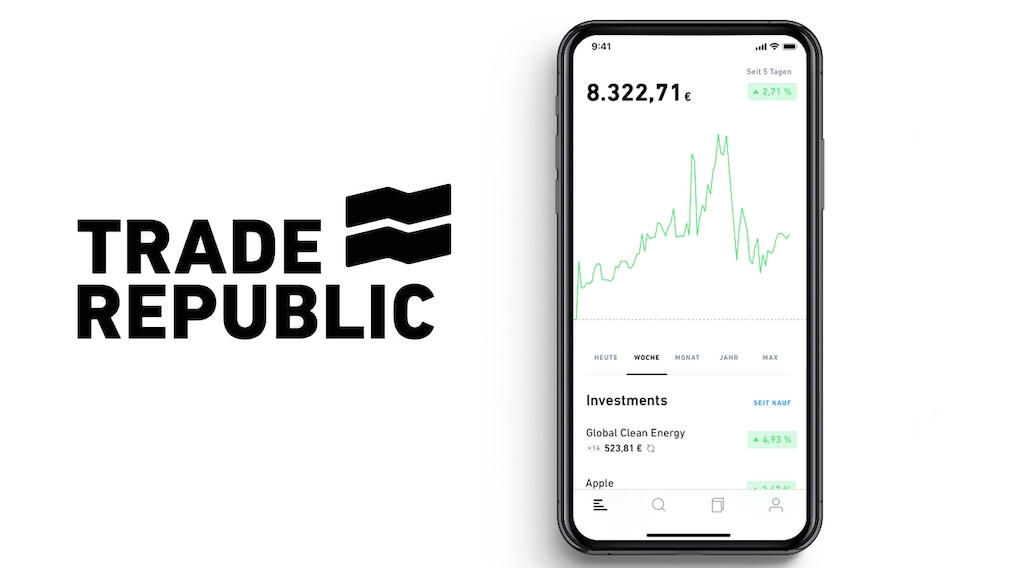
Trade Republic has done something that was once considered impossible in European retail finance: make investing genuinely frictionless and affordable for millions of people. Born in Munich in 2015 and headquartered today in Berlin, the company has grown from a three-person startup into a fully licensed bank with more than 10 million customers, €150 billion in assets under management, and a valuation of €12.5 billion as of December 2025—positioning it as Europe’s largest neobroker by any meaningful measure.
What began as a single product—a mobile app charging just €1 per trade—has evolved into a comprehensive wealth and banking platform. Trade Republic now offers fractional stocks, ETFs, bonds, derivatives, cryptocurrency, a full debit card with cashback-to-investment features, individual IBANs, and 2.25% interest on uninvested cash. Its journey from scrappy challenger to regulated ECB-licensed bank is one of the defining fintech stories of the last decade.

The Founding Story of Trade Republic: From Neon Trading to Trade Republic
The idea for Trade Republic emerged from a shared frustration. Christian Hecker, who had studied philosophy at the University of St. Gallen and worked at Goldman Sachs, Thomas Pischke, a physicist, and Marco Cancellieri, a computer scientist, all noticed the same problem: investing in Europe was expensive, opaque, and dominated by incumbents who had little incentive to lower their fees.
The trio incorporated the company in Munich in 2015 under the name Neon Trading GmbH. Their thesis was simple—a mobile-first, low-cost brokerage could unlock investing for the tens of millions of Europeans who held their savings in near-zero interest bank accounts simply because opening a brokerage account was too complicated or expensive.
In 2017 Sino AG, a Munich-based investment holding company with a focus on capital markets, became Trade Republic’s first major institutional backer and took a majority stake. The partnership provided not just capital but also regulatory know-how and access to capital-market infrastructure—critical at a time when the company was still navigating BaFin’s approval process.
Trade Republic soft-launched in closed beta in February 2019 and opened publicly in May 2019, initially serving only German residents. The app offered a tightly curated product: German and international stocks, ETFs, and knock-out certificates, all at a flat €1 external fee per trade with no account maintenance charges.

The Founders of Trade Republic
Christian Hecker – CEO & Co-Founder
Christian Hecker is the public face of Trade Republic and the architect of its long-term vision. A philosophy graduate of the University of St. Gallen in Switzerland, he subsequently worked in investment banking before pivoting to entrepreneurship. Hecker’s interdisciplinary background—combining humanistic inquiry with financial markets—shapes the company’s stated mission of democratising wealth creation. He has championed the idea that investing should be as simple and guilt-free as online banking, a philosophy reflected in Trade Republic’s minimalist, jargon-free design.
Thomas Pischke – CTO & Co-Founder
Thomas Pischke holds a degree in physics and brings rigorous quantitative thinking to the company’s technical infrastructure. As CTO, he oversees the engineering teams responsible for Trade Republic’s app, trading engine, and, post-banking-licence, its core banking platform. Pischke’s background in physics gives him a systems-level approach to building technology that needs to be fast, reliable, and capable of handling millions of simultaneous user sessions.
Marco Cancellieri – CPO & Co-Founder
Marco Cancellieri studied computer science and leads product design and user experience. He is widely credited with Trade Republic’s signature mobile interface—the clean, gesture-driven experience that strips away the complexity traditional brokers layer on top of financial products. Cancellieri’s product philosophy mirrors the founders’ broader belief: that simplicity lowers the psychological barrier to investing for first-time users.
Growth Timeline of Trade Republic: From 150,000 to 10 Million Users
Trade Republic’s growth curve is steep by any standard in European fintech.

Products & Features of Trade Republic
Trade Republic’s product suite has expanded dramatically from its original trading-only roots. Today it positions itself as a one-stop wealth and banking platform, summarised in its tagline: “Invest, spend and bank.”
Core Trading Products
Stocks & Fractional Shares
Users can buy and sell equities from major European and US markets. Fractional shares allow investment from as little as €1, making diversification accessible regardless of share price. All trades settle through HSBC Transaction Services as the executing broker, with Trade Republic charging a flat €1 external fee.
Exchange-Traded Funds (ETFs)
Trade Republic gives access to a broad range of ETFs—including major global index trackers from iShares, Vanguard, and Amundi. ETFs can be held outright or set up as automated savings plans (see below). The €1 external fee applies; ETF savings plans with Trade Republic itself as counterparty are charged no external fee.
Derivatives & Structured Products
Knock-out certificates and factor certificates give more experienced investors access to leveraged exposure. These are provided by specialist issuers and are subject to the standard €1 fee per trade.
Bonds & Fixed Income
Introduced in 2024, Trade Republic’s fixed-income offering lets customers buy government and corporate bonds directly—a product category previously confined to institutional or high-net-worth investors in much of Europe.
Cryptocurrency
Trade Republic supports trading in major cryptocurrency assets including Bitcoin, Ethereum, and a selection of altcoins. The 2025 Crypto Wallet update gave users self-custody transfer capabilities, enabling withdrawals to external wallets—a significant upgrade that brought Trade Republic closer to dedicated crypto exchanges.
Private Markets
Launched in 2025, Trade Republic’s Private Markets product offers retail access to private equity and alternative investments, a category historically restricted to institutional and qualified investors. This positions Trade Republic at the frontier of retail investment democratisation.
Savings Plans
Trade Republic’s savings plans (Sparpläne in German) are one of its most popular features. Users schedule automatic recurring purchases of stocks or ETFs on a weekly, bi-weekly, or monthly basis from as little as €1. The feature has been credited with helping a generation of first-time German investors build a portfolio habit, and is a core growth driver for the platform’s AUM.
Banking Features (Post-Licence)
The December 2023 ECB banking licence transformed Trade Republic from a regulated investment broker into a regulated bank. This unlocked an entirely new product tier:
- Individual IBAN: Every customer receives a personal German IBAN, enabling direct debits, salary deposits, and SEPA transfers—essentially making Trade Republic a primary bank account.
- 25% Interest on Cash: Uninvested cash earns 2.25% p.a., passed through from ECB deposit facility rates. This is credited daily and is one of Trade Republic’s most prominent marketing claims.
- Trade Republic Card: A Visa debit card linked directly to the account, accepted wherever Visa is supported.
- Saveback: 1% of every card purchase is automatically invested into the customer’s chosen savings plan—turning daily spending into passive investing.
- Child Savings Accounts: Introduced in 2025, these allow parents to open a savings plan for a minor, investing in the child’s name from birth.
- Transfers & Standing Orders: Full current-account functionality including scheduled transfers and direct debit mandates.

Business Model of Trade Republic: How Trade Republic Makes Money
Trade Republic’s revenue model has three distinct layers, with an important structural shift underway driven by upcoming EU regulation.
1. Transaction Fees (€1 Per Trade)
The cornerstone of Trade Republic’s value proposition is its €1 flat fee per trade—applied to all external settlement orders covering stocks, ETFs, derivatives, and crypto. Trades executed within Trade Republic’s own ecosystem (e.g., ETF savings plans where Trade Republic is the counterparty) carry no external fee. The simplicity and transparency of this model has been central to the brand’s growth.
2. Payment for Order Flow (PFOF)
For much of its history, PFOF has been Trade Republic’s most significant revenue stream alongside the €1 fee. Under PFOF, Trade Republic routes customer orders to market makers who execute the trade and pay a small rebate per share or contract. In the fiscal year to September 2024, PFOF accounted for approximately one-third of total revenue (approximately €90 million of the €272.4 million total).
However, the EU’s revised Markets in Financial Instruments Regulation (MiFIR) bans PFOF for European brokers effective 30 June 2026. Trade Republic is actively diversifying its revenue model to compensate, with banking fees, subscription services, and Saveback all playing a larger role.
3. Interest Income on Customer Cash
Since January 2023 Trade Republic has passed through ECB deposit facility rates to customers on their uninvested cash. The company retains a spread between the ECB rate and the amount passed through. With ECB rates remaining above 2% for an extended period, this has become a material revenue contributor. The current rate passed to customers is 2.25% p.a.
4. Additional Streams
Secondary revenue sources include currency conversion fees on non-euro trades, securities lending income, and fees generated by private-markets products introduced in 2025.
Financial Performance of Trade Republic

The company has been profitable for three consecutive years—a rare achievement among high-growth neobrokers of its scale. Unlike many fintech peers that burned cash to acquire users, Trade Republic’s lean cost structure (mobile-first, minimal branch infrastructure) allowed it to reach profitability earlier and sustain it.
Funding History & Valuation of Trade Republic
Trade Republic’s fundraising journey mirrors its growth trajectory—concentrated in a small number of high-conviction rounds with tier-one investors.
| Round | Date | Amount | Valuation | Key Investors |
| Seed / Sino AG | 2017 | Undisclosed | — | Sino AG |
| Series A | 2019 | Undisclosed | — | Creandum, Project A |
| Series B | 2020 | $67 million | — | Accel, Founders Fund, Creandum |
| Series C | May 2021 | $900 million | $5 billion | Accel, Founders Fund, Sequoia |
| Series C Extension | June 2022 | $268 million | $5.4 billion | Existing investors |
| Secondary Deal | Dec 2025 | €1.2 billion | €12.5 billion | New & existing investors |
The December 2025 secondary transaction is particularly notable: it involved existing shareholders selling to new investors at an implied €12.5 billion valuation—more than doubling the ‘5.4 billion valuation from the 2022 extension round. Unlike a primary funding round, a secondary sale does not inject new capital into the company, signalling that Trade Republic does not currently need fresh external funding to operate, consistent with its three years of profitability.
The GameStop Controversy: January 2021
In late January 2021, a coordinated campaign by retail investors—largely organised on Reddit’s r/WallStreetBets community—drove the share price of GameStop (GME) to extraordinary heights. The sudden spike in order volume created extreme clearing and liquidity pressure on brokers across the globe.
Trade Republic responded by restricting buy orders on GameStop and a small number of similarly affected stocks. The decision was met with fierce backlash from users who felt the restriction unfairly protected institutional short-sellers at the expense of retail investors. Approximately 4,000 formal complaints were filed with BaFin.
Trade Republic defended the decision by citing capacity constraints at its market-making partners rather than any deliberate policy to suppress the rally. BaFin conducted a review but did not pursue regulatory action. The episode nonetheless spotlighted the operational risks embedded in broker relationships with third-party market makers, and contributed to the German regulator’s subsequent scrutiny of retail broker practices.
Trade Republic subsequently reinforced its market-making and clearing relationships and improved its internal communication protocols around trading suspensions.
Competitive Landscape
Trade Republic competes across two converging categories: neobrokers and neobanks.
Key Competitors
1. Scalable Capital
Germany’s second-largest neobroker, Scalable Capital offers a subscription-based “Flatrate” model alongside a free tier. It has roughly 2.5–3 million customers and assets under management below Trade Republic’s €150 billion. Scalable competes primarily on ETF savings plans and robo-advisory.
2. Revolut
The London-based super-app has banking, crypto, and brokerage features, with tens of millions of users across Europe. However, its brokerage offering is less deep than Trade Republic’s, and it has faced regulatory delays in key markets. Revolut’s strength is in FX and multi-currency banking rather than investment products.
3. eToro
eToro’s social trading model (copy-trading, social feeds) differentiates it from Trade Republic’s solo investor focus. eToro has a global user base but a narrower European regulated footprint and does not yet offer full banking services at the same level.
4. Robinhood (US)
Robinhood is the closest US analogue—commission-free mobile-first brokerage with rapid retail adoption. However, Robinhood operates primarily in the US market and relies much more heavily on PFOF, a revenue stream that remains legal in the US market. Trade Republic’s European banking licence and product breadth are not matched by Robinhood in the near term.
Traditional Banks
Incumbent banks such as Deutsche Bank, Commerzbank, and ING remain Trade Republic’s largest structural competitors—not because their brokerage fees are competitive (they are not) but because millions of Europeans have their salary accounts at these institutions and have not yet separated their banking and investing. Trade Republic’s individual IBAN and banking card directly address this inertia.
For a comparison with another innovative fintech in the wealth management space, see our analysis of iCapital Network – Founder, Features, Business Model and Funding.
Future Outlook of Trade Republic
1. Navigating the PFOF Ban
The European PFOF ban (effective 30 June 2026) is the single biggest regulatory headwind Trade Republic faces in the near term. With PFOF contributing roughly one-third of FY2024 revenue, the company must replace approximately €90 million in annual income. Management has signalled a multi-pronged response: higher reliance on interest margin, expansion of Saveback, growth in Private Markets fees, and potential introduction of a premium subscription tier.
2. Geographic Expansion
With 17 European countries in its footprint, Trade Republic has room to enter the remaining EU member states as well as push deeper into existing markets. The full EU banking passport enables relatively friction-free geographic expansion compared with the pre-licence era, when each country required a separate regulatory notification.
3. Product Deepening
Trade Republic has shown a consistent pattern of launching a product category (e.g., crypto in 2021, bonds in 2024, Private Markets in 2025) and then expanding its depth over time. Expect continued additions in areas such as pension products (particularly relevant in Germany, where private pension reform is ongoing), more sophisticated fixed-income offerings, and potentially insurance products.
4. IPO Potential
With €12.5 billion valuation, three years of profitability, and a 10 million-strong customer base, Trade Republic is frequently cited as a strong IPO candidate on the Frankfurt Stock Exchange or via a US listing. The company has not confirmed any such plans, but its scale and financial profile put it in a different league from most private fintechs.
Frequently Asked Questions (FAQs)
Q1: What is Trade Republic?
Trade Republic is a German neobroker and licensed bank (Trade Republic Bank GmbH) that lets European retail investors buy stocks, ETFs, bonds, derivatives, and crypto from a smartphone app. It also offers a debit card, individual IBAN, and 2.25% interest p.a. on uninvested cash balances.
Q2: When did Trade Republic launch and who founded it?
Trade Republic was incorporated in 2015 in Munich as Neon Trading by three co-founders—Christian Hecker (CEO), Thomas Pischke (CTO), and Marco Cancellieri (CPO). The app launched in closed beta in February 2019 and opened to the public in May 2019.
Q3: How does Trade Republic make money?
Trade Republic earns revenue from three main streams: (1) a €1 external settlement fee per trade on stocks, ETFs, derivatives, and crypto; (2) payment for order flow (PFOF), where market makers pay for routed order flow—this accounted for roughly one-third of revenue in the fiscal year to September 2024; and (3) net interest margin on uninvested cash balances held by customers. With the EU ban on PFOF taking effect in mid-2026, the company is actively diversifying into subscription-style banking fees, Saveback, and asset-class expansion.
Q4: How many customers does Trade Republic have?
Trade Republic surpassed 10 million customers by late 2025, up from roughly 5 million in mid-2024—effectively doubling its user base in around 18 months. At its December 2025 secondary transaction, the company reported more than €150 billion in assets under management across 17 European countries.
Q5: Is Trade Republic safe? Is it regulated?
Yes. Trade Republic Bank GmbH holds a full EU banking licence granted by the European Central Bank in December 2023 and is supervised by the German financial regulator BaFin. Customer cash deposits benefit from German deposit guarantee schemes up to €100,000 per customer. Securities are held in segregated custody and are not on Trade Republic’s balance sheet, providing an additional layer of protection.
Q6: What is the Trade Republic Card and Saveback feature?
The Trade Republic Card is a Visa debit card linked to the customer’s Trade Republic account. The Saveback feature automatically invests 1% of every card purchase into a chosen savings plan—typically an ETF—turning everyday spending into a micro-investment habit. Uninvested cash in the account earns 2.25% interest per annum.
Q7: What happened with Trade Republic and GameStop in January 2021?
During the meme-stock frenzy in January 2021, Trade Republic restricted buy orders on GameStop and a handful of other heavily shorted stocks, citing capacity and risk-management constraints from its market-making partners. The decision triggered approximately 4,000 complaints to BaFin and significant user backlash. Trade Republic later reinstated full access and improved its communication around trading suspensions.
Q8: In which countries is Trade Republic available?
Trade Republic operates across 17 European countries, including Germany (its home market), Austria, France, Spain, Italy, the Netherlands, and others. The full EU banking licence allows the company to passport its services across the European Economic Area, supporting further geographic expansion.
Q9: What is Trade Republic’s current valuation and total funding?
In December 2025, Trade Republic completed a €1.2 billion secondary share sale that established an implied valuation of €12.5 billion—more than double its ‘5.4 billion 2022 valuation. Over its primary funding history, the company raised more than $1.3 billion across five rounds, with investors including Accel, Founders Fund, Sequoia, Creandum, and Project A.
Q10: How does Trade Republic compare with Robinhood and other neobrokers?
Trade Republic is Europe’s largest neobroker by AUM and customer count. Its €1 flat-fee model differs from Robinhood’s commission-free approach in the US (which relies more heavily on PFOF). Trade Republic distinguishes itself by combining brokerage with full banking features—current accounts, debit cards, and savings interest—a combination no European peer had fully replicated as of late 2025. Rivals such as Scalable Capital, Revolut, and eToro compete on overlapping features but not the same breadth of regulated banking products.
To read more content like this, subscribe to our newsletter