Last Updated on September 14, 2026 by Team TBH
Selling software internationally can become complicated quickly once tax, payment, compliance, and consumer protection requirements start changing from one market to another.
Merchant of Record platforms help remove much of that burden by acting as the legal seller of record and taking responsibility for areas such as VAT, GST, tax remittance, chargebacks, PCI DSS obligations, fraud, and regulatory compliance.
For SaaS and digital product companies, however, the right platform depends heavily on the business model. A traditional subscription SaaS company may need something very different from an AI product charging customers based on tokens, API calls, credits, or compute usage.
After reviewing platforms based on pricing, international coverage, setup, Merchant of Record capabilities, and available customer evidence, these four options stood out.
Merchant of Record Platforms at a Glance
| Company | Best For | Established | Headquarters |
| Fungies.io | Global SaaS and digital product sales | 2022 | Not disclosed |
| Dodo Payments | SaaS and AI builder monetization | 2024 | Dover, DE |
| Polar | AI startups and SaaS companies needing usage-based billing | 2022 | Stockholm, Sweden |
| Creem | Indie hackers, micro-SaaS, and digital product creators | 2021 | Randvere, Estonia |
Note: Information in this comparison is based on review platforms and the official websites of the listed companies.
What Should You Compare Before Choosing a Merchant of Record Platform?
The wrong Merchant of Record platform can create problems beyond payment processing fees.
International SaaS companies may need to manage VAT and GST obligations across multiple jurisdictions while also handling fraud, chargebacks, regional payment methods, and local regulatory requirements.
A suitable Merchant of Record provider should reduce those responsibilities rather than simply add another payment tool to the stack.
Before choosing one, consider:
- Tax coverage: Check whether the provider handles the countries where you already sell or plan to expand.
- Billing models: Confirm support for subscriptions, usage-based billing, credits, one-time purchases, or other pricing models.
- Payment methods: Review supported currencies and regional payment options.
- Fraud and chargebacks: Understand how disputes and fraud prevention are managed.
- Developer experience: Consider APIs, integrations, setup time, and how much custom development will be required.
- Pricing: Compare the effective transaction cost at your expected revenue level.
- Reporting: Check whether the platform provides visibility into payment failures, conversion, chargebacks, and regional performance.
With those criteria in mind, here is a closer look at the four platforms.
1. Fungies.io – Best for Global SaaS and Digital Product Sales
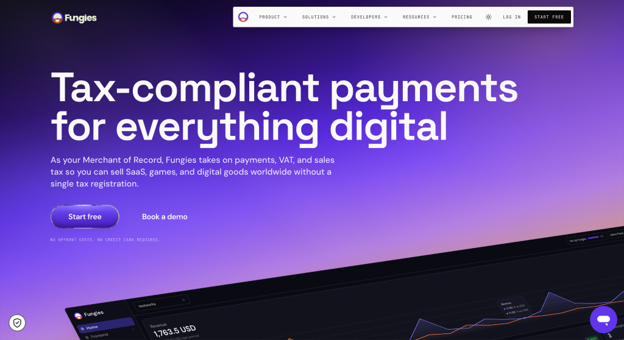
What Fungies.io Offers
Fungies.io is a Merchant of Record platform built for SaaS companies and digital businesses selling internationally. The platform combines checkout, subscription management, payment processing, tax remittance, and regulatory liability coverage across more than 150 countries. Its pricing model is straightforward: 5% + $0.50 per transaction with no monthly fee. For companies that want to expand internationally without combining several different payment, tax, subscription, and compliance tools, Fungies.io provides these functions within one platform.
Where Fungies.io Stands Out
One of Fungies.io’s main advantages is reducing vendor sprawl. SaaS founders selling internationally may otherwise need separate tools for billing, payment processing, tax remittance, fraud prevention, and subscription management. Fungies.io combines those responsibilities while also providing developer-focused tools such as CLI and MCP integrations. The platform also emphasizes merchant setup speed, with approval to first payment reportedly possible in under 15 minutes.
Customer and Market Signals
Customers frequently mention setup speed and responsive support. Reviews also highlight storefront customization and API integrations, making the platform particularly relevant for technical founders who want greater control over their payment stack.
2. Dodo Payments – Best for SaaS and AI Builder Monetization
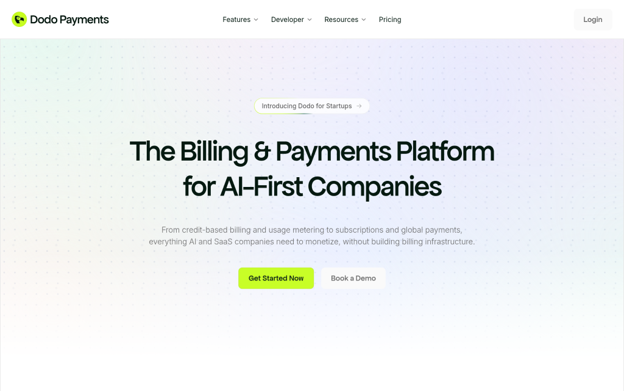
What Dodo Payments Offers
Dodo Payments is designed for SaaS and AI businesses that need flexible monetization options.
It supports:
- Credit-based billing
- Usage-based billing
- Subscriptions
- One-time payments
The platform operates across more than 150 countries and supports 40+ payment methods. As a Merchant of Record, it also handles global tax remittance, regulatory liability, fraud protection, and digital product delivery.Additional functionality includes license keys and affiliate programs. For technical teams, its Sentra AI assistant works inside VS Code to support code-first billing workflows.
Where Dodo Payments Stands Out
Dodo Payments is particularly focused on monetization models used by AI-native products.
Traditional seat-based subscriptions do not always fit businesses charging for API usage, agent runs, credits, or other forms of consumption. Dodo Payments supports these billing structures while keeping payment processing and Merchant of Record responsibilities within the same platform. The company has also raised $1.1 million in pre-seed funding and works with customers including Draftly and PeerPush.
Customer and Market Signals
Dodo Payments was founded in 2024, so its public review history remains relatively limited. That shorter operating history is worth considering for companies that place significant weight on long-term customer reviews. However, its early customer adoption, investor backing, and focus on AI monetization provide useful signals for SaaS and AI businesses evaluating newer Merchant of Record platforms.
3. Polar – Best for AI Startups and SaaS Companies Needing Usage-Based Billing
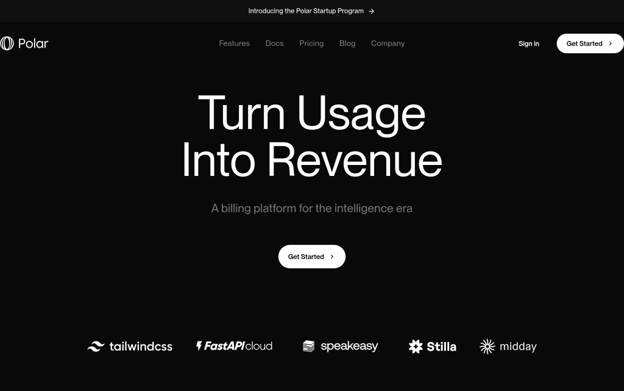
What Polar Offers
Polar is a financial infrastructure platform designed primarily for AI startups and SaaS companies using flexible billing models.
The platform supports:
- Usage-based billing
- Subscriptions
- Seat-based pricing
- Credits
- Trials
- Discounts
Its event tracking can measure tokens, API calls, agent runs, GPU seconds, storage, and similar usage metrics.
As a Merchant of Record, Polar also handles receipts, customer accounts, dunning, tax remittance, sales tax, and VAT obligations.
Real-time usage tracking is combined with analytics that allow companies to monitor unit economics from within the same system.
Where Polar Stands Out
Polar’s main differentiator is the combination of detailed usage tracking and billing. AI businesses often need to transfer usage data between analytics systems and billing platforms before they can accurately charge customers. Polar brings these functions together. This can be particularly useful for companies that need to price based on tokens, API requests, compute, storage, or other consumption metrics.Polar has also raised a $10 million Seed round led by Accel and follows an open-source development model.
Customer and Market Signals
Customers include Tailwind Labs, Midday, and Stilla AI. The platform has also received public support from people associated with companies and projects such as Vercel, FastAPI, and Ghostty. Its open-source approach may be particularly attractive to technical buyers that value transparency in billing infrastructure.
4. creem – Best for Indie Hackers, Micro-SaaS, and Digital Product Creators
What Creem Offers
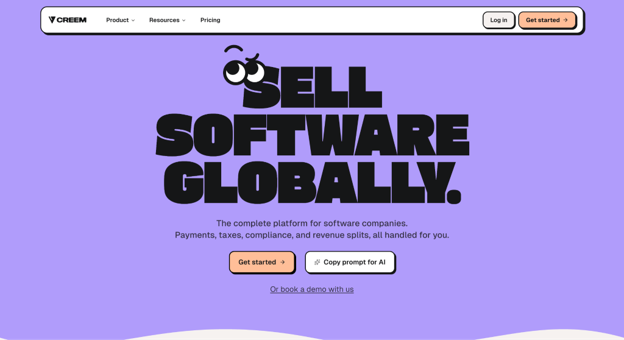
Creem is a Merchant of Record platform designed for indie hackers, micro-SaaS companies, and digital creators that want to sell globally without enterprise contracts.
The platform supports:
- Subscriptions
- One-time payments
- Multi-party revenue splits
- Multi-currency payouts
Creem operates across more than 190 countries and automatically calculates and remits VAT, GST, and sales tax.
It supports more than 80 currencies, including stablecoins.
Pricing is 3.9% + $0.40 per transaction, with no monthly minimums.
Where Creem Stands Out
Creem focuses on reducing the barriers smaller businesses often encounter when accessing global Merchant of Record services.
Many established platforms require sales calls, enterprise agreements, or pricing tiers before businesses can access certain functionality.
Creem instead emphasizes straightforward access and transparent pricing.
The platform reports more than 20,000 stores and €930,000 in annualized revenue, despite originally being built by a two-person founding team.
Customer and Market Signals
Creem reached #2 Product of the Day and #1 Fintech Product of the Month on Product Hunt.
Available user feedback frequently focuses on straightforward setup, transparent pricing, and the ability to start without going through an enterprise sales process.
That positioning makes it particularly relevant for independent developers and smaller SaaS companies.
How These Merchant of Record Platforms Were Selected
Initial Research
The research began with a broad list of Merchant of Record platforms collected from SaaS directories, fintech review platforms, founder communities, Product Hunt listings, and official company websites.
At this stage, the goal was to identify a wide enough range of legitimate providers before applying stricter criteria.
Candidate Filtering
Platforms with limited documentation, unverifiable customer activity, or insufficient information about their Merchant of Record capabilities were removed.
The remaining providers were evaluated based on recurring customer feedback around:
- Merchant setup
- Tax remittance
- Regulatory coverage
- Chargeback handling
- International payment performance
- Pricing transparency
Claim Validation
Claims made on company websites were compared with available reviews and case studies.
International coverage, pricing, Merchant of Record functionality, and customer outcomes were not evaluated solely from promotional claims.
Published pricing also served as an important signal because platforms that disclose fees make it easier for businesses to evaluate the true cost before entering a sales process.
Industry Position
External signals were also considered, including funding, product awards, customer adoption, and mentions within fintech and SaaS communities.
For example, Polar’s $10 million Seed round and Creem’s Product Hunt recognition provide additional context around market traction.
These factors were treated as supporting signals rather than standalone proof of platform quality.
Merchant of Record Validation
The final stage focused specifically on whether each provider delivered Merchant of Record functionality rather than basic payment processing.
This included reviewing support for:
- Tax remittance
- VAT and GST
- Regulatory liability
- Fraud management
- Chargebacks and disputes
- Multi-currency payments
- Global merchant support
Platforms with documented evidence of helping SaaS and digital product businesses sell internationally were prioritized.
How to Choose the Right Merchant of Record Platform
The best Merchant of Record platform depends on your business model, target markets, technical requirements, and transaction volume.
Match the Platform to Your Business Model
Start by determining whether the provider regularly works with businesses similar to yours.
Traditional SaaS subscription businesses may prioritize mature subscription infrastructure, while AI companies may need sophisticated usage-based billing.
Digital creators and micro-SaaS companies may place more importance on simple setup and predictable pricing.
Review Billing Options
Make sure the platform supports the way you monetize your product.
Possible requirements include:
- Monthly subscriptions
- Annual subscriptions
- Seat-based pricing
- Usage-based billing
- Credits
- One-time purchases
- Trials
A platform with dozens of features is not necessarily the best choice if it does not support your primary billing model well.
Compare Effective Pricing
Headline transaction fees only tell part of the story.
A 3.9% + $0.40 transaction fee has a very different impact at $10,000 in monthly revenue compared with $500,000.
Companies should also consider what they save by outsourcing tax remittance, compliance, fraud management, and related operational work.
Evaluate Reporting
Useful Merchant of Record reporting can include:
- Checkout conversion by region
- Failed payment rates
- Payment retry success
- Authorization rates
- Chargeback rates
- Revenue by geography
Without access to this data, it becomes harder to identify where payment infrastructure may be affecting growth.
Confirm Market Coverage
Finally, verify the exact jurisdictions supported by the provider. A company advertising coverage across 150 countries may still not support every market that matters to your business. Check your most important current and future markets individually rather than relying only on the total country count.
Which Merchant of Record Platform Is the Best Fit?
Each of these platforms addresses a different part of the market.
Fungies.io may suit SaaS and digital product companies that want broad international coverage, transparent transaction-based pricing, and quick developer-focused setup.
Dodo Payments is particularly relevant for SaaS and AI businesses that need flexible monetization across usage, credits, subscriptions, and one-time payments.
Polar stands out for AI and SaaS companies where detailed usage tracking is central to the billing model.
Creem targets indie hackers, micro-SaaS businesses, and creators that prioritize straightforward onboarding and transparent pricing.
The right choice ultimately depends on how you charge customers, where you sell, how technical your team is, and how much payment and compliance infrastructure you want to manage internally.
To read more content like this, explore The Brand Hopper
Subscribe to our newsletter