Last Updated on July 6, 2026 by Team TBH
Most AI brands assume any marketing agency can handle their campaigns, and that assumption tends to be expensive. Marketing agencies that specialize in tech audiences operate completely differently from generalist shops, and the gap shows up fast in results. The hardest parts of this space, such as spotting inflated follower counts, attributing actual sales to specific creator campaigns, and managing content approvals without losing momentum, require genuine experience. After reviewing dozens of agencies across performance data, client retention, and campaign outcomes, this guide covers the seven best options for AI brands in 2026.
The research approach for this ranking
Agencies were evaluated from publicly available sources, including case studies, client reviews, directories, and official websites, with only those showing a real track record in digital marketing making the final cut.
→ See the full research breakdown
- Clickstrike – Best for AI product marketing and technical B2B influencer campaigns
- Brighter Click – Best for vertical-specific paid media management and multi-channel acquisition strategy
- inbeat – Best for paid social advertising and micro-influencer marketing
- Directive – Best for B2B demand generation and qualified pipeline marketing
- Media Glitch – Best for multi-channel performance marketing
- NoGood – Best for SaaS, B2B, and enterprise growth marketing
- Neoreach – Best for enterprise influencer marketing campaigns and brand activation
Why Influencer Marketing Agencies Matter for Your Business
Running influencer campaigns in the AI space without the right agency is like shipping code without QA. The risk is real.
Identifying authentic creators with genuine audiences versus inflated follower counts is harder than it looks, and most brands only discover the problem after burning budget. Accurately attributing revenue and sign-ups to specific creator campaigns adds another layer that most generalist agencies simply aren’t built for.
Specialized agencies bring the creator relationships, tracking infrastructure, and vertical knowledge to get this right. The outcome is better earned media value, lower cost per engagement, and creator-attributed returns you can actually defend in a board meeting.
Top 7 Influencer Marketing Agencies: Breakdown and Comparison
Note: All data in this table is sourced from review platforms and the official websites of the listed companies.
| Company Name | Years Operating | Headquartered In |
| Clickstrike | Since 2018 | New York |
| Brighter Click | – | Raleigh |
| inbeat | Since 2018 | Montreal, Canada |
| Directive | Since 2014 | Irvine, California |
| Media Glitch | – | – |
| NoGood | – | New York City, Miami, San Francisco |
| Neoreach | Since 2013 | Orlando, FL |
1. Clickstrike – Best for AI Product Marketing and Technical B2B Influencer Campaigns
What Does Clickstrike Do?
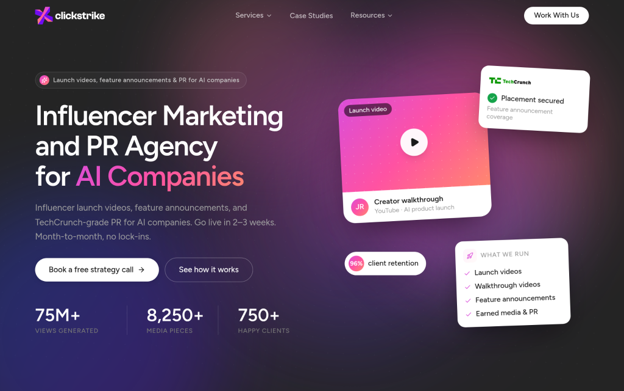
Brands that need to reach technical buyers, developers, and early adopters will find that Clickstrike, PR agency for AI companies, covers exactly that territory, connecting clients with tech creators across YouTube, TikTok, X, and LinkedIn. The agency runs custom month-to-month engagements with no setup fees, no long-term contracts, and no pricing markups on creator deals. They’ve generated 75M+ views and 8,250+ media placements for clients, with features secured in TechCrunch, Forbes, and Business Insider backing that reach with serious credibility.
Why Does Clickstrike Stand Out for Influencer Marketing Agencies?
AI brands rarely find an agency that genuinely understands the difference between marketing a software product and marketing a consumer brand. Clickstrike is built around that distinction. Their 96% client retention rate and Clutch Champion recognition aren’t just vanity metrics. Clients stay because the results hold up.
Summary of Real User Reviews:
From what the reviews show, clients point most often to Clickstrike’s transparent pricing and the fact that a real human manages each engagement rather than handing things off to rotating junior staff. Case studies like generating $192,000 in revenue within three weeks and producing 100+ brand assets for Neurahub reinforce the pattern. That kind of documented, repeatable performance is rare in a space where most agencies rely on vague promises.
2. Brighter Click – Best for Vertical-Specific Paid Media Management and Multi-Channel Acquisition Strategy
What Does Brighter Click Do?
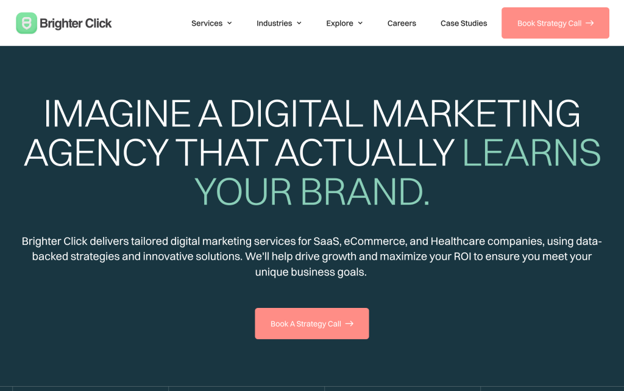
Brighter Click operates as a specialized digital marketing agency focused on paid media across Meta, Google, TikTok, Pinterest, and LinkedIn. Their model covers creative strategy, UGC sourcing from a pool of 525+ vetted creators, creator strategy, and fractional CMO leadership for brands that need executive-level direction without a full-time hire. They work across eCommerce, SaaS, Healthcare, Fintech, and Clinical Trial Marketing, among others, which gives them a depth of vertical knowledge that shows up in their results. A 264% year-over-year growth result for one eCommerce client is hard to argue with.
Why Does Brighter Click Stand Out for Influencer Marketing Agencies?
Most agencies treat creative and data as separate departments. Brighter Click runs them through a single proprietary technology layer that centralizes performance insights without relying on manual reporting. That kind of integrated thinking typically shortens the feedback loop between what a creator posts and what the numbers actually say.
Summary of Real User Reviews:
Review data for Brighter Click skews toward their documented case study performance rather than individual testimonials, which makes sense given their specialized vertical approach. Their 45.9% cost reduction result in healthcare and the triple-digit growth in eCommerce tend to be the details people cite most. From what the research shows, brands in niche verticals appreciate working with an agency that already understands the rules of their space before the first campaign kicks off.
3. inbeat – Best for Paid Social Advertising and Micro-Influencer Marketing
What Does inbeat Do?
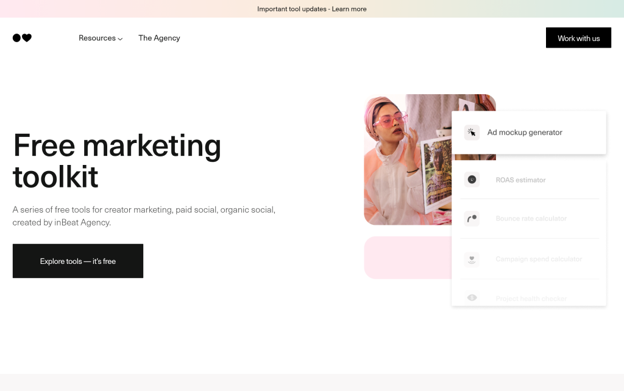
inBeat Agency runs as a creative growth agency built around paid social, micro-creator marketing, and creator-driven content strategies for brands that want performance, not just reach. They serve 250+ brands through dedicated services covering UGC marketing, TikTok marketing, and full creator campaign management. What separates them slightly from the pack is their free marketing toolkit, which includes calculators and mockup generators available to any digital marketer without an account or subscription. Not many agencies give away tools like that.
Why Does inbeat Stand Out for Influencer Marketing Agencies?
Micro-creator campaigns require a very specific kind of sourcing discipline. inBeat’s experience managing campaigns with 1,000+ micro-creators means they’ve already worked through the creator vetting, FTC disclosure compliance, and content approval challenges that trip up less experienced teams. Their dual model of free public tools plus premium agency services creates a natural trust signal before a single proposal is signed.
Summary of Real User Reviews:
Clients from brands like PhoneLoops and Parallel point to inBeat’s ability to source authentic creators quickly and manage relationships at scale without losing content quality. From what the reviews show, the consistent thread is that inBeat treats micro-influencer campaigns as a performance channel rather than a reach exercise. That performance-first framing is what makes the difference between campaigns that generate attributed sign-ups and campaigns that just produce pretty content.
4. Directive – Best for B2B Demand Generation and Qualified Pipeline Marketing
What Does Directive Do?
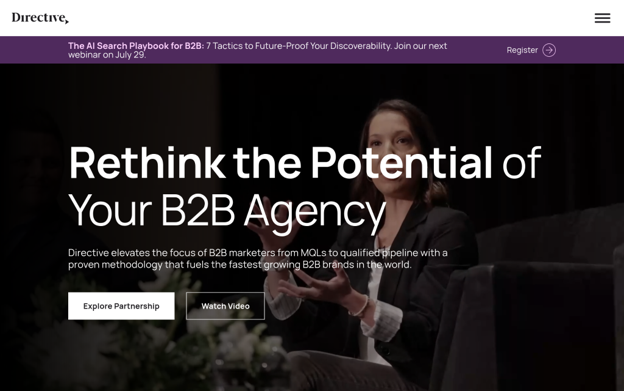
Directive is a B2B marketing agency that shifts the focus away from MQL volume and toward qualified pipeline, which is a different and more honest way to measure marketing success. They run three integrated divisions covering Performance, Commerce, and Communications, all connected through Stratos, their own custom AI intelligence platform that unifies CRM, paid media, SEO, and operations data in one place. With 420+ brands served and $1B+ in revenue generated, their client list reads like a who’s who of B2B software, including ZoomInfo, Adobe, Calendly, and Cisco.
Why Does Directive Stand Out for Influencer Marketing Agencies?
B2B influencer campaigns live or die on audience quality. Directive’s proprietary DiscoverabilityOS methodology is designed to match content and creator strategy to buyers who are actually in-market. Their status as one of the first LinkedIn Ads Certified Agencies globally adds real platform-level credibility, and that’s not the kind of thing you fake.
Summary of Real User Reviews:
Directive earns consistent recognition in independent roundups of top B2B marketing agencies, which signals broad external validation rather than a curated handful of testimonials. Clients working in competitive software categories tend to highlight the agency’s ability to build pipeline that sales teams can actually use. From what the data shows, brands that have outgrown surface-level awareness metrics tend to find Directive’s qualified pipeline focus a much better fit.
5. Media Glitch – Best for Multi-Channel Performance Marketing
What Does Media Glitch Do?
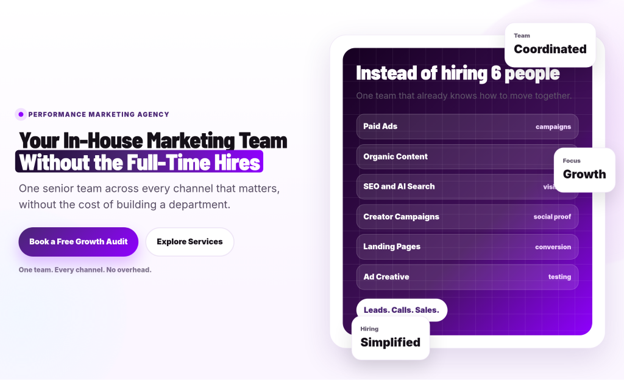
Media Glitch positions itself as a full-funnel performance marketing agency that puts a senior team across paid ads, organic content, SEO, creator campaigns, landing pages, and ad creative under one coordinated roof. The pitch is straightforward: brands get the horsepower of an internal marketing department without the cost of building one (not cheap to hire that team in-house, but that’s the point). They track everything against metrics like CPL, CVR, and ROAS, and they’ve started including ChatGPT and Perplexity alongside Meta and Google as active channels, which shows they’re paying attention to where search behavior is shifting.
Why Does Media Glitch Stand Out for Influencer Marketing Agencies?
Creator campaigns don’t perform in isolation. Media Glitch’s approach of running creator content inside a coordinated multi-channel funnel means creator-driven awareness actually connects to measurable down-funnel outcomes. Their free Growth Audit, which maps current channels, gaps, and next best opportunities, makes it easier to see whether the fit is right before any contract is signed.
Summary of Real User Reviews:
Public review data for Media Glitch is limited, so the clearest signal comes from their positioning and documented methodology rather than aggregated client feedback. The emphasis on straightforward communication and faster execution does appear consistently in how they describe client relationships. From what’s available, brands drawn to Media Glitch tend to be those who want fewer hand-off points and faster experimentation cycles across multiple channels simultaneously.
6. NoGood – Best for SaaS, B2B, and Enterprise Growth Marketing
What Does NoGood Do?
NoGood runs as a growth marketing agency with a genuinely AI-native operating model, deploying custom squads of specialists suited to each client’s specific growth challenges rather than running every account through the same playbook. They cover paid and organic channels across AEO, SEO, social strategy, paid search, performance branding, and conversion rate. All of that is backed by proprietary AI systems and agents built for high-velocity experimentation. Their client list includes Anthropic, AWS, and MongoDB, which says a lot about who trusts them with serious budgets.
Why Does NoGood Stand Out for Influencer Marketing Agencies?
The real differentiator here is how they connect influencer and creator strategy to broader growth infrastructure, including real-time executive dashboards that track performance without waiting for end-of-month reports. An 84% client retention rate in a space where brands switch agencies regularly is the kind of proof point that’s hard to fake.
Summary of Real User Reviews:
Client testimonials for NoGood consistently highlight their proactive communication style and the flexibility to shift strategy when growth experiments don’t pan out as expected. Case study results ranging from 75% to 879% improvements across different metrics reflect the variability of their client base, but the directional outcomes are consistently positive. From what the reviews show, brands that expect a partner to challenge their assumptions tend to get more out of the engagement than those looking for execution-only support.
7. Neoreach – Best for Enterprise Influencer Marketing Campaigns and Brand Activation
What Does Neoreach Do?
NeoReach operates as a full-service creator marketing agency with a 250 million creator database backed by algorithms for return prediction, creator matching, and fraud detection, which addresses the bot follower and fake engagement problem at a scale most agencies can’t match. They’ve managed $250M+ in creator spend for major brands including Netflix, Airbnb, Walmart, and DraftKings, so the enterprise-level campaign management is well within their capability. Their recent Influencers.com acquisition and Blueberry AI partnership show a company that’s actively building rather than coasting on an established reputation (think enterprise pricing, but also enterprise results).
Why Does Neoreach Stand Out for Influencer Marketing Agencies?
Influencer fraud, including bot followers, fake engagement, and pod activity, is one of the most damaging and least visible problems in creator marketing. NeoReach’s proprietary fraud detection infrastructure tackles that directly at the data layer rather than relying on manual spot checks. That scale of detection capability is genuinely hard to match without the technology investment NeoReach has already made.
Summary of Real User Reviews:
NeoReach holds a G2 rating of 4.5 and picked up multiple major awards in 2025, including Best Influencer Marketing Partnership at the Digiday Media Awards and Digital Marketing Agency of the Year at the U.S. Agency Awards. Clients working on large-scale activations tend to highlight the platform’s depth and the team’s ability to coordinate complex, multi-creator campaigns without losing brand consistency. From what the data shows, the agency earns the most praise from brands that need both scale and accountability in the same engagement.
Research Methodology and Selection Process
Putting together a list like this starts with a broad sourcing phase and gets progressively more selective as the evidence comes into focus.
Initial Data Collection
The process began by pulling agency names from directories, review aggregators, and industry-specific roundups covering creator marketing and creator-driven campaigns. Official websites were reviewed alongside any public-facing documentation about services, client industries, and campaign history. The goal at this stage was to build a wide longlist without filtering too early, capturing both well-known agencies and some that appear more frequently in niche tech marketing conversations than in mainstream marketing press.
Shortlisting Phase
Once the longlist reached a workable size, agencies with incomplete or unverifiable track records were removed. Review patterns were analyzed to distinguish agencies with consistent client experiences from those with a handful of standout testimonials surrounded by noise. Agencies that appeared credible on paper but lacked documented results in digital marketing or influencer-specific campaigns were set aside at this stage. What remained was a shorter group of agencies with a demonstrably real presence in the space.
Verification of Claims
Each agency’s stated capabilities were cross-referenced against what clients actually reported in reviews and case studies. Where an agency claimed outcomes, such as sales figures, media placements, or retention rates, those numbers were checked against any available supporting documentation. Discrepancies between marketing language and real-world client feedback were noted and factored into final placement decisions.
Authority and Industry Contribution Layer
Recognition signals were then factored in, including industry awards, mentions in reputable publications, and whether agencies had contributed original thinking to the influencer marketing space through research, frameworks, or documented methodologies. Agencies that appear repeatedly across multiple independent sources carry stronger signals of sustained authority than those with a single high-profile mention.
Influencer Marketing Agencies-Specific Evidence
The final layer focused on creator marketing depth. Agencies were checked for dedicated service pages covering creator sourcing, campaign management, content approvals, FTC disclosure compliance and brand safety adherence, and post-campaign measurement. Verified client reviews of creator campaign work, alongside case studies showing creator-driven results, were weighted heavily in final ranking decisions.
How to Choose the Right Influencer Marketing Agencies
Picking an influencer marketing agency for an AI brand is a different process than picking one for a consumer product. The technical audience, the longer sales cycle, and the need for content that actually earns credibility with developers or buyers all raise the bar. Here’s what to check before signing anything.
- Industry/Domain Experience: Look for agencies that have run campaigns for tech, SaaS, or AI brands. Generic consumer experience doesn’t translate well to audiences that will fact-check product claims.
- Features and Service: Confirm whether the agency handles creator sourcing, content approvals, and post-campaign reporting in-house or outsources pieces of that to freelancer networks, since fragmented execution tends to create delays.
- Pricing Structure: Understand whether pricing includes markups on creator fees or whether the agency operates with transparent, pass-through rates. The difference matters at scale.
- Results Measurement: Ask how they attribute sales and sign-ups driven by creator content to specific campaigns. Agencies that track everything at this level of detail are worth the premium.
- Industry Knowledge and Compliance: Confirm the agency understands FTC endorsement guidelines and platform-specific advertising policies, especially for restricted categories such as financial products or pharmaceuticals that require special influencer disclosures.
Bottom Line
Choosing the right creator marketing agency for an AI brand comes down to three things: vertical knowledge, transparent pricing, and the ability to prove what their campaigns actually generate. The agencies on this list each bring something distinct, whether that’s micro-creator sourcing depth, enterprise-scale fraud detection, or a specialized focus on technical B2B audiences. The space will keep getting more competitive as more AI brands enter the market, so the agencies that track real attribution now will have a clear edge.
To read more content like this, explore The Brand Hopper
Subscribe to our newsletter