Last Updated on August 13, 2026 by Team TBH
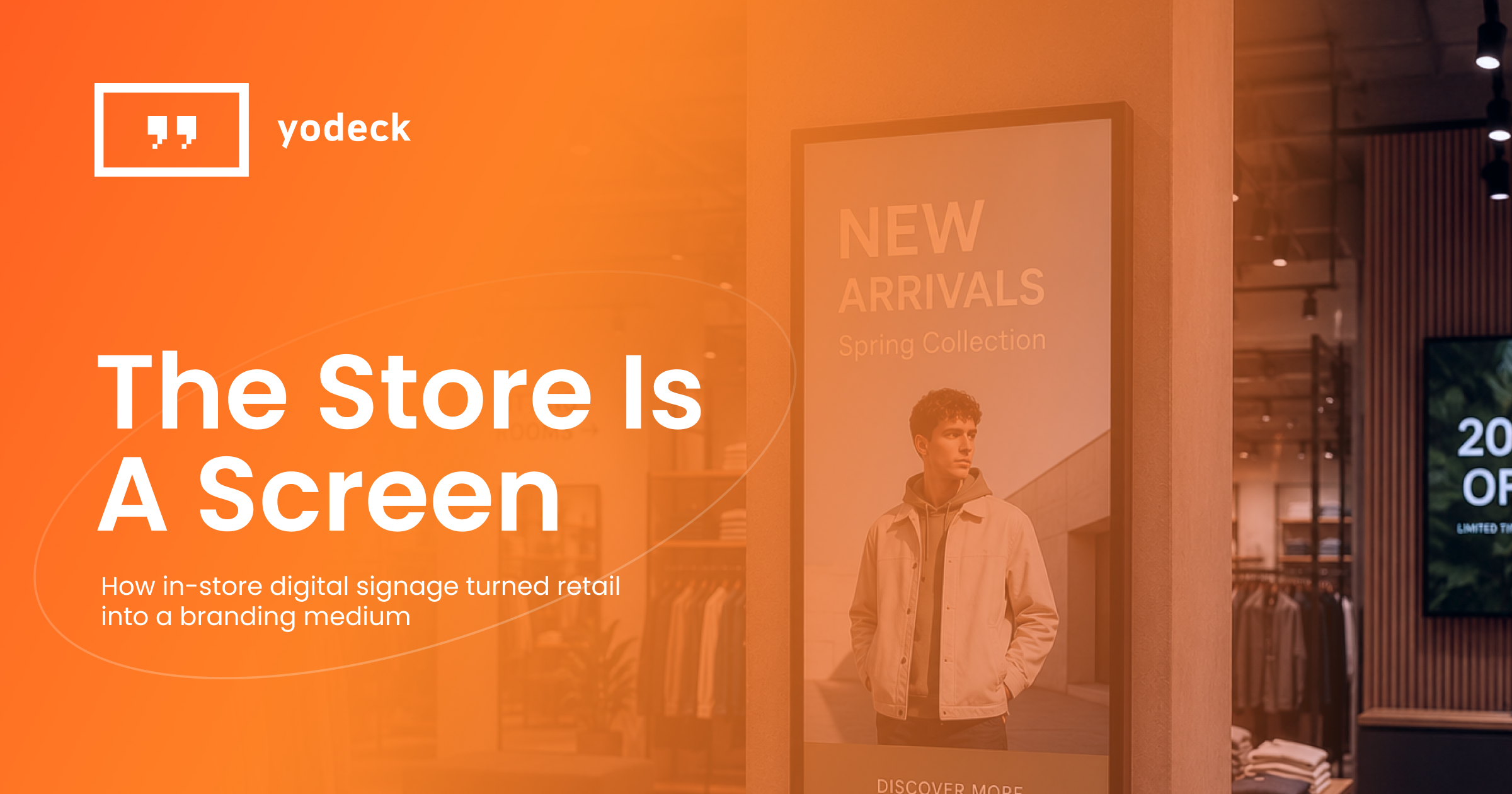
For two decades, brands poured budget into websites and social feeds while the physical stores remained stagnant. That balance is shifting. The in-store digital signage going up inside shops, cafes and showrooms is turning the store back into a place where a brand gets to say something, not only sell something.
Why the physical store went quiet, and why it’s loud again
The brand’s voice didn’t disappear when marketing moved online, it scaled up and moved to the screen in your pocket. What went quiet was the physical store.
Brand teams designed for the feed, the homepage and the ad unit, and the in-store experience was left to shelf labels and the occasional poster. A customer could meet a brand’s sharpest creative on Instagram and then walk into a location that looked a decade behind.
Digital displays are starting to close that gap. A screen on a wall can carry the same art direction, typography and motion a brand uses everywhere else, and it can change as often as a social post. The store stopped being the channel a brand forgot and became one it could direct.
Digital menu boards are a brand statement, not a price list
Ask what a screen says about a brand, and the clearest answer sits above the counter. A coffee chain’s digital menu boards do more than list a flat white and its price. They set the type, the colour, the photography and the pace at which one offer gives way to the next. Two cafes can sell the same drink at the same price and still feel like different companies, and the board is largely the reason.
The shift is small but real. A printed menu is something you update as rarely as possible, because every change costs money and a reprint. A screen is something you program, the way a brand programs its homepage. The companies that grasp this stopped handing menu design to whoever runs the laminator and gave it to the team that owns the brand’s look.
Relevance beats reach once a customer is in the room
Impressions are the wrong target for a store’s influence. Everyone looking at the screen is already there, already a step from the product. The question is no longer how many people see the content but whether the content fits the person, the place and the moment.
This is where narrowcasting comes into play. Narrowcasting is the practice of sending specific content to specific screens rather than broadcasting one message everywhere. A breakfast board in the morning and a dinner board at night. A promotion on the screens of one region and a different one in another. A breakfast board in the morning and a dinner board at night. A promotion on one region’s screens and a different one in another. And content matched to how long someone actually stands there: a flagship has room to run a two-minute brand film, while a transit-station kiosk has three seconds to land a single offer before the commuter moves on.
Consistency is the hard part at scale
One screen is easy. Two hundred screens across forty locations is a brand-governance problem. The risk is not that a store has no screen, it is that every store has a screen showing something slightly off: an old logo, a local manager’s clip art, a promotion that ended in spring. Each small drift chips at the thing the brand spent years building.
This is why centralised control matters more than picture quality in any retail digital signage rollout. Cloud-based digital signage platforms exist for this reason: one dashboard, many screens, a single source of truth for what the brand looks like in the room. The brand decision comes first, and the platform makes the answer enforceable.
The brands getting it right treat screens as editorial
The companies pulling ahead with in-store digital signage share a habit. They run the display like a small publication, not an ad slot. There is a calendar. There is someone responsible for what shows on Tuesday. The content has a reason to exist beyond filling the panel.
That sounds obvious and is rare in practice. Most screens default to a looping promo no one has touched in months, which trains customers to ignore the glass entirely. A screen that changes with the day, the weather or a local event keeps eyes on it, and the brand keeps a channel it controls. The cost of the hardware is small next to the cost of a customer learning that the screen never has anything to say.
A measurement gap is part of why this slips. A brand can report a banner ad’s click-through rate to two decimal places but has no idea whether anyone read the screen beside the till, so the display drops off the plan, then off the content calendar, then into neglect. The brands that keep their screens sharp put store content under the same owner as the website and the campaign, on the logic that a screen customers physically stand in front of is too visible to leave to chance.
What this asks of brand teams
Owning the store as a medium is a brand decision before a hardware one. It means the people who guard the logo also sustain meaningful engagement. It means store content sits in the same plan as the campaign and the feed, reviewed with the same eyes. The technology to do this is cheap and well understood. The discipline to use it well is the part still up for grabs.
Watch the brands treating their screens as a channel, and the platforms that let them run it at scale. The screen in the room is becoming a retention tool, reaching customers at the exact moment they decide whether to come back.
To read more content like this, explore The Brand Hopper
Subscribe to our newsletter