Last Updated on September 24, 2026 by Team TBH
Brand teams invest considerable time in customer interviews, focus groups, product tests and feedback calls. These conversations can reveal how customers describe a problem, what prevents them from buying and which parts of an experience they value most.
Yet the final strategy often relies on a few remembered comments or a short summary written after the session. The team may retain the conclusion while losing the language and context that produced it.
This creates a gap between customer research and brand decision-making. Closing that gap requires more than recording every conversation. Teams need a system for capturing, organising and reviewing customer language without treating automated output as unquestionable insight.
Why Customer Language Matters
Customers do not always describe a product in the same language a brand uses internally.
A company may promote an advanced technical feature, while customers focus on saving time or avoiding a frustrating task. A marketing team may describe a service as flexible, while users value the confidence of knowing what will happen next.
These differences can influence positioning, product messaging and content strategy. The phrases customers naturally use may reveal what they understand, what confuses them and which outcomes feel relevant.
However, one memorable quote should not define an entire brand strategy. Its value depends on who said it, what question was asked and what happened earlier in the conversation. Preserving context is therefore as important as preserving the words.
Where Brand Research Notes Break Down
During a customer interview, the researcher must listen, decide what to ask next and take notes at the same time. This divided attention makes it easy to shorten a complex answer or miss an unexpected point.
Different researchers may also record different details. One person may focus on product complaints, while another notices language related to trust or price. When these notes are combined, the result may reflect the researchers’ priorities as much as the participants’ experiences.
Memory creates another filter. Immediately after a session, teams often remember the most surprising or emotionally expressive comments. Less dramatic observations may be forgotten even when they appear repeatedly across interviews.
A fuller record allows the team to return to the evidence instead of depending only on first impressions.
Which Research Conversations Should Be Captured?
Recording and transcription may support several types of brand research:
- Customer discovery interviews
- Focus groups
- Product or concept tests
- Usability sessions
- Win-loss interviews
- Churn interviews
- Sales and customer success feedback meetings
The research objective should determine what the team captures. A concept test may focus on first reactions and comprehension, while a churn interview may examine unmet expectations and moments of frustration.
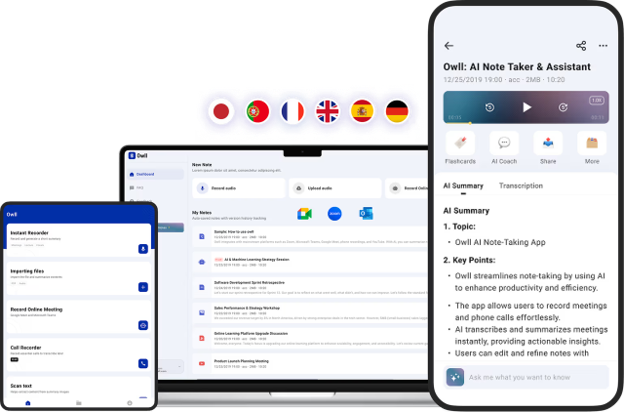
An AI meeting recorder such as Owll can record, transcribe and summarise conversations conducted through Zoom, Google Meet and Microsoft Teams. It can also process uploaded interviews, voice memos and other recordings.
The ability to record does not mean every conversation should be recorded. Participants need to understand what is being collected, why it is needed and how it will be used.
Begin With Consent and a Clear Research Question
Useful research starts before the conversation.
Teams should define the question they are trying to answer. “What do customers think about our brand?” is too broad to guide a focused interview. A more useful question might examine why customers choose one solution over another, how they describe a particular problem or which part of onboarding creates uncertainty.
A clear objective also limits unnecessary data collection. Researchers can avoid gathering personal information that does not contribute to the study.
Before recording, participants should receive a straightforward explanation covering:
- What will be recorded
- The purpose of the research
- Who may review the material
- How long it may be retained
- Whether quotations will be anonymised
- How participants can raise concerns
Consent should be treated as part of the research process, not as a technical formality.
Build a Searchable Voice-of-Customer Record
Once a session has been recorded, transcription makes its content easier to revisit. Owll’s AI transcription software supports more than 99 languages and is designed to handle conversations that switch between languages.
Searchable text helps researchers locate repeated phrases, product names, objections and descriptions of desired outcomes. Speaker identification and timestamps can help connect a statement to the person who made it and the surrounding discussion.
This is particularly useful when several teams need different information from the same research. Product managers may search for feature problems, marketers may examine customer language and customer success teams may look for recurring expectations.
The transcript should remain connected to the original recording. If a phrase appears unclear or especially important, the researcher should review the source rather than relying on the text alone.
Move From Transcripts to Themes
A transcript is a record of a conversation, not a finished research analysis.
Researchers can begin by tagging relevant passages according to themes such as:
- Customer needs
- Pain points
- Buying triggers
- Objections
- Desired outcomes
- Trust signals
- Competitor comparisons
- Words used to describe the problem
These categories should develop from the research question and the conversations themselves. Teams should avoid forcing every comment into a framework created before the interviews began.
AI may help summarise or group material, but researchers still need to decide whether two statements genuinely express the same idea. Similar words can carry different meanings in different contexts.
Frequency Is Not the Same as Importance
A comment mentioned by many participants deserves attention, but frequency is only one factor.
A problem raised by one strategic customer may have significant commercial consequences. An uncommon comment may reveal a risk that other participants did not encounter. Conversely, a frequently mentioned preference may have little effect on an actual purchase decision.
Researchers should consider:
- Who expressed the view
- Which customer segment they represent
- At what stage of the journey it occurred
- How strongly the participant felt
- Whether behaviour supported the statement
- Whether the pattern appeared in other evidence
This prevents analysis from becoming a simple word-counting exercise.
Connect Insight to Brand Decisions
Customer research becomes valuable when it influences a decision.
Verified findings may help a brand revise its positioning, clarify a product page, improve onboarding or change the way sales teams explain a feature. Customer language can also help marketers write content that reflects real questions instead of internal terminology.
The team should document how each major insight relates to evidence. A practical insight record can include the theme, relevant participant segments, supporting quotations, conflicting views and the decision being considered.
Quotations should not be removed from their context simply because they make attractive marketing copy. If a customer described a benefit under specific conditions, those conditions matter.
Preserve Contradictions
Research teams naturally notice feedback that supports an existing strategy. Contradictory comments are often more uncomfortable—and more useful.
If loyal customers value one message while new customers find it confusing, averaging the responses may conceal an important difference. If buyers praise a feature but rarely use it, the gap between stated preference and behaviour deserves investigation.
A good research record preserves disagreement, uncertainty and outliers. These details can prevent a brand from presenting a false level of confidence.
The goal is not to make every customer comment fit one story. It is to understand where different stories exist and why.
Review Accuracy and Protect Privacy
Automated transcripts may misidentify names, technical terms, figures or brand references. Important quotations should be checked against the source recording before they are included in a report or campaign.
Researchers should also remove or mask personal information that is not necessary for analysis. Access to raw recordings and transcripts should be limited to people with a legitimate research need, and retention periods should be defined in advance.
An AI-generated summary should not replace the researcher’s responsibility to interpret evidence. It can make material easier to navigate, but it cannot determine whether a participant is representative or whether a conclusion is strategically sound.
Keep the Customer’s Meaning, Not Just the Words
The purpose of customer research is not to collect the largest possible archive of recordings. It is to help the organisation understand customers well enough to make better decisions.
Recording preserves the conversation. Transcription makes it searchable. The research team must still identify patterns, examine contradictions and connect findings to specific brand choices.
When that process is handled carefully, customer interviews become more than a collection of memorable quotes. They become a traceable source of insight—one that allows the brand to answer a basic but essential question: what did the customer actually say?
To read more content like this, explore The Brand Hopper
Subscribe to our newsletter