Last Updated on November 25, 2026 by Team TBH
On October 6, 2026, DWF Labs hosted founders and blockchain teams for an evening in Singapore. The next day, its managing partner took the stage at TOKEN2049. DWF was part of the same Web3 conference week on both days, but its role changed overnight. The company went from putting on its own event to contributing a speaker to someone else’s program.
The company called its gathering DWF Labs Haus. In its account of the Singapore edition, DWF describes the photo booth, capsule toy machine, and merchandise that greeted its guests. The company counted more than 300 people at Haus, including representatives of institutions and blockchain projects.
The Singapore Conference Started a Day After DWF Labs Haus
The entry for TOKEN2049 Singapore on AlphaWire’s Web3 events page lists October 7 and 8 as the conference dates. DWF’s recap covered the broader conference week. That calendar included Haus on the evening before TOKEN2049 opened, the company’s exhibition stand at the conference, and appearances by its partners on other stages around Singapore.
Two other events in DWF’s account also took place on October 6. Andrei Grachev, its managing partner, spoke at Gamma Prime’s summit. His colleague Lingling Jiang, a partner at the firm, took part in a panel at the Digital Asset Yield Summit. Her subject was stablecoins, digital tokens designed to track the value of a reference asset. She discussed why issuers should publish frequent updates about the assets backing their tokens.
For someone reading a company announcement, the names attached to Jiang’s panel answer different questions. Her affiliation explains why the session figures in DWF’s recap. The summit name identifies the event where she spoke, and Jiang herself gets credit for the argument about transparency. At Haus, DWF had a broader responsibility. The company could speak for the evening as a whole, from bringing people together to arranging what they found when they arrived.
DWF Took a Different Role on the Show Floor
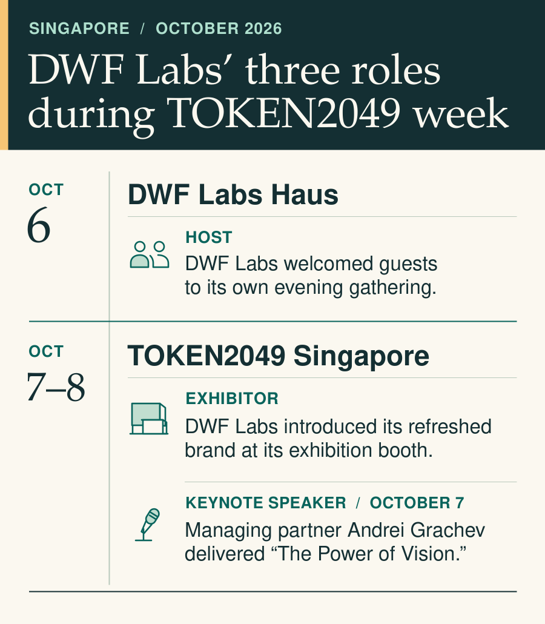
When TOKEN2049 opened, DWF had a refreshed brand to introduce. Its exhibition booth brought the new design and messaging onto the show floor, where potential partners could meet the team. At Haus, DWF’s name identified the gathering itself. At TOKEN2049, visitors looking for the firm could find it on a stand among the other exhibitors.
Grachev’s October 7 keynote, “The Power of Vision,” gave the firm another way to participate. He argued that smaller companies can challenge established players by solving a specific problem their rivals have left in place. He urged teams to move quickly and described the limits of copying an established company in a crowded market. Those views belonged to Grachev, speaking on the conference stage. In its account of the exhibition, DWF singled out a benefit the stand offered its wider team. Potential partners could stop by and meet them in person.
In Singapore, the timing of Haus helped distinguish it from the conference where DWF exhibited and spoke. A year earlier in Buenos Aires, visitors to another Web3 gathering could walk into the main venue and still find events that independent groups had organized.
Independent Teams Ran Events Inside Devconnect’s Main Venue
At Devconnect in Buenos Aires in 2025, the Ethereum World’s Fair occupied La Rural. Exhibiting teams showed visitors working applications built on Ethereum, grouped into districts devoted to subjects including art and privacy. In its account of the week in Buenos Aires, the Ethereum Foundation’s Devcon Team counted 40 events run by independent teams inside La Rural.
Visitors could use the Devconnect app to find their way around the venue, browse the program, and build a personal schedule. That shared guide brought together contributions from teams with different responsibilities. On the fairgrounds, the division of work was visible in the rooms themselves. The fair provided discussion corners, coworking spaces, and bookable meeting rooms. Community groups organized 15 hubs, giving people interested in a particular subject a place to meet. Exhibitors had applications to demonstrate, and visitors could try new wallets and talk to the teams building them.
The Devcon Team separately counted at least 500 community-run side events across Buenos Aires, including workshops, meetups, and hackathons. The distinction between those gatherings and the 40 events at La Rural was geographic. Independent teams organized events in both settings, including some that visitors could attend without leaving the fairgrounds.
How Local Groups Shaped the Week in Buenos Aires
Local organizing had begun months before the fair opened. In April 2025, the Ethereum Foundation began supporting initiatives through a grants program called Destino Devconnect. It reported supporting at least 100 events across 14 Latin American countries. Those figures cover the regional effort leading up to Devconnect. The foundation supplied funding, while local teams did the work of putting the gatherings on.
One of the major events during Devconnect was ETHCon Buenos Aires. SEED Latam, Crecimiento, Ethereum Argentina, ETH Kipu, and Mujeres en Cripto organized it with regional partners. Its talks and panels covered subjects ranging from art to public infrastructure. Representatives of Mercado Libre and YPF were among the speakers.
A company describing its participation in ETHCon can point directly to a speaker and the discussion that person joined. The organizing credit belongs to the local groups and regional partners who brought those speakers together. The conference calendar tells a reader where ETHCon fits. The list of hosts identifies who actually put it on.
To read more content like this, explore The Brand Hopper
Subscribe to our newsletter