Last Updated on November 2, 2026 by Team TBH
HP and Lenovo are two of the world’s largest PC manufacturers, competing across consumer laptops, business computers, gaming systems, workstations, and AI-powered devices. Together, they accounted for approximately 48.5% of global PC shipments in 2025, making them two of the most influential brands in the industry.
But which brand is actually better? The answer depends on whether you are a student, gamer, content creator, business professional, or IT manager purchasing computers for an organization.
In this guide, we compare HP and Lenovo across global market share, financial performance, laptop portfolios, premium and business models, gaming laptops, AI PCs, pricing, build quality, and after-sales support.
A Quick History of Both Brands
HP
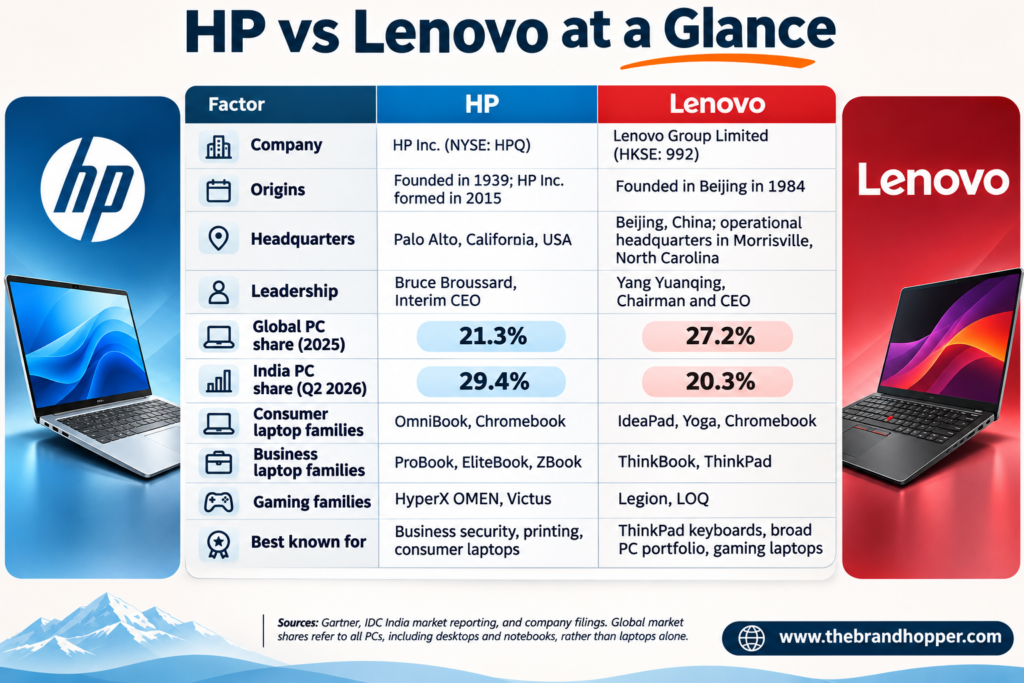
HP was founded in 1939 by Bill Hewlett and David Packard in a small garage in Palo Alto, California. It became one of Silicon Valley’s most influential technology companies.
In November 2015, Hewlett-Packard separated into two independent publicly traded companies: HP Inc., which retained the personal computer and printing businesses, and Hewlett Packard Enterprise, which took over enterprise technology infrastructure and services.
HP Inc. subsequently expanded its portfolio through acquisitions. It acquired gaming peripherals company HyperX in 2021 and video-conferencing company Poly in 2022.
In January 2026, HP announced that OMEN and HyperX would operate under one master gaming brand, HyperX, with OMEN continuing as a product sub-brand for gaming systems.
HP also underwent a leadership transition in 2026. Enrique Lores stepped down as President and CEO on February 3, 2026, and Bruce Broussard, a member of HP’s Board of Directors and former CEO of Humana, was appointed Interim CEO.
Lenovo
Lenovo was founded in Beijing in 1984 as Legend by a group of engineers led by Liu Chuanzhi. It initially focused on distributing and developing computer technology in China.
Its defining milestone came in 2005, when Lenovo completed the acquisition of IBM’s personal computing business. The deal brought the ThinkPad brand into Lenovo’s portfolio and significantly expanded its global presence.
Lenovo subsequently acquired IBM’s x86 server business in 2014 and Motorola Mobility’s handset business in 2014, strengthening its presence in enterprise infrastructure and smartphones.
Today, Lenovo is a global technology company with operations in approximately 180 markets. Its portfolio includes PCs, smartphones, tablets, servers, storage, software, and IT services.
Lenovo is also an Official Technology Partner of FIFA, including the FIFA World Cup 2026.
Market Share: Who Sells More PCs?
Lenovo is the world’s largest PC manufacturer by shipment volume, while HP holds the second position.
According to Gartner’s preliminary full-year 2025 data, Lenovo shipped approximately 73.6 million PCs, compared with 57.5 million for HP.
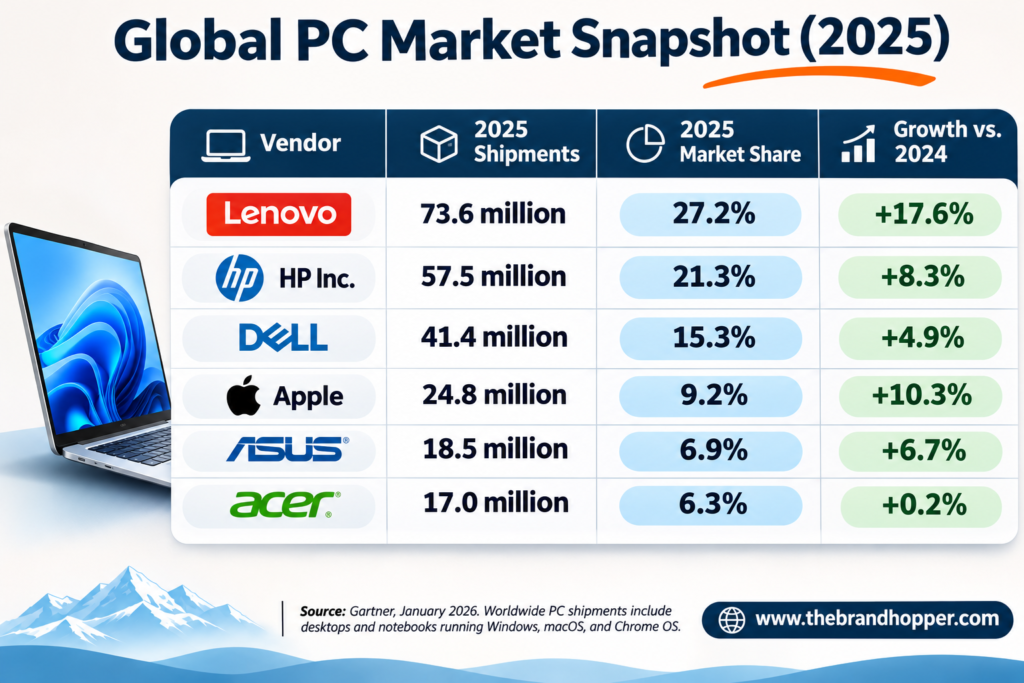
Lenovo’s lead reflects its broad product portfolio, global distribution network, and presence across consumer, commercial, and enterprise PC markets.
HP remains a strong competitor, particularly in commercial PCs, where it has an established presence among businesses, government organizations, and educational institutions.
The Global PC Market in Q3 2026
The global PC market experienced a sharp correction in the third quarter of 2026 as higher memory and storage costs pushed up computer prices.
Gartner reported that worldwide PC shipments fell 22.4% year-on-year to approximately 55.4 million units in Q3 2026.
| Vendor | Q3 2026 shipments | Market share | Year-on-year shipment growth |
|---|---|---|---|
| Lenovo | 15.0 million | 27.1% | -22.4% |
| HP Inc. | 10.4 million | 18.7% | -30.9% |
| Dell | 7.6 million | 13.7% | -25.4% |
| Apple | 5.8 million | 10.5% | -7.1% |
| ASUS | 4.7 million | 8.5% | -13.0% |
| Acer | 3.9 million | 7.0% | -11.2% |
Source: Gartner preliminary worldwide PC shipment estimates, October 12, 2026.
Lenovo maintained its 27.1% market share despite a substantial decline in shipments. HP experienced a steeper contraction, with shipments falling 30.9% and its market share declining to 18.7%.
Gartner attributed the market decline to higher memory and storage costs, weaker affordability, and a shift in demand toward higher-priced configurations.
Financial Muscle: Which Company Is Stronger?
Both companies are financially established, but Lenovo is considerably larger by total revenue and has recently delivered stronger revenue growth.
Their fiscal years differ: Lenovo’s financial year ends on March 31, while HP’s ends on October 31. The figures below therefore refer to different reporting periods.
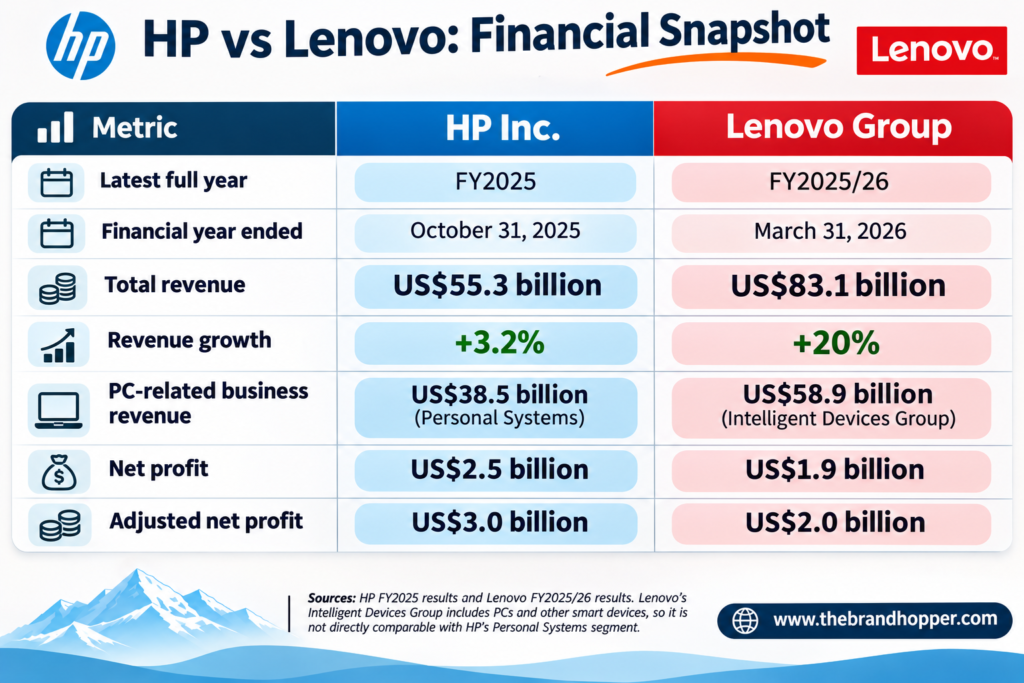
Lenovo’s Intelligent Devices Group generated US$58.9 billion in FY2025/26, representing 17% year-on-year growth. The group includes PCs and smart devices, rather than laptops alone.
HP’s Personal Systems business generated US$38.5 billion in FY2025, up 6% year-on-year. Its commercial PC business contributed US$27.4 billion, while consumer PCs generated US$11.1 billion.
HP also has a substantial printing business, which generated approximately US$16.7 billion in FY2025 revenue.
Latest Quarterly Performance
Lenovo reported its first-quarter FY2026/27 results in August 2026, recording its strongest quarterly revenue in company history.
Group revenue reached US$26.9 billion, up 43% year-on-year. Adjusted net income increased 176% to US$1.1 billion, while AI-related revenue reached US$9.3 billion.
HP’s third-quarter FY2026 results, covering the three months ended July 31, 2026, showed revenue of US$15.7 billion, up 12.5% year-on-year.
Its Personal Systems business generated US$11.8 billion in revenue, up 18.5%. However, PC unit volume declined 15.8%, while average selling prices increased 40.8%, reflecting pricing actions, currency effects, and a shift toward higher-value configurations.
Winner, financial strength: Lenovo for total revenue, growth, and scale; HP remains a substantial business with a profitable printing segment and a strong commercial PC operation.
Laptop Lineups Decoded
Both companies offer laptops across nearly every major price and performance category.
Their product families are structured differently, but there is considerable overlap in the customers they target.
| Category | HP | Lenovo |
|---|---|---|
| Budget and everyday | OmniBook 3, OmniBook 5, Chromebook | IdeaPad Slim, IdeaPad 5, Chromebook |
| Premium consumer | OmniBook Ultra, OmniBook X, OmniBook 7 | Yoga Slim, Yoga Pro |
| Mainstream business | ProBook, EliteBook | ThinkBook, ThinkPad E, L, T series |
| Premium business | EliteBook X, EliteBook 8 | ThinkPad X1 Carbon, X1 2-in-1, X9 |
| Mobile workstations | ZBook | ThinkPad P series |
| Gaming | HyperX OMEN, Victus | LOQ, Legion |
The specific processors, configurations, and availability vary by country and product generation. Not every model in a product family is sold in every market.
Premium Laptops: OmniBook Ultra vs. Lenovo Yoga
HP’s OmniBook family represents its premium consumer laptop portfolio. The OmniBook Ultra 14 is among its most advanced models, with configurations powered by Qualcomm Snapdragon X2 processors.
The OmniBook Ultra 14 can be configured with Snapdragon X2 Elite processors offering up to 85 NPU TOPS, as well as an X2 Plus option offering up to 80 NPU TOPS. These specifications are configuration-dependent and should not be interpreted as a measure of overall CPU or graphics performance.
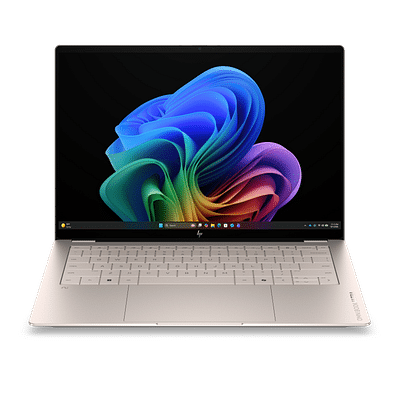
Lenovo competes through its Yoga portfolio, particularly the Yoga Slim and Yoga Pro ranges. The Yoga Slim 7i Ultra Aura Edition uses Intel Core Ultra Series 3 processors and offers a 14-inch OLED display, with selected configurations weighing less than 1 kg.
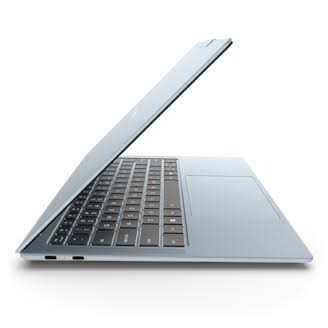
For creators and professionals who need more graphics performance, Lenovo’s Yoga Pro models offer configurations with dedicated NVIDIA graphics.
Winner, premium consumer: HP offers an impressive lightweight Snapdragon-based option, while Lenovo provides a broad selection of premium designs and configurations. The better choice depends on operating-system compatibility, processor performance, battery life, display quality, and intended workload.
Business Laptops: EliteBook vs. ThinkPad
Business laptops are an important part of both companies’ portfolios. These products are designed for professional users and organizations that require security, reliability, manageability, and long-term support.
Lenovo ThinkPad
The ThinkPad is one of the most recognizable business laptop families in the world. It is known for its keyboard design, TrackPoint pointing device, business-focused features, and extensive range of configurations.
The ThinkPad portfolio includes the entry-level E series, mainstream L and T series, premium X1 Carbon and X1 2-in-1 models, and mobile workstations in the P series.
The ThinkPad X1 Carbon Gen 14 Aura Edition is a premium example of Lenovo’s business laptop strategy. It features Intel Core Ultra Series 3 processors, an NPU of up to 49 TOPS in the cited configuration, and a lightweight design.
ThinkPad models also offer enterprise-oriented security and manageability features, with specifications varying by model and configuration.
HP EliteBook
HP’s EliteBook family competes directly with ThinkPad in the enterprise laptop market. It includes mainstream EliteBook models and premium systems such as the EliteBook X family.
EliteBooks focus on security, manageability, conferencing, and productivity. HP Wolf Security provides hardware and software security features designed to protect business devices against cyber threats.
HP also offers a broad portfolio of commercial support services, including device management, warranty extensions, and on-site support options.
Winner, business laptops: Lenovo ThinkPad is a strong choice for users who prioritize keyboard experience, portability, and a broad business range. HP EliteBook is equally competitive for organizations prioritizing HP’s security and fleet-management ecosystem.
Gaming Laptops: Legion vs. HyperX OMEN
Lenovo and HP both offer gaming laptops across entry-level, mid-range, and high-performance categories.
Lenovo’s gaming portfolio is divided between the more affordable LOQ range and the premium Legion family.
The 2026 Legion and LOQ ranges include models powered by newer Intel and AMD processors, alongside NVIDIA GeForce RTX 50-series laptop GPUs. Selected models feature OLED displays, high-refresh-rate panels, and Lenovo’s advanced cooling systems.
Lenovo also sells the Legion Go handheld gaming device, including a SteamOS-powered version.
HP has reorganized its gaming portfolio under the HyperX master brand. OMEN continues as the dedicated product sub-brand for high-performance gaming systems, while Victus targets more budget-conscious gamers.
The HyperX OMEN MAX 16 is one of HP’s flagship 2026 gaming laptops. It offers configurations with up to an NVIDIA GeForce RTX 5090 laptop GPU, up to 64GB of DDR5 memory, and a 16-inch 2.5K OLED display with a 240Hz refresh rate.
Winner, gaming: Lenovo has an extensive range across LOQ, Legion, and Legion Go. HP’s HyperX OMEN MAX 16 is a serious flagship competitor, so the best choice depends on the specific GPU, cooling system, display, and price.
AI PCs: Who Is Ahead?
Artificial intelligence has become a major focus for both HP and Lenovo. Their latest laptops increasingly include dedicated neural processing units, or NPUs, designed to accelerate AI workloads locally on the device.
These devices support features such as background noise reduction, image processing, live captions, productivity assistance, and other AI-enabled applications.
Lenovo’s AI strategy extends beyond PCs into smartphones, servers, infrastructure, and enterprise services. In Q1 FY2026/27, AI-related revenue reached US$9.3 billion, accounting for 35% of total group revenue.
HP is also expanding its AI PC portfolio through OmniBook and EliteBook products. Its OmniBook Ultra 14, for example, offers Snapdragon X2 configurations with up to 85 NPU TOPS.
However, NPU TOPS alone do not determine which laptop is better for AI workloads. CPU performance, GPU capability, memory, software compatibility, and the specific AI application all matter.
Winner, AI PCs: Both brands are competitive. Lenovo has a broader AI strategy across devices and infrastructure, while HP offers strong AI-focused consumer and commercial PCs.
Laptop Prices in 2026: Why Everything Costs More
Laptop prices have come under pressure in 2026 as memory and storage component costs have increased.
Demand from AI data centres has contributed to higher demand for memory and storage components. Gartner reported that DRAM costs surged fivefold year-on-year in Q2 2026, while warning that higher component prices were affecting PC shipments.
In February 2026, Gartner forecast that combined DRAM and SSD prices could increase substantially by the end of the year, potentially pushing average PC prices higher.
The impact became visible in HP’s FY2026 third-quarter results. Commercial PC average selling prices increased 41.1% year-on-year, while consumer PC average selling prices rose 37.1%.
These increases do not mean every laptop became more expensive by the same percentage. HP’s figures reflect both pricing actions and changes in product mix, while individual retail prices vary by configuration and market.
Buying tip: Compare the processor, RAM, SSD, graphics, display, battery, and warranty rather than relying only on the model name. Prices announced at CES or in the US may differ significantly from retail prices in India.
Build Quality, Support and Warranty
Both HP and Lenovo offer laptops across a wide range of materials, designs, and price categories. Build quality therefore depends more on the specific model and product family than on the brand as a whole.
ThinkPad, EliteBook, Yoga Pro, and OmniBook Ultra models generally target more demanding users and offer more premium construction than entry-level IdeaPad or OmniBook models.
For business users, both companies provide enterprise support and warranty services. HP offers Care Pack services, while Lenovo provides Premium Care and Premier Support options.
Warranty duration, accidental damage protection, on-site support, and service availability vary by model, country, and purchase configuration.
In India, HP and Lenovo both have established service networks. HP’s large market presence can make it easier to find authorized service options in many locations, while Lenovo offers dedicated support services for ThinkPad business customers.
Winner, support: No universal winner. Compare local service availability, warranty terms, turnaround time, and the exact support package included with the laptop.
HP vs. Lenovo: Which Should You Buy?
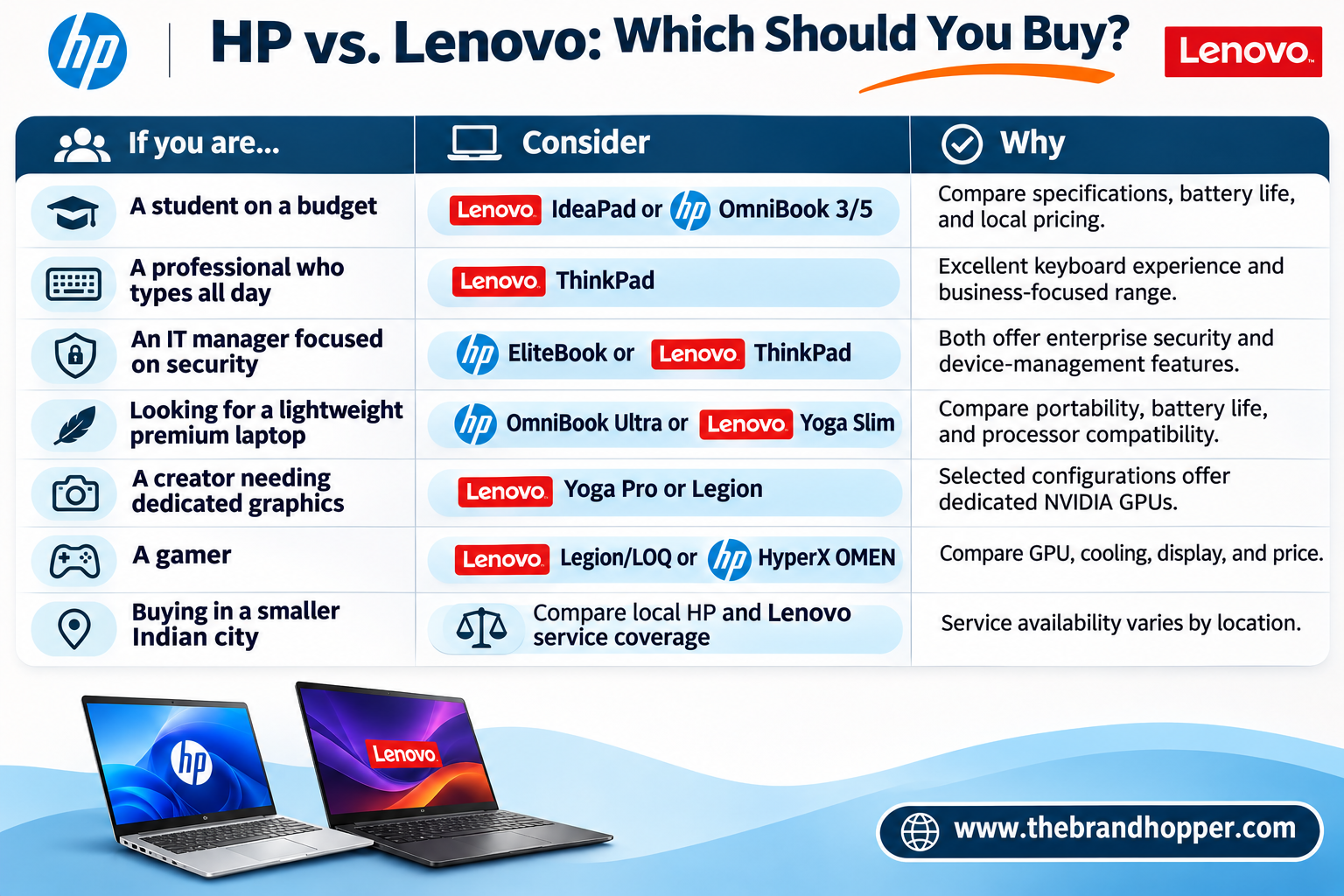
The Bottom Line
Lenovo has the advantage in global PC shipments, overall revenue, and breadth of its product portfolio. Its ThinkPad, Yoga, IdeaPad, Legion, and LOQ ranges cover a wide variety of consumer and professional requirements.
HP remains a major competitor, with a particularly strong position in India, an established commercial PC business, premium OmniBook laptops, enterprise-focused EliteBooks, and a reorganized HyperX OMEN gaming portfolio.
Neither brand is universally better. The right decision depends on the specific laptop configuration, intended workload, budget, warranty, and local after-sales support.
For most buyers, comparing individual models from both brands is more useful than choosing based on the company name alone.
Frequently Asked Questions
Q: Is HP or Lenovo better for laptops?
A: Lenovo offers a broader range of laptops across consumer, business, and gaming categories. HP is also highly competitive, particularly in premium consumer laptops and enterprise-focused EliteBook systems. The better choice depends on the model and intended use.
Q: Which brand sells more PCs, HP or Lenovo?
A: Lenovo. Gartner estimates that Lenovo shipped approximately 73.6 million PCs in 2025, giving it a 27.2% global market share. HP shipped approximately 57.5 million PCs, with a 21.3% share.
Q: Which is No. 1 in India, HP or Lenovo?
A: HP led India’s traditional PC market in Q2 2026, with a reported 29.4% share. Lenovo ranked second with approximately 20.3%.
Q: Is Lenovo a Chinese company?
A: Yes. Lenovo was founded in Beijing, China, in 1984. It is listed on the Hong Kong Stock Exchange and operates globally, with operational headquarters in Beijing and Morrisville, North Carolina.
Q: Who is the CEO of HP in 2026?
A: Bruce Broussard has been HP’s Interim CEO since February 3, 2026, following Enrique Lores’s departure. HP’s Board of Directors announced a search for a permanent CEO.
Q: Which is better for students, HP or Lenovo?
A: Both brands offer suitable student laptops. Lenovo IdeaPad models and HP OmniBook 3 and 5 models cover a wide range of budgets. Students should compare processor generation, memory, storage, battery life, weight, and warranty before buying.
Q: Which is better for gaming, HP or Lenovo?
A: Lenovo offers a broad gaming range through its Legion and LOQ brands, while HP competes through HyperX OMEN and Victus. Compare the exact GPU, cooling system, display refresh rate, and price to identify the better gaming laptop.
Q: Why are HP and Lenovo laptops more expensive in 2026?
A: Higher memory and storage costs have contributed to increased PC prices in 2026. Demand from AI data centres has added pressure to component supply, while manufacturers have adjusted prices and product configurations.
Also Read: Dell vs HP: Which Laptop Brand Is Better?
To read more content like this, subscribe to our newsletter