Last Updated on September 5, 2026 by Team TBH
Uber and Lyft turned “hailing a ride” from a street-corner arm wave into a smartphone tap, and more than fifteen years later they remain the two dominant ride-hailing apps in North America.
But the two companies have taken increasingly different paths — one built a sprawling, multi-billion-dollar global logistics and delivery empire, while the other doubled down on being a leaner, US-focused, pure-play rideshare business.
Here’s a complete, data-driven comparison of both platforms using the latest figures, covering history, ownership, financials, market share, and which one actually deserves your next ride request.
How Uber Began: A Cold Paris Night and a Missed Taxi
Uber’s origin story is one of Silicon Valley’s most repeated founding myths, and it holds up reasonably well: in 2008, entrepreneurs Travis Kalanick and Garrett Camp were in Paris and struggled to hail a cab on a cold night, sparking the idea for an app that could summon a private driver with a single tap.

The company was founded as UberCab in March 2009, and it began actually offering rides in San Francisco in 2010 with just three cars available for hire.
Growth from there was explosive: Uber expanded into multiple international markets by 2012 and became one of the fastest-growing (and most controversial) startups in tech history, eventually going public via IPO in 2019.
How Lyft Began: A Carpooling Idea That Pivoted
Lyft’s founders, John Zimmer and Logan Green, actually started their ride-sharing journey years earlier with a company called Zimride, launched in 2007 as a peer-to-peer carpooling service aimed at long-distance trips between cities.

Recognizing that short, everyday urban trips represented a much bigger opportunity, the pair launched Lyft as a standalone product on May 22, 2012, explicitly positioning it as a friendlier, lower-cost alternative to Uber, complete with the now-retired signature pink mustaches once mounted on drivers’ front grilles.
Lyft went public in March 2019, just months before Uber’s own IPO.
Who Owns Uber Today?
Uber Technologies, Inc. is a publicly traded company (NYSE: UBER) with no single controlling shareholder, having diluted founder Travis Kalanick’s stake significantly through the company’s rocky 2017 leadership shakeup and subsequent IPO.
As of early 2026, the largest institutional shareholders are Vanguard Group (~9.34%), BlackRock (~6.82%), and Capital Research Global Investors (~5.78%).
Current CEO Dara Khosrowshahi, who took over in 2017 following Kalanick’s ouster amid a wave of corporate governance scandals, holds a comparatively modest personal stake of under a million shares, worth tens of millions of dollars rather than a controlling position.
Kalanick himself sold down the vast majority of his Uber holdings years ago and has since moved on to other ventures.
Who Owns Lyft Today?
Lyft, Inc. is likewise a publicly traded company (NASDAQ: LYFT) with a diffuse institutional shareholder base and no controlling owner.
Co-founders Logan Green and John Zimmer remain shareholders, though their stakes have been diluted over multiple funding rounds and the company’s 2019 IPO, similar to the pattern at Uber.
Neither founder currently serves as CEO: David Risher, a former Amazon executive and nonprofit leader, took over as Lyft’s CEO in April 2023, immediately implementing a significant workforce reduction (cutting roughly 26% of staff) as part of a broader push toward operational discipline and profitability that has visibly paid off in Lyft’s improving FY2025 financial results.
Uber vs Lyft: FY2025 Financial Results Compared
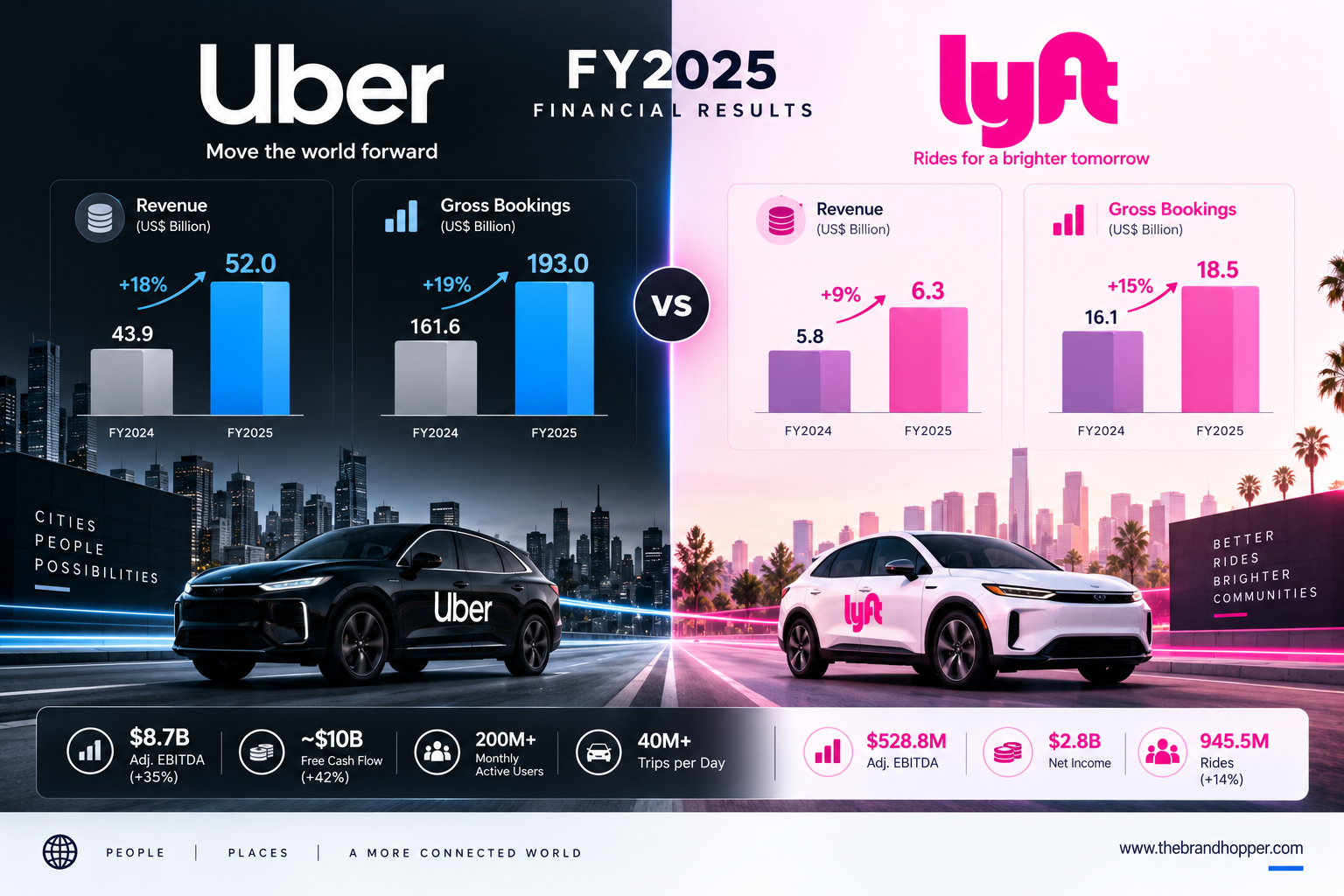
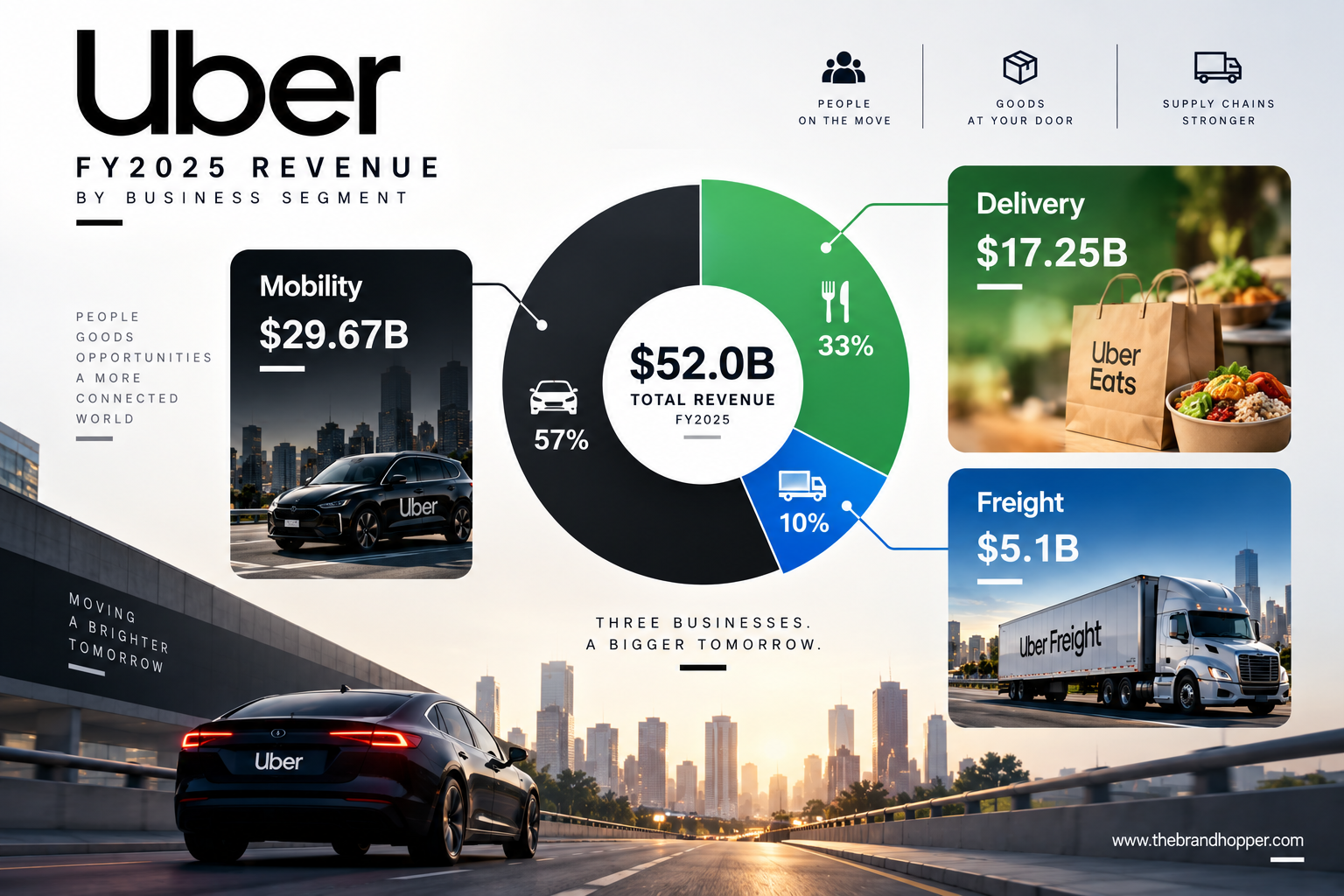
The scale gap between these two companies has only widened. Uber closed FY2025 with revenue of $52.0 billion, up 18.3% year-over-year, alongside $193 billion in total gross bookings — Uber’s fifth consecutive year of 20%-plus annual gross bookings growth.
Profitability has scaled right alongside revenue: Uber posted record Adjusted EBITDA of $8.7 billion (up 35% YoY) and free cash flow of roughly $9.8-10 billion (up 42% YoY) for the year, with more than 200 million monthly active platform users completing over 40 million trips every single day.
Lyft, by comparison, reported FY2025 revenue of $6.3 billion, up 9% year-over-year, and gross bookings of $18.5 billion, up 15%.
Lyft’s standout figure was net income of $2.8 billion for the year, a dramatic swing from just $22.8 million in 2024, though that jump was significantly boosted by a one-time tax valuation allowance release rather than pure operating improvement; Lyft’s Adjusted EBITDA of $528.8 million (up from $382.4 million in 2024) is the more representative measure of its underlying operating profitability.
Lyft also delivered an all-time-high 945.5 million rides for the year, up 14%, marking its eleventh consecutive quarter of double-digit ride growth heading into year-end.
Business Model: Diversified Giant vs Focused Specialist
The clearest structural difference between the two companies is diversification.
Uber now operates as three distinct, meaningfully sized businesses: Mobility (ride-hailing) generated $29.67 billion in FY2025 revenue (57% of the total), Delivery (Uber Eats) generated $17.25 billion (33% of the total, and Uber’s fastest-growing segment at 25% YoY growth), and Freight generated $5.1 billion (about 10% of the total, though this segment actually declined 1% amid a soft freight market).
Lyft, by contrast, remains almost entirely a pure-play rideshare company focused overwhelmingly on the US and Canadian markets, without a comparable food-delivery or freight-logistics arm to diversify its revenue base.
This makes Uber a fundamentally different kind of investment and business proposition — a diversified transportation-and-logistics conglomerate — compared to Lyft’s more concentrated, single-category bet.
Market Share: Uber’s Dominance vs Lyft’s Niche
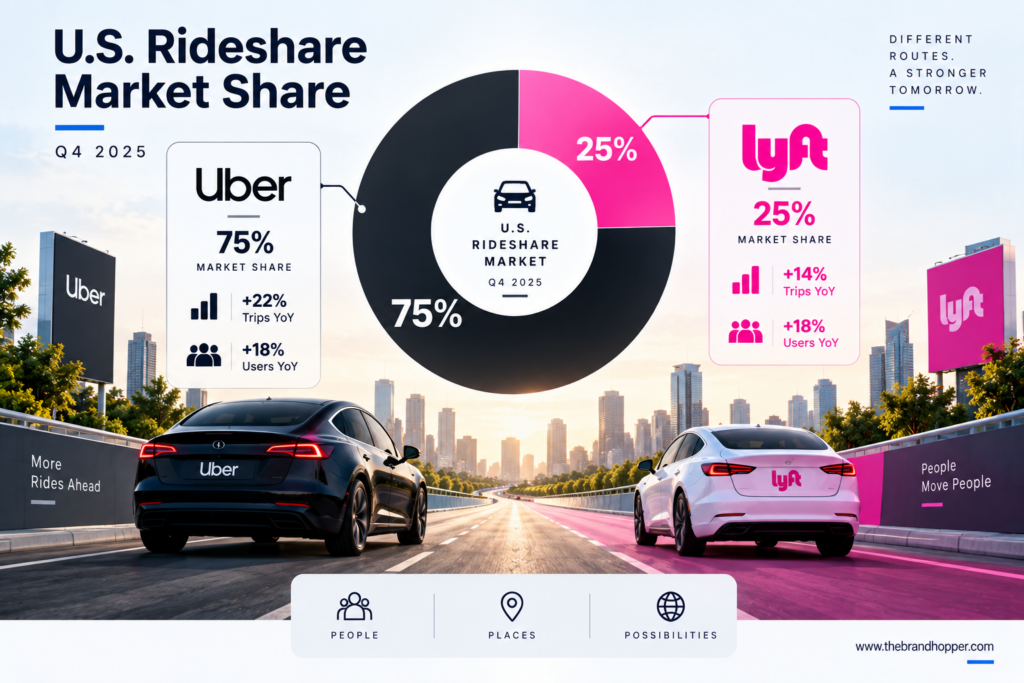
In the US, the market where both companies compete most directly, Uber holds roughly three-quarters of the rideshare market to Lyft’s one-quarter, a gap that has remained fairly consistent for years despite Lyft’s periodic pushes to close it.
In Q4 2025, Uber’s trip volume grew 22% year-over-year compared to Lyft’s 14% growth, and both platforms saw user growth of roughly 18% — but because Uber’s base is so much larger to begin with, it added roughly seven times as many total riders as Lyft did in absolute terms during the same period.
Uber’s global footprint, spanning dozens of countries, also gives it access to international growth markets that Lyft, which operates almost exclusively in the US and Canada, simply doesn’t have.
Pricing and the Driver Experience
For riders, pricing between Uber and Lyft is famously close and highly situational: neither app is consistently cheaper, and prices fluctuate based on real-time demand (surge or “Prime Time” pricing), driver availability, and local market conditions, making a quick price-check across both apps before booking the most reliable way to save money on any given ride.
For drivers, the two platforms have historically competed on commission structures, bonus incentives, and driver-friendly features, with Lyft frequently marketing itself as the more driver-focused alternative, particularly since CEO David Risher’s tenure has emphasized driver relationships and platform trust as explicit strategic priorities.
Neither company classifies its drivers as employees in most US markets, a classification that has remained the subject of ongoing regulatory and legal battles in states like California and Massachusetts.
Autonomous Vehicles: The Next Battleground
Both companies are increasingly betting on autonomous vehicles as the next major front in ride-hailing competition.
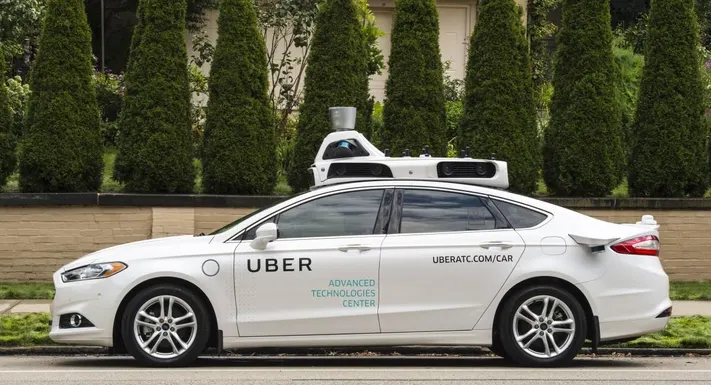
Uber has pursued a partnership-heavy strategy, integrating self-driving vehicles from multiple third-party providers directly into its app across a growing list of pilot cities, positioning itself as the marketplace layer on top of whichever autonomous technology ultimately wins rather than building its own self-driving stack from scratch.
Lyft has taken a similar partnership approach on a smaller scale, working with autonomous vehicle developers to add robotaxi options in select markets, though its more limited financial resources compared to Uber mean it’s generally moved more cautiously and with fewer simultaneous partnerships.
How quickly and broadly autonomous rides scale across both platforms over the next few years is widely seen as one of the most important long-term competitive variables separating the two companies’ future growth trajectories.
Which App Is Better for You? A Practical Breakdown
If you travel internationally or frequently order food delivery alongside rides, Uber’s larger footprint and Uber Eats integration make it the more versatile single-app choice, and its larger driver network in most markets often means shorter wait times, especially outside major US cities.
If you primarily ride within the US or Canada and want to support what has positioned itself as the more driver-friendly, community-oriented alternative, Lyft remains a strong choice, and its recent swing to profitability suggests the company’s leaner strategy under Risher is working.
If you’re comparing them purely as investments, Uber offers a larger, more diversified, faster-growing, and more consistently profitable business, while Lyft offers a smaller, more narrowly focused turnaround story that’s shown real recent progress but still operates at a fraction of Uber’s scale.
For most everyday riders, the pragmatic answer is simply to keep both apps installed and compare real-time pricing before every ride — neither company wins that comparison consistently enough to make loyalty to just one worthwhile.
Uber vs Lyft at a Glance (FY2025)
| Fact | Uber | Lyft |
| Founded | 2009 (as UberCab) | 2012 (as a Zimride spin-off) |
| Founders | Travis Kalanick & Garrett Camp | John Zimmer & Logan Green |
| IPO | 2019 | March 2019 |
| Stock listing | NYSE: UBER | NASDAQ: LYFT |
| Largest shareholders | Vanguard (~9.34%), BlackRock (~6.82%) | Diffuse institutional base; founders retain stakes |
| CEO | Dara Khosrowshahi (since 2017) | David Risher (since April 2023) |
| FY2025 revenue | $52.0 billion (+18.3% YoY) | $6.3 billion (+9% YoY) |
| FY2025 gross bookings | $193 billion | $18.5 billion (+15% YoY) |
| FY2025 Adjusted EBITDA | $8.7 billion (+35% YoY) | $528.8 million (up from $382.4M) |
| FY2025 net income | Not directly comparable (EBITDA-focused reporting) | $2.8 billion (boosted by one-time tax benefit) |
| Business segments | Mobility, Delivery (Uber Eats), Freight | Rideshare only (US/Canada-focused) |
| US market share | ~75% | ~25% |
| FY2025 daily/annual usage | 40M+ trips/day, 200M+ monthly users | 945.5 million rides for the year (+14%) |
Key Takeaways
Uber and Lyft both emerged from the same basic insight — that hailing a ride should be as easy as tapping a phone — but have grown into very different businesses over the past decade and a half.
Uber has become a diversified, highly profitable global transportation-and-logistics giant spanning rides, food delivery, and freight, posting $52 billion in FY2025 revenue and $8.7 billion in Adjusted EBITDA.
Lyft has stayed a smaller, US-focused, pure-play rideshare company that posted a genuinely strong FY2025 turnaround under CEO David Risher, including its first meaningful profitable year, even though it still operates at roughly one-eighth of Uber’s revenue scale.
Neither company is going away, and for riders, the smartest strategy remains checking both apps rather than picking a permanent favorite.
Frequently Asked Questions
Q: Is Uber or Lyft bigger?
A: Uber is significantly bigger. In FY2025, Uber reported $52.0 billion in revenue and $193 billion in gross bookings, compared to Lyft’s $6.3 billion in revenue and $18.5 billion in gross bookings.
Q: Who owns Uber?
A: Uber Technologies, Inc. is a publicly traded company (NYSE: UBER) with no controlling shareholder. The largest holders are institutional investors like Vanguard (~9.34%) and BlackRock (~6.82%), and it’s led by CEO Dara Khosrowshahi.
Q: Who owns Lyft?
A: Lyft, Inc. is a publicly traded company (NASDAQ: LYFT) with a diffuse institutional shareholder base. Co-founders Logan Green and John Zimmer remain shareholders, though the company is now led by CEO David Risher, who took over in 2023.
Q: Is Uber or Lyft more profitable?
A: By underlying operating metrics, Uber is far more profitable, posting $8.7 billion in Adjusted EBITDA for FY2025. Lyft reported a headline net income of $2.8 billion, but that figure was significantly boosted by a one-time tax benefit; its Adjusted EBITDA of $528.8 million is the more comparable operating profitability figure.
Q: Which company has a bigger market share, Uber or Lyft?
A: Uber holds roughly three-quarters of the US rideshare market, with Lyft holding the remaining quarter, a gap that has stayed fairly consistent over the past several years.
Q: Does Uber or Lyft have food delivery?
A: Uber does, through Uber Eats, which generated $17.25 billion in FY2025 revenue (33% of Uber’s total). Lyft does not have a comparable food-delivery business and remains focused primarily on rideshare.
Q: Who founded Uber and Lyft?
A: Uber was founded in 2009 by Travis Kalanick and Garrett Camp. Lyft was founded in 2012 by John Zimmer and Logan Green, building on their earlier carpooling company, Zimride, launched in 2007.
Q: Is Uber or Lyft cheaper?
A: Neither is consistently cheaper. Pricing on both platforms fluctuates based on real-time demand, driver availability, and location, so comparing both apps before booking is the most reliable way to find the lower price for any specific ride.
Also Read:
- Netflix vs Amazon Prime: Which Is Better?
- GoPro vs DJI: Best Action Camera Brand?
- Intel vs AMD: Which CPU Brand Is Better?
- Rolex vs Omega: Which Luxury Watch Brand Wins?
To read more content like this, subscribe to our newsletter