Last Updated on October 1, 2026 by Team TBH
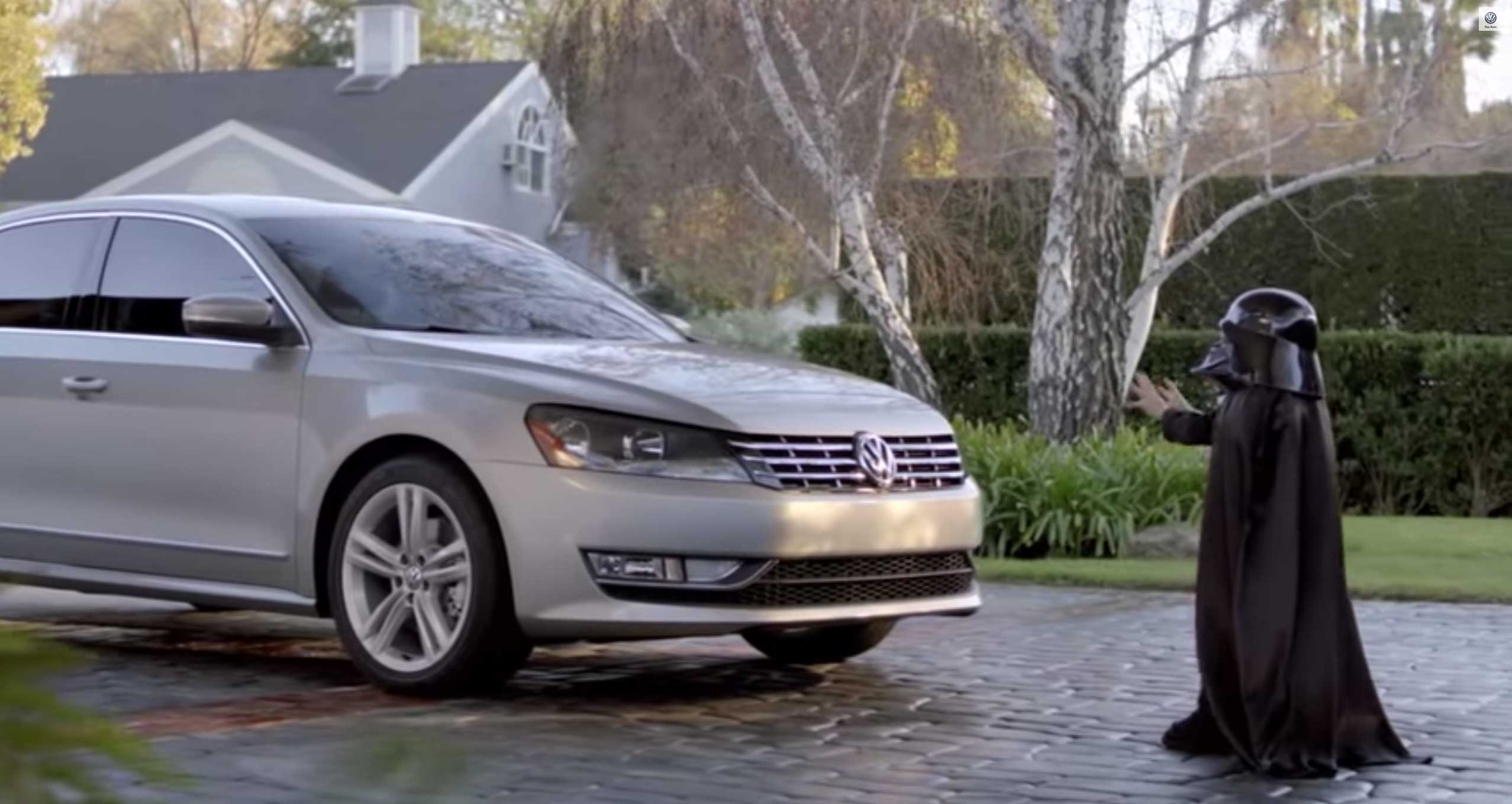
On February 6, 2011, during Super Bowl XLV, Volkswagen aired a 30-second commercial that would become one of the most studied automotive ads of its era: a pint-sized Darth Vader marching around a suburban home trying, and repeatedly failing, to move objects with the Force — until his father’s new Volkswagen Passat mysteriously roars to life.
“The Force” wasn’t just a memorable ad; it was a carefully timed launch strategy for the redesigned 2012 Passat, which Volkswagen was introducing specifically for the U.S. market.
Volkswagen released the spot online before the game, generating millions of views before it even aired and helping establish the now-common practice of using digital platforms to build anticipation around major-event advertising.
The campaign also delivered measurable commercial results. The U.S. Passat was redesigned as part of Volkswagen’s strategy to expand its presence in the American midsize-car market, and 2011 Passat sales reached 20,902 units, up 116% from the previous year. Volkswagen had returned to Super Bowl advertising in 2010 after a nine-year hiatus, making its 2011 appearance the company’s second consecutive Super Bowl campaign.
Fifteen years later, the story looks very different. The Passat was discontinued in the United States after the 2022 model year, ending the U.S. run of the model that “The Force” had helped launch. Volkswagen returned to the Super Bowl in 2024 with “An American Love Story,” a 60-second film celebrating 75 years of Volkswagen in America and using the company’s history — from the Beetle to the ID. Buzz — as the centerpiece.
Volkswagen’s recent U.S. sales trajectory has also been more mixed than a simple decline narrative suggests. The Volkswagen brand sold 329,813 vehicles in the U.S. in 2025, down about 13% from 2024, while the first quarter of 2026 saw another decline.
However, sales rebounded sharply in the second quarter: Q2 2026 sales rose 24.9% year over year, lifting first-half 2026 sales to 162,961 vehicles, up 2.3% from the first half of 2025.
This case study follows the full arc — from the creative strategy and results of “The Force” to Volkswagen’s evolving U.S. product lineup, advertising strategy, and sales performance in 2025 and 2026.
Background: Why Volkswagen Needed a Cultural Moment in 2011
Volkswagen entered 2011 with a specific, numbers-driven problem: the outgoing Passat sold only 12,497 units in the U.S. in 2010, a small volume compared with the Toyota Camry and Honda Accord, which dominated the midsize sedan market.
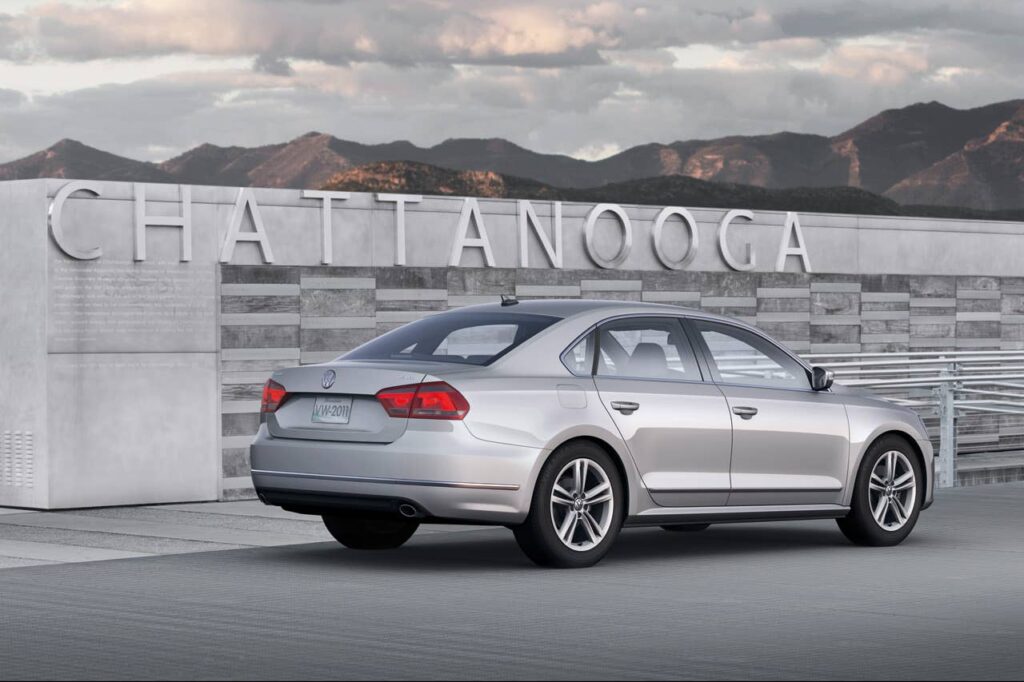
To address that gap, Volkswagen developed an all-new 2012 Passat specifically for the American market — making it larger, more stylish and more affordable than its predecessor — and built it at the newly established assembly plant in Chattanooga, Tennessee.
The plant assembled its first customer Passat on April 18, 2011, with the official plant opening following in May.
Volkswagen’s broader U.S. strategy called for substantially increasing sales, while demand for the new Passat ultimately reached about 10,000 units a month as the launch gained momentum in 2012.
To generate awareness and anticipation for the redesigned sedan, Volkswagen of America, marketing chief Tim Ellis and agency Deutsch LA chose one of the biggest media stages available: Super Bowl XLV.
Importantly, this was not Volkswagen’s first Super Bowl appearance in more than ten years — the company had returned to the event in 2010 after a nine-year hiatus, making the 2011 campaign its second consecutive Super Bowl appearance.
The Creative Idea: A Six-Year-Old, a Costume, and No Dialogue
Deutsch LA’s creative idea paired a universally recognized piece of pop culture — Star Wars — with a simple, largely wordless story about childhood wonder.
Six-year-old actor Max Page plays a boy in a full Darth Vader costume attempting to use the Force on a doll, the family dog, a washing machine and other household objects, with the sequence set to John Williams’ iconic “Imperial March” and no spoken dialogue. When his father arrives home in the new Passat, the boy focuses everything he has on the car — and its engine roars to life, apparently by his will.
In reality, his father has quietly triggered the Passat’s remote-start feature with the key fob, a small product feature folded seamlessly into the emotional payoff rather than presented as a conventional feature demonstration.
TIME later reported that the creative team’s spark came from a real photograph of a boy dressed as Darth Vader inside a Burger King, which had been displayed above a copy machine in Deutsch’s Los Angeles office.
That image helped inspire the concept of a young Darth Vader trying and failing to use the Force around his home. Volkswagen also officially confirmed that it had partnered with Lucasfilm for the Passat advertisement, bringing the Star Wars characters and music into the campaign.
The partnership extended beyond the commercial: later in 2011, Lucasfilm and eBay included a one-of-a-kind Star Wars-edition 2012 Volkswagen Passat in the “Use the Force for Good” charity auction, with proceeds benefiting Stand Up To Cancer. The customized Passat was also showcased at events including San Diego Comic-Con.

Campaign Execution: Breaking the Super Bowl Secrecy Rule
Volkswagen’s distribution strategy broke with 2011-era convention as sharply as its creative did. Rather than guarding the ad as a surprise for game day, VW released the full 60-second version on YouTube on Wednesday, February 2, 2011 — four days before Super Bowl XLV.
Within its first 24 hours, the video had passed 1 million views, and by Thursday morning it had reached about 1.8 million views. By kickoff on Sunday, Deutsch reported that the ad had accumulated approximately 17 million views, meaning “The Force” had already generated enormous online attention before it appeared on television.
A 30-second cut aired during the Super Bowl broadcast, while the longer 60-second version remained available online. Volkswagen also ran a separate commercial promoting the 21st Century Beetle, and “The Force” ultimately ranked No. 3 in USA Today’s Ad Meter for Super Bowl XLV.
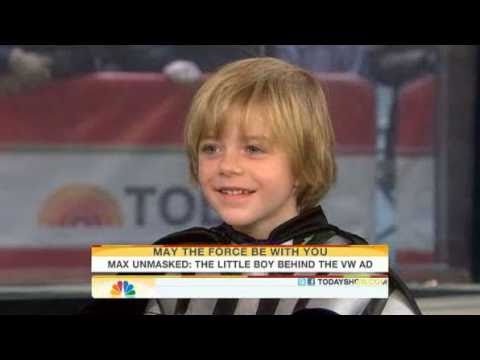
The campaign’s media life continued beyond the game itself. Six-year-old star Max Page appeared on NBC’s Today show on February 7, where he removed his Darth Vader mask and was introduced to viewers following the commercial’s breakout success.
Deutsch LA’s combination of early digital release, organic sharing and a high-profile Super Bowl broadcast became an influential model for subsequent advertisers. Volkswagen itself said the strategy had allowed the company to dominate the advertising conversation before the game, while later advertising-industry coverage identified “The Force” as an important catalyst for the practice of pre-releasing Super Bowl commercials online.
Results: Views, Awards, and Real Passat Sales Growth
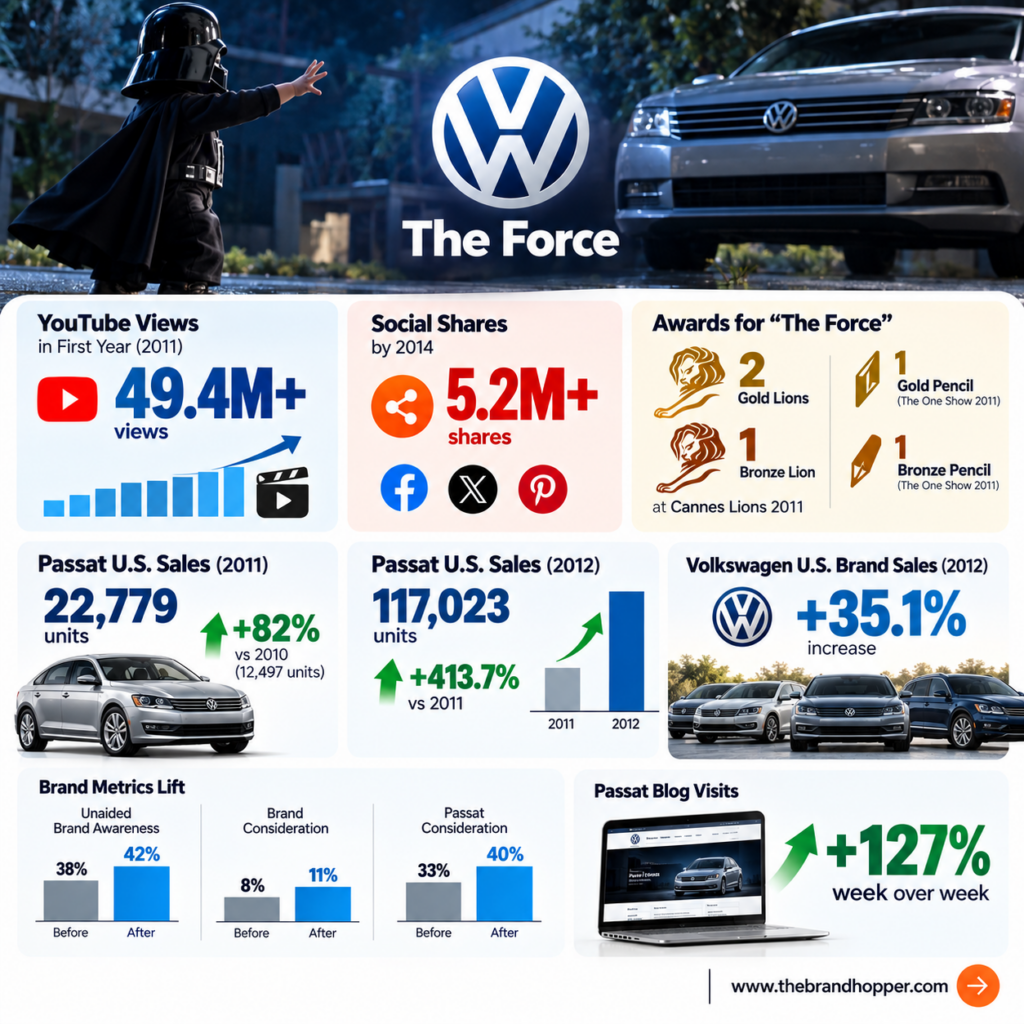
By measurable reach, “The Force” was one of the most-watched advertising videos of its era. The commercial accumulated more than 49.4 million views in its first year, according to the IPA effectiveness case study, making it the most-viewed video advertisement globally in 2011.
The ad also set a major social-sharing record. By 2013, “The Force” was the most-shared Super Bowl advertisement ever, and by 2014 it had accumulated more than 5.2 million social shares. It held the record for roughly 41 months before Activia’s “La La La” surpassed it in 2014.
Awards followed the audience response. “The Force” won two Gold Lions and one Bronze Lion at the 2011 Cannes Lions International Festival of Creativity, while Volkswagen won 34 Lions overall that year — including eight Gold, 14 Silver and 11 Bronze Lions, plus a Titanium Lion for its “Think Blue.” work.
At The One Show, “The Force” won a Gold Pencil for Non-Broadcast/Single and a Bronze Pencil for Consumer Television in 2011. Adweek subsequently named it its Best Commercial of 2011, while the commercial also won the U.S. viewer vote on CBS’s Clash of the Commercials: USA vs. the World in May 2011.
The business results were equally significant. The redesigned Chattanooga-built Passat sold 22,779 units in the U.S. in 2011, up roughly 82% from 12,497 units in 2010, despite being available for only part of the year.
The momentum accelerated dramatically in 2012. Volkswagen sold 117,023 Passats in the U.S., a 413.7% increase over 2011, making it the model’s best sales year and contributing to Volkswagen’s broader 35.1% increase in U.S. brand sales that year.
The campaign also produced measurable changes in Volkswagen’s brand metrics. An ANA Educational Foundation case study reported that unaided Volkswagen brand awareness increased from 38% to 42%, while brand consideration rose from 8% to 11% following the Super Bowl; Passat consideration increased from 33% to 40%, and visits to the Passat blog rose 127% week over week.
Taken together, the evidence suggests that “The Force” delivered more than viral attention. It generated massive earned-media reach, industry recognition, stronger brand-funnel metrics and a substantial increase in Passat sales, making it an unusually strong example of a Super Bowl campaign connecting creative impact with measurable business results.
The Part Most Case Studies Skip: The Passat Was Discontinued in 2022
The part of this story most case studies leave out is what happened to the car the ad was built to sell. In 2022, Volkswagen discontinued the U.S.-market Passat after the model year, closing out the nameplate with a 1,973-unit Limited Edition run. U.S. Passat sales had fallen from 41,401 units in 2018 to 14,123 in 2019, before recovering temporarily during the pandemic and then declining to just 2,408 units in its final 2022 model year.
The decline reflected the changing U.S. vehicle market, where SUVs and crossovers had taken an increasingly large share of consumer demand. When Volkswagen announced the Passat’s discontinuation, it specifically pointed to strong demand for the Atlas and Atlas Cross Sport and the upcoming American production of the ID.4 as factors in Chattanooga’s future.
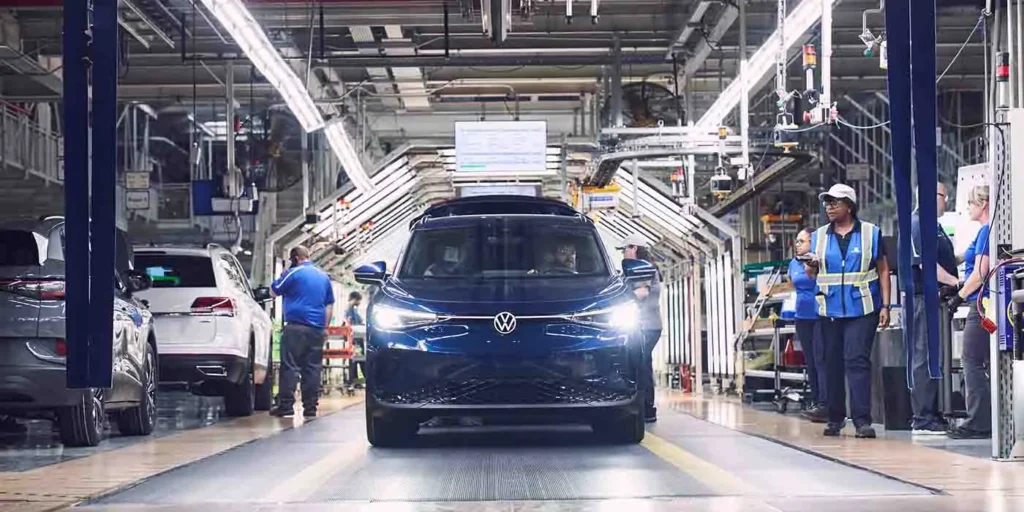
The Chattanooga plant that had launched Passat production in 2011 was subsequently transitioned toward Volkswagen’s electrification strategy. Passat assembly was phased out in early 2022, and U.S. production of the all-electric ID.4 began in July 2022.
Volkswagen invested $800 million in the Chattanooga facility to support electrification, including dedicated facilities for vehicle and battery-pack assembly. Volkswagen later reported that up to 7,000 ID.4s could roll off the Tennessee production line each month, illustrating the scale of the plant’s EV transition.
That makes the ending of the “The Force” story more complicated than a simple advertising success narrative. The campaign helped launch a redesigned Passat that achieved a dramatic sales increase in the U.S., but the same Passat nameplate disappeared from the American market 11 years after the commercial, while the Chattanooga facility moved from producing the campaign’s star sedan toward Volkswagen’s electric-vehicle strategy.
2024: Volkswagen Returns to the Super Bowl, Leaning on Its Own Legacy
Volkswagen did not return to national Super Bowl advertising for 10 years after “The Force.” That changed at Super Bowl LVIII in February 2024, when VW aired “An American Love Story” to mark the brand’s 75th anniversary in the United States. Volkswagen described the 60-second spot as its first national Super Bowl advertisement in a decade.
The campaign centered on a two-minute extended film, while a 60-second version aired nationally during the third quarter of the Super Bowl. The extended film traced Volkswagen’s American story from the arrival of the first Beetles in 1949 through decades of cultural history and ultimately to the ID. Buzz electric microbus, which was launching in the U.S. in 2024.
Set to Neil Diamond’s “I Am… I Said,” the film blended historical and recreated footage with references to Herbie Rides Again, Herbie Goes to Monte Carlo, The Simpsons and Star Wars character likenesses. Volkswagen also incorporated nods to earlier creative work, reinforcing the campaign’s broader theme of the brand’s long relationship with American culture.
Notably, Volkswagen brought back Lance Acord, the director associated with “The Force,” to direct “An American Love Story” in collaboration with creative agency Johannes Leonardo. The connection between the two campaigns was therefore explicit at the production level, even though Volkswagen positioned the 2024 film primarily as a celebration of its 75-year American history.
The rollout also echoed an important element of Volkswagen’s earlier digital strategy. In the weeks leading up to Super Bowl LVIII, the brand released seven video vignettes, including “Car Meetup,” which aired during the February 3, 2024 episode of Saturday Night Live; the teasers provided additional context for the historical moments featured in the main film.
The approach was therefore more than a single Super Bowl commercial. Volkswagen combined early digital storytelling, multiple short-form releases, a two-minute extended film and a 60-second national broadcast spot, creating a multi-stage campaign around the brand’s 75th anniversary and the arrival of the ID. Buzz.
Volkswagen in the U.S. Today: 2025-2026 Sales Reality
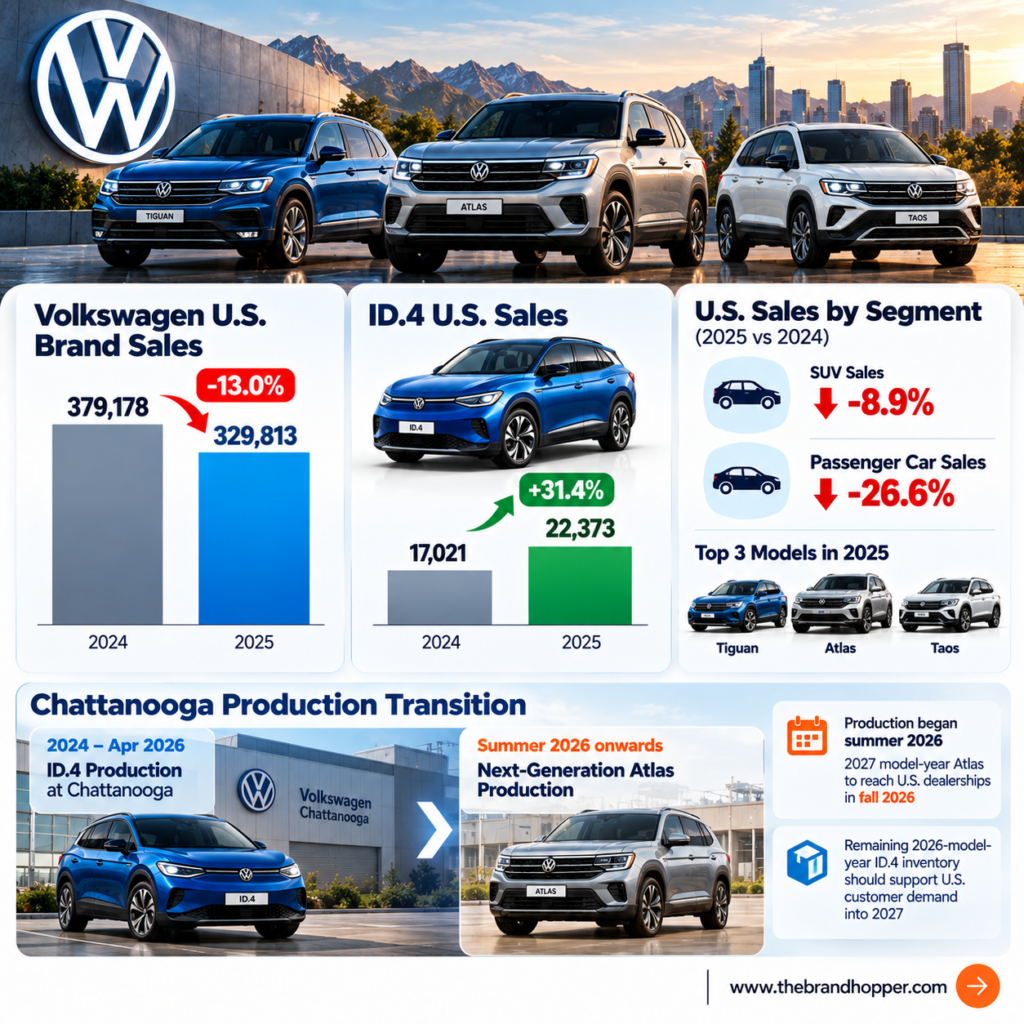
Volkswagen’s U.S. sales performance in the years following the Passat-era growth story shows how significantly the company’s product mix has changed. Volkswagen brand sales in the U.S. fell 13.0% in 2025 to 329,813 vehicles, compared with 379,178 in 2024.
The decline was broad across most of the lineup. SUV sales fell 8.9%, while passenger-car sales dropped 26.6%; the Tiguan, Atlas and Taos were Volkswagen’s three best-selling models in the U.S. during 2025.
The ID.4 provided an important exception. Volkswagen sold 22,373 ID.4s in 2025, up 31.4% from 17,021 in 2024, although its absolute volume remained much smaller than the company’s leading combustion-powered SUVs.
The story changed again in 2026. Volkswagen decided in the first quarter to refocus its North American production strategy toward higher-volume products that better match market demand, and ID.4 production at the Chattanooga plant was discontinued in mid-April 2026.
The production capacity is being redirected toward the second-generation Volkswagen Atlas, the 2027 model-year version of the company’s large SUV. Production began in summer 2026, with the new Atlas scheduled to reach U.S. dealerships in fall 2026.
Volkswagen said the remaining 2026-model-year ID.4 inventory should support U.S. customer demand into 2027, even after Chattanooga production ended.
The wider Volkswagen Group also entered a difficult second half of 2026. In September, Volkswagen cut its full-year 2026 operating-return guidance to up to 1%, down from its previous 4.0%–5.5% range, citing a challenging market environment, additional restructuring costs and an approximately €6 billion non-cash impairment of Porsche goodwill.
None of this erases what “The Force” achieved for Volkswagen’s brand narrative. But it does make the long-term story more interesting: the Chattanooga facility that launched the U.S. Passat in 2011 subsequently produced the ID.4 and is now shifting its focus toward the Atlas, illustrating how dramatically Volkswagen’s American product strategy has changed over fifteen years.
The human story behind the commercial has also continued. Max Page, the child actor who played Darth Vader, has become an advocate for pediatric health care and is now a film student at Loyola Marymount University, where he is making a documentary about the congenital-heart community.
Lessons for Marketers
1. Emotional storytelling outperforms product-spec advertising when the emotion is earned, not manufactured — “The Force” never lists a single Passat feature aloud, letting the remote-start payoff double as both story climax and product demo.
2. Distribution strategy can be as innovative as the creative itself. Releasing the ad online four days before the Super Bowl was the riskier decision in 2011, and it is now the industry default.
3. A single campaign can outlive its own product. The Passat that “The Force” was built to sell no longer exists in the U.S. market, yet the ad itself remains a top-cited case study — a reminder that brand equity built through storytelling can outlast the SKU it was designed to move.
4. Legacy campaigns are assets a brand can reactivate. Volkswagen’s 2024 return to the Super Bowl deliberately rehired “The Force”‘s director and referenced its own iconography, treating a 13-year-old ad as active brand equity rather than a closed chapter.
5. Positive publicity from an ad doesn’t guarantee durable category performance. “The Force” measurably lifted 2011-2012 Passat sales, but Volkswagen’s broader 2025-2026 U.S. sales trends show that campaign-level wins and long-run market share are two different problems that require separate strategies.
Frequently Asked Questions
Q: When did Volkswagen’s “The Force” ad air?
A: “The Force” was uploaded online on February 1, 2011, and aired in a 30-second broadcast cut during Super Bowl XLV on February 6, 2011.
Q: Who was the boy in the Volkswagen Darth Vader commercial?
A: The boy was played by then-six-year-old actor Max Page. He has since become an advocate for Children’s Hospital Los Angeles following multiple childhood heart surgeries and continues acting while studying at Loyola Marymount University.
Q: Is the Volkswagen Passat still sold in the U.S.?
A: No. Volkswagen discontinued the U.S.-market Passat sedan after the 2022 model year, ending it with a 1,973-unit Limited Edition run as American sedan demand declined; the Chattanooga plant that built it was converted to produce the ID.4 electric SUV.
Q: Did “The Force” actually increase Volkswagen’s sales?
A: Yes. U.S. Passat sales more than doubled year over year to nearly 23,000 units in 2011 (a partial sales year for the redesigned model), with continued growth in 2012, though the car itself and broader market shifts also contributed.
Q: Has Volkswagen returned to the Super Bowl since “The Force”?
A: Yes. After a decade-long absence, Volkswagen returned to Super Bowl LVIII in February 2024 with “An American Love Story,” marking the brand’s 75th U.S. anniversary and reuniting with Lance Acord, the original director of “The Force.”
Q: How is Volkswagen performing in the U.S. market in 2025 and 2026?
A: Volkswagen’s U.S. sales fell about 13% in 2025 versus 2024, with combustion models declining broadly even as the ID.4 electric SUV grew; 2026 has been mixed, with the ID.4’s U.S. production scaled back after a sharp sales pullback for that specific model.
Q: What made “The Force” different from other Super Bowl ads at the time?
A: Volkswagen released the full ad on YouTube four days before the Super Bowl broadcast, a break from the industry norm of guarding ads as a surprise — a distribution strategy now considered standard practice.
Q: What is being built at the Chattanooga plant now?
A: The Chattanooga, Tennessee plant that built the Passat for ‘The Force’ switched to producing the ID.4 electric SUV in 2022, and Volkswagen confirmed it will end ID.4 production there from mid-April 2026, shifting the plant’s capacity to the redesigned, gasoline-powered second-generation Atlas SUV due in dealerships in autumn 2026.
Conclusion
“The Force” endures as a case study for good reason: it is one of the clearest examples of a brand using pop-culture fluency, restrained product placement, and a genuinely disruptive distribution strategy to turn a single ad into a multi-week cultural event.
What makes the story worth updating in 2026, rather than leaving it frozen in 2011, is everything that happened afterward — the Passat’s quiet discontinuation in 2022, Volkswagen’s calculated 2024 return to the Super Bowl built explicitly on “The Force”‘s own legacy, and a current U.S. sales picture defined by SUV and EV transition rather than sedan growth.
Read together, the full timeline is a more useful lesson for marketers than the original ad alone: a great campaign can build brand equity that survives the product it was made for, but it cannot substitute for the category and business strategy decisions a company makes in the years that follow.
Also Read: Patagonia’s “Don’t Buy This Jacket” Campaign: Complete Case Study
To read more content like this, subscribe to our newsletter