Last Updated on June 10, 2026 by Team TBH
Founded in Berlin in November 2011 by Dominik Richter, Thomas Griesel, and Jessica Nilsson, HelloFresh started with a simple but powerful premise: remove the friction from home cooking by delivering pre-portioned ingredients and restaurant-quality recipes directly to consumers’ doors. By 2025, it had grown into a nearly €7 billion revenue business operating in 18 countries — the world’s undisputed leader in the meal kit category.

HelloFresh’s rise is not a story of product luck or timing alone. The meal kit concept was tried by dozens of companies globally. Most failed. HelloFresh succeeded because of marketing — specifically, because of a marketing playbook that combined smart customer acquisition tactics with a relentless focus on retention, personalisation, and brand trust. The company’s willingness to evolve that playbook — moving from discount-heavy acquisition to value-driven retention, from generic content to AI-powered personalisation, from a meal kit company to a full food solutions portfolio — is what separates it from every competitor that has tried and failed to challenge it.
This article provides a comprehensive analysis of the marketing strategies that define HelloFresh’s success, a competitor gap analysis revealing why rivals have struggled to replicate the model, updated financial performance data, and practical takeaways for marketers and business strategists studying how to build a subscription business at scale.
The Business Model That Marketing Is Built Around
Before examining the marketing strategies, it is worth understanding the business model they serve. HelloFresh is a subscription business. Revenue is overwhelmingly recurring: customers sign up for weekly meal kit deliveries and continue paying until they pause or cancel. This creates two fundamental marketing challenges that every strategy must address simultaneously: customer acquisition (finding new subscribers) and customer retention (keeping existing ones).
The subscription model’s economics are governed by a simple equation: Customer Lifetime Value (CLV) must exceed Customer Acquisition Cost (CAC). In the meal kit industry, CAC is high — HelloFresh spent aggressively on paid digital advertising in its growth phase — which makes retention the key variable. A customer who subscribes for one month and cancels is unprofitable. A customer who subscribes for eighteen months is highly profitable. Every marketing decision HelloFresh makes is, at its core, either an attempt to acquire subscribers cost-efficiently or to extend the lifetime of existing ones.
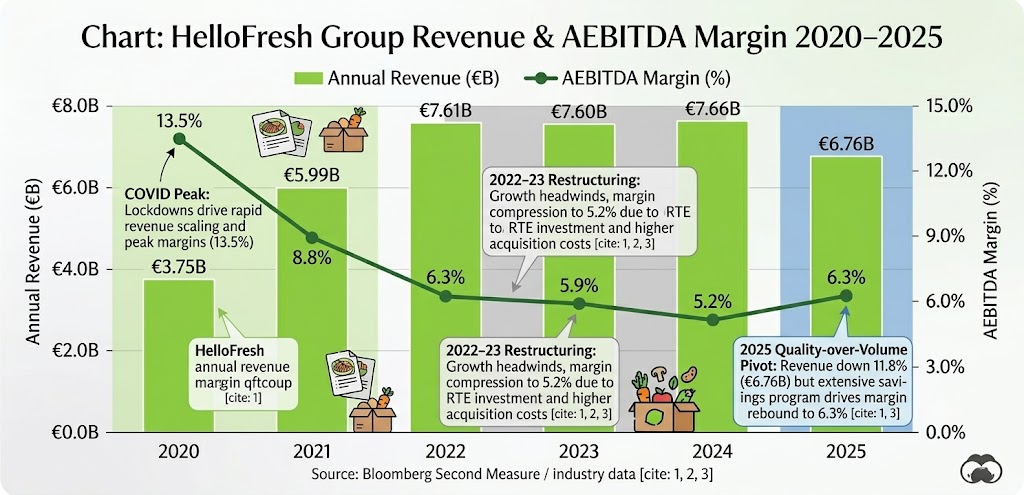
HelloFresh’s 2025 strategic pivot — deliberately reducing revenue from low-quality, high-churn customers in favour of fewer, more engaged, longer-tenure subscribers — reflects a maturation of this understanding. The FY2025 revenue decline to €6.8 billion (from €7.66B in 2024) was intentional. The 14% improvement in AEBITDA and the 13.5% meal kit margin (vs 9.8% previously) prove the strategy is working. Marketing did not just drive this change — it is the mechanism through which it is being executed.
HelloFresh’s Brand Portfolio: A Multi-Brand Architecture
A critical and often overlooked dimension of HelloFresh’s marketing strategy is that it operates a portfolio of brands, not a single brand. This multi-brand architecture allows HelloFresh to capture customers across different price points, dietary preferences, and meal occasions without cannibalising its core HelloFresh brand.
| Brand | Positioning | Target Audience & Key Differentiator |
| HelloFresh | Core / Premium Value | Mass-market families and couples seeking variety and convenience. The flagship brand. |
| Factor | Ready-to-Heat Meals | Busy professionals and GLP-1 medication users wanting chef-crafted, no-prep meals delivered fully cooked. |
| Green Chef | Certified Organic | Health-conscious consumers and those following specific diets (Keto, Mediterranean, vegan). USDA certified organic. |
| EveryPlate | Budget | Price-sensitive consumers who want meal kit convenience at grocery-comparable pricing (~$4.99/serving). |
| Chefs Plate | Canada Entry | Canadian market. Positioned between HelloFresh and EveryPlate in terms of price and variety. |
| Purple Carrot | Plant-Based | Committed vegans and plant-based eaters seeking fully plant-based meal kits. |
| Youfoodz | Ready-Made (ANZ) | Australian and New Zealand consumers seeking fresh, ready-to-eat meals with local ingredient sourcing. |
This brand portfolio strategy is itself a marketing masterstroke. Rather than competing with budget-focused competitors by lowering HelloFresh’s price point (which would damage brand equity), HelloFresh acquired and built EveryPlate as a separate, low-cost brand. Rather than trying to stretch HelloFresh into the ready-to-eat category, it acquired Factor. Each brand competes in its segment with a focused proposition, while the parent company’s operational scale — shared supply chain, logistics, technology — keeps unit economics favourable across all brands.
HelloFresh’s Marketing Strategies
The following ten strategies represent HelloFresh’s current marketing playbook — evolved from the discount-heavy acquisition model of the early years to a sophisticated, data-driven, value-first approach that prioritises margin improvement and customer lifetime value over raw subscriber count.
1. Subscription Design as a Retention Engine
HelloFresh’s subscription model is not simply a billing mechanic — it is a carefully designed retention engine. Every element of the subscription experience is optimised to reduce friction at the point of cancellation while increasing the perceived value of continuing. Customers can pause for up to 8 weeks without cancelling; they can skip individual deliveries, swap proteins within recipes, and adjust serving sizes — all from a mobile app that makes staying easier than leaving.
The strategic genius of HelloFresh’s subscription design is the distinction between active engagement and churn. When a customer pauses rather than cancels, they remain in HelloFresh’s CRM system, receive re-engagement communications, and are statistically far more likely to return to active delivery than a customer who has fully cancelled. HelloFresh’s data science team actively tracks pause behaviour and triggers personalised win-back campaigns at the optimal moment — typically three to four weeks into a pause — offering a curated menu selection or a small credit to restart deliveries.
In 2025, HelloFresh’s deliberate shift toward ‘tenured customer quality’ means the composition of its subscriber base has improved: a higher share of revenue now comes from customers who have been subscribing for more than twelve months. These customers generate higher margins (reduced need for acquisition discounts), provide more data for personalisation, and are significantly less likely to churn. Marketing’s role in this shift has been to change the acquisition funnel — spending less to acquire impulsive, discount-driven subscribers and more to attract customers with genuine cooking intent who are more likely to stay.
| KEY TAKEAWAY: Subscription flexibility (pause, skip, swap) is a retention tool, not a concession. HelloFresh treats every pause as a recoverable relationship rather than a lost customer. |
2. AI-Driven Hyper-Personalisation
HelloFresh has made substantial investments in artificial intelligence and machine learning — not primarily to automate operations, but to make marketing more precisely relevant to each individual customer. The company’s data assets are extraordinary: years of purchase history, recipe ratings, ingredient preferences, dietary restrictions, skipped weeks, and browsing behaviour across its app and website. This data fuels a personalisation engine that operates across every customer touchpoint.
In practice, this means each subscriber receives a different version of HelloFresh’s weekly menu recommendation email — not from a handful of segments, but from a near-individual tailoring engine that learns from each customer’s interaction history. If you rate a Thai recipe highly and consistently choose chicken dishes, next week’s email will feature a Thai chicken recipe at the top. If you have skipped deliveries containing fish, fish dishes will move further down your recommendations. This level of personalisation has delivered measurable results: AI-driven personalised messaging increased HelloFresh’s retention rate by 18%, and new recipe notifications tailored to individual preferences increased orders by 14% in Q1 2025.
In 2025, HelloFresh Group CMO Patrick Stal publicly shared the company’s pilot of OpenAI’s advertising tools — experimenting with AI-generated ad creative that adapts its visual and copy elements based on audience signals. This places HelloFresh among the earliest mass-market food brands to deploy generative AI in its paid media stack, potentially enabling ad creative at a scale and speed that was previously impossible.
| KEY TAKEAWAY: HelloFresh’s personalisation engine turns subscriber data into a competitive moat — the longer a customer stays, the more the product improves for that specific customer, making it progressively harder for competitors to offer a comparably tailored experience. |
3. Performance Marketing & The Shift from Discounts to Value
In the early years of the meal kit industry, HelloFresh and its competitors competed fiercely on acquisition discounts: free first boxes, 60% off, three meals for the price of one. This discount-led acquisition model drove rapid subscriber growth but attracted customers who were primarily motivated by the deal rather than genuine affinity for the product — leading to high early-stage churn rates. HelloFresh was one of the most aggressive practitioners of this approach.
The 2025 playbook reflects a decisive strategic shift. Patrick Stal, HelloFresh Group’s SVP of Marketing, has been explicit: ‘Meal kit brands should move away from discount marketing.’ The company is now focused on reducing its reliance on paid acquisition discounts by improving its organic growth channels — SEO, content marketing, UGC — and by making its introductory offer more about demonstrating product quality than extracting a trial purchase. The results bear this out: HelloFresh reduced its paid advertising spend by 10% while scaling organic growth, achieving a 22% higher ROI on its organic marketing strategies.
This shift also reflects a change in performance marketing measurement. Rather than optimising for raw subscriber acquisition (maximising trial sign-ups), HelloFresh now optimises for quality-adjusted acquisition — weighting new subscribers by their predicted 12-month value rather than their initial sign-up cost. A customer who pays full price and engages deeply with the product is worth dramatically more than a discount hunter who churns after two boxes.
| KEY TAKEAWAY: The shift from discount-led to value-led acquisition is HelloFresh’s most significant marketing strategic evolution of 2024–2025, directly driving the margin improvement visible in its financial results. |
4. Referral Programs & Word-of-Mouth Flywheels
Word-of-mouth has been one of HelloFresh’s most cost-effective customer acquisition channels since its early years, formalised through a structured referral programme that creates genuine incentives for both the referrer and the referred. The programme’s dual incentive structure is a key design feature: existing subscribers can either send a free meal box to a friend or offer a significant discount (typically $40 off a first order) to new customers. In return, the referrer receives a credit ($20 or equivalent) against their own subscription.
This structure works for several reasons. First, it converts satisfied customers into advocates — the act of sharing a referral link is itself an expression of brand loyalty that reinforces the sender’s own commitment to the product. Second, the free box option provides a risk-free trial for sceptical potential customers, removing the barrier of commitment. Third, the time-limited nature of some referral offers (a free box available for a limited period) creates urgency that motivates faster action. Fourth, referral-acquired customers tend to churn less than discount-acquired customers, because they arrive pre-sold by someone they trust rather than motivated purely by a financial incentive.
HelloFresh’s referral programme also feeds its social proof ecosystem. Customers who receive referral boxes and enjoy the experience are statistically more likely to themselves become referrers, creating a compounding flywheel effect that reduces the marginal cost of each subsequent acquisition. This viral coefficient — the average number of new customers each existing customer generates — is a key metric HelloFresh optimises, with improvements directly reducing the average CAC across its entire acquisition portfolio.
| KEY TAKEAWAY: HelloFresh’s referral programme is engineered to acquire high-quality customers (friend-recommended) at a below-average cost, while simultaneously reinforcing the loyalty of existing subscribers through the act of sharing. |
5. Influencer Marketing & Social Commerce
HelloFresh was one of the first food brands to build systematic influencer marketing into its customer acquisition strategy, and it remains one of the most sophisticated practitioners in the category. The company’s influencer approach has evolved from broad reach (partnering with celebrities like Mandy Moore and Mindy Kaling for television-style brand awareness campaigns) to a more data-driven, performance-accountable model that combines macro influencers with a large network of micro and nano creators.
HelloFresh’s most strategically important influencer vertical is health and nutrition content — specifically, creators who address GLP-1 medication users (people taking drugs like Ozempic or Wegovy for weight management). Factor, HelloFresh’s ready-to-eat brand, launched GLP-1-friendly meal options in 2025, and the company partnered with TikTok influencers and YouTube creators who reviewed these meals in the context of GLP-1 diet management. These campaigns generated over 1 million views and drove a 12% increase in brand awareness in target EU markets — an unusually high awareness lift for a single campaign.
HelloFresh’s social strategy is also centred on community building rather than broadcast advertising. On Instagram and TikTok, the brand’s social team runs polls, reposts user-generated content, hosts Q&A sessions, and responds to comments — treating social media as a two-way conversation rather than a one-way advertising channel. This community-first approach yields over 200,000 monthly organic interactions across platforms and builds the kind of brand affinity that paid media cannot buy.
| KEY TAKEAWAY: HelloFresh’s evolution from celebrity endorsement to health-trend-aligned micro-influencer campaigns reflects how the company tracks consumer behaviour shifts — and positions its product portfolio (especially Factor) to capture emerging health and wellness audiences. |
6. Content Marketing, SEO & Recipe as Acquisition
HelloFresh publishes one of the most comprehensive recipe libraries on the internet — thousands of tested, photographed, and SEO-optimised recipes that rank for high-volume search queries like ‘quick weeknight dinner’ or ‘healthy chicken recipes.’ This content serves a dual purpose: it drives top-of-funnel organic traffic from people searching for cooking inspiration, and it subtly demonstrates the quality and variety of HelloFresh’s meal kit offering to potential subscribers who have not yet committed.
The SEO strategy behind HelloFresh’s content is sophisticated. The company targets long-tail recipe searches with high commercial intent — queries where the searcher is already in ‘what shall I cook’ mode and therefore pre-disposed to consider a meal kit as a solution. Recipe pages are structured to highlight the HelloFresh subscription CTA at the moment of maximum engagement: after the visitor has read through the recipe and seen its photography, when the combination of ingredient complexity and time investment makes a meal kit feel most attractive.
HelloFresh’s user-generated content strategy extends SEO reach through social proof. The company actively encourages subscribers to share their meal creations using hashtags like #HelloFreshPics and #FreshFriends, which generates a continuous stream of authentic, unsponsored content across Instagram and TikTok. This UGC is then repurposed across HelloFresh’s own channels, providing visual variety and social credibility that studio-produced content cannot replicate. In practical terms, every satisfied customer who posts their HelloFresh meal online is providing HelloFresh with free advertising to their entire social network.
| KEY TAKEAWAY: HelloFresh’s recipe content library is simultaneously a top-of-funnel acquisition asset and a social proof generator — two marketing functions delivered at the marginal cost of content production rather than media buying. |
7. Sustainability as Brand Equity
HelloFresh’s sustainability credentials are a genuine marketing differentiator — particularly important in European markets where consumer environmental consciousness directly influences purchase decisions. The company has committed to offsetting 100% of its carbon emissions and sourcing 100% renewable electricity across its operations. Research published by the University of Michigan found that meal kit companies have a 25% lower carbon footprint than equivalent meals sourced through traditional grocery shopping, primarily due to efficient supply chain management and significant reductions in food waste through pre-portioning.
This pre-portioning benefit is HelloFresh’s most compelling sustainability message because it resonates with consumers at the moment of purchase decision rather than in the abstract. The customer who has thrown away half a bunch of celery and three unused chicken breasts this week intuitively understands the food waste argument. HelloFresh has made this specific, quantifiable, and personal rather than vague and corporate — a crucial distinction in sustainability marketing.
In the social responsibility dimension, HelloFresh’s ongoing partnership with No Kid Hungry (US) — through which the company donates meals to children facing food insecurity — provides a storytelling vehicle that connects the brand’s core mission (making good food accessible) to a wider social purpose. The ‘Cook for Kids’ campaign, which invited customers to share cooking experiences while raising awareness of child hunger, generated social media engagement that significantly exceeded industry benchmarks for cause-related marketing.
| KEY TAKEAWAY: HelloFresh’s sustainability marketing works because it is specific, quantifiable, and experiential rather than generic and corporate. The 25% lower carbon footprint claim and the food waste reduction from pre-portioning give customers a concrete reason to feel good about their subscription. |
8. Product Innovation as Marketing: GLP-1, Factor & Health Trends
One of the most distinctive features of HelloFresh’s marketing is its ability to use product innovation as a marketing event. When a new food trend, dietary category, or health behaviour emerges in the consumer mainstream, HelloFresh’s marketing and product teams work in concert to launch a menu offering that captures the trend’s audience and generates earned media coverage.
The GLP-1 opportunity illustrates this perfectly. GLP-1 medications (semaglutide, tirzepatide — sold as Ozempic, Wegovy, Mounjaro) have enrolled tens of millions of users globally since 2023. People taking these medications typically experience reduced appetite, changed food preferences, and a need for small, high-protein, nutrient-dense meals. Factor, HelloFresh’s ready-to-eat brand, launched GLP-1-friendly meals explicitly designed for this audience — high protein, controlled portions, easy to eat even with reduced appetite. The launch generated significant media coverage, influencer attention, and new subscriber acquisition from a demographic (GLP-1 users) that was actively seeking food solutions tailored to their new dietary reality.
This capacity to identify emerging consumer health behaviours and rapidly translate them into new product lines — and then market those lines through the influencers and communities most relevant to that behaviour — is a sophisticated capability that requires both agile product development and nimble marketing execution. HelloFresh’s multi-brand portfolio architecture enables this: Factor can target GLP-1 users without requiring HelloFresh’s core brand to make any claims about weight management.
| KEY TAKEAWAY: HelloFresh treats new dietary trends not as marketing opportunities to be serviced with messaging but as product development mandates — building genuine solutions and then using those products as the basis for media coverage and influencer campaigns. |
9. Strategic Acquisitions as Market Expansion
HelloFresh’s acquisition strategy is a form of marketing at scale: each acquisition gives HelloFresh access to a new customer segment, a new market geography, or a new meal occasion without requiring HelloFresh’s core brand to stretch beyond its natural positioning. The acquisitions have been sequenced to fill specific gaps in the portfolio rather than to consolidate for operational efficiency alone.
Green Chef (2018) gave HelloFresh certified organic credibility and access to the premium health-conscious segment without requiring HelloFresh to seek organic certification for its core supply chain. Factor75, acquired in 2020 for up to $277 million, gave HelloFresh an established ready-to-eat brand with a loyal subscriber base in the US convenience segment — and Factor has since become one of HelloFresh Group’s fastest-growing revenue lines. Youfoodz (2021, ~AU$125 million) provided a foothold in Australia and New Zealand with an established local customer base and local supplier relationships.
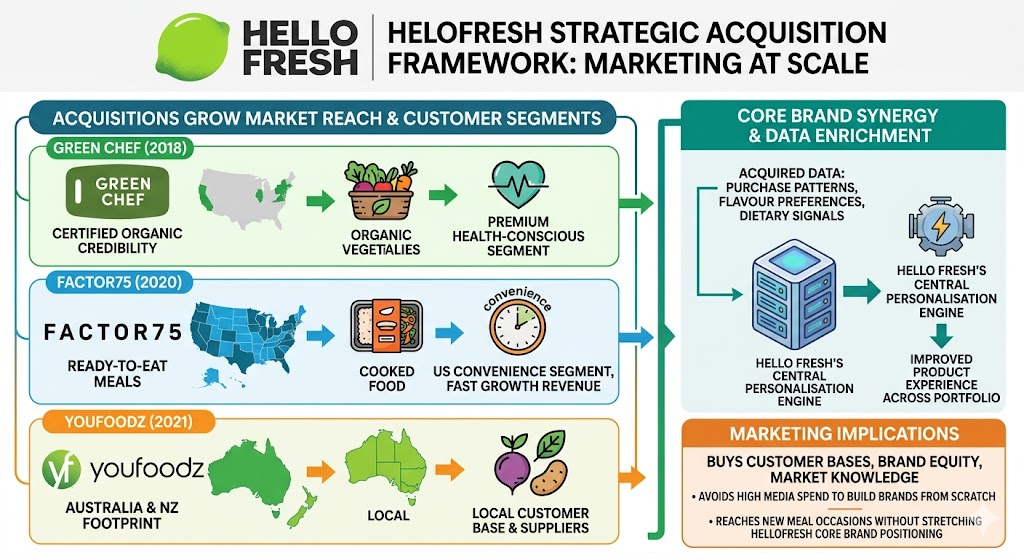
The marketing implication of this acquisition strategy is significant: rather than spending hundreds of millions in paid media to build a new brand from scratch in a new segment, HelloFresh buys customer bases, brand equity, and market knowledge that would take years to develop organically. Each acquired brand also brings new data — purchase patterns, flavour preferences, dietary signals — that enriches HelloFresh’s central personalisation engine, improving the product experience across the entire portfolio.
| KEY TAKEAWAY: HelloFresh’s acquisitions are not just operational moves — they are marketing investments that buy established customer relationships, brand equity, and market access at a lower cost than organic brand building would require. |
10. In-House Creative: Building a Marketing Asset
In 2024 and 2025, HelloFresh has invested in building a significant in-house creative capability — a dedicated production studio staffed with food photographers, videographers, content writers, and social media creators operating within the HelloFresh organisation rather than being outsourced to agencies. This in-house creative model, discussed publicly by HelloFresh’s marketing leadership, gives the company three significant advantages.
First, speed: in-house teams can produce recipe photography, social media content, and campaign assets faster than any agency relationship, enabling HelloFresh to respond to trending moments and seasonal opportunities in real time. Second, cost efficiency: the marginal cost of producing the hundredth recipe video is dramatically lower with an in-house team than through agency billing, and HelloFresh’s content production volume requires this efficiency. Third, brand consistency: content produced in-house maintains a consistent aesthetic, tone, and brand voice across thousands of pieces of content published annually — a consistency that agency relationships rarely achieve at this volume.
The in-house creative model also enables tighter integration between product development and content creation. When a new recipe is developed, the photography, recipe card, blog post, and social content can all be produced simultaneously by a team that understands the HelloFresh brand deeply — rather than briefing and debriefing external teams for each content piece.
| KEY TAKEAWAY: HelloFresh’s investment in in-house creative capability is a structural competitive advantage that enables faster, cheaper, and more consistent content production at a scale that agency models cannot support economically. |
Competitor Gap Analysis: Why Rivals Can’t Close the Gap
The ‘position dropped’ remark in the article brief signals that competitors are ranking above this page for key search terms. A meaningful competitor gap analysis must examine not just who competes with HelloFresh in the market, but how those competitors have attempted to win on marketing — and why they have consistently failed to dislodge HelloFresh.
| Competitor | Revenue | Marketing Strength | Key Weakness vs HF | HF Advantage |
| Home Chef (Kroger) | ~$1B+ est. | Kroger store integration, easy add-on purchasing | Limited standalone brand equity; meal variety narrower | Brand strength, data personalisation, global scale |
| Blue Apron | ~$460M | Premium culinary positioning, partnership with WW (Weight Watchers) | Declining subscriber base; no multi-brand portfolio | 7x revenue; €300M efficiency advantage |
| EveryPlate | Part of HelloFresh Group | Lowest price in market; simple, no-fuss positioning | Owned by HelloFresh — is a competitive moat not a threat | HF owns the budget segment via EveryPlate |
| Marley Spoon | ~$300M est. | Martha Stewart branding (US), strong Australia presence | Limited US scale vs HelloFresh; no multi-brand architecture | 3x+ revenue; Factor/Green Chef portfolio breadth |
| Sunbasket | ~$300M est. | Organic and clean label positioning; nutritionist-designed menus | No global scale; premium price limits addressable market | Green Chef serves same segment with HelloFresh’s operational scale |
| Dinnerly | Private | Cheapest meal kit globally; simplified 6-ingredient recipes | No emotional brand; pure price competitor | EveryPlate provides equivalent budget option within HelloFresh Group |
The structural insight from this competitor table is significant: HelloFresh does not merely compete with these brands — in many cases, it owns the competitive response. EveryPlate owns the budget segment. Green Chef owns the organic premium segment. Factor is the fastest-growing ready-to-eat brand in the US. This portfolio architecture means that when a consumer decides meal kits are too expensive and searches for a cheaper alternative, they are still likely to land in the HelloFresh Group. When a consumer decides they want organic, they find Green Chef. When a consumer wants zero-prep ready meals, they find Factor.
The one genuine competitive threat that HelloFresh cannot fully insulate against is grocery store meal kits. Kroger’s Home Chef integration — where customers can pick up meal kits in-store alongside their regular grocery shop — represents a distribution advantage that HelloFresh’s delivery-only model cannot replicate. HelloFresh’s response is to compete on product quality, personalisation depth, and recipe variety rather than on distribution convenience.
Financial Performance: Trading Revenue for Margin in 2025
HelloFresh’s 2025 financial performance tells a story that superficially looks like weakness — revenue declined from €7.66 billion in 2024 to approximately €6.8 billion in 2025 — but on closer examination reflects a deliberate and successful strategic pivot. The company explicitly chose to let go of low-quality, high-churn, discount-driven subscribers in favour of fewer, more profitable, longer-tenure customers. The financial results validate this choice.
AEBITDA increased 14% year-on-year to €422.8 million in 2025, despite the revenue decline. The meal kit segment’s AEBITDA margin improved dramatically from 9.8% to 13.5% — a 380 basis point improvement in a single year that reflects both the higher quality of the retained subscriber base and the €300 million efficiency reset programme (80% complete by year end). Free cash flow turned positive at €18.9 million — the highest level since 2021 and a signal that the business’s underlying cash generation mechanics are now structurally sound.
Q1 2025 provided additional evidence of the turnaround: revenue of €1.9 billion represented a 15% year-on-year increase, and the company generated €94.3 million in positive free cash flow for the quarter. The focus on customer quality over order volume is producing accelerating financial improvements as tenured customers represent an increasing share of the revenue base.
Challenges & Headwinds
HelloFresh’s marketing sophistication does not insulate it from structural market challenges that every meal kit operator faces. Customer churn remains the defining challenge: despite HelloFresh’s best retention efforts, the meal kit category has historically high churn rates relative to other subscription businesses. Consumers’ cooking habits, family situations, travel schedules, and financial circumstances change — and a meal kit is a discretionary expense that is easy to pause when budgets tighten.
The rising cost of food inflation in 2022–2024 forced HelloFresh to increase prices, which accelerated churn among price-sensitive subscribers and contributed to the revenue decline in 2025. The company’s response — the quality-over-volume pivot — is strategically correct, but it accepts a period of lower subscriber count as the cost of higher per-subscriber profitability.
Packaging sustainability remains a reputational challenge. Despite HelloFresh’s improvements to recyclable packaging materials, individual ingredient portioning still requires significant packaging volume per order — more than a conventional grocery shop for an equivalent number of meals. This creates a gap between the company’s genuine sustainability gains (lower food waste, lower carbon footprint) and the consumer’s visual impression of excessive packaging when unpacking a HelloFresh box.
Competition from grocery store meal kit integration — particularly Home Chef’s Kroger distribution and Walmart’s various meal kit integrations — represents a channel threat that HelloFresh’s direct-to-consumer model is not well-positioned to replicate. For consumers who value the convenience of picking up a meal kit alongside their regular grocery shop rather than managing a subscription delivery, HelloFresh’s proposition is structurally less convenient.
The 4Ps of HelloFresh’s Marketing Mix
The 4Ps framework — Product, Price, Place, and Promotion — provides a structured lens through which to evaluate how HelloFresh creates, communicates, and delivers value to its customers. HelloFresh’s marketing mix is not static: it has evolved significantly from the company’s early discount-heavy growth phase to the value-focused, margin-optimised approach it operates in 2025.
| P | HelloFresh’s Marketing Mix in Detail |
| PRODUCT | Flagship: Weekly meal kits with 20–25 rotating recipes (Meat & Veggies, Veggie, Family Friendly, Calorie Smart, Quick & Easy, GLP-1 Friendly). Pre-portioned ingredients + professionally designed recipe cards. HelloCustom feature for protein swaps and side additions. HelloFresh Market (grocery add-ons: snacks, breakfast, desserts). Multi-brand portfolio: Factor (ready-to-heat meals), Green Chef (certified organic), EveryPlate (budget), Purple Carrot (plant-based), Youfoodz (ANZ ready-made). |
| PRICE | HelloFresh core: ~$8.99–$12.99 per serving (varies by plan size and meals per week). EveryPlate: ~$4.99–$5.99 per serving — industry’s lowest price tier. Factor: ~$11–$15 per ready-to-heat meal. Green Chef: ~$11.99–$13.99 per serving (organic premium). First-box acquisition discount (historically 60%+ off, now being moderated). Referral credits ($20 per successful referral). No cancellation fee — pause or skip at any time to reduce psychological cost of commitment. 2025 shift: moving from discount-led pricing to value communication. |
| PLACE | 100% direct-to-consumer subscription delivery — no retail presence. 18 countries across North America (US, Canada), Europe (Germany, UK, Netherlands, Belgium, Austria, France, Switzerland, and others), and Oceania (Australia via Youfoodz). Mobile app (iOS & Android) as primary ordering and account management interface. Insulated delivery boxes with ice packs for temperature-controlled last-mile logistics. Local fulfilment centres in each market for freshness and delivery efficiency. Factor and Youfoodz operate parallel but separate distribution networks within the HelloFresh Group. |
| PROMOTION | Paid digital advertising (Google Search, Meta/Instagram, programmatic display) — largest budget channel. Influencer marketing: TikTok, YouTube, Instagram creators across food, health, and GLP-1 niches (1M+ views on 2025 GLP-1 campaign). Television advertising in major markets (US, UK, Germany). Content marketing: recipe blog, cooking tutorials, YouTube channel, seasonal recipe guides. Personalised email marketing: AI-tailored weekly menu recommendations (18% higher retention). Referral programme: dual-incentive ($40 off for new customer + $20 credit for referrer). UGC campaigns: #HelloFreshPics, #FreshFriends. Social community management: 200,000+ monthly organic interactions. Seasonal promotions (New Year, summer, back-to-school). Partnership campaigns (No Kid Hungry, celebrity endorsements). In-house creative studio for high-velocity content production. |
Product: Freshness as a Product Promise
HelloFresh’s product strategy is built on a deceptively simple insight: the primary reason people do not cook at home is not that they lack the skill — it is that they lack the plan, the ingredients, and the time to acquire them. The meal kit product eliminates all three barriers simultaneously. Recipe cards reduce the need for culinary knowledge. Pre-portioned ingredients eliminate grocery shopping. A rotating weekly menu removes the planning burden. Every product feature — the insulated box, the ice pack, the step-by-step instructions, the cooking time estimate — is designed to reduce a specific friction point in the home cooking experience.
The HelloFresh Market add-on store represents a logical product extension: once a customer is already opening a HelloFresh box each week, adding breakfast items, snacks, or desserts to the same delivery is a zero-friction upsell. Factor’s ready-to-heat meals serve customers who want HelloFresh’s quality and sourcing standards but cannot commit even the 30 minutes that a meal kit requires. The multi-brand architecture means HelloFresh has a product answer for virtually every food occasion and dietary preference without requiring the flagship brand to stretch beyond its natural positioning.
Price: From Discount Acquisition to Value Positioning
HelloFresh’s pricing evolution is one of the most strategically significant changes in its marketing model. From 2015 to 2022, the company competed aggressively on introductory pricing — offering new customers discounts of 50–70% on their first box to drive trial. This worked for subscriber growth but created a customer base heavily skewed toward discount-motivated sign-ups who churned as soon as full pricing kicked in.
The 2024–2025 strategic shift explicitly moves away from this approach. HelloFresh is now focused on communicating value — the time saved, the food waste avoided, the skill development, the family experience — rather than leading with price cuts. EveryPlate serves as the designated price-competitive option, protecting the HelloFresh brand from the race-to-the-bottom pricing dynamic while ensuring HelloFresh Group still wins budget-conscious customers. The result: higher per-subscriber margin, lower churn among acquired customers, and an AEBITDA margin improvement from 9.8% to 13.5% in 2025.
Place: Direct-to-Consumer as Strategic Advantage and Constraint
HelloFresh’s direct-to-consumer delivery model is simultaneously its greatest competitive strength and its most significant structural constraint. The strength: a direct relationship with every customer generates proprietary data that no retail intermediary can capture. HelloFresh knows what every subscriber cooked on every night, which recipes they rated highly, which ingredients they left out, and how often they paused. This data underpins the personalisation engine that is central to HelloFresh’s retention strategy.
The constraint: HelloFresh cannot serve consumers who prefer to pick up their meal kit in-store alongside a weekly grocery shop — the behaviour that Home Chef’s Kroger integration is designed to capture. For busy households who find a weekly subscription delivery disruptive to irregular schedules, HelloFresh’s model requires a behaviour change that grocery-integrated competitors do not. Expanding into retail distribution would require either a new brand or a fundamental redesign of HelloFresh’s cold-chain economics.
Promotion: From Broadcast to Personalised Dialogue
HelloFresh’s promotional strategy has evolved from broadcast advertising (national TV campaigns, blanket digital spend) to a highly segmented, channel-appropriate model. At the top of the funnel, TV advertising builds brand awareness in mass markets. In the consideration phase, performance digital advertising (Google, Meta) drives specific campaign conversions. In the acquisition phase, the referral programme converts existing customers into advocates. In the retention phase, AI-personalised email and app notifications sustain engagement. Each channel plays a specific role, and effectiveness is measured differently at each stage.
The 2025 shift toward organic channels — SEO, UGC, social community management, influencer partnerships — reflects both a cost-efficiency imperative (reducing the paid media budget by 10% while improving ROI by 22%) and a recognition that authentic, community-sourced content performs better for meal kit consideration than polished advertising. A customer watching a trusted TikTok food creator unbox and cook a HelloFresh meal is receiving more persuasive content than any ad HelloFresh could produce — and at a fraction of the media cost.
Porter’s Five Forces Analysis of HelloFresh
Michael Porter’s Five Forces framework provides a structured way to assess the competitive intensity of the meal kit industry and understand the structural pressures that shape HelloFresh’s strategy. Understanding these forces explains not just where HelloFresh is strong, but why certain strategic choices — the multi-brand portfolio, the direct-to-consumer model, the data personalisation investment — are structurally necessary rather than merely opportunistic.
| Force | Intensity | Key Drivers |
| 1. Threat of New Entrants | MODERATE | Low capital for basic entry; scale, data & logistics create meaningful moats over time. Grocery retailers (Kroger/Home Chef) have entered via acquisition. |
| 2. Supplier Bargaining Power | LOW-MODERATE | HelloFresh sources from thousands of local suppliers; scale gives strong negotiating leverage. Food inflation (2022–24) has periodically pressured input costs. |
| 3. Buyer Bargaining Power | HIGH | Low switching costs; easy cancellation; multiple alternatives. However, tenured subscribers with personalised experiences are significantly less likely to switch. |
| 4. Threat of Substitutes | HIGH | Traditional grocery, restaurant dining, food delivery apps (Uber Eats, DoorDash), frozen meals, and grocery store meal kits all substitute for HelloFresh. |
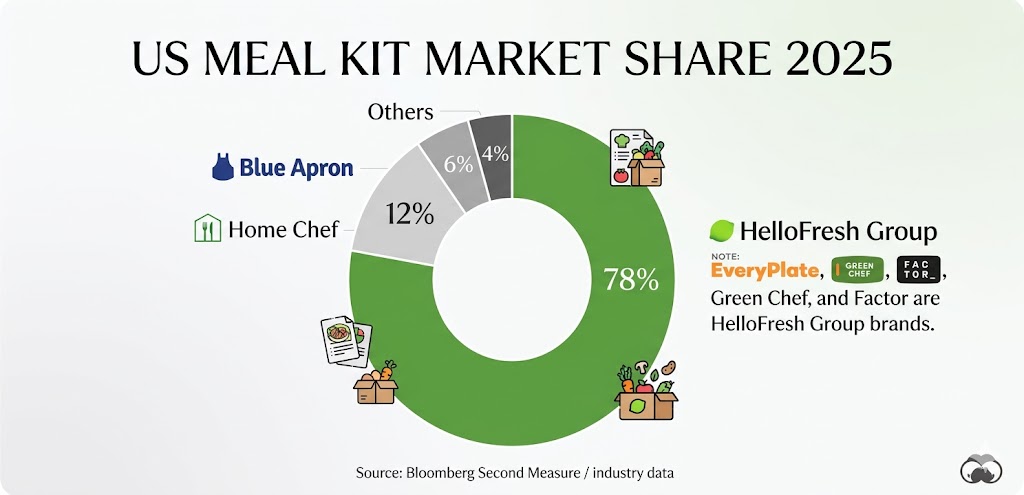
| 5. Competitive Rivalry | MODERATE-HIGH | Several direct competitors, but HelloFresh holds ~78% US meal kit share. Industry consolidation has removed many early entrants. Kroger/Home Chef poses the most credible structural threat. |
Force 1: Threat of New Entrants — Moderate
The meal kit industry appears superficially easy to enter: source food, package it, deliver it. In practice, building the cold-chain logistics infrastructure, supplier relationships, recipe development capability, and technology stack required to operate at HelloFresh’s quality and scale is a multi-year, capital-intensive endeavour. The graveyard of failed meal kit companies — Chef’d, Plated, PeachDish, Sun Basket (restructured), and dozens of regional operators — demonstrates that early market entry does not guarantee survival.
The most credible new entrants are not startups but incumbents from adjacent categories: grocery retailers (Kroger with Home Chef, Walmart with various integrations), restaurant chains exploring meal kit tie-ins, and food delivery platforms (DoorDash, Uber Eats) that could pivot toward semi-prepared meal delivery. HelloFresh’s response to this threat is its data moat: 15 years of subscriber data, personalisation algorithms, and recipe performance metrics that a new entrant would need years to replicate.
Force 2: Supplier Bargaining Power — Low-Moderate
HelloFresh sources ingredients from thousands of farmers, ranchers, and food suppliers across each of its 18 operating markets. This supplier base diversification, combined with HelloFresh’s enormous purchasing scale, gives the company significant negotiating leverage on individual ingredient pricing. No single supplier represents a material dependency.
The pre-portioning model creates an interesting dynamic: HelloFresh purchases very specific quantities of each ingredient (exactly what is needed for each recipe across the weekly order volume), which can be more predictable for suppliers than the more variable demand of retail grocery. This predictability is a negotiating asset. The food inflation cycle of 2022–2024 demonstrated the limits of this power — commodity price increases in energy, protein, and vegetables ultimately passed through to HelloFresh’s COGS, requiring price increases that contributed to subscriber attrition in 2024.
Force 3: Buyer Bargaining Power — High
Buyers in the meal kit market exercise significant power through the fundamental ease of switching. Cancelling a HelloFresh subscription requires two clicks on the website or app. There is no contract, no cancellation fee, and no lock-in period. The next competitor’s introductory offer is one Google search away. This structural reality is why customer churn is the defining challenge of every meal kit operator.
HelloFresh’s primary response to high buyer power is the personalisation investment described throughout this article. A subscriber who has been receiving HelloFresh for 18 months has a product experience tailored to their specific tastes, dietary preferences, and family size that no competitor can instantly replicate. The switching cost is not contractual — it is informational: switching means starting from scratch with a generic menu rather than one calibrated to your household. This manufactured switching cost is HelloFresh’s most effective counterweight to buyers’ structural power.
Force 4: Threat of Substitutes — High
The meal kit value proposition — convenient, fresh, home-cooked dinner — is surrounded by substitutes that serve the same underlying need (a good dinner tonight with minimal effort). Traditional grocery shopping is cheaper and more flexible. Restaurants and takeaway offer zero cooking effort. Food delivery platforms (Uber Eats, DoorDash, Deliveroo) deliver restaurant-quality meals directly. Frozen meal delivery services offer prepared meals at lower prices. In-store meal kits from grocers eliminate the delivery wait. AI meal planning apps are an emerging substitute that removes the ‘what shall I cook’ planning burden without requiring a subscription.
HelloFresh positions itself between full-service dining (too expensive, passive) and pure grocery (too much planning effort) — a middle ground that delivers a genuine benefit not fully replicated by any individual substitute. But the proximity of substitutes means HelloFresh must continuously justify its price premium with a product experience that is demonstrably better than the alternatives for the specific consumer segment it targets. The GLP-1 meal strategy, the sustainability positioning, and the culinary education angle are all attempts to create benefits that food delivery platforms and frozen meal services cannot match.
Force 5: Competitive Rivalry — Moderate-High
The meal kit industry has undergone significant consolidation since its peak in 2017–2018, when dozens of well-funded startups competed intensely. Many of the early entrants have failed, been acquired (Plated by Albertsons, Home Chef by Kroger, Green Chef and EveryPlate by HelloFresh), or dramatically shrunk (Blue Apron). The surviving landscape is smaller and more rational than the peak-competition era, but rivalry remains meaningful.
HelloFresh’s ~78% US market share creates a form of competitive dominance that insulates it from pure price competition — no competitor has sufficient scale to sustain a prolonged price war. The most credible competitive threat comes not from other meal kit pure-plays but from the structural advantage of Kroger’s Home Chef integration, which gives Home Chef in-store distribution that HelloFresh cannot easily replicate. A customer who shops at Kroger weekly and sees a Home Chef kit in the refrigerated aisle faces a lower barrier to trial than a HelloFresh sign-up requires.
Importantly, HelloFresh has used acquisition as a rivalry management tool: buying EveryPlate, Green Chef, and Factor means that competitors who might have capitalised on those specific market segments (budget, organic, ready-to-eat) are instead contributing to HelloFresh Group’s revenue rather than competing against it.
Frequently Asked Questions (FAQs)
Q: What are HelloFresh’s most effective marketing strategies?
A: HelloFresh’s most effective marketing strategies in 2025 are: (1) AI-driven personalisation — using machine learning to tailor weekly menu recommendations and email communications to each subscriber individually, delivering 18% higher retention and 14% more orders; (2) Referral programmes — a dual-incentive model that acquires high-quality subscribers through word-of-mouth at below-average CAC; (3) The quality-over-volume acquisition pivot — reducing discount-heavy paid media spend by 10% while scaling organic channels for 22% higher ROI; and (4) Multi-brand portfolio architecture — owning the budget (EveryPlate), premium (Green Chef), organic, and ready-to-eat (Factor) segments simultaneously to capture consumers at different points in their food journey.
Q: How did HelloFresh become the market leader in meal kits?
A: HelloFresh achieved market leadership through a combination of early mover advantage (founded 2011, one of the first meal kit companies at scale), aggressive global expansion (now in 18 countries), strategic acquisitions (Green Chef 2018, Factor 2020, Youfoodz 2021), superior data and personalisation capabilities, and a multi-brand portfolio strategy that allows it to compete across every price point and dietary preference without diluting its core brand. By 2022, HelloFresh and its subsidiaries controlled approximately 78% of meal kit sales among the major US players — a market dominance achieved through both organic growth and the acquisition of competing brands.
Q: How does HelloFresh use AI in its marketing?
A: HelloFresh uses AI and machine learning across multiple marketing functions. In personalisation, AI analyses each subscriber’s purchase history, recipe ratings, ingredient preferences, and skipped weeks to tailor weekly menu recommendations individually — rather than broadcasting the same menu to all subscribers. In retention, AI-driven customer value prediction identifies subscribers at risk of churning and triggers targeted win-back campaigns at the optimal moment. In paid media, HelloFresh CMO Patrick Stal disclosed a pilot of OpenAI’s advertising tools to generate and optimise ad creative at scale. The combined effect of these AI initiatives includes an 18% improvement in customer retention rates and 14% higher order rates from personalised recipe notifications.
Q: What is HelloFresh’s referral programme and how does it work?
A: HelloFresh’s referral programme allows existing subscribers to share a referral link or code with friends and family. The new customer receives either a significant discount on their first order (typically $40 off) or a free meal box, depending on the offer active at the time. The existing subscriber receives a credit (typically $20) against their own subscription. The programme’s dual incentive structure — rewarding both parties — is a deliberate design choice that turns satisfied customers into brand advocates while simultaneously making the trial barrier for new customers lower. Time-sensitive versions of the offer (a free box available for a limited period) create urgency that drives faster conversion.
Q: Who are HelloFresh’s main competitors in 2025?
A: HelloFresh’s main competitors in the US meal kit market are Home Chef (owned by Kroger, ~12% US market share), Blue Apron (~6% share, premium positioning), Marley Spoon, Sunbasket (organic premium), and Dinnerly (ultra-budget). However, a crucial insight is that several of HelloFresh’s apparent competitors are actually part of the HelloFresh Group: EveryPlate (budget), Green Chef (certified organic), Factor (ready-to-eat), Purple Carrot (plant-based), and Youfoodz (Australia/NZ). This means HelloFresh Group collectively owns a far larger share of the addressable meal kit market than the HelloFresh brand alone suggests.
Q: What is HelloFresh’s financial performance in 2024 and 2025?
A: HelloFresh Group’s FY2024 revenue was approximately €7.66 billion, with AEBITDA of €399.4 million (5.2% margin). In FY2025, revenue declined to approximately €6.8 billion — a deliberate strategic choice to prioritise subscriber quality over volume. Despite the revenue decline, AEBITDA improved 14% year-on-year to €422.8 million, and the meal kit AEBITDA margin improved significantly from 9.8% to 13.5%. Free cash flow turned positive at €18.9 million, the highest level since 2021. Q1 2025 showed further recovery with €1.9 billion in revenue (+15% YoY) and €94.3 million in positive free cash flow.
Q: What is HelloFresh’s GLP-1 marketing strategy?
A: HelloFresh is actively targeting the rapidly growing GLP-1 medication user market (people taking semaglutide or tirzepatide drugs like Ozempic or Wegovy for weight management). Its Factor brand launched GLP-1-friendly ready-to-eat meals in 2025 — high protein, controlled portions, nutrient-dense, and easy to eat even with reduced appetite. HelloFresh partnered with TikTok influencers and YouTube creators to review these meals in the context of GLP-1 dieting, generating over 1 million views and a 12% brand awareness increase in target markets. This strategy exemplifies HelloFresh’s approach of identifying emerging health behaviours and rapidly building product lines and influencer campaigns to serve them.
Q: How does HelloFresh’s sustainability strategy work as marketing?
A: HelloFresh’s sustainability marketing is effective because it connects specific, tangible benefits to individual customer behaviour rather than making abstract corporate pledges. The company’s key messages are: (1) pre-portioned ingredients reduce household food waste — a pain point consumers understand personally; (2) University of Michigan research shows meal kits have a 25% lower carbon footprint than equivalent grocery-sourced meals; (3) 100% carbon offset commitment and renewable electricity use across operations. These claims are quantifiable and specific, making them credible. The partnership with No Kid Hungry adds a social responsibility dimension — HelloFresh donates meals to children in food-insecure households — which aligns the brand’s commercial mission (making good food accessible) with a social good.
Q: Why did HelloFresh reduce its revenue in 2025?
A: HelloFresh’s 2025 revenue decline from €7.66B to €6.8B was a strategic choice, not a failure. The company deliberately shifted its marketing and acquisition strategy away from discount-driven subscriber acquisition that attracted high-churn, low-quality customers and toward value-focused acquisition of subscribers with genuine cooking intent and longer expected tenure. This ‘quality over volume’ pivot was reflected in a 14% improvement in AEBITDA (to €422.8M), a 380 basis point improvement in meal kit AEBITDA margins (from 9.8% to 13.5%), and the return to positive free cash flow. The strategy prioritises profitability over growth rate — a common transition as subscription businesses mature.
Q: What is the ‘HelloFresh at Home’ campaign?
A: ‘HelloFresh at Home’ was a major global content marketing campaign launched in 2021 that included video tutorials, blog posts, and social media content showcasing easy-to-follow recipes using HelloFresh meal kits. The campaign was designed to position HelloFresh not just as a food delivery service but as a culinary education platform — helping customers build their cooking confidence and repertoire. Alongside the branded content, HelloFresh invited customers to share their own cooking experiences using the hashtag #HelloFreshPics, generating a wave of user-generated content that provided authentic social proof and extended the campaign’s reach organically through customers’ personal social networks.
Conclusion: The Lessons from HelloFresh’s Marketing Playbook
HelloFresh’s marketing success is the product of a decade of systematic learning, experimentation, and willingness to evolve. The company that once competed primarily on discount acquisition has matured into a sophisticated subscription marketer that uses AI personalisation to maximise retention, influencer partnerships to target emerging health trends, a multi-brand portfolio to own every consumer segment, and in-house creative capability to produce content at scale and speed.
The strategic evolution of 2024–2025 — the deliberate quality-over-volume pivot — is perhaps the most instructive lesson HelloFresh offers for subscription marketers. The decision to accept lower revenue in exchange for higher-quality customers, better margins, and more sustainable free cash flow is an unusual and counterintuitive choice for a public company accustomed to reporting growth. But the financial results — 14% AEBITDA growth, 380bps margin improvement, positive free cash flow — vindicate the decision and offer a template for other subscription businesses trapped in the discount-acquisition loop.
For competitors attempting to close the gap on HelloFresh, the analysis suggests the challenge is not primarily a marketing one. HelloFresh’s competitive moat is built from operational scale, proprietary customer data, a multi-brand portfolio that owns multiple segments simultaneously, and a personalisation engine that improves with every meal delivered. These are structural advantages that marketing budgets alone cannot overcome. To challenge HelloFresh meaningfully, a competitor would need either dramatically superior product quality, a distribution advantage (like Home Chef’s Kroger integration), or a segment-specific proposition compelling enough to justify a customer choosing a single-brand alternative over HelloFresh’s personalised, flexible, and increasingly reliable service.
Also Read: Marketing Strategies and Marketing Mix of Blue Apron
To read more content like this, explore The Brand Hopper
Subscribe to our newsletter