Last Updated on August 12, 2026 by Team TBH
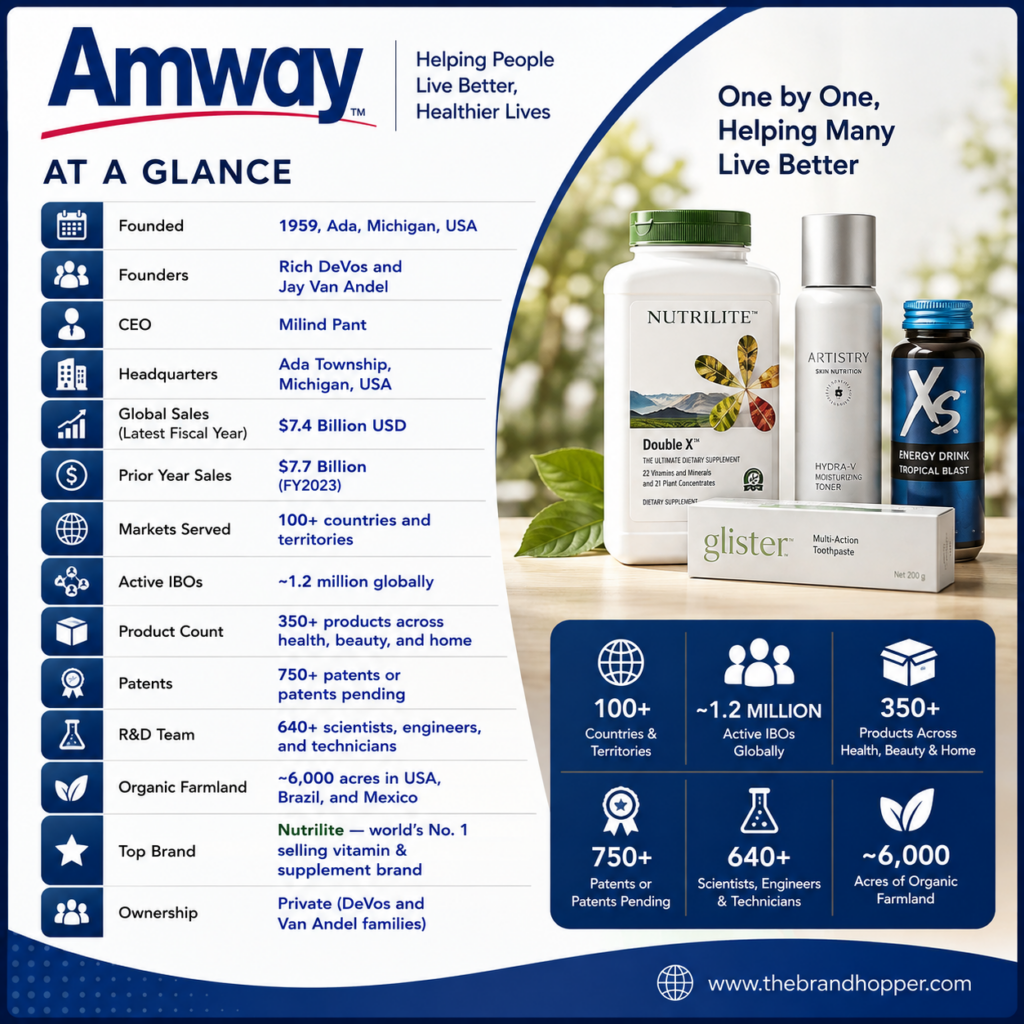
Amway is one of the most studied, debated, and misunderstood business models in the world. Founded in 1959 in Ada, Michigan by Rich DeVos and Jay Van Andel, Amway — short for ‘American Way’ — set out to prove that entrepreneurship, fuelled by direct selling, could create income opportunities for ordinary people worldwide. More than six decades later, it has done exactly that, operating in over 100 countries and generating $7.4 billion in global sales for its most recent fiscal year, according to Amway’s official newsroom. It consistently ranks as the world’s largest direct selling company in the annual Direct Selling News Global 100 list.
This article is a comprehensive breakdown of Amway’s marketing strategy — covering its unique business model, product portfolio, digital transformation, brand positioning, pricing approach, global localization, sustainability commitments, and how it continues to evolve in a world where social media and e-commerce have redrawn the rules of direct selling.
| Global Sales
$7.4 Billion |
Countries
100+ |
Active IBOs
~1.2 Million |
Founded
1959, Ada MI |
Amway: Company Overview
Amway’s Product Portfolio
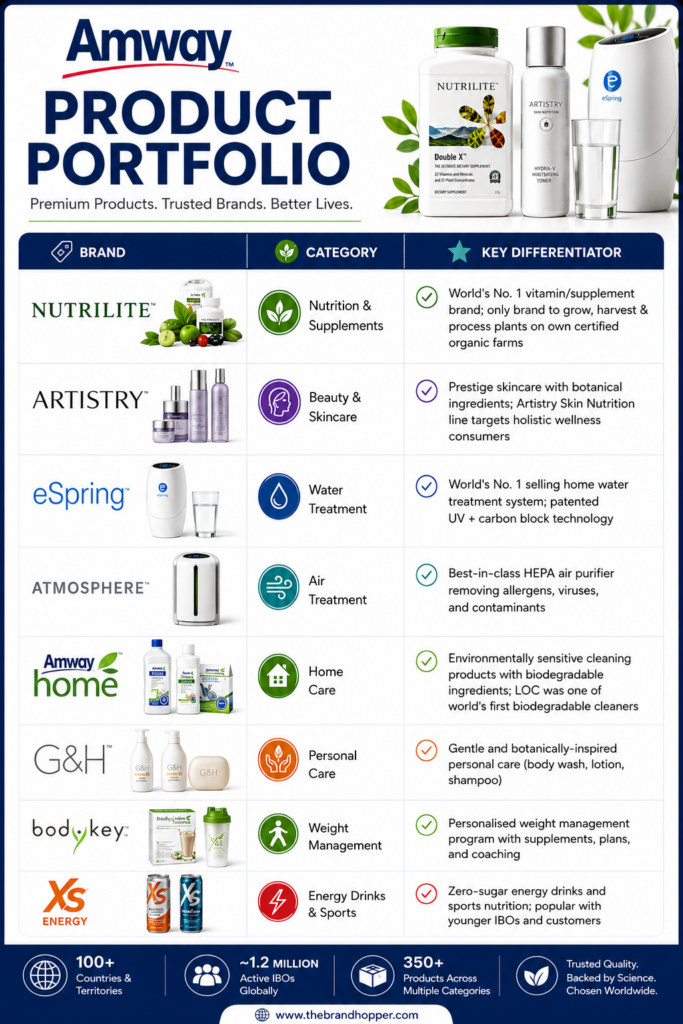
Amway’s product strategy is built around high-quality, premium-priced wellness products that are exclusive to the Amway direct selling channel. This exclusivity is fundamental to the business model — customers can only purchase authentic Amway products through an IBO or Amway’s official online channels, creating a built-in distribution advantage for the IBO network.
| Key Product Insight
Nutrition (Nutrilite) accounts for 64% of Amway’s total global sales and grew 2% in the latest fiscal year — reinforcing that Amway is fundamentally a health and wellness company, not just a direct sales distribution vehicle. |
The Amway Business Model: Multi-Level Marketing Explained
Amway operates a Multi-Level Marketing (MLM) model — also called network marketing or direct selling — where Independent Business Owners (IBOs) serve simultaneously as customers, salespeople, and recruiters. This eliminates the traditional retail supply chain (distributors → wholesalers → retailers → customers) and creates a direct, person-to-person transaction between the IBO and the end customer.
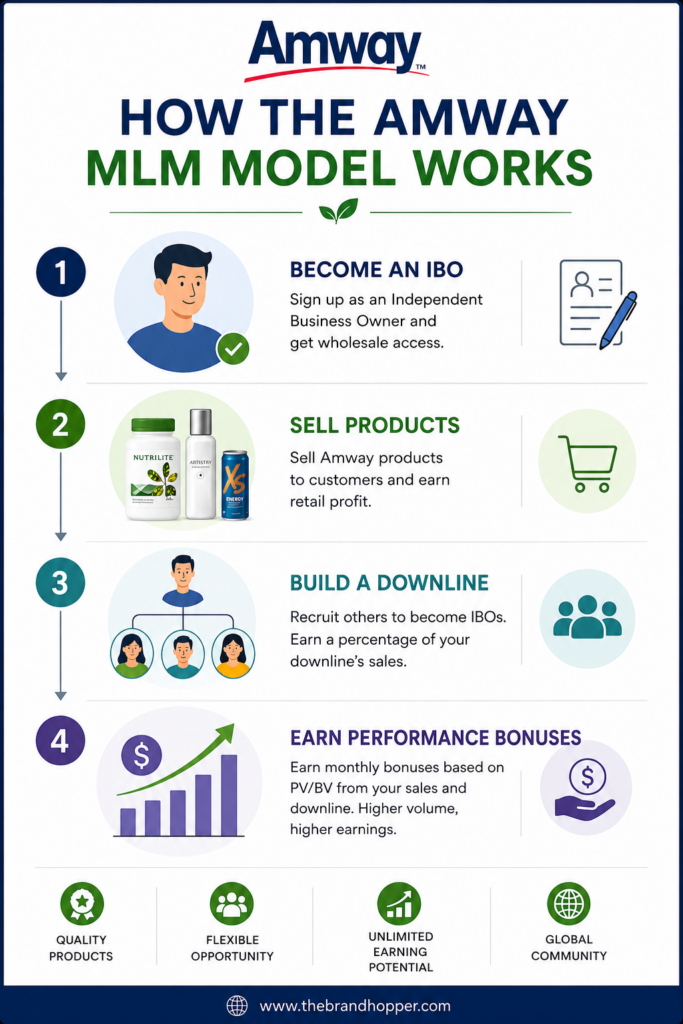
How the Amway MLM Model Works
Step 1 — Become an IBO: An individual signs up as an Independent Business Owner, paying a small registration fee. They gain access to Amway products at wholesale prices and the right to sell at suggested retail prices, earning the margin.
Step 2 — Sell products: The IBO sells Amway products directly to customers — friends, family, colleagues, or contacts developed through digital and social channels — earning a retail profit on each sale.
Step 3 — Build a downline: IBOs can recruit other people to become IBOs in their network (their ‘downline’). When downline IBOs make sales, the recruiting IBO earns a performance bonus — a percentage of the downline’s sales volume. This multi-tier earning structure is the ‘multi-level’ component of the model.
Step 4 — Earn performance bonuses: Amway uses a point-based Performance Value (PV) and Business Volume (BV) system. IBOs earn monthly performance bonuses based on the total PV/BV of their personal sales and their downline’s sales. Higher volumes unlock higher bonus percentages, creating an incentive structure that rewards both personal selling and network building.
Why the Business Model Works
The model’s power lies in eliminating intermediary costs that traditional retail chains incur. By removing wholesalers, retailers, and most advertising expenditure, Amway can redirect that margin to:
- Higher-quality products with premium ingredients
- Generous IBO compensation (performance bonuses + retail profit)
- Investment in R&D ($335 million invested in R&D facilities across the Americas over seven years, per Amway’s official reporting)
- Brand-building through word-of-mouth and relationship marketing
| Amway vs. Pyramid Scheme: A Critical Distinction
Amway is frequently — and incorrectly — conflated with illegal pyramid schemes. The distinction is straightforward: Amway’s revenue comes from genuine product sales to real customers, not from recruitment fees. In 1979, the U.S. Federal Trade Commission (FTC) ruled that Amway was a legitimate direct selling business, not a pyramid scheme, a decision that remains foundational to the legal framework of the entire MLM industry. Amway has operated the same business model since 1959, which further distinguishes it from fraudulent schemes that change models to avoid scrutiny. |
Amway’s Core Marketing Strategies
Amway’s marketing operates at two levels: corporate brand marketing (setting quality standards, product innovation, and global brand guidelines) and IBO-driven word-of-mouth marketing (personal selling, social media, and network building). Here are its 10 core marketing strategies.
1. Direct Selling as the Core Distribution Strategy
Amway’s most fundamental marketing strategy is its distribution model: selling exclusively through IBOs, with no retail shelf presence. This is not merely a cost decision — it is a brand strategy. By restricting product access to the IBO channel, Amway ensures that every purchase comes with a personal consultation and a relationship. This creates a selling experience that positions Amway products as premium wellness investments rather than generic consumer goods.
The direct selling model also creates a self-reinforcing marketing engine: each IBO is simultaneously a customer (using and believing in the products) and a salesperson (recommending them). This authenticity is far more persuasive than traditional advertising for high-consideration wellness purchases like vitamins, supplements, and skincare.
2. Product Quality and Innovation Strategy
Amway’s marketing credibility rests on having products that can withstand personal recommendation. The company invests heavily in R&D through a team of 640+ scientists, engineers, and technicians, and holds 750+ patents or patents pending. Key product-quality marketing claims include:
- Nutrilite organic farms: ~6,000 acres of certified organic farmland in the U.S., Brazil, and Mexico — the only supplement brand globally to grow, harvest, and process plants on its own certified organic farms. Farms hold Regenerative Organic Certification (ROC) and Fair for Life Fair Trade certification.
- NutriCert program: A certification standard for partner farms supplying ingredients to Nutrilite, ensuring consistent agricultural and quality standards across the supply chain.
- eSpring UV technology: Patented UV + carbon block filtration system with independent certification — the technical credibility that justifies the premium price point.
- Artistry Skin Nutrition: A product line aligned with the clean beauty and skin-as-wellness trend, using botanical extracts backed by Amway’s plant science research.
3. Digital Transformation and E-Commerce Strategy
Amway’s most significant strategic evolution in recent years is its digital transformation. The company has invested heavily in digital infrastructure to make selling and ordering easier for IBOs while maintaining the human relationship that defines direct selling. Key metrics:
| Digital Metric | Performance |
| % of global orders placed digitally | 90%+ |
| Year-over-year growth in online sales volume | 29% |
| Digital order penetration (Korea & USA) | Exceeds 80% |
| IBO digital tools provided | Personalised e-commerce storefronts, mobile business management app, online training portals |
| 2024 campaign launch | ‘Own Your Future’ digital-first initiative |
Amway now provides each IBO with a personalised e-commerce storefront — a branded mini-website through which their customers can browse and purchase products online, with all orders still credited to that IBO’s account. This hybrid model combines the scale of e-commerce with the accountability of the IBO relationship, preserving the human element while enabling digital convenience.
4. The ‘Own Your Future’ Campaign and Brand Repositioning
Recognising that MLM carries stigma — particularly among younger consumers — Amway launched its ‘Own Your Future’ campaign, a digital-first initiative focused on repositioning direct selling as entrepreneurship rather than network recruitment. The campaign emphasised flexibility, independence, and purpose-driven income — themes that resonate strongly with gig-economy workers, millennials, and Gen Z.
The campaign contributed to a 3.2% uptick in new IBO sign-ups — a meaningful result at a time when overall global sales were under pressure from US dollar strength and macroeconomic headwinds. This demonstrates the power of narrative positioning: the campaign did not change the product or the compensation plan, it changed the framing — from ‘selling products’ to ‘building your own business’.
5. IBO Empowerment, Training and Recognition Programs
For a company that has no in-house salesforce — relying entirely on 1.2 million independent contractors — the quality of its IBO training and support ecosystem is a marketing strategy in itself. Amway invests substantially in:
- Education and training: Amway Business School (ABS), online learning pathways, product knowledge certifications, and sales technique training — all delivered digitally through the IBO app and learning management platforms.
- Recognition culture: A tiered recognition system (Silver, Gold, Platinum, Diamond, Executive Diamond, Double Diamond, Triple Diamond, Crown Ambassador) creates an aspiration ladder that motivates IBOs at every level. Annual recognition events celebrate top IBOs globally.
- Sample programs: IBOs can send product samples to prospective customers through Amway’s sample programs, reducing the barrier to first purchase.
- Digital marketing resources: Templates, social media content packs, and personalised storefronts give IBOs professional marketing materials even if they lack design skills.
- IBO app: A mobile application for business management — tracking orders, commissions, downline performance, and customer data — with an enhanced version planned for continued rollout.
6. Premium Pricing Strategy
Amway’s products are priced significantly above comparable mass-market products. A month’s supply of Nutrilite daily supplements, for example, costs considerably more than similar products available in pharmacies or on Amazon. This is a deliberate strategy, not a marketing weakness.
The premium price serves multiple functions: it creates the margin necessary to pay IBO bonuses on top of the retail mark-up; it positions Amway products as quality investments rather than commodity purchases; and it reinforces the value of the personal consultation an IBO provides. The pricing model depends entirely on IBOs being able to convince customers that quality and provenance (organic farming, independent certification, patent-backed technology) justify the premium — making product knowledge training a critical marketing function.
7. Global Localization Strategy
Operating in 100+ markets creates enormous complexity in marketing. Amway addresses this through a glocal (global + local) approach: maintaining consistent global brand standards for Nutrilite, Artistry, and eSpring while adapting product formulations, packaging, marketing materials, and compensation structures to local regulatory requirements and cultural preferences.
Key localization examples include: Artistry product shades adjusted for Asian skin tones (China, South Korea, Japan are among Amway’s largest markets); Amway India’s product line adjusted to comply with FSSAI (Food Safety and Standards Authority of India) regulations; and Nutrilite formulations adapted for local dietary deficiency profiles (e.g., iron and vitamin D formulations differ by region). China — Amway’s largest single market — uses a store-based model in addition to direct selling, complying with China’s specific MLM regulations that restrict recruitment-based compensation.
8. Sustainability and Corporate Responsibility as a Marketing Strategy
Amway’s sustainability commitments are not merely CSR box-ticking — they are a core part of its product marketing story, particularly for Nutrilite. The certified organic farmland, the regenerative agriculture practices, the Fair for Life Fair Trade certification, and the NutriCert program for partner farms all translate into marketing claims that resonate with the growing ‘clean and green’ consumer segment.
Amway Home’s biodegradable cleaning products — including LOC (Liquid Organic Cleaner), one of the world’s first biodegradable multi-purpose cleaners — were ahead of their time in environmental positioning. This legacy of sustainable formulation supports Amway’s messaging to environmentally conscious consumers without requiring the company to pivot its product line.
- Regenerative Organic Certification (ROC) on Nutrilite farms
- Fair for Life Fair Trade certification on select farms
- FSSC 22000 food safety certification
- Biodegradable ingredients in Amway Home product range
- Water stewardship and reduced tillage practices on organic farms
9. Social Media and Influencer-Style IBO Marketing
In the traditional direct selling era, IBOs relied on home meetings and one-on-one pitches. In the digital era, Amway has embraced social media as an IBO marketing platform, training IBOs to build personal brands on Instagram, Facebook, YouTube, and TikTok — essentially turning each IBO into a micro-influencer for Amway products.
This approach aligns perfectly with the modern influencer marketing playbook: authentic personal testimonials from real users carry more credibility than brand advertising, particularly in the wellness and beauty categories. Amway’s brand guidelines govern what IBOs can and cannot say in their social content, while still allowing personal storytelling and product demonstration — preserving authenticity while protecting the brand.
Amway’s own social accounts (global and local market accounts) maintain consistent brand presence, share product education content, and amplify IBO success stories — reinforcing the entrepreneurship narrative of the ‘Own Your Future’ campaign at scale.
10. Customer Retention Through Relationship Marketing
The Amway model’s greatest long-term advantage is relationship-based retention. A customer who buys Nutrilite supplements from a friend or neighbour is far more likely to re-order than one who bought from an e-commerce search result. This human connection creates a natural renewal loop — IBOs follow up, check in on results, suggest complementary products, and provide a personalised customer service experience that no algorithm can fully replicate.
Amway reinforces this with Loyalty Programs and autoship options (regular automatic deliveries) that reduce purchase friction and lock in recurring revenue. For the IBO, an autoship customer generates consistent monthly PV/BV with minimal effort, making retention as profitable as acquisition.
Amway’s STP Analysis
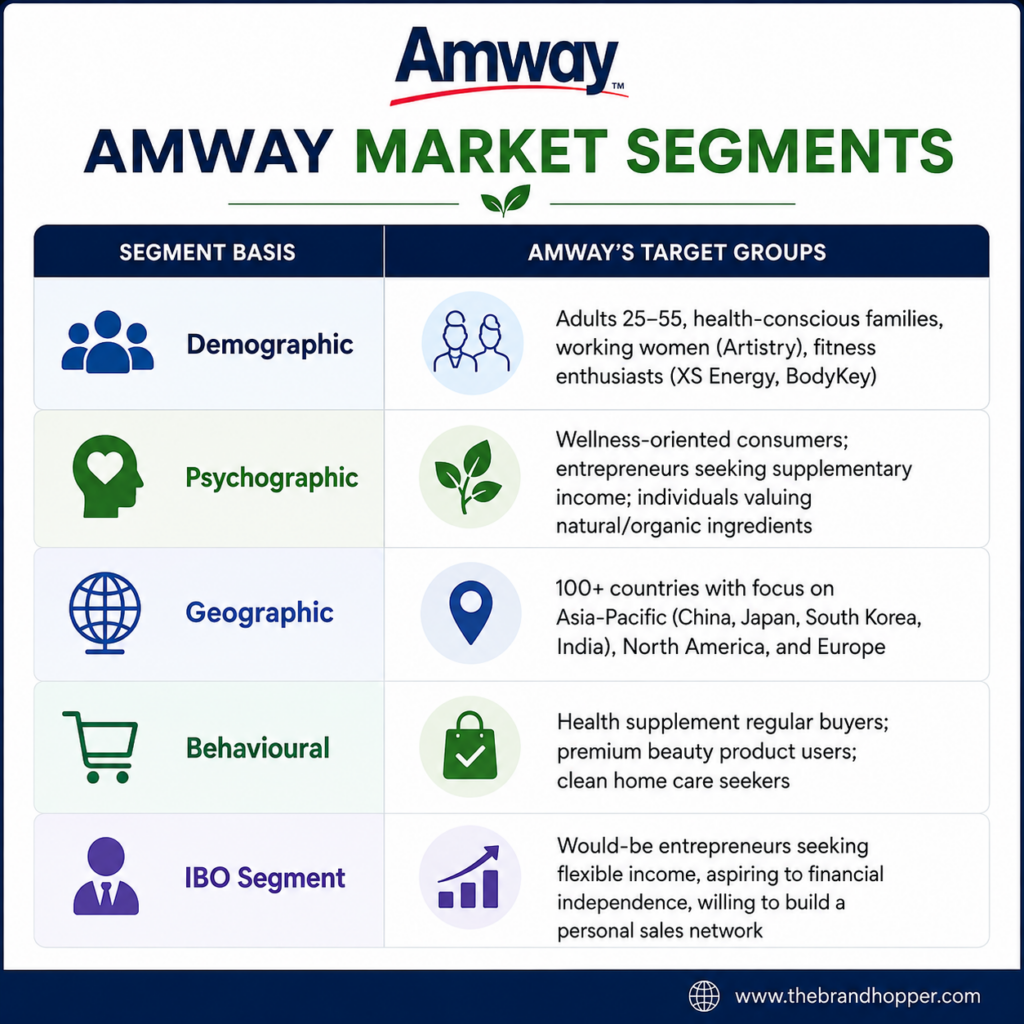
Segmentation
Amway segments its market across several dimensions:
Targeting
Amway pursues a differentiated targeting strategy: Nutrilite targets health-conscious consumers of all ages; Artistry targets women aged 25–50 in the premium skincare market; XS Energy targets younger, active consumers; eSpring targets families concerned about water quality; and the IBO opportunity targets entrepreneurial adults seeking income supplementation. Rather than a single target market, Amway’s multi-brand portfolio allows it to address multiple consumer segments through a unified distribution network.
Positioning
Amway’s core positioning is: “Science-backed wellness products, delivered by people who use and believe in them.” The company positions itself at the intersection of premium quality (independent certifications, organic farms, patents) and entrepreneurial opportunity (the ‘Own Your Future’ narrative). This dual positioning — product excellence for customers and business opportunity for IBOs — is what distinguishes Amway from both conventional consumer brands and from pure-play employment companies.
Amway’s Marketing Mix: The 4Ps
| Marketing Mix | Amway’s Approach | Key Detail |
| Product | Health, Beauty, Home — premium wellness brands | 350+ products across Nutrilite, Artistry, eSpring, G&H, Atmosphere, Amway Home, XS Energy, BodyKey. Exclusive to Amway channel. |
| Price | Premium pricing strategy | Products priced above mass-market equivalents to fund IBO bonuses, R&D investment, and brand positioning as a quality wellness choice. |
| Place | Direct selling + digital e-commerce | No retail shelves. Sales via 1.2 million IBOs globally, personalised IBO e-commerce storefronts, and Amway’s own digital platforms. 90%+ of orders now placed digitally. |
| Promotion | Word-of-mouth + digital + IBO social media | Minimal above-the-line advertising. Promotion driven by IBO personal testimonials, social media micro-influencer activity, events, recognition programs, and corporate campaigns like ‘Own Your Future’. |
SWOT Analysis of Amway
| SWOT | Factors |
| STRENGTHS | Global leader in direct selling (#1 for 13+ consecutive years per DSN Global 100) | Powerful anchor brand in Nutrilite (#1 global vitamin/supplement brand) | 750+ patents reinforcing product differentiation | ~6,000 acres certified organic farmland — unique supply chain asset | Strong IBO loyalty and repeat purchase behaviour | Privately held: no short-term quarterly earnings pressure | $7.4B revenue with 100+ country diversification |
| WEAKNESSES | Revenue in multi-year decline ($8.8B in 2018 → $7.4B, impacted by USD strength and Russia exit) | High product prices limit mass-market penetration | MLM structure faces persistent public perception issues and regulatory scrutiny | Heavy dependence on IBO motivation and retention — attrition is a constant challenge | Limited brand awareness without traditional advertising in new markets |
| OPPORTUNITIES | Growing global wellness market (projected to exceed $7 trillion by the late 2020s) | Digital/social media dramatically expands IBO reach beyond local networks | Clean beauty and functional nutrition trends align with Amway’s product strengths | Emerging markets (South Asia, Southeast Asia, Africa, Latin America) growing disposable income | Gut microbiome, immunity, and longevity supplement categories fast-growing |
| THREATS | Increased regulatory scrutiny of MLM models (India, China, EU) | Rise of DTC (direct-to-consumer) wellness brands on Amazon, Shopify with lower price points | Competition from established supplement brands (GNC, Herbalife, Usana) and clean beauty brands | Currency headwinds from US dollar strength (reduces reported USD revenue from international markets) | Negative media coverage and social perception of MLM continues to affect IBO recruitment |
Amway’s Revenue Performance: Context and Perspective
Amway has experienced a period of revenue contraction since its peak. It reported $8.8 billion in 2018 — a figure cited in its official newsroom release. Since then, global sales have declined year over year, primarily driven by: (1) the withdrawal from Russia following geopolitical events in 2022, (2) the persistent strengthening of the US dollar (which reduces the dollar-reported value of non-USD market sales), and (3) slowing IBO recruitment in mature markets.
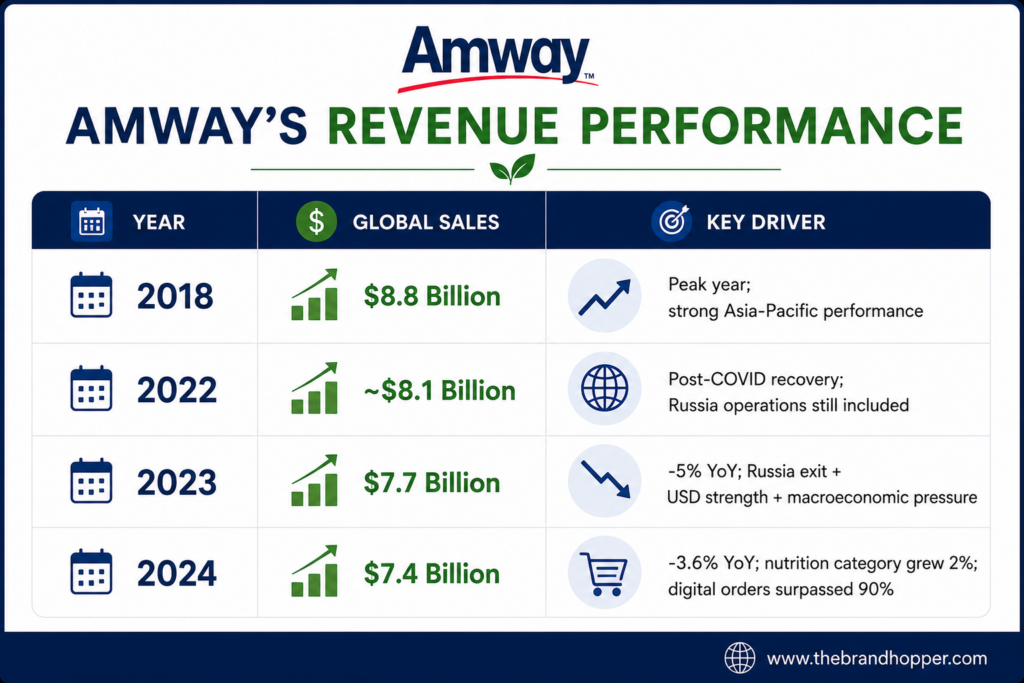
Despite headline revenue decline, Amway’s nutrition segment grew 2% in 2024 and now represents 64% of global sales, signalling product portfolio resilience. Digital order growth of 29% year-over-year demonstrates that the underlying business model is adapting successfully to the digital era, even if macroeconomic factors are compressing reported USD revenues.
Is Amway a Pyramid Scheme? The Definitive Answer
The question surfaces consistently because Amway’s structure — where recruiting others generates income — superficially resembles an illegal pyramid scheme. The critical legal and business distinction is where the money comes from:
- Pyramid scheme: Revenue comes primarily from recruitment fees paid by new participants. No real products of value are sold. The scheme collapses when recruitment slows.
- Amway: Revenue comes from product sales to end customers. IBOs earn from sales volume, not from recruitment. The 1979 FTC ruling explicitly found Amway to be a legitimate business, not a pyramid scheme.
However, legitimate concerns exist about income concentration: Amway’s income disclosure statements consistently show that the majority of IBOs earn modest incomes, with high earnings concentrated among a small percentage of top-tier IBOs (Diamond and above). This is a transparency issue that Amway has addressed through more detailed IBO income disclosures — but it remains a reputational vulnerability.
Amway’s longevity (65+ years on the same business model) and its consistent legal standing across 100+ regulatory jurisdictions are the most credible evidence of its legitimacy. Countries with strict consumer protection frameworks — including Germany, Japan, South Korea, and the United Kingdom — all permit Amway’s operations.
Amway’s Key Competitors
Amway competes across two distinct arenas:
| Competitor | Type | Primary Overlap with Amway |
| Herbalife Nutrition | Direct Selling / MLM | Nutrition and weight management; direct competition for IBO recruitment in same markets |
| Nu Skin Enterprises | Direct Selling / MLM | Beauty and anti-aging; competes directly with Artistry |
| USANA Health Sciences | Direct Selling / MLM | Nutrition supplements; competes with Nutrilite |
| Oriflame | Direct Selling / MLM | Beauty and personal care in Europe and Asia |
| Nature’s Sunshine | Direct Selling | Herbal supplements; competes with Nutrilite |
| Brita / Culligan | Retail Brand | Home water filtration; competes with eSpring |
| GNC / Holland & Barrett | Retail Chain | Vitamins and supplements available via retail at lower price points |
| Amazon / Walmart (private label) | E-Commerce | Low-cost supplement and beauty alternatives available at a fraction of Amway’s price point |
| Also Read
For another example of brand-building through premium positioning and customer experience, see our analysis of Starbucks. |
Read: It’s Not Just a Coffee, It’s Starbucks — The Brand Hopper
Frequently Asked Questions (FAQs)
Q: What is Amway’s marketing strategy in one sentence?
A: Amway’s marketing strategy is to sell science-backed, premium wellness products exclusively through a global network of Independent Business Owners (IBOs) who use, believe in, and personally recommend the products — eliminating retail intermediaries and creating a self-reinforcing word-of-mouth marketing engine amplified by digital tools.
Q: How much does Amway make per year?
A: Amway reported global sales of $7.4 billion for its most recent fiscal year (source: Amway Global newsroom, 2025). This compares to $7.7 billion the prior year and a peak of $8.8 billion in 2018. Revenue has been impacted by US dollar strength (which compresses international sales when converted to USD) and the exit from Russia. The nutrition category (Nutrilite) grew 2% and now represents 64% of total global sales.
Q: What is Amway’s most profitable product?
A: Nutrilite is Amway’s most important product line — it accounts for 64% of total global sales and grew 2% in the most recent fiscal year. Nutrilite is also the world’s No. 1 selling vitamin and dietary supplements brand. The eSpring water treatment system and Artistry skincare range are the other major revenue contributors.
Q: How does Amway use digital marketing?
A: Amway has undergone a significant digital transformation. Over 90% of global orders are now placed digitally, with online sales volume growing 29% year-over-year. Each IBO receives a personalised e-commerce storefront, a mobile business management app, and digital marketing resource packs. IBOs are trained to use social media platforms (Instagram, Facebook, YouTube, TikTok) as personal branding and marketing channels, effectively becoming micro-influencers for Amway products.
Q: How does Amway differ from a pyramid scheme?
A: The fundamental difference is the source of revenue. In an illegal pyramid scheme, income is generated primarily from recruitment fees — there is no genuine product being sold. Amway’s revenue comes from real product sales to genuine end customers. IBOs earn performance bonuses based on product sales volume, not on recruitment. In 1979, the U.S. Federal Trade Commission (FTC) specifically ruled that Amway is a legitimate direct selling business, a precedent that has stood for more than four decades.
Q: What is Amway’s target market?
A: Amway targets two distinct groups: (1) health and wellness consumers — primarily adults 25–55 who prioritise quality, natural ingredients, and scientifically validated products in nutrition (Nutrilite), beauty (Artistry), water treatment (eSpring), and home care (Amway Home); and (2) entrepreneurial individuals seeking a flexible, home-based income opportunity through IBO registration — particularly in markets with high mobile device penetration and growing middle-class income.
Q: How does Amway compete against cheaper supplement brands like GNC or Amazon private labels?
A: Amway competes on quality differentiation rather than price. Nutrilite’s organic farmland ownership, NutriCert-certified partner farms, 750+ patents, and independent certifications (ROC, Fair for Life) provide verifiable reasons why the product commands a premium. The personal selling model also adds a consultation component — IBOs help customers understand formulations, dosage, and product combinations — which commodity retail channels cannot replicate. The trust embedded in a personal recommendation justifies a price premium that purely transactional retail cannot.
Q: What are Amway’s biggest growth opportunities?
A: Amway’s most significant growth opportunities are: (1) the rapidly growing global wellness and functional nutrition market; (2) digital acceleration — expanding IBO e-commerce storefronts and social selling capabilities; (3) emerging market penetration in South and Southeast Asia, Africa, and Latin America where wellness spending is growing and entrepreneurship is culturally valued; (4) gut microbiome, immunity, and longevity supplement categories, which are science-driven growth areas aligned with Nutrilite’s plant-based positioning; and (5) Artistry’s expansion in the clean beauty segment, which has secular tailwinds.
Conclusion
Amway’s marketing strategy is a masterclass in commitment to a model that most conventional marketing wisdom would never design from scratch — and yet it works at global scale, for 65+ years and counting. The company’s genius is that it has made its distributors into both its salesforce and its most loyal customers, creating a system where the marketing budget is paid not in advertising spend but in IBO bonuses and performance rewards.
Its current challenges — declining headline revenue, MLM perception issues, recruitment pressure — are real but manageable. The nutrition category’s resilience (64% of sales, growing 2%), the dramatic digital transformation (90%+ digital orders, 29% online sales growth), and the ‘Own Your Future’ brand repositioning all point toward a company that understands its structural vulnerabilities and is actively working to address them.
The global wellness market — estimated to be on track to exceed $7 trillion — is a structural tailwind that few companies are better positioned to ride than Amway: a science-backed, organically-sourced supplement company with 100+ country distribution, a loyal IBO base of over a million, and six decades of brand trust. The marketing strategy, at its core, has never been about selling products. It has always been about selling the belief that a better life — healthier, wealthier, more purposeful — is within reach.
To read more content like this, subscribe to our newsletter