Last Updated on May 26, 2026 by Team TBH
When you pick up a pair of Ray-Bans at an airport, browse Oakley frames at a sports shop, collect your prescription glasses from LensCrafters, or clean them with a Transitions lens at sunset, there is a good chance you are interacting with the same company — and most people have never heard its name.
EssilorLuxottica is the world’s largest eyewear company. Formed in 2018 from the merger of Italy’s Luxottica Group and France’s Essilor International, it now controls an empire spanning more than 150 brands, roughly 17,600 retail locations globally (13,500 directly owned, 4,100 franchised), and the most advanced optical lens technology on the planet. In 2024, the group generated €26.5 billion (~$29.3 billion) in revenue — a figure that places it among the most powerful consumer goods companies in the world. In the first half of 2025 alone, revenue reached €14.02 billion, growing 7.3% year-on-year.
This is not simply an eyewear company. It is the company that designed and manufactures frames for Chanel, Prada, Armani, Burberry, Ferrari, and Versace. It makes the lenses that correct the vision of an estimated 3.5 billion people who need glasses worldwide. It partnered with Meta to create the Ray-Ban smart glasses that became the first mainstream wearable computer. And in October 2024, it paid $1.5 billion to acquire Supreme — the most influential streetwear brand in the world.
Understanding EssilorLuxottica is understanding how one company quietly came to sit at the intersection of fashion, healthcare, technology, and retail.
From Spectacle Parts to a $90 Billion Empire: The History
Luxottica was founded in 1961 by Leonardo Del Vecchio in Agordo, a small town in Italy’s Dolomites. Del Vecchio, an orphan who had trained as a tool-and-die maker in Milan, began making spectacle parts for other manufacturers. By the 1970s, he had shifted to producing finished frames under the Luxottica name, and by the 1980s, the company had become Italy’s dominant eyewear manufacturer.
The acquisition strategy that defined Luxottica began in 1988 with the purchase of the US optical retailer LensCrafters, giving it direct-to-consumer reach. The buyout of Ray-Ban followed in 1999 — not 1988 as is frequently misreported — purchased from Bausch & Lomb for $640 million at a time when Ray-Ban was in commercial decline. Luxottica’s subsequent repositioning of the brand as a premium product (by halving the number of styles, raising prices, and pulling it from cheap display racks) became one of the most studied brand turnarounds in business history. Persol was acquired in 1995. Oakley, after a brief and acrimonious public dispute, was acquired in 2007 for $2.1 billion. Oliver Peoples followed the same year.
Essilor International, the French lens technology company, had an equally distinguished history. Founded in 1849 as the Paris Optical Cooperative, it had developed Varilux — the world’s first progressive lens — in 1959, transforming vision correction for people with presbyopia. It created Transitions photochromic lenses (which darken in sunlight) and Crizal anti-reflective coatings, becoming the world leader in corrective lenses.
The 2018 merger of these two giants into EssilorLuxottica was the defining event in the modern history of eyewear. It combined the world’s largest frame manufacturer and retailer with the world’s largest lens maker — creating a vertically integrated company that could control every element of the eyewear experience from raw material to retail shelf.
Leonardo Del Vecchio, who remained the group’s controlling shareholder and executive chairman, passed away in June 2022. His legacy is a company valued at approximately €55 billion ($60 billion) at the time of his death, which has continued to grow under co-CEO Francesco Milleri.
The Vertical Integration Advantage
EssilorLuxottica’s competitive moat is built on vertical integration at a depth that no competitor can match. The company:
- Designs and manufactures its own frames (at plants in Italy, China, and Brazil)
- Makes its own lenses through Essilor’s global manufacturing network
- Licences the world’s most coveted fashion brands to make eyewear under those names
- Sells directly to consumers through its own retail chains (LensCrafters, Sunglass Hut, Pearle Vision) and its own e-commerce platforms
- Controls optical distribution through wholesale operations that supply independent opticians in over 150 countries
This means that when a customer buys a pair of Prada glasses at Sunglass Hut, EssilorLuxottica has earned margin at the design, manufacturing, licensing, and retail stages of that transaction simultaneously. It is a structural advantage that has made the group the target of antitrust scrutiny in multiple jurisdictions and the subject of academic case studies on market power.
Part I: Owned Eyewear Brands
These are the brands EssilorLuxottica owns outright — their heritage, positioning, and what makes each one distinctly itself.
1. Ray-Ban
- Founded: 1937 (acquired by Luxottica 1999)
- Category: Mainstream premium sunglasses and optical
- Price range: ~$150–$300
Ray-Ban is the most recognisable eyewear brand on the planet. Created in 1937 by Bausch & Lomb for the US Army Air Corps — who needed pilots to have sunglasses that blocked ultraviolet and infrared rays from high altitudes — the original Aviator became a cultural landmark, immortalised by Tom Cruise in Top Gun, Bob Dylan, and Michael Jackson. The Wayfarer, introduced in 1956, became perhaps even more iconic, appearing on the faces of James Dean, Audrey Hepburn, and entire generations of style-setters.
Under Luxottica’s stewardship since 1999, Ray-Ban has been transformed from a declining mid-market brand into the world’s bestselling premium sunglasses. The brand’s most significant recent chapter, however, is technological. In partnership with Meta, EssilorLuxottica launched Ray-Ban Meta smart glasses — a wearable that embeds AI capabilities, cameras, and speakers into the classic Wayfarer frame. The product has become the most commercially successful smart glasses in history: by 2025, Ray-Ban Meta revenue tripled year-on-year, and more than 7 million units had been sold cumulatively. In September 2025, the second generation launched, including a new model with a built-in display for augmented reality content — a landmark in the mainstream adoption of wearable computing.
Ray-Ban Meta represents the most important evolution in eyewear’s relationship with technology since the invention of photochromic lenses. For EssilorLuxottica, it signals a strategic pivot from fashion accessory to tech platform.
2. Oakley
- Founded: 1975 by Jim Jannard (acquired by Luxottica 2007)
- Category: Sports performance and lifestyle eyewear
- Price range: ~$100–$400+
Oakley was born in a garage in Southern California, where Jim Jannard began selling motorcycle grip putty out of his truck before pivoting to sunglasses in 1980. The brand’s angular, futuristic designs — built on genuine lens technology that reduced optical distortion — became the defining aesthetic of extreme sports in the 1980s and 1990s. When Luxottica made its $2.1 billion hostile acquisition approach in 2007, Oakley’s CEO initially described it as an “abuse of power” — before accepting the deal.
Under EssilorLuxottica, Oakley has retained its sports credibility while expanding into lifestyle and fashion. Its Prizm lens technology — which enhances colour and contrast tuned to specific environments — remains the most technically advanced sports lens in the consumer market. In 2024, Oakley debuted the WTR Icon surf helmet, its first foray into head protection, at the Lexus Pipe Pro competition.
The brand has also become part of the smart glasses narrative. In 2025, Oakley Meta HSTN launched — AI-powered smart glasses built on Oakley’s athletic heritage and targeting fitness-oriented users in a way that the Ray-Ban Meta Wayfarer form factor does not. The expansion of Meta’s smart glasses technology into the Oakley brand opens a new, high-performance consumer segment for wearable AI.
3. Persol
- Founded: 1917 in Turin, Italy (acquired by Luxottica 1995)
- Category: Italian luxury heritage eyewear
- Price range: ~$250–$600
Persol is among the oldest and most craftsman-oriented brands in EssilorLuxottica’s portfolio, with origins in 1917 as eyewear for pilots and sports enthusiasts. The name derives from the Italian per il sole (for the sun). Its most famous innovation is the Meflecto temple system — a patented hinge mechanism that allows the temples to flex in multiple directions, adapting to any head size without losing structural integrity. It remains in use today, more than 70 years after its invention.
Persol’s cultural cachet was cemented by its association with Steve McQueen, who wore the 714 folding model (the only Persol that folds for compact storage) in The Thomas Crown Affair (1968) — an association that has made the 714 perhaps the most coveted vintage sunglasses model in existence. The frames are still handcrafted at Persol’s historic Lauriano plant in Turin, where artisan craftspeople work with acetate that takes up to 25 days to cure before being cut. Recent campaigns have deliberately celebrated this craftsmanship, reinforcing the brand’s positioning at the top of the heritage luxury segment.
4. Oliver Peoples
- Founded: 1987 in West Hollywood (acquired by Luxottica 2007)
- Category: Cult luxury optical
- Price range: ~$300–$800
Oliver Peoples was founded in 1987 by Larry Leight, who opened a boutique on Sunset Boulevard selling vintage-inspired frames that became an immediate cult favourite with Hollywood’s creative community. The brand’s handcrafted acetate frames — made in Japan with meticulous attention to colour and material quality — have been worn by Benedit Cumberbatch, Natalie Portman, and Johnny Depp. It remains one of EssilorLuxottica’s most exclusive owned brands, positioned at the intersection of art, cinema, and luxury.
Oliver Peoples collaborates regularly with fashion designers and film productions, and its association with the entertainment industry has given it cultural credibility that money cannot buy. The brand’s flagship stores in cities like Los Angeles, New York, London, and Tokyo operate more like galleries than optical shops.
5. Vogue Eyewear

- Founded: 1973 (part of Luxottica since the 1990s)
- Category: Fashion-forward affordable eyewear
- Price range: ~$80–$180
Vogue Eyewear occupies the accessible fashion tier of EssilorLuxottica’s portfolio, targeting younger consumers and trendsetters who want style without the luxury price premium. The brand has worked with ambassadors and influencers extensively, and its collaborations — including a notable partnership with Gigi Hadid — have generated significant cultural traction on social media. Vogue Eyewear is a key volume driver for EssilorLuxottica in markets where premium pricing puts Ray-Ban out of reach for younger buyers.
6. Arnette
- Founded: 1992
- Category: Action sports and street eyewear
- Price range: ~$60–$130
Arnette was born in the action sports subculture of the early 1990s and remains rooted in skateboarding, surfing, and snowboarding culture. It is EssilorLuxottica’s most affordable owned brand targeted at the youth market, known for bold, polarised-lens designs at accessible price points. Its influencer marketing strategy focuses heavily on professional skateboarders and surfers.
7. Costa del Mar
- Founded: 1983 in Florida (acquired by Essilor in 2014)
- Category: Performance fishing and outdoor eyewear
- Price range: ~$150–$350
Costa del Mar was founded by a group of Florida anglers who needed polarised lenses that could cut through water glare better than anything on the market. The brand’s proprietary 580 lens technology — which blocks high-energy visible light at the 580 nanometre wavelength (the band responsible for the most harmful and distorting light when on the water) — remains unmatched for fishing and water sports applications. Costa del Mar has a passionate and loyal following among professional and recreational anglers in North America, and the brand’s sustainability commitments (it uses recycled materials and supports ocean conservation) resonate strongly with its environmentally conscious customer base.
8. Alain Mikli

- Founded: 1978 in Paris (acquired by Luxottica 2013)
- Category: Avant-garde luxury designer eyewear
- Price range: ~$300–$700+
Alain Mikli is EssilorLuxottica’s most artistically adventurous owned brand — known for handcrafted frames made in France using innovative materials, bold geometric shapes, and vivid colour combinations. Mikli’s designs have been worn by Lady Gaga, Madonna, and Karl Lagerfeld. The brand also designs eyewear for stage productions, films, and fashion shows, operating at the niche intersection of eyewear and wearable art.
9. Supreme (Acquired October 2024)
- Founded: 1994 in New York (acquired by EssilorLuxottica October 2024 for $1.5 billion)
- Category: Streetwear, skateboarding, and cultural icon
The acquisition of Supreme was EssilorLuxottica’s most surprising and strategically bold move in years. Founded in 1994 by James Jebbia in a small shop on Lafayette Street in New York, Supreme built its cultural empire through deliberate scarcity, authentic connection to skateboarding culture, and collaborations with artists and brands ranging from Louis Vuitton to The North Face. Its red box logo is one of the most recognisable marks in youth culture globally.
EssilorLuxottica’s $1.5 billion acquisition — completed in October 2024 — was widely analysed as a bold bet on the convergence of streetwear and eyewear. Supreme had already collaborated with brands in the EssilorLuxottica portfolio; the acquisition gives EssilorLuxottica an owned brand with extraordinary credibility among younger, style-driven consumers who may never have considered buying from a traditional eyewear company. It also provides a platform to launch limited-edition eyewear drops using Supreme’s signature scarcity model — a sharp contrast to the mass distribution that characterises most of the group’s other brands.
Part II: Lens Technology Brands (The Essilor Legacy)
This is the half of EssilorLuxottica that is invisible to most consumers — but arguably more valuable. The lens technology brands control how billions of people see the world.
Varilux
Created by Essilor in 1959, Varilux is the world’s first and best-selling progressive (no-line bifocal) lens. Before Varilux, people with presbyopia — the age-related loss of near-vision that affects virtually everyone over 45 — had to use bifocal lenses with an ugly visible line. Varilux eliminated the line while providing seamless vision correction at multiple distances. Today’s Varilux X series uses AI-powered lens design to calculate and personalise the progressive corridor for each individual wearer. Varilux lenses are sold through independent opticians in over 100 countries.
Transitions
Transitions Optical — whose photochromic lenses darken outdoors and return to clear indoors — is the world’s leading brand in light-adaptive lenses. Founded as a joint venture between Essilor and PPG Industries, it became fully part of EssilorLuxottica post-merger. Transitions lenses are available in multiple formats (including Transitions Gen S, XTRActive, and Vantage) and are distributed under licence through virtually every major spectacle frame brand in the world — including, notably, competitors’ frames.
Stellest
Stellest is EssilorLuxottica’s most medically significant recent innovation — a lens designed specifically to slow the progression of myopia in children. With myopia (short-sightedness) now classified as a global health epidemic — affecting an estimated 2.6 billion people worldwide and projected to affect half the global population by 2050 — Stellest lenses represent an important entry into preventive paediatric eye care. Clinical studies show Stellest slows myopia progression by 67% on average compared to single-vision lenses.
Crizal
Crizal is the world’s leading brand in anti-reflective lens coatings, offering protection against reflections, scratches, smudges, dust, and UV light. It is the most widely prescribed lens coating in the world and is available across EssilorLuxottica’s lens portfolio.
Part III: Licensed Fashion & Luxury Brands
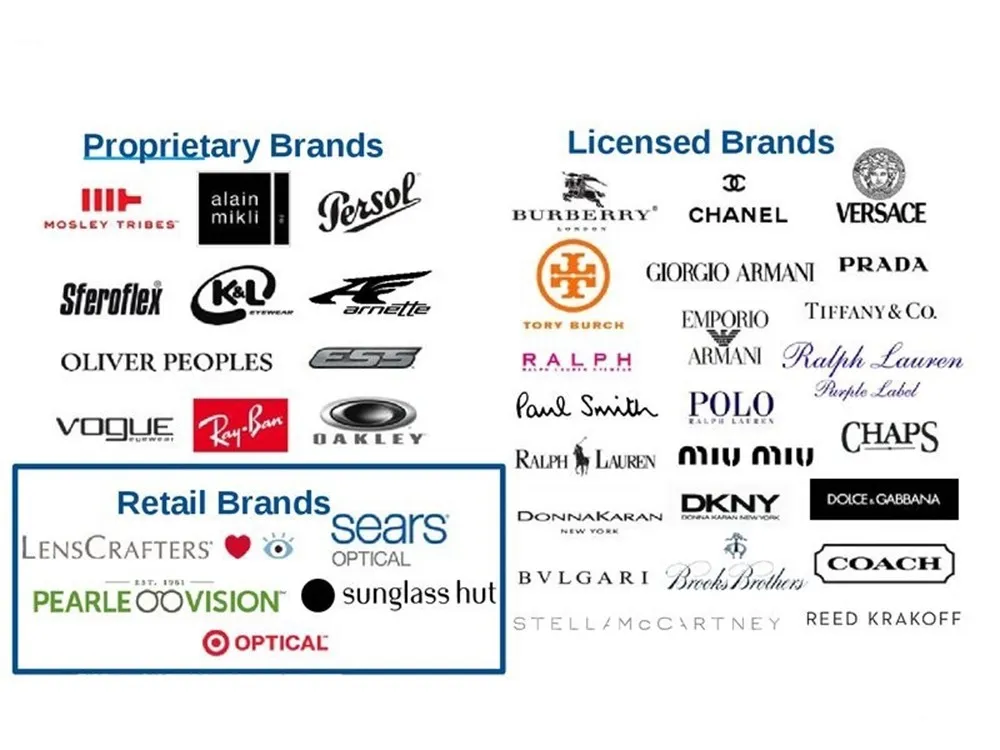
EssilorLuxottica holds licence agreements with more than 20 of the world’s most prestigious fashion and luxury houses. These partnerships allow it to design and manufacture eyewear sold under these brand names, sharing revenue with the brand owners. The arrangements typically run for 5–16 years, and several have been renewed multiple times, reflecting their commercial success.
Giorgio Armani and Emporio Armani — one of Luxottica’s oldest and most valuable partnerships, Armani eyewear reflects the brand’s philosophy of understated Italian elegance. The Emporio Armani line targets a younger demographic with a slightly lower price point.
Prada and Miu Miu — Prada’s eyewear partnership with EssilorLuxottica produces collections that mirror the house’s avant-garde fashion sensibility. Miu Miu frames, produced under the same arrangement, have achieved cult status among fashion-forward younger consumers.
Chanel — EssilorLuxottica designs Chanel eyewear incorporating the house’s iconic codes: double-C logos, quilting motifs, and premium materials. Chanel frames are among the highest-priced in the licensed portfolio.
Burberry — The collaboration draws on Burberry’s British heritage, incorporating the iconic Burberry check and its signature camel, black, and red palette into eyewear collections.
Versace and Versace Versus — Versace eyewear channels the Medusa brand’s baroque opulence and Gianni Versace’s original design vision into sunglasses and optical frames.
Dolce & Gabbana — The partnership has been renewed for 16 years, a testament to its commercial success. D&G eyewear embodies the Italian house’s maximalist, sensory aesthetic.
Tiffany & Co. — The collaboration translates Tiffany’s jewellery heritage into eyewear, with frames incorporating sterling silver details and Tiffany Blue accents.
Michael Kors and Michael Kors Collection — The jet-set luxury aesthetic of Michael Kors translates well into sunglasses, with the collection consistently among the bestselling licensed brands in Sunglass Hut.
Coach — Coach’s accessible American luxury positioning makes it one of the most commercially effective licensed brands in EssilorLuxottica’s portfolio, particularly in North American retail.
Ralph Lauren and Polo Ralph Lauren — Ralph Lauren’s quintessentially American style — polo motifs, preppy detailing, and classic silhouettes — has been part of the portfolio for decades.
Ferrari — Performance-inspired eyewear inspired by Ferrari’s racing heritage, targeting male consumers who associate with the Italian supercar brand’s identity.
Moncler — The luxury outerwear brand’s partnership with EssilorLuxottica produces ski and performance-inspired eyewear that complements Moncler’s technical fashion positioning.
Diesel — A 10-year exclusive licensing agreement (first collection available from Q1 2025) brings Diesel’s edgy, youth-oriented aesthetic into the portfolio, targeting a demographic between Arnette’s action sports base and the mainstream.
Part IV: Retail Banners
EssilorLuxottica’s retail network is one of its most powerful competitive assets — a direct-to-consumer channel that gives it pricing power and consumer insight unavailable to pure wholesale eyewear businesses.
LensCrafters (USA, Canada, China) — The largest optical retail chain in North America, known for its in-store optical labs that can produce prescription glasses within an hour. LensCrafters serves both the optical (prescription) and sunglass market.
Sunglass Hut — The world’s largest sunglasses retail chain, with thousands of locations in airports, shopping centres, and tourist destinations globally. Sunglass Hut is the primary retail distribution channel for Ray-Ban and Oakley outside specialty sports retail.
Pearle Vision — A network of optician franchise stores across North America, operating as a community-based optical care provider.
GMO (GrandOptical, Générale d’Optique, Solaris) — European retail chains operating primarily in France, Belgium, and Southern Europe.
Salmoiraghi & Viganò — Italy’s leading optical retail chain, deeply embedded in Italian consumer culture.
The Smart Glasses Revolution: EssilorLuxottica’s Technology Pivot
The single biggest strategic development at EssilorLuxottica in recent years is not the Supreme acquisition or any licence renewal — it is the company’s deepening partnership with Meta to develop AI-powered smart glasses.
The Ray-Ban Meta collaboration began publicly in 2019, with the first product launching in September 2021. The category grew slowly until 2024, when a combination of improved AI capabilities (open-ear speakers, Meta AI integration, a built-in camera for visual queries) and the mainstream cachet of the Ray-Ban Wayfarer design drove adoption to scale. By 2025, Ray-Ban Meta revenue had tripled year-on-year, with over 7 million cumulative units sold — making it the first smart glasses product to achieve genuine mainstream commercial success since Google Glass failed spectacularly in 2013.
The success has prompted EssilorLuxottica and Meta to expand the platform beyond Ray-Ban. The Oakley Meta HSTN launched in 2025, targeting athletic and fitness-oriented consumers with a performance-focused design. A Ray-Ban Meta Display model launched in September 2025, incorporating a small transparent display that can project notifications and navigation cues onto the lens — the first step toward genuine augmented reality in a mass-market form factor.
EssilorLuxottica’s CEO Francesco Milleri has described smart glasses as the company’s most important strategic priority for the coming decade. The company is investing in proprietary display technology, AI integration, and hearing health capabilities (its Nuance Audio glasses, which incorporate directional hearing enhancement, cleared US and European regulatory approval in early 2025) to extend the concept of “smart eyewear” beyond any single partnership.
EssilorLuxottica in Numbers (2024–2025)
| Metric | Figure |
|---|---|
| Annual Revenue (2024) | €25.4 billion (~$28.7B) |
| H1 2025 Revenue | €14.02 billion (+7.3% YoY) |
| Brands in Portfolio | 150+ |
| Retail Locations | ~17,600 (13,500 owned + 4,100 franchised) |
| Countries of Operation | 150+ |
| Ray-Ban Meta Units Sold (cumulative, 2025) | 7 million+ |
| Supreme Acquisition Price (2024) | $1.5 billion |
| Global Eyewear Market Size (2025 est.) | $181–221 billion |
| Myopia Sufferers Globally | 2.6 billion (Stellest addressable market) |
| Market Cap (approx.) | ~€55–60 billion |
Competitor Gap Analysis: What Rivals Are Doing
To understand EssilorLuxottica’s position, it helps to know who is competing with it — and on what terms.
Safilo Group (Italy) is EssilorLuxottica’s most direct competitor in the frame manufacturing and licensing space. Safilo holds licences for Hugo Boss, Jimmy Choo, Missoni, and David Beckham eyewear, and owns Carrera, Smith Optics, and Polaroid Eyewear. Its revenue (~€1 billion annually) is a fraction of EssilorLuxottica’s, reflecting the scale gap that exists in this industry.
Kering Eyewear — the eyewear division of luxury group Kering — has been building a direct challenge to EssilorLuxottica’s licensed brand model. Rather than licensing its brands (Gucci, Saint Laurent, Balenciaga, Bottega Veneta, Alexander McQueen) to EssilorLuxottica, Kering brought eyewear production in-house in 2014. This move deprived EssilorLuxottica of some of its most valuable licences and created the most credible rival in the luxury segment.
Marchon Eyewear holds licences for Nike, Calvin Klein, Flexon, and Lacoste and competes primarily in the mid-market optical segment.
Hoya Corporation (Japan) is the world’s second-largest lens manufacturer, competing directly with Essilor’s lens technology brands — particularly Varilux and Transitions. Hoya’s iD series of progressive lenses is the main alternative to Varilux in premium optical.
Despite these competitors, EssilorLuxottica’s scale, vertical integration, retail network, and technology leadership make it structurally dominant in a way that no single rival can challenge comprehensively. The key vulnerability is the risk of further in-housing by luxury groups following Kering’s model — a trend that remains the industry’s most closely watched strategic development.
Frequently Asked Questions (FAQs)
1. Is it still called Luxottica, or is it EssilorLuxottica?
The company is officially called EssilorLuxottica following the 2018 merger between Luxottica Group (Italy) and Essilor International (France). However, “Luxottica” is still widely used informally to refer to the eyewear frame and retail side of the business. For accuracy, EssilorLuxottica is the correct name for the combined group.
2. How many brands does EssilorLuxottica own?
EssilorLuxottica has more than 150 brands in its portfolio, spanning proprietary eyewear brands (Ray-Ban, Oakley, Persol, Supreme), lens technology brands (Varilux, Transitions, Stellest, Crizal), over 20 licensed fashion and luxury brands (Chanel, Prada, Armani, Versace, etc.), and retail chains (LensCrafters, Sunglass Hut, Pearle Vision).
3. Who owns Ray-Ban?
Ray-Ban is owned by EssilorLuxottica. It was originally created in 1937 by Bausch & Lomb for the US Army Air Corps, and acquired by Luxottica in 1999 for $640 million. Today, Ray-Ban is the world’s bestselling premium sunglass brand and the platform for the breakthrough Ray-Ban Meta smart glasses.
4. Who owns Oakley?
Oakley is owned by EssilorLuxottica, acquired by Luxottica in 2007 for $2.1 billion. Oakley remains operationally independent within the group, maintaining its sports performance identity and R&D focus while benefiting from EssilorLuxottica’s global distribution network.
5. Why did EssilorLuxottica buy Supreme?
EssilorLuxottica acquired Supreme for $1.5 billion in October 2024 to gain a brand with extraordinary credibility among younger, style-driven consumers — a demographic that is increasingly important to the eyewear category but not naturally drawn to traditional eyewear brands. Supreme’s scarcity-model drop strategy and cultural cachet represent a growth channel that EssilorLuxottica’s existing brands cannot easily replicate.
6. Does EssilorLuxottica make lenses as well as frames?
Yes — this is one of EssilorLuxottica’s most important competitive advantages. Through the Essilor side of the business, the group makes and markets the world’s leading corrective lens technologies, including Varilux (progressive lenses), Transitions (photochromic/light-adaptive lenses), Stellest (myopia control lenses for children), and Crizal (anti-reflective coatings). This lens manufacturing capability means EssilorLuxottica earns from the lens as well as the frame on many prescriptions filled globally.
7. Does Chanel make its own glasses?
No. Chanel eyewear is designed and manufactured by EssilorLuxottica under a licensing agreement. This means EssilorLuxottica produces all Chanel eyewear using Chanel’s design briefs, brand guidelines, and quality standards, in exchange for a royalty payment to Chanel. The arrangement is common across the luxury fashion industry — most major fashion houses do not manufacture their own glasses.
8. What are Ray-Ban Meta smart glasses?
Ray-Ban Meta smart glasses are a collaboration between EssilorLuxottica and Meta Platforms that embeds AI capabilities, a camera, open-ear speakers, and a microphone into Ray-Ban’s classic Wayfarer and other frame designs. Users can take photos, play music, make calls, and access Meta AI for real-time questions and image analysis — all without looking at a phone screen. The product became the first mainstream smart glasses in history, selling over 7 million units cumulatively by 2025.
9. Is EssilorLuxottica a monopoly?
EssilorLuxottica is the world’s largest eyewear company with a dominant market position. It has faced antitrust scrutiny in the European Union and the United States, and its vertical integration model — controlling design, manufacturing, licensing, and retail simultaneously — has been studied and criticised for potentially reducing consumer choice and maintaining high eyewear prices. However, it operates in a competitive global market with rivals including Safilo, Kering Eyewear, Marchon, and Hoya.
10. What is Stellest and why does it matter?
Stellest is a lens developed by EssilorLuxottica specifically designed to slow the progression of myopia in children. Myopia (short-sightedness) is growing at epidemic rates globally, projected to affect 50% of the world’s population by 2050. Clinical trials show Stellest lenses slow myopia progression by 67% on average compared to standard single-vision lenses, making it one of the group’s most medically significant products — and one of its most significant growth opportunities as paediatric eye health becomes a global public health priority.
All revenue figures, acquisition prices, brand ownership data, and market statistics cited in this article are sourced from EssilorLuxottica official earnings releases, company annual reports, and publicly available industry research as of May 2026.
Also Read: Inditex Beyond Zara: List of Brands Owned by Inditex Group
To read more content like this, subscribe to our newsletter