Last Updated on June 3, 2026 by Team TBH
Walk into any electronics showroom on any continent and you will almost certainly see the LG logo — on a curved OLED television glowing in 4K, on a side-by-side refrigerator with a built-in screen, on a heat pump quietly cooling an office building. LG’s red emblem, styled as a stylised human face, is one of the most recognised brand marks in the world: a promise of ‘Life’s Good’ that the company has been building toward for nearly eight decades.
LG Group is South Korea’s fourth-largest chaebol — a family-controlled industrial conglomerate — with over 70 affiliated companies operating in consumer electronics, chemicals, energy solutions, telecommunications, display technology, and logistics. At its core is LG Electronics, which in 2024 posted record revenue of approximately $61.4 billion USD — its highest annual revenue ever — driven by home appliances, OLED televisions, and a rapidly growing vehicle components business.
But LG’s story is not just about TVs and washing machines. It is about how a small cosmetics company founded in the rubble of post-war Korea reinvented itself generation by generation: first into electronics, then into chemicals, then into cutting-edge battery technology that powers the electric vehicle revolution, and now into artificial intelligence and physical robotics. Understanding LG means understanding both the arc of South Korea’s extraordinary economic transformation and the relentless corporate drive to stay relevant across eight decades of technological disruption.
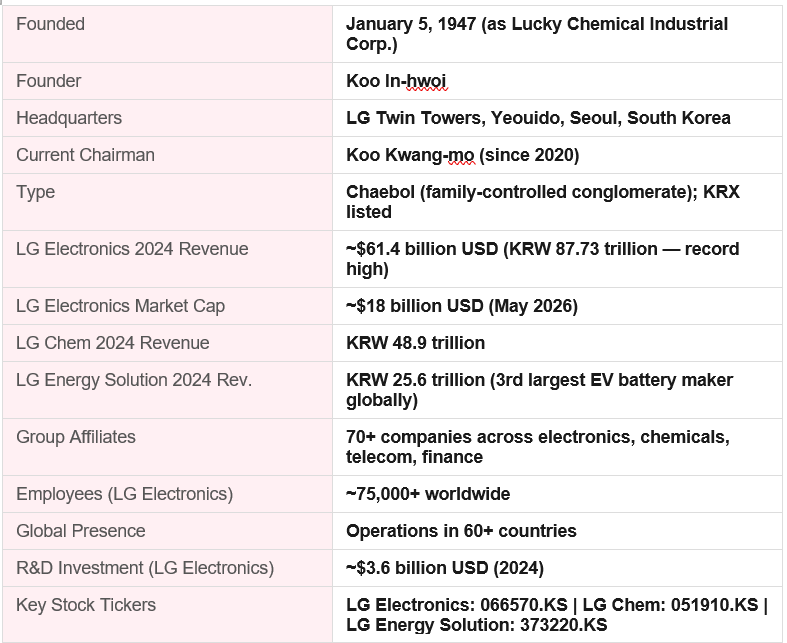
LG Group at a Glance
Founding History of LG: From Lucky Chemical to Lucky-Goldstar
Koo In-hwoi and the Birth of Lucky Chemical (1947)
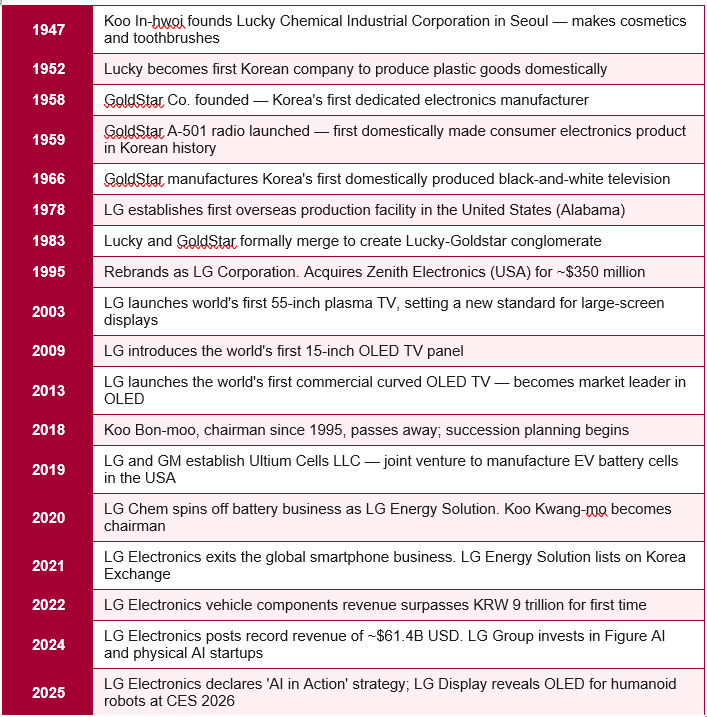
On January 5, 1947, two years after Korea’s liberation from Japanese colonial rule, an entrepreneur named Koo In-hwoi incorporated Lucky Chemical Industrial Corporation in Seoul. Korea in 1947 was a country rebuilding almost from nothing — its industrial base had been stripped by colonialism and devastated by war. Koo chose consumer goods: his first products were cosmetics and toothbrushes, then plastic goods. The decision was astute. Koreans needed these things, and Koo had access to the raw materials and the manufacturing know-how.
Lucky became the first company in Korea to produce plastic goods domestically, in 1952. It was also the first to produce toothpaste — a product category that defined the Lucky brand for a generation of Korean consumers. Koo’s approach to building the company was characteristically chaebol: he integrated family members into management, cultivated government relationships during the Park Chung-hee era of export-led industrialisation, and reinvested profits aggressively into new product categories. By the mid-1950s, Lucky was a profitable, growing company — but its founder had larger ambitions.
“Life’s Good” — the LG brand promise, coined decades after the company’s founding, captures an aspiration that has been at the heart of every product LG has ever made: making everyday life materially better for the people who use it.
GoldStar: Korea’s First Electronics Company (1958–1983)
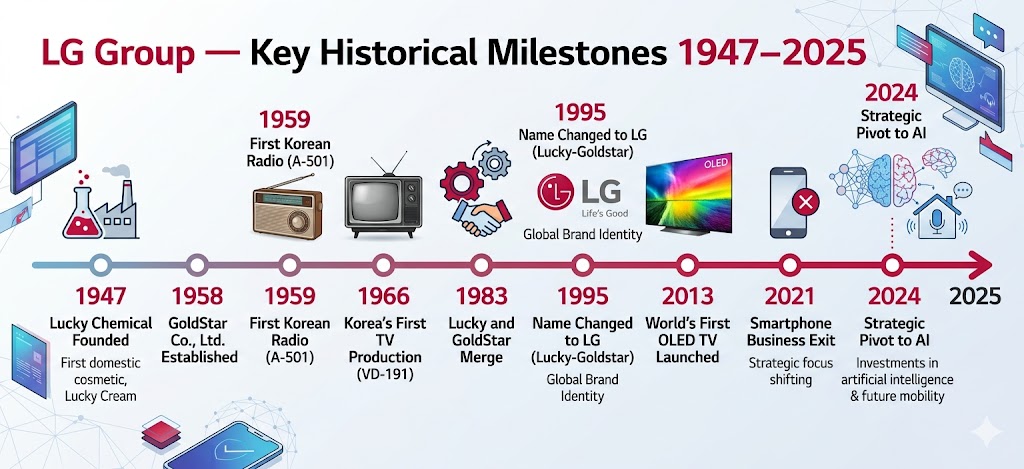
In 1958, Koo In-hwoi made the decision that would define LG’s next chapter: he founded GoldStar Co., Ltd., a separate company dedicated entirely to electronics manufacturing. GoldStar’s first product was the A-501 radio, released in 1959 — the first domestically manufactured consumer electronics device in Korean history. This was not a minor milestone. Korea had no consumer electronics industry. GoldStar built one from nothing, working with American and Japanese technology partnerships to master manufacturing processes that the country had never attempted before.
The 1960s and 1970s were years of breakneck expansion for both Lucky and GoldStar. Television manufacturing began in 1966. Refrigerators and air conditioners followed. GoldStar’s first exports to the United States began in the early 1970s, initially through discount retailers — a humble start for what would become one of the world’s largest consumer electronics brands. Simultaneously, Lucky deepened its chemicals business, moving into petrochemicals, polymers, and specialty materials that fed both LG’s own manufacturing needs and South Korea’s broader industrialisation.
The Merger and the LG Name (1983–1995)
In 1983, Lucky and GoldStar were formally merged under the holding structure Lucky-Goldstar — the origin of the LG abbreviation that the world knows today. The merger consolidated the two companies’ complementary strengths: Lucky’s chemicals and consumer goods expertise with GoldStar’s electronics manufacturing capability. The combined entity was among the top four Korean chaebols, alongside Samsung, Hyundai, and Daewoo, in an era of state-directed industrial expansion.
In 1995, the company made a decisive branding move: it dropped Lucky-Goldstar and renamed itself LG Corporation. The change was more than cosmetic. The old name was rooted in Korean domesticity; LG was designed to be a global identity. The same year, LG acquired Zenith Electronics in the United States — then one of America’s most storied TV brands — for approximately $350 million, immediately giving LG a commanding position in the US market and access to Zenith’s pioneering digital television technology patents.
Leadership: Three Generations of the Koo Family
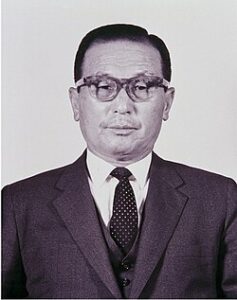
LG Group has been led by the Koo family across three generations — a continuity of ownership and vision unusual even among South Korea’s family-controlled chaebols. Koo In-hwoi founded the group and led it until his death in December 1969, having established both the cosmetics/chemicals and electronics pillars. His eldest son, Koo Ja-kyung, assumed the chairmanship and guided LG through its critical years of diversification and internationalisation in the 1970s and 1980s.
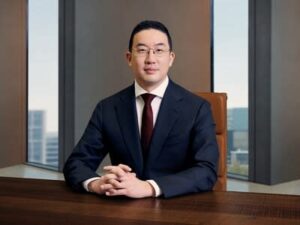
The third generation, Koo Bon-moo, took over in 1995 and oversaw LG’s most transformative decades: the global rebranding, the acquisition of Zenith, the launch of OLED televisions, and the strategic entry into electric vehicle battery manufacturing. Koo Bon-moo passed away in May 2018 after a prolonged illness, and following a period of transition, his son Koo Kwang-mo became chairman in 2020. Under Koo Kwang-mo’s leadership, LG has accelerated its pivot toward AI, physical robotics, and clean energy infrastructure — while also making the difficult but strategically correct decision to exit the smartphone business in 2021.
LG Group’s Business Divisions
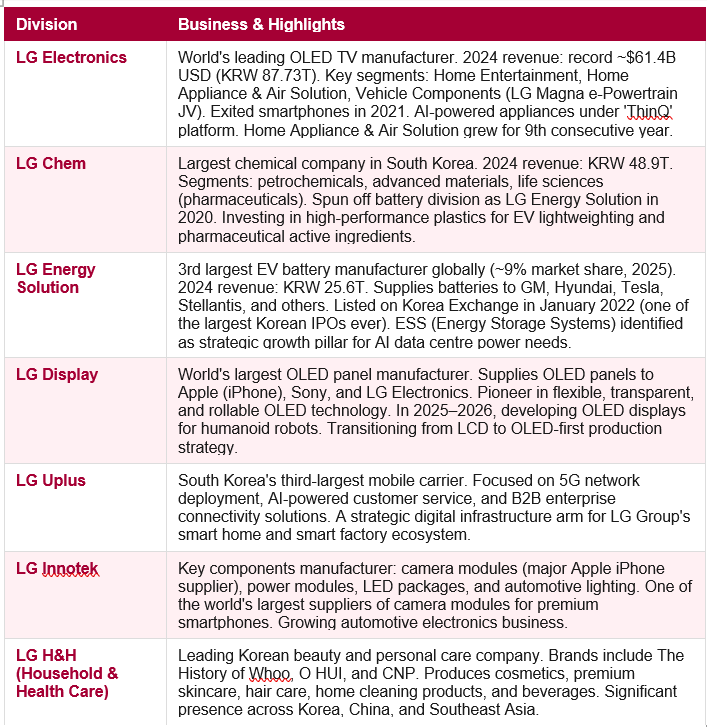
LG Group operates through a network of more than 70 affiliated companies. The seven principal publicly listed or strategically significant subsidiaries are described below.
Key Milestones: LG Group 1947–2025
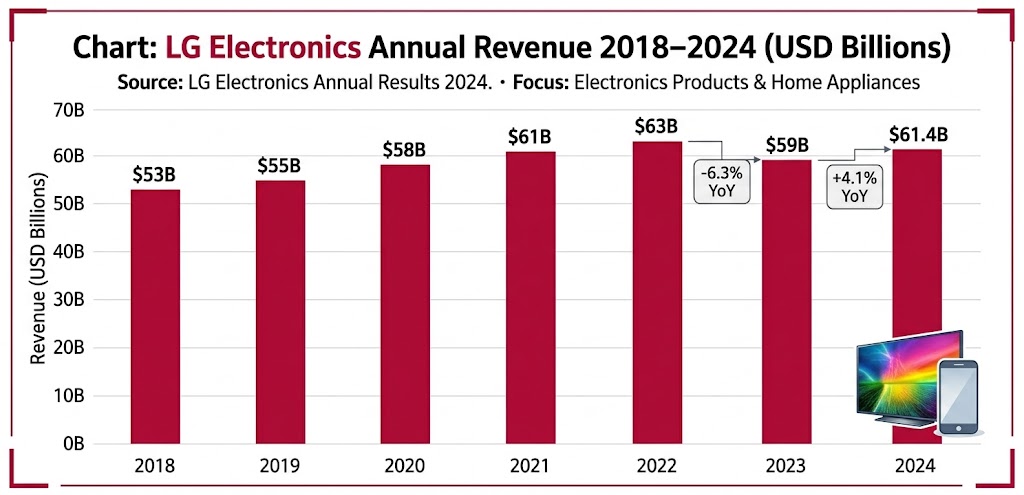
Financial Performance: Record Revenue in 2024
LG Electronics delivered its strongest financial performance in company history in 2024. Consolidated revenue reached approximately $61.4 billion USD (KRW 87.73 trillion) — a record for the company — driven by sustained growth in its Home Appliance & Air Solution segment (nine consecutive years of growth), continued strength in OLED television sales, and the rapid scaling of its vehicle components business. Operating profit for the full year was KRW 3.42 trillion.
The Vehicle Components Solutions (VS) division — which produces infotainment systems, EV powertrains, and ADAS components through its joint venture with Canadian automotive supplier Magna International — has become LG Electronics’ most strategically important growth engine. As automakers globally accelerate EV transitions, demand for sophisticated electronic systems from a trusted Tier 1 supplier like LG has grown commensurately.
LG Chem’s 2024 revenue of KRW 48.9 trillion reflected more challenging conditions in its petrochemicals business, where margin pressure from overcapacity in China weighed on results. Operating profit fell 63.75% year-on-year to KRW 916.8 billion. The company is accelerating a strategic shift toward high-value advanced materials for EVs and pharmaceuticals, where margins are structurally higher.
LG Energy Solution faced a more difficult 2024, with revenue declining 24.1% to KRW 25.6 trillion as EV demand growth slowed in key Western markets and pricing pressures intensified from Chinese battery competitors. Operating profit fell 73.4% to KRW 575.4 billion. However, the company maintained its position as the world’s third-largest EV battery manufacturer (approximately 9% global market share in 2025), and is targeting a 5–10% revenue recovery in 2025, supported by new plant openings in North America.
Global Footprint: LG’s International Expansion
LG operates in more than 60 countries, with manufacturing plants, sales subsidiaries, and R&D centres spread across six continents. Its international expansion unfolded in deliberate waves, each timed to match both LG’s own capabilities and the openness of target markets.
United States: Building an American Brand
LG’s first overseas manufacturing plant opened in the United States in the late 1970s, producing white goods for the American market. The 1995 acquisition of Zenith Electronics — for decades an iconic American TV brand — was LG’s most audacious early move in the US, giving it not just market share but Zenith’s invaluable digital broadcast patents that would prove critical in the transition to HDTV. Today, LG operates manufacturing facilities in the USA including its Clarksville, Tennessee home appliance plant — a $250 million investment — and produces batteries through the Ultium Cells LLC joint venture with GM in Ohio and Tennessee.
Europe: From Manufacturing to Market Leadership
LG established manufacturing facilities in Poland and other Central European countries from the 1990s onwards, taking advantage of lower labour costs and EU single-market access. Today, Poland is LG Electronics’ largest European manufacturing hub. The company’s OLED TV range has achieved premium market leadership across key European markets, outselling competing OLED brands from Sony and Philips.
Asia and Emerging Markets
In Asia, LG maintains significant manufacturing presences in China, India, Vietnam, and Indonesia. India has been a particularly strong market for LG’s home appliance business — LG Electronics India has consistently ranked among the top two home appliance brands in the country for over two decades. In China, LG Energy Solution operates battery manufacturing facilities that supply both domestic and global automakers. Southeast Asia represents a growing consumer market for LG’s premium appliance and air conditioning products.
LG’s AI Strategy: ‘AI in Action’ and Physical Intelligence
LG Group Chairman Koo Kwang-mo has been explicit: artificial intelligence is the group’s primary growth driver for the next decade. This is not marketing language — it is a capital allocation commitment, demonstrated by LG Group’s 2024 investments in Figure AI, DYNA Robotics, and Skilled AI, three of the leading US-based physical AI startups developing humanoid and industrial robots.
For LG Electronics specifically, the AI strategy is articulated as ‘AI in Action’ — a framework built on three pillars: Affectionate Intelligence (AI that understands users’ emotional contexts and anticipates needs), Core Technology Excellence (proprietary AI chips and models embedded in products), and an Orchestrated Ecosystem (seamless connectivity across home, mobility, and commercial spaces via the ThinQ platform). LG’s AI appliances can now recognise individual household members, adapt energy usage patterns based on lifestyle data, and interact through natural language.
LG Display’s 2025–2026 pivot toward OLED displays for humanoid robots — unveiled at CES 2026 — illustrates a complementary AI play. As physical AI robots require flexible, expressive faces to interact naturally with humans, LG’s expertise in plastic OLED technology positions it as a potential key supplier for one of the most talked-about emerging hardware markets.
LG Energy Solution has identified energy storage systems (ESS) as a critical pillar of its AI-era strategy. AI data centres require enormous, reliable power — and grid-scale battery storage is increasingly positioned as essential infrastructure for managing the variable supply from renewable energy sources that power these facilities. LG’s Chairman explicitly called ESS ‘vital for the AI era’ at the group’s 2025 strategic review.
Competitive Landscape of LG : LG vs the World
LG competes in multiple industries simultaneously, meaning its competitive landscape shifts depending on the segment in question.
Consumer Electronics: Samsung, Sony, TCL
In TVs and home appliances, LG’s primary global rival is Samsung Electronics — its fellow Korean chaebol and the world’s largest consumer electronics company. Samsung and LG have competed for decades in every television technology cycle, from plasma to LCD to OLED. LG’s OLED technology, particularly its W-OLED (White OLED) panel architecture used in its premium TV line, is widely regarded as the reference standard for picture quality. Samsung has responded with Neo QLED and QD-OLED technology, creating a genuine two-horse premium display race. TCL, Hisense, and Xiaomi from China have taken significant share in the mid and budget TV segments globally, putting sustained pressure on LG’s volume-end business.
EV Batteries: CATL, BYD, Samsung SDI, Panasonic
In EV batteries, LG Energy Solution competes primarily with China’s CATL (the world’s largest battery maker with approximately 37% global share in 2025), BYD’s battery division, South Korea’s Samsung SDI, and Japan’s Panasonic. LG Energy Solution holds approximately 9% global market share and is the dominant non-Chinese supplier to major North American and European automakers. Its diversified customer base — spanning GM, Hyundai, Ford, Stellantis, and others — and its geographical distribution across Asian, American, and European manufacturing give it structural advantages over purely Asian-focused competitors.
Chemicals: Lotte, Hanwha, BASF
LG Chem competes with domestic rivals including Lotte Chemical and Hanwha Solutions, as well as global chemical giants such as BASF, Dow, and SABIC. Its competitive advantage lies in advanced materials for EV applications — particularly cathode active materials (CAM) for batteries, high-performance engineering plastics for EV lightweighting, and pharmaceutical active pharmaceutical ingredients (APIs). These are growing, high-margin segments where LG Chem’s combination of chemical expertise and deep LG group synergies gives it a genuine edge.
Challenges and Strategic Risks
LG Group faces a set of interconnected challenges that will test its management through the second half of the 2020s.
The EV market slowdown is the most immediate risk to LG Energy Solution. Western EV adoption, while growing, has proceeded more slowly than the bullish projections of 2021–2022. This has contributed directly to the 24% revenue decline at LG Energy Solution in 2024. Battery oversupply — particularly from Chinese manufacturers — has compressed pricing across the industry. LG’s response has been to diversify its product range (toward higher-nickel, safer battery chemistries) and its customer base (ESS alongside EVs), but the headwinds are significant.
Competition from Chinese manufacturers in the battery and display segments is structural rather than cyclical. CATL and BYD benefit from lower-cost labour, larger domestic scale, and deep government support. In displays, BOE Technology has emerged as a serious OLED challenger to LG Display. LG’s response — moving toward premium, differentiated products and deepening IP moats — is the right strategy, but execution risk remains high.
LG Electronics’ decision to exit smartphones in 2021, while strategically correct (the division had lost money for years), removed a significant channel for showcasing LG’s AI, display, and camera technology in consumers’ most personal device. As AI and connectivity become central to the home appliance and mobility businesses, having no smartphone presence limits LG’s ecosystem integration compared to Samsung.
Currency and geopolitical risk is a constant concern for a company with manufacturing and revenue dispersed across 60+ countries. USD/KRW exchange rate movements, US-China trade tensions affecting supply chains, and potential disruptions to the Ultium Cells JV from shifts in US EV policy all represent material uncertainties.
Future Outlook: LG Group to 2030
LG Group enters the second half of the 2020s in a genuinely interesting position: stronger financially than at any time in the last decade (record electronics revenue, energy solution listed and scaling), but facing material strategic transitions in its two most important growth bets — EV batteries and AI.
The vehicle components business within LG Electronics is the most promising near-term growth engine. As EVs proliferate, each vehicle requires an order of magnitude more sophisticated electronics than its combustion-engine predecessor: infotainment, ADAS, powertrains, cameras, lighting. LG’s position as a trusted Tier 1 automotive electronics supplier — built through the Magna JV and decades of component-making expertise — gives it a structural tailwind that is independent of smartphone market dynamics.
LG Energy Solution’s mid-to-long-term strategy of doubling revenue and diversifying beyond EVs into ESS and new-format batteries (cylindrical cells for humanoid robots, solid-state batteries for premium EVs) represents the right direction. The critical variable is the pace of EV market recovery in the West and the trajectory of battery pricing. If EV adoption accelerates as expected through 2026–2028, LG Energy Solution is well-positioned to return to strong revenue growth.
On AI, LG’s investments in physical AI startups and its ‘AI in Action’ strategy for home appliances represent a credible thesis: that AI’s greatest consumer impact will not be in language models but in the physical environment — in homes, factories, and vehicles. LG’s manufacturing expertise, component supply chain, and 75-year heritage in home products give it unique credentials to execute on this thesis, if it can integrate AI meaningfully enough to justify the premium that differentiated products command.
Frequently Asked Questions (FAQs)
Q: What does LG stand for and where is the company from?
A: LG stands for Lucky-Goldstar — the combined name of the two companies that merged in 1983: Lucky Chemical Industrial Corporation (founded 1947, cosmetics and chemicals) and GoldStar Co. Ltd. (founded 1958, electronics). The company renamed itself LG Corporation in 1995 to create a global brand identity. LG’s marketing tagline, ‘Life’s Good’, is a backronym built around the initials. LG is headquartered in Seoul, South Korea.
Q: Who founded LG and who leads it today?
A: LG was founded on January 5, 1947 by Koo In-hwoi, a South Korean entrepreneur who started with cosmetics and plastics before pivoting into electronics. LG has been led by the Koo family across three generations. The current chairman is Koo Kwang-mo (grandson of the founder), who assumed the role in 2020 following the death of his father Koo Bon-moo in 2018. LG Electronics’ CEO is William Cho (since 2021).
Q: What is LG Group’s annual revenue and how profitable is it?
A: LG Electronics, the group’s flagship subsidiary, posted record consolidated revenue of approximately $61.4 billion USD (KRW 87.73 trillion) in 2024 — the highest in the company’s history. LG Chem’s 2024 revenue was KRW 48.9 trillion. LG Energy Solution’s 2024 revenue was KRW 25.6 trillion. LG Electronics’ operating profit in 2024 was KRW 3.42 trillion. LG Electronics’ market capitalisation is approximately $18 billion as of May 2026.
Q: Does LG still make smartphones?
A: No. LG Electronics officially exited the global smartphone business on July 31, 2021, after years of mounting losses in its Mobile Communications division. At its peak, LG was the world’s third-largest smartphone maker, but it struggled to compete with Samsung at the premium end and Chinese manufacturers at the mid-range. The decision freed up capital and engineering resources to reinvest in home appliances, vehicle components, and AI. LG’s ThinQ smart home platform continues to serve as the AI connectivity hub for its appliances.
Q: What is LG’s OLED TV technology and why is it significant?
A: LG pioneered the commercialisation of OLED (Organic Light-Emitting Diode) television technology. Unlike conventional LCD TVs that use a backlight, OLED TVs emit light from individual pixels, enabling perfect blacks, infinite contrast ratios, and significantly thinner panel designs. LG launched the world’s first commercial curved OLED TV in 2013 and has been the dominant manufacturer of OLED TV panels ever since. LG Display, its panel-making subsidiary, supplies OLED panels to LG Electronics, Sony, and other premium TV brands, and is now developing OLED technology for humanoid robots.
Q: What is LG Energy Solution and who are its customers?
A: LG Energy Solution is the battery manufacturing subsidiary spun off from LG Chem in December 2020 and listed on the Korea Exchange in January 2022. It is the world’s third-largest EV battery manufacturer, with approximately 9% global market share in 2025. Its customers include General Motors (Ultium Cells JV), Hyundai, Ford, Stellantis, Honda, and others. It also supplies batteries for consumer electronics and is rapidly expanding its Energy Storage System (ESS) business, targeting grid-scale battery storage for renewable energy and AI data centres.
Q: What is LG Group’s AI strategy?
A: LG Group Chairman Koo Kwang-mo has positioned AI as the group’s primary growth driver. LG Electronics’ strategy is called ‘AI in Action’, built on three pillars: Affectionate Intelligence (emotionally aware AI in appliances and devices), Core Technology Excellence (proprietary AI chips and models), and an Orchestrated Ecosystem (the ThinQ platform connecting home, mobility, and commercial spaces). At the group level, LG has invested in physical AI startups including Figure AI, DYNA Robotics, and Skilled AI, and LG Display is developing OLED technology for humanoid robot faces. LG Energy Solution identified ESS as critical AI-era infrastructure.
Q: How does LG compare to Samsung?
A: Samsung and LG are South Korea’s two largest electronics chaebols and direct competitors in TVs, home appliances, and batteries. Samsung is significantly larger by revenue and market capitalisation — Samsung Electronics alone generates over $200 billion annually. However, LG holds meaningful advantages in specific categories: LG Electronics is widely regarded as the premium OLED TV leader, while Samsung leads in QLED. LG Energy Solution is a major EV battery supplier, while Samsung SDI focuses more on premium cylindrical cells. The two companies maintain a fierce competitive rivalry across multiple product categories globally.
Q: Why did LG acquire Zenith Electronics in 1995?
A: LG acquired Zenith Electronics — one of the last remaining American TV manufacturers — for approximately $350 million in 1995. The strategic rationale was twofold: immediate market access (Zenith had strong US brand recognition and distribution) and long-term technology (Zenith had developed critical digital broadcast and HDTV patents). These patents proved enormously valuable as the US television industry transitioned to digital broadcasting in the 2000s, generating significant licensing revenue and giving LG a technology foundation for its US market expansion.
Q: What does ‘chaebol’ mean and how does it apply to LG?
A: ‘Chaebol’ (재벌) is a Korean term for a large family-controlled business conglomerate, typically with diversified operations across multiple industries and close relationships with the South Korean government. LG is South Korea’s fourth-largest chaebol, after Samsung, SK, and Hyundai. The Koo family maintains controlling ownership across the group’s affiliates through cross-shareholding structures. The chaebol model has been central to South Korea’s economic development since the 1960s, with government-directed credit and export support helping companies like LG build global scale rapidly.
Conclusion
LG Group’s journey from a post-war cosmetics company to a $60+ billion global technology conglomerate is one of the defining industrial stories of the 20th and 21st centuries. In nearly eight decades, it has survived colonial legacy, war, the chaebol crises of the 1990s, the collapse of the CRT television market, the brutal smartphone wars, and the EV battery downcycle — each time finding a way to reinvent itself around the next wave of technology.
The group’s 2024 milestones — record revenue at LG Electronics, a listed and globally significant LG Energy Solution, and leadership positions in OLED, EV components, and home appliances — confirm that the current strategy is working. The challenges ahead — Chinese competition in batteries and displays, slower EV adoption than hoped, the absence of a smartphone presence — are real and serious. But LG enters this period with stronger fundamentals than it has had in years.
The bet on AI is the most consequential strategic decision of the Koo Kwang-mo era. If AI genuinely transforms the home environment — making appliances more intelligent, autonomous, and personalised — then LG’s 75 years of home product manufacturing experience, combined with its component supply chain, OLED display technology, and energy storage infrastructure, position it as one of the most credible operators in what may become the defining technology market of the next decade. For LG, Life’s Good — and it intends to keep it that way.
Also Read: Samsung Electronics- History of Korean Electronics Giant
To read more content like this, subscribe to our newsletter