Last Updated on September 7, 2026 by Team TBH
Johnson & Johnson (NYSE: JNJ) is one of the world’s most consequential healthcare companies—139 years old, yet still posting record-breaking results.
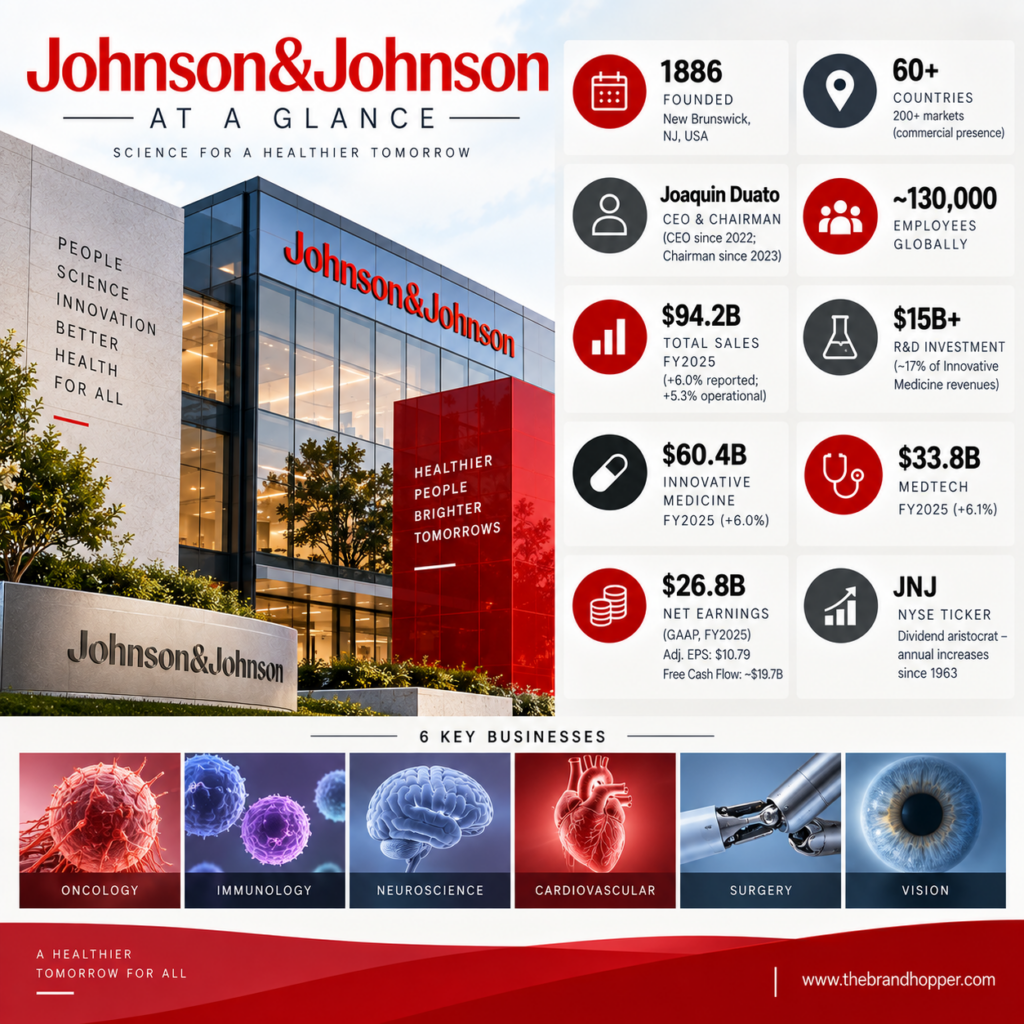
In full-year 2025, J&J reported worldwide sales of $94.2 billion (+6.0%), driven by Innovative Medicine ($60.4 billion) and MedTech ($33.8 billion). The company is now guiding toward $100.5 billion in 2026—a first-ever nine-digit milestone for a healthcare company.
The single biggest recent event: J&J spun off its Consumer Health division as Kenvue Inc. (NYSE: KVUE) in August 2023. Brands like Tylenol, Band-Aid, Listerine, and Neutrogena now live under Kenvue. J&J itself is a focused two-segment company—pharma and medical devices only.
J&J After Kenvue: A Sharpened Identity
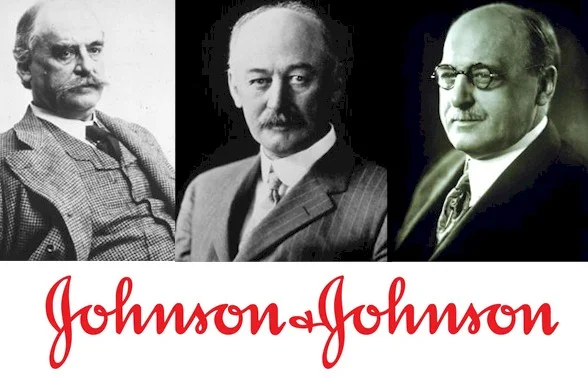
J&J was founded in 1886 by three brothers—Robert Wood Johnson II, James Wood Johnson, and Edward Mead Johnson. Its first product was a sterile surgical dressing, establishing a healthcare-first identity that persists today.
For decades, J&J operated three segments: Pharmaceutical, Medical Devices, and Consumer. The August 2023 Kenvue spinoff ended that era. By separating ~$15 billion in consumer revenues into an independent company, J&J freed its entire strategy—capital allocation, marketing, R&D—to focus purely on pharmaceutical innovation and medical technology.
The financial results validate the pivot. In FY2025, Innovative Medicine exceeded $60 billion for the first time. MedTech grew 6.1%. CEO Joaquin Duato described the year as “a catapult year fueled by the strongest portfolio and pipeline in our history.”
Marketing Strategies of Johnson & Johnson
1. Segmentation, Targeting & Positioning (STP)
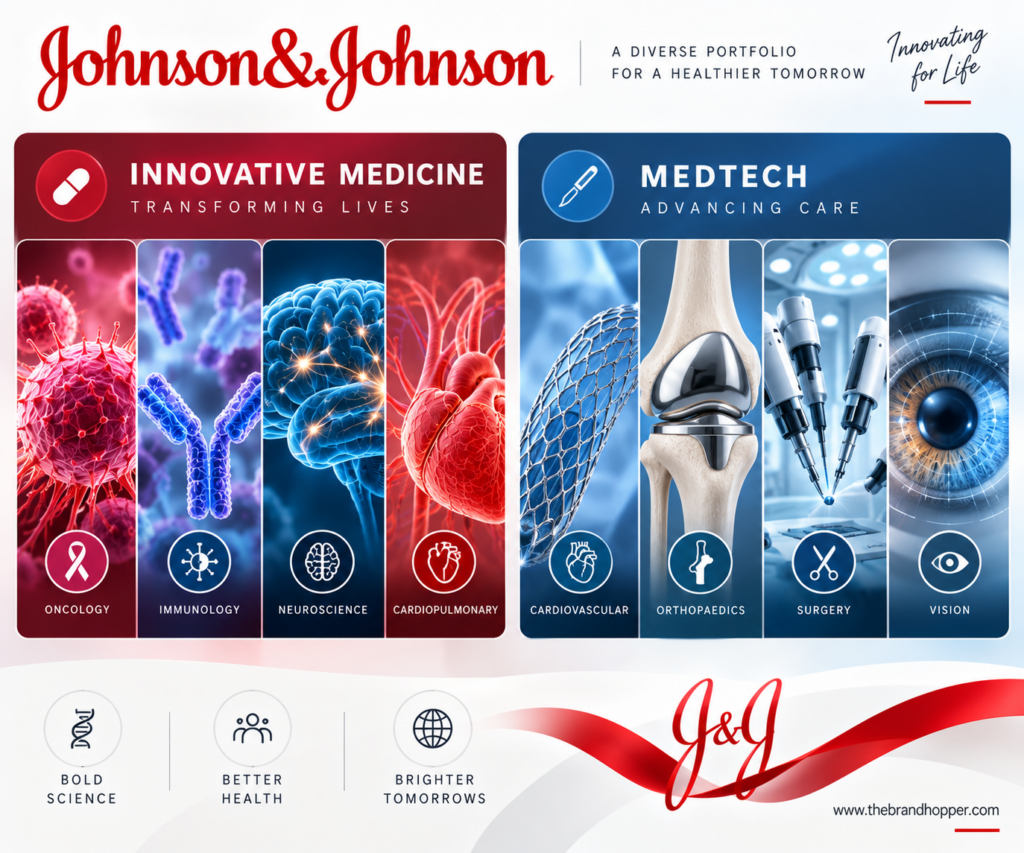
J&J segments its pharmaceutical market by therapeutic area: Oncology, Immunology, Neuroscience, and Cardiopulmonary. Within each, it goes deeper—by line of therapy, biomarker profile, and healthcare provider type.
For example, RYBREVANT/LAZCLUZE targets EGFR-mutated non-small cell lung cancer patients specifically. AKEEGA targets BRCA2-mutated prostate cancer. This biomarker-driven precision is the defining feature of modern specialty pharma marketing.
In MedTech, segmentation follows clinical setting: catheterisation labs for electrophysiology, ICUs for Abiomed Impella pumps, optical practices for Acuvue lenses. Each segment gets a tailored go-to-market approach—clinical evidence, health economics, and surgeon training calibrated to the buying process.
J&J’s positioning rests on three pillars: scientific leadership (evidence-based, clinically differentiated products); outcomes focus (solutions that improve patient results and lower total costs); and 139 years of brand trust. In markets where payers, physicians, and patients all scrutinise clinical data simultaneously, credibility at scale is J&J’s deepest competitive moat.
2. Innovation-Led Marketing: R&D as a Brand Asset
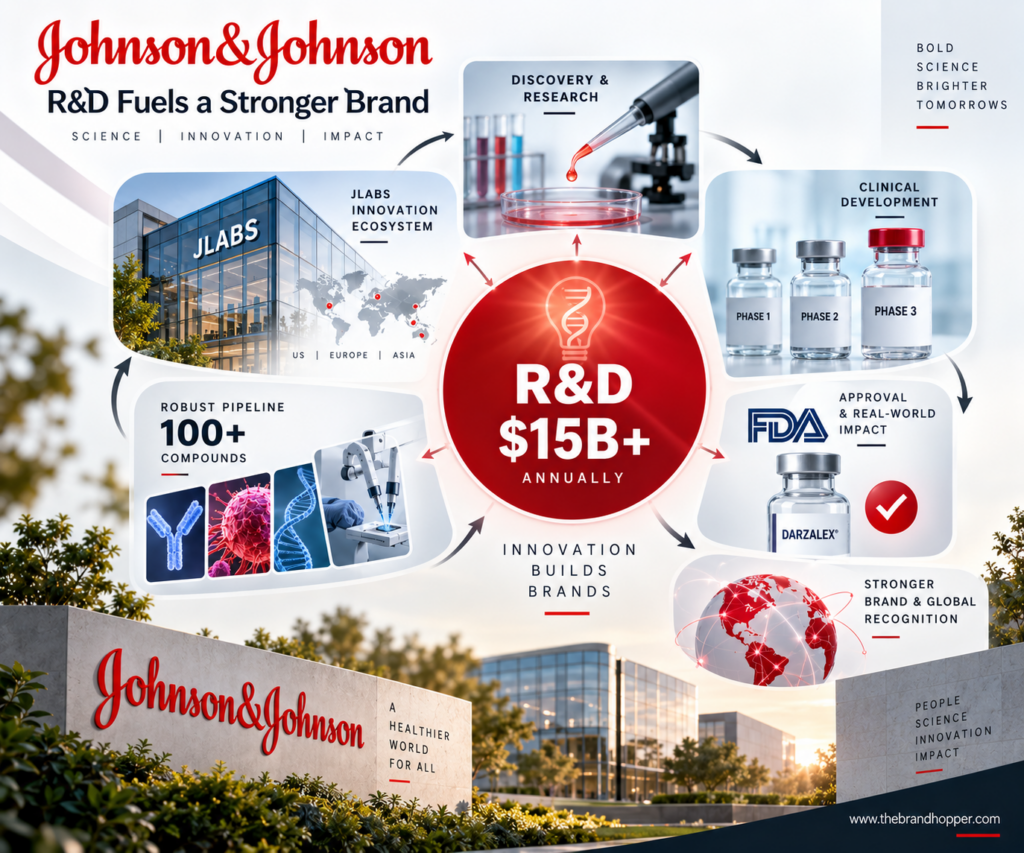
J&J invests ~$15 billion+ annually in R&D—one of the largest budgets of any company in any industry. This spend is not just operational; it is marketing.
Every Phase 3 trial, every data package at ASCO or ASH, every FDA approval generates brand awareness and credibility that advertising cannot replicate. When DARZALEX received approval for high-risk smoldering myeloma—the first and only therapy for that indication—the approval itself reached every haematologist globally within days.
The JLABS incubator network, hosted at J&J campuses worldwide, keeps the company close to the biotech ecosystem that generates tomorrow’s breakthroughs. JLABS residents have raised over $50 billion collectively—and several have become J&J acquisitions, including Halda Therapeutics (acquired 2025 for its targeted protein degradation platform).
J&J’s publicly disclosed pipeline—100+ compounds across six therapeutic areas—is itself a brand communication tool. It signals innovation leadership to analysts, payers, and partners, attracts talent, and shapes reimbursement expectations long before a drug is approved.
3. The Credo: Trust as a Marketing Foundation
J&J’s “Credo”—written in 1943 by Robert Wood Johnson II—places patients and healthcare providers first, employees second, communities third, and shareholders last. This unusual ordering was revolutionary then and remains a differentiator today.
The Credo’s commercial value was proven in 1982 when seven people died after consuming tampered Tylenol. J&J immediately withdrew 31 million bottles at a cost of over $100 million. Within a year, Tylenol had recaptured 95% of its market share. (Tylenol is now a Kenvue brand—but the Credo-driven trust infrastructure it demonstrated underpins every J&J brand decision today.)
J&J reinforces its Credo through the Earthwards programme, which evaluates products against nine sustainability criteria—renewable energy, waste reduction, packaging, and ingredient transparency. Products that meet defined thresholds earn Earthwards recognition, increasingly important for hospital systems and government payers with sustainability procurement criteria. J&J has committed to net-zero emissions by 2045 and 100% renewable electricity across global operations.
4. Healthcare Professional (HCP) Marketing
Pharmaceutical marketing is fundamentally information-based. Prescribers evaluate clinical trial data, safety profiles, dosing convenience, and formulary access—not ad slogans. J&J’s Medical Affairs function bridges science and commercial messaging.
Medical Science Liaisons (MSLs) engage key opinion leaders (KOLs) at academic medical centres one-on-one, sharing data and collecting real-world insights. This peer-to-peer scientific engagement builds prescribing relationships that no digital campaign can replicate.
Medical congress presence is J&J’s most powerful HCP channel. Presenting landmark data at ASCO, ASH, EULAR, and ESC reaches every specialist in the target audience simultaneously. In 2025, data showing TECVAYLI + DARZALEX FASPRO delivering “unprecedented” survival benefits in myeloma reached every haematologist globally within days of the top-line results.
Digital HCP marketing has grown rapidly. J&J delivers personalised clinical content to oncologists through targeted LinkedIn campaigns, HCP-only digital portals (Janssen.com), and webinar series featuring KOLs discussing real-world evidence. Digital CME programmes extend educational reach beyond traditional conference attendance.
5. Multi-Channel Digital & Patient Marketing
J&J operates three distinct digital ecosystems: HCP (clinical content for physicians and nurses), Patient (disease education and access support), and Investor/Media (corporate performance and innovation narrative). Each requires different content, channels, and regulatory compliance.
The Janssen CarePath programme helps patients navigate insurance, provides co-pay assistance, and offers nurse support for complex therapies. This post-prescription relationship drives adherence, reduces abandonment, and generates patient advocacy.
Disease awareness campaigns—”J&J Talks Cancer,” multiple myeloma patient partnerships, depression awareness—create top-of-funnel awareness before patients reach their physician. These campaigns drive patient-physician conversations that accelerate diagnosis and treatment initiation.
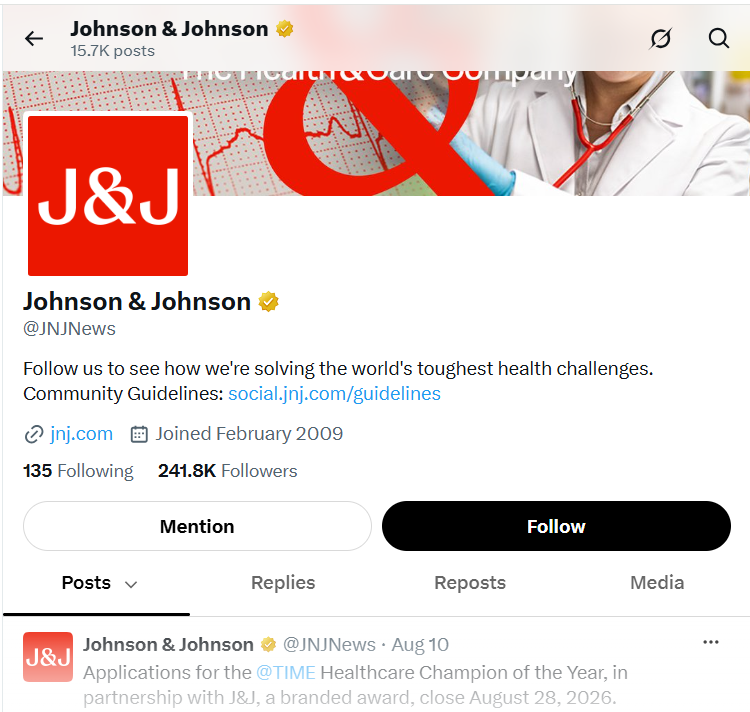
On social media, J&J’s @JNJNews on Twitter/X has over 240K followers and LinkedIn over 10 million. YouTube features surgical technique videos, patient testimony content, and innovation documentaries. These channels serve brand awareness, patient education, and employer branding simultaneously.
6. Strategic Partnerships & Value-Based Market Access
For J&J, acquisitions are brand statements as well as business transactions. The Shockwave Medical acquisition ($13.1 billion, 2024) and Halda Therapeutics acquisition (2025) signal innovation leadership to the scientific community, investors, and payers.
J&J’s collaboration with Genmab—co-developing and co-commercialising DARZALEX globally—is a case study in alliance-as-marketing-amplifier. Genmab’s scientific credibility plus J&J’s commercial infrastructure created a product that achieved blockbuster status across 30+ countries simultaneously.
Market access—securing formulary placement and favourable payer coverage—is as important as physician marketing in specialty pharma. J&J’s market access teams build health economic models that quantify the value of its therapies in QALYs gained and hospitalisations avoided. For drugs like DARZALEX, which may cost $200,000+ per patient per year, the reimbursement environment directly determines commercial uptake.
J&J has structured performance-based contracts for several products, linking rebates to clinical outcomes in real-world populations. This outcomes-based pricing positions J&J as a partner in sustainable healthcare—not just a supplier—and is an increasingly powerful competitive differentiator.
Marketing Mix (4Ps) of Johnson & Johnson
Product
Innovative Medicine covers four therapeutic areas: Oncology (DARZALEX, CARVYKTI, RYBREVANT/LAZCLUZE, ERLEADA, AKEEGA, TECVAYLI), Immunology (TREMFYA, SIMPONI/SIMPONI ARIA), Neuroscience (SPRAVATO, CAPLYTA), and Cardiopulmonary (OPSUMIT, UPTRAVI).
MedTech covers Cardiovascular (Shockwave, Abiomed Impella, electrophysiology), Orthopaedics (DePuy Synthes—being separated as an independent business), Surgery (Ethicon, OTTAVA robotic system submitted to FDA in 2025), and Vision (Acuvue—the world’s largest contact lens brand).
Price
Specialty drug pricing is complex: US list prices are set, then significant rebates are negotiated with PBMs and government programmes. In Europe, national HTA processes determine reimbursement. Cell therapies like CARVYKTI carry among the highest list prices in oncology, reflecting manufacturing complexity and durable patient outcomes.
Janssen CarePath and the Janssen Patient Assistance Foundation reduce out-of-pocket burden for eligible patients. J&J also reached an agreement with the US Government in 2025 to improve medicine access and lower costs for Americans, combining pricing commitments with domestic manufacturing investments.
Place (Distribution)
Innovative Medicine reaches patients through specialty pharmacies (SPRAVATO REMS-supervised clinical settings), hospital infusion centres (IV therapies), and specialty distributors internationally. CARVYKTI, as a cell therapy, is distributed through a small network of certified treatment centres globally.
MedTech products reach hospital systems, ASCs, and private practices through J&J’s global direct sales force and distributor network. Acuvue lenses are distributed through eye care professionals worldwide, with acuvue.com providing patient education and professional locators.
Promotion
J&J promotes simultaneously to physicians (clinical data, MSL visits, medical conferences, digital portals), patients (disease awareness campaigns, CarePath support, social media), and investors/payers (earnings calls, pipeline disclosures, health economic publications).
DTC advertising—permitted in the US—combines TV, digital video, and patient testimonials for products like STELARA and SPRAVATO to drive patient-physician conversations. Corporate communications through jnj.com, investor.jnj.com, and social channels sustain J&J’s innovation and ESG narrative for institutional audiences.
Key Campaigns & Marketing Initiatives
J&J’s most powerful campaigns are clinical milestones rather than advertisements. The DARZALEX FASPRO approval for high-risk smoldering myeloma—the first therapy ever approved for this indication—was a coordinated multi-channel launch: simultaneous FDA approval press release, investor webcast, MSL outreach, patient advocacy partnerships, and social media.
OTTAVA Robotic Surgical System (submitted to FDA in 2025) is J&J’s most ambitious MedTech marketing initiative. Years of conference demonstrations, surgeon engagement programmes, and milestone press releases have built physician anticipation and institutional evaluation pipelines before commercial launch.
The nursing appreciation platform (nursing.jnj.com) and “Those Who Care” narrative celebrate frontline healthcare workers—genuine purpose marketing that reinforces J&J’s brand among the largest professional healthcare community globally. Nurses are also direct users of Ethicon products and influential voices in procurement decisions.

Frequently Asked Questions (FAQs)
Q1: What is Johnson & Johnson’s marketing strategy?
A: J&J’s marketing strategy is built on six pillars: (1) biomarker-driven STP in Innovative Medicine; (2) R&D-led brand building ($15B+ annually); (3) the Credo as a trust foundation; (4) evidence-based HCP marketing through MSLs and medical congresses; (5) multi-channel digital engagement across HCP, patient, and investor audiences; and (6) value-based market access and outcomes-based pricing.
Q2: What happened to J&J’s consumer brands?
A: In August 2023, J&J spun off its Consumer Health division as Kenvue Inc. (NYSE: KVUE). All consumer brands—Tylenol, Band-Aid, Listerine, Neutrogena, Johnson’s Baby, Aveeno, Neosporin—are now owned by Kenvue. J&J retained the Johnson & Johnson name for its pharmaceutical (Innovative Medicine) and medical technology (MedTech) businesses.
Q3: What is Johnson & Johnson’s revenue?
A: J&J reported worldwide sales of $94.2 billion in FY2025 (calendar year ended December 2025), up 6.0%. Innovative Medicine: $60.4 billion (+6.0%). MedTech: $33.8 billion (+6.1%). GAAP net earnings: $26.8 billion. Adjusted EPS: $10.79. For 2026, J&J guides toward ~$100.5 billion—the first guidance above $100B in company history. Source: J&J Q4 and Full-Year 2025 Earnings Release, January 21, 2026.
Q4: What is J&J’s best-selling product?
A: DARZALEX (daratumumab) and its subcutaneous formulation DARZALEX FASPRO are J&J’s best-selling products—among the world’s top-selling drugs. DARZALEX is approved for multiple myeloma indications (from newly diagnosed to relapsed/refractory and smoldering myeloma). Other key products include TREMFYA, CARVYKTI, ERLEADA, SPRAVATO, RYBREVANT/LAZCLUZE, AKEEGA, CAPLYTA, and TECVAYLI.
Q5: What is J&J’s Credo?
A: The J&J Credo was written in 1943 by Robert Wood Johnson II. It places responsibilities in priority order: first to patients, doctors, and nurses; second to employees; third to communities; fourth to shareholders. This ordering—placing financial returns last—is operationalised in J&J’s crisis management and product decisions. The full text is available at jnj.com/credo-purpose.
Q6: Who is Johnson & Johnson’s CEO?
A: Joaquin Duato has been Chairman and CEO of Johnson & Johnson since January 2022 (CEO) and January 2023 (Chairman). Under his leadership, J&J completed the Kenvue spinoff, delivered FY2025 sales of $94.2 billion, and issued first-ever guidance above $100 billion for 2026.
Q7: What are J&J’s main therapeutic areas?
A: J&J’s Innovative Medicine segment operates across four areas: (1) Oncology—multiple myeloma (DARZALEX, CARVYKTI, TECVAYLI), prostate cancer (ERLEADA, AKEEGA), lung cancer (RYBREVANT/LAZCLUZE); (2) Immunology—TREMFYA, SIMPONI/SIMPONI ARIA; (3) Neuroscience—SPRAVATO (treatment-resistant depression), CAPLYTA (MDD); (4) Cardiopulmonary—OPSUMIT, UPTRAVI.
Q8: Who are J&J’s main competitors?
A: In Innovative Medicine: Bristol-Myers Squibb, AbbVie, Roche/Genentech, AstraZeneca, Novartis, Pfizer, Eli Lilly. In MedTech: Medtronic (cardiovascular, spinal), Stryker and Zimmer Biomet (orthopaedics), Intuitive Surgical (robotic surgery—da Vinci vs. J&J’s OTTAVA), Abbott (cardiovascular), Becton Dickinson (surgery), CooperVision/Alcon (contact lenses).
Q9: What sustainability commitments has J&J made?
A: J&J has committed to: net-zero greenhouse gas emissions across its value chain by 2045; 100% renewable electricity across global operations; carbon neutrality for Scope 1 and 2 by 2030; halving single-use plastic packaging. The Earthwards programme evaluates products against nine sustainability criteria. Progress is disclosed in J&J’s annual ESG report (jnj.com/esg-resources).
Q10: What is J&J’s OTTAVA robotic surgical system?
A: OTTAVA is J&J MedTech’s first robotic surgery system, submitted to the FDA in 2025. It enters the surgical robotics market currently dominated by Intuitive Surgical’s da Vinci system. OTTAVA has been positioned as a surgeon-centric robotic platform designed around operating room workflow. When it receives FDA clearance, J&J will have a pre-built physician awareness and hospital evaluation pipeline ready to accelerate commercial adoption.
Conclusion
J&J’s post-Kenvue marketing strategy is sharper, more focused, and more commercially effective than the diversified conglomerate approach it replaced. With $94.2 billion in FY2025 sales, $100.5 billion guidance for 2026, and a pipeline CEO Joaquin Duato calls “the strongest in our history,” the commercial case for J&J’s strategic clarity is clear.
What makes J&J’s marketing strategy distinctive is not any single tactic—it’s the compounding effect of 139 years of brand trust (the Credo), an R&D engine that generates its own brand awareness, and a commercial organisation that can communicate simultaneously to physicians, patients, payers, and investors across 60+ countries.
For marketers and business students, J&J’s evolution from three-segment healthcare conglomerate to focused precision medicine company offers a masterclass in strategic clarity. The Credo—placing patients before profit since 1943—remains its most enduring and irreplaceable competitive advantage.
Also Read: Siemens’ 17 Biggest Competitors & Rivals Analysed
To read more content like this, subscribe to our newsletter