Last Updated on August 20, 2026 by Team TBH
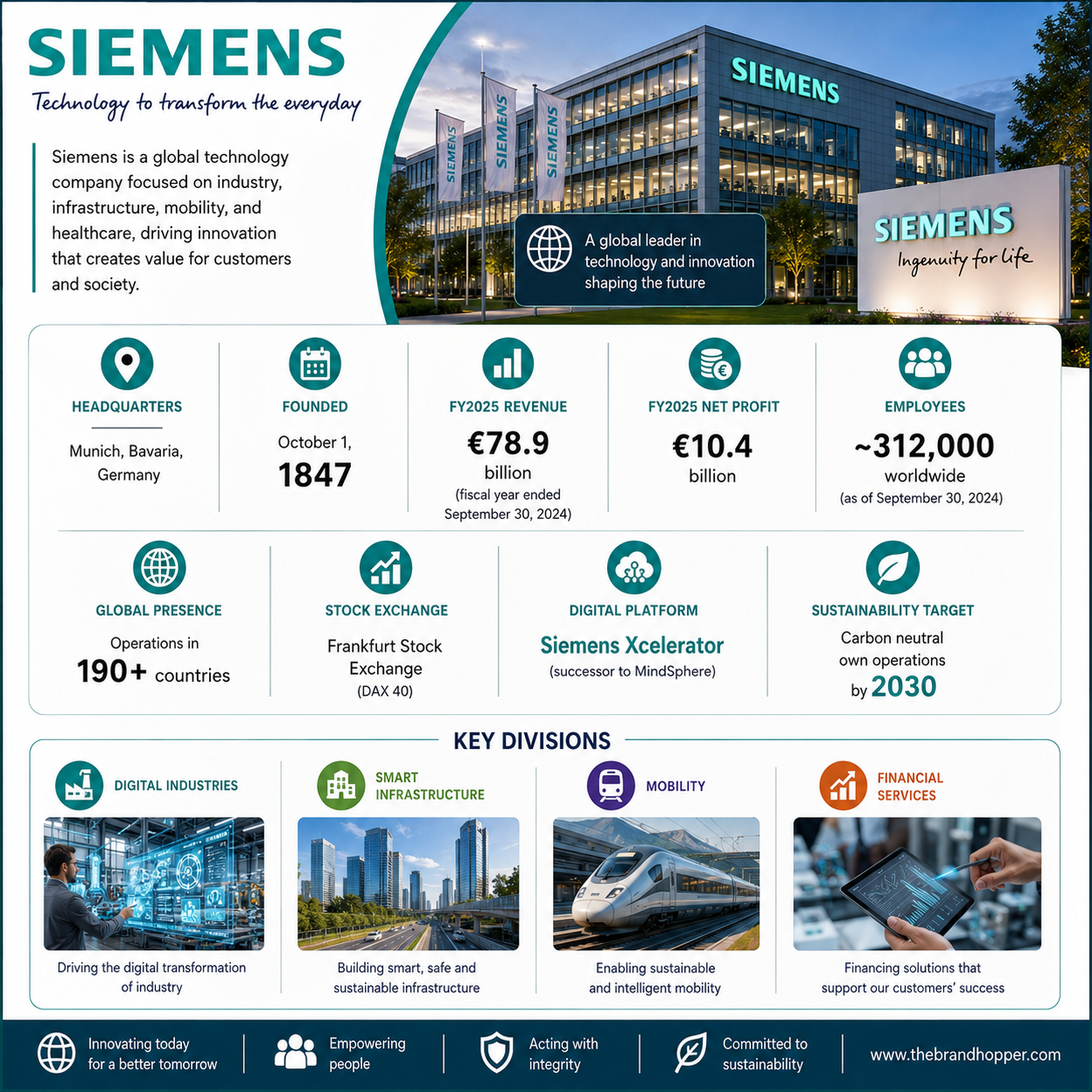
Siemens AG is a German multinational conglomerate headquartered in Munich, Germany — one of the largest industrial technology companies in the world and a leader in electrification, automation, and digitalization. Founded on October 1, 1847 by Werner von Siemens and Johann Georg Halske as a telegraph company, Siemens has evolved over 175 years into a global force across energy, healthcare, industrial automation, infrastructure, and mobility.
In fiscal year 2025 (ended September 30, 2025), Siemens AG reported group revenues of €78.9 billion and net profit of €10.4 billion, employing approximately 312,000 people in more than 190 countries. The company operates through four core segments: Siemens Digital Industries, Siemens Smart Infrastructure, Siemens Mobility, and Siemens Financial Services. Siemens Healthineers and Siemens Energy are separately listed entities in which Siemens AG holds significant stakes.
Innovation is central to Siemens’ identity. The company invests heavily in R&D, with a focus on AI-driven automation, digital twins, and sustainable infrastructure. Its Xcelerator platform — Siemens’ open digital business ecosystem — is the successor to MindSphere, enabling industrial companies to accelerate their digital transformation across the value chain.
Siemens has committed to carbon neutrality in its own operations by 2030. Through its Siemens Stiftung foundation, the company also supports social and educational projects globally. The company’s stock is listed on the Frankfurt Stock Exchange and is a constituent of the DAX 40 index.
Top 17 Competitors of Siemens
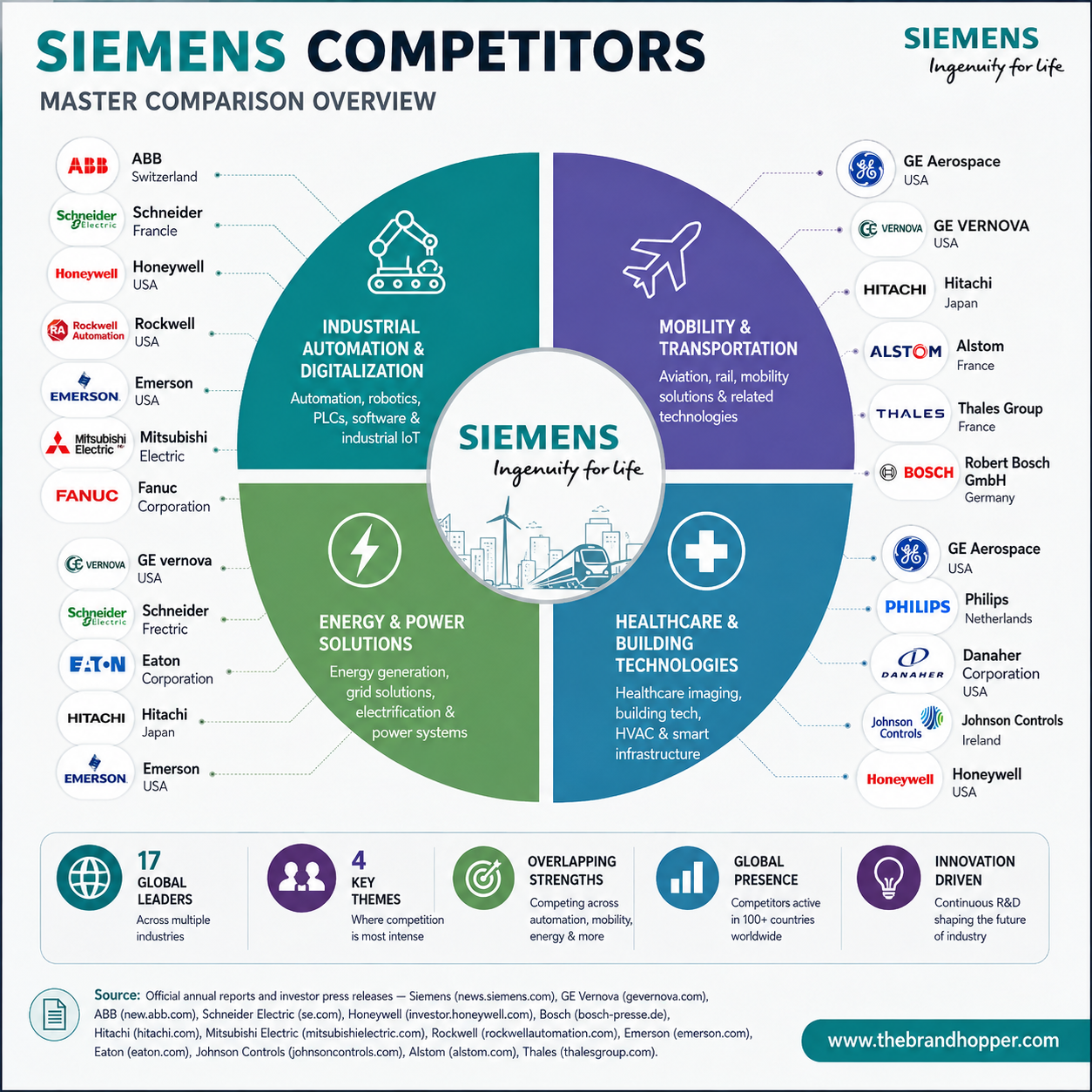
Siemens competes across multiple industries — from industrial automation and power systems to healthcare imaging and rail mobility. Its rivals range from broad-based industrial conglomerates to focused automation specialists. Here is a detailed look at 17 of Siemens’ most significant competitors, with verified revenue data and competitive analysis.
1. GE Aerospace (formerly General Electric)
Website – https://www.ge.com/
General Electric has undergone one of the most significant corporate restructurings in industrial history. In January 2023, GE HealthCare Technologies Inc. was spun off as an independent publicly traded company. Then in April 2024, the remaining GE corporation split into two: GE Aerospace (aviation, propulsion, and defense) and GE Vernova (energy — covered separately). What was once the world’s most diversified industrial conglomerate is now three focused public companies.
GE Aerospace is a direct competitor to Siemens Mobility in transportation electrification and intelligent systems. GE Aerospace’s FY2025 revenues were approximately $45.9 billion, driven by record aircraft engine orders and services backlog. In power generation, gas turbine technology and services remain an overlap area, while GE HealthCare — with approximately $20.62 billion in revenue — competes directly with Siemens Healthineers in medical imaging, diagnostics, and AI-assisted radiology.
GE Aerospace’s competitive edge against Siemens lies in its unrivalled position in commercial and military aviation propulsion. Its LEAP and GE9X engines power the world’s most advanced aircraft, giving it a technology moat in aerospace that Siemens does not directly contest. However, in digital industrial solutions, power infrastructure, and healthcare, the competitive battleground remains intense across all three post-split GE entities.
| Aspect | GE Aerospace / GE HealthCare |
| FY2025 Revenue | GE Aerospace ~$45.9B; GE HealthCare ~$20.625B |
| Industry Focus | Aviation, defense propulsion; Medical imaging & AI diagnostics |
| Key Overlap with Siemens | Healthcare imaging, mobility systems, digital industrial software |
| Competitive Strength | Aviation market dominance, established GE brand heritage globally |
| Digital Platform | Predix (industrial IoT); AI-assisted diagnostics at GE HealthCare |
| Global Reach | Operations in 180+ countries across all three GE entities |
2. GE Vernova

Website – https://www.gevernova.com/
GE Vernova became an independent publicly traded company in April 2024 after its spin-off from General Electric. It is now a dedicated energy technology company, making it one of the most direct energy-sector competitors to Siemens Energy. GE Vernova reported FY2025 revenues of $38.1 billion, a 9% increase year-over-year driven by higher services and equipment volume across its wind, grid, and power generation segments.
GE Vernova’s three segments — Power (gas turbines, steam turbines), Wind (Onshore Wind, Offshore Wind), and Electrification (grid solutions, power conversion) — mirror almost exactly the competitive landscape of Siemens Energy. Both companies are racing to secure large-scale grid modernization contracts as global electricity demand surges from data centers, EV adoption, and industrial decarbonization.
GE Vernova’s Haliade-X offshore wind turbine, generating up to 14 MW, competes directly with Siemens Gamesa’s (Siemens Energy subsidiary) offshore wind platforms. In the grid equipment space, both companies are bidding for multi-billion-dollar contracts to modernize aging transmission infrastructure across the US, Europe, and India.
| Aspect | GE Vernova |
| FY2025 Revenue | $38.1 billion (up 9% YoY) |
| Industry Focus | Power generation, Wind energy, Grid electrification |
| Key Overlap with Siemens | Gas turbines, offshore wind, grid modernization, energy transition |
| Competitive Strength | Haliade-X offshore wind; strong US power services backlog |
| Listed Since | April 2024 (NYSE: GEV) |
| Global Reach | Operations in 100+ countries |
3. ABB Ltd.

Website – https://global.abb/group/en
ABB Ltd. is a Swiss-Swedish multinational corporation and one of the most direct competitors to Siemens across automation, robotics, and electrification. In 2025, ABB reported record revenues of $33.20 billion, representing 9% comparable growth year-over-year — driven by strong demand for electrification and industrial automation globally.
ABB’s four business divisions — Electrification, Motion, Process Automation, and Robotics & Discrete Automation — overlap directly with Siemens Digital Industries and Siemens Smart Infrastructure. ABB’s robotics business (YuMi collaborative robots, large-scale industrial robots) competes with Siemens’ integrated automation solutions for smart manufacturing. ABB Ability™, its digital platform, parallels Siemens’ Xcelerator in connecting industrial systems through IoT, AI, and cloud analytics.
ABB’s strategic focus on electric vehicle charging infrastructure (Terra series chargers), data center power management, and marine electrification represents newer growth vectors that overlap with Siemens’ Smart Infrastructure division. Both companies are competing intensely for market leadership as global demand for intelligent grid infrastructure and factory automation accelerates.
| Aspect | ABB Ltd. |
| FY2025 Revenue | $33.20 billion (record; +7% comparable) |
| Industry Focus | Electrification, Motion, Robotics, Process Automation |
| Key Overlap with Siemens | Industrial automation, robotics, power grids, smart buildings |
| Competitive Strength | ABB Ability™ platform; market leader in industrial robotics |
| Headquarters | Zurich, Switzerland |
| Global Reach | Operations in 100+ countries; ~105,000 employees |
4. Schneider Electric

Website – https://www.se.com/us/
Schneider Electric is a French multinational and a premier competitor to Siemens in energy management and industrial automation. In FY2024, Schneider Electric reported record revenues of €40.2 billion, driven by strong demand from the data center, energy transition, and grid infrastructure markets.
Schneider Electric’s EcoStruxure platform — an IoT-enabled architecture covering power, IT, industry, and buildings — is the most direct competitor to Siemens’ Xcelerator digital platform. Both companies are racing to position themselves as the software layer connecting industrial assets, buildings, and energy infrastructure. Schneider’s critical power segment (APC by Schneider Electric) dominates the data center UPS market, an area Siemens is actively targeting with its Smart Infrastructure division.
Schneider Electric’s 2024 performance was buoyed by record-high data center investment globally, driven by the AI infrastructure build-out. The company’s order backlog in data center and grid automation hit record levels, highlighting the intensity of competition with Siemens in next-generation infrastructure. Schneider’s sustainability credentials — ranking #1 in Gartner’s Supply Chain Top 25 — also strengthen its bid in ESG-conscious procurement cycles that Siemens competes for.
| Aspect | Schneider Electric |
| FY2024 Revenue | €40.2 billion (record; +9% organic) |
| Industry Focus | Energy management, Industrial automation, Data center power |
| Key Overlap with Siemens | Smart infrastructure, building management, grid solutions, IIoT platforms |
| Competitive Strength | EcoStruxure platform; #1 in data center power management |
| Headquarters | Rueil-Malmaison, France |
| Global Reach | Operations in 100+ countries; ~150,000 employees |
5. Honeywell International

Website – https://www.honeywell.com/us/en
Honeywell International is a US-based industrial technology conglomerate and a formidable competitor to Siemens across automation, aerospace, and building technologies. In FY2025, Honeywell reported revenues of $37.44 billion, with strong performance across its Safety & Productivity Solutions and Industrial Automation segments.
Honeywell’s portfolio spans industrial process controls, building management systems, fire safety, and aerospace avionics — overlapping with Siemens across multiple divisions. Honeywell’s building technologies unit (fire, HVAC controls, security) competes with Siemens Smart Infrastructure in smart building automation. In process industries, Honeywell’s Experion PKS distributed control system rivals Siemens’ SIMATIC PCS 7 for petrochemical, refining, and pharmaceutical process automation contracts.
Honeywell is also pursuing strategic restructuring, announcing plans to separate into three independent companies by 2025: Honeywell Aerospace, Honeywell Automation, and Honeywell Advanced Materials. This mirrors GE’s 2024 breakup and signals a broader industrial trend toward focused pure-play companies — a move that would intensify direct competition with specific Siemens divisions.
| Aspect | Honeywell International |
| FY2025 Revenue | $37.44 billion |
| Industry Focus | Industrial automation, Aerospace avionics, Building technologies, Safety |
| Key Overlap with Siemens | Building management, process automation, industrial software, safety systems |
| Competitive Strength | Experion PKS DCS; dominant in building automation and industrial safety |
| Pending Restructuring | Separating into 3 pure-play companies (announced 2024) |
| Global Reach | Operations in 100+ countries; ~100,000 employees |
6. Robert Bosch GmbH

Website – https://www.bosch.com/
Robert Bosch GmbH is a privately held German multinational and the largest industrial company globally by some measures in the sectors Siemens competes in. In 2025, Bosch reported revenues of €91 billion, making it larger than Siemens AG by reported revenue. Bosch operates across Mobility (automotive technology), Industrial Technology, Consumer Goods, and Energy & Building Technology.
In industrial automation, Bosch Rexroth — Bosch’s industrial technology division — directly competes with Siemens Digital Industries. Bosch Rexroth’s hydraulics, pneumatics, linear motion, and drive & control technologies are used across the same manufacturing environments that Siemens SIMATIC and TIA Portal systems serve. Both companies compete heavily in the factory automation space for automotive manufacturing lines, packaging machinery, and semiconductor fab equipment.
Despite Bosch’s size, its private ownership model limits direct financial comparison. Bosch remains family-controlled through the Robert Bosch Stiftung foundation, meaning it can invest in long-term technology bets — including AI-driven manufacturing and hydrogen technology — without quarterly earnings pressure. This patient capital approach gives Bosch a strategic agility that mirrors Siemens’ own long-term R&D orientation.
| Aspect | Robert Bosch GmbH |
| 2025 Revenue | €91 billion |
| Industry Focus | Mobility tech, Industrial automation, Consumer goods, Energy & buildings |
| Key Overlap with Siemens | Factory automation (Bosch Rexroth vs. Siemens Digital Industries) |
| Competitive Strength | Scale, private ownership patience, automotive supply chain depth |
| Headquarters | Gerlingen, Germany |
| Global Reach | ~400,000 employees; 60+ manufacturing plants worldwide |
7. Hitachi

Website – https://www.hitachi.com/
Hitachi is a Japanese multinational that has undergone a dramatic transformation from a diversified conglomerate into a focused digital-industrial powerhouse. In FY2025, Hitachi reported revenues of approximately ¥10,586 billion (~$57 billion), making it one of the largest industrial companies in Asia and a significant global competitor to Siemens.
Hitachi’s Lumada platform — its industrial IoT and data analytics ecosystem — is the most direct Asian competitor to Siemens’ Xcelerator. Lumada powers digital transformation across energy, railway, healthcare, and manufacturing, overlapping with virtually every Siemens division. In rail transportation, Hitachi Rail (following its acquisition of Bombardier’s UK rolling stock portfolio) competes directly with Siemens Mobility for major light rail and high-speed train contracts in Europe and Asia.
Hitachi’s strategic pivot toward social innovation — using data and digital technology to solve societal challenges — mirrors Siemens’ own positioning around sustainability and digital infrastructure. Both companies are targeting the same smart city, intelligent transportation, and sustainable energy infrastructure projects globally, making the competitive overlap deep and growing.
| Aspect | Hitachi |
| FY2025 Revenue | ~¥10,586 billion (~$57 billion USD) |
| Industry Focus | Digital industrial, IT, Energy, Transportation, Construction machinery |
| Key Overlap with Siemens | Industrial IoT (Lumada vs. Xcelerator), rail mobility, energy systems |
| Competitive Strength | Asian market depth; Lumada ecosystem; Hitachi Rail in Europe |
| Headquarters | Tokyo, Japan |
| Global Reach | ~270,000 employees; operations in 100+ countries |
8. Mitsubishi Electric

Website – https://www.mitsubishielectric.com/en/index.html
Mitsubishi Electric is a Japanese multinational and a global leader in electrical and electronic equipment. In FY2025 (ended March 31, 2025), Mitsubishi Electric reported revenues of ¥5,521 billion (~$35.6 billion) — driven by strong demand for factory automation equipment, building systems, and defense electronics.
Mitsubishi Electric’s FA (Factory Automation) division — comprising programmable controllers (MELSEC), servo systems, inverters, HMIs, and industrial robots — competes directly with Siemens Digital Industries at nearly every level of the industrial automation stack. The company’s MELSERVO and FREQROL product lines are widely deployed in automotive, food & beverage, and semiconductor manufacturing — the same markets Siemens SIMATIC and SINUMERIK systems target.
The e-F@ctory concept, which integrates IT and automation technology to achieve zero-defect manufacturing, is Mitsubishi Electric’s answer to Siemens’ Digital Enterprise suite. Both companies are competing to become the primary automation architecture for smart factory transformations, particularly in Asia and Europe.
| Aspect | Mitsubishi Electric |
| FY2025 Revenue | ¥5,521 billion (~$35.6 billion) |
| Industry Focus | Factory automation, Building systems, Power systems, Defense electronics |
| Key Overlap with Siemens | PLCs, servo drives, HMIs, industrial robots, smart manufacturing |
| Competitive Strength | e-F@ctory smart manufacturing; strong Asia-Pacific market share in FA |
| Headquarters | Tokyo, Japan |
| Global Reach | Operations in 40+ countries; ~150,000 employees |
9. Koninklijke Philips N.V. (Philips)

Website – https://www.philips.com/global
Koninklijke Philips N.V. (Philips) is a Dutch health technology company and the most direct competitor to Siemens Healthineers in medical imaging and diagnostics. Having divested its consumer electronics and lighting (Signify) businesses, Philips is now focused entirely on healthcare technology. In FY2025, Philips reported revenues of approximately €17.8 billion from health technology, comprising diagnostic imaging, ultrasound, patient monitoring, and health informatics.
Philips and Siemens Healthineers are in a direct two-horse race in several premium medical imaging categories. Philips’ EPIQ Elite ultrasound system, Ingenia Ambition MRI (using BlueSeal helium-free magnet technology), and Spectral CT systems compete product-for-product with Siemens Healthineers’ MAGNETOM, SOMATOM, and ACUSON lines. The clinical differentiation is increasingly driven by AI algorithms — both companies have invested heavily in AI-powered diagnostic software to differentiate identical-seeming hardware.
Philips faced significant quality and regulatory challenges in recent years related to its sleep apnea device recall, which temporarily impacted its financial performance and brand reputation. Despite these headwinds, its healthcare imaging business remains a strong competitor to Siemens Healthineers, and its ongoing recovery positions it for continued rivalry.
| Aspect | Philips |
| FY2025 Revenue | ~€17.8billion (health technology) |
| Industry Focus | Diagnostic imaging, Patient monitoring, Health informatics, Ultrasound |
| Key Overlap with Siemens | MRI, CT, ultrasound systems; AI diagnostics; hospital IT (Siemens Healthineers) |
| Competitive Strength | BlueSeal MRI technology; strong in hospital enterprise imaging networks |
| Headquarters | Amsterdam, Netherlands |
| Global Reach | Operations in 100+ countries; ~69,000 employees |
10. Rockwell Automation
Website – https://www.rockwellautomation.com/
Rockwell Automation is a US-headquartered industrial automation specialist and the most focused pure-play competitor to Siemens Digital Industries in North America. In FY2025, Rockwell Automation reported net sales of $8.34 billion across its three segments: Intelligent Devices, Software & Control, and Lifecycle Services. While smaller than Siemens by revenue, Rockwell’s deep specialization in discrete manufacturing automation gives it formidable market power in its home markets.
Rockwell’s Allen-Bradley product line — PLCs, drives, sensors, and HMIs — and its FactoryTalk software suite are the dominant automation ecosystem in North American manufacturing. Siemens has steadily grown its SIMATIC market share in the Americas, making the two companies direct rivals on factory floors across automotive, food & beverage, pharmaceutical, and consumer goods manufacturing.
Rockwell’s partnership with PTC (which includes a $1 billion cross-shareholding) enhances its digital capabilities with ThingWorx IIoT platform, Vuforia augmented reality, and Creo product lifecycle management — a strategic response to Siemens’ acquisition of Mendix, QR80/NX, and its Polarion ALM tools.
| Aspect | Rockwell Automation |
| FY2025 Revenue | $8.34 billion |
| Industry Focus | Industrial automation, Manufacturing software, Lifecycle services |
| Key Overlap with Siemens | PLCs, SCADA, manufacturing execution systems, industrial software |
| Competitive Strength | Allen-Bradley dominance in North America; FactoryTalk + PTC partnership |
| Headquarters | Milwaukee, Wisconsin, USA |
| Global Reach | ~29,000 employees; manufacturing operations in 6 continents |
11. Emerson Electric

Website – https://www.emerson.com/
Emerson Electric is a US-based technology and engineering company that has sharpened its focus on industrial automation following the divestiture of its Climate Technologies segment (now Copeland) in 2023. In FY2025, Emerson reported revenues of $18.01 billion, reflecting its transformation into a focused automation and software company. The acquisition of National Instruments (NI) in 2023 for $8.2 billion significantly expanded Emerson’s test & measurement capabilities.
Emerson’s DeltaV distributed control system is a leading competitor to Siemens SIMATIC PCS 7/PCS neo in the process industries — particularly refining, chemicals, and life sciences. Emerson and Siemens frequently compete head-to-head for large-scale DCS replacement and greenfield projects worth hundreds of millions of dollars. Both companies are integrating AI and digital twin capabilities into their process automation platforms to maintain competitive relevance.
| Aspect | Emerson Electric |
| FY2025 Revenue | $18.01 billion |
| Industry Focus | Process automation, Test & measurement, Industrial software |
| Key Overlap with Siemens | DCS systems, process control software, industrial automation |
| Competitive Strength | DeltaV DCS leadership in process industries; National Instruments acquisition |
| Headquarters | St. Louis, Missouri, USA |
| Global Reach | ~70,000 employees; operations in 150+ countries |
12. Eaton Corporation

Website – https://www.eaton.com/
Eaton Corporation is a US-based power management company and a growing competitor to Siemens, particularly in electrical infrastructure, power quality, and vehicle electrification. Eaton delivered a record-breaking FY2025, with revenues of $27.44 billion — up 10.3% year-over-year — driven by strong growth in its Electrical Americas and Electrical Global segments.
Eaton’s electrical division produces circuit breakers, power distribution equipment, UPS systems, and electrical components that compete with Siemens’ low-voltage and medium-voltage power distribution products. In the rapidly growing data center power market, both Eaton and Siemens are targeting hyperscaler and colocation data center customers with advanced power management and backup solutions.
Eaton’s eMobility division — supplying electric vehicle powertrain components and charging infrastructure — represents an emerging overlap with Siemens’ electrification strategy. Eaton’s record backlog in 2024, driven by infrastructure bill spending in the US and data center construction globally, confirms its trajectory as a rising competitive force against Siemens.
| Aspect | Eaton Corporation |
| FY2025 Revenue | $27.44 billion (record; +10.3% YoY) |
| Industry Focus | Electrical distribution, Power quality, eMobility, Aerospace |
| Key Overlap with Siemens | LV/MV electrical equipment, data center power, smart grid infrastructure |
| Competitive Strength | Dominant in circuit protection; record backlog; strong US federal contracts |
| Headquarters | Dublin, Ireland |
| Global Reach | ~100,000 employees; operations in 175+ countries |
13. Johnson Controls International

Website – https://www.johnsoncontrols.com/
Johnson Controls International (JCI) is a global leader in smart, healthy, and sustainable buildings — making it a direct competitor to Siemens Smart Infrastructure. In FY2025, Johnson Controls reported revenues of approximately $23.59 billion (continuing operations). The company completed the divestiture of its Residential and Light Commercial HVAC business (York) to Bosch in 2024, sharpening its focus on building automation and fire & security systems.
Johnson Controls’ OpenBlue platform — its AI-powered smart building digital ecosystem — is a direct competitor to Siemens’ Desigo CC building management system and SieSmart cloud services. Both companies compete for large-scale commercial building automation contracts in hospitals, airports, campuses, and data centers, where energy efficiency, sustainability, and occupant experience are the primary selection criteria.
| Aspect | Johnson Controls |
| FY2025 Revenue | ~$23.59 billion (continuing operations) |
| Industry Focus | Building automation, HVAC, Fire & security, Smart building technology |
| Key Overlap with Siemens | Building management systems, fire safety, smart infrastructure |
| Competitive Strength | OpenBlue AI platform; dominant in fire protection and security |
| Headquarters | Cork, Ireland |
| Global Reach | ~100,000 employees; operations in 150+ countries |
14. Alstom

Website – https://www.alstom.com/
Alstom is a French multinational and the most direct rail mobility competitor to Siemens Mobility globally. In FY2025, Alstom reported revenues of approximately €18.49 billion. The company is the world’s second-largest rail equipment manufacturer — with Siemens Mobility being its closest rival — producing trains, signaling systems, and rail infrastructure across high-speed, regional, commuter, and metro segments.
Alstom’s Avelia Liberty high-speed trains (used on Amtrak’s Acela replacement corridor), Citadis trams, and TRAXX locomotives compete with Siemens Mobility’s Velaro, Desiro, and Vectron platforms across the global rail market. Both companies bid head-to-head for major contracts — UK’s Transpennine Express, India’s Vande Bharat Metro, and several European high-speed rail tenders — representing billions of euros in annual competitive battleground.
Alstom’s acquisition of Bombardier Transportation in 2021 made it a much more formidable rival, particularly in North America (where Bombardier had strong legacy contracts) and in mainline rail. Siemens Mobility and Alstom are now the two dominant players in the global rail equipment market, with CRRC of China being the third major force primarily in Asian markets.
| Aspect | Alstom |
| FY2025 Revenue | ~€18.49 billion |
| Industry Focus | Rail rolling stock, Signalling, Rail infrastructure, Services |
| Key Overlap with Siemens | Trains, trams, signaling systems — direct competition in Siemens Mobility |
| Competitive Strength | Post-Bombardier scale; Avelia high-speed platform; global service network |
| Headquarters | Saint-Ouen, France |
| Global Reach | ~80,000 employees; rail projects in 63 countries |
15. Thales Group
Website – https://www.thalesgroup.com/
Thales Group is a French multinational operating in defense, aerospace, digital identity, and transportation. In FY2025, Thales reported revenues of €22.1 billion. Thales competes with Siemens in rail signaling (where both companies offer ETCS/ERTMS systems for European high-speed rail networks), digital security, and defense electronics.
Thales’s Ground Transportation Systems (GTS) division — following its acquisition of Bombardier’s signaling business (distinct from Alstom’s rolling stock deal) — has made Thales one of the top three global rail signaling companies. Siemens Mobility’s signaling division directly competes with Thales GTS for major urban metro and mainline digital train control contracts in Europe, the Middle East, and Asia.
Beyond rail, Thales’ cybersecurity and digital identity businesses compete with Siemens’ industrial cybersecurity solutions (Siemens SINEMA, OT security products). As operational technology (OT) cybersecurity becomes critical for industrial and infrastructure operators, both companies are competing to become trusted security partners for the same customer base.
| Aspect | Thales Group |
| FY2025 Revenue | €22.1 billion |
| Industry Focus | Defense electronics, Aerospace, Rail signaling, Digital security |
| Key Overlap with Siemens | Rail signaling (ETCS/ERTMS), OT cybersecurity, defense systems |
| Competitive Strength | Bombardier signaling acquisition; strong defense sector positioning |
| Headquarters | Courbevoie, France |
| Global Reach | ~80,000 employees; operations in 68 countries |
16. Danaher Corporation

Website – https://www.danaher.com/
Danaher Corporation is a US-based science and technology innovator that competes with Siemens Healthineers in diagnostics and life sciences instrumentation. In FY2025, Danaher reported revenues of approximately $24.568 billion. Following the separation of its environmental and applied solutions business (Veralto) in September 2023, Danaher is now focused on two segments: Biotechnology and Diagnostics.
Danaher’s Diagnostics segment — which includes Beckman Coulter, Radiometer, and IDEXX Laboratories partnerships — competes with Siemens Healthineers’ Atellica immunoassay analyzers, blood gas analyzers, and laboratory diagnostics platforms. Both companies supply hospital clinical laboratories worldwide, competing on throughput, menu breadth, and connectivity to laboratory information systems.
Danaher’s Biotechnology segment (Cytiva, formerly GE Healthcare Life Sciences, plus Pall Life Sciences) targets biopharmaceutical manufacturing — a high-growth market that overlaps with Siemens’ industrial and digital solutions for pharma manufacturing, though from the equipment and filtration side rather than the automation side.
| Aspect | Danaher Corporation |
| FY2025 Revenue | ~$24.568 billion |
| Industry Focus | Diagnostics, Biotechnology, Life sciences instrumentation |
| Key Overlap with Siemens | Clinical diagnostics, immunoassay analyzers (vs. Siemens Healthineers) |
| Competitive Strength | Danaher Business System (operational excellence model); Beckman Coulter brand |
| Headquarters | Washington, D.C., USA |
| Global Reach | ~65,000 employees; operations in 60+ countries |
17. Fanuc Corporation
Website – https://www.fanuc.co.jp/en/
Fanuc Corporation is a Japanese specialist in factory automation — CNC systems, robots, and robotic machinery — and one of the most tightly focused competitors to Siemens Digital Industries. In FY2025 (ended March 31, 2025), Fanuc reported revenues of approximately ¥857.83 billion (~$5.66 billion). Despite being smaller in overall revenue than Siemens, Fanuc holds dominant global market share in two specific segments: CNC (computer numerical control) systems and industrial robots.
Fanuc’s ROBOCUT wire-cut EDM machines, ROBODRILL high-speed machining centers, and its extensive industrial robot lineup (with the CRX collaborative robot series addressing human-robot collaboration) compete with Siemens SINUMERIK CNC systems and Siemens-equipped machine tools globally. In the CNC market — the brain of every precision machining center — Fanuc is the world’s #1 supplier by installed base, giving it entrenched competitive power against Siemens SINUMERIK.
Fanuc is also a major IoT platform player through its FIELD system (Fanuc Intelligent Edge Link and Drive), which collects and analyzes machine data across factory floors — a direct functional competitor to Siemens’ MindSphere/Xcelerator analytics at the machine level.
| Aspect | Fanuc Corporation |
| FY2025 Revenue | ~¥857.83 billion (~$5.66 billion) |
| Industry Focus | CNC systems, Industrial robots, Robotic machinery |
| Key Overlap with Siemens | CNC controllers (vs. Siemens SINUMERIK), industrial robots, factory automation |
| Competitive Strength | World #1 in CNC market share; ROBOCUT and ROBODRILL product leadership |
| Headquarters | Yamanashi Prefecture, Japan |
| Global Reach | ~10,000 employees; CNC installed in machines in 100+ countries |
Siemens Competitors: Master Comparison Table
Frequently Asked Questions (FAQs)
Q: Who are Siemens’ biggest competitors?
A: Siemens’ biggest competitors include ABB Ltd., Schneider Electric, Honeywell International, GE Aerospace, GE Vernova, Robert Bosch GmbH, Hitachi, Mitsubishi Electric, Rockwell Automation, Emerson Electric, Eaton, Johnson Controls, Alstom, Thales, Danaher, and Fanuc. The most significant direct rivals vary by Siemens division: ABB and Schneider Electric in automation and electrification; Alstom in rail mobility; Philips and Danaher in healthcare; and Honeywell and Rockwell Automation in industrial software and building technologies.
Q: What is Siemens’ revenue for fiscal year 2024?
A: Siemens AG reported group revenues of €75.9 billion for fiscal year 2024 (ended September 30, 2024), with a net profit of €9.0 billion. The company employed approximately 312,000 people globally. Note: Siemens Energy and Siemens Healthineers are separately listed companies, and their revenues are not fully consolidated in Siemens AG’s group figures.
Q: How does Siemens compare to ABB in industrial automation?
A: Both Siemens and ABB are global leaders in industrial automation, but with different emphases. Siemens Digital Industries offers a broader software-driven ecosystem (SIMATIC, TIA Portal, Xcelerator) spanning discrete and process automation. ABB leads in robotics (YuMi, IRB series) and industrial robot market share. Siemens tends to dominate in Europe and process industries, while ABB has strong positioning across all geographic regions and in power grids. ABB reported $32.85 billion in FY2024 revenues (record growth), while Siemens AG reported €75.9 billion across all its divisions.
Q: Is Siemens larger than GE?
A: Post-split, Siemens AG (€75.9B) is larger than any individual GE company. However, the combined revenues of the three GE spin-offs — GE Aerospace (~$38.7B), GE Vernova ($34.9B), and GE HealthCare (~$23.5B) — total approximately $97 billion, significantly exceeding Siemens AG’s €75.9 billion. As a unified entity, GE was historically Siemens’ closest peer; as three separate companies, each competes with a specific Siemens division or subsidiary.
Q: Which companies compete with Siemens in rail transportation?
A: Siemens Mobility’s primary competitors in rail are Alstom (France, ~€18.48B revenue), Hitachi Rail (Japan), Thales Ground Transportation Systems (signaling), and CRRC Corporation (China, primarily Asian markets). Alstom — enlarged through its 2021 acquisition of Bombardier Transportation — is the closest global rival to Siemens Mobility, with both companies competing directly for major high-speed, metro, and commuter rail tenders in Europe, the Americas, and the Middle East.
Q: Who competes with Siemens Healthineers?
A: Siemens Healthineers’ primary competitors are Philips (Netherlands, ~€18.2B in health tech revenue), GE HealthCare ($23.5B, independently listed since 2023), Danaher Corporation (~$23.9B, particularly in clinical diagnostics), Canon Medical, and Hologic. In medical imaging, the core competitive triad is Siemens Healthineers, Philips, and GE HealthCare — with all three offering comparable MRI, CT, ultrasound, and AI diagnostic platforms. Differentiation is increasingly driven by AI software capabilities and enterprise imaging network integration.
Q: What makes Siemens unique compared to its competitors?
A: Siemens’ key differentiators are: (1) Breadth — very few companies match Siemens’ simultaneous depth across energy, factory automation, healthcare, mobility, and smart infrastructure; (2) Xcelerator platform — a unified digital business ecosystem integrating IoT, AI, and digital twins across industrial assets; (3) Software-first identity — Siemens has invested billions in industrial software (acquisition of Mendix, Bentley Systems stake, SIMATIC IT) to position as an industrial software company, not just a hardware manufacturer; (4) European industrial heritage — deep relationships in European industry, rail, and energy sectors built over 175+ years.
Q: How does Siemens compete against Schneider Electric?
A: Siemens and Schneider Electric compete most directly in smart building management systems, medium-voltage switchgear, industrial automation, and digital energy management platforms. Schneider’s EcoStruxure competes with Siemens’ Xcelerator and Desigo CC. Schneider Electric has shown revenue strength in 2024 (€38.2B, record) driven by data center and energy transition demand, while Siemens Smart Infrastructure competes in the same project pipeline. Schneider is generally seen as stronger in data center critical power and building energy management, while Siemens has broader industrial automation depth.
Q: Does Siemens compete with Bosch?
A: Yes, particularly through Bosch Rexroth (industrial automation, hydraulics, drives) which competes with Siemens Digital Industries’ automation portfolio. Both are German multinationals with strong engineering cultures. Bosch (revenue €90.3B in 2024) is larger by total revenue but more diversified into automotive technology. In factory automation, Bosch Rexroth and Siemens Digital Industries compete for the same production line automation contracts, especially in automotive, packaging, and machine-tool sectors.
Q: What are the key trends driving competition in Siemens’ markets?
A: Several macro-trends are intensifying competition across Siemens’ key markets: (1) Energy transition and grid modernization — driving demand for smart grid technology, offshore wind, and energy storage (Siemens, GE Vernova, Schneider Electric all competing); (2) AI-driven factory automation — smart manufacturing upgrades fuelling demand for PLCs, robots, and digital twins (Siemens, ABB, Fanuc, Rockwell competing); (3) Data center infrastructure boom — massive spending on power management and building systems (Schneider, Eaton, Honeywell, Siemens competing); (4) Healthcare AI — AI-powered diagnostics differentiation (Siemens Healthineers, Philips, GE HealthCare competing); (5) Rail electrification and mobility infrastructure — global rail investment driving train and signaling contracts (Siemens Mobility, Alstom, Hitachi Rail competing).
Also Read: A Deep Dive into the Marketing Strategies of Siemens
To read more content like this, subscribe to our newsletter