Last Updated on June 15, 2026 by Team TBH
Imagine a company that contributes roughly 70% of its parent group’s profit and over 90% of its market capitalisation. Imagine that same company crossing the $30 billion revenue milestone for the first time in its 56-year history — while simultaneously declaring an ambition to become the world’s largest AI-led technology services company. That is Tata Consultancy Services (TCS) in 2026.
TCS is an Indian multinational information technology services, consulting, and business solutions company headquartered in Mumbai, Maharashtra. With over 580,000 professionals across 56 countries and 194 delivery centres globally, it is the largest IT services exporter from India, the second-largest employer in the Indian private sector, and the second most valuable IT services brand in the world with a brand value of $21.2 billion — behind only Accenture.
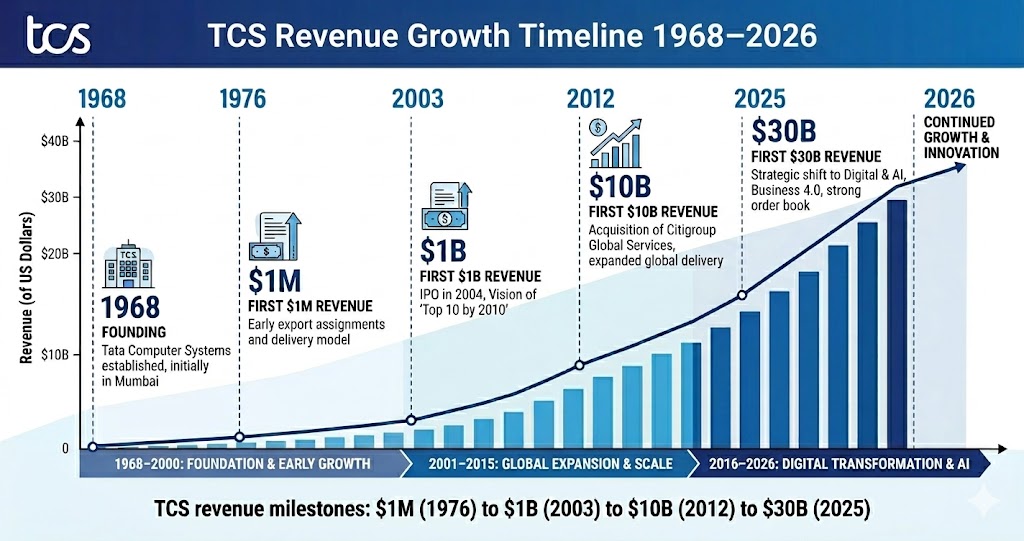
Born in 1968 as a division of Tata Sons to meet the computing needs of Tata Group companies, TCS has evolved through five decades of technological transformation: from punch-card era computing and Y2K-era software migration to the cloud, digital, and now AI eras. In FY2026, 130 of TCS’s top 139 clients chose it as their AI services partner — a metric that encapsulates the trust built through five decades of delivery excellence.
This comprehensive brand story covers TCS’s full history, its product and services portfolio, AI-first strategy, financial performance through Q4 FY2026, recent acquisitions, global innovation footprint, ESG commitments, competitive positioning, and the leadership vision taking it into the next chapter of enterprise technology.
History: 56 Years of Pioneering Technology
TCS’s story is one of deliberate evolution — from a modest management consultancy within a conglomerate to the flagship of India’s technology industry and one of the world’s top five IT services companies by revenue and market capitalisation. The following timeline captures the defining moments across more than half a century.
| 1968 | Tata Consultancy Services launched as ‘Tata Computer Systems’, a division of Tata Sons on April 1, 1968. FC Kohli — a technocrat from Tata Electric Companies — appointed General Manager to lead the startup. |
| 1970 | TCS acquires an ICL 1903 computer. Government mandate requires TCS to export twice the value of the imported machine — effectively orienting the company towards global markets from its earliest years. |
| 1971 | First overseas assignment won: a Middle Eastern power generation company hires TCS for management consultancy and computerised inventory control. |
| 1976 | Crosses $1 million in export revenues. Wins top exporter award from the Engineering Export Promotion Council (1976–77). Begins building software for financial accounting, share registry, inter-bank reconciliation. |
| 1981 | FC Kohli’s foresight leads to the creation of the Tata Research and Design Development Centre (TRDDC) in Pune — India’s first software research institution — marking TCS’s long-term commitment to R&D and computer-aided software engineering. |
| 1985 | Establishes TCS America — its first overseas subsidiary — signalling the beginning of a global delivery model that would define the IT outsourcing industry. |
| 1992 | Builds the core trading platform for the newly created National Stock Exchange (NSE) of India, fundamentally transforming the country’s capital markets infrastructure. |
| 1997 | Completes a massive Y2K compliance programme for thousands of global companies — establishing TCS as a reliable partner for mission-critical, large-scale technology transformation. |
| 2000 | Unveils a $2 million global e-business development facility in Mumbai. Aggressively pursues the internet commerce opportunity, growing it into a half-billion dollar division by 2004. |
| 2001 | Acquires CMC Ltd., a public sector unit, adding defence and government technology capabilities. Enters China and Uruguay — first Indian IT company in both countries. |
| 2004 | Conducts India’s largest-ever private sector IPO, raising ~$1.4 billion. Becomes a public limited company listed on BSE and NSE. |
| 2005-06 | Acquires Comicrom S.A. (Chile), Financial Network Services (Australia), and Swedish Indian IT Resources AB. Forms C-Edge Technologies as a JV with State Bank of India. |
| 2009 | Crosses $6 billion in annual revenue. Breaks into top 10 global IT services companies by revenue, profit, headcount, and market capitalisation. |
| 2012 | Crosses $10 billion in revenue — a landmark in Indian corporate history. Begins significant investments in digital technologies: mobility, analytics, cloud, and IoT. |
| 2014 | Becomes the first Indian company to exceed Rs 5 lakh crore (approximately $75B) in market capitalisation. |
| 2018 | Becomes the first Indian IT company to reach $100 billion in market capitalisation — and only the second Indian company ever after Reliance Industries (2007). |
| 2020 | COVID-19 pandemic accelerates remote delivery model. TCS deploys 95% of its workforce to work-from-home within two weeks — a supply chain resilience benchmark for the entire industry. |
| 2023 | K Krithivasan appointed CEO & MD (June 2023), succeeding Rajesh Gopinathan. Launches TCS AI.Cloud unit to consolidate all AI and cloud capabilities. Annualized AI revenue reaches $900M+. |
| 2024 | Launches TCS AI WisdomNext — an industry-first GenAI aggregation platform enabling enterprise clients to compare and deploy multiple AI models. Crosses 300 active GenAI projects with clients. |
| 2025 | Crosses $30 billion in annual revenue for the first time. Acquires ListEngage ($72.8M, October 2025) and signs definitive agreement to acquire Coastal Cloud ($700M). Annualised AI revenue reaches $1.5 billion. |
| 2026 | Completes Coastal Cloud acquisition (January 2026). Q4 FY2026 EBIT margin reaches 4-year high of 25.3%. Annualised AI revenue hits $2.3B. Total FY2026 order book reaches record $40.7B TCV. CEO declares aspiration to become world’s largest AI-led technology services company. |
Business Segments & Revenue Mix of TCS
TCS serves clients across eight verticals, with Banking, Financial Services & Insurance (BFSI) remaining the largest at nearly a third of total revenues. The diversification across life sciences, manufacturing, retail, and energy ensures resilience against sector-specific cycles.
| Vertical | Revenue Share (Q3 FY26) | Key Clients / Sub-segments |
| Banking, Financial Services & Insurance (BFSI) | 31.9% | Global banks, insurers, asset managers, capital markets firms |
| Consumer Business (Retail, CPG, Travel) | 15.4% | Retail chains, e-commerce platforms, airlines, hospitality |
| Life Sciences & Healthcare | 10.5% | Pharma majors, medical devices, health systems, payers |
| Manufacturing | 8.8% | Automotive, industrial, aerospace, hi-tech manufacturing |
| Technology & Services | 8.4% | ISVs, platform companies, SaaS providers |
| Energy, Resources & Utilities | 6.0% | Oil & gas, mining, utilities, renewables |
| Communication & Media | 5.9% | Telecom carriers, media companies, streaming platforms |
| Regional Markets & Others | 13.1% | India domestic, Middle East, Africa, emerging markets |
Geographically, North America remains TCS’s largest market (~54% of revenue), followed by Europe (~31%), India (~6%), and rest of world (~9%). The UK is TCS’s second-largest single-country market, where TCS is now the third-largest IT services player by revenue — displacing IBM — with 4.5% growth in EMEA in FY2026.
Products & Services Portfolio of TCS
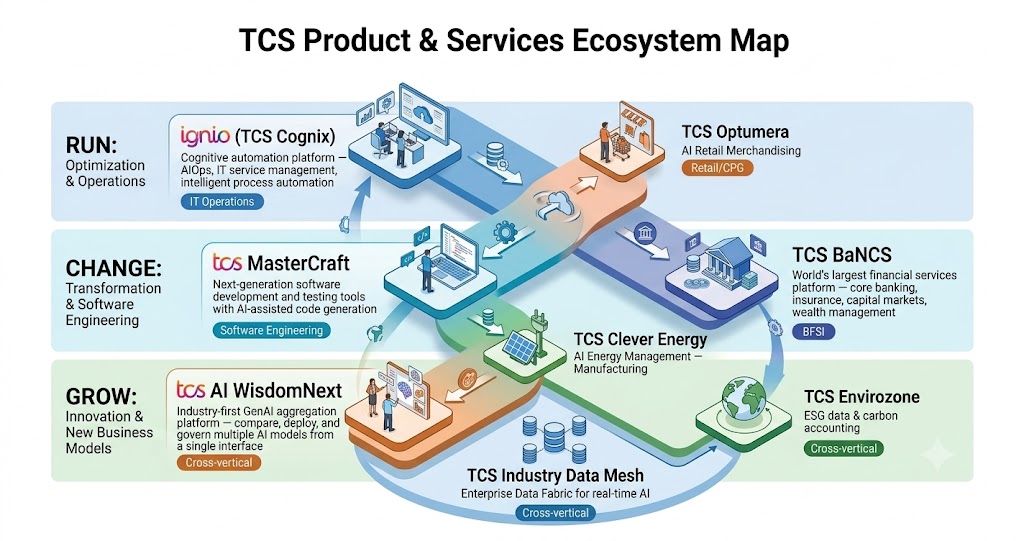
TCS offers a broad portfolio spanning the entire enterprise technology stack — from business process outsourcing to AI-enabled cognitive services. The portfolio is organised across three horizons: Run (keeping existing systems operational and optimised), Change (transforming technology landscapes), and Grow (building new digital businesses).
Core IT Services
- Application Development & Maintenance — custom software development, legacy modernisation, application management
- Cloud Services — cloud migration, multi-cloud management, cloud-native development across AWS, Azure, and Google Cloud
- Cybersecurity Services — threat intelligence, zero-trust architecture, security operations centres (SOCs)
- Data & Analytics — enterprise data platforms, business intelligence, AI/ML model deployment
- Digital Engineering — product engineering, embedded systems, IoT connectivity
- ERP & Enterprise Solutions — SAP, Oracle, Salesforce implementation and support
- IT Infrastructure Services — data centre management, end-user computing, network services
Business Process Services
- Finance & Accounting BPS — accounts payable/receivable, financial close, regulatory reporting
- HR Services BPS — talent acquisition, payroll, benefits administration
- Supply Chain BPS — procurement, logistics coordination, inventory management
- Customer Experience BPS — contact centre, customer analytics, omnichannel engagement
Industry-Specific Platforms & Products of TCS
TCS’s product portfolio provides IP-led recurring revenue and deep client lock-in:
| Product/Platform | Description | Vertical |
| TCS BaNCS | World’s largest financial services platform — core banking, insurance, capital markets, wealth management | BFSI |
| TCS AI WisdomNext | Industry-first GenAI aggregation platform — compare, deploy, and govern multiple AI models from a single interface | Cross-vertical |
| ignio (TCS Cognix) | Cognitive automation platform — AIOps, IT service management, intelligent process automation | IT Operations |
| TCS MasterCraft | Next-generation software development and testing tools with AI-assisted code generation | Software Engineering |
| TCS Optumera | AI-powered retail merchandising optimisation — pricing, promotions, assortment | Retail / CPG |
| TCS Clever Energy | AI-driven energy management and sustainability optimisation for manufacturing | Manufacturing |
| TCS Envirozone | ESG data management, carbon accounting, and sustainability reporting platform | Cross-vertical |
| TCS Industry Data Mesh | Enterprise data fabric connecting siloed data sources for real-time AI inferencing | Cross-vertical |
AI-First Strategy: The Road to Becoming the World’s Largest AI-Led IT Company
“TCS aims to become the world’s largest AI-led technology services company. FY26 marked an inflection point as enterprise clients shifted from AI experimentation to scaled deployment.” — K Krithivasan, CEO & MD, TCS (May 2026)
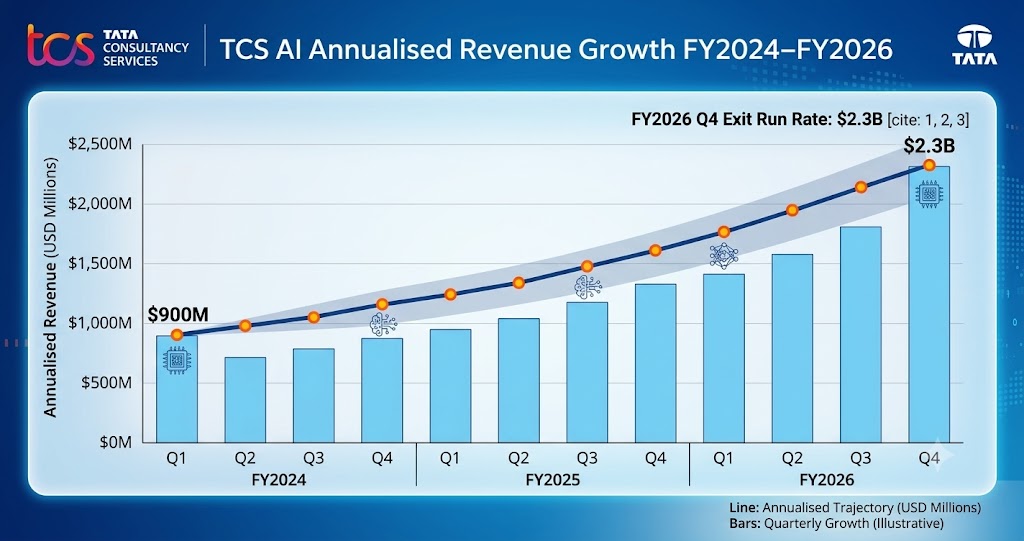
TCS’s AI strategy is not a bolt-on capability — it is a fundamental repositioning of its entire business model. With $2.3 billion in annualised AI revenue as of Q4 FY2026 (up from approximately $900 million in FY2024), 130 of its top 139 clients choosing TCS as their AI services partner, and an organisation-wide reskilling programme that has trained hundreds of thousands of employees in AI and GenAI tools, TCS is executing the most comprehensive AI transformation of any IT services company globally.
Five Strategic Pillars of TCS’s AI Vision
CEO K Krithivasan outlined TCS’s AI transformation strategy around five pillars at Davos 2026:
| Pillar | Description |
| 1. Full-Stack AI Services | From AI infrastructure (Nvidia-powered AI factories) to AI applications (industry-specific models) to AI governance — TCS aims to be the end-to-end partner for enterprise AI transformation |
| 2. Internal AI Transformation | TCS has deployed AI across its own operations — from software engineering (AI-assisted code generation via MasterCraft) to HR, finance, and client delivery — improving its own margins while creating replicable blueprints for clients |
| 3. Platform-Led Delivery | AI WisdomNext, ignio, and TCS BaNCS create recurring revenue streams and IP-based defensibility distinct from pure labour arbitrage |
| 4. Ecosystem Expansion | Strategic partnerships with Microsoft, Google Cloud, AWS, Nvidia, and Salesforce create co-innovation capacity and co-selling channels at global scale |
| 5. Sovereign AI & Emerging Tech | Investments in sovereign cloud, semiconductor design services (post-Chips Act boom), quantum computing advisory, and green energy transitions address next-decade client needs |
TCS AI WisdomNext — The GenAI Aggregation Platform
Launched in 2024, TCS AI WisdomNext is described as the industry’s first enterprise GenAI aggregation platform. It provides a unified interface for enterprises to compare, deploy, and govern multiple AI models across cloud providers — whether OpenAI’s GPT models, Google Gemini, Anthropic Claude, Meta Llama, or domain-specific open-source models. Key capabilities include:
- Model benchmarking and comparison across providers on task-specific performance, cost, and latency
- Ready-to-deploy business solution blueprints with built-in guardrails, compliance controls, and audit trails
- Integration with TCS’s industry-specific data assets — particularly in BFSI, life sciences, and retail
- Agentic AI orchestration — enabling multi-step autonomous workflows across enterprise systems
WisdomNext is now deployed at scale across TCS’s largest clients, including a leading Australian integrated infrastructure services provider and multiple US insurers running AI-driven claims processing and underwriting workflows.
AI Revenue Trajectory
| Period | Annualised AI Revenue | Key Driver |
| FY2024 | ~$900 million | Early GenAI pilots, AI.Cloud unit launch |
| Q3 FY2025 | ~$1.2 billion | Scaling from pilots to production deployments |
| FY2025 (full year) | ~$1.5 billion | 300+ active GenAI projects; WisdomNext adoption |
| Q3 FY2026 | $1.8 billion | Enterprise shift from experiments to scaled AI |
| Q4 FY2026 | $2.3 billion | Agentic AI deployments; Coastal Cloud AI capabilities |
Key AI Partnerships
- Microsoft — Co-developing AI-led solutions integrating Microsoft Azure OpenAI Service with TCS’s industry platforms (TCS Optumera, TCS Clever Energy, TCS Industry Data Mesh)
- Nvidia — Building enterprise AI factories and scaling AI infrastructure for clients; TCS is a key Nvidia partner for enterprise AI deployment
- Google Cloud — Generative AI solutions on Vertex AI, integrating with TCS’s BFSI and healthcare platforms
- Salesforce — TCS is now among the top 5 Salesforce advisory firms globally following Coastal Cloud and ListEngage acquisitions
Strategic Acquisitions & Partnerships of TCS
TCS’s acquisition strategy has historically been disciplined — unlike Accenture’s more aggressive M&A cadence, TCS traditionally grew organically and acquired selectively for capability gaps. In 2025–2026, this strategy has accelerated meaningfully, with two significant acquisitions targeting the Salesforce ecosystem and agentic AI capabilities.
| Year | Acquisition | Value | Strategic Rationale |
| 2001 | CMC Ltd. (India) | Undisclosed | Government and defence IT capabilities; public sector entry |
| 2004 | WTI Advanced Technology | Undisclosed | Engineering design capabilities |
| 2005 | Comicrom S.A. (Chile) | Undisclosed | Latin America geographic expansion |
| 2005 | Financial Network Services (Australia) | Undisclosed | Financial services software IP in APAC |
| 2014 | Alti (France) | ~$65M | European banking and financial advisory |
| 2019 | W12 Studios (UK) | Undisclosed | Digital design and innovation capability |
| 2021 | Postbank Systems (Germany) | Undisclosed | European BFSI transformation capabilities |
| Oct 2025 | ListEngage (USA) | $72.8M | Salesforce Marketing Cloud, Data Cloud, CRM; agentic AI marketing capabilities |
| Jan 2026 | Coastal Cloud (USA) | $700M | Salesforce Summit partner; makes TCS a top-5 Salesforce advisory firm globally |
Deep Dive: Coastal Cloud Acquisition ($700M, January 2026)
The $700 million acquisition of Coastal Cloud is TCS’s largest acquisition to date and its most strategically significant — marking the company’s decisive entry into the Salesforce ecosystem at scale, and reinforcing its agentic AI capabilities for customer experience transformation.
Coastal Cloud is a Salesforce Summit Partner (the highest Salesforce partner tier) specialising in Salesforce implementation, customisation, and managed services across financial services, healthcare, and the public sector in North America. With approximately 1,000 consultants and deep Salesforce expertise, Coastal Cloud immediately elevates TCS’s Salesforce practice — which, combined with the earlier ListEngage acquisition, positions TCS among the top five Salesforce advisory firms globally.
The strategic rationale extends beyond Salesforce revenue: Coastal Cloud’s capabilities in agentic AI — where Salesforce’s Agentforce platform is a leading enterprise AI agent deployment environment — gives TCS a critical foothold in the AI agent economy. Enterprises are rapidly deploying autonomous AI agents for sales, service, marketing, and commerce operations, and TCS’s combined Salesforce + AI capabilities position it directly in this fast-growing space.
Global Footprint: 56 Countries, 7 Pace Ports
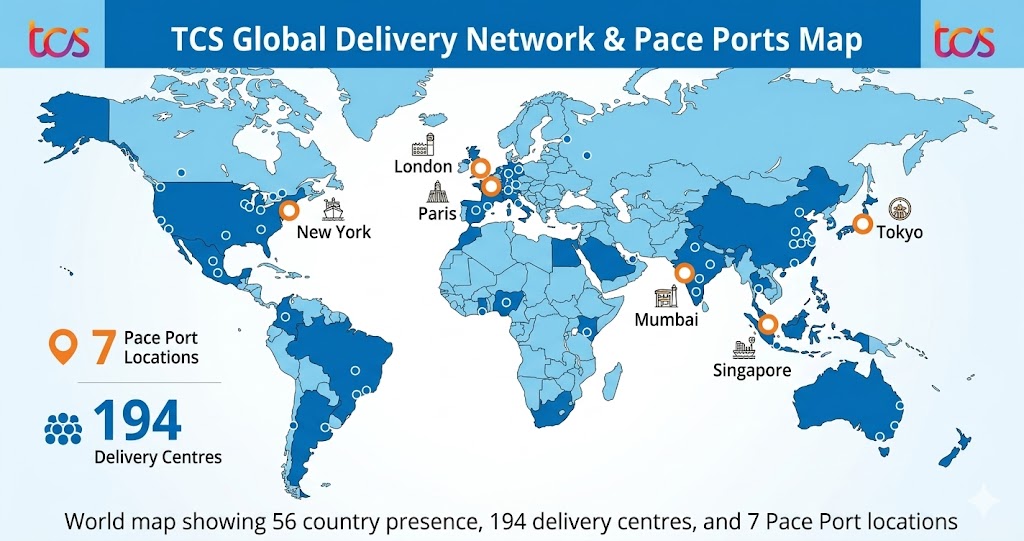
TCS operates one of the largest and most geographically diversified delivery networks in the IT services industry. With 194 delivery centres across 56 countries serving clients in over 150 locations worldwide, TCS combines the cost efficiency of India-based delivery with the proximity and domain expertise of local teams in each major market.
| Region | Key Presence | % of Revenue (est.) |
| North America | US, Canada — largest market; >40 offices | ~54% |
| Europe | UK (#2 market), Germany, Netherlands, France, Nordics, Switzerland | ~31% |
| India | Pan-India operations; BPS, domestic IT, government | ~6% |
| Asia Pacific | Australia, Japan, Singapore, China | ~5% |
| Rest of World | Middle East, Africa, Latin America | ~4% |
TCS Pace Ports — Co-Innovation Centres
TCS Pace Ports are physical co-innovation hubs that bring together TCS’s intellectual property, technology expertise, startups, academia, and client innovation teams to rapidly prototype and scale new solutions. As of 2026, TCS operates Pace Ports in:
| Pace Port | Location | Specialisation |
| Pace Port New York | New York, USA | Digital, AI, fintech; financial services co-innovation |
| Pace Port Pittsburgh | Pittsburgh, USA | Manufacturing, robotics, autonomous systems, academic partnerships |
| Pace Port Toronto | Toronto, Canada | Largest Pace Port (16,000 sq ft); AI, smart cities, banking |
| Pace Port Amsterdam | Amsterdam, Netherlands | European regulatory tech, ESG, digital commerce |
| Pace Port Tokyo | Tokyo, Japan | Manufacturing AI, semiconductor design, Industry 4.0 |
| Pace Port London | London, UK | BFSI, insurtech, AI regulation, UK market co-innovation |
| Pace Port Paris | Paris, France | European enterprise AI, sovereign cloud, luxury retail tech |
Each Pace Port runs TCS Pace Sprints — structured 8-to-12-week innovation programmes where clients co-develop proofs of concept with TCS engineers, designers, and domain specialists, then scale successful pilots through TCS’s delivery network. Hundreds of Pace Sprints have been completed across industries since the programme’s launch.
Financial Performance: FY2025 & FY2026
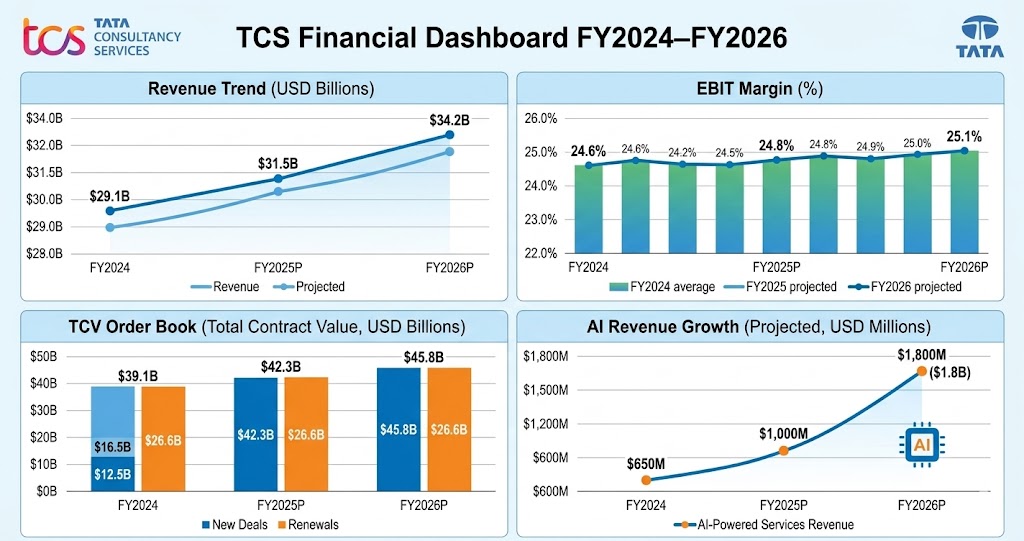
TCS’s financial story in 2025–2026 is one of milestone-crossing, margin recovery, and AI-led growth acceleration — despite a challenging global IT spending environment shaped by macroeconomic caution, higher interest rates, and enterprise budget scrutiny.
FY2025: Crossing the $30 Billion Threshold
TCS crossed $30 billion in annual revenue for the first time in FY2025 (year ending March 31, 2025) — a historic milestone that no Indian IT company had reached before.
| Metric | FY2025 | FY2024 | YoY Change |
| Revenue (USD) | $30.17 billion | $29.08 billion | +3.7% |
| Revenue (INR) | ₹2,55,324 crore | ₹2,40,893 crore | +5.98% |
| Net Income | ₹46,659 crore | ₹45,908 crore | +1.6% |
| EBIT Margin | 24.5% | 24.6% | -10bps |
| Total Contract Value (TCV) | $39.4 billion | $34.1 billion | +15.5% |
| Headcount | 580,000+ | 601,546 | -3.4% (AI-driven efficiency) |
| Dividend | ₹126 per share (including specials) | ₹73 per share | +72.6% |
FY2026: AI-Led Growth Acceleration
FY2026 (April 2025 — March 2026) saw TCS achieve three consecutive quarters of sequential revenue growth after a period of macro-driven softness, driven by mega deal wins, AI transformation contracts, and recovery in the BFSI vertical.
| Metric | Q4 FY2026 (Jan–Mar 2026) | Q3 FY2026 (Oct–Dec 2025) | Q4 FY2025 (Jan–Mar 2025) |
| Revenue (INR) | ₹70,698 crore | ₹63,973 crore | ₹63,973 crore (est.) |
| YoY Revenue Growth | 9.6% | 4.5% | 4.2% |
| Net Profit | ₹13,718 crore | ₹10,657 crore | ₹12,224 crore |
| YoY Profit Growth | +12.2% | +11.0% | -1.7% |
| EBIT Margin | 25.3% (4-year high) | 24.5% | 24.5% |
| Total Contract Value (TCV) | $12 billion | $10.2 billion | $12.2 billion |
| AI Revenue (Annualised) | $2.3 billion | $1.8 billion | ~$1.5 billion |
Key FY2026 Achievement: TCS’s full-year FY2026 order book reached a record $40.7 billion in total contract value — providing strong multi-year revenue visibility and signalling accelerating demand for AI-led enterprise transformation services.
Revenue by Vertical & Geography — Structural Insights
Several structural shifts are evident in TCS’s recent financial performance. First, AI revenue is becoming material: at $2.3 billion annualised (approximately 7–8% of total revenue), it is no longer a pilot-stage metric. Second, BFSI — TCS’s largest vertical at 31.9% — has recovered after a two-year period of caution driven by interest rate pressures on bank technology budgets. Third, the UK market has been a particular bright spot, with TCS displacing IBM as the third-largest IT services player in EMEA. Fourth, headcount reduction of approximately 3.4% YoY in FY2025 reflects AI-driven productivity improvements — TCS is doing more revenue with fewer people, a structural margin driver.
Leadership: K Krithivasan and the AI-Era Vision
K Krithivasan, known internally as ‘KK’, took charge as TCS’s CEO & MD in June 2023 — succeeding Rajesh Gopinathan who had led the company through the digital transformation boom of 2018–2023. A TCS veteran with over three decades at the company, Krithivasan was previously President of TCS’s BFSI business unit — the company’s largest and most complex vertical.
Krithivasan’s leadership has been defined by three imperatives: deepening client relationships through AI co-creation, repositioning TCS from a labour-arbitrage provider to an IP and platform-led services company, and building the internal AI infrastructure to sustain margin improvement while growing revenues. His Davos 2026 statement — that TCS aims to become ‘the world’s largest AI-led technology services company’ — was not marketing hyperbole but a strategic declaration backed by $2.3 billion in annualised AI revenue and 130 of 139 top clients choosing TCS as their AI partner.
Under Krithivasan’s tenure, TCS has also accelerated its shareholder-friendly capital allocation policy: in FY2025 alone, TCS paid ₹126 per share in dividends (including special dividends), returning substantial capital to shareholders including its majority owner Tata Sons, which uses TCS dividends to fund Tata Group’s broader investment agenda.
| Previous CEO | Tenure | Key Contribution |
| FC Kohli | 1968–1996 (General Manager / CEO equivalent) | Founded TCS vision; TRDDC; export orientation; Y2K positioning |
| S. Ramadorai | 1996–2009 | Scaled TCS to $6B revenue; IPO in 2004; global delivery model |
| N. Chandrasekaran | 2009–2017 | $10B to $18B revenue; digital pivot; became Tata Sons Chairman |
| Rajesh Gopinathan | 2017–2023 | Digital transformation era; COVID resilience; $29B revenue |
| K Krithivasan | 2023–Present | AI-first strategy; $30B milestone; $40.7B order book; AI revenue to $2.3B |
Why Is TCS So Successful? The Five Pillars
TCS’s sustained outperformance — in a fiercely competitive industry where peers like Infosys, Wipro, HCL Technologies, Cognizant, and Accenture are all competing for the same clients and talent — stems from five compounding advantages that have been built over 56 years.
1. The Tata Brand and Trust Capital
No other IT services company in the world carries the reputational weight that comes from being part of the Tata Group — India’s most trusted corporate brand for over 150 years. The Tata brand conveys ethical business practices, long-term partnership orientation, and institutional stability that opens doors at the board and C-suite level that purely commercial brands cannot access as easily. For government contracts, heavily regulated BFSI clients, and markets like the UK and Middle East where trust is a procurement criterion, the Tata name provides a structural advantage.
2. Scale and the Talent Engine
With 580,000+ professionals across 149 nationalities and 56 countries, TCS has built one of the most diversified talent platforms in global technology. Its talent acquisition pipeline — drawing primarily from India’s engineering graduate pool (which produces over 1.5 million engineers annually) — combined with TCS’s internal learning platform (which has reskilled hundreds of thousands of employees in cloud, AI, and GenAI skills) creates a continuous talent renewal engine. TCS’s global learning & development investment exceeds $300 million annually.
The company’s contextual knowledge retention — where the same teams work with the same clients for years, accumulating irreplaceable institutional knowledge about client systems, processes, and business logic — is a switching cost that competitors find very difficult to overcome. Average TCS client relationship tenure for its top 50 accounts exceeds 15 years.
3. Customer-Centricity and Relationship Capital
TCS’s go-to-market structure is organised by client relationship — not by service line or geography — ensuring that account managers are incentivised to deepen relationships holistically rather than sell individual service towers. The metric TCS tracks most religiously is Net Promoter Score (NPS) from clients: consistent measurement, transparent reporting, and client-centric investment decisions have produced industry-leading client satisfaction scores. In FY2026, 130 of TCS’s top 139 clients chose TCS as their AI services partner — a reflection of trust built through decades of delivery excellence, not just the quality of TCS’s AI offerings.
4. Financial Discipline and Capital Efficiency
TCS operates with exceptional capital efficiency. It generates substantial free cash flow — converting over 95% of net income into free cash — with minimal capital expenditure requirements relative to its revenue. The company’s Intellectual Property investments (WisdomNext, ignio, BaNCS, Optumera) are expensed rather than capitalised, making its profitability metrics more conservative than they appear. With EBIT margins recovering to a 4-year high of 25.3% in Q4 FY2026, TCS consistently operates at margin levels that Western peers like Accenture (approximately 15–16% EBIT) cannot match — a reflection of India-based delivery cost structures combined with IP-led value capture.
5. Strategic Adaptability
TCS has successfully navigated five distinct technology eras — mainframe computing, client-server, internet, mobile/cloud, and now AI — without losing its leadership position in any of them. This adaptability stems from a long-standing investment in R&D through TRDDC and the TCS Research division, a co-innovation culture through Pace Ports, and a leadership ethos that consistently invests in the next technology wave before client demand peaks. The transition from a Y2K-era code migration house to a $2.3 billion AI revenue business is the most vivid current example of this adaptive capacity.
ESG & Corporate Sustainability
TCS reduced its absolute Scope 1 and Scope 2 carbon emissions by 71% against its 2016 baseline by FY2023 — achieving its 70% reduction target two full years ahead of schedule. Its 2030 net zero commitment is among the most credible in the Indian corporate sector.
Environmental Commitments
- 71% reduction in absolute Scope 1 & 2 emissions vs 2016 baseline — target achieved 2 years early
- 2030 net zero target across Scope 1 and Scope 2 emissions
- Zero Waste to Landfill (ZWL) Certification achieved at 8 campuses in FY2025
- 86% of TCS office portfolio accredited for zero waste to landfill
- All new TCS campuses designed for water efficiency, sewage recycling, and rainwater harvesting
- TCS Envirozone platform — sustainability-as-a-service, winner of Stevie Awards 2024 & 2025
Social & CSR Initiatives
- BridgeIT — digital literacy programme connecting rural schools to technology and quality education
- STEM@Schools — science and technology curriculum support for government schools across India
- TCS iON — digital infrastructure for education: online examinations, learning platforms, skill certifications
- Women in STEM — 35.2% female workforce with structured mentoring, pay parity monitoring, and leadership pipelines
- Accessibility — assistive technology programmes for persons with disabilities
Competitive Positioning in the Global IT Services Market
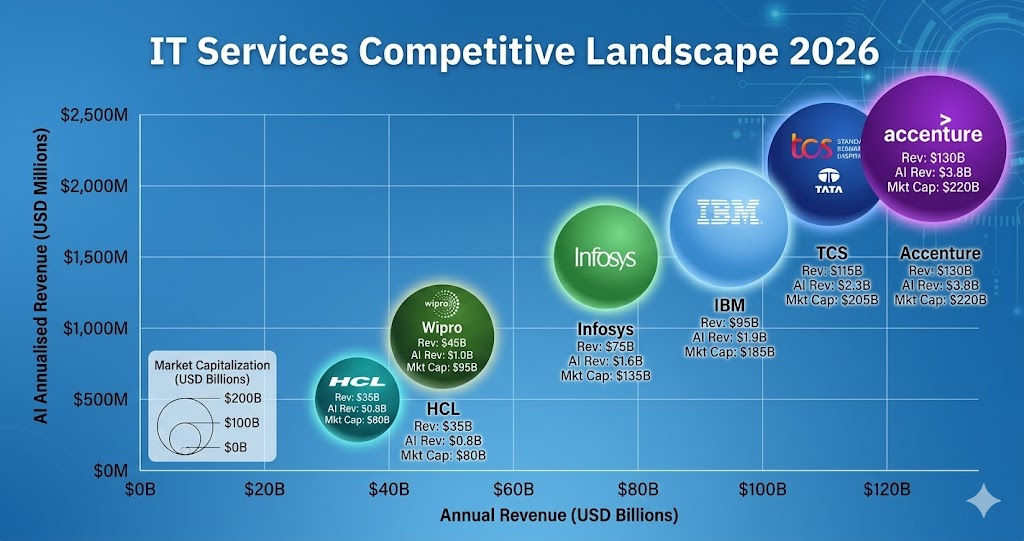
TCS occupies a unique position in the global IT services landscape: it is simultaneously the most valuable IT brand from an emerging market, the most profitable large-cap IT services company globally, and (by some metrics) the largest pure-play IT services company in the world. The competitive set it operates in spans global system integrators, offshore-first IT providers, and emerging AI-native challengers.
| Company | Revenue (FY2025 est.) | AI Revenue | Market Cap | TCS Advantage Over This Rival |
| TCS | $30.17B | $2.3B annualised | ~$81.6B | Full-stack AI + scale + brand + margin |
| Accenture | ~$67B | $2.7B+ (FY2025) | ~$200B | TCS: better margins (~25% vs ~16%); AI revenue growing faster % |
| Infosys | ~$19.5B | ~$1B est. | ~$70B | TCS: 3x Infosys’s deal TCV; Tata brand; larger global delivery |
| Wipro | ~$11B | ~$600M est. | ~$25B | TCS: scale advantage; TCV pipeline; AI maturity |
| HCL Technologies | ~$14B | ~$800M est. | ~$45B | TCS: more diversified; stronger BFSI; larger order book |
| IBM (Services) | ~$18B (consulting) | Significant (embedded) | ~$230B | TCS: growth momentum; EMEA gains over IBM; cost advantage |
| Cognizant | ~$19.5B | ~$700M est. | ~$35B | TCS: order book 2x larger; AI revenue ahead; brand premium |
Accenture remains the revenue and brand leader in IT services globally, with $67 billion in annual revenue and $42.3 billion in brand value versus TCS’s $21.2 billion. However, TCS’s EBIT margin of 25.3% versus Accenture’s approximately 15–16% reflects the structural profitability advantage of India-based delivery — and TCS’s AI revenue growth rate is outpacing Accenture’s on a percentage basis. The two companies are on convergent paths as AI becomes a larger share of both companies’ revenues.
Frequently Asked Questions (FAQs)
Q: What does TCS do, and what are its main services?
A: Tata Consultancy Services (TCS) is a global IT services, consulting, and business solutions company. Its core services span application development and maintenance, cloud migration, cybersecurity, data analytics, digital engineering, ERP implementation, and business process outsourcing (BPO). It also offers proprietary platforms including TCS BaNCS (financial services), TCS AI WisdomNext (GenAI aggregation), ignio (IT automation), and TCS Optumera (retail AI). TCS serves clients in banking, healthcare, retail, manufacturing, telecom, and energy across 56 countries.
Q: Who owns TCS, and what is TCS’s relationship with the Tata Group?
A: TCS is a listed public company, with Tata Sons Pvt. Ltd. holding a 72.02% controlling stake valued at over Rs 7.82 lakh crore (approximately $94B). TCS is the crown jewel of the Tata Group — contributing approximately 70% of Tata Group’s total profit and over 90% of its market capitalisation. The dividends TCS pays to Tata Sons are a primary funding source for Tata Group’s investments across Tata Motors, Tata Steel, Indian Hotels, Air India, and other conglomerates. TCS has been listed on BSE and NSE since August 2004.
Q: What is TCS’s revenue for FY2025 and FY2026?
A: TCS crossed the $30 billion revenue milestone for the first time in FY2025 (year ending March 31, 2025), reporting $30.17 billion in annual revenue — a 3.7% increase year-on-year. In FY2026, revenue growth accelerated: Q4 FY2026 (January–March 2026) revenue grew 9.6% YoY to ₹70,698 crore, with EBIT margins reaching a 4-year high of 25.3%. The full-year FY2026 order book (total contract value) reached a record $40.7 billion. Annualised AI revenue reached $2.3 billion in Q4 FY2026.
Q: Who is the current CEO of TCS?
A: K Krithivasan (known as KK) has been TCS’s CEO & MD since June 2023. He succeeded Rajesh Gopinathan, who led TCS from 2017 to 2023. Krithivasan is a 30+ year TCS veteran who previously served as President of TCS’s BFSI (Banking, Financial Services & Insurance) division — the company’s largest and most complex business unit. Under his leadership, TCS has crossed the $30 billion revenue milestone, achieved a record $40.7 billion order book, and declared its ambition to become the world’s largest AI-led technology services company.
Q: What is TCS’s AI strategy, and how much AI revenue does it generate?
A: TCS’s AI strategy centres on becoming a ‘full-stack AI services’ provider — from AI infrastructure (Nvidia-powered AI factories) to AI applications (industry-specific models and platforms like WisdomNext and ignio) to AI governance. Key planks include: deploying AI internally to improve its own productivity, leveraging WisdomNext to enable enterprise clients to compare and deploy multiple AI models from a single platform, and embedding AI in every service line. AI revenue reached $2.3 billion on an annualised basis in Q4 FY2026 — up from approximately $900 million in FY2024. 130 of TCS’s top 139 clients have chosen TCS as their AI services partner.
Q: What are TCS’s recent acquisitions?
A: TCS completed two significant acquisitions in 2025–2026: (1) ListEngage (October 2025, $72.8M) — a US-based Salesforce Marketing Cloud specialist that strengthens TCS’s CRM and AI-driven digital marketing capabilities; and (2) Coastal Cloud (January 2026, $700M) — TCS’s largest-ever acquisition. Coastal Cloud is a Salesforce Summit Partner in North America, and its acquisition makes TCS one of the top five Salesforce advisory firms globally. Both acquisitions are strategically aligned with the explosive growth of Salesforce’s AI Agentforce platform and the enterprise demand for AI-powered customer experience transformation.
Q: Is TCS better than Infosys or Wipro?
A: TCS is significantly larger than both by every major metric. TCS’s annual revenue ($30.17B in FY2025) is approximately 1.55x Infosys ($19.5B) and 2.7x Wipro ($11B). TCS’s total contract value order book ($40.7B in FY2026) is approximately double Infosys’s. TCS’s annualised AI revenue ($2.3B) is approximately 2.3x Infosys’s estimated AI revenue. TCS’s EBIT margins (25.3%) are roughly comparable to Infosys (~21%) and higher than Wipro (~17%). In brand value, TCS ($21.2B) leads both. Infosys is a stronger competitor in enterprise digital strategy consulting and cloud-native engineering; Wipro has been investing aggressively in AI partnerships. But by scale, order book, profitability, and client trust, TCS is the clear leader.
Q: What does TCS’s ESG / sustainability record look like?
A: TCS has one of the strongest ESG track records in Indian corporate history. It achieved a 71% reduction in absolute Scope 1 and Scope 2 carbon emissions against its 2016 baseline by FY2023 — reaching its target two years ahead of schedule. Its 2030 net zero commitment applies to Scope 1 and 2 emissions. In FY2025, 8 TCS campuses achieved Zero Waste to Landfill (ZWL) certification, with 86% of its total office portfolio accredited. TCS’s own sustainability platform, TCS Envirozone, won Stevie Awards in 2024 and 2025, and the company has won multiple ESG initiative of the year awards from environmental finance and sustainability bodies.
Q: How many employees does TCS have in 2026?
A: As of Q4 FY2026 (March 2026), TCS employs over 580,000 professionals across 56 countries in 194 delivery centres. Women represent 35.2% of the total workforce, and employees come from 149 nationalities. The headcount has reduced from a peak of approximately 614,000 in FY2023 as AI-driven productivity improvements enable TCS to generate more revenue per employee — a structural efficiency gain that has contributed to the margin improvement in FY2026.
Conclusion: TCS in 2026 — From IT Giant to AI Powerhouse
When FC Kohli set up Tata Computer Systems in a Mumbai office in April 1968, the idea that his little startup would one day cross $30 billion in annual revenue, employ more than half a million people across 56 countries, and declare an ambition to become the world’s largest AI company would have seemed fantastical. Yet that is precisely where TCS stands in 2026.
The journey from punch-card computing to GenAI aggregation platforms has been one of continuous reinvention — always grounded in the twin anchors of delivery excellence and long-term client trust that FC Kohli instilled in TCS’s DNA. Each technology era brought competitive threats that looked existential: the PC revolution, the Y2K cliff, the dot-com bust, the cloud disruption, and now AI. Each time, TCS emerged stronger.
The AI era is the most disruptive yet. AI does not just change how TCS delivers its services — it changes how many people TCS needs to deliver them, what clients value, and which competitors are relevant. The rise of AI-native challengers, the deepening capabilities of hyperscalers as IT services providers, and the commoditisation risk to traditional labour-arbitrage IT outsourcing all represent genuine threats. TCS’s response — $2.3 billion in annualised AI revenue, 130 of 139 top clients as AI partners, WisdomNext deployed at scale, and a record $40.7 billion order book — suggests the response is working.
TCS enters the second half of the 2020s not just as India’s largest and most profitable company, but as a genuine contender for the title of the world’s most trusted AI transformation partner. Whether it achieves that audacious goal will define TCS’s next chapter — and India’s standing in the global technology economy.
Also Read: Who are Foxconn’s Top Competitors in Technology Industry?
To read more content like this, subscribe to our newsletter