

Last Updated on October 23, 2026 by Team TBH
Tory Burch is an American luxury lifestyle brand founded in 2004 by designer and entrepreneur Tory Burch. What began with a boutique in New York City and an e-commerce website has developed into a global fashion business offering handbags, footwear, ready-to-wear, accessories, beauty products, and home goods.
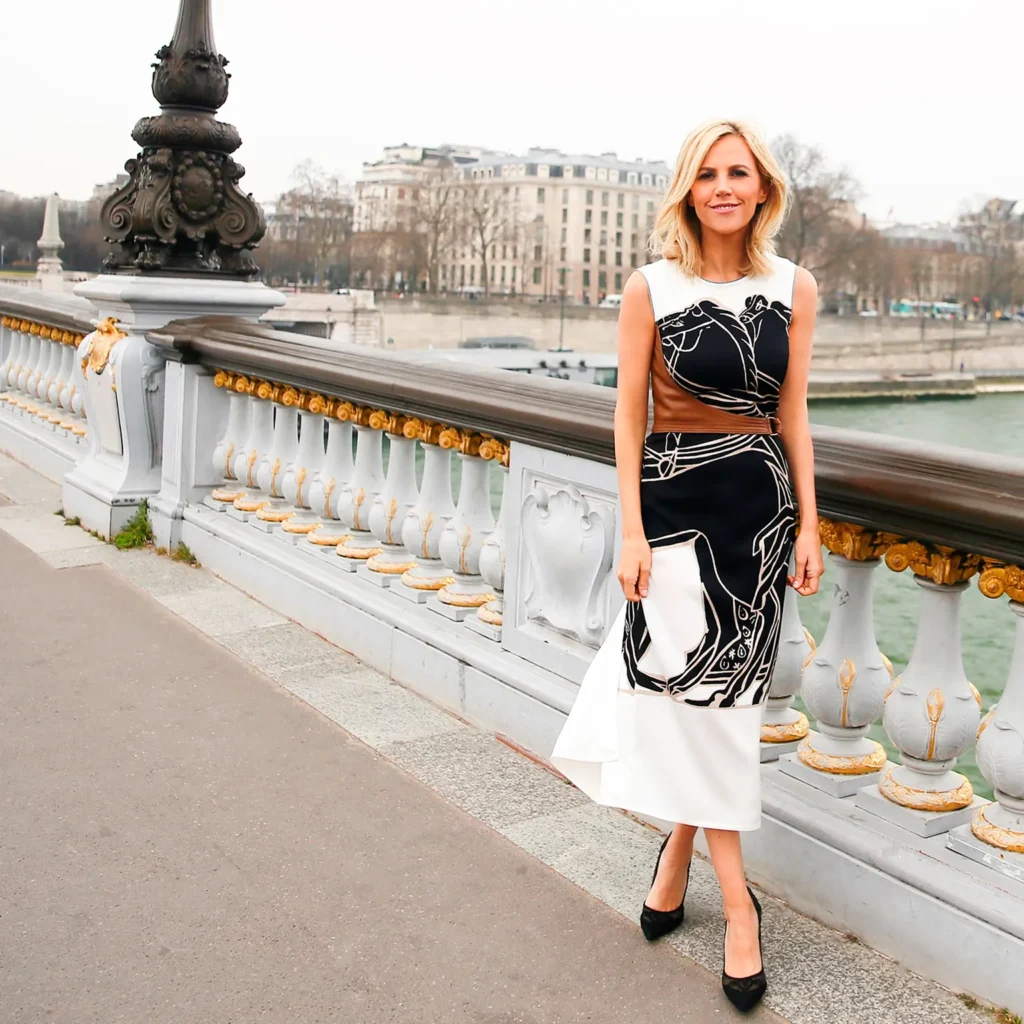
The brand’s commercial strategy combines contemporary American design, recognisable product signatures, fashion-led storytelling, selective retail distribution, and a commitment to supporting women entrepreneurs. Its positioning sits between mass-market fashion and the most expensive luxury houses, although its products and prices span different categories.
The brand has continued to evolve creatively, with fashion commentators using the term “Toryssance” to describe its renewed visibility and design direction during the 2020s. Products such as the Pierced Mule and Pierced Pump helped attract attention from fashion audiences, while campaigns featuring prominent models and the launch of Sublime fragrance broadened the brand’s cultural reach.
Tory Burch remains a privately held business, so its financial figures should be distinguished from publicly reported retail sales or independently audited public-company results. In February 2026, S&P Global Ratings estimated its annual revenue at approximately $1.7 billion. The company’s official Foundation website reports a global network of 400 stores and 13 e-commerce sites.
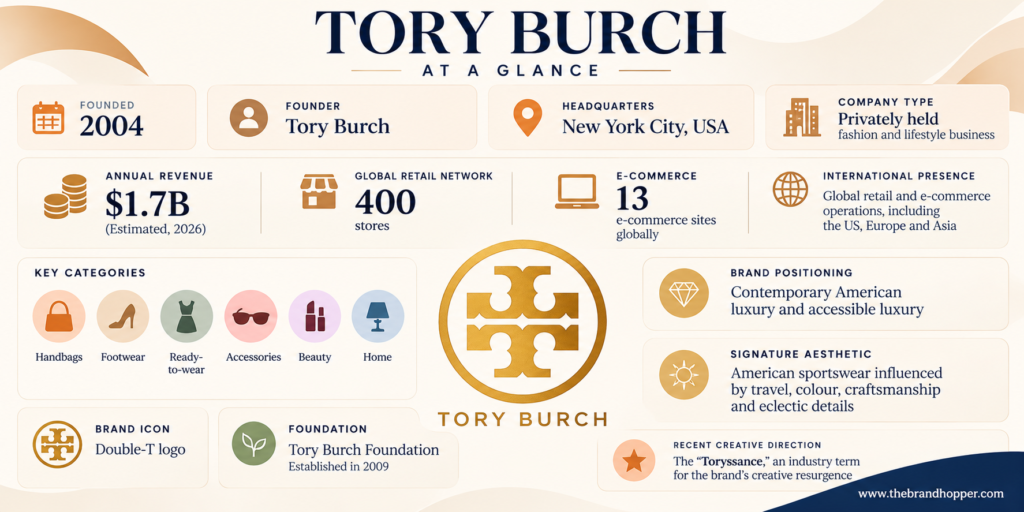
The Tory Burch Story: From Greenwich Village to Global Luxury
Tory Burch launched her eponymous label in February 2004, opening a boutique on Elizabeth Street in New York City alongside an e-commerce website. The business was initially funded with approximately $2 million contributed by Tory Burch and her then-husband, Christopher Burch, according to accounts of the company’s early history.
The brand entered the market with a proposition centred on designer-led fashion at prices below those of the most expensive luxury houses. This helped establish its association with accessible luxury: products with a distinctive designer identity, sold through a more attainable price structure than ultra-luxury brands.
The Reva ballet flat became one of the brand’s best-known early products. Named after Tory Burch’s mother, the shoe helped establish a recognisable design signature and contributed to the brand’s visibility during its early years. The Reva has since been reintroduced in updated forms, illustrating how the brand revisits familiar designs while adapting them for contemporary consumers.
Tory Burch’s personal story is also an important part of the brand’s public identity. She grew up in Valley Forge, Pennsylvania, studied art history at the University of Pennsylvania, and worked in fashion and publishing before launching her business. Her experience helped shape a founder narrative centred on entrepreneurship, ambition, and women’s economic empowerment.
Over time, the company expanded beyond footwear into handbags, ready-to-wear, accessories, beauty, and home products. The broader portfolio allows customers to engage with the brand across multiple categories rather than through a single hero product.
The brand’s more recent creative evolution has been described by fashion commentators as the “Toryssance.” The term refers to renewed attention around its design direction, runway presentations, and accessories, rather than a formal corporate programme or a measurable financial milestone.
The Pierced footwear collection has been one of the most visible examples of this evolution. The Pierced Mule appeared among the 10 hottest products in Lyst’s third-quarter 2023 index, while the brand itself was recognised as a breakout label for the quarter.
Marketing Strategies of Tory Burch
Tory Burch’s marketing strategy combines a consistent brand identity with contemporary creative direction, fashion campaigns, celebrity visibility, social media, retail experiences, and philanthropic initiatives. These activities reinforce one another, helping the brand maintain a recognisable identity while attracting new customers.
1. Brand Identity: The Double-T and Accessible Luxury Positioning
Tory Burch’s brand identity is built around its Double-T logo, a distinctive visual language, and a design philosophy associated with contemporary American style. The company describes its collections as reflecting Tory Burch’s interest in travel, colour, and distinctive details.
The Double-T logo is an important recognition device across footwear, handbags, and accessories. It helps customers identify the brand across different product categories and provides a recurring visual element in product design.

The logo is not the only source of brand recognition. Product silhouettes, distinctive hardware, materials, and recurring design details also help establish continuity between collections.
Tory Burch’s positioning in accessible luxury gives it a different role from both mass-market fashion brands and the most expensive luxury houses. Its price points vary considerably by category, but the overall proposition is built around designer identity, quality, and a recognisable lifestyle aesthetic.
Retail design also contributes to this identity. The brand’s boutiques provide a physical setting for its collections and allow customers to experience its merchandising, product presentation, and service in a branded environment.
The brand’s creative evolution has introduced more sculptural accessories, unexpected details, and contemporary runway styling without abandoning its established design language. This balance between continuity and change can help a mature fashion label attract new customers while retaining existing ones.
2. Campaign Storytelling: From Heritage to Editorial Fashion
Fashion campaigns help Tory Burch communicate the mood and design ideas behind each collection. Rather than relying on product-only advertising, the brand uses photography, casting, locations, styling, and art direction to build a wider narrative around its collections.
The Spring/Summer 2025 campaign was photographed by Jamie Hawkesworth at a Brutalist sports centre in Paris. It featured Irina Shayk, Mona Tougaard, and Ida Heiner, combining ready-to-wear and accessories with an athletic architectural setting.

The campaign’s setting provided a contrast with conventional luxury fashion imagery. Its emphasis on architecture, movement, and athletic references offered a way to present the collection through a distinctive visual concept.
The Fall/Winter 2025 campaign moved to New York City, with photography by Jamie Hawkesworth. The change in location created a different atmosphere while retaining a consistent level of editorial styling and photography.
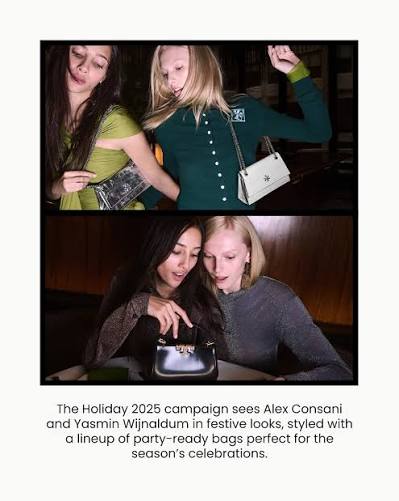
The Holiday 2025 campaign featured Alex Consani and Yasmin Wijnaldum. The campaign continued the brand’s emphasis on fashion imagery that connects clothing and accessories with a particular setting and mood.
The brand has continued this approach in 2026. Its Spring/Summer 2026 campaign, photographed by Jamie Hawkesworth at Tory Burch’s home in Antigua, featured Alex Consani, Hejia Li, and Awar Odhiang. The campaign presented the collection through an environment that reflected the designer’s personal aesthetic and the collection’s combination of American sportswear, romance, and craftsmanship.
These examples illustrate how seasonal campaigns can create a consistent brand world without repeating the same visual formula. However, the effectiveness of an individual campaign should be assessed using evidence such as reach, engagement, brand lift, traffic, or sales rather than photography alone.
3. The Sublime Effect: Celebrity-Led Fragrance Marketing
Tory Burch launched Sublime fragrance in August 2024 in partnership with Shiseido Americas. The fragrance was created by perfumers Rodrigo Flores-Roux and Christine Hassan, and its campaign featured Kendall Jenner.
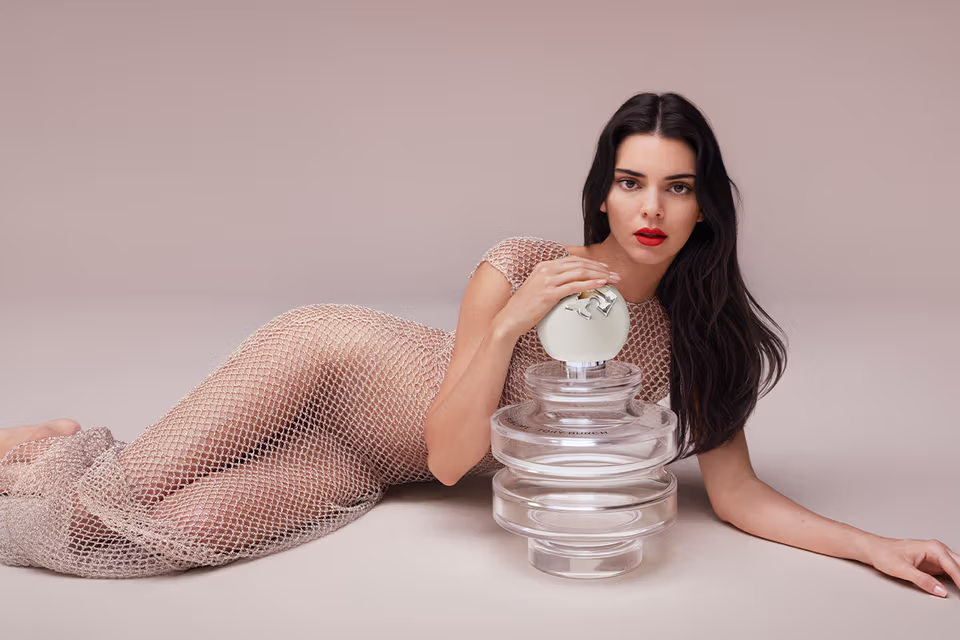
The launch gave Tory Burch an opportunity to expand its brand storytelling into beauty. Fragrance is a category in which packaging, scent, celebrity associations, visual imagery, and emotional positioning can work together to create a distinct consumer proposition.
Kendall Jenner’s role brought a widely recognised public figure to the campaign. Her participation provided an opportunity to reach audiences beyond the brand’s existing fashion customers, although the actual incremental reach and sales impact would require campaign performance data to quantify.
The campaign also incorporated original music by London-based musician Bakar, who covered Edwyn Collins’s song “A Girl Like You” for the campaign video. This extended the campaign beyond still photography into a music-led format.
The fragrance was developed with Shiseido’s beauty expertise, while Tory Burch supplied the brand identity and creative direction. The partnership allowed the fashion label to enter a beauty category using a specialist partner rather than relying exclusively on its existing fashion infrastructure.
Sublime demonstrates how a fashion brand can use celebrity casting, product development, photography, and music to create a multi-channel launch. Claims that the campaign was one of the brand’s most successful marketing initiatives should, however, be supported by sales, awareness, or engagement data.
4. Celebrity and Influencer Marketing
Tory Burch uses models, celebrities, and other public figures in seasonal campaigns to communicate its collections to fashion audiences. Recurring campaign talent can create continuity between seasons, while new casting choices can introduce the brand to different audience groups.
The Spring/Summer 2025 campaign featured Irina Shayk, Mona Tougaard, and Ida Heiner. The Holiday 2025 campaign featured Alex Consani and Yasmin Wijnaldum, illustrating how the brand uses different talent combinations to support different campaign concepts.
Influencer marketing can extend the reach of these campaigns through product styling, fashion-week content, event appearances, and creator-led social posts. The value of a partnership depends on audience fit, engagement quality, brand safety, and the relevance of the content—not just the number of followers.
The brand’s social channels also allow it to respond to product interest and fashion conversations. When a product attracts organic attention, editorial content, styling ideas, and additional product imagery can help sustain that interest.
At New York Fashion Week for Fall 2025, Tory Burch’s top brand post generated approximately $448,000 in Media Impact Value (MIV), according to reporting based on Launchmetrics data. Camila Coelho was among the influencers generating substantial MIV during the season. MIV is a proprietary estimate of media impact and should not be treated as revenue, profit, or a direct measure of campaign return on investment.
The strategic lesson is that influencer activity is most useful when it reinforces the brand’s product and creative identity. Celebrity visibility can attract attention, but long-term brand value also depends on product desirability, customer experience, and consistent communication.
5. Product Virality Strategy: Creating Must-Have Products
A distinctive product can become a marketing asset when its design is easy to recognise, photograph, discuss, and incorporate into personal styling. Tory Burch’s Pierced footwear collection illustrates how a product design can become part of a wider conversation about a brand’s creative direction.
The Pierced Mule ranked sixth among the hottest products in Lyst’s third-quarter 2023 index. Lyst also identified Tory Burch as a breakout brand for the quarter, reporting a 15% increase in searches for the label. These findings support the claim that the product and brand attracted increased fashion interest during that period.

The Pierced collection’s defining detail is sculptural hardware that creates the appearance of a toe ring or piercing. This distinctive visual feature makes the product easy to identify in campaign images, social posts, and street-style photography.
The collection has since expanded across different footwear styles. The brand’s current assortment includes Pierced Mules, Pierced Loafers, Pierced Pumps, and other designs. Product prices vary by material and style, with current US listings placing standard Pierced Mules around $425 and some versions at $475.
Products such as the Romy bag and other accessories also help extend the brand’s visual language beyond footwear. Each product category provides new opportunities for campaigns, styling content, and editorial coverage.
Product virality cannot be fully engineered or guaranteed. Brands can improve the likelihood of attention through distinctive design, effective distribution, relevant creators, and responsive social content, but consumer adoption and sustained demand remain uncertain.
6. Omnichannel Retail: Connecting Stores and E-commerce
Tory Burch operates through physical stores and e-commerce, allowing customers to encounter the brand across multiple shopping channels. The Tory Burch Foundation’s official website reports 400 stores and 13 e-commerce sites globally. These figures should be attributed to the company’s published information rather than treated as a separately audited store count.
Physical retail gives the brand control over product presentation, store design, service, and the broader shopping environment. Boutiques can also support collection launches, personal styling, and direct customer engagement.
E-commerce extends the brand’s reach beyond locations with physical stores. It also enables product discovery, comparison, and purchasing outside traditional store hours, while giving the company a direct channel for communicating with customers.
The brand also uses selected wholesale and retail partners. Department stores and authorised retailers can introduce Tory Burch products to shoppers who prefer multi-brand environments, while the brand’s own channels provide a more controlled presentation of its collections.
In China and other international markets, local retail and digital distribution are important to reaching customers with different shopping habits and platform preferences. The brand’s international strategy should be evaluated market by market, because the availability of products, websites, platforms, and retail partners differs across countries.
A strong omnichannel strategy is not simply the presence of stores and a website. It requires accurate inventory information, consistent product data, reliable fulfilment, clear returns policies, and a coherent customer experience across channels.
7. Digital-First and Community-Led Social Media
Social media is a natural marketing channel for a fashion brand whose products are highly visual. Tory Burch uses digital platforms to share campaign imagery, collection launches, runway content, styling ideas, and brand stories.
Fashion content can serve different purposes at different stages of the customer journey. Campaign imagery builds awareness, product-focused content supports consideration, and shopping links help customers move from discovery to purchase.
The brand’s creative work also provides material for fashion media, influencers, stylists, and customers to discuss and share. This can extend the life of a campaign beyond its initial paid-media placement.
Community engagement is another potential source of insight. Comments, saves, shares, product questions, and recurring styling themes can help a brand understand what audiences notice and how they interpret its products.
The Pierced collection provides an example of a product that attracted fashion-industry and consumer attention beyond conventional product advertising. The brand can reinforce that interest through additional styling content, product storytelling, and campaign imagery.
Email marketing can complement social media by communicating new arrivals, collection launches, product recommendations, and promotional information to subscribers. The extent to which Tory Burch uses segmentation or individualised recommendations should be distinguished from publicly documented marketing activity unless supported by a specific source.
The effectiveness of social media should be measured against relevant goals, such as qualified traffic, engagement, customer acquisition, conversion, and repeat purchases. High visibility or media-impact estimates alone do not establish commercial performance.
8. Limited Editions, Collaborations, and Exclusivity
Seasonal collections create regular opportunities for Tory Burch to introduce new designs and refresh its brand communication. Resort, holiday, and runway collections provide distinct reasons to publish new campaign imagery, engage fashion media, and reconnect with customers.
Collaborations can also introduce a brand to new audiences or provide access to specialist capabilities. The partnership with Shiseido for Sublime is a clear example of a fashion company working with a beauty specialist to develop and launch a fragrance.
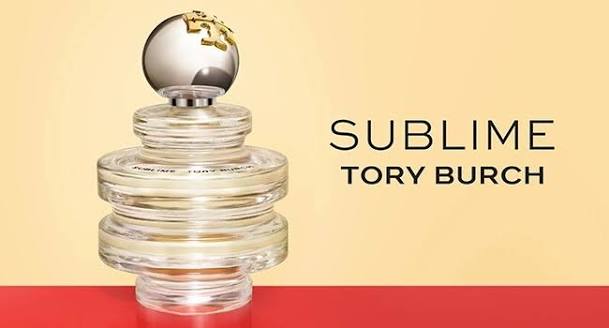
The brand has also used limited-edition collaborations and capsule collections. Such projects can generate novelty and provide editorial content, although each collaboration should be evaluated on its actual distribution, customer response, and commercial results.
Exclusivity can be created through limited availability, distinctive materials, seasonal designs, or products that are offered for a specific period. However, claims that all seasonal collections are limited in quantity should not be made without evidence about production and availability.
Personalisation and monogramming can add an individual element to selected products and may be especially relevant for gifting. Availability varies by product and market, so customers should confirm which items qualify for personalisation through the official store or website.
9. Philanthropy and Social Purpose: The Tory Burch Foundation
The Tory Burch Foundation was established in 2009 to support women entrepreneurs through access to capital, education, and community. Its work is closely connected to the founder’s public commitment to women’s economic empowerment.
The Foundation’s programmes include the Fellows Program and the Capital Program, alongside resources and educational opportunities for entrepreneurs. These initiatives are intended to help women build and grow businesses, develop professional networks, and access resources that can be difficult to secure through traditional channels.
In May 2025, the Foundation announced a commitment to support women entrepreneurs whose combined business revenue or economic impact reaches $1 billion by 2030. At that time, the Foundation reported supporting 387 women entrepreneurs whose businesses had generated a combined $340 million in revenue. These were the figures reported at the time of the announcement, not a complete statement of the Foundation’s latest programme impact.
The Foundation’s 2025 annual report provides newer impact information. It states that entrepreneurs in the Fellows community added $470 million to the economy, while the Foundation continues to work toward its $1 billion goal for 2030. The economic-impact figure should not be directly compared with the earlier $340 million revenue figure because they describe different measures.
By May 2026, reporting on the Foundation’s Capital Program indicated that it had distributed $100 million in loans to 5,600 women entrepreneurs through its partnership with Bank of America. These updated figures supersede the older $57 million and 3,500-entrepreneur figures when describing the programme’s more recent cumulative results.
The Foundation also supports the #EmbraceAmbition initiative, which challenges stereotypes surrounding women’s ambition and leadership. The initiative connects the brand’s public messaging with the Foundation’s wider mission of increasing women’s economic power.
From a marketing perspective, philanthropy can strengthen a brand’s purpose narrative when it is supported by substantive programmes and transparent reporting. The Foundation’s work provides a documented example of how a founder-led brand can connect its public identity with a separate philanthropic organisation.
The Foundation should nevertheless be described as a nonprofit organisation, not as a commercial marketing programme. Its mission and impact are meaningful in their own right, regardless of any reputational benefits to the Tory Burch brand.
Marketing Mix of Tory Burch (4Ps)
The 4Ps framework—Product, Price, Place, and Promotion—helps explain how Tory Burch translates its brand identity into product development, pricing, distribution, and communications.
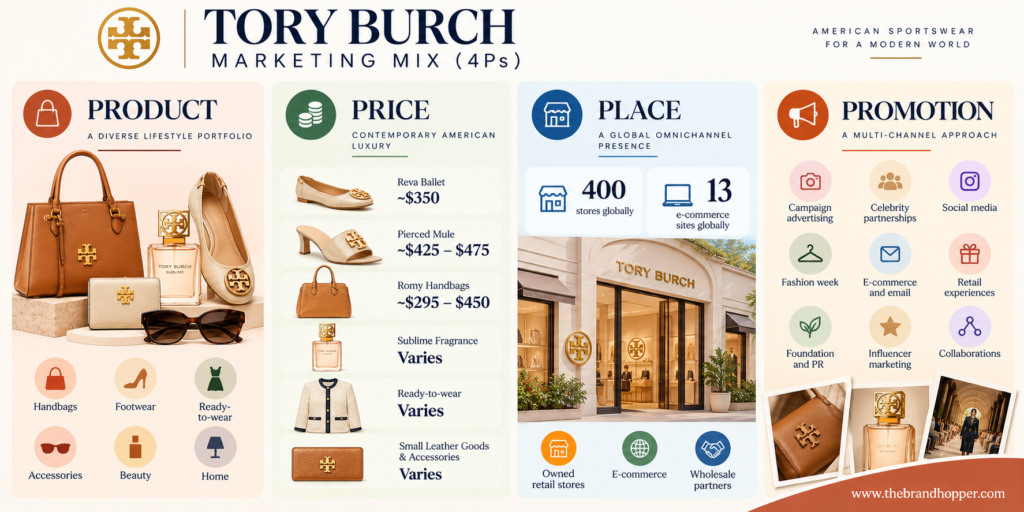
Product
Tory Burch offers a lifestyle portfolio that includes handbags, footwear, ready-to-wear, accessories, beauty products, and home goods. This allows the brand to reach customers through multiple categories and create a consistent design identity across products.
| Category | Key Products | Marketing Role |
|---|---|---|
| Handbags | Romy, Lee Radziwill, and Pierced bags | Major category for brand recognition and design storytelling |
| Footwear | Reva ballet flats, Pierced Mules, Pierced Pumps, sandals, and boots | Combines recognisable icons with seasonal design updates |
| Ready-to-wear | Dresses, blouses, knitwear, trousers, and outerwear | Extends the brand’s aesthetic across a complete wardrobe |
| Accessories | Scarves, belts, hats, sunglasses, and jewellery | Provides additional styling options and gifting opportunities |
| Beauty | Sublime fragrance and other beauty products | Extends the brand into fragrance and personal care |
| Home | Selected home and lifestyle products | Broadens the brand’s lifestyle proposition |
| Seasonal collections | Resort, holiday, runway, and capsule collections | Creates newness and recurring campaign opportunities |
The Reva ballet flat illustrates how a product can become part of a brand’s heritage. The style was reintroduced in updated forms, retaining its connection to the original design while adapting its construction and appearance for contemporary customers.
The Pierced collection illustrates a different product strategy: introducing a distinctive visual detail that can be extended across multiple styles. The design gives the brand a recognisable contemporary product family while maintaining a connection to its broader accessories business.
Product innovation at Tory Burch therefore combines established icons with seasonal experimentation. The commercial value of this strategy depends on product quality, customer demand, availability, and the brand’s ability to sustain interest beyond the initial launch.
Price
Tory Burch operates in the contemporary American luxury and accessible luxury segments. Prices vary considerably by category, material, product size, and collection, so broad ranges should be treated as indicative rather than universal.
The following examples are based on US product listings and are intended to illustrate the brand’s current price positioning. Prices can change and may differ by region or sale status.
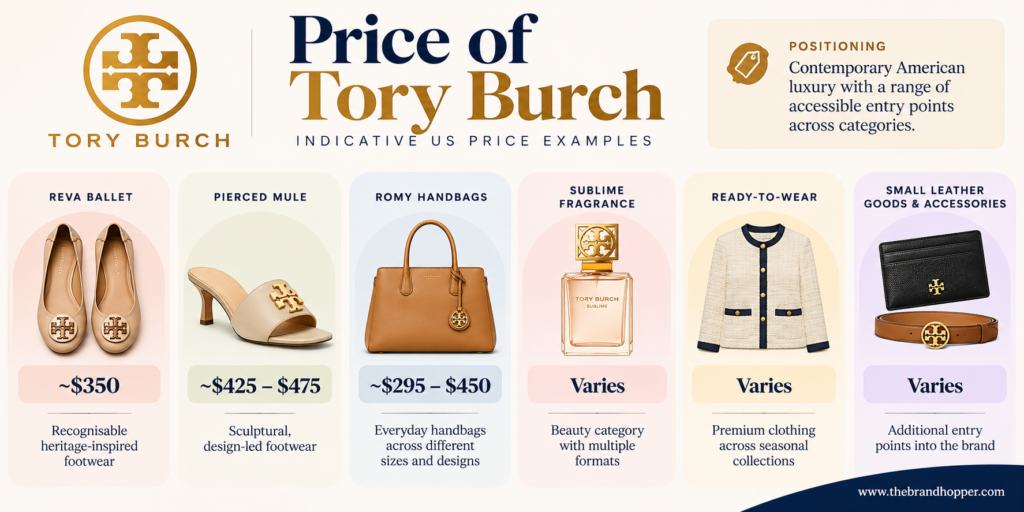
Tory Burch’s pricing reflects its position between mass-market fashion and the highest-priced luxury houses. Its products are not uniformly inexpensive, and certain materials or designs can command substantially higher prices than core styles.
Discounting and outlet availability can affect the final price paid by customers. However, a fixed seasonal discount percentage should not be presented as a permanent brand policy unless supported by current, documented information.
Place
Tory Burch’s distribution strategy combines its own retail stores, e-commerce, and selected wholesale partners. Its official Foundation website reports 400 stores and 13 e-commerce sites globally.
Owned retail allows the company to manage product presentation and customer experience directly. Stores can also support product discovery, collection launches, and brand storytelling in a physical setting.
E-commerce enables customers to browse products and purchase from locations where a nearby boutique may not be available. It also gives the brand a direct channel for communicating new arrivals, seasonal collections, and product information.
Wholesale partners can extend reach among customers who prefer department stores or other multi-brand retail environments. The appropriate retail partners and their product assortments vary by country and market.
International distribution requires local adaptation. Store locations, e-commerce platforms, payment methods, fulfilment, product availability, and marketing channels need to reflect the requirements of each market rather than being assumed to operate identically worldwide.
The central objective is consistency across channels. Customers should be able to recognise the brand and access reliable product information whether they encounter it through a boutique, the official website, or an authorised retail partner.
Promotion
Tory Burch’s promotional mix combines seasonal campaigns, fashion shows, celebrity partnerships, social media, editorial coverage, retail experiences, and Foundation-related communications. These channels support different stages of the customer journey, from brand awareness to product consideration and purchase.
| Promotional Channel | Key Activities | Examples |
|---|---|---|
| Campaign advertising | Seasonal fashion imagery and collection storytelling | Spring/Summer 2025 and Spring/Summer 2026 campaigns |
| Celebrity partnerships | Public figures featured in brand campaigns | Kendall Jenner for Sublime fragrance |
| Influencer marketing | Creator content, styling, and fashion-week visibility | Creator activity associated with seasonal collections |
| Social media | Campaign imagery, product content, and audience engagement | Pierced collection and runway-related content |
| E-commerce and email | Product discovery and direct customer communication | New arrivals, collection launches, and product updates |
| Fashion week | Runway presentations and fashion-media exposure | Seasonal New York Fashion Week collections |
| Foundation and PR | Entrepreneurship programmes and women’s economic empowerment | #EmbraceAmbition and the Foundation’s 2030 goal |
| Collaborations | Partnerships that combine complementary expertise | Sublime fragrance developed with Shiseido |
| Retail experiences | Store environments and product presentation | Owned boutiques and seasonal merchandising |
The Sublime fragrance launch illustrates the combination of celebrity casting, product development, photography, and music. The Pierced collection illustrates how distinctive product design can become a recurring theme in fashion media and social content.
The Foundation provides another communication dimension by connecting the brand’s public identity with support for women entrepreneurs. Its programmes and impact reporting should be discussed accurately, without assuming that philanthropic activity automatically produces a particular sales or loyalty outcome.
A sound promotional strategy is ultimately evaluated against measurable objectives. Brand awareness, qualified traffic, customer acquisition, conversion, repeat purchases, and contribution margin are more useful performance measures than media visibility alone.
Frequently Asked Questions (FAQs)
Q1. What is Tory Burch’s marketing strategy?
A: Tory Burch’s marketing strategy combines accessible luxury positioning, a recognisable visual identity, seasonal fashion campaigns, celebrity and influencer partnerships, omnichannel retail, and philanthropic storytelling through the Tory Burch Foundation.
The strategy also relies on product design to create recognition and consumer interest. The Reva ballet flat and Pierced collection illustrate how distinctive products can support a brand’s identity over multiple seasons.
Q2. What is the “Toryssance”?
A: “Toryssance” is an informal fashion-industry term used to describe Tory Burch’s creative resurgence during the 2020s. It refers to increased attention around the brand’s design direction, runway presentations, and products rather than a formal company initiative.
The Pierced Mule’s inclusion in Lyst’s third-quarter 2023 list of the hottest products is one documented example of the brand’s increased fashion visibility during this period.
Q3. What is the Tory Burch Foundation?
A: The Tory Burch Foundation is a nonprofit organisation established in 2009 to support women entrepreneurs through capital, education, and community.
Its programmes include the Fellows Program and the Capital Program. In May 2025, the Foundation set a goal of supporting women entrepreneurs whose combined revenue or economic impact reaches $1 billion by 2030, and its 2025 annual report subsequently reported that Fellows added $470 million to the economy.
Q4. What was the Sublime fragrance campaign?
A: Sublime is a fragrance launched by Tory Burch in August 2024 in partnership with Shiseido Americas. Its campaign featured Kendall Jenner and original music by Bakar, extending the launch across visual and music-led formats.
The campaign demonstrates how a fashion brand can extend its identity into beauty through specialist product development, celebrity participation, and coordinated creative communication.
Q5. What is Tory Burch’s pricing strategy?
A: Tory Burch uses an accessible luxury and contemporary American luxury positioning, with prices varying by category, material, and design.
Current US examples include selected Reva Ballet styles at around $350, Pierced Mules at approximately $425–$475, and Romy handbags at around $295–$450. These are examples rather than universal price ranges; customers should consult the official website for current prices.
Q6. How does Tory Burch use social media?
A: Tory Burch uses social media to communicate seasonal campaigns, new collections, product styling, runway presentations, and brand stories. Fashion creators and campaign talent can extend the reach of these activities through their own audiences.
The commercial effectiveness of social media depends on more than reach. Engagement quality, qualified website traffic, conversions, customer acquisition, and repeat purchases are relevant measures when evaluating performance.
Q7. Who are Tory Burch’s target customers?
A: Tory Burch appeals to consumers who value designer fashion, distinctive accessories, contemporary American style, and products positioned between mass-market and ultra-luxury offerings.
Its audience can include working professionals, established fashion consumers, and younger shoppers attracted by contemporary products or campaigns. The exact demographic composition should be supported by customer research rather than inferred solely from campaign casting or product prices.
Q8. What makes Tory Burch different from other accessible luxury brands?
A: Tory Burch combines a founder-led identity, recognisable design elements, a broad fashion and lifestyle portfolio, and a philanthropic organisation focused on women entrepreneurs.
Its products and campaigns also demonstrate a balance between heritage-inspired designs and contemporary collections. These characteristics distinguish the brand’s positioning, although claims of superiority over competitors require comparative evidence.
Q9. How many stores does Tory Burch have?
A: The Tory Burch Foundation’s official website reports 400 stores and 13 e-commerce sites globally.
Q10. What sustainability initiatives does Tory Burch report?
A: Tory Burch states that more than 95% of its leather comes from Leather Working Group-certified tanneries with silver or gold ratings. The company also reports that more than 70% of the content in its new brand boxes, bags, and dustbags is certified and recycled.
These are specific sourcing and packaging disclosures. They should not be interpreted as proof that every product is sustainable or that the company has eliminated its environmental impact.
Conclusion
Tory Burch’s marketing strategy demonstrates how a fashion brand can build recognition through a consistent design identity while evolving its products and creative communication. Since its founding in 2004, the company has expanded from a New York boutique and e-commerce operation into a global fashion and lifestyle business.
The Reva ballet flat illustrates the value of a recognisable product, while the Pierced collection shows how contemporary design can attract attention from fashion audiences. The Sublime fragrance launch demonstrates how a brand can extend its identity into another category through specialist partnerships, celebrity casting, and coordinated creative work.
The company’s retail network and e-commerce operations provide multiple points of access, while its seasonal campaigns help communicate the mood and design ideas behind each collection. These activities support the brand’s positioning, but their commercial impact should be measured through appropriate performance data rather than assumed from visibility alone.
The Tory Burch Foundation adds a distinct philanthropic dimension to the founder’s public identity. Its programmes provide capital, education, and community for women entrepreneurs, while its $1 billion economic-impact goal for 2030 creates a measurable long-term ambition.
For other fashion brands, the central lesson is the importance of aligning product design, pricing, distribution, and promotion around a coherent brand identity. A recognisable product, effective storytelling, strong retail execution, and credible purpose initiatives can reinforce one another—but sustainable brand growth still depends on customer demand, product quality, operational execution, and financial performance.
Also Read: Coach New York Marketing Strategy: The $5.6B Playbook
To read more content like this, subscribe to our newsletter