Last Updated on September 23, 2026 by Team TBH
Few brands in fashion have executed a more remarkable comeback than Coach. A decade ago, many analysts were writing Coach off — dismissed as an outlet-store staple that had over-discounted its way into irrelevance. Today, Coach is generating $5.6 billion in annual revenue, growing at double-digit rates, attracting 930,000 new North American customers in a single fiscal year (60% of them Gen Z and Millennials), and sitting firmly back in the top 20 fashion brands in the United States.
The turnaround didn’t happen by accident. It was the result of a deliberate, sustained, and strategically sophisticated marketing and brand strategy executed over nearly a decade — one that touched every element of the brand: its identity, its product, its price architecture, its channel mix, its ambassador constellation, its digital footprint, and its relationship with a new generation of consumers.
A Brief History of Coach: From Workshop to World Stage
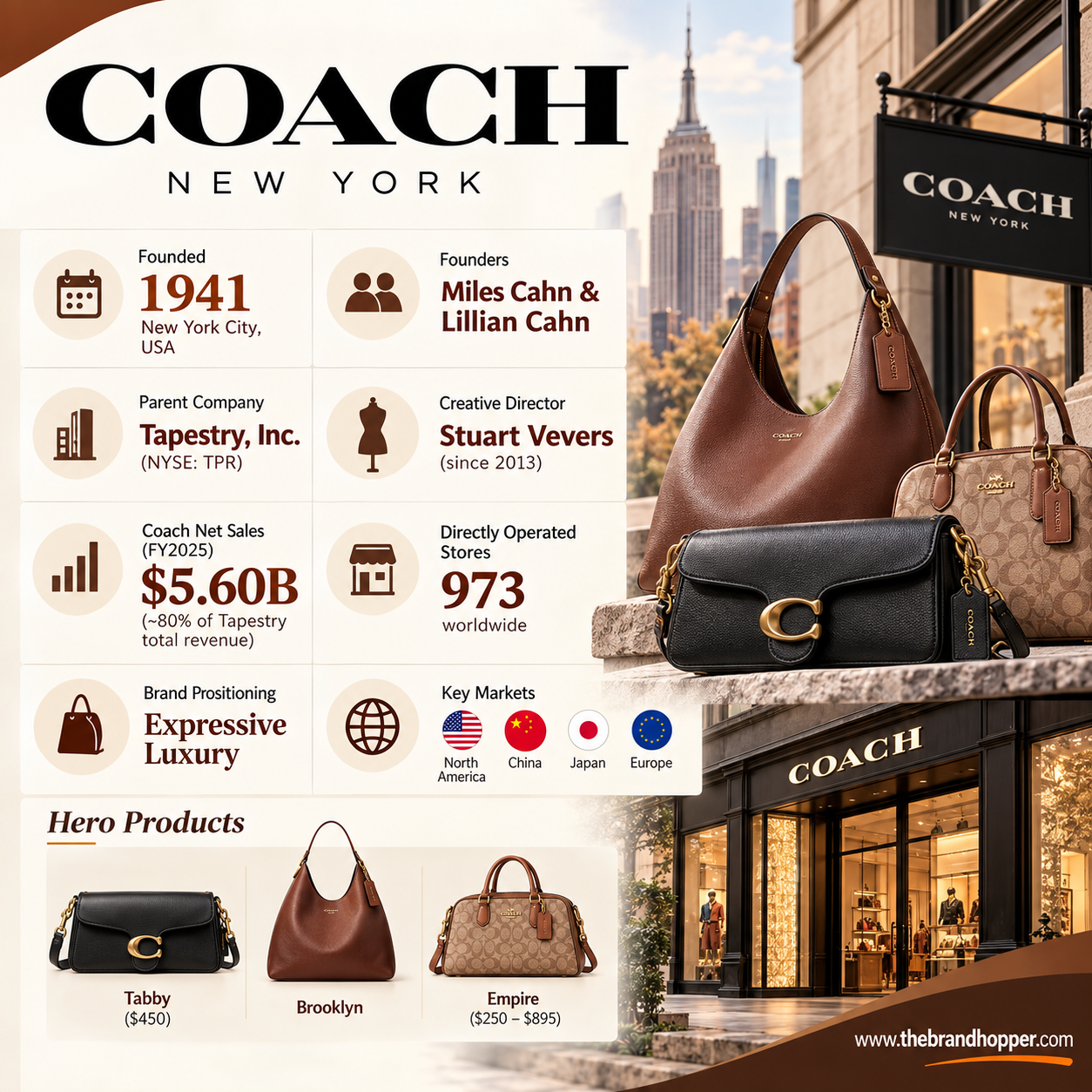
Coach was born in 1941 in a Manhattan loft workshop, founded by Miles and Lillian Cahn. The company’s original products were small leather goods — wallets, coin pouches, and billfolds — crafted from full-grain leather in the American tradition of sturdy durability. The handbag came later, inspired by the texture and suppleness of a well-worn baseball glove.
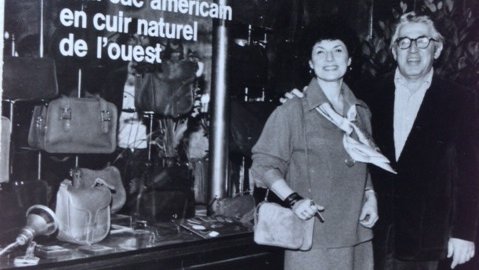
In the 1970s and 1980s, Coach grew steadily as an American leather goods brand known for functional, durable products with a clean aesthetic. The 1980s shift toward lifestyle branding — and the appointment of Lew Frankfort as CEO — set the stage for Coach’s emergence as an aspirational mass-luxury brand in the 1990s and early 2000s. Sales soared as Coach positioned itself between European luxury (Gucci, Louis Vuitton) and the mass market (Nine West, Guess) — a space it called “accessible luxury.”
By the early 2010s, the accessible luxury positioning had backfired. Coach had opened too many outlet stores and offered too many promotions, training consumers to wait for discounts rather than paying full price. Revenue peaked and then declined. The brand’s status equity — the perception premium that makes a luxury good worth more than its functional value — had eroded.
The turnaround began in 2013 with the hire of Stuart Vevers as Executive Creative Director, the closure of hundreds of underperforming stores, and a radical reduction in promotions and outlet-channel discounting. Tapestry, Inc. (formerly Coach, Inc.) acquired Kate Spade in 2017 and Stuart Weitzman in 2015, creating a multi-brand luxury portfolio. Today, under CEO Joanne Crevoiserat and Creative Director Stuart Vevers, Coach has completed its transformation from accessible luxury to what it now calls “expressive luxury” — and the numbers back it up.
Marketing Strategies of Coach
Coach’s marketing strategy is not a single campaign or a seasonal effort — it is a deeply integrated, multi-year brand-building system that operates across product design, channel management, ambassador marketing, digital engagement, cultural collaboration, and customer loyalty. Below is a comprehensive analysis of each strategic pillar.
1. The “Expressive Luxury” Repositioning
The most foundational element of Coach’s current marketing strategy is a deliberate repositioning from “accessible luxury” to “expressive luxury.” This is not merely a slogan change — it represents a complete reconfiguration of what Coach stands for, who it speaks to, and how it justifies its price architecture.
“Expressive luxury,” as defined by Stuart Vevers and the Coach brand team, centres on individuality, self-expression, and the idea that fashion is a means of exploring who you are — not a status signal based on which logo you wear. This positioning speaks directly to the values of Gen Z and younger Millennials, who research consistently shows are sceptical of traditional status-based luxury (European heritage houses, conspicuous logos) but responsive to brands that feel authentic, creative, and values-aligned.


The strategic genius of this repositioning is that it allows Coach to raise prices and reduce promotions (which rebuilds margin and brand equity) while simultaneously attracting younger consumers who would have found the old “accessible luxury” positioning either aspirationally empty or simply boring. Coach’s AUR — average unit retail, the average price a customer pays — grew at a low-double-digit rate across FY2025 and a mid-teens rate in Q4, meaning customers are paying significantly more per purchase than they did five years ago. That is the proof point that the repositioning is working.
2. The Celebrity Ambassador Constellation Strategy
Coach has reinvented the traditional celebrity endorsement model by building what it describes as a “constellation” of over 40 brand ambassadors — a deliberately diverse, cross-cultural, cross-generational cast of faces whose collective reach covers Coach’s entire global target audience simultaneously.
Rather than relying on a single superstar face (as many heritage luxury brands do), the constellation model gives Coach flexibility and redundancy: if one ambassador becomes controversial, the brand can simply feature others. More importantly, it reflects the fragmented nature of modern attention — there is no single cultural figure who speaks to all of Coach’s target markets simultaneously. Coach’s constellation is designed to ensure that wherever a target consumer looks — whether they follow K-pop, hip-hop, indie film, football, or high fashion — they see someone they admire wearing Coach.
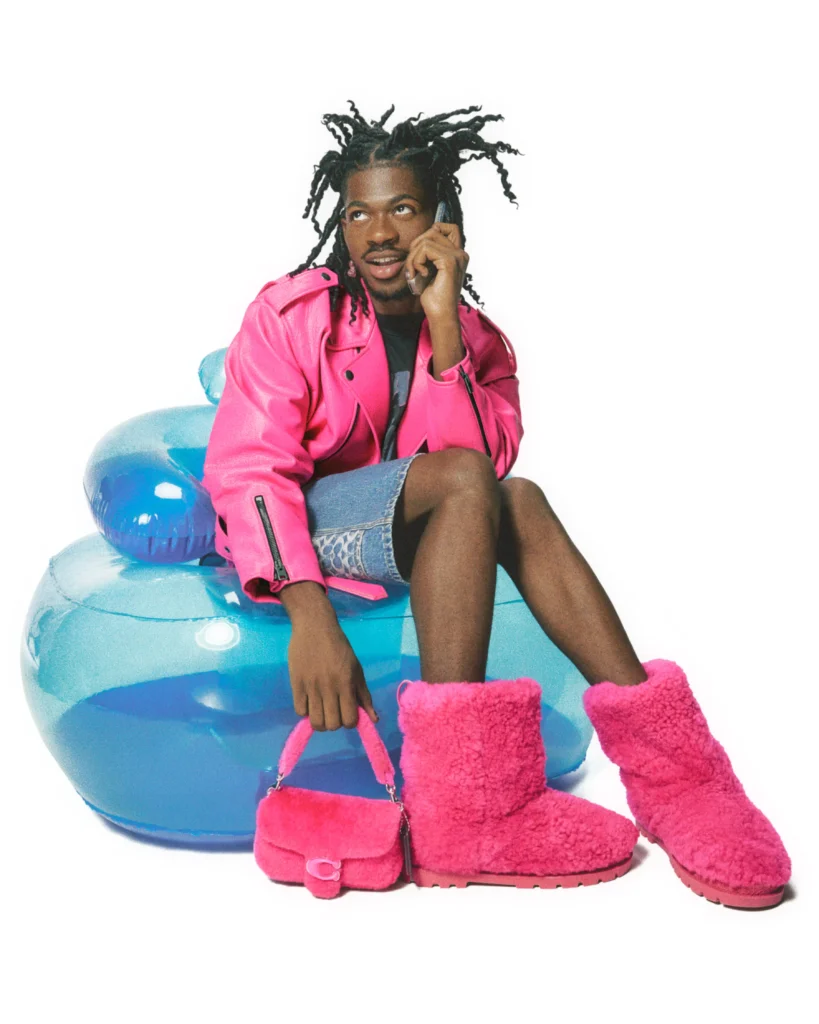
Recent ambassadors include Lil Nas X (global ambassador since early 2023, starring in the flagship “Find Your Courage” campaign), Camila Mendes (actress and lead face of multiple handbag campaigns), Michael B. Jordan (Jordan North America ambassador), Jennifer Lopez, Megan Thee Stallion, Noah Beck, Wisdom Kaye, K-pop star Youngji Lee, Japanese model Kouki, and Chinese actress Wu Jinyan. The constellation also incorporates virtual influencer “imma” — a CGI character with millions of Instagram followers — signalling Coach’s willingness to engage with digital-native culture on its own terms.

3. Data-Driven Product Innovation: The Tabby Bag Story
One of the most instructive examples of Coach’s modern marketing approach is the story of the Tabby bag. The Tabby was originally a vintage Coach style from the 1970s — recognisable by its distinctive half-moon flap and the C-clasp hardware. When Coach’s data team identified the Tabby’s retro aesthetic as aligning closely with the vintage-revival aesthetic trending among young consumers on social media, the brand reintroduced it as a hero product in a refreshed form.
The Tabby’s success was not accidental. Coach’s data infrastructure — built around customer transaction data, social listening, search trend analysis, and omnichannel purchase behaviour — identified the Tabby as a product with high organic social media velocity and high conversion potential among the under-35 audience. Rather than simply launching it and hoping, Coach built an integrated marketing plan that paired TikTok creator content with ambassador campaigns, placed the Tabby in hands of cultural figures who felt genuine rather than paid, and used its “In My Tabby Era” social media moment to generate earned media that amplified the paid spend.

Today the Tabby is Coach’s best-known and best-selling individual product, with the standard shoulder bag priced at $450. The Brooklyn and Empire bags have followed a similar data-informed launch model. The lesson is that Coach’s product marketing is no longer driven purely by the creative director’s intuition — it is a systematic collaboration between creative vision and consumer data analytics, led by CEO Joanne Crevoiserat who has described this approach as central to the company’s strategy.
4. Digital-First Marketing and Social Media Strategy
Coach’s digital marketing operation has been fundamentally rebuilt to lead with social media rather than treat it as an afterthought to traditional advertising. The brand operates active presences across Instagram, TikTok, Pinterest, YouTube, Twitter/X, and WeChat (for China), with a deliberate content strategy tailored to the norms and algorithms of each platform.
TikTok has become particularly important. Coach’s TikTok content strategy blends organic creator partnerships, hashtag challenges, and campaign content that feels native to the platform rather than exported from a television commercial shoot. The “In My Tabby Era” moment — a TikTok-native phrase that users adopted organically to describe the feeling of owning their first Tabby bag — generated millions of views and created the kind of consumer-voice endorsement that money cannot buy. Coach was smart enough not to overcommercialise it: they let the trend breathe rather than immediately slapping a branded hashtag on it.
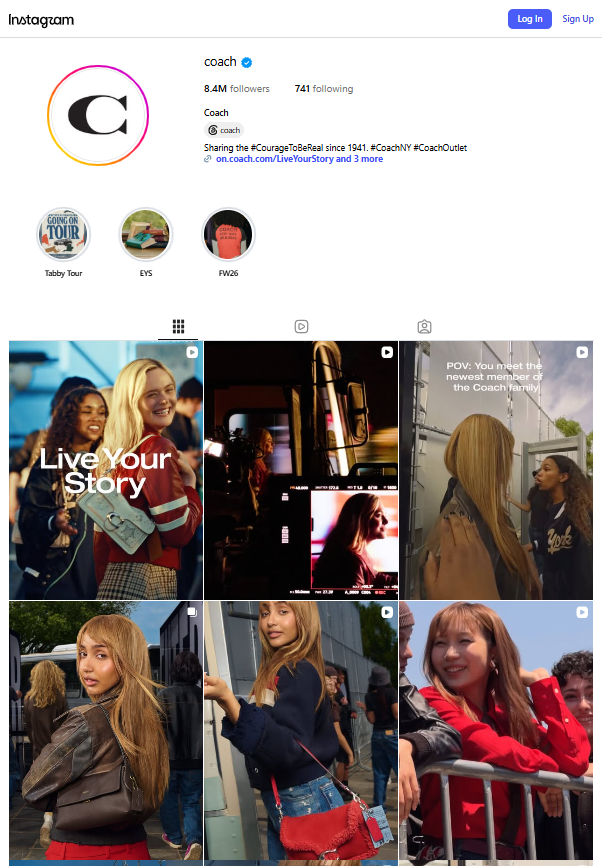
On Instagram, Coach focuses on aesthetic storytelling — mixing campaign imagery, behind-the-scenes content from runway shows and studio sessions, user-generated content (UGC) from customers and influencers, and ambassador content that feels personal rather than scripted. The brand has cultivated a visual identity on Instagram that is immediately recognisable: warm leather tones, New York City backdrops, diverse casting, and a sense of effortless American cool. Coach maintains over 8 million Instagram followers and engages them with both aspirational content and community-building interaction.
In China — one of Coach’s most important international markets — the digital strategy centres on WeChat, Weibo, Xiaohongshu (Red), and Douyin (the Chinese TikTok), with localised content featuring Chinese ambassadors like Wu Jinyan and influencer partnerships calibrated to Chinese platform cultures. Coach’s revenue growth in Greater China has been a significant driver of Tapestry’s overall FY2025 performance.
5. Experiential Marketing: Runway Shows, Pop-Ups and In-Store Events
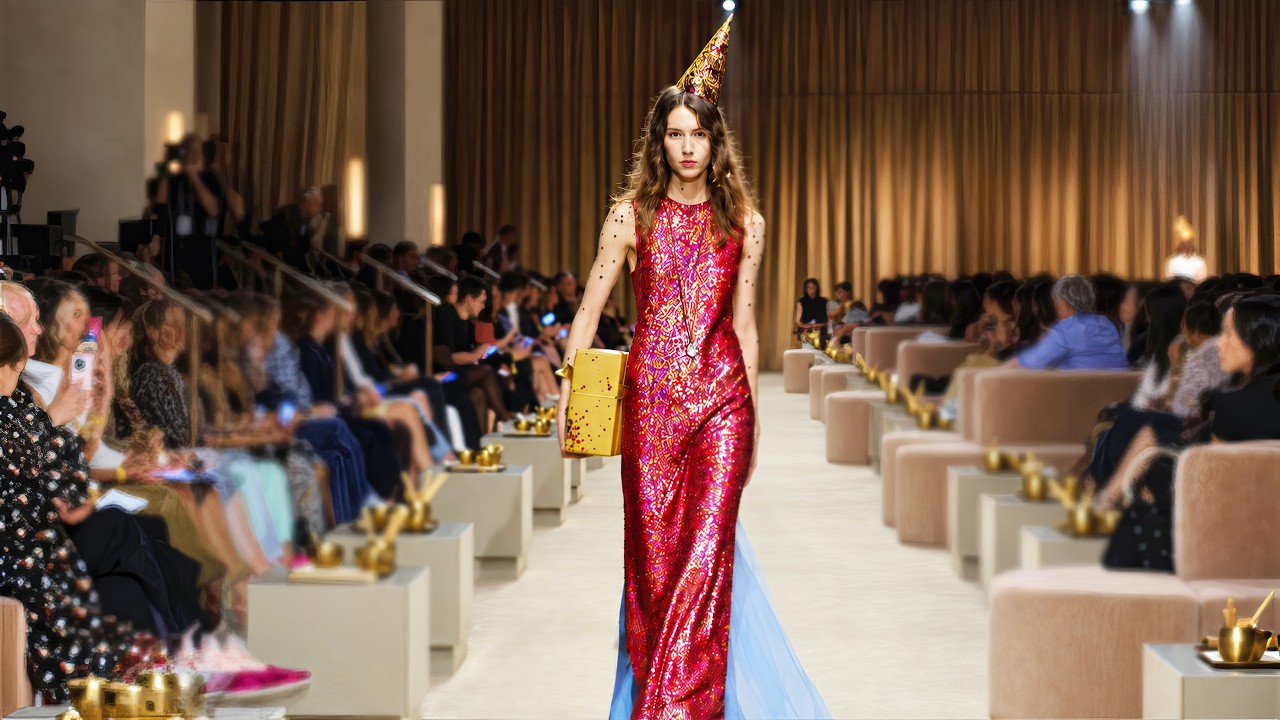
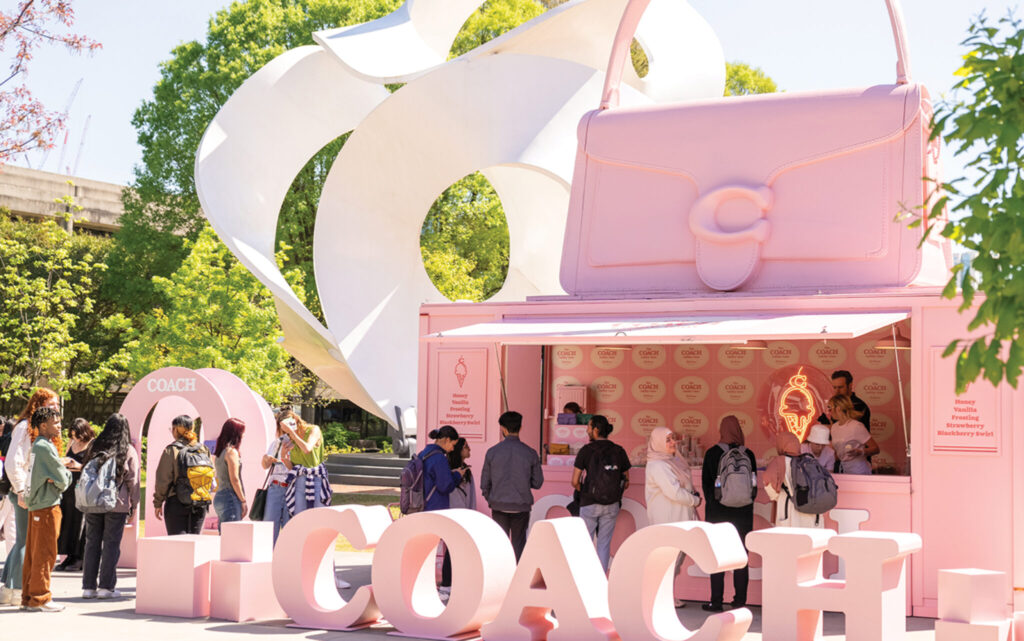
Coach uses live and immersive experiences as a core component of its brand-building strategy, understanding that in the age of social media, a well-executed experiential moment generates organic coverage that no advertising spend can replicate. The New York Fashion Week (NYFW) runway show is Coach’s most important annual experiential moment: it sets the creative agenda for the season, generates international press coverage, creates content for digital and social channels, and delivers the kind of cultural credibility that a luxury brand needs to command premium prices.
Coach’s NYFW shows under Stuart Vevers have been held at increasingly memorable locations and with increasingly elaborate creative concepts: shows at the Hudson River esplanade, performances incorporating live music, runway sets that blur the line between fashion and theatre. The brand intentionally invites its full ambassador constellation to its shows, maximising social media coverage as each ambassador’s following documents their front-row presence.
Pop-up stores and experiential activations extend Coach’s experiential marketing beyond New York. The Coach Tokyo pop-up — a recurring format in the brand’s most important Asian market — combines product retail with immersive brand storytelling, leather goods personalisation services (monogramming, painting, patching), and collaborations with local artists. These events serve a dual purpose: they drive immediate sales and they generate high-quality organic content that lives on social media for months after the event closes.
6. Cultural Collaborations: Art, Music and Heritage
Coach has built a rich tradition of collaborations with artists, musicians, and cultural icons that extends the brand beyond transactional fashion retail into genuine cultural participation. These collaborations do two things simultaneously: they create limited-edition products that drive purchase urgency and press coverage, and they communicate the brand’s cultural values and aesthetic sensibilities to consumers who might not otherwise engage with a leather goods campaign.
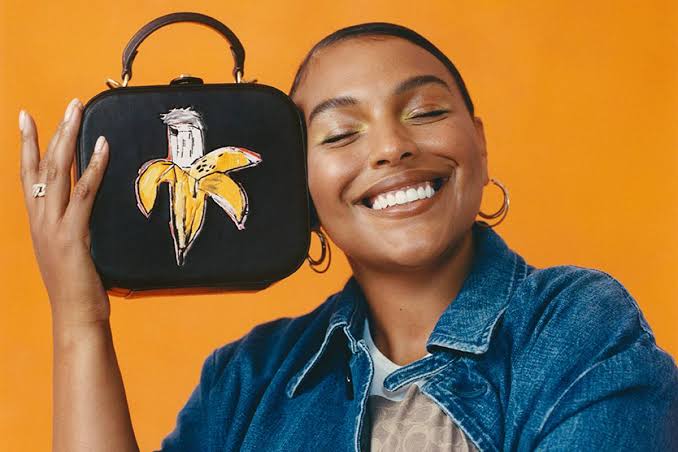
The collaboration with the estate of artist Jean-Michel Basquiat — whose raw, expressive New York street-art aesthetic translates powerfully onto leather goods — has been one of Coach’s most celebrated and commercially successful creative partnerships. The Basquiat collection brought an authentically New York, counter-cultural creative voice into Coach’s product line that felt true to both the artist’s legacy and Coach’s New York heritage.
Beyond product collaborations, Coach has partnered with cultural institutions, music festivals, and entertainment productions to ensure the brand appears in cultural contexts that its target audience cares about. The brand has also embraced co-design: ambassador Selena Gomez co-designed a bag with Stuart Vevers during her time as a Coach ambassador, creating a product that felt personal and story-rich rather than simply badge-engineered.
Coach’s collaboration strategy is disciplined: partners are chosen for authentic cultural resonance rather than simply fame. Each collaboration is evaluated against the question of whether it will feel coherent with Coach’s “expressive luxury” positioning and attract consumers who genuinely identify with that positioning.
7. Aspirational and Inclusive Advertising
Coach’s advertising philosophy has evolved significantly from the airbrushed, aspirational campaigns of the early 2000s. Today, Coach advertising is built around a principle of authentic self-expression: campaigns feature a diverse cast of real people and genuine cultural figures of varied backgrounds, ages, body types, and identities, all unified by the common thread of wearing Coach as an expression of who they are rather than who they are trying to be.
Campaign messaging centres on themes like courage, self-discovery, authenticity, and the idea that expressive luxury is about feeling good in what you wear rather than impressing anyone else. Phrases like “Find Your Courage,” “Be Your Own Story,” and imagery that pairs Coach products with the real interests and personalities of the people wearing them — rather than idealised fantasy scenarios — create emotional resonance that traditional luxury advertising rarely achieves with younger consumers.
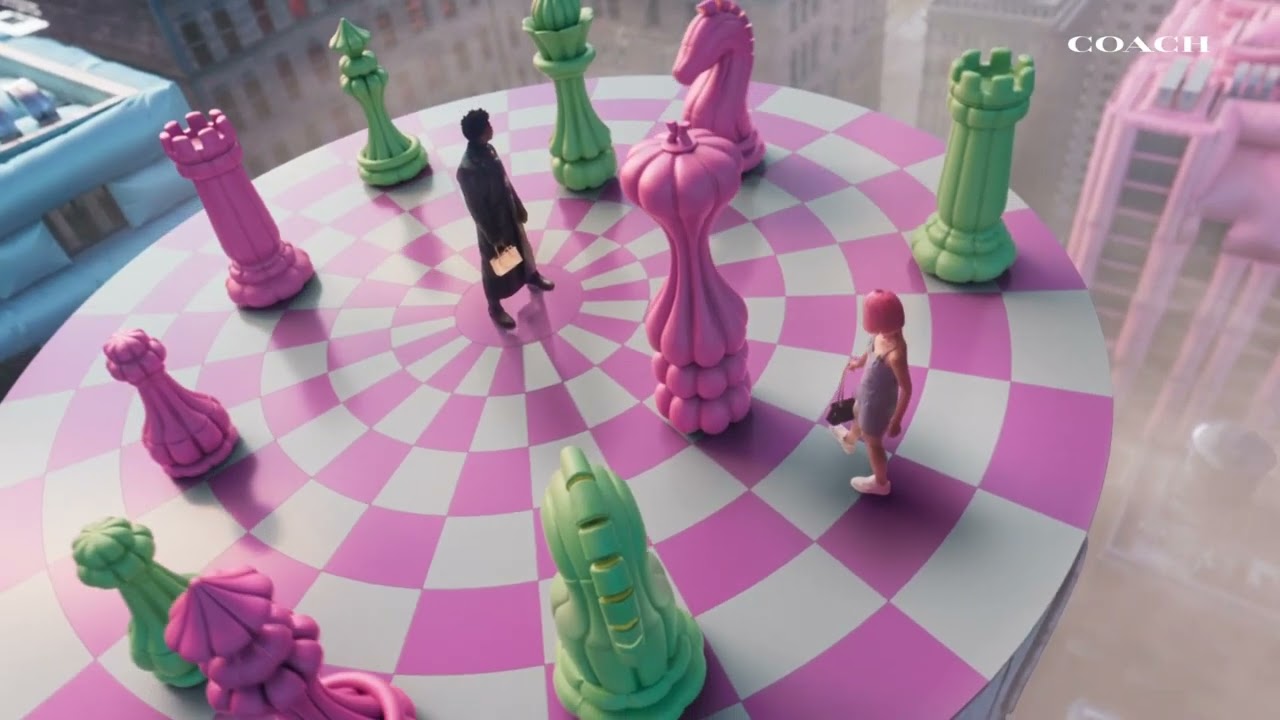
The media mix for advertising has also shifted dramatically. While Coach still places in premium fashion publications (Vogue, Harper’s Bazaar, Elle, InStyle) for brand credibility, the majority of its advertising investment now flows through digital channels — social media, streaming platforms, digital editorial — where engagement can be measured, optimised, and attributed to customer behaviour. Traditional outdoor advertising (billboards, transit) remains important in key urban markets (New York, London, Tokyo, Shanghai) for brand visibility, but it is increasingly supplemented with digital OOH formats that can be updated in real time.
8. Classic American Appeal: The New York Heritage
Coach has never lost sight of its most distinctive asset: its New York heritage. In a global luxury landscape dominated by European heritage houses (Gucci in Florence, Louis Vuitton in Paris, Burberry in London), Coach’s unapologetically American identity is a genuine differentiator. The brand leans into this heritage strategically, incorporating New York City iconography, American optimism, and a distinctly casual-but-elevated aesthetic that no European house can authentically replicate.
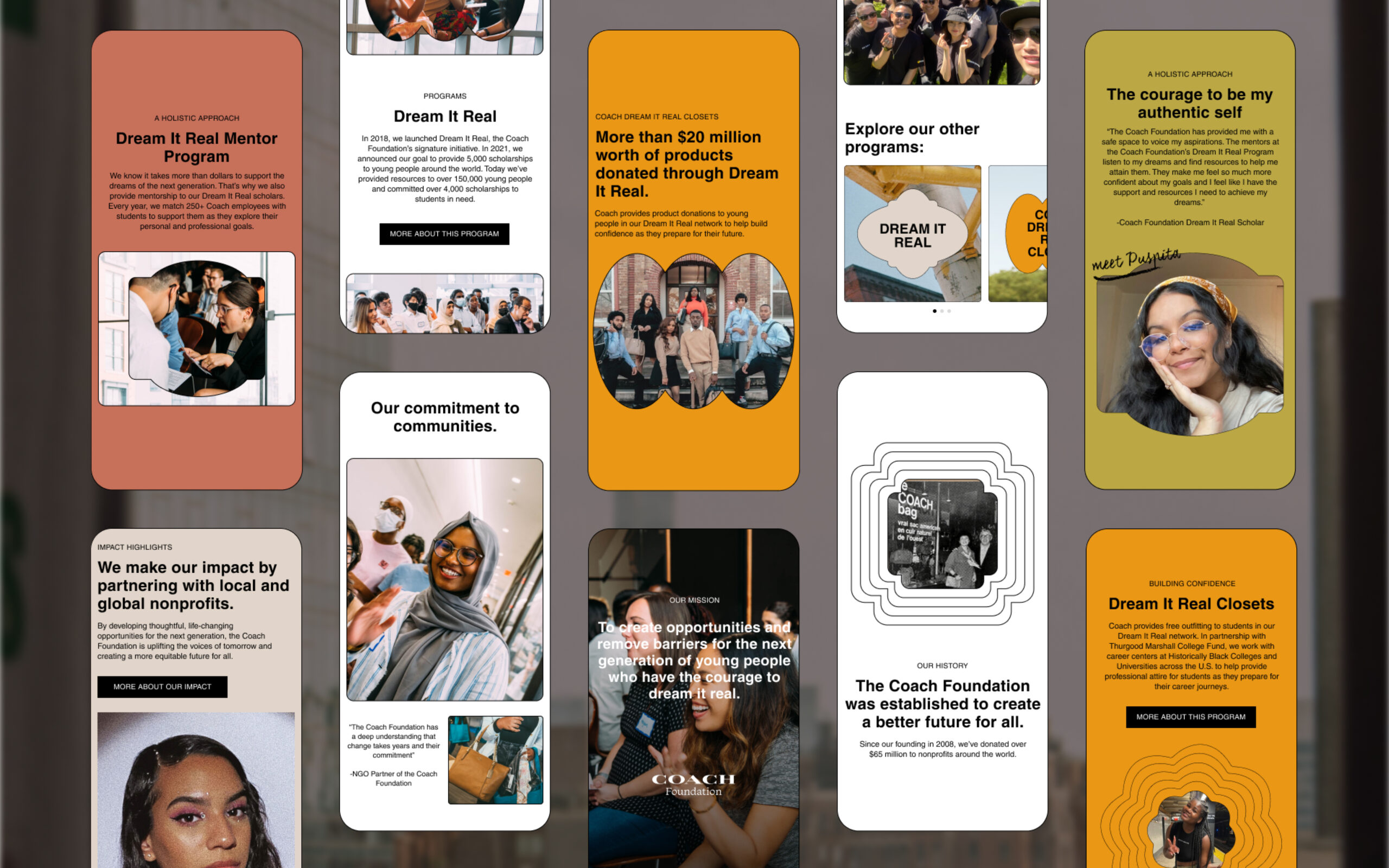
This “Americana” positioning is expressed through product design (touches of red, white, and blue; heritage hardware; New York City-inspired motifs), through campaign settings (the streets, parks, and subways of New York City), and through the brand’s cultural associations (New York music, New York art, New York fashion). The Coach Foundation, the brand’s charitable arm, focuses on youth programmes and creative education in New York City communities — reinforcing the local connection in a way that feels genuine rather than commercially calculated.
As luxury consumption globalises and younger consumers in China, India, Japan, and Southeast Asia seek brands that feel authentically American — as distinct from authentically European — Coach’s heritage becomes more valuable, not less. The brand’s ability to command a premium in international markets specifically because of its New York identity is a strategic asset that is difficult to compete with.
9. Sustainability and Responsible Sourcing
Coach has integrated sustainability into its marketing and brand strategy in response to both consumer demand and its parent company Tapestry’s commitment to responsible business practices. Tapestry has published its Global Impact Report outlining its environmental and social commitments, and Coach as the group’s flagship brand carries significant responsibility in delivering on these commitments.
The Coach (Re)Loved programme invites customers to bring in pre-loved Coach handbags — regardless of condition — for repair, transformation, or resale through Coach’s own resale platform. This circular fashion initiative resonates strongly with Gen Z consumers who are more likely than any previous generation to consider a brand’s environmental footprint as part of their purchase decision. It also serves a commercial purpose: by bringing customers into stores with pre-loved bags, Coach creates conversion opportunities for new purchases and reinforces the durability and longevity narrative that differentiates leather goods from fast fashion.
Coach has committed to using more sustainable leather alternatives and has increased its use of recycled materials in packaging and accessories. The brand’s communication of these commitments — through its website, social media, and in-store materials — is deliberately understated rather than greenwashed: Coach tends to let the programme mechanics speak for themselves rather than making sweeping environmental claims that could attract scrutiny.
10. Philanthropic Responsibility: The Coach Foundation
As a socially responsible company, Coach supports a range of nonprofit organisations and causes through the Coach Foundation, with a particular focus on education, youth empowerment, the arts, and social justice. The Coach Foundation has contributed millions of dollars to programmes supporting underserved communities, with a geographic emphasis on New York City — the brand’s spiritual home.
The brand has been an active supporter of LGBTQ+ rights, participating in Pride campaigns and donating proceeds from limited-edition Pride collections to LGBTQ+ advocacy organisations. Coach’s support for International Women’s Day, its alignment with United Nations Sustainable Development Goals, and its disaster relief donations following natural catastrophes all form part of a corporate values narrative that demonstrates to consumers — particularly younger ones — that Coach takes its responsibilities beyond commerce seriously.
These philanthropic commitments are communicated authentically rather than prominently: Coach tends not to lead its advertising with its charitable work, but makes it consistently visible for consumers who seek out this information. This approach avoids the cynicism that can attach to brands that appear to use charity as a marketing device, while still ensuring that purpose-driven consumers are aware of Coach’s commitments.
11. Premium Quality and Craftsmanship Narrative
Quality has always been the foundation of Coach’s competitive positioning, and the brand’s marketing consistently reinforces this through product storytelling, materials communication, and the visibility of its craftsmanship process. Coach uses only carefully sourced leathers — including full-grain cowhide, pebble grain, glovetanned leather (used in its original 1970s styles), metallic leathers, and technical fabrics — and the tactile quality of its materials is a central feature of the in-store retail experience.
The brand communicates craftsmanship through its “Stories of Craft” content series, which takes consumers behind the scenes into Coach’s leather ateliers and shows the precision skills involved in cutting, stitching, and finishing a Coach product. This type of process storytelling builds the same kind of heritage and craft credibility that European luxury houses use to justify their premium prices, and it is increasingly important as Coach raises its AUR and competes more directly with higher-priced European competitors.
The durability narrative is also central: Coach products are designed and positioned to last for years, developing a patina that makes them more beautiful over time. This longevity argument resonates both with luxury consumers who want investment pieces and with sustainability-minded consumers who see long-lasting goods as more environmentally responsible than fast fashion.
12. Loyalty Programme and Exclusive Access
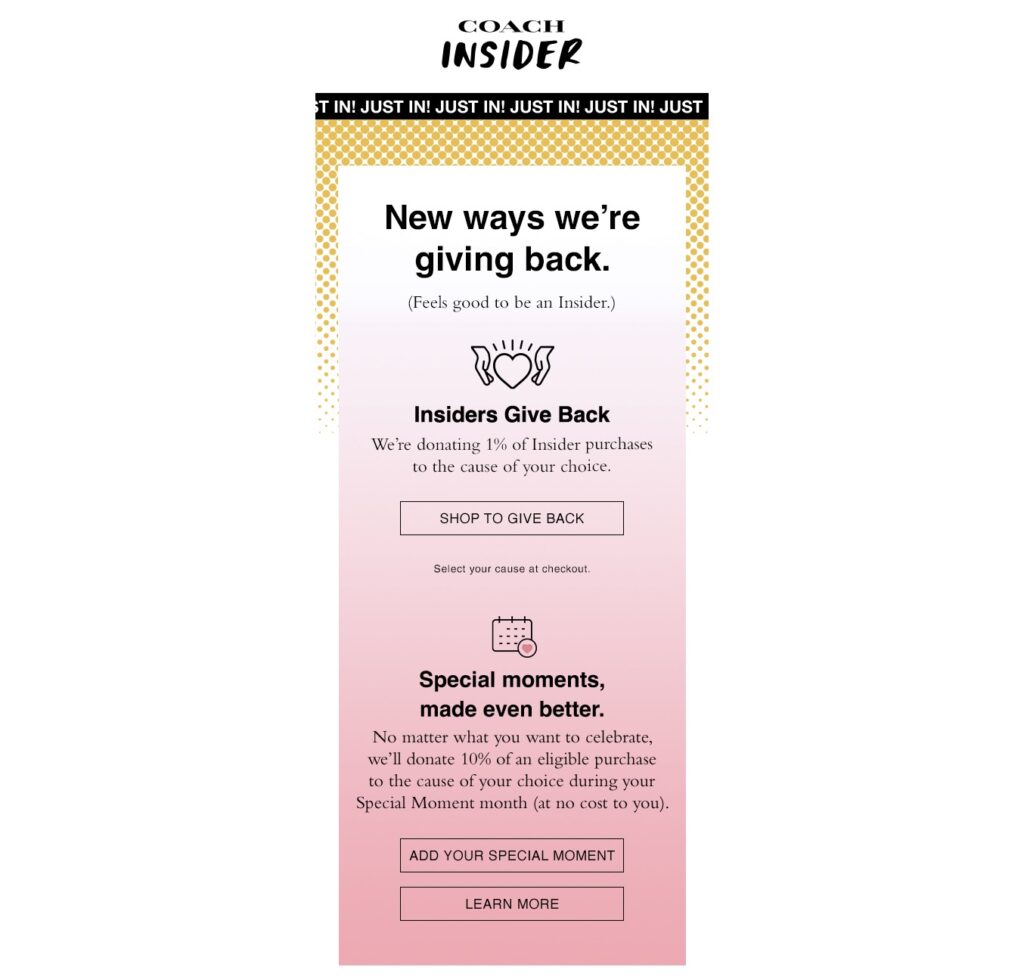
Coach’s customer loyalty programme — Coach Insider — provides members with early access to new arrivals, exclusive product drops and limited editions, personalised birthday offers, priority access to experiential events, and customisation services. The programme is designed to make loyal customers feel genuinely valued as insiders to the brand, rather than simply as transaction numbers receiving discount coupons.
The personalisation service — where customers can have their Coach bags monogrammed, custom-painted, or embellished with patches, pins, and charms at in-store customisation bars — is a particularly effective loyalty and engagement tool. It creates a product that is genuinely unique to each customer, deepens their emotional attachment to the Coach brand, and generates organic social media sharing as customers show off their customised pieces. The customisation service has been a standout success at Coach’s flagship stores and is increasingly available at mall locations and pop-up events.
Marketing Mix of Coach: The 4Ps
1. Product Strategy
Coach’s product strategy is anchored by three hero handbag lines that have been its commercial backbone in recent years: the Tabby (priced from $450), the Brooklyn, and the Empire (ranging from $250 to $895). These bags are designed to be recognisably Coach — featuring the brand’s signature C hardware, quality leather construction, and distinctively American aesthetic — while feeling contemporary enough to attract younger buyers and distinctive enough to justify their price premiums.
Beyond its handbag core, Coach’s product portfolio spans small leather goods (wallets, wristlets, card cases, key rings), tech accessories (phone covers, AirPod cases), footwear (trainers, boots, sandals), ready-to-wear clothing, outerwear, scarves, jewellery, eyewear, fragrance, and luggage. This breadth serves two strategic purposes: it provides lower-entry price points (a Coach card case at $100 can introduce a consumer to the brand who cannot yet afford a $450 bag) and it maximises the basket size of existing customers who are already emotionally committed to the brand.
Product innovation is guided by three principles established by Stuart Vevers: innovative functionality (products designed for how people actually use them), expressive beauty (design that has a point of view and invites self-expression), and enduring quality (construction that ages gracefully and lasts for years). Limited edition collaborations (with artists, musicians, and cultural estates like the Jean-Michel Basquiat partnership) create urgency, drive press coverage, and attract customers who might not otherwise consider Coach — functioning as a customer acquisition mechanism as much as a product line.
2. Price Strategy
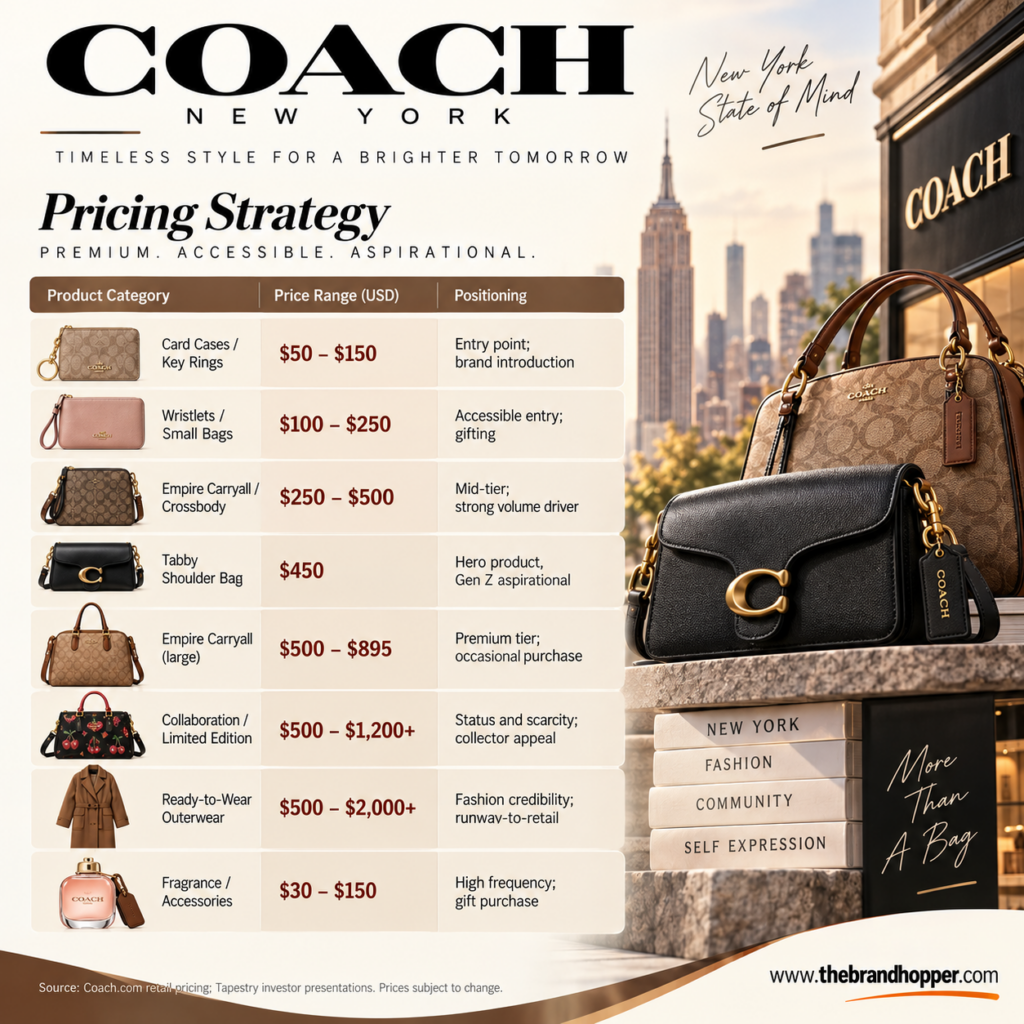
Coach’s pricing philosophy has shifted meaningfully in recent years. The brand has deliberately moved away from the heavy promotional cadence (friends & family sales, outlet discounting, markdown events) that eroded its price integrity in the 2010s. Instead, it has pursued a strategy of raising AUR through innovation and reduced promotional activity, accepting that it may sell slightly fewer units while generating significantly more revenue per unit.
This pricing discipline has been central to the brand’s margin improvement and its repositioning. When a brand discounts heavily, consumers learn to wait for the sale — undermining full-price revenue and signalling desperation rather than desirability. By reducing promotions, Coach has trained its customers to buy at full price when a product resonates, which is a more sustainable commercial model and a more aspirational brand signal.
Coach still operates Factory stores (outlet locations) that serve a value-oriented customer segment and help clear excess inventory, but the balance between full-price and outlet has shifted significantly toward full-price, and Factory stores are now managed more carefully to ensure they do not cannibalise the full-price perception of the brand.
3. Promotion Strategy
Coach’s promotional mix is deliberately multi-channel, with a growing emphasis on digital and social media relative to traditional advertising. The key promotional channels and approaches include:
Fashion Media and Editorial: Coach maintains a presence in the world’s leading fashion publications — Vogue, Harper’s Bazaar, Elle, InStyle, GQ, CR Fashion Book — through full-page editorial advertising, advertorials, and sponsored content. These placements serve a brand legitimacy function: being seen in the pages of Vogue signals that Coach belongs in the same cultural conversation as Gucci, Prada, and Tory Burch. They are less important for direct consumer response (clicks, conversions) and more important for shaping the perceptions of the fashion press, stylists, and editors who in turn influence how consumers perceive the brand.
Digital and Social Advertising: The majority of Coach’s advertising budget now flows through Meta (Instagram, Facebook), TikTok, Pinterest, YouTube, and programmatic digital channels. These platforms allow Coach to target specific audience segments (by age, interest, location, purchase history, and lookalike profiles) with tailored creative and to measure performance with a precision that traditional media cannot match. Digital advertising is also more agile: Coach can test multiple creative executions simultaneously, read performance data in real time, and reallocate budget toward what works within hours.
Ambassador and Influencer Marketing: The 40+ ambassador constellation (described above) generates a consistent stream of paid and earned media across social platforms. In addition to its macro ambassadors (celebrities with millions of followers), Coach works with a broad network of micro and mid-tier influencers whose smaller but more engaged followings generate authentic recommendations that convert at higher rates than mass media advertising.
Events and Experiential: New York Fashion Week, global pop-up activations, in-store customisation events, and brand partnership experiences (from music festivals to cultural venues) create content, generate earned media coverage, and build the experiential brand equity that product advertising alone cannot deliver.
PR and Earned Media: Coach’s PR team works to secure organic editorial coverage in fashion and lifestyle media by providing exclusive access to collection previews, backstage content, designer interviews, and ambassador stories. Earned media — coverage that the brand does not pay for directly — carries significantly more credibility with consumers than paid advertising, and Coach’s investment in storytelling generates a consistent flow of editorial coverage that amplifies its paid spend.
4. Placement Strategy
Coach’s distribution strategy is built on a direct-to-consumer (DTC) foundation, with wholesale and travel retail as important secondary channels. DTC — which includes Coach’s own retail stores, factory stores, and e-commerce platform — accounts for 86% of Tapestry’s total revenue, reflecting the group’s deliberate strategy of controlling its own brand experience rather than distributing through intermediaries who dilute brand perception.
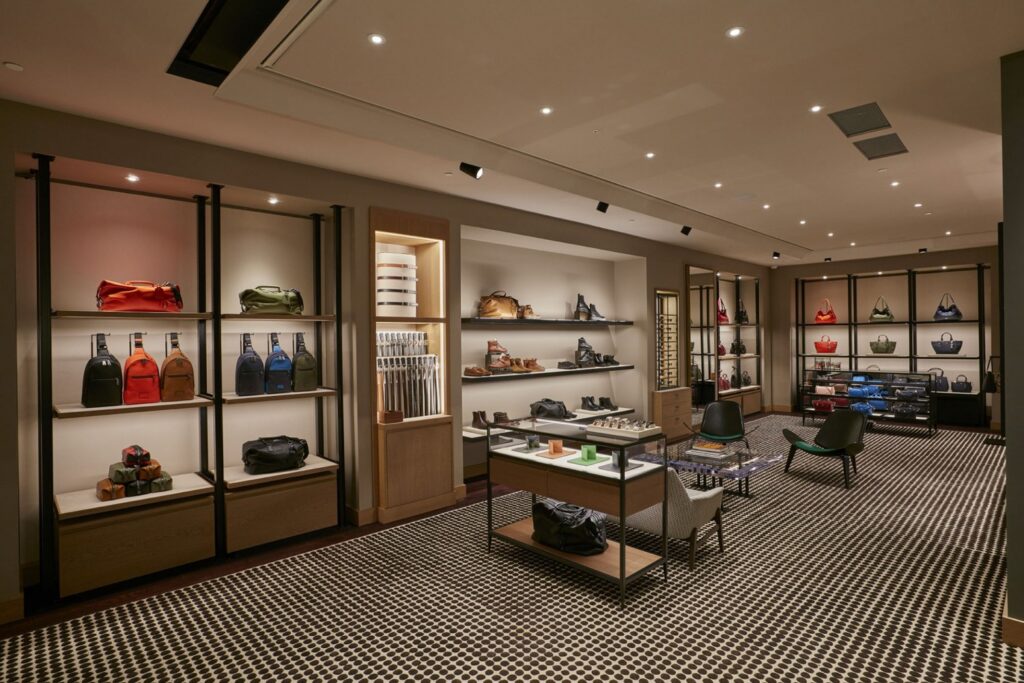
Coach’s own retail stores are the primary brand-building channel: they are designed to communicate the full Coach world — product, craft, heritage, and the “expressive luxury” aesthetic — in a way that no department store or online marketplace can replicate. Flagship stores (on Fifth Avenue in New York, Rodeo Drive in Los Angeles, Bond Street in London, and Ginza in Tokyo) are as much brand marketing investments as they are retail operations, generating global press coverage and creating reference points for the brand’s aesthetic.
Coach’s wholesale channel — sales through partner department stores — remains commercially important as a distribution reach mechanism. Key wholesale partners in North America include Macy’s, Bloomingdale’s, Nordstrom, Saks Fifth Avenue and Neiman Marcus. Internationally, Coach’s products are sold through premium department stores in Europe, Asia, and the Middle East, including Harvey Nichols (UK), Selfridges (UK), Lane Crawford (Hong Kong), and Galeries Lafayette (France).
Coach’s e-commerce platform (coach.com) functions as both a retail channel and a brand marketing vehicle. The website features editorial content, campaign imagery, behind-the-scenes brand stories, and the full product range with rich product storytelling that would be impossible in a physical retail setting. E-commerce has become increasingly important following the post-pandemic acceleration of online luxury shopping, and Coach has invested significantly in its digital commerce capabilities including personalised product recommendations, virtual try-on tools, and seamless mobile checkout.
Travel retail — sales through duty-free airport and destination resort outlets — serves Coach’s international tourist customer, particularly Chinese and Japanese travellers who purchase luxury goods while abroad for a combination of price (sometimes lower than domestic retail due to tax refund schemes) and the experience of buying in a location that feels symbolically significant. Coach has maintained a strong travel retail presence at leading international airports in North America, Europe, and Asia-Pacific.
STP Analysis of Coach
1. Segmentation
Coach segments its market across demographic, psychographic, and geographic dimensions.
Demographically, the brand targets primarily women aged 18–45 (with men’s products addressing a secondary male segment aged 25–50).
Psychographically, Coach targets consumers who value self-expression, creativity, and individual style over brand heritage or status display — consumers who want their accessories to feel personal and authentic, not borrowed.
Geographically, Coach’s primary markets are North America (the largest revenue contributor), Greater China (the most important international market and a high-growth opportunity), Japan, South Korea, and Europe. Each geographic market requires tailored product assortments, pricing strategies, and marketing approaches — the Chinese market, for example, places a higher value on brand storytelling and KOL (Key Opinion Leader) marketing than North American markets.
2. Targeting
Coach’s primary target is the “timeless Gen Z and Millennial” consumer: people aged roughly 18–35 who are fashion-aware, culturally engaged, and looking for a brand that feels both aspirational and authentic. In FY2025, Coach attracted 930,000 new customers in North America alone, with 60% of them being Gen Z and Millennials — a clear validation that the targeting strategy is working.
A secondary target is the “loyal coach customer” — existing brand advocates (typically women 35–55) who have been purchasing Coach for years and who continue to engage with the brand through its loyalty programme, new product launches, and elevated ready-to-wear offering. This customer has higher average transaction values and drives the bulk of repeat purchase revenue.
3. Positioning
Coach positions itself as the leading “expressive luxury” brand — occupying a premium market position above aspirational brands like Michael Kors, Kate Spade, and Tory Burch, and below true ultra-luxury houses (Gucci, Louis Vuitton, Chanel) on both price and perceived exclusivity. This positioning allows Coach to attract consumers who aspire to European luxury but prefer American cultural values and a more accessible (without being cheap) price architecture.
The key competitive differentiation is the “expressive” dimension: Coach is not just a quality leather goods brand, but a brand that stands for a specific value system (self-expression, creativity, authenticity, courage) that resonates with its target audience on a deeper level than product features alone. This values-based positioning creates emotional loyalty that sustains the brand through trend cycles and competitive pressures.
Coach vs Competitors: How It Stacks Up
| Brand | Parent / Owner | Price Tier | Key Strength |
| Coach (New York) | Tapestry, Inc. | Mid-to-upper luxury ($200–$2,000+) | Expressive luxury, Gen Z appeal, American heritage |
| Kate Spade | Tapestry, Inc. | Mid luxury ($100–$800) | Playful aesthetic, millennial base, gifting |
| Michael Kors | Capri Holdings | Accessible luxury ($100–$700) | Volume distribution, logo recognition |
| Tory Burch | Independently held | Mid-to-upper luxury ($200–$900) | Preppy-American aesthetic, strong e-commerce |
| Louis Vuitton | LVMH | True luxury ($800–$5,000+) | Heritage, global status, strongest brand equity |
| Gucci | Kering | True luxury ($800–$5,000+) | Italian heritage, bold creative direction |
| Marc Jacobs | LVMH | Upper mid-to-true luxury | NYC edgy cool, designer credibility |
Frequently Asked Questions (FAQs)
Q1. Who owns Coach New York?
A: Coach New York is owned by Tapestry, Inc. (NYSE: TPR), an American luxury fashion holding company headquartered in New York City. Tapestry also owns Kate Spade and Stuart Weitzman. Tapestry was formerly known as Coach, Inc. and rebranded in 2017 when it acquired Kate Spade.
In FY2025, Coach generated approximately $5.6 billion in revenue, representing roughly 80% of Tapestry’s record $7.0 billion in total annual revenue. Source: Tapestry FY2025 Full Year Results (August 2025).
Q2. What is Coach’s current marketing positioning?
A: Coach has repositioned itself from “accessible luxury” to “expressive luxury” — a shift led by Creative Director Stuart Vevers (hired in 2013) and executed systematically over the past decade. “Expressive luxury” centres on individual self-expression, creativity, and authenticity rather than status display or European heritage.
This positioning targets Gen Z and Millennial consumers who value brands that feel genuine and values-aligned rather than purely aspirational. Source: Business of Fashion; Coach brand communications.
Q3. What is Coach’s best-selling product?
A: The Tabby bag is Coach’s current hero product and best-known item. The Tabby is a reimagining of a vintage 1970s Coach style, featuring a half-moon flap and the brand’s distinctive C-hardware clasp.
The Tabby shoulder bag retails for $450. It has been instrumental in driving Coach’s return to cultural relevance among younger consumers and was identified through data analytics as having strong organic social media traction among under-35 shoppers. The Brooklyn and Empire bags ($250–$895) are additional hero products. Source: Fortune (data-driven Tabby story, November 2024); Tapestry investor presentations.
Q4. How does Coach target Gen Z consumers?
A: Coach targets Gen Z through several interconnected strategies: (1) An ambassador “constellation” of 40+ diverse cultural figures that includes figures relevant across music, film, K-pop, and social media; (2) TikTok-native content including the viral “In My Tabby Era” moment; (3) Data-driven product launches calibrated against social media trend analysis; (4) The Coach (Re)Loved circular fashion programme that appeals to sustainability-conscious Gen Z shoppers; (5) Reduced promotional discounting that maintains the brand’s aspirational premium; and (6) In-store customisation services (monogramming, painting, charm bars) that appeal to Gen Z’s desire for personalised self-expression. In FY2025, 60% of Coach’s 930,000 new North American customers were Gen Z and Millennials. Source: Tapestry FY2025 earnings; Business of Fashion.
Q5. Who are Coach’s brand ambassadors?
A: Coach has built a diverse “constellation” of 40+ brand ambassadors chosen for their authentic cultural relevance rather than simply their fame. Current and recent ambassadors include Lil Nas X (global ambassador, starring in the “Find Your Courage” campaign), Camila Mendes (lead face of multiple handbag campaigns), Michael B. Jordan (Jordan North America ambassador), Jennifer Lopez, Megan Thee Stallion, Noah Beck, Wisdom Kaye, K-pop star Youngji Lee, Japanese model Kouki, and Chinese actress Wu Jinyan. Virtual influencer “imma” has also been featured in Gen Z-targeted campaigns. Source: Business of Fashion; Retail Dive; Rolling Stone.
Q6. What is the Coach Foundation?
A: The Coach Foundation is the philanthropic arm of Coach (under Tapestry, Inc.), focusing on education, youth empowerment, the arts, and social justice. The Foundation has donated millions of dollars to nonprofits and programmes supporting underserved communities, with a particular emphasis on New York City.
Coach also participates in Pride campaigns (donating proceeds to LGBTQ+ advocacy organisations), International Women’s Day initiatives, and disaster relief programmes. These philanthropic commitments are communicated through the brand’s website, social media, and limited-edition charitable collections. Source: Tapestry Global Impact Report; Coach brand communications.
Q7. What is Coach’s sustainability strategy?
A: Coach’s sustainability strategy includes the Coach (Re)Loved programme (which invites customers to bring in pre-loved Coach bags for repair, transformation, or resale, enabling a circular fashion model), increased use of recycled and more sustainably sourced materials in products and packaging, and adherence to Tapestry’s broader environmental commitments outlined in the company’s Global Impact Report.
The (Re)Loved programme also serves as a customer engagement tool, as bringing pre-loved bags into stores creates opportunities for interactions that often lead to new purchases. Source: coach.com/reloved; Tapestry Global Impact Report.
Q8. How has Coach’s revenue grown in recent years?
A: Coach has experienced a sustained revenue resurgence. In FY2025 (fiscal year ended approximately June 2025), Coach generated approximately $5.6 billion in revenue — approximately 10% growth year-over-year — and delivered a segment operating margin of approximately 33.5%.
Tapestry as a group achieved a record $7.0 billion in total FY2025 revenue (+5% YoY). Average unit retail (AUR) grew at a low-double-digit rate for the full year and mid-teens in Q4, reflecting the successful pricing strategy and reduced discounting.
Coach attracted 930,000 new North American customers in FY2025, 60% of whom were Gen Z or Millennials. For FY2026, Tapestry guided revenue approaching $7.2 billion.
Q9. How does Coach use social media in its marketing?
A: Coach uses a platform-tailored social media strategy across Instagram, TikTok, Pinterest, YouTube, Twitter/X, WeChat, Weibo, Xiaohongshu (Red), and Douyin.
On TikTok, Coach focuses on native content, creator partnerships, and hashtag campaigns (including the viral “In My Tabby Era” movement).
On Instagram, it blends aspirational campaign imagery, user-generated content, behind-the-scenes content, and ambassador storytelling.
For China specifically, Coach uses WeChat, Weibo, and Douyin with localised content featuring Chinese ambassadors.
Coach also employs a broad network of micro and mid-tier influencers (in addition to its macro ambassadors) whose engaged followings drive higher conversion rates.
Q10. How does Coach differentiate from Michael Kors and Kate Spade?
A: Coach sits above Michael Kors and its own sister brand Kate Spade on the luxury spectrum.
Michael Kors (owned by Capri Holdings) has historically competed on heavy distribution and promotional pricing, which has eroded its brand premium over time.
Kate Spade (also owned by Tapestry) targets a slightly younger, more playful and colourful aesthetic at a lower price point.
Coach differentiates itself through: (1) A higher average unit retail (AUR) and more disciplined promotional strategy than either; (2) The “expressive luxury” positioning that sits above accessible luxury; (3) Stuart Vevers’s distinctive creative direction that gives Coach a recognisable fashion point of view; (4) The Tabby and other hero products that have created genuine cultural buzz; and (5) A stronger global brand and distribution infrastructure.
Conclusion
Coach’s marketing strategy is a case study in brand revitalisation. In less than a decade, the brand went from being written off as an over-discounted accessible luxury label to generating $5.6 billion in annual revenue at a 33.5% segment operating margin, with 930,000 new North American customers acquired in a single fiscal year and growing double-digits year-on-year. The transformation was achieved not through one magic campaign, but through a systematic, sustained brand-building strategy that touched product, price, place, and promotion simultaneously.
The key lessons from Coach’s marketing strategy are clear. Repositioning takes time and discipline: the “expressive luxury” pivot began in 2013 with Stuart Vevers’s appointment and is only delivering full financial results today. Pricing discipline is as important as creative execution: Coach’s decision to reduce promotions and raise AUR was painful in the short term but has rebuilt the brand equity that justifies premium prices. Ambassador diversity beats single-star dependency: the 40+ constellation strategy ensures broad cultural relevance without the risk of over-reliance on any one personality. And data is not the enemy of creativity: the Tabby bag story shows that data intelligence and creative vision can work together productively, with data identifying the opportunity and creativity executing it.
For brands and marketers studying how to rehabilitate a faded luxury heritage brand for the Gen Z era, Coach offers the most complete playbook available. Its marketing strategy is not a set of campaigns — it is a philosophy of brand-building that puts authentic self-expression at the centre of everything the brand does, and then backs it up with a disciplined commercial strategy that ensures the philosophy translates into profit.
Also Read: The Art of Luxury: Chanel Marketing Strategies and Marketing Mix
Also Read: Gucci Marketing Strategies: How the Brand Stays Iconic
To read more content like this, subscribe to our newsletter