Last Updated on October 25, 2026 by Team TBH
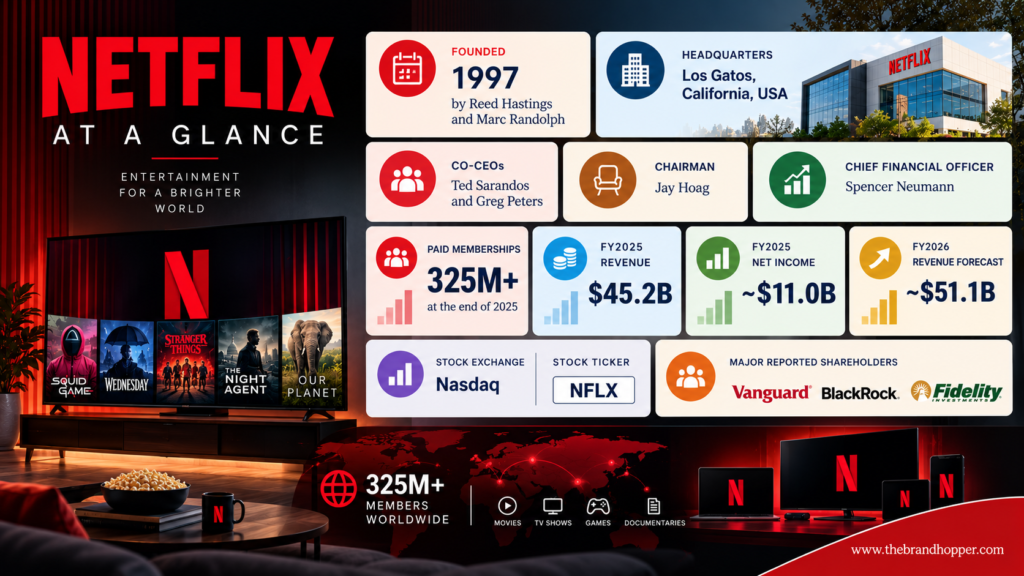
Netflix is one of the world’s largest streaming entertainment companies, with more than 325 million paid memberships by the end of 2025. Although millions of people use the service, the company is owned by its shareholders rather than by a single individual or parent company.
Netflix, Inc. is publicly traded on Nasdaq under the ticker NFLX. Its major reported institutional shareholders include Vanguard, BlackRock and Fidelity, while co-founders Reed Hastings and Marc Randolph are no longer responsible for its day-to-day management.
Quick Answer: Who Owns Netflix?
Netflix is owned by its shareholders, with no single controlling shareholder. Its 2026 proxy statement reported Vanguard, BlackRock and FMR LLC (Fidelity) as institutional shareholders holding more than 5%, based on the ownership disclosures cited in that filing.
Netflix is run by co-CEOs Ted Sarandos and Greg Peters. Following Reed Hastings’s departure from the board in June 2026, Jay Hoag became Chairman of the Board.
Who Owns Netflix? The Major Shareholders
Netflix’s 2026 proxy statement disclosed the following institutional holdings, based on the ownership reports referenced in the filing.
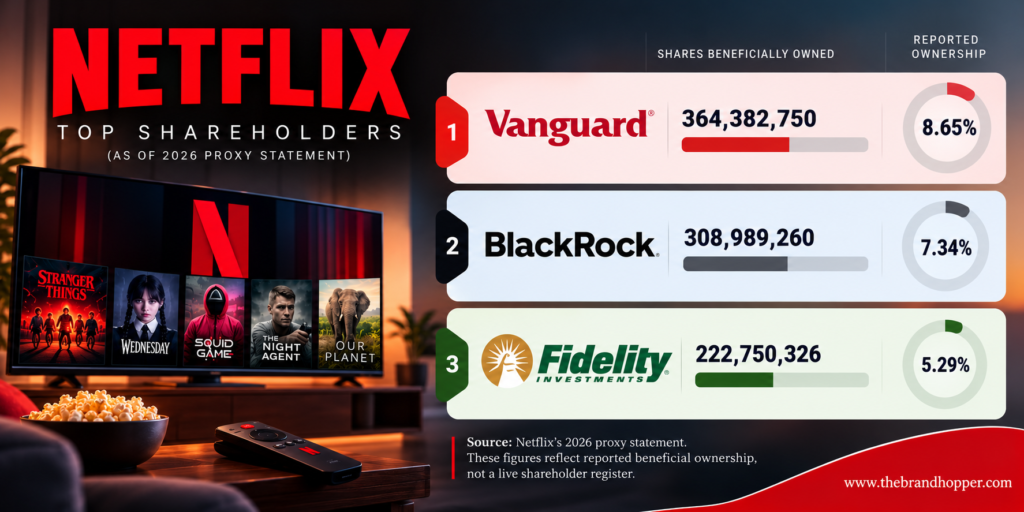
Institutional investment managers often hold shares through funds and investment products on behalf of clients. Their reported holdings should not be interpreted as shares owned personally by the firms’ executives.
Netflix’s remaining shares are held by other institutional investors, investment funds and individual shareholders. Many investors hold their shares through brokerage accounts, so they may not appear individually on the company’s register of shareholders of record.
Does Any One Shareholder Control Netflix?
No single shareholder has a controlling stake in Netflix. The company has one class of common stock, with each share carrying one vote, rather than a dual-class structure that gives founders enhanced voting power.
Consequently, corporate control rests with the board of directors and the company’s governance processes, with shareholders voting on directors and other matters presented for approval.
Why Netflix’s Ownership Structure Matters
Because Netflix does not have a controlling shareholder, its governance depends on the board, management and shareholder voting rights. Large institutional investors can influence corporate governance through their voting decisions, although their influence does not automatically give them control over day-to-day operations.
How Much of Netflix Does Reed Hastings Own?
Reed Hastings co-founded Netflix in 1997 and led the company for more than two decades. According to Netflix’s 2026 proxy statement, he beneficially owned approximately 37.8 million shares as of April 6, 2026, including options; the filing put his stake at less than 1% of the company.

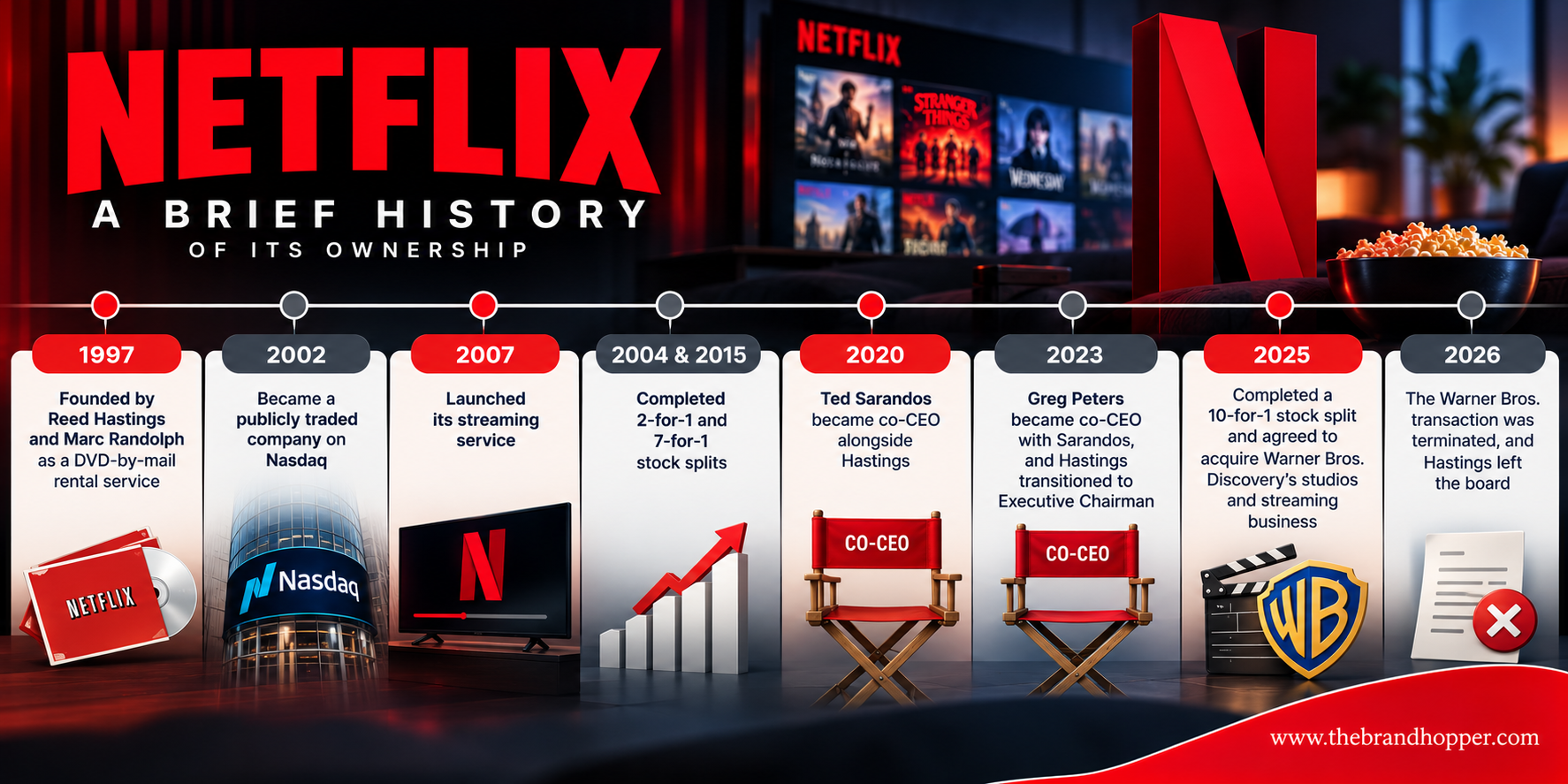
Hastings gradually stepped back from executive responsibilities. He became co-CEO with Ted Sarandos in 2020, transitioned to Executive Chairman in January 2023, and became a non-executive Chairman in April 2025.
In April 2026, Hastings announced that he would not stand for re-election to the board. His board tenure ended at the annual meeting on June 4, 2026.
What About Netflix’s Other Co-Founder?
Marc Randolph co-founded Netflix with Hastings and served as its first CEO. He left the company in the early 2000s and is not identified as one of Netflix’s major shareholders in its 2026 proxy statement.
Who Runs Netflix?
Netflix’s senior leadership includes the following executives:
| Name | Role |
|---|---|
| Ted Sarandos | Co-CEO and President |
| Greg Peters | Co-CEO and President |
| Spencer Neumann | Chief Financial Officer |
| David Hyman | Chief Legal Officer and Secretary |
| Jay Hoag | Chairman of the Board |
Sarandos and Peters oversee Netflix’s strategy and operations. Hoag provides board-level leadership, while the board oversees governance and management accountability.

Netflix’s 2026 proxy statement reported that Sarandos and Peters each held less than 1% of the company’s shares on the basis used in that filing.
The Warner Bros. Deal That Would Have Changed Netflix
In December 2025, Netflix agreed to acquire Warner Bros. Discovery’s studios and streaming business, including HBO Max, following a planned separation of WBD’s cable networks. The original proposal valued the consideration to WBD shareholders at $27.75 per share.
In January 2026, the companies amended the agreement so that the consideration would be paid entirely in cash. In February, WBD determined that Paramount Skydance’s competing proposal was superior under the terms of the merger agreement.
Netflix declined to raise its offer, and WBD terminated the agreement. Paramount Skydance’s proposal included payment of the $2.8 billion termination fee owed to Netflix.
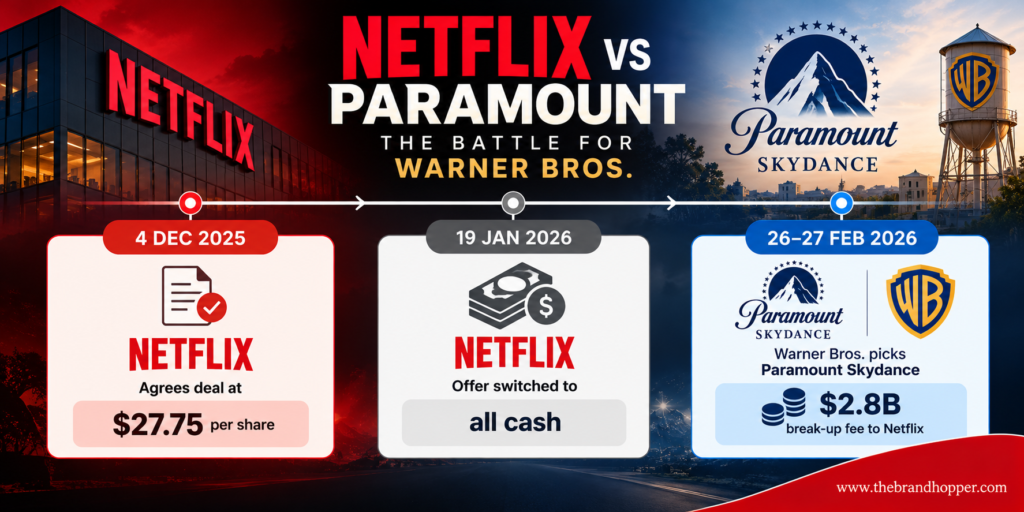
The transaction did not close, so WBD shareholders did not become Netflix shareholders through the deal. Netflix remained an independent, publicly traded company and received the termination fee.
Stock Splits and Share Buybacks
Netflix completed a 10-for-1 stock split in November 2025. Each shareholder received nine additional shares for every share held, and trading on a split-adjusted basis began on November 17, 2025.
A stock split increases the number of shares held by each investor while proportionately reducing the per-share price. It does not, by itself, change the investor’s percentage ownership of the company.
Netflix also repurchases its own shares. During the third quarter of 2026, it bought back approximately 63.9 million shares for $4.8 billion, leaving $22.3 billion available under its repurchase authorisation at September 30, 2026.
Netflix does not pay a regular dividend. Share repurchases are one way it returns capital to shareholders, although buybacks do not guarantee that the stock price will increase.
Netflix’s Financial Performance
Netflix’s 2025 annual report and third-quarter 2026 filing show continued revenue and profit growth.
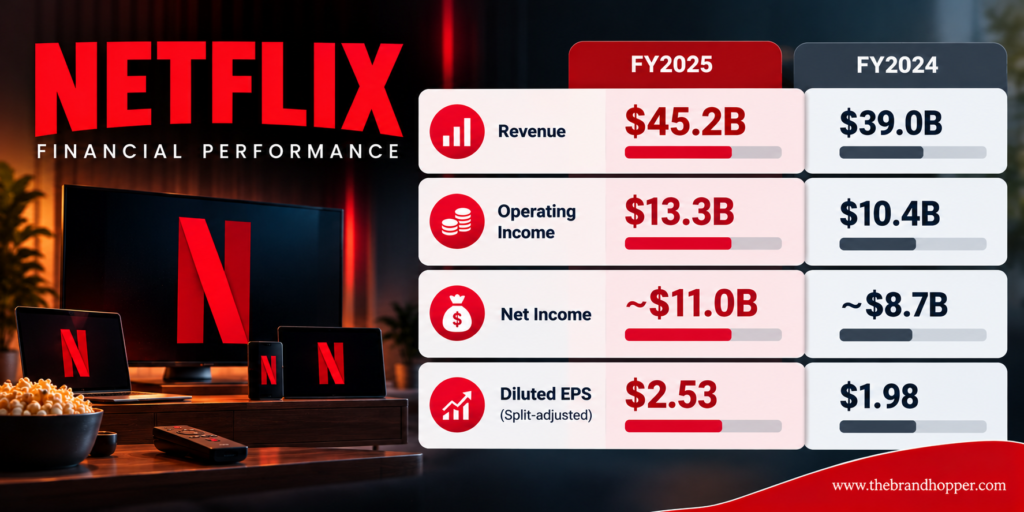
Revenue increased approximately 16% in 2025, supported by membership growth, price increases and higher advertising revenue.
In the third quarter of 2026, revenue reached $12.87 billion, up 12% year over year. Operating income was $4.46 billion, the operating margin was 34.6%, and net income was approximately $3.66 billion.
For full-year 2026, Netflix forecast revenue of approximately $51.1 billion and an operating margin of 31.5%. These are company forecasts, not final full-year results.
Netflix also announced workforce reductions of approximately 1,000 roles in October 2026, according to Reuters. The reported cuts represented roughly 6% of its workforce.
How Netflix Makes Money
Netflix earns most of its revenue from paid memberships. Subscription prices and available plans vary by country, while the US market currently offers ad-supported and ad-free options at different monthly price points.
Advertising has become an increasingly important revenue source. Netflix reported that advertising revenue grew to more than $1.5 billion in 2025 and expected it to roughly double in 2026.
The company also invests in original series and films, licenses content from other studios, and expands into live programming, games and other entertainment formats. Its strategy combines subscription revenue with advertising and additional content opportunities.
What Does Netflix Own?
Netflix owns and operates its streaming platform and controls a substantial portfolio of original films and series. It also owns or controls production assets, intellectual property and businesses associated with its entertainment operations.
In 2021, Netflix acquired the Roald Dahl Story Company, expanding its ability to develop adaptations and other projects based on the author’s works, including Charlie and the Chocolate Factory and Matilda.
Netflix also licenses content from external studios and distributors. Owning the Netflix service does not mean the company owns every title available on its platform.
A Brief History of Netflix’s Ownership
How to Buy Netflix Shares
Investors can buy Netflix shares through a brokerage account that provides access to Nasdaq. The stock trades under the ticker NFLX.
Investors based in India may access US shares through eligible international investment services, subject to applicable Indian foreign-exchange rules, tax requirements and platform terms. US-focused mutual funds and exchange-traded funds may offer indirect exposure to Netflix, depending on their holdings.
Netflix does not pay a regular dividend, so shareholder returns depend primarily on changes in the share price and the broader effects of the company’s capital-allocation decisions.
The Bottom Line
Netflix is owned by its shareholders and is not controlled by a single individual or parent company. Vanguard, BlackRock and Fidelity were the largest institutional holders above 5% reported in its 2026 proxy statement, although those percentages should not be treated as real-time holdings.
The company is managed by co-CEOs Ted Sarandos and Greg Peters, under a board chaired by Jay Hoag. Despite the failed Warner Bros. acquisition, Netflix remains an independent entertainment business focused on subscriptions, advertising, original content and live programming.
Frequently Asked Questions
Q: Who owns Netflix?
A: Netflix is owned by its shareholders through Netflix, Inc., a publicly traded company listed on Nasdaq under NFLX.
Q: Does Netflix have a parent company?
A: No. Netflix, Inc. is an independent public company and does not have a corporate parent.
Q: Who is Netflix’s largest shareholder?
A: The Vanguard Group was the largest institutional holder listed in Netflix’s 2026 proxy statement, with reported beneficial ownership of 8.65%. This is a filing-based figure, not a live ownership estimate.
Q: Does Reed Hastings still own Netflix?
A: Yes. Hastings retained a minority stake. Netflix’s 2026 proxy statement reported approximately 37.8 million beneficially owned shares, including options, as of April 6, 2026.
Q: Who is the CEO of Netflix?
A: Netflix has two co-CEOs: Ted Sarandos and Greg Peters. Jay Hoag is Chairman of the Board.
Q: Did Netflix buy Warner Bros.?
A: No. Netflix’s agreement to acquire Warner Bros. Discovery’s studios and streaming business was terminated in February 2026 after Netflix declined to match a competing Paramount Skydance offer.
Q: How many paid memberships does Netflix have?
A: Netflix reported more than 325 million paid memberships by the end of 2025. The company has also described its broader audience as approaching one billion people; that audience estimate is not the same as paid memberships.
Q: Does Netflix pay a dividend?
A: No. Netflix does not pay a regular dividend. It has returned capital to shareholders through share repurchases.
Also Read: Netflix vs Amazon Prime: Which Is Better? (2026 Guide)
To read more content like this, subscribe to our newsletter