Last Updated on August 31, 2026 by Team TBH
What makes a brand strong? And how do you build one? These two questions sit at the core of modern brand management — and Kevin Lane Keller’s Customer-Based Brand Equity (CBBE) model answers both with remarkable precision. Introduced in his landmark 1993 paper in the Journal of Marketing and expanded in Strategic Brand Management, the CBBE framework is now the most widely taught and applied brand-building model in the world.
Unlike financial brand valuation, which measures equity in dollars, CBBE measures it in minds. The model holds that a brand’s true power lies in what consumers have learned, felt, seen, and heard about it over time — and that managing that knowledge systematically is the discipline of brand building.
What is Customer-Based Brand Equity (CBBE)?
Keller defines CBBE as the differential effect that brand knowledge has on consumer response to the marketing of that brand. Three components make up this definition:
- Differential effect — CBBE exists when consumers respond differently to a branded product versus an identical unbranded version.
- Brand knowledge — The source of that difference: what consumers recall, recognise, and feel about the brand from all past exposures.
- Consumer response to marketing — How brand knowledge changes reactions to pricing, advertising, distribution, and new products.
A practical illustration: Hitachi and General Electric once co-owned a factory in England producing identical television sets. The only difference was the brand label. Hitachi televisions sold for a $75 premium and moved twice as many units. That is CBBE in action — the brand, not the product, created the advantage.
The Four Steps of Brand Building
The CBBE model structures brand building as a sequential ladder. Each step must be completed before the next becomes achievable. Together, they answer four questions that every consumer asks about every brand:
Step 1 — Brand Identity: Who are you? Establish clear identification with consumers and associate the brand with a specific category or need.
Step 2 — Brand Meaning: What are you? Build the tangible (performance) and intangible (imagery) associations that give the brand substance.
Step 3 — Brand Response: What about you? Elicit the right consumer judgments (quality, credibility) and feelings (warmth, excitement, self-respect).
Step 4 — Brand Resonance: What about you and me? Convert brand response into an active, loyal relationship between consumer and brand.
The sequence is non-negotiable. Emotional resonance cannot be built before meaning is clear; meaning cannot be established before identity exists. Brands that skip steps invest in foundations that aren’t there.
The CBBE Pyramid: Six Brand Building Blocks
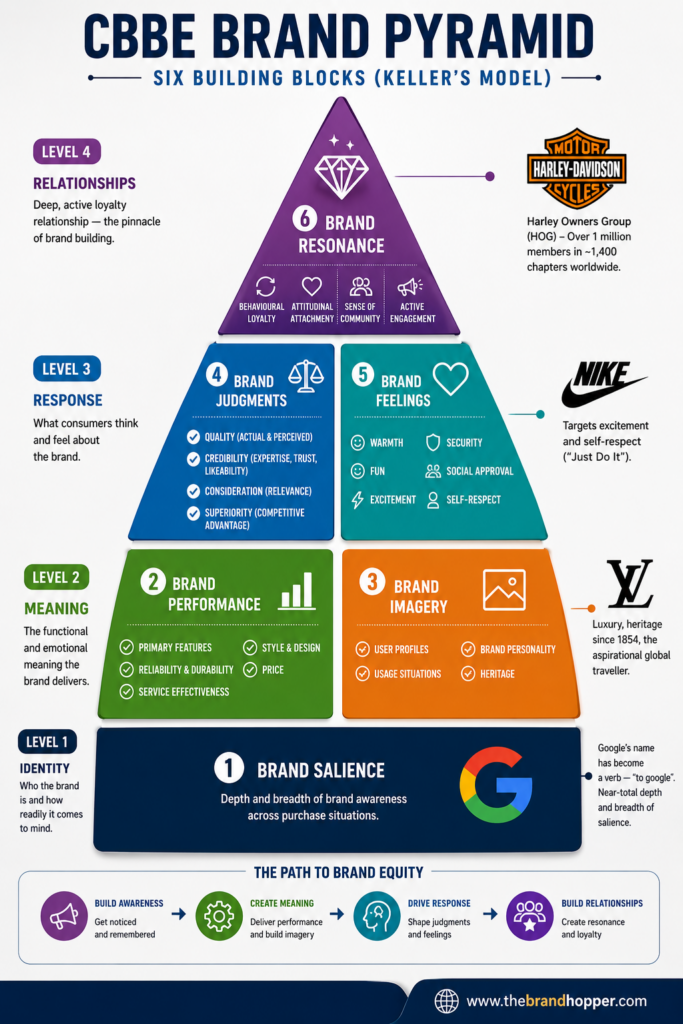
The four steps are executed through six building blocks arranged as a pyramid. Reaching the pinnacle requires every lower block to be in place.
1. Brand Salience (Level 1 — Identity)
Salience is the depth and breadth of brand awareness — how readily and consistently a brand comes to mind across purchase situations. Google is the ultimate example: its name has become a verb (‘to google’), representing near-total depth and breadth of salience.
2. Brand Performance (Level 2 — Meaning)
Performance covers five dimensions of functional brand meaning: primary features, reliability and durability, service effectiveness, style and design, and price. Toyota has built its performance associations so durably that ‘reliability’ is virtually synonymous with the brand name.
3. Brand Imagery (Level 2 — Meaning)
Imagery represents the intangible, emotional associations consumers hold — user profiles, usage situations, brand personality, and heritage. Louis Vuitton’s imagery (luxury, heritage since 1854, the aspirational global traveller) is entirely distinct from its functional product attributes and commands a disproportionate share of the brand’s equity.
4. Brand Judgments (Level 3 — Response)
Judgments are the rational evaluations consumers form: quality (actual and perceived), credibility (expertise, trustworthiness, likeability), consideration (relevance to their need), and superiority (competitive advantage). Tesla has strong superiority judgments in EV technology among consumers who have never owned one.
5. Brand Feelings (Level 3 — Response)
Keller identifies six feeling types that brands can elicit: warmth, fun, excitement, security, social approval, and self-respect. Nike targets excitement and self-respect (‘Just Do It’); Hallmark targets warmth; Rolex targets social approval. The most powerful brands deliberately choose and consistently own their emotional territory.
6. Brand Resonance (Level 4 — Relationships)
Resonance is the pinnacle — the deep, active loyalty relationship between brand and consumer. It has four dimensions: behavioural loyalty (repeat purchase), attitudinal attachment (genuine love of the brand), sense of community (identity with other brand users), and active engagement (volunteering time and energy for the brand). Harley-Davidson’s Harley Owners Group (HOG), with over one million members in approximately 1,400 chapters worldwide, is the textbook example of Brand Resonance.
CBBE in Action: Real-World Brand Examples
Apple illustrates CBBE operating at maximum effectiveness across all four levels. Salience is near-universal; performance associations include build quality and the iOS ecosystem; imagery associations — innovation, simplicity, creative empowerment — are among the strongest of any brand globally. Brand feelings (excitement at product launches, self-respect from the ‘Think Different’ heritage, social approval from iPhone as status symbol) layer on top. The result: Apple has consistently been ranked the world’s most valuable brand by Interbrand’s Best Global Brands methodology.
Starbucks demonstrates resonance through infrastructure. Its Starbucks Rewards programme reported approximately 33.8 million active members in the United States in fiscal year 2024 (source: Starbucks FY2024 earnings). These are not passive customers — they actively engage with the brand through an app, accumulate points, and participate in personalised offers. That is behavioural loyalty, attitudinal attachment, and active engagement operating simultaneously.
How to Build Customer-Based Brand Equity: Key Principles
1. Start with identity — define the brand’s category membership, unique value proposition, and brand elements (name, logo, tagline) before anything else. Consistency builds salience.
2. Earn performance before claiming imagery — the product must genuinely deliver before emotional advertising can be credible. Overpromising on imagery creates CBBE liability when experience disappoints.
3. Choose your emotional territory deliberately — identify which of the six brand feelings are most authentic to your brand and most valued by your target consumer. Own that territory consistently.
4. Build community structures — resonance must be enabled by infrastructure: loyalty programmes, branded communities, events, and content ecosystems that give consumers a reason to engage beyond purchase.
5. Measure continuously — use brand tracking studies, brand audits, and conjoint analysis to monitor which pyramid levels are strong and where gaps exist. CBBE erodes without active management.
Read CBBE in a more advanced manner here — Marketing Concept | Customer-Based Brand Equity Model (CBBE)
Conclusion
The CBBE model endures because its core insight is timeless: brand equity lives in the minds of consumers, not in the ambitions of brand managers. Build identity before meaning. Build meaning before response. Earn response before seeking resonance. Brands that respect this sequence build equity that compounds over time and proves genuinely difficult for competitors to erode. That is as true for a startup finding its first customers as it is for a global brand managing a household name.
Frequently Asked Questions (FAQs)
Q1. What is the CBBE model and who created it?
The Customer-Based Brand Equity (CBBE) model was created by Professor Kevin Lane Keller and first published in the Journal of Marketing in 1993 (Vol. 57, No. 1). It defines brand equity as the differential effect that brand knowledge has on consumer response to marketing and structures brand building as a four-step pyramid of six building blocks: Salience, Performance, Imagery, Judgments, Feelings, and Resonance.
Q2. What are the four steps in Keller’s CBBE model?
The four sequential steps are: (1) Brand Identity — establishing who the brand is (‘Who are you?’); (2) Brand Meaning — building performance and imagery associations (‘What are you?’); (3) Brand Response — eliciting the right judgments and feelings (‘What about you?’); and (4) Brand Resonance — creating an active loyalty relationship (‘What about you and me?’). Each step must be completed before the next is achievable.
Q3. What are the six building blocks of the CBBE pyramid?
From base to pinnacle: (1) Brand Salience — depth and breadth of awareness; (2) Brand Performance — functional associations across features, reliability, service, design, and price; (3) Brand Imagery — intangible associations including user profile, personality, and heritage; (4) Brand Judgments — rational evaluations of quality, credibility, consideration, and superiority; (5) Brand Feelings — emotional responses including warmth, fun, excitement, security, social approval, and self-respect; (6) Brand Resonance — the loyalty relationship through behavioural loyalty, attitudinal attachment, sense of community, and active engagement.
Q4. What is the difference between positive and negative CBBE?
Positive CBBE occurs when consumers react more favourably to a product when they know its brand — they are willing to pay more, are more loyal, and more receptive to its marketing. Negative CBBE occurs when brand identification actually reduces consumer preference, typically due to quality failures, reputational damage, or sustained misalignment between brand claims and consumer experience.
Q5. What is Brand Resonance and why does it matter commercially?
Brand Resonance is the pinnacle of the CBBE pyramid — the state in which the brand forms a central part of the consumer’s identity and community. Its four dimensions are behavioural loyalty (repeat purchase), attitudinal attachment (genuine brand affinity), sense of community (identification with other users), and active engagement (investing time and energy in the brand beyond purchase). Commercially, resonance is the most durable and competitively defensible form of brand equity because it is the hardest for rivals to replicate.
Q6. How is CBBE measured in practice?
CBBE measurement combines qualitative research (free association exercises, brand mapping, projective techniques to surface deep associations) with quantitative methods (unaided/aided awareness surveys, brand tracking studies, conjoint analysis to isolate price premium attributable to the brand, and Net Promoter Score as a resonance proxy). Keller recommends a formal Brand Audit — examining both brand elements (inventory) and consumer perceptions (exploratory) — at least every two to three years.
Q7. Can the CBBE model be applied to small brands or startups?
Yes — the sequential logic of the CBBE pyramid is equally applicable regardless of brand size. For startups, the framework is particularly valuable as a roadmap: establish clear identity and deliver genuine product performance before investing heavily in emotional advertising. Attempting to build resonance without identity and meaning in place wastes resources and can create consumer confusion. The pyramid’s discipline is, if anything, more forgiving to smaller brands because it forces prioritisation of what is within every brand’s control.
To read more content like this, subscribe to our newsletter