Last Updated on September 23, 2026 by Team TBH
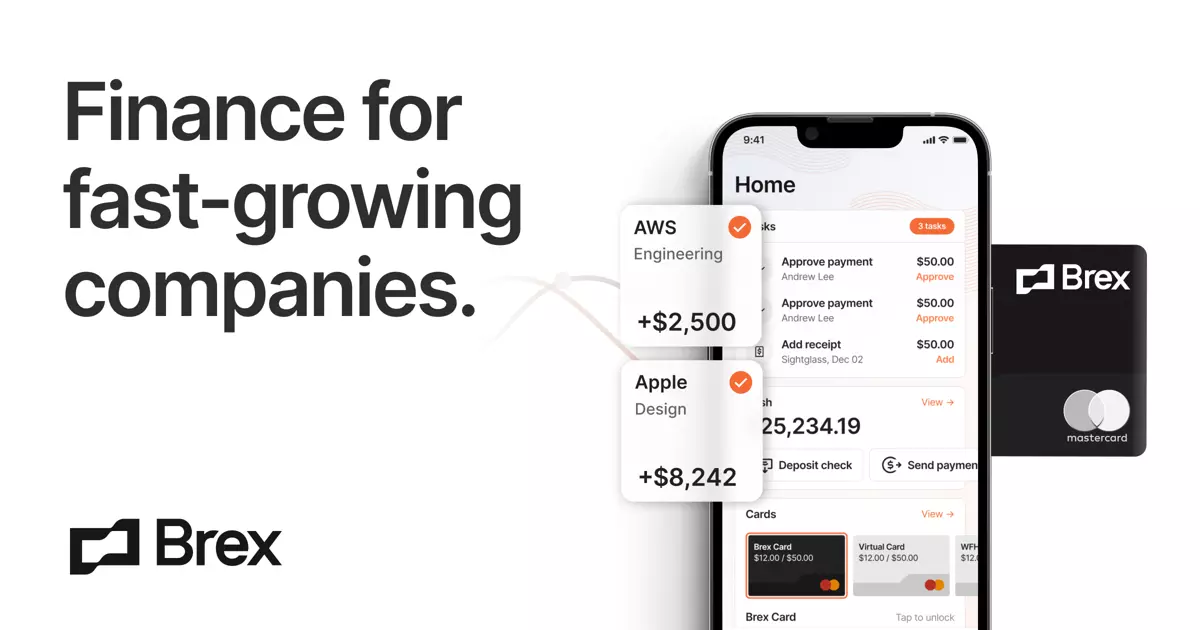
Every few years, a startup comes along that doesn’t just build a better product — it rewrites what the product category can look like. Brex is one of those companies. Founded in 2017 by two Brazilian entrepreneurs who dropped out of Stanford, Brex reimagined the corporate credit card from first principles: no personal guarantees from founders, credit limits based on company cash rather than personal credit history, real-time expense tracking, and an automated spend management platform that replaces entire finance teams’ worth of manual work.
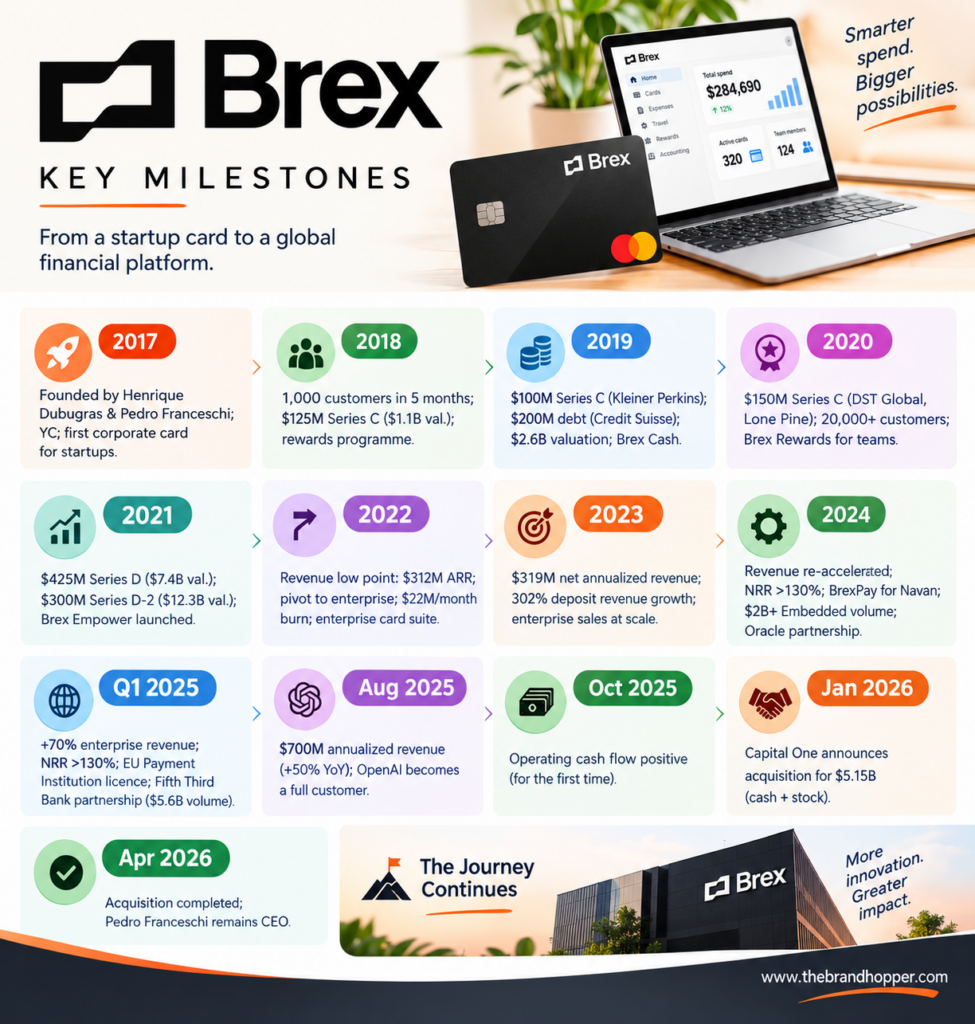
The result, according to Sacra research, is a company that hit $700 million in annualized revenue in August 2025, growing at 50% year-over-year, after becoming operating-cash-flow positive for the first time in October 2025. In January 2026, Capital One Financial Corporation — one of the largest credit card issuers in the United States — agreed to acquire Brex for $5.15 billion in a cash and stock transaction. The deal closed on April 7, 2026.
The story of how Brex got here — from a rejected Stanford MBA idea, to a Y Combinator startup, to a $12.3 billion peak valuation in 2022, to a $5.15 billion acquisition exit in 2026 — is a masterclass in product-market fit, platform thinking, and the brutal realities of fintech scaling. This comprehensive article covers the complete Brex story: its founders, business model, revenue trajectory, funding history, enterprise growth, and the competitive landscape that shaped every strategic decision along the way.

Founders of Brex
Brex was built by two founders who had already proven themselves as entrepreneurs before they arrived in Silicon Valley. That pre-existing technical depth and operational experience — rare for first-time US startup founders at the time — is a significant reason why Brex executed so quickly after launch.
Henrique Dubugras — Co-Founder

Henrique Dubugras’ entrepreneurial instincts emerged early. Before arriving in California, he co-founded Pagar.me in Brazil, a successful online payments processor that processed billions of reais in transaction volume and gave Henrique a front-row seat to the friction that businesses face when accessing financial services. The experience instilled in him a deep conviction that the infrastructure of business finance — credit cards, payments, expense management — was overdue for a technology-first rebuild.
Henrique enrolled in Stanford’s computer science programme (not an MBA, as he has sometimes been described) with an initial vision around virtual reality. But when Y Combinator’s application deadline approached in 2017, he and Pedro pivoted to the idea that would become Brex: a corporate card purpose-built for venture-backed startups, with credit limits based on bank balance rather than personal credit score, and a product experience built for the digital-first generation of founders. The idea was rejected on first submission, then accepted on the second.
As Brex scaled, Henrique served as co-CEO alongside Pedro, often representing the company externally as its most visible spokesperson. He has stepped back from day-to-day operational responsibilities in more recent years, with Pedro taking the sole CEO role as Brex entered its enterprise scaling phase.
Pedro Franceschi — Co-Founder and CEO

Pedro Franceschi brings rare technical and operational depth to his co-founder role. Before Brex, he co-founded Stone — one of Brazil’s leading payments processors — gaining direct experience in building financial technology infrastructure at scale. Stone went on to become a publicly listed company in the United States, processing hundreds of billions in transactions annually, providing Pedro with an unusually strong operational and technical foundation for building Brex.
As CEO — the role Pedro has held since Brex’s enterprise pivot — he has led the company’s most critical strategic decisions: the 2022 shift away from SMBs and startups toward larger enterprise clients; the build-out of Brex Empower; the expansion into stablecoin payments; the EU Payment Institution licensing; and the partnership ecosystem that culminated in the Oracle and Fifth Third Bank relationships. Under Pedro’s leadership, Brex went from $312 million in annualized revenue in 2022 to $700 million by August 2025 — growth that directly enabled the Capital One acquisition.
Following the $5.15 billion Capital One acquisition in April 2026, Pedro remained CEO of Brex, continuing to operate the business within Capital One’s broader financial services structure. Capital One has stated its intention to allow Brex to retain its product velocity and startup culture, a critical consideration given that cultural integration risk is one of the most significant risks identified in the Sacra analysis of the deal.
Business Model of Brex
Brex’s business model has evolved significantly from its 2017 launch. What began as a single-product corporate card for venture-backed startups is now a multi-layered financial operating system targeting enterprise companies with complex global spend needs. The model combines interchange revenue, SaaS subscription fees, banking spread revenue, and embedded finance partnerships.
1. Corporate Credit Cards — The Foundation
Brex’s corporate cards remain the primary revenue engine, generating income through interchange fees charged on every transaction. Brex collects approximately 2.7% on transaction volume processed through its platform as gross revenue, with roughly 65% gross margins after the interchange is split between the card network, issuing bank, and payment processors. The core insight that launched Brex — offering high credit limits to startups based on their bank balance rather than personal credit history, with no monthly fee — allowed it to acquire early customers at low cost and grow with them as their spending scaled.

Today, Brex cards span two primary tiers: Brex Essentials (free) and Brex Premium ($12 per user per month). The Premium tier adds dynamic approval chains, AI-powered compliance audit, live budget tracking, and group travel policies — features designed for enterprise finance teams managing complex global operations. Brex also holds a KBRA-rated AAA rating (the highest possible) on $260 million of charge-card asset-backed notes from its latest securitisation, improving financing costs and securitisation liquidity.
2. Brex Empower — Spend Management SaaS
Brex Empower is the spend management software layer that transforms Brex from a card provider into a full financial operations platform. Empower enables finance teams to build rule-based spending workflows, reimburse employee expenses, manage budgets, review purchases, and export data directly to accounting software — eliminating the manual reconciliation work that typically consumes significant finance team time.
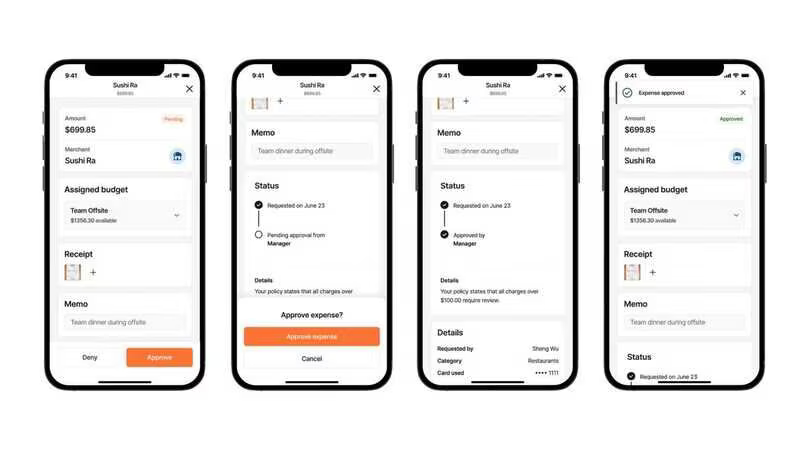
The platform’s impact at scale is striking. Across Brex’s customer base, automation through Empower has freed over $163 million in annualized salary costs, saved over 208,000 hours per month of finance team labour, and handled nearly 70% of all expenses entirely without human intervention. Managers using Brex review expenses six times faster than with traditional expense tools, and accounting teams close books three times faster. OpenAI — whose global spend and financial operations now run on Brex — is among the most visible enterprise customers demonstrating these capabilities.
3. Brex Business Accounts — Banking
Brex offers business cash management accounts where companies can hold operating funds, earn interest, and make ACH and wire payments. Brex parks customer funds with its FDIC-insured partner banks, generating spread revenue (revenue from the interest rate differential between what Brex earns from partner banks and what it pays to customers). This revenue stream grew rapidly when interest rates rose significantly between 2022 and 2024, becoming a major contributor to Brex’s overall revenue growth during that period.
4. Brex Embedded — The B2B Distribution Engine
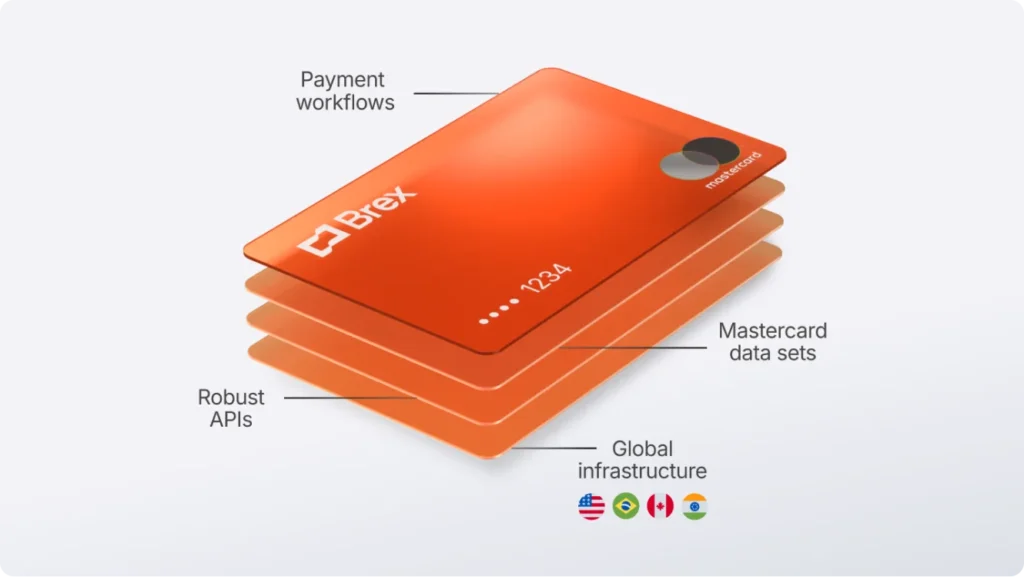
Brex Embedded is an increasingly important revenue and growth driver. It enables banks, ERPs, and technology platforms to white-label or integrate Brex’s payment and card infrastructure directly into their own products. In its first year, Brex Embedded crossed nearly $2 billion in annualized payment volume.
The most significant Embedded partnerships to date are: First, Fifth Third Bank — where the Brex-powered Fifth Third Commercial Card has become the default card solution for Fifth Third’s Commercial Banking clients, unlocking $5.6 billion in annual commercial card payment volume and access to approximately 8% of the US commercial banking sector through a single relationship. Second, Oracle Fusion Cloud ERP — where Brex became the first fintech issuer embedded directly in Oracle’s enterprise planning software, allowing companies to use Brex virtual cards inside their payables workflows without leaving the Oracle environment. The Oracle channel delivers 4x faster sales cycles, 5x larger customers, 70% more spend per customer, and a 3x higher win rate compared to Brex’s direct sales motion, with public company win rates approaching 90%.
5. AI-Native Accounting and Finance Automation
Brex has invested heavily in artificial intelligence across its product suite. Brex AI works on over 400 types of custom accounting fields, suggesting what to enter based on each company’s unique data. AI-powered accounting rules provide GL coding and merchant mapping suggestions that finance teams can accept, revise, or reject. End-to-end accounting automations push expenses directly to ERP systems with pre-set accounting fields for compliant or completed expenses.
The AI-native Accounting API — launched in partnership with Rillet and Campfire as initial partners — enables two-way data flow between Brex and ERP systems in real time, eliminating over 10,000 hours of manual work within the first few months of its launch. Brex’s integration with Zip, the procurement platform, also embeds Brex virtual cards directly into procurement workflows as “Brex for Zip,” connecting purchase requests with payment execution across 30+ currencies.
6. Stablecoin Payments
In 2025, Brex announced it would become the first global corporate card platform to enable instant balance payments with stablecoins — specifically USDC (a US dollar-pegged stablecoin). Launched via partner Column Bank N.A., the feature allows Brex customers to accept USDC with automatic conversion into USD in their Brex business accounts, send stablecoins directly from USD balances, and pay card balances in USDC. This positions Brex to capture treasury and international payment use cases that traditional card and banking products handle inefficiently.
7. Bill Pay and Travel
Bill Pay extends Brex beyond employee spending into vendor payment automation, allowing finance teams to process invoices and pay suppliers digitally rather than manually cutting cheques or initiating wire transfers. Brex also launched BrexPay for Navan, embedding Brex’s corporate card payment directly into Navan’s travel and expense management platform — creating a complex co-opetition relationship where Brex simultaneously competes with Navan in spend management while distributing through it in travel.
Revenue of Brex
| Period | Revenue (Annualized) | Key Driver |
| 2021 | ~$215M | Card interchange + rapid customer growth |
| 2022 (low point) | ~$312M (+30% YoY) | Interest rate tailwind; SMB churn after pivot decision |
| 2023 | $319M net annualized | Deposits revenue +302% YoY; interchange stabilisation |
| 2024 | ~$470M (estimated) | Enterprise pivot gaining traction; Empower SaaS growth |
| August 2025 | $700M (+50% YoY) | Enterprise revenue +70% in Q1 2025; NRR >130%; Embedded growth |
| October 2025 | Operating cash flow positive | First time in company history |
Source: Sacra Brex Research Report; Brex corporate communications; Pedro Franceschi Q1 2025 update.
Brex’s revenue story is one of the more instructive in fintech: a company that burned through significant cash during its hyper-growth startup-focused years (reportedly $22 million per month in 2022), made a painful strategic pivot away from its original customer base, and then built itself back to near-profitability on the strength of its enterprise product. The $700 million annualized revenue figure as of August 2025 — growing at 50% year-over-year — reflects the compounding effect of three simultaneous tailwinds: enterprise NRR exceeding 130% (meaning existing enterprise customers increase their spend significantly each year), the Brex Embedded channel delivering outsized customer quality metrics, and AI-powered automation reducing the cost-to-serve while expanding product value.
Revenue breakdown has also shifted. Interchange from card transactions remains the largest component, but SaaS fees from Brex Empower Premium and bill pay, spread revenue from business accounts, and Embedded partnership fees have all grown as a proportion of the total. The mix shift matters: SaaS and banking spread revenue are less volatile than interchange, which depends on overall startup and enterprise spending volume. A more diversified revenue structure makes Brex a more stable acquisition target — and a more attractive long-term asset for Capital One.
Key Milestones of Brex
Funding and Investors of Brex
Brex raised a total of $1.5 billion in equity and debt financing across 10 rounds from its founding in 2017 through its final private round in 2021. Its investor roster reads like a who’s-who of global growth capital.
| Date | Round | Amount | Post-Money Valuation | Lead Investors |
| Apr 2017 | Series A | $7M | — | Ribbit Capital, Y Combinator |
| Mar 2018 | Series B | $50M | — | Y Combinator, Peter Thiel, Max Levchin, Yuri Milner, Ribbit Capital |
| Oct 2018 | Series C | $125M | $1.1B | Greenoaks, DST Global, IVP |
| Apr 2019 | Conventional Debt | $100M | — | Barclays |
| Jun 2019 | Series C | $100M | $2.6B | Kleiner Perkins, Y Combinator, Greenoaks, Ribbit Capital, DST Global, IVP |
| Dec 2019 | Conventional Debt | $200M | — | Credit Suisse |
| May 2020 | Series C | $150M | — | Lone Pine Capital, DST Global |
| Apr 2021 | Series D | $425M | $7.4B | Tiger Global Management, TCV, Baillie Gifford, Durable Capital, Base10, Y Combinator, Ribbit Capital, Greenoaks, GIC, DST Global, Lone Pine, IVP, Endeavor |
| Aug 2021 | Venture Debt | $150M | — | SVB, American Express, Bank of America |
| Oct 2021 | Series D-2 | $300M | $12.3B | Greenoaks Capital, TCV |
Total equity + debt raised: $1.5 billion. Note: Brex’s $12.3 billion peak private valuation (October 2021) was significantly above the $5.15 billion Capital One acquisition price, reflecting the broader correction in growth-stage fintech valuations between 2022 and 2026.
Growth and Growth Factors of Brex
Brex’s growth story has two distinct chapters. The first (2017–2021) is about explosive startup-market expansion: product-market fit with venture-backed companies, a differentiated card offering with no personal guarantee requirement, and a land-and-expand growth motion that scaled with its customers as they grew. The second chapter (2022–present) is about a painful but ultimately successful enterprise pivot: walking away from SMBs, rebuilding the product for enterprise complexity, and using Brex Embedded to unlock distribution at scale.
1. The Startup Card That Built the Brand
Brex’s initial growth was driven by an elegantly simple product insight: startups have money in the bank (from venture rounds) but can’t get corporate credit cards because they have no credit history. Traditional card issuers like American Express required personal guarantees from founders. Brex eliminated that requirement, set credit limits based on cash in account, and launched with rewards tailored to startup spending categories (AWS, Google Ads, Uber). The Y Combinator network gave Brex an early distribution moat — fellow YC startups from the same batch became early customers, then referred others.
By 2020, Brex had grown from 100 to 20,000+ customers, with revenue and transaction volume doubling in 2021. The customer acquisition was low-cost because the product was genuinely differentiated for its target segment — and the interchange model meant Brex’s revenue grew automatically as its customers’ transaction volume grew.
2. The 2022 Enterprise Pivot — Painful but Necessary
The decision to stop serving SMBs — announced in 2022 — was one of the most controversial in recent fintech history. Overnight, Brex told tens of thousands of small business customers to find a new provider. The immediate financial impact was severe: revenue growth dropped to 30% (from much faster rates in 2021), and the company was reportedly burning $22 million per month.
But the strategic logic was sound: enterprise companies have 10–100x the transaction volume of startups, are willing to pay for software features, have longer retention profiles, and are much less sensitive to card rewards than SMBs. The enterprise NRR exceeding 130% — meaning enterprise customers spend 30%+ more than their initial contract value each year — validates the hypothesis. Brex traded short-term customer count for long-term revenue quality.
3. Enterprise Product Depth — Empower and AI
The launch of Brex Empower and its subsequent expansion into AI-powered automation is the operational engine behind the enterprise growth. By building features that genuinely replace headcount (208,000+ hours saved per month, $163M+ in annualized salary cost freed), Brex has created a software product that enterprise CFOs can quantify in ROI terms — the most effective sales argument in enterprise software. Enterprise clients include OpenAI (global spend and financial operations), DoorDash, ClassPass, and Scale AI.
4. Brex Embedded — Unlocking Bank and ERP Distribution
Brex Embedded is perhaps the most underappreciated growth engine in the company’s recent story. By embedding Brex’s card and payment infrastructure inside partner platforms — banks like Fifth Third ($5.6B in commercial card volume unlocked through one partnership) and ERPs like Oracle (access to Oracle’s entire global enterprise customer base) — Brex can acquire large enterprise clients through partner relationships rather than a direct sales motion. The economics are significantly better: 4x faster sales cycles, 5x larger customers, 3x higher win rates. These metrics explain why Brex Embedded crossed $2 billion in annualized payment volume so quickly.
5. Global Expansion and Stablecoin Payments
Brex’s EU Payment Institution licence — obtained via a Netherlands-based entity — authorises direct issuance of commercial credit cards and payment origination across the entire EU. The company already serves 1,500+ customers with EU operations, and nearly half of all current customers operate in more than one country. The addition of stablecoin payments (USDC) for global settlement extends this international positioning, enabling companies to move money across borders faster and more cheaply than traditional wire transfers allow.
The Capital One Acquisition: What It Means
On January 22, 2026, Capital One Financial Corporation announced a definitive agreement to acquire Brex for $5.15 billion in a mix of approximately $2.75 billion in cash and approximately 10.6 million Capital One shares. The acquisition closed on April 7, 2026, with Pedro Franceschi remaining as CEO of Brex within Capital One’s organisation.

The deal is significant on multiple dimensions. For Capital One — which had just completed its $35 billion acquisition of Discover Financial — Brex adds a modern, AI-native enterprise spend management platform to its commercial banking and corporate card capabilities. Capital One is effectively buying Brex’s technology, enterprise customer relationships, and distribution infrastructure (including the Oracle and Fifth Third partnerships) to compete more effectively against JPMorgan, American Express, and the growing cohort of fintech-native corporate spend platforms.
For Brex, the acquisition provides access to Capital One’s balance sheet, regulatory infrastructure, banking relationships, and commercial distribution — resources that would otherwise have required a multi-year IPO journey (and the associated public market volatility) to unlock. Pedro Franceschi has indicated he intends to use Capital One’s platform to accelerate Brex’s enterprise roadmap.
The acquisition price of $5.15 billion — while a strong outcome by most metrics — is less than half of Brex’s $12.3 billion peak private valuation in October 2021. This gap reflects the broader correction in growth-stage fintech valuations since 2022, and illustrates a broader lesson: private market valuations at peak are rarely sustained to exit. For investors who participated in Brex’s 2021 rounds at $7.4B or $12.3B, returns on equity will be modest. For earlier investors (Ribbit Capital, Y Combinator, Kleiner Perkins, DST Global) who invested at lower valuations, the return profile is significantly more attractive.
Competitors of Brex
Brex competes at the intersection of corporate card issuance, spend management software, business banking, and embedded finance — meaning its competitive set is broader than it appears. The most relevant competitors can be grouped into: direct spend management challengers, banking-first competitors, and traditional financial institutions.
1. Divvy (Now Bill.com)

Website: bill.com (formerly Divvy)
Divvy was acquired by Bill.com in May 2021 and rebranded as the Bill Spend & Expense product. The combined Bill.com and Divvy platform serves the SMB market that Brex deliberately exited in 2022 — meaning the two companies no longer directly overlap on customer segment, though they share technical capabilities. Bill.com’ broader platform processes over $300 billion in payment volume annually for more than 460,000 SMB customers, making it the dominant technology provider in the space below Brex’s enterprise target market. For enterprises evaluating corporate spend management, Divvy/Bill is an unlikely choice; for startups and small businesses that are below Brex’s minimum threshold, it is often the first alternative considered.
2. Ramp

Website: ramp.com
Ramp is Brex’s most direct and formidable competitor, and by most metrics has surpassed Brex in scale. Launched in 2020 with a focus on cash back rather than rewards and a free expense management platform bundled with the card, Ramp fundamentally altered the economics of the startup corporate card market — forcing Brex to launch its own expense management product to remain competitive. By September 2025, Ramp had reached $1 billion in annualized revenue, growing 133% year-over-year as total payments volume reached $57 billion (up from $22.3 billion in 2023). By June 2026, Ramp was valued at $44 billion and had 70,000+ business customers.
The contrast with Brex is striking: Ramp chose to stay closer to the mid-market and serve a broader range of companies rather than pivoting exclusively to enterprise, and its growth trajectory — and current market valuation — suggests this was the right call. Ramp’s $44 billion valuation versus Brex’s $5.15 billion acquisition price represents a dramatic reversal of the two companies’ relative standing from 2021, when Brex was at $12.3 billion and Ramp was still a startup.
3. Airbase (Now Part of Paylocity)

Website: airbase.com
Airbase was a comprehensive spend management platform targeting larger companies with complex financial operations — corporate cards, bill pay, expense management, and AP automation in a single integrated product. In October 2024, Paylocity — a publicly listed HR and payroll software company — acquired Airbase, integrating its spend management capabilities with Paylocity’s payroll and workforce management platform. Airbase had reached approximately $96.6 million in annualized revenue ($72.5M in 2023) and raised $251.5 million in total funding before the acquisition. The integration with Paylocity gives Airbase distribution through Paylocity’s 38,000+ business customers, potentially creating a stronger cross-sell opportunity for combined HR + finance management.
4. Expensify

Website: expensify.com
Expensify is a well-established expense management software provider, listed on Nasdaq (EXFY). Unlike Brex, Ramp, and Airbase, which combine corporate cards with expense software, Expensify has historically focused on expense reporting, receipt scanning, travel booking, and reimbursement management as a software-only play — compatible with any corporate card. The company serves businesses ranging from sole traders to large enterprises, and its lower price point and flexibility make it a popular choice for companies that already have bank-issued corporate cards and want a better expense management layer. Expensify has faced competitive pressure as card-first competitors bundle expense management for free, but its 12 million+ users and name recognition sustain a loyal customer base.
5. Pleo

Website: pleo.io
Pleo is Europe’s leading corporate card and spend management platform, founded in Copenhagen in 2015 and operating across the United Kingdom, Germany, Denmark, Spain, Sweden, and other European markets. Pleo’s product combines physical and virtual cards, expense management, invoice management, and integrations with major accounting software. Its user experience — mobile-first, intuitive, and designed for non-finance employees to submit expenses easily — is widely considered best-in-class in Europe. As Brex has secured its EU Payment Institution licence and begun expanding its European customer base, Pleo is the most direct competitor it will encounter in the European market.
[IMAGE: Zoho Expense — Expense Management Inside the Zoho Software Ecosystem | Source: https://thebrandhopper.com/wp-content/uploads/2024/01/Zoho-Expense-300×138.png]
6. Zoho Expense

Website: zoho.com/expense
Zoho Expense is the expense management module within Zoho’s broad suite of business software — which includes Zoho CRM, Zoho Books, Zoho Payroll, and dozens of other applications. For companies already using the Zoho ecosystem, Zoho Expense is a natural choice: it integrates seamlessly with other Zoho products, offers an affordable price point, and eliminates the need for data migration between systems. While it lacks the card issuance, embedded banking, and AI automation capabilities of Brex, its ecosystem lock-in among Zoho’s 100 million+ users globally (particularly in South Asia, Southeast Asia, and emerging markets) makes it a formidable competitor in price-sensitive international markets.
7. Mercury

Website: mercury.com
Mercury is Brex’s closest competitor among banking-first platforms for startups. Founded in 2019, Mercury offers business bank accounts, corporate cards (via its IO Mastercard), wire and ACH transfers, and treasury management to more than 300,000 businesses, primarily early-stage startups. In May 2026, Mercury raised $200 million at a $5.2 billion valuation, bringing total funding to over $400 million. The company holds $20 billion in customer deposits and reached approximately $650 million in annualized revenue — driven primarily by interest income on those deposits. Mercury has received conditional OCC approval to become a federally chartered bank.
Mercury competes with Brex at the entry point of the startup financial stack: a new company needs a bank account before it needs a corporate card, making Mercury a “day one” financial partner in a way Brex has never fully been. Brex’s decision to exit the SMB market effectively ceded much of this early-stage startup territory to Mercury.
8. Navan (formerly TripActions)

Website: navan.com
Navan is a travel and expense management platform that IPO’d in 2026 at a $6.2 billion valuation. Its platform combines corporate travel booking, expense management, and corporate cards into a unified product, targeting mid-market and enterprise companies with heavy business travel programmes. Brex’s BrexPay for Navan integration — where Brex cards can be used within Navan’s travel platform — creates a partnership-within-competition dynamic: Brex distributes through Navan in travel while competing head-to-head in broader expense management. As Navan expands its card capabilities and Brex expands its travel management features, the overlap between the two platforms is likely to increase.
9. Traditional Banks and American Express
American Express, JPMorgan Chase, and Citibank continue to be the dominant corporate card issuers by volume, particularly for larger Fortune 500 enterprises. Their advantages include brand trust, global acceptance, extensive travel benefits, and deep relationships with corporate procurement and treasury departments. The traditional bank card model charged $300–$600 per year for cards with restrictive credit limits and manual expense management — the original inefficiency that Brex was founded to address. Capital One’s acquisition of Brex is partly motivated by the opportunity to compete more effectively against these incumbents in the commercial card market.
Frequently Asked Questions (FAQs)
Q1. What is Brex and what does it do?
A: Brex is an AI-native enterprise financial software platform that provides corporate credit cards, spend management software (Brex Empower), business bank accounts, bill pay, travel management, and embedded finance capabilities for global enterprises. Founded in 2017 by Henrique Dubugras and Pedro Franceschi, Brex was initially focused on venture-backed startups before pivoting to enterprise clients in 2022. In April 2026, Brex was acquired by Capital One for $5.15 billion. OpenAI, DoorDash, ClassPass, and Scale AI are among its enterprise customers.
Q2. How much revenue does Brex generate?
A: According to Sacra research, Brex hit $700 million in annualized revenue in August 2025, growing at 50% year-over-year. In Q1 2025, CEO Pedro Franceschi reported that enterprise revenue grew 70% year-over-year, with enterprise net revenue retention (NRR) exceeding 130%. Brex became operating-cash-flow positive for the first time in October 2025, a significant milestone after years of significant cash burn. Prior revenue milestones include approximately $319 million in net annualized revenue for 2023 and approximately $312 million in 2022.
Q3. Who acquired Brex and for how much?
A: Capital One Financial Corporation announced the acquisition of Brex on January 22, 2026, for $5.15 billion in a mix of approximately $2.75 billion in cash and approximately 10.6 million Capital One shares. The acquisition closed on April 7, 2026. Pedro Franceschi remained as CEO of Brex following the transaction. BofA Securities advised Capital One; Centerview Partners advised Brex.
Q4. What is Brex’s valuation?
A: Brex’s peak private market valuation was $12.3 billion, reached in October 2021 following its $300 million Series D-2 round led by Greenoaks Capital. Its final exit valuation was $5.15 billion (Capital One acquisition, April 2026) — significantly below the 2021 peak, reflecting the broader correction in growth-stage fintech valuations between 2022 and 2026.
Q5. How does Brex make money?
A: Brex generates revenue from four primary sources: (1) Interchange fees — approximately 2.7% of transaction volume on cards, generating approximately 65% gross margins; (2) SaaS subscription fees — from Brex Empower Premium ($12/user/month) and other paid software tiers; (3) Banking spread revenue — earned by parking customer cash deposits with FDIC-insured partner banks at a higher interest rate than Brex pays customers; and (4) Embedded finance partnership revenue — from bank and ERP partnerships such as Fifth Third Bank and Oracle.
Q6. Who are Brex’s main competitors?
A: Brex’s most significant competitors include Ramp (the market leader with $1B+ ARR and $44B valuation as of mid-2026), Mercury (banking-first platform with $5.2B valuation and 300,000+ customers), Navan (travel + expense management, $6.2B IPO valuation), Airbase/Paylocity (acquired October 2024), and Bill.com/Divvy (SMB-focused). In Europe, Pleo is the primary competitor. In the traditional banking segment, American Express, JPMorgan, and Citibank remain dominant by corporate card volume.
Q7. What is Brex Empower?
A: Brex Empower is Brex’s enterprise spend management software platform, launched in 2022 as a dedicated product for large companies. It enables finance teams to build rule-based spend approval workflows, reimburse employees, manage budgets, automate GL coding with AI, and export data directly to ERP systems. Across Brex’s customer base, Empower automation has freed over $163 million in annualized salary costs, saved 208,000+ hours per month of finance team labour, and handles nearly 70% of all expenses without human review. OpenAI runs its global spend and financial operations on Brex Empower.
Q8. What is Brex Embedded?
A: Brex Embedded is a white-label financial infrastructure product that enables banks, ERPs, and technology platforms to embed Brex’s corporate card and payments capabilities within their own products. Key partnerships include Fifth Third Bank (where the Brex-powered commercial card has become the default card for Fifth Third’s commercial banking clients, unlocking $5.6 billion in annual payment volume) and Oracle Fusion Cloud ERP (where Brex is the first fintech issuer embedded in Oracle’s enterprise planning software). In its first year, Brex Embedded crossed $2 billion in annualized payment volume.
Q9. Did Brex exit the startup market?
A: Yes. In 2022, Brex announced it would stop serving SMBs and startups below a certain revenue or funding threshold, redirecting its resources toward large enterprise clients. The decision was driven by the significantly higher revenue potential of enterprise contracts (10–100x the transaction volume of SMBs), better unit economics, and higher retention profiles. The pivot was painful in the short term — revenue growth slowed to 30% in 2022 — but is widely credited with enabling Brex’s subsequent growth to $700 million in annualized revenue and its ultimate acquisition by Capital One.
Q10. What stablecoin payments does Brex support?
A: In 2025, Brex became the first global corporate card platform to offer stablecoin payments, starting with USDC (US Dollar Coin, a dollar-pegged stablecoin). Launched via partner Column Bank N.A., Brex customers can: accept USDC payments with automatic conversion to USD in their Brex business accounts; send stablecoins directly from their USD balances; and pay their Brex card balances in USDC. Brex has also announced plans to expand stablecoin support and is active in the Genius Act policy discussions around stablecoin regulation.
Conclusion
Brex’s journey from a 2017 Y Combinator batch startup to a $5.15 billion acquisition target is both impressive and instructive. It demonstrates what a genuinely differentiated product idea — the corporate card for startups, built for the venture-backed generation — can achieve when executed with technical excellence and ambition. It also demonstrates the dangers of peak-cycle private market valuations: the $12.3 billion valuation Brex reached in 2021 was a high-water mark that neither the subsequent operating environment nor the exit market would fully sustain.
What Brex accomplished in the years between that peak and the Capital One acquisition is arguably more impressive than the peak itself: a painful pivot away from 20,000+ SMB customers, a rebuild of the product for enterprise complexity, the development of Brex Embedded as a distribution engine, the Oracle and Fifth Third partnerships that proved enterprise financial infrastructure can be delivered through software rather than banking relationships, and a path to operating cash flow positivity at $700 million in annualized revenue. These are the accomplishments of a company that survived its own hype cycle and built something durable.
Under Capital One’s ownership, Brex now has access to the balance sheet, regulatory infrastructure, and commercial distribution of one of the United States’ largest banks. The combination of Brex’s AI-native product velocity and Capital One’s institutional scale — if the integration is managed without killing the cultural and product qualities that made Brex valuable — could create a genuinely formidable competitor in the global enterprise corporate spend market. The next chapter of the Brex story is being written within Capital One, with Pedro Franceschi still at the helm, and the enterprise finance market watching closely.
Also Read: Trade Republic – History, Founders, Business & Revenue Model, Funding
To read more content like this, subscribe to our newsletter