Last Updated on June 24, 2026 by Team TBH
BYDFi and Bitget are both established crypto exchanges, but their product strategies are not identical. Many traders assume platforms outside the largest global exchanges offer similar fee tiers, perpetual contracts, copy trading tools, and fiat access. In 2026, the more useful question is how each platform fits a trader’s actual workflow.
Bitget is widely known for its copy trading ecosystem. BYDFi, meanwhile, has been expanding its trading toolkit across crypto, derivatives, automation, demo trading, and selected traditional market products. For readers comparing BYDFi and Bitget to decide which crypto exchange is better, the key differences come down to asset coverage, fees, trading tools, security practices, and regional availability.
Features, fees, asset availability, and limits may vary by region and may change over time. Users should check the official platform pages before trading.
Onboarding and Trading Tools
Onboarding speed matters, but it is only one part of the user experience. BYDFi focuses on a straightforward onboarding flow with access to spot trading, futures, copy trading, trading bots, and demo trading tools. For users comparing BYDFi and Bitget, the question is not only how quickly an account can be opened, but also whether the platform provides enough tools to test strategies, manage risk, and trade across different asset classes.
That tool coverage is especially relevant for beginners who want to practice before committing real funds. A demo account, copy trading controls, and automated bot settings can help users understand order behavior, leverage exposure, and strategy limits before they scale up.
Asset Coverage: Crypto and TradFi
Most traders still think of crypto exchanges as crypto-only venues. Bitget offers a broad crypto-native product mix, including spot markets, derivatives, copy trading, and other exchange services. BYDFi has also positioned itself around multi-asset access by adding TradFi products such as selected stocks, forex pairs, and commodities settled in USDT, where available.
That matters for traders who want to manage crypto exposure alongside instruments such as gold, major technology stocks, or currency pairs from the same account environment. BYDFi’s TradFi section includes selected assets such as AAPL, AMZN, TSLA, MSFT, AMD, COIN, forex pairs, and Gold (XAUUSD), subject to regional availability and platform updates. Users should confirm the current list, hours, fees, and regional restrictions directly on the platform.
Fees and Futures Trading
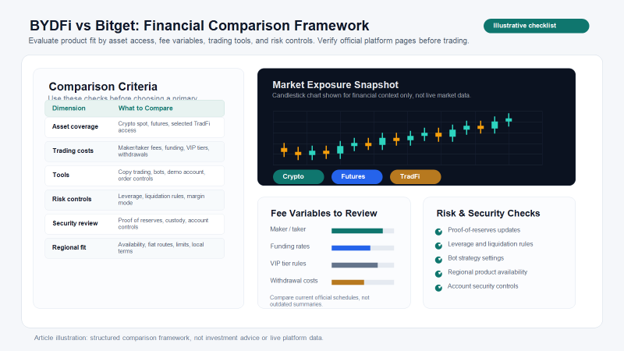
At the base tier, BYDFi and Bitget appear broadly comparable for derivatives traders, but fee schedules can change and VIP discounts may differ by volume, balance, and region. Traders should compare futures maker and taker fees, spot fees, funding costs, withdrawal limits, and VIP tier requirements before choosing a primary venue.
BYDFi lists base futures fees around maker 0.02% and taker 0.06%, with lower rates available at higher VIP tiers. Bitget publishes its own fee schedule and VIP structure, so the practical cost difference depends on trading volume, product choice, and whether the user trades mostly spot, futures, or automated strategies.
For derivatives, both platform choice and risk settings matter. Leverage, margin mode, liquidation rules, funding rates, and position sizing can have more impact on outcomes than a small difference in headline fees.
Copy Trading and Trading Bots
Bitget is widely recognized for its copy trading features and remains strongly associated with that category. BYDFi has also developed copy trading and automation features, including copy trading tools, Smart Copy-style controls, and bot strategies such as Spot DCA, Spot Grid, Futures Grid, and Spot Martingale.
Bitget remains a strong option for users who mainly prioritize copy trading and crypto-native services, while BYDFi may be more suitable for users who also want demo tools, bots, derivatives, and selected TradFi access in one platform environment.
For newer users, the more important comparison is how much control each platform gives over allocation, copied position behavior, risk limits, and strategy testing. Dedicated demo funds, bot configuration screens, and clear performance data can make automated trading easier to evaluate before real capital is involved.
Bot marketplaces and community strategy libraries can be useful, but they should not be treated as shortcuts to guaranteed performance. Traders still need to understand how each bot enters and exits positions, how it behaves in high volatility, and what happens when market conditions move outside the strategy’s assumptions.
Security, Proof of Reserves, and Risk Controls
Security is another area where readers should look beyond brand size alone. BYDFi has published Proof of Reserves information and has previously reported reserve ratios above 100% for major assets such as BTC, ETH, and USDT. Bitget also publishes platform security and reserve information through its own official channels.
Because reserve ratios and protection fund details can change, users should review the latest official disclosures before depositing substantial funds. Useful checks include Proof of Reserves methodology, update frequency, supported assets, account security controls, withdrawal rules, and incident history.
Fiat Access and Practical Reach
Practical access still matters. BYDFi supports multiple languages and fiat routes through third-party providers, including card purchases, bank transfer options, P2P trading, and one-click buy flows, depending on location. Bitget also offers fiat on-ramps and regional payment options through its own integrations.
For many traders, the better exchange is not the one with the longest asset list. It is the one that supports the products, deposit methods, language settings, fee tiers, and account controls they actually need in their region.
Final Takeaway
There is no universal winner between BYDFi and Bitget. Bitget may appeal to users who already rely on its copy trading ecosystem and broader crypto-native services. BYDFi may appeal to traders who want a straightforward interface, demo trading, trading bots, derivatives, and a crypto-plus-TradFi product mix in one place.
The stronger choice depends on how a trader allocates across assets, whether they need automation tools, how often they use futures, and which fee tier they realistically qualify for. A cautious comparison should include current platform pages, regional terms, risk controls, and fee schedules.
Crypto derivatives, copy trading, and automated bots involve market risk. Traders should understand leverage, liquidation rules, and strategy settings before using real funds.
FAQ
Is BYDFi or Bitget better for beginners in 2026?
Both platforms can work for beginners, depending on what the user wants to learn first. BYDFi offers demo trading, copy trading, bots, and a relatively direct interface, which can help users practice strategy testing and risk management. Bitget is also beginner-friendly for users focused on copy trading and crypto-native exchange tools.
Can I trade traditional assets on BYDFi?
BYDFi offers selected TradFi access, including certain stocks, forex pairs, and commodities settled in USDT, depending on regional availability. Supported instruments, fees, and trading hours may vary by region and should be checked on the official platform before trading.
What fees should traders compare?
Traders should compare futures maker and taker fees, spot fees, funding rates, withdrawal fees, and VIP tier requirements. The relevant cost depends on whether the user trades spot, futures, bots, copy trading, or a mix of products.
Which platform is better for multi-asset traders?
BYDFi may be worth considering for traders who want crypto products alongside selected TradFi markets from one platform environment. Bitget may be more suitable for users who prioritize its existing copy trading ecosystem and crypto-focused features. The better choice depends on region, available products, and individual trading needs.
To read more content like this, explore The Brand Hopper
Subscribe to our newsletter